Gay Marriage and School Bathrooms

Will same-sex marriage turn public schools into orgies of sexual confusion?  Ken Ham of Answers in Genesis has connected the dots.

The Supreme Court is wrestling with two cases about same-sex marriage.

Conservatives have long insisted that same-sex marriage would lead to a breakdown in the value of marriage itself.  One commenter recently called same-sex marriage the threshold of an “abyss of nihilism.”

Ham’s analysis sexualizes that nihilism and brings it right into public schools.  Ham, America’s leading young-earth creationist, insists that same-sex marriage is only part of an “evolving sexual agenda.”  (Ham is a smart guy, so I am confident he chose that word—“evolving”—intentionally.)

In Ham’s recent piece, he argues that the next step after gay marriage will be a profound and aggressive attack on all traditional gender norms.  As evidence, he cites recent public-school guidelines in Massachusetts.  As we’ve noted on ILYBYGTH, these new school rules allow students to identify their own gender identity and require schools to respect those identifications.

As Ham writes, the trickiest part of this school rule has become bathrooms.  If a student was born a boy but identifies as a girl, Massachusetts schools must respect that choice. Ham worries about a boy who pretends to identify as a girl just to get access to the girls’ locker room.

Ham is not the first conservative thinker to make this connection between same-sex marriage and a sexual free-for-all in public schools.  But for those of us non-conservatives who try to understand conservatism in American education, Ham’s argument offers two important reminders.  First, schools are tied into every culture-war argument.  Though marriage laws seem relatively distant from education policy, conservative (and liberal) arguments against same-sex marriage often rely on the harmful effects gay marriage will have on children and schooling.  Second, for those outside the orbit of American creationism, Ham’s argument underscores the fact that creationism is an outgrowth of conservative Christianity, not the root.  Besides Ham’s use of the word “evolving” to damn the same-sex marriage “agenda,” this article does not talk about creationism or evolution.  Rather, Ham concludes that the main reason to oppose same-sex marriage and the abandonment of gender rules is more broadly Christian.  As Ham argues,

As Christians, we should affirm our children’s God-given genders and cultivate godly masculinity and femininity in them, rather than encouraging them to abandon the gender God gave them in the womb . . .

For Ham, as for many creationists, Christianity comes first.  Creationism is only one important element of the crusade.  Ham himself has often reminded readers of this fact.  Nevertheless, it is common for outsiders like me to pigeonhole Answers in Genesis as narrowly interested in establishing the case for a young earth.

As Ham’s recent argument proves, AiG’s sort of young-earth creationism has a much broader conservative agenda.

 

Richard Dawkins Encourages Creationism

Does Richard Dawkins’ brand of in-your-face science atheism push religious people to embrace a “creationist” identity?

That’s a common argument—one I heartily agree with—made recently by Andrew Brown in his Guardian blog.

In this case, Brown argues that Dawkins’ attitudes push British Muslims, especially disaffected youth, to adopt more radical creationist positions.

Brown reports a talk by Salman Hameed, who insisted that Muslims often feel forced to make a false choice between science and faith. Not surprisingly, many choose faith.  Hameed related a telling anecdote.  One young woman reported attending a lecture in which

the lecturer started by asking if there were any creationists in the room. She put her hand up, because she believes that God created the universe, and was immediately singled out for humiliation.   

In the case of young British Muslims, Brown makes a compelling argument.  Already facing a crisis of cultural identity, many young British Muslims come to see their religious identity as a way to channel their feelings of alienation.  In such a Dawkins-influenced climate, young British folks may feel pressured to reject modern science as part of their assertion of an oppositional Muslim identity.  As Brown puts it,

Because there is a self-consciously oppositional culture among young poor Muslims, who feel themselves stigmatised and disadvantaged, they can tend to embrace creationism simply because they know it’s wrong by the lights of the majority. Dawkins’ dismissal of Muslim creationism as “alien rubbish” was not only found as a YouTube clip on the EDL website for a while, but also used in the propaganda of Harun Yahya, the Turkish creationist and self-publicist. The emotional logic is clear: if this rich, sneering white man is against it, it must be good for disaffected young Muslims who feel that they are themselves treated as “alien rubbish”.

Brown is right on.

Offering a false choice between religion and science fuels creationism.  As Brown points out here, so does suggesting a false equation of “Western” or “White” with “atheist.”  Better, as Brown says, to engage in the arduous and awkward task of building true dialogue.

Broun and the Budget

US Representative Paul Broun (R-GA) garnered a lot of attention last year, including a commentary in the Chronicle of Higher Education by yours truly, for his claim that evolution, embryology, and the Big Bang theory were lies from the pit of hell.

Today Broun took to the pages of the New York Times to call for more drastic budget cuts.  Broun calls Representative Paul Ryan’s budget cuts too mild.  Instead, Broun insists, we need to cut the federal government drastically, including eliminating the Departments of Education and Energy.

Broun writes,

Constitutionally speaking, the federal government should not have a role in K-12 public education anyway. Overpaid Washington bureaucrats shouldn’t be deciding how to provide for teachers and students, whose own state and local governments are better equipped to understand their needs. A Heritage Foundation study showed that in 2010, the average salary of an Education Department employee reached $103,000 — nearly double the average public-school teacher’s salary. Let’s phase out a large portion of the department’s roughly $70 billion budget. We can transfer the remaining dollars directly to the states, where they will be used more wisely.

Broun’s missive demonstrates the tight connections between various strains of conservative educational ideology.  Does Broun want less evolution taught in public schools?  Yes.  Does he also want a smaller, leaner, more local government?  Yes.

In Broun’s conservative thinking, these are not utterly separate ideas, but facets of the same good ideas.  If education decisions were made closer to home, Broun argues, they would be made “more wisely.”  Local governments, Broun writes, are “better equipped to understand [teachers’ and students’] needs.”  In short, not only would an elimination the Education Department make good fiscal sense, Broun insists, but it would allow schools to respect the religious views of local creationist parents.


Creationist Mom Reaches Out to Evolution

Sometimes stereotypes have some truth to them.  Then there’s “D.”

D first got in touch with me a couple of months ago.  As she described herself, she is a Christian young-earth creationist homeschooling mom.  She had read about my blog on Ken Ham’s Answers in Genesis page.  I’ll include our brief correspondence to let D speak for herself:

From: D
Sent: Monday, January 21, 2013 8:36 PM
To: alaats@binghamton.edu
Subject: thank you

Hi Dr. Laats,
I have to say that it is very refreshing that you don’t think creationists like myself are complete idiots.  Really, I appreciate that. 
As a young earth creationist that homeschools, I wouldn’t give any Richard Dawkins books the time of day.  If someone is THAT hostile towards me, then I have no interest in what they have to say.  But I look forward to reading your blog when I have a chance because you try to understand where I am coming from, and you don’t think we are completely unable to do any science. 
Thank you,
“D”

I suggested that D might give Dawkins a shot.

From: D
Sent: Monday, January 22, 2013 9:48 PM
To: alaats@binghamton.edu
Subject: Re: thank you

Dear Dr. Laats,
I also agree that we should be looking at the other side, and I do plan to do that.  As a Christian homeschool Mom I am not trying to protect my sons from learning evolution.  The public school is not a place we feel comfortable putting our children because their thoughts and beliefs are not welcome in the classroom.  They would have to follow the advice my father in law got from his father before he joined the Navy, “keep your eyes and ears open and your mouth shut”.  Learning can not take place, in my opinion, in that kind of environment.
I am going to teach my kids about evolution, somehow.  There is a lot of material out there.  I would read Dawkins if I had to, but the amount of information out there that he has published alone is way too much to look at, sort through, and figure out what to teach.  For the sake of time, I’m looking for something comprehensive and succinct, and what a child in high school should know about the subject.  I am familiar with the NCSE website and that is what I plan to use as of now, though it will be guess work to know what all to cover.  
Thanks for your time,
D

I was surprised and happy to hear that D was using materials from the National Center for Science Education to teach her kids.  I think the folks at NCSE would be happy to hear it, too.  The NCSE is a leading voice for evolution education and a staunch opponent of creationism in public schools.  And too often, people like me tend to suggest a stark division between two sides: either Answers in Genesis OR the National Center for Science Education.  D has reminded me that smart people make all kinds of decisions about what to read and what to do with that material.  People choose public schools, private schools, or homeschools for all sorts of different reasons.  D’s work reminded me how quickly and easily we can oversimplify the many approaches people make to these snarled questions of evolution, religion, and education.

Yesterday, I heard back from D:

From: D
Sent: Monday, March 18, 2013 5:09 PM
To: alaats@binghamton.edu
Subject: Hi

Hi Dr Laats,
Well, I wanted to let you know that I checked out the [Dawkins] book The Greatest Show on Earth.  I never would have considered it except for your response.  Dawkins says on page 155 ” it would be so nice if those that oppose Evolution would take a tiny bit of trouble to learn the merest rudiments of what it is that they are opposing.”  I couldn’t believe that I totally agreed with Dawkins about something!  I am happy to listen, minus the hostility.  I don’t sense hostility in this book, which makes it readable.  This has made me realize that I can not get my head wrapped around what evolution IS.  He says we did not descend from monkeys, but we have a common ancestor.  I do understand that we would find no missing links because of the extreme gradual process, that is what I understand from the book, hopefully that is correct.  So I looked on Internet, and I guess I don’t understand phylogenies.  So we did not descend from monkey, but have a common ancestor, and then branched off to chimpanzees and humans etc.  So, it seems to me that we descended from something “monkey like”.  I guess I don’t understand how he can say that we did not evolve from monkeys, whether it was monkeys or monkey like, it seems similar.  Can you shed any light on this please?  As you can see, I am making an honest attempt to understand this so I don’t teach it incorrectly.  Thanks for the help,
D

First of all, my hat’s off to D for engaging with Richard Dawkins’ writings.  It is far too easy for all of us to read only those materials that confirm our own beliefs.  I am optimistic that there may be far more “Ds” out there than we might think: people who have strong beliefs, yet hope to find out as much as they can about the other side.  How many of us can say–like D–that we have taken the time to puzzle through books and websites of people with whom we totally disagree?

As for D’s question about phylogenies, I suggested she check out Dennis Venema’s series about evolution theory on recent pages of the BioLogos Forum.

Any other suggestions for someone like D?


Are Conservatives Facing Oppression in Texas’ Private Schools?

The Texas Freedom Network Insider gives us a look this morning at an intriguing and influential line of conservative educational thinking.  For several decades now, conservative educational activists have claimed to be fighting for their civil rights.

The TFN, a liberal watchdog group, denounced Texas State Senator Dan Patrick’s attempt to make this argument recently.

Patrick, as chair of the Senate Education Committee, made his statement in favor of Senate Bill 573.  The bill would allow homeschool and private-school students to compete in the state’s University Interscholastic League.

Patrick claimed in a recent hearing,

“When you say the UIL has functioned for a hundred years, and everybody’s been happy, if you were black in this state before the civil rights movement, it didn’t function for you. And now I feel there’s discrimination against Catholics and Christians in these parochial schools.”

The TFN columnist and several commentators did not buy Patrick’s argument.  After sharing pictures of a lavish private school and a cramped, inadequate African-American school (c. 1941), the TFN columnist asked, “Seriously, guys?”

Commenter Linda Hunter asked, “Is it possible he [Patrick] actually believes what he’s saying? If so, perhaps he received the standard whitewashed version of history in school. Oh, I don’t think even that explains his argument.”

Whether Patrick is sincere or not, this line of argument has long been a favorite of conservative educational thinkers and activists.

Gish fossils say noTo cite just one example, in the early 1980s the late creationist leader Duane Gish was invited to join a conference of mainstream scientists to discuss evolution and creationism.  At the time, Gish was a leading voice at the Institute for Creation Research and best known for his book Evolution: The Fossils Say No! (1973, 1978, 1979)

At the conference with the American Association for the Advancement of Science, Gish grumbled right away that he had been led into a trap.  He complained that only two creationists had been invited to face a bevy of evolutionists.  As he put it, he would “proceed to take one of the two seats on the back of the bus reserved for the creationists in this meeting.”[1]

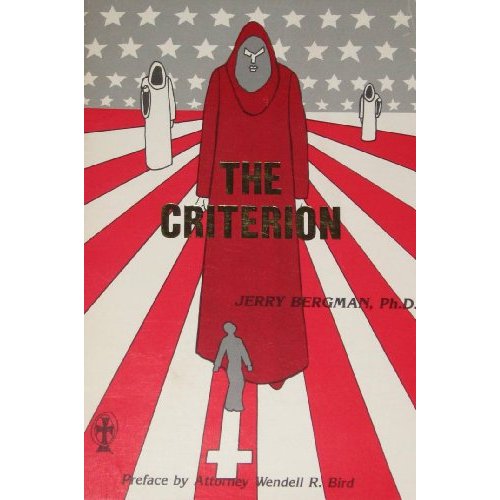
Around the same time, the creationist academic Jerry Bergman protested that he had been denied tenure at Bowling Green State University due to rampant discrimination against his religious beliefs.  As Bergman claimed in his 1984 book The Criterion,

“Several universities state it was their ‘right’ to protect students from creationists and, in one case, from ‘fundamentalist Christians.’. . . This is all plainly illegal, but it is extremely difficult to bring redress against these common, gross injustices.  This is due to the verbal ‘smoke-screen’ thrown up around the issue.  But, a similar case might be if a black were fired on the suspicion that he had ‘talked to students about being black,’ or a woman being fired for having ‘talked to students about women’s issues.’[2]

Bergman the criterionFor Gish and Bergman in the 1980s, as for Senator Patrick today, as for the generation of conservative activists in between, the notion is a powerful one.  Many intellectuals and pundits have claimed that conservatives today face the same kind of repression that bedeviled African Americans in the run-up to the Civil Rights movement in the 1950s.

For those of us who want to understand conservative educational philosophy, the Texas Freedom Network’s question is not the point.  Whether or not conservatives really believe they are oppressed, pundits and politicians have found the claim of minority persecution effective.

Check out Senator Patrick’s speech on the TFN Insider.  They include a video so we can see this ideology in action.


[1] Duane T. Gish, “The Scientific Case for Creation,” in Frank Awbrey and William Thwaites, eds., Evolutionists Confront Creationists: Proceedings of the 63rd Annual Meeting of the Pacific Division, American Association for the Advancement of Science, Vol. I, Part 3 (San Francisco: Pacific Division, American Association for the Advancement of Science, 1984), 26.

[2] Jerry Bergman, The Criterion: Religious Discrimination in America (Richfield, MN: Onesimus Press, 1984), 44.

Required Reading: Meet Tim LaHaye

Do you know Tim LaHaye?

LaHaye

LaHaye

If you’re interested in conservative educational thinking in the United States, you should.

Steve Fouse at AliveReligion recently offered a helpful introduction to LaHaye’s enormous influence among conservative and fundamentalist circles.

As Fouse points out, arguments about conservatism that seek to explain away its popularity miss the boat on LaHaye.  Fouse takes Thomas Frank to task for making such oversimplistic assumptions.  Fouse prefers the explanations of historians such as Darren Dochuk.  Dochuk’s more complex perspective fits better the career of a fundamentalist Renaissance Man like LaHaye.

Fouse notes LaHaye’s wide-ranging interests, from LaHaye’s role in the Institute for Creation Research, to his best-selling apocalyptic novels, to his evangelical sex guides.

Fouse mentions LaHaye’s central interest in educational issues, from sex ed to creationism.  If anything, Fouse downplays the influence LaHaye has had in late twentieth-century educational conservatism.

Fouse could have mentioned, for instance, LaHaye’s role in arguing for increased phonics instruction.  In his 1983 book The Battle for the Public Schools, LaHaye argued that abandoning phonics could be part of a massive conspiracy to “reduce the standard of living in our country so that someday the citizens of America will voluntarily merge with the Soviet Union and other countries in a one-world socialist state”   (46).   Disappearing phonics instruction showed the extent to which Christian America had been undermined.  It served as a canary in the secular coalmine.  “Some modern educators,” LaHaye insisted, “use look-and-say instead of phonics because the material enables them to secularize our once God-conscious school system” (50).

Similarly, Fouse did not mention LaHaye’s ardent activism in favor of more traditionalism in US History instruction.  In LaHaye’s 1987 Faith of Our Founding Fathers, LaHaye argued that the nation had endured a “Deliberate Rape of History” (5). Between 1954 and 1976, LaHaye insisted, a generation of “left-wing scholars for hire” worked for secularizing organizations such as the Carnegie Foundation (6).  Such authors systematically distorted the truth of America’s Christian heritage.  Thus, in order to find the true history of America’s founding, readers needed to look to older books, written by those “closest to the events they describe” (6). LaHaye insisted on the Christian beliefs of the Founding Fathers, demonstrating that “most were deeply religious, all had a great respect for the Christian traditions of the colonies, and all were significantly influenced in their thinking by the Bible, moral values, and their church” (30).

Thanks to Steve for offering his post about this important figure.  All of us who hope to understand conservatism in American education should check it out.


David Long at the Smithsonian

Drop your plans for Friday!

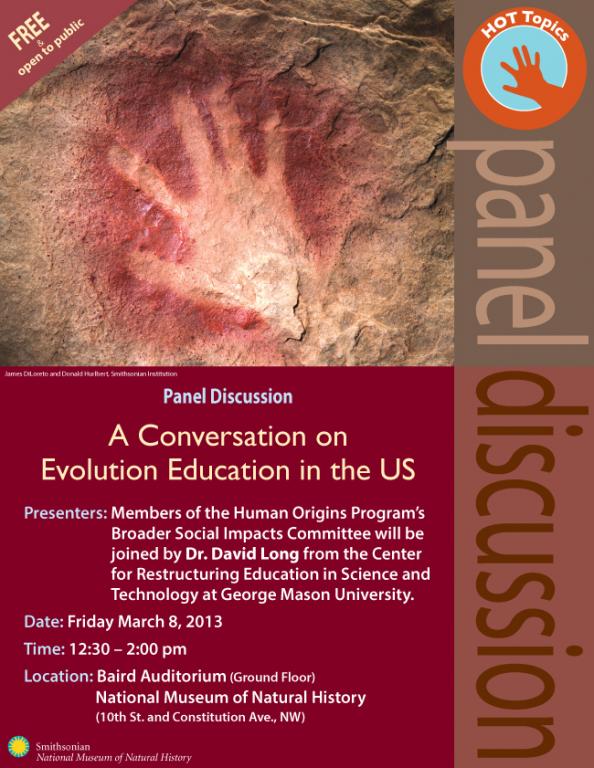
You need to get down to our nation’s scenic capital for a stirring panel discussion of evolution education.

ILYBYGTH contributor David Long will take part, along with participants from the Smithsonian’s “What Does It Mean to Be Human” Broader Social Impacts Committee.

The event will take place at 12:30 in the Baird Auditorium, National Museum of Natural History.  Free and open to the public.  Don’t miss it!

smithsonian flyer

Creationists Love The Bible

The young-earth creationists of Ken Ham’s Answers in Genesis endorse The Bible.  Not just the Good Book, but now also the Good Movie.

Dr. Elizabeth Mitchell (MD) reviewed the new ten-hour History Channel film on the AiG website today.

I believe the folks at AiG will agree with me when I say this: they have a tendency to be extremely particular about the company they keep.  They only endorse those who agree on the importance of a young earth and a six-day creation.  Even other conservative Christians will come into AiG disfavor if they dispute those ideas.  Recently, for instance, founder Ken Ham took the 700 Club’s Pat Robertson to task for making nice with evolutionary science.

So when an AiG reviewer praises the new Bible film as something that “allows the plain truths of biblical history from the time of our origins to speak and connects those truths to the relevant issues of life,” it says a great deal about the content of the film.

Mitchell notes that the film depicts a literal world wide flood.  “Even in its opening scene,” Mitchell writes,

“a believable Noah recounts the six days of creation for his seasick family in a massive, storm-tossed Ark in a Flood that is clearly global. The worldwide scope of the Flood is portrayed by the graphic of a flooded planet and the narrator’s confirmation that the floodwaters had ‘engulfed the world.'”

Mitchell notes the necessary shortcuts that a ten-hour film must make in condensing such a massive set of books.  In the end, however, Mitchell believes that the film is true to the original.  The best proof of the film’s merit will be, in Mitchell’s words, that

“The Bible will likely lead many to Christ. Why? Because it presents the Bible’s history as real history—instead of eroding trust in God’s Word from the very first verse. Because it demonstrates the relevance of the Fall of mankind soon after creation to all the evil that has ever cursed our world. Because it depicts the Old Testament sacrifices that God intended to prefigure the ultimate sacrifice of Christ, the Lamb of God who takes away the sin of the world (John 1:29). And because it presents the Bible’s history as a continuous narrative of God’s plans for us from creation through the covenant people of Abraham and Moses to Christ and the early church, thus showing how Jesus Christ is indeed God’s answer for the sin-guilt of the entire world.”

As long as important doctrine is respected, it seems, including the truths of a young earth and a six-day creation, Answers in Genesis is happy to endorse any work that will lead to more conversions.

As we’ve been discussing lately, the Hollywood Christian power couple behind this film have advocated for more Bibles (books, that is, not films) in public schools.  If ardent young-earth creationists can endorse the film, what does that tell us about the sectarian intentions of the filmmakers?

Stanford: Science Teachers Must Value Creationism

Can a science teacher do a good job if she does not value the creationist beliefs of some of her students?

According to Stanford University education scholars, the answer appears to be ‘no.’

Hard to believe?

The Teacher Performance Assessment developed by the Stanford Center for Assessment, Learning and Equity (SCALE) has become the new standard for teacher certification or licensure in twenty-four states and the District of Columbia.

In order to receive certification in these states, new teachers must submit a portfolio of lessons and reflections.  These materials will be judged according to a series of rubrics.

According to one of these rubrics, teachers must acknowledge, value, and incorporate the cultural beliefs and backgrounds of their students.  In “Rubric 3: Using Knowledge of Students to Inform Teaching and Learning,” the Stanford folks provide a ranking of new teachers’ ability to relate to their students.  At the lowest level, new science teachers will be penalized if they don’t include enough knowledge of students’ backgrounds.  Also at this lowest level (Level 1), new teachers will be dinged if the teachers’ “justification of learning tasks . . . represents a deficit view of students and their backgrounds.”  At the higher levels, new teachers are supposed to justify their “learning tasks” by including “examples of personal/ cultural/ community assets.”

In the case of creationist students, it appears new science teachers must not view those beliefs as a “deficit.”  Indeed, to be considered truly proficient, new science teachers are encouraged to include those cultural and community beliefs in their science classes.

For those of us who have observed the creation/evolution struggles from the outside, this new rubric for judging science teachers raises a few vital questions: Was it the intention of the Stanford folks to force new science teachers to value creationist beliefs?  Will new science teachers really be judged negatively if they view creationist beliefs in their classroom as a “deficit view?”  That is, will new teachers really be pushed to see creationism as a legitimate cultural belief, instead of merely a lack of understanding of evolution?

It seems doubtful.  Maybe I’m not giving the SCALE group enough credit, but my hunch is that they did not intend to force science teachers to avoid impugning creationist beliefs in science classes.  Nevertheless, it seems the rubric they’ve created will certainly be read that way.

Inter-faith Creationism?

It is no longer surprising to see deeply conservative religious thinkers reach across religious lines to work together.  Could we soon see effective Muslim-Christian coalitions to support the teaching of creationism?

Perhaps as a model, interfaith creationists could consider Robert George and Hamza Yusuf’s collaboration.  The two leading intellectuals, one Catholic, one Muslim, co-wrote an open letter to hotels, requesting the removal of pornography from television options.

Even more apt, we could consider the fact that American creationism has always used the work of fellow creationist writers from different religious traditions.  In the 1920s, as my grad-school mentor Ronald Numbers argued, Catholic writers such as Alfred McCann were favorites among ferociously Protestant creationists.  More recently, this tradition has continued with the creationist embrace of Jonathan Wells’ work.

Could this tradition of creationist ecumenism work to bridge the Christian-Muslim divide?

There is no doubt that both religions harbor fervent creationists.  A recent article in The Economist detailed recent creationist developments among Islamic populations.  The article cited a study by Salman Hameed of Muslim attitudes to evolution.  That study found that 20% of Muslims in Indonesia, Malaysia, and Pakistan embraced evolution.  In Egypt, only 8% did.

As The Economist article describes, “controversial” Turkish evangelist Adnan Oktar, known as Harun Yahya, has long conducted an energetic creationist campaign in Muslim circles, including a series of conferences in the USA.

Of course, the conservative theology behind both Islamic and Christian creationism creates some barriers.  Orthodox religious thinkers on both sides will be wary of working with people from opposing traditions.

But there has also been a long tradition of cooperation.  As Ronald Numbers pointed out in The Creationists, in the mid-1980s, the Institute for Creation Research received a telephone call from the minister of education of Turkey, requesting teaching materials (Creationists, 2006, pg. 421).  In 1992, a Turkish creationism conference invited ICR stalwarts Duane Gish and John Morris as keynote speakers.  Professor Numbers also describes the founding in 1990 of the Turkish Science Research Foundation (Bilim Arastirma Vakfi, or BAV).  In Numbers’ words, “For years BAV maintained a cozy relationship with Christian young-earth creationists, feting them at conferences, translating their books, and carrying their message to the Islamic world”  (Creationists, 2006, pg. 425).

For a long generation, then, Muslim and Christian creationists have worked together.  The question is not whether such cooperation can happen.  Rather, the question is whether and when these efforts will gather enough support to become a major influence on the politics and policies of creationism and evolution education.