You Might Be a Fundamentalist If…

What does it mean to be a “fundamentalist” in America? And what does “fundamentalism” mean for American education?

Theologian Roger E. Olson offers a great introduction to the intricate theological and cultural boundaries of American fundamentalism.

As with any theological tendency, the definition of “fundamentalism” has long been fraught with bitter disputation.  As I learned in my study of 1920s American fundamentalism, there will be exceptions to every rule and protestations of every boundary.

Olson offers outsiders like me a convenient double list.  First, he gives his carefully hedged list of theological determinants.  In the context of American Christianity, someone is likely a fundamentalist if he or she agrees with some or all of the following list:

  • Embrace of traditional conservative Christian doctrine, such as divinity of Christ, the trinity, inspiration of Scripture, salvation by grace through faith, and so on;
  • Refusal to fellowship with those who are not similarly theologically aligned;
  • Refusal to fellowship with those who fellowship with those who are not similarly theologically aligned;
  • Embrace of Biblical inerrancy—the notion that the original autographs of the Bible are without error;
  • Belief that the King James Version is the proper English translation;
  • Belief that young earth creationism and premillennial eschatology are central to true Christian faith;
  • Belief that America is “God’s Nation;”
  • An insistence that good education must be Bible-based;
  • Belief that Catholics are not real Christians.

Does Professor Olson insist on this list as the ultimate definition?  No.  As he warns, “These are not absolute litmus tests. It’s theoretically possible that a person might hold most of these beliefs and, for some unforeseen reason (a fluke) not be a fundamentalist.”

Most helpful of all, Professor Olson notes that the label “fundamentalist” is often used in looser ways.  The list above describes a certain tradition among American Protestantism.  But “fundamentalism,” as Olson argues, has long been used to describe other phenomena as well.

Olson gives us four of these other traditional uses of “fundamentalism.”

First, there’s a sense that “anyone considered religiously conservative and fanatical” is a fundamentalist.  Second, some people use “fundamentalism” to describe any sort of religiously motivated anti-modernism.  Third, some folks call anyone they don’t like a fundamentalist.  If you are conniving, or manipulative in your dealings with other church folk, even if you are theologically liberal, you might be called a fundamentalist.  Finally, Olson offers his “historical-theological meaning:” “militant defense of conservative Protestantism against liberal theology and higher biblical criticism.”

Many thanks to the good professor for offering this nuanced public definition.  My summary here doesn’t do justice, and I suggest reading the article in its entirety.  Outsiders to the world of conservative American Christianity like me often have a very difficult time decoding the dense layers of meaning attached to such labels.  Yet for many within the porous boundaries of “fundamentalism,” many of the distinctions remain more inherited and implied than intellectually understood.

Olson relates one anecdote that reveals some of these implicit meanings, the sort of meanings that might often be lost on outsiders.

“About fifteen years ago I noticed that a seminary historically noted for being fundamentalist (in the historical-theological sense) had set up a table in the evangelical college where I then taught to recruit undergraduates. I approached the recruiter, a relatively young (early middle aged) employee of the seminary. I told him I would have difficulty recommending that any of my students attend his seminary. He asked why. I told him that the seminary had a reputation for being fundamentalist. He said ‘No, we’re changing. We’re evangelical now.’ So I asked him this question: ‘If Billy Graham volunteered to preach in your seminary’s chapel free of charge, no honorarium expected, would your president allow it?’ His slightly red-faced response was ‘We’re moving in that direction.’ Enough said.”

Before I started my academic research into American religion, I wouldn’t have made much sense of this encounter.  For insiders, though, it is just obvious, even humorous, that some seminaries just would not have Graham.  And some might claim to be “evangelical” while everyone knows they are still “fundamentalist.”

Before we move on, let’s consider some of the implications of this definition of fundamentalism for American education.  If, as Olson argues, his list includes broad and widely shared tendencies among conservative Protestants, we can see why such folks have long been so keenly interested in educational issues.  Some of the connections are obvious.  Professor Olson suggests that young-earth creationism is considered a “crucial Christian belief…” among many fundamentalists.  Supporters of creationist school policies, then, would have ardent supporters from the fundamentalist community.  Second, Olson’s fundamentalists often believe “the Bible ought to be the basis of an entire educational curriculum, including studies of science, philosophy, psychology, etc.”  Again, the educational implications are obvious.

But beyond creationism and Bible, elements of Olson’s definition offer insights into the intersection between American fundamentalism and American education.  For instance, the notion of “secondary separation” should deflate some of the ever-present suspicion of a vast fundamentalist educational conspiracy.  As Olson describes, many fundamentalist types refuse to work with those with whom they disagree.  More than that, fundamentalists often refuse to associate with those who fellowship with those with whom they disagree.  That is, a fundamentalist must be very careful to associate only with those who are free of any connection to any organization or church that has any sort of suspect connection.

In educational politics, this sort of rigid separationism can have important consequences.  Many fundamentalists might sternly oppose policies, for instance, that promote teaching intelligent design in public schools.  Or fundamentalists might (and have) fought against prayers in public schools, when those prayers become broad and ecumenical.

Finally, the rigid separationist tradition has led to a long history of separate educational institutions.  From Bob Jones University and Dallas Theological Seminary in the 1920s, through a host of new colleges and schools throughout the twentieth century, fundamentalists have often been keen to found their own schools.  After all, if education must be based on the Bible, and young people must be taught to avoid the dangers of less-strict separationism, then many fundamentalists would insist on their own schools, their own textbooks, their own teachers, and so on.

As with any theological or cultural definition, Professor Olson’s attempt to give a brief and readable account can be disputed endlessly.  But for those of us outsiders trying to understand the complicated landscape of conservatism in American education, Olson’s article is a good place to begin.
 

“Science Buff” Pushes Creationism in Missouri

H/T: Sensuous Curmudgeon

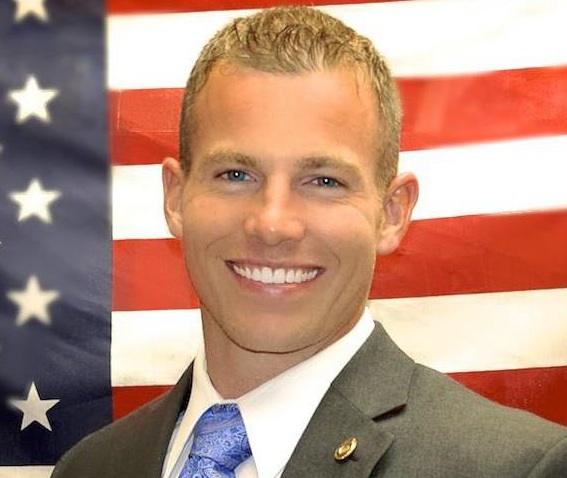
Why does dreamy Missouri legislator Rick Brattin want Missouri schools to teach both evolution and intelligent design?  In his words, because “I’m a science enthusiast. I’m a huge science buff.”

Image Source: Riverfront Times

Image Source: Riverfront Times

In an interview last week with St. Louis’ Riverfront Times, the Republican lawmaker explained that he had introduced a new “equal time” bill because true science demanded it.

Those of us hoping to understand conservatism and creationism in America’s schools should pay attention to Brattin’s rationale.  In this interview, Brattin articulated a vision of science, religion, and education that resonates among many creationists and their allies.  Evolution, Brattin claimed, actually played the role of obstructionist religion.  Brattin told the paper, “I’ve had numerous college professors within biology, school science teachers…who say they are not allowed to teach any type of theory [like intelligent design]…. They are banned from the science community.”

As we’ve noted here before, not only creationists but conservatives of various types often complain that they have been excluded from intellectual debate.  These arguments seem to convince Representative Brattin.  As Gallup polls have suggested, calls for equal treatment and fair play do very well among the general populace, as well.

A Visit to a Creationist Homeschool Science Fair

What would a creationist homeschool science fair look like?

Greg Laden at ScienceBlogs described his recent trip to one in Minneapolis-St. Paul.

Laden offered more than just a snarky blanket condemnation of the creationism and science on display.  Some of the exhibits, Laden wrote, were actually pretty good.  In one exhibit, students created and explained plant tissue batteries, for instance.

Some students, though, conducted experiments that disappointed the mainstream scientists.  One student, for instance, made salt stalactites to prove that they could form more quickly than some mainstream scientists believed.  According to Laden, mainstream science already knew that even limestone stalactites could form fairly quickly.  Another student retreated from science to explain animal behavior.  Faced with a question he or she could not answer, one student told Laden that “a certain problem would be solved because ‘God put something in the animal to make that happen.'”

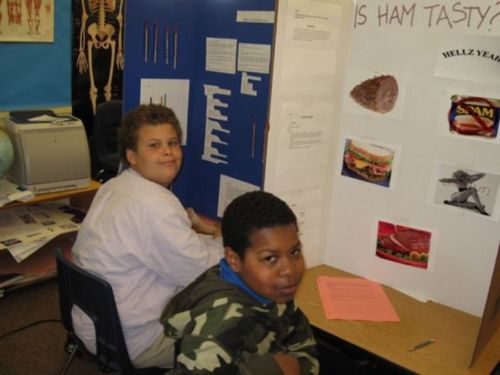
Non-creationist science fair...

Non-creationist science fair: “Is Ham Tasty? Hellz Yeah”

Best of all, IMHO, Laden recognized that some of the weaknesses of student presentations were not due to religious belief, but rather due to the age of the presenters.  As Laden put it, “many of the limitations and shortfalls of the less than stellar posters were typical of small scale school science fairs in general, not peculiar to these students.”

This point is clearly one that could use more study.  We observers of creationism and evolution education often lament the fact that relatively few students learn any real evolutionary science.  But we must remember the broader point: relatively few students learn any real anything in too many of America’s schools.  It is not fair to assume that students’ generally weak grasp of evolutionary concepts is necessarily due to religious dissent.  Rather, we should measure the successful teaching of evolutionary concepts alongside other basic concepts such as the appreciation of literature, the history of the founding of the country, or algebra.  My hunch is that the “shocking” weakness of most American adults in mastering the basic concepts of evolutionary theory might not look so shocking compared to the weakness of American adults in mastering other basic concepts.

Nothing New? Not Quite, Mr. Perlstein

Is Toni Morrison bad for young people?  How about porn and graphic violence?

In yesterday’s Nation, Rick Perlstein offered an insightful article into the nature of these sorts of school debates over books.  As usual, Perlstein writes with clarity and perspective.  But his argument would be better if he had included a longer historical perspective.

The specific issue that attracted Perlstein’s attention was a recent flap in Fairfax County, Virginia, over the reading of Toni Morrison’s Beloved.  As Perlstein reported, parents complained about gruesome depictions of bestiality and rape.

Beyond just reporting another such dust-up, Perlstein made some great points about the predictable pattern of such cultural controversies.

First, he noted from his historical research into the 1970s how common it has been for conservative activists to claim to be merely shocked and offended parents, taken by surprise by the filth brought home in student backpacks.

Second, he decried the too-easy sanctimony of some liberals.  It is too easy to take the Kevin-Bacon-in-Footloose position, Perlstein wrote.

“Liberals get in the biggest political trouble, . . .” Perlstein argued in his 2008 book Nixonland, “when they presume a reform is an inevitable concomitant of progress.”

Perlstein’s argument is certainly worth reading in its entirety.  But it would be even stronger if he had stretched his timeline beyond the wall of 1968.  As I argued in my 1920s book, and as I’m developing in my current book, in order to understand conservative educational activism we have to go back at least to the 1920s.

For instance, the tradition of objecting to textbook content has long been a central conservative educational tactic.  Anti-evolution firebrand T.T. Martin tried this strategy in 1923.  The textbook at issue, Harold Fairbanks’ Home Geography for Primary Grades, contained a few basic evolutionary concepts.  Children reading such things, Martin charged, would soon abandon their Christian faith.  In typically colorful prose, Martin warned, “that child’s faith in the Saviour is gone forever, and her soul is doomed for Hell; and with your taxes, you paid to have it done.”

Image Source: JacketFlap

Image Source: JacketFlap

Similarly, an examination of the 1940 campaign to eliminate the social-studies textbooks of Harold Rugg could add a great deal to this conversation.  Before they came under attack from conservative activists in the American Legion and National Association of Manufacturers, these books sold in the millions.  Critics charged, however, that the books would pervert young people’s minds and morals.  As one influential American Legion critic put it in 1940, children reading Rugg’s books would soon be

“convinced that our ‘capitalistic system’ is the fault of selfish fellows like Benjamin Franklin and Thomas Jefferson who wanted to save their property; that the poor man wasn’t given proper consideration, that in Russia the youth are engaged in creating a beautiful, new democratic order, that modern business is for the benefit of the profit-makers, that advertising in an economic waste, that morality is a relative value, and that family life will soon be radically changed by state control.”    

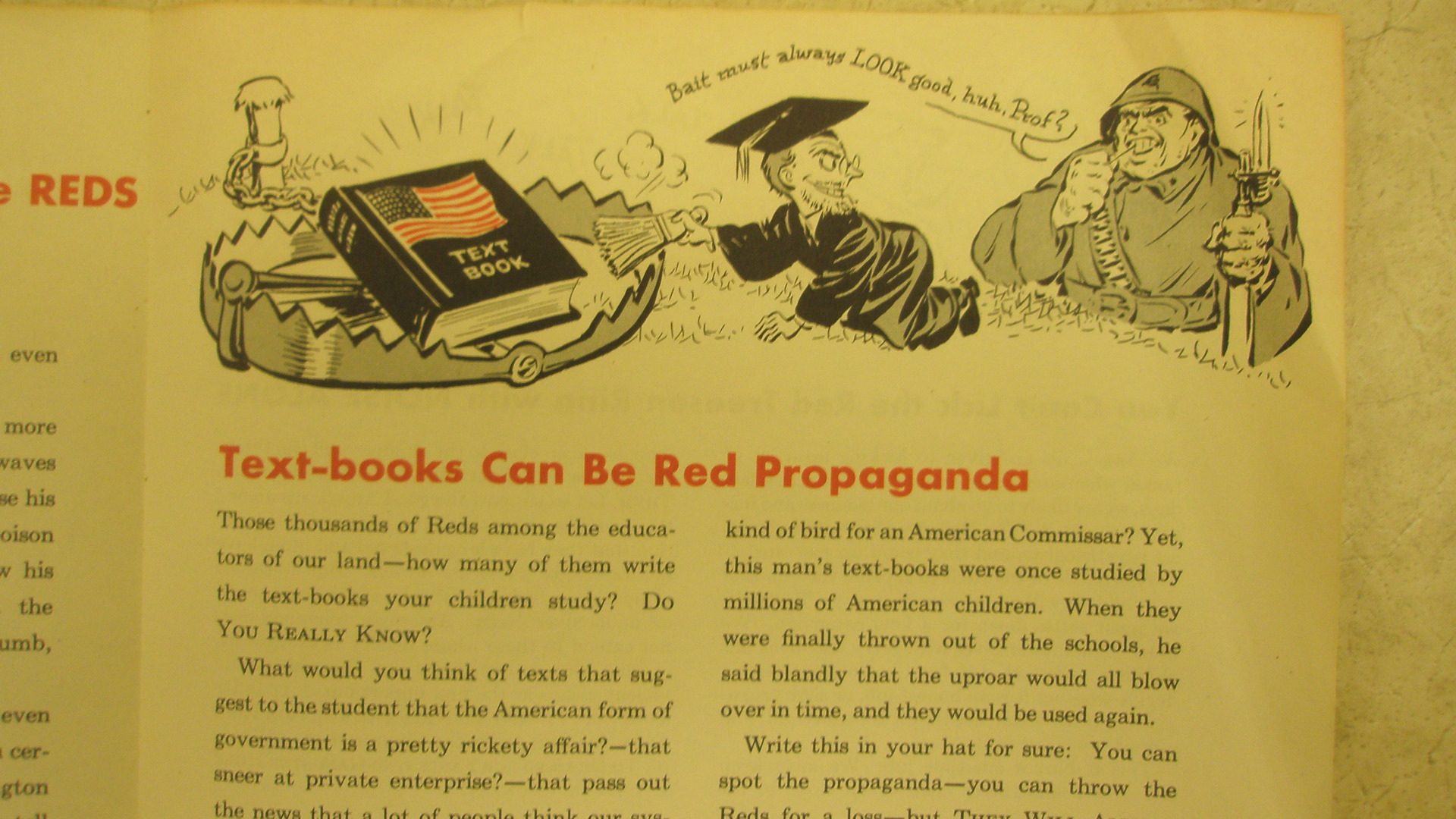
Or consider this gem from the 1950s...

Or consider this gem from the 1950s…

Including the longer history of these sorts of controversies offers more than a chance for historians to sell a few more books.

In cases like this, a longer perspective helps us see that there are indeed ways in which each new book controversy offers “nothing new,” as Perlstein’s title suggested.  But there are other aspects of this long history that show us how things have changed dramatically.

Most compellingly, Perlstein comments that activists in 2013 seem to be reading from a conservative script in some ways.  In every case—whether from 2013 or 1974—activists claim to be mere surprised parents, frightened and disgusted by the literature imposed on their students.

Perlstein compares this to similar stories from the 1970s.  But there are equally familiar stories from much further back.  The wildly popular evangelist Bob Jones Sr. used to warn his audiences in the 1920s about the surprises in store for conservative parents at many modern schools.  One family had scrimped and saved to send their daughter to a fancy college.  The parents had no idea what kind of teaching went on there.  After one year, Jones preached,

“she came home with her faith shattered.  She laughed at God and the old time religion.  She broke the hearts of her father and mother.  They wept over her.  They prayed over her.  It availed nothing.  At last they chided her.  She rushed upstairs, stood in front of a mirror, took a gun and blew out her brains.”

In the 1920s, as in the 1930s, ’40s, ‘50s, and ‘60s, these claims of parent shock and surprise at the influence of schooling have resonated powerfully among American conservatives.

In other ways, the longer view can give us hope that this culture war is not simply and eternally deadlocked.  Since the 1970s, for instance, conservatives like the ones Perlstein mentioned have all argued that their opposition to books such as Toni Morrison’s Beloved did not make them racist.  Perlstein cites 1970s activist Alice Moore, who argued that her policies echoed those of the NAACP.  (Listen to this clip from a 1974 school board meeting in which Moore makes her case: Kanawha Board 4 – 11-74 – 3.

Such conservative efforts to fight an image of racism go back beyond the 1970s.  In a school fight in Pasadena in the late 1940s and early 1950s, conservatives insisted they did not fight against new zoning rules because they were racist.  In one telling comment, a conservative activist insisted that she could not have been racist, since her school petition had been signed by “her Negro, Mexican and Oriental neighbors” as well as whites.  She could not be a racist, she said, because she had quickly become friends with one of her new neighbors, a “Negro physician.”

However, before World War II, conservative activists made no such efforts to combat an image of racism.  As historian Jeffrey Moran has long argued (see here and here) white religious conservatives in the 1920s often paid little attention to their African American co-religionists.

Does it matter?  Can a longer historical perspective give us better understanding of the battle over Beloved in Fairfax County?

If we don’t see the ways conservative school activism has changed over the decades, we might be tempted to conclude too quickly, as Perlstein seems to do, that nothing ever changes.  That would be misleading.

Instead, the longer lens shows us that school battles have indeed changed dramatically over the course of the twentieth and twenty-first centuries.  For those of us who agree with Perlstein that schools should force students to “think and question, to blow apart settled ways of looking at the world, and, yes, force them into mental worlds that disturb,” the historical perspective offers a more profound reason for optimism.

Evolution for Christians

How are evangelical Christians supposed to understand evolution?  This morning at BioLogos, evangelical scientist Dennis Venema begins a series that hopes to explain why evolutionary ideas do not conflict with a Bible-based evangelical faith.

One of the trickiest aspects of understanding American creationism is that there are potentially as many “creationisms” as there are creationists.  Many outsiders like me tend to use the term “creationist” as a catch-all term, when in fact the differences among and between types of creationism are perhaps the key to bridging many of our evolution-creation culture-war divides.

Some “creationists,” for instance, embrace the young-earth creationism promulgated by organizations such Answers in Genesis or the Institute for Creation Research.

Others might find an old-earth version more compelling, one such as that defended by Hugh Ross and Reasons to Believe.

Yet others might prefer the big-tent creationism of the intelligent-design movement, promoted most assiduously by the Discovery Institute.

Still others might prefer the sort on offer by Dennis Venema in this series.  BioLogos calls its brand of creationism “evolutionary creationism.”  In general, BioLogos’ creationism embraces the tenets of evolutionary science.  Such evolution, many evolutionary creationists insist, is simply God’s method of creation.
I’m looking forward to following Venema’s series.  Venema describes it this way:

“The goal of this course is straightforward: to provide evangelical Christians with a step-by-step introduction to the science of evolutionary biology. This will provide benefits beyond just the joy of learning more about God’s wonderful creation. An understanding of the basic science of evolution is of great benefit for reflecting on its theological implications, since this reflection can then be done from a scientifically-informed perspective. From time to time we might comment briefly on some issues of theological interest (and suggest resources for those looking to explore those issues further), but for the most part, we’re going to focus on the science.”     


Teaching the Bible, Texas Style

A new report from the Texas Freedom Network warns that some public schools in Texas are teaching religion.  Not all religions, but the Bible-loving, apocalypse-watching, evolution-denying type of conservative evangelical Protestantism.

How do these public schools justify it?  According to the TFN report, public schools fold these sectarian doctrines into their Bible courses.  Public-school courses about the Bible are explicitly constitutional.  US Supreme Court Justice Tom Clark made very clear in his majority opinion in Abington Township v. Schempp (1963) that public schools can teach the Bible, if they did so in a non-devotional way.  As Clark specified,

“Nothing we have said here indicates that such study of the Bible or of religion, when presented objectively as part of a secular program of education, may not be effected consistently with the First Amendment.”

However, the TFN report argues that many of the Texas school districts are using Bible classes to teach religious doctrine, including the notion that the Bible demands a young earth.  The report’s author, Mark A. Chancey of Southern Methodist University, reports that the courses are generally poorly taught, with low academic rigor, by underprepared teachers.

Professor Chancey includes excerpts from some of the teaching materials.  In the Dalhart Independent School District, for example, one student information sheet included the following information:

“Since God is perfect and infallible, an inspired book is absolutely infallible and errorless in its facts and doctrines as presented in the original manuscript” (pg. 28).

In the Bible courses of Lazbuddie, Texas, students will read the following:

“We should have an understanding of what happened in Noah’s day if we are to know when the coming of our Lord is near.  What are the similarities between the days of Noah and the days preceding the coming of Jesus Christ (Matthew 24:37-39)?” (pg. 32)

In Dayton schools, students watch the Left Behind movie, fundamentalist author Tim LaHaye’s dramatization of the rapture and final days (pg. 19).

As Chancey points out, these doctrines are intensely sectarian.  They teach a specific interpretation of the Bible as eternally true.  Students in these public school classes would be told that the doctrines of conservative evangelical Protestantism are the correct and only interpretation of the Bible.

Are we shocked?

We shouldn’t be.

Here’s why not:

First of all, the numbers of schools and students involved is very small.  Professor Chancey found 57 districts plus three charter schools who taught Bible courses in 2011-2012, a small percentage of the 1037 districts in Texas.  Not all of these districts taught the Bible in such heavy-handed sectarian ways.  And of the districts that reported their student numbers, only three had more than fifty students enrolled in Bible class.  Six districts had fewer than five students in Bible (pg. 5).

Second, the practice of teaching sectarian religion in public-school Bible classes has a long and surprisingly uncontroversial history.  As I explored in my 1920s book, while public attention was focused on anti-evolution laws, between 1919 and 1931 eleven states quietly passed mandatory Bible-reading laws for public schools.

Finally, even after the anti-Bible SCOTUS ruling in 1963, many public schools simply continued the practice.  As political scientists Kenneth Dolbeare and Philip Hammond found in their survey of schools in a Midwestern state, the Supreme Court rulings against public-school Bible reading made absolutely no difference in school practice.  Where students had read the Bible before, they continued to do so, without raising any controversy.

So Professor Chancey’s findings that a few students in a few public schools in Texas learn a sectarian interpretation of the Bible should come as no surprise.  As Chancey notes, similar Bible classes go on in several other states as well (pg. v).  Moreover, as political scientists Michael Berkman and Eric Plutzer have convincingly argued, public school teachers usually teach ideas that are locally uncontroversial.  In some places, that means teaching creationism as science.  In others, it means teaching the Bible as history.


Creationists: Randy Moore Wants Your Children!

There is no doubting Randy Moore’s evolution-education credentials.

A professor of biology at the University of Minnesota, Professor Moore has received the National Center for Science Education’s Friend of Darwin award, and the National Association of Biology Teachers Evolution Education award.

Randy Moore, in short, has long been one of the most engaging and engaged voices in the campaign to get more evolution education into America’s schools.

And what is Moore’s most recent argument to make America’s schools more evolution-friendly?

In a remarkable article in the “evolutionary-creationist” BioLogos Forum, Moore and colleague Sehoya Cotner offered two recommendations for improving evolution education:

1.) Let Jesus teach it!

2.) Catch creationist kids young!

Here are their actual words:

“We know of no evidence that the availability of such solely science-focused workshops, seminars, and other forms of evolution-related education will significantly affect what creationism-based biology teachers teach. Since the impediments to better teaching of evolution are primarily the philosophical and religious views of biology teachers, programs that do not address the more personal, ‘non-science’ issues of science educators directly and effectively are likely to have little impact on what students learn in high-school biology classrooms. Instead, if further fact-based instruction in evolution is part of the answer, it is likely to be most effective with young children, who are developmentally primed to seek explanations for natural phenomena. However, evolution instruction is essentially absent prior to high-school biology; by high school, a student’s teleological demands have likely been met by supernatural explanations, creating a cycle of adults who know little about evolution and teach creationism-flavored biology.”

In other words, as Moore and Cotner convincingly demonstrate, simply assuming that the scientific evidence for evolution will convince creationist teachers has not worked, and will not work.  They rely heavily on the research of Penn State political scientists Michael Berkman and Eric Plutzer.  Instead, evolution education needs to get away from the delusion that the scientific evidence alone will do the job.  With adults, effective evolution education, as Moore and Cotner contend, must address “philosophical and religious” issues involved.  This conclusion makes eminent sense.  However, it brings us to an awkward realization: science education must range far beyond science education to be effective science education.  Are creationist teachers to be taught that Jesus wants them to accept evolution?  That seems to be Moore’s and Cotner’s implication, and it raises a host of thorny issues.

The second prong of their policy argument is equally radical.  If “fact-based” evolution education is to work, Moore and Cotner argue, it must reach young students before their families’ influence has become decisive.  In other words, effective evolution education must evangelize aggressively to counter the “supernatural explanations” offered young people by their parents and church leaders.  Effective evolution education must seek to replace those family influences with the influence of scientific evidence.

Randy Moore has long been one of the smartest voices in the field of evolution education.  And his logic in this article seems uncontrovertible.  Yet it raises disturbing questions.  Can evolution educators discuss “philosophical and religious” implications of evolutionary theory?  Doesn’t that amount to sectarian religious education?  In other words, if science educators try to teach that Jesus is not against evolution, isn’t that making a strictly religious argument?

And we need to ask tough questions about targeting young minds:  Can a campaign to reach young creationist kids work?  Is it the place of public education to target family culture and religion?

Revisionaries on PBS

The Revisionaries is coming next week to PBS.

In conjunction with Binghamton University’s Evolutionary Studies Program, we screened the film not too long ago.  At our screening we had a spirited discussion about the nature of science and the politics of education.  Now folks beyond the major metropolitan areas of New York, LA, and Binghamton will have a chance to see it.

Why would you want to, you ask?

For anyone interested in the teaching of American history, evolution/creation, the nature of American conservatism, or even just the functioning of educational and cultural politics, this film is a must-see.  Director Scott Thurman followed the goings-on at the Texas textbook review hearings of 2009-2010.  He spent time with conservative leaders such as Don McLeroy and Cynthia Dunbar.  Thurman gave each of them a chance to explain their educational ideology.  The film shows the campaign for non-evolution to be included in science classes.  Viewers can watch the fight to change the standards for social studies, to include more Reagan and less hip-hop.

According to the National Center for Science Education website, The Revisionaries will be shown as part of PBS’ Independent Lens series, during the week of January 28, 2013.  Check your local listings!

The Trauma of Evolution

Can we educate by banning ideas?  For one group of conservative Christian homeschoolers, proper education means banishing lots of ideas.  How can progressive educators like me understand this impulse to put up intellectual walls around young people’s minds?  I wonder if some creationists view exposure to evolutionary ideas as a form of trauma, an entirely harmful experience.

The Finish Well homeschooling conference, in the words of its organizers, “is designed to equip homeschooling families to confidently homeschool the high school years for the glory of God!”

One of the ways the conference promises to help attendees is by purging the atmosphere of any hint of evolution.  In order to secure a table at the conference, vendors are required to agree to the following statements:

“1) Scripture teaches a literal 6 day creation week, a young earth of approximately 6,000 years, and a literal understanding of Adam and Eve, the Fall, and the world-wide Flood of Noah’s day. 2) The Bible is the verbally inspired Word of God. It is inerrant and our ultimate authority in what we believe and how we live. Any speakers who contradict these two truths during their speaking session will be immediately asked to leave.”

Clearly, the goal of Finish Well is not only to keep out evolution.  Any other explanation about humanity’s origins will be verboten as well, including the evolutionary creationism of folks such as Darrel Falk or the big-tent creationism of the intelligent-design movement.

This notion of proper education is one of the hardest intellectual nuts for progressive educators like me to crack.  How are we to understand this idea that good education means hiding important ideas away from young people?  My first reaction, my gut reaction, is that this is precisely the sort of totalitarian impulse that kills any real education.  This sort of intellectual protectionism smacks of Nazi Germany or Stalinist Russia.  To me, and to lots of people, one of the first rules of true liberal education means opening intellectual doors, not bricking them up.  Real education, in my opinion, means allowing young people to explore a variety of ideas, to make up their own minds.

But in the conservative tradition, an important aspect of improving education has long consisted of the effort to remove “dangerous” ideas from the educational mix.  For generations, various types of conservative activists have insisted that simple exposure to certain ideas represented a danger—something from which young people had to be protected.

This idea played a big part in the first “creationist” controversies in the 1920s, as I explored in my 1920s book.  One of the public leaders of the anti-evolution movement of that decade was populist politician and former US Secretary of State William Jennings Bryan.  Bryan condemned the notion that good education meant a willy-nilly exposure to perfidious ideas.  In a battle with the University of Wisconsin over the teaching of evolution on campus, Bryan offered this sarcastic advertisement for the college:

“Our class rooms furnish an arena in which a brutish doctrine tears to pieces the religious faith of young men and young women; parents of the children are cordially invited to witness the spectacle.”  [SOURCE: William Jennings Bryan, “The Modern Arena,” The Commoner (June, 1921): 3.]

For my current book, I’m exploring the longer history of conservative educational activism.  This notion of proper-education-as-protection echoed throughout the twentieth century.  For instance, Grace Brosseau, President General of the Daughters of the American Revolution, argued that young children ought not be harmed by “the decrepit theory that both sides of the question should be presented to permit the forming of unbiased opinions.”  Such modern theories of education, Brosseau insisted, fundamentally misunderstood the nature of childhood and the responsibilities of education.  As she explained in 1929,

“One does not place before a delicate child a cup of strong black coffee and a glass of milk; or a big cigar and a stick of barley candy; or a narcotic and an orange, and in the name of progress and freedom insist that both must be tested in order that the child be given the right of choice.”

Instead, parents and teachers must give students only what students need to develop the “delicate and impressionable fabric of the mind.” [SOURCE: “The 38th Continental Congress, N.S.D.A.R.,” DAR Magazine 63 (May 1929): 261-271.]

More recently, the late Mel and Norma Gabler echoed this notion that proper education meant protecting young people from dangerous ideas.  In their 1985 book What Are They Teaching Our Children, the Gablers compared modern teaching to letting young children float in dangerous seas in flimsy lifeboats.  Modern teachers, the Gablers argued, too often allowed children to drift near sharp reefs and crashing waves, without offering any sort of guidance.  The teachers knew the rocks were there, the Gablers argued, yet these ‘progressive’ teachers did not see fit to warn the students.  Better for the students to ‘discover’ such dangers for themselves.  The Gablers asked, “Has the instructor gone mad?” (pg. 99).

For the Gablers, as for Bryan, Brosseau, and the organizers of the Finish Well conference, the notion that some ideas must be hidden from children made perfect sense.  For those like me who don’t agree, perhaps one key to understanding might come from the school controversies of the 1920s.  During that decade, many state lawmakers proposed bills that promised to keep certain ideas out of children’s paths.  One 1927 bill in Florida would have banned “any theory that denies the existence of God, that denies the divine creation of man, or that teaches atheism or infidelity, or that contains vulgar, obscene, or indecent matter” [Florida House Bill 87, 1927].

To the authors of this bill, evolution and atheism could be treated the same way as “obscene” material.  To those 1920s legislators, it made sense to keep obscene materials out of the hands of school children.

I agree that young people ought not be exposed to “obscene” materials.  And maybe this is the way for folks like me to understand the conservative impulse to keep some ideas out of schools.  After all, all of us—not just conservatives or fundamentalists—agree that some things must be kept from children.  No one wants young people to view a lot of hard-core porn at school, for instance.  Nor do we think that children should see graphic violence.  Exposure to such things seems traumatic.

Is this the key to understanding the conservative insistence on keeping certain ideas out?  For some young-earth creationists, mere exposure to evolutionary ideas represents a danger to their young children.  It might be that such conservatives view exposure to evolutionary ideas as an intellectual trauma, a theological trauma.  Such ideas might be ‘out there’ in the world, just like genocide, rape, and lynching might be ‘out there,’ but that does not imply that education must include graphic exposure to them.

Is this the way to understand Finish Well’s prohibition of any hint of evolution?  I’d love to hear from those who believe that young people should be protected from such ideas.

Science at the Creation Museum

Thanks to the ever-watchful Sensuous Curmudgeon, we came across a recent article in Scientific American in which an evolution-believing science teacher journeyed to Answers in Genesis’ Creation Museum outside of Kentucky.

Image Source: Answers in Genesis Creation Museum

Image Source: Answers in Genesis Creation Museum

For folks like me and the author Jacob Tanenbaum, the scientific claims of the museum are impossible to accept.  A science teacher, Tanenbaum recoiled at the misleading scientific claims made by the museum.  “What disturbed me most,” Tanenbaum reported,

“was the theme . . . that the differences between biblical literalists and mainstream scientists are minor. They are not minor; they are poles apart. This is not to say that science and religion are incompatible; many scientists believe in some kind of higher power, and many religious people accept the idea of evolution. Still, a literal interpretation of Genesis cannot be reconciled with modern science.”

Fair enough.  During my trip to the Creation Museum, though, what struck me most powerfully was simply how plausible it all seemed.  For those who did not set out to debunk the information, the museum seemed just as authoritative as Chicago’s Field Museum or any other natural-history museum.

But what Tanenbaum wrote makes sense: the Creation Museum presents a misleading picture of the differences between creation science and mainstream science.

My beef with Tanenbaum is with his own misleading conclusion.  The problem with such creation science education, Tanenbaum argues, is “that 40 percent of the American electorate seems to have forgotten what science is. Considering that our nation put a man on the moon and invented the airplane and the Internet, this development is extraordinary.”

Tanenbaum may be a gifted teacher of mainstream science, but this conclusion suggests that he is not deeply versed in the culture of creation science that he condemns.  For those of us who want to understand creationism, we need to get beyond this naive assumption that creationists don’t know what science is, or that they are somehow hypocritical in their use of technology.

As I argued in a recent commentary in the Chronicle of Higher Education, simple ignorance does not explain American creationism.  Many creationists have studied mainstream science.  In many cases, such as that of leading creation science author Henry Morris, they have earned advanced technical degrees.  And, beyond such stand-out leaders such as Morris, many rank-and-file creationists have extensive science educations.  As political scientists Michael Berkman and Eric Plutzer discovered in their National-Science-Foundation-funded study of high-school biology teachers, of those teachers who espoused a belief in young-earth creationism (i.e., the Creation-Museum type of creationism), fully 55% had earned college degrees in science.   Furthermore, Berkman and Plutzer’s review of other such surveys led them to the following conclusion: “the overall evidence suggests that the high support for creationism in the classroom cannot be attributed primarily, or even substantially, to overall scientific illiteracy in the United States” (pg. 52).

Also, as creationists often remind themselves and their evolutionist foes, belief in evolution is not necessary for sophisticated engineering.  Dobzhansky’s claim that nothing in biology makes sense except in the light of evolution may be true, but that would not stop creationists from traveling to the moon, perfecting airplanes, or inventing the internet.

In the end, I think it makes a big difference whether Americans with creationist beliefs have “forgotten what science is” or if they have a distinctly different definition of science.  Building an anti-creationist argument on the foundation that creationism disables technical education, as does Tanenbaum and other prominent pro-science voices such as Bill Nye, is both a false claim and poor strategy.

Please don’t misunderstand me: this is not a brief for creationism.  However, if those of us, like me, Bill Nye, and Jacob Tanenbaum–who stand outside the borders of creationism looking in–if we really want to understand creationism, we must abandon our own naive assumptions about the meanings of that creationist belief.