In Search Of . . . Love in an Age of Culture War

Can a creationist and an evolutionist be in love?  I’ve got no idea.  I’m sorry to the searcher who came by ILYBYGTH in search of an answer to this timeless question.

This touching search, though, brought to mind a memory from my wasted youth.  Readers of a certain maturity may remember the other gig Leonard Nimoy enjoyed.

This episode: Nimoy In Search Of . . . Atlantis!

Every week, Nimoy hosted a smarmy pre-cable show about the search for the paranormal: Atlantis, Roswell, etc.Managing this blog has opened my eyes to some of the searching that goes on these days.  As we’ve noted here before, Google Trends offers all of us a way to take the intellectual temperature of Fundamentalist America.

The editing tools of this blog offer additional perspectives.  We can see some of the search terms that direct people here.  Some of them are just pathetic, such as one about plagiarizing “What the Bible Means to Me.”  Some of them are encouraging, like the many searches for “I Love You But You’re Going to Hell.”  Some of them tell us something about what people care about.  We see a lot of searches, for instance, for “traditional schools vs. progressive schools.”  We see searches for “Richard Dawkins is going to hell.”  And we see various permutations of searches like, “Why are fundamentalists so resistant to evolution?”

A lot of the search terms we see are puzzling.  Consider a few recent gems:

  • “Tim Tebow is going to hell”
  • “Santorum loves Satan”
  • “Smart people become professors”
  • “Mounted patrol Horace Mann”

What were these anonymous searchers looking for?  Why do they dislike Tim Tebow so much?  And how did Horace Mann get a horse?  We will likely never know, and that’s what makes it so intriguing.

Along these lines, we have a new all-time favorite for poignancy:

  • Can a creationist and evolutionist be in love?

Somewhere, out there, two star-crossed lovers gaze longingly at one another, one from his Bible college dormitory, the other from the mean streets of secular public education.

If there’s hope for this culture-war Romeo & Juliet, there’s hope for us all.

In the News: Fanaticism, Freedom, and Building Code Violations

It has all the elements of a Left Behind novel: Government thugs storm into a Bible meeting.  They threaten to arrest the pastor and fine his congregants for praying together.  They appeal for community support by accusing Bible-believing Christians of “fanaticism” and “intolerance.”

And that’s the way the story is being told in some of Fundamentalist America’s news outlets, such as Glenn Beck’s Blaze.  It is the tale told by the Bible pastor himself and his wife in recent YouTube videos.

Of course, neighbors and city officials in Phoenix tell a different story.

In any event, this story is worth the attention of all of us who are struggling to understand Fundamentalist America.

In short, as Ray Stern and Sarah Fenske have been following the story in the Phoenix New Times, Michael Salman is battling his neighbors over his desire to build a church in his backyard.  Several years ago, he built a shed-like structure and began hosting smallish worship services there.  He has been in a battle with the city ever since about code violations and his right to freedom of worship and freedom of assembly.

As Alan Weinstein, the director of the Law & Public Policy Program at the Cleveland-Marshall College of Law in Cleveland, commented in 2008,

“Say I just bought a 63-inch TV, and every Sunday at 11 a.m., I have 20 people over my house to worship at the church of the NFL,” Weinstein says. “There are probably football fans who do that every Sunday. And if they don’t stop that, they can’t stop a Bible study that’s meeting once a week, either.”

The city has insisted all along  that the issue is not about religion but about building and fire codes.  The neighbors, too, complain about Salman’s building plans.  They say his proposed church would be too close to a property line.  They say it would change the character of the quiet neighborhood of large homes and large lots.  But they also agree that Salman’s kind of religious zealotry left a bad taste in their mouths.  As Sarah Fenske reported in 2008,

When, at a neighborhood association meeting, one neighbor told Salman he didn’t like the plan, Andrea and Mike Julius watched Salman grow visibly angry. . . .

“It was clear at that point what we were dealing with,” Andrea Julius says. “I don’t want to say someone who seemed possessed, but not a cool-headed person.”

Tom Woods remembers thinking the same thing. When neighbors complained about how his project would affect their property values, Woods says, Salman was dismissive.

“He gave us a lecture on the fact that all of us were going to make money on our property, and if we were true Christians, we ought to be willing to sacrifice a little bit,” Woods recalls. “You can imagine, a few guys in the audience were all over him for that.

“That meeting is where the real animosity started. He made no effort at being conciliatory or cooperative. That really united the neighbors against him,” Woods says. “He was his own worst enemy.”

And Salman’s personal story and theology are somewhat different from what his neighbors might have hoped for.  In his youth, he was a drug-using, gun-toting member of a Phoenix street gang.  He served jail time for shooting up a rival’s house, nearly killing the rival’s mother.  In jail, he experienced a religious conversion.  Upon release, he dedicated his life to his new Bible ministry.  He embraced some beliefs decidedly outside the mainstream, such as the human-government-defying Embassy of God movement.  He also posted a series of sermons on YouTube, including this one in which Salman calls evolution “nothing but hogwash.”

But does that mean he shouldn’t be allowed to have a church in his backyard?  He doesn’t think so.

Does the fact that he wants to build a church mean that he can ignore building codes?  The city of Phoenix and his neighbors don’t think so.

Perhaps the most telling twist in this continuing story is that when Salman recently tried to turn himself in for some jail time, Phoenix authorities refused to arrest him.  As Ray Stern reported in the Phoenix New Times, when Salman reported to jail to serve a pending 60-day sentence, jail officials turned him away.

Salman had an easy explanation: “God granted me an injunction.”  Though Phoenix officials wouldn’t comment, the fear of bad publicity likely had more influence on their decision than the fear of God.

Medievalism and Fundamentalist America

Are Fundamentalists medieval?  Only kinda sorta, says Carl Pyrdum at Got Medieval.  On the one hand, as Pyrdum points out, American Protestant fundamentalism would not be recognizable to European medieval church folks.  But on the other hand, both medieval chroniclers and some American fundamentalists take lessons from lake monsters.

Here’s the story:  As we’ve reported here recently, Accelerated Christian Education–a very conservative fundamentalist school curriculum publisher popular with Christian schools and fundamentalist homeschoolers–has been accused of teaching children that the Loch Ness Monster helps disprove evolution.  Pyrdum describes a story from a seventh-century life of St. Columba as Columba traveled in today’s Scotland.    When Columba came to Loch Ness, he encountered the terrifying monster within.  Instead of quaking in fear, Columba dispelled the monster with a holy wave.

St. Columba and Nessie

Pyrdum is being lighthearted in his discussion, but I think there are some lessons to be learned from this comparison across the centuries.  First of all, we must lament Pyrdum’s lumping together of the Westboro Baptist Church with Answers in Genesis as all fundamentalist together.  As we’ve written here before, the WBC often serves as a sort of menacing but misleading symbol of all of Fundamentalist America.  This is simply unfair.  I’m no fundamentalist, but the differences between a tiny cultish group like the WBC and Answers in Genesis still seem worthy of respecting.

Those quibbles aside, Pyrdum’s description of Columba’s encounter with Nessie shows the very different world of early medieval European Christianity.  As Pyrdum extracts, Columba’s trouncing of the monster won the admiration of all his fellows:

Then the brethren seeing that the monster had gone back, and their comrade Lugne returned to them in the boat safe and sound, were struck with admiration, and gave glory to God in the blessed man. And even the barbarous heathens, who were present, were forced by the greatness of this miracle, which they themselves had seen, to magnify the God of the Christians.

Columba’s world is one inhabited by both Christians and heathens; it is one in which Christians expected to be able to demonstrate significantly more power than the heathen; it was one in which God intervened directly, powerfully, and often.  Prydum does not make this point, but to our minds this world view is one that would resonate powerfully with many twentieth-century American fundamentalists.  In tone and substance, it feels very similar to the world inhabited by those Left Behind in Tim LaHaye and Jerry Jenkins’ best-selling series about the fundamentalist apocalypse.

The first connection might be a fascination with lake monsters, but I think the more powerful link is the similarity across the centuries.  Pyrdum may be correct that medieval Europeans would not understand the world of postmodern fundamentalism. However, those fundamentalists would have an easy time relating to the struggles of St. Columba, a stranger in a strange land, demonstrating the power of God’s love among the heathen multitudes.

Evolution in American Schools: The View from the UK

—Thanks to EB.

What Scottish people look like.

Our Man in Scotland informs us of a recent news item in Scotsman.com.  It seems some Christian-press textbooks have suggested that the Loch Ness Monster can help disprove evolution.  If the earth is really only roughly six to eight thousand years old, the creationist line goes, humans and dinosaurs must have coexisted at some point.  Relics like the Loch Ness Monster show that such coexistence continues into the present.BTW, the article cites as an authoritative reference frequent ILYBYGTH commentator Jonny Scaramanga.  In addition, the article implies that such notions are included in curricular materials produced by two leading Christian school publishers, Accelerated Christian Education and Bob Jones University Press.  I can’t confirm that these textbooks really contain such materials.  However, it is true that the coexistence of humans and dinosaurs has long been a key idea for many creationist intellectuals.

For instance, The Creation Museum of Ken Ham’s Answers In Genesis actively promotes the notion that human history is replete with evidence of human/dinosaur coexistence.  I visited the museum a while back and was struck by the emphasis on the ubiquity of the dragon motif in a variety of human cultures.  This served as proof, AIG contends, that humans throughout history have lived alongside dinosaurs.

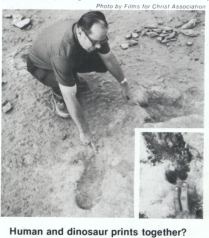
Further back in twentieth-century history, the debate over the authenticity of the Paluxy River tracks   covered similar ground.  Creationists interpreted these fossilized footprints in Texas as evidence that humans and dinosaurs had coexisted.

Not surprisingly, mainstream scientists disagreed.  For mainstream scientists, the notion that humans and dinosaurs coexisted is simply impossible.  Even a rough understanding of the evolutionary “bush” of life shows that millennia separated the age of dinosaurs from that of humans.  But, of course, taking a Biblical worldview, it is just as obvious that dinosaurs and humans coexisted.  If God created the world, humans, plants and animals after their kind in Eden, then there must be some crossover between dinosaurs and humans.

With this understanding, it would be shocking for creationists to teach students anything BUT a hope that Nessie proves to be a plesiosaur.  If true, Nessie would bolster creationists’ claims for a young earth.

In the News: Dinosaur Billboards and the Creation Museum

ABC News reported recently that Answers in Genesis’ Creation Museum has launched a new nationwide billboard advertising campaign.

The billboards feature retro-style dinosaurs, and appeared recently in cities such as Chicago, San Francisco, and Houston.  Some critics have wondered why the ads focus on dinosaurs instead of God, or whether this equates to a ‘Flintstones’ theology, but Ken Ham of Answers in Genesis pooh-poohed such folks.  Ham pointed out on his AIG blog that atheists have long used billboards to promote their point of view.

Getting It Wrong at The Atlantic

Watch out!  A couple of recent articles in The Atlantic dish out some misleading histories of Fundamentalist America.  It would be easy for those of us trying to understand FA to be confused.

First, let me say that I get it: Fundamentalist America is not easy to understand.  As Kevin White has noted recently on Mere Orthodoxy, this is true even for those who consider themselves FA citizens.  Even among only conservative evangelical Protestantism, we can be dazzled and confused by what historian Timothy L. Smith called the “kaleidoscope” of American evangelicalism.  Once we add conservative Catholics, cultural traditionalists, Burkean conservatives, free-market ideologues, etc. etc. etc…., mapping out a sensible understanding of Fundamentalist America can seem like an overwhelming task.  For those raised in the traditions of Tradition, this kaleidoscope can be bewildering.  And it can be even more so for those of us trying to understand Fundamentalist America from the outside.

I understand this difficulty.  I sympathize.  In the case of the recent articles in The Atlantic, neither author set out to mislead.  Unfortunately, each of them got it wrong.

First, Jonathan Merritt reflects on the thirty-third anniversary of the Christian Right.  Merritt pegs the founding of the “modern” religious Right in America to Jerry Falwell’s founding of the Moral Majority in June, 1979.  As Merritt argues,

“Previously, Evangelical Christians had been reticent to engage in partisan politics. But the cultural revolution of the 1960s brought on a blitzkrieg of social changes that left many religious conservatives feeling as if their way of life was being threatened. In response, the faithful flooded the public square — millions of them under the Moral Majority’s banner — to influence national elections and legislation. Standing tall at the helm of the movement was the silver-haired Falwell, a man whose presence could silence a room and whose rhetoric would often rouse it to raucousness.”

There is some truth to this, but only if we understand it in a very limited way.  Only if we put the emphasis of this entire paragraph on the word “partisan” does this give an accurate impression of the history of activism by religious conservatives.  A sensible reader might read this paragraph and conclude that it was not until 1979 that religious and cultural conservatives “flooded the public square.”  A reader might think that only the “blitzkrieg of social changes” from the late 1960s and 1970s spurred religious conservatives to public action.

This is a woefully misleading impression of the nature of conservative religious activism in America.  Even if we leave out the enormously important “long history” of Great Awakenings, abolitionism, and temperance, we have a twentieth century chock-full of religious activists working to maintain a traditional Godly public square.

And this activism did not differ in essence from that of later, post-1979 religious conservatives.  In the 1920s, for instance, the threat of evolution in public schools and the weakening of Biblical morality in public life spurred conservatives to action.  In the 1940s and 1950s, conservatives’ perceptions of a rapidly changing social order gave rise to new organizations such as the National Association of Evangelicals, and culture-changing revival campaigns like those of Billy Graham.

It is true that these cultural campaigns did not seize on partisan politics with vigor until the late 1970s.  Most conservative Christian activists did not see themselves as working within the confines of the Republican Party until that time.  But the implication that conservative religious folks had been somehow quiescent in earlier decades gives a very misleading impression of the history of Fundamentalist America.

Atlantic Editor Robert Wright offers up the next flawed history.  Wright suggests that the recent aggressive atheism of prominent evolutionists has led conservative religious people to turn away from science altogether.  He argues,

“I do think that in recent years disagreement over evolution has become more politically charged, more acrimonious, and that the rancor may be affecting other science-related policy areas, such as climate change.

“My theory is highly conjectural, but here goes:

“A few decades ago, Darwinians and creationists had a de facto nonaggression pact: Creationists would let Darwinians reign in biology class, and otherwise Darwinians would leave creationists alone. The deal worked. I went to a public high school in a pretty religious part of the country–south-central Texas–and I don’t remember anyone complaining about sophomores being taught natural selection. It just wasn’t an issue.

“A few years ago, such biologists as Richard Dawkins and PZ Myers started violating the nonaggression pact. I don’t just mean they professed atheism–many Darwinians had long done that; I mean they started proselytizing, ridiculing the faithful, and talking as if religion was an inherently pernicious thing. They not only highlighted the previously subdued tension between Darwinism and creationism but depicted Darwinism as the enemy of religion more broadly.”

I take Wright’s point to be less about the history of creationism and more about evolutionists’ strategy.  I agree that it will continue to be counterproductive for evolutionists to insist that evolution and religion must be eternally at odds.  As Wright concludes, “if somebody wants to convince a fundamentalist Christian that climate scientists aren’t to be trusted, the Christian’s prior association of scientists like Dawkins with evil makes that job easier.”  Fair enough.

But his admittedly conjectural assertions about a “non-aggression pact” between creationists and evolutionists suggests a dangerously false understanding of history.  As I’m sure he would readily admit, the evidence from his own high-school career does not adequately sum up the American experience.  The notion that Dawkins and Myers represent a new element in the creation/evolution debates underestimates the importance of the long history of activism by the likes of Robert Ingersoll and Thomas Henry Huxley.  Both promoted “freethought,” what a later age would call atheism or agnosticism.  And both were associated firmly in the public mind with Darwinian evolution.  Indeed, Huxley relished his nickname, “Darwin’s Bulldog.”  As Huxley wrote to Darwin,

“And as to the curs which will bark and yelp — you must recollect that some of your friends at any rate are endowed with an amount of combativeness which (though you have often & justly rebuked it) may stand you in good stead — I am sharpening up my claws and beak in readiness.”

Such aggressive evolutionism has been associated in the public mind with a combative anti-theism for as long as the public has wondered about creationism and evolutionism.  In addition, Wright’s suggestion that creationists had tacitly agreed to “let Darwinians reign in biology class” until recently woefully misses the historical boat.  Since the 1920s, conservative activists have worked energetically and consistently to make sure Darwin did not so reign.  Most famously, the 1920s saw the issue come to a public head with the Scopes “Monkey” trial in Tennessee.  But unlike the persistent Inherit-the-Wind myth suggests, creationists did not crawl back to their isolated hollers after that 1925 trial.

It is notoriously difficult to know what goes on behind closed classroom doors, but the available evidence suggests that anti-evolution sentiment remained both powerful and polticially active in every decade of the twentieth century.  One large-scale study in 1942, for example, asked thousands of high-school biology teachers about their teaching.  The survey authors concluded that evolution was taught in “notably less than half of the high schools of the United States.”  And of those schools in which evolution was taught, the study authors concluded that it was “frequently diluted beyond recognition,” either by pairing it with the teaching of special creation, or by the separation of human origins from the idea of organic evolution.  Other studies found similar results.

More recently, Michael B. Berkman and Eric Plutzer confirmed the continuing tendency of American teachers to avoid teaching evolution.  Their study of 926 US public high school biology teachers found a sizeable minority (28%) who reported to teach evolution.  It also found a smaller but still significant group (13%) who reported teaching creation.  The large middle, what Berkman and Plutzer call the “Cautious 60%,” teach a mish-mash of creationism and evolution.  One important reason teachers gave for skipping evolution is an understandable desire to avoid controversy.  In other words, in twenty-first century America as in 1920s, 1940s, 1950s, 1960s, and 1970s America, anti-evolution sentiment dictated large percentages of education policy.

Unlike the picture Wright paints, however, this is not a recent development but a generations-old cultural trend.  The suggestion that recent Gallup poll data mark any significant change in America’s enduring trench lines in this culture-war front is misleading.

My hunch is that neither of these authors hoped to use their misunderstandings of the history of Fundamentalist America as a weapon.  My hunch is that both of them sincerely believe in the historical narratives they deliver.  However, this understanding of the history of conservative religious activism in public life is not merely neutral.  It promotes a myth that religious Americans in the past did not participate in politics; it suggests that recent conservative cultural activism represents a break from American traditions.

Let me be clear: I do not object to this misuse of history because I disagree with the politics.  I do not hope to promote the values or agendas of Fundamentalist America; I don’t want to offer my own slanted history in rebuttal.  But I do object as an historian.  If we hope to understand Fundamentalist America, we need to be honest and fair about its history.  Suggesting that an activist conservative Christianity, or a defensive creationist community, are somehow recent developments distorts that history in pernicious ways.

Further reading: Oscar Riddle, F.L. Fitzpatrick, H.B. Glass, B.C. Gruenberg, D.F. Miller, E.W. Sinnott, eds., The Teaching of Biology in Secondary Schools of the United States: A Report of Results from a Questionnaire (Washington, DC: Union of American Biological Sciences, 1942); Estelle R. Laba and Eugene W. Gross, “Evolution Slighted in High-School Biology,” Clearing House 24 (March 1950); Michael B. Berkman and Eric Pluzter, Evolution, Creationism, and the Battle to Control America’s Classrooms (Cambridge University Press, 2010); George M. Marsden, Fundamentalism and American Culture: The Shaping of Twentieth-Century Evangelicalism, 1870-1925 (New York: Oxford University Press, 2006); Joel A. Carpenter, Revive Us Again: The Reawakening of American Fundamentalism (New York: Oxford University Press, 1997); Ronald L. Numbers, The Creationists: From Scientific Creationism to Intelligent Design, Exp. Ed. (Cambridge: Harvard University Press, 2006).


The Bible in America: Proof-Texting and the Cultural Divide

Quick: What does the Bible have to say about vegetarianism?  …about the war in Iraq?  …about Catholicism?

I don’t know the answers to these questions.  And, without meaning any disrespect, I can honestly say I don’t care.  I don’t think my ignorance on these issues makes me “ignorant.”  I don’t think it makes me uneducated.  I just don’t think the Bible’s opinions on these issues are important.  Don’t get me wrong: I’m not anti-Bible.  In fact, I’m confident I’d be better off if I had spent my youth memorizing the Psalms instead of the lyrics to the Gilligan’s Island theme song.  But I didn’t.  And I don’t feel the loss.

Just sit right back and you’ll hear a tale…

However, many citizens of Fundamentalist America would consider my ignorance deeply embarrassing.  For many conservative religious folks, especially among the Protestant denominations, the ability to cite Scriptural chapter and verse is one sign of an adequate spiritual education. 

This divide fuels America’s culture wars.  Many non- or anti-fundamentalists doubt that fundamentalists are even capable of rational, logical intellectualism.  (Consider a few examples: here, here, here, here, and here.)  The more ardently conservatives dig into their Bibles to prove their points, the more confident anti-fundamentalists become that conservatives have lost all claim to intellectual coherence.    

And many fundamentalists don’t seem to understand that their compilations of Biblical proof-texts carry very little weight outside the borders of Fundamentalist America.  They build arguments against homosexuality  or same-sex marriage based on collections of chapter and verse.  But such arguments are only compelling—or even comprehensible—if we accept the premise of the Bible proof-text in the first place.  As a result, different sides do not speak to one another.  They speak—or yell—past one another, scoring points that only the people on their own side can recognize.    

If we outsiders are to understand Fundamentalist America, we need to understand the proof-text tradition.  Why do religious conservatives care so much what Leviticus has to say about whether or not people should have sex with animals?   Why is it so important that evidence for a young earth can be found not only in Genesis, but also in Mark 10:6, 1 Corinthians 15:26, and Matthew 19:4,5? 

It is not a stretch to say that this style of proof-text argument had been, until the late 1800s or early 1900s, the standard style of theological disputation among Protestants.  In the nineteenth century, European scholars began to look at the Bible in a new way.  By the turn of the twentieth century, leading American Protestant theologians disputed the intellectual usefulness of the Scriptural proof-text.  In 1907, for instance, William Newton Clarke lambasted his more conservative colleagues for their continued reliance on this method.  “Even if,” Clarke argued, “a proof-text method were a good method in itself, it could not be successfully employed now, since the texts of the Bible have suffered such serious though unintended distortion.”  Since liberal theologians had come to disagree with the notion of an inerrant Bible, the method of proving an argument by assembling an overwhelming dose of chapter and verse no longer seemed compelling.

During the twentieth century, however, among Bible-centered Protestants—including self-styled fundamentalists, neo-evangelicals, Pentecostal groups, conservative Lutherans, and others—the proof-text tradition continued.  For those groups who maintained a faith in the Bible as inerrant, it remained convincing to prove every point with an assembly of relevant texts. 

Consider the following doctrinal statement from David Cloud’s Way of Life Ministries.  Each point is proven with an array of relevant texts. 

STATEMENT OF FAITH

Way of Life Literature
P.O. Box 610368, Port Huron, MI 48061
866-295-4143 (toll free), fbns@wayoflife.org
http://www.wayoflife.org


THE SCRIPTURES

The Bible, with its 66 books, is the very Word of God. The Bible is verbally and plenarily inspired as originally given and it is divinely preserved in the Hebrew Masoretic Text and the Greek Received Text. The Bible is our sole authority in all matters of faith and practice. The King James Version in English is an example of an accurate translation of the preserved Hebrew and Greek texts; we believe it can be used with confidence. We reject modern textual criticism and the modern versions that this pseudo-science has produced, such as the American Standard Version, the New American Standard Version, the Revised Standard Version, and the New International Version). We also reject the dynamic equivalency method of Bible translation which results in a careless version that only contains the general ideas rather than the very words of God. Examples of dynamic equivalency versions are the Today’s English Version, the Living Bible, and The Message.

2 Samuel 23:2; Psalm 12:6-7; Proverbs 30:5-6; Matthew 5:18; 24:35; John 17:17; Acts 1:16; 3:21; 1 Corinthians 2:7-16; 2 Timothy 3:15- 17; 2 Peter 1:19-21; Revelation 22:18-19

THE CREATION

We believe in the Genesis account of Creation and that it is to be accepted literally and not figuratively; that the world was made in six 24-hour days; that man was created directly in God’s own image and did not evolve from any lower form of life; that all animal and vegetable life was made directly and made subject to God’s law that they bring forth only “after their kind.”

Genesis 1; Nehemiah 9:6; Job 38:4-41; Ps. 104:24-30; Jn. 1:1-3; Acts 14:15; 17:24-26; Rom. 1:18-21; Col. 1:15-17; Hebrews 1:1-3; 11:3

THE WAY OF SALVATION (THE GOSPEL)

Salvation is by the grace of God alone, which means that it is a free gift that is neither merited nor secured in whole or in part by any virtue or work of man or by any religious duty or sacrament. The gift of God’s grace was purchased by Jesus Christ alone, by His blood and death on Calvary. The sinner receives God’s salvation by repentance toward God and faith in the Lord Jesus Christ. Though salvation is by God’s grace alone through faith, it results in a changed life; salvation is not by works but it is unto works. The faith for salvation comes by hearing God’s Word. Men must hear the gospel in order to be saved. The Gospel is defined in 1 Corinthians 15:1-4.

John 1:11-13; 3:16-18, 36; 5:24; 14:6; Acts 4:12; 15:11; 20:21; Romans 10:9-10,13, 17; Ephesians 1:7; 1:12-14; 2:8-10; Titus 3:3-8; Hebrews 1:3; 1 Peter 1:18-19; 1 John 4:10

CIVIL GOVERNMENT AND RELIGIOUS LIBERTY

We believe that civil government is of divine appointment for the interests and good order of human society; that magistrates are to be prayed for (1 Tim. 2:1-4), conscientiously honored and obeyed (Mat. 22:21; Rom. 13:1-7; Titus 3:1; 1 Pet. 2:13-14), except only in the things opposed to the will of God (Acts 4:18-20; 5:29); that church and state should be separate, as we see in Scripture; the state owing the church protection and full freedom, no ecclesiastical group or denomination being preferred above another. A free church in a free state is the Christian ideal.

We can see the proof-text tradition in David Cloud’s sermons as well. 

The way Cloud and Way of Life use proof-texts is just one example from a galaxy of possible examples out there.  Especially among Bible-based conservative evangelical Protestant groups, the proof-text is the method by which truth is established.  The Bible is the inerrant authority.  In order to make any point, about any subject, the name of the game is proof-texting.  Of course, among many conservative Protestants, the term “proof-text” has taken on negative connotations.  It should not mean that one simply has to slap a bunch of Bible citations together to prove a point.  In this continuing intellectual tradition, the cogency of the argument is based on the proper selection of texts.  How well do the selected texts establish the point at hand?  Does the author use each text in a way that respects the context and original meaning of the selected passage?  Does the author consider relevant passages that might disagree with this interpretation?  Or does a poorly educated pastor merely assume an air of false erudition by throwing Scriptural citations around willy-nilly

To be sure, it is an intellectual tradition that no longer carries weight in mainstream religion and culture.  Though large majorities of Americans might believe that the Bible contains the answers to all of life’s questions, those same majorities do not necessarily agree that the Bible should be the main intellectual authority in all matters.  Indeed, especially galling to many non- and anti-fundamentalists is proof-texters’ assumption that their particular religious tradition should be considered binding in matters of public policy.  In other words, it may be fine for Way of Life to demonstrate the validity of its creed through proof-texts.  But that does not mean that proof-texts can be used to demonstrate the need to teach religious doctrine in science classes. 

These are important arguments.  Proof-texters need to understand that their intellectual tradition does not carry weight outside the borders of Fundamentalist America.  But that is a much different thing than admitting to being non-intellectual or anti-intellectual.  If we outsiders can better understand the tradition of proof-texting, we will be better able to speak intelligently, reasonably, calmly, and even productively with Fundamentalist America.     

FURTHER READING: William Newton Clarke, The Use of the Scriptures in Theology (Edinburgh: T. & T. Clark, 1907); Timothy P. Weber, “The Two-Edged Sword: The Fundamentalist Use of the Bible,” Nathan O. Hatch and Mark A. Noll, eds., The Bible in America: Essays in Cultural History (New York: Oxford University Press, 1982), 101-120.

Required Reading: Matthew Lee Anderson on Non-Culture War Conservatism

“Why do the angry people get all the attention?” 

That was one of those audience questions that has stuck with me.  It was at a talk about the history of American creationism I gave a while ago to an audience of (mostly) committed students of biological evolution.  I had included one of my go-to bits from the aggressive atheist Richard Dawkins.  I often explain my purpose in studying conservative religion in American public life as a quest to deflate Dawkins’ 1986 warning: Anyone who does not believe in evolution, Dawkins insisted, must be “ignorant, stupid or insane (or wicked, but I’d rather not consider that).”  Though I don’t believe in creationism, I think many people who are not ignorant, stupid, or insane do believe it.  Our talk turned after that to the prominence of mean-spirited, angry culture warriors.  Why do such voices get all the attention, when most of us, whatever our beliefs, would prefer a respectful dialogue?  

Yesterday at Mere Orthodoxy, Matthew Lee Anderson posted another in his series on what it would take for conservative religious Americans to create a post-culture war persona.    

Anderson suggests “four moves” that would move the public engagement of conservative religious Americans in healthier directions:

1) Recover a robust doctrine of creation that is isn’t afraid to be doctrinal.

2) Emphasize the moral imagination and attempt to construct arguments that both appeal to and buttress it.

3) Remember that the church does not simply engage the culture, including politics, but is a culture and so has her own political order.

4) Reframe American exceptionalism around America’s responsibilities rather rather than its virtues. 

As Anderson admits, some of these moves might just be restatements of the goals of the last two generations of culturally engaged evangelicalism.  Carl Henry’s call in 1947 for a “progressive Fundamentalism with a social message” comes to mind.  But for those of us from the outside, those of us trying to understand conservative religion in American public life in order to take away some of the power of all the “angry voices,” understanding Anderson’s moves (and his supporting reading lists) might be a good place to start.

Required Viewing: In God We Teach

As we’ve noted recently, the controversy over religion in public schools did not go away in 1963 when the Supreme Court ruled that school-sponsored devotions violated the First Amendment. 

A new documentary probes a recent case from New Jersey.  As reviewed by Rob Boston on Wall of Separation, the film In God We Teach examines what can happen when an activist teacher meets an activist student.  In this 2006 case, teacher David Paszkiewicz was accused of preaching conservative evangelical Protestantism in class. 

As Boston describes,

David Paszkiewicz told students, “If you reject [Jesus’] gift of salvation, then you know where you belong” and “[Jesus] did everything in his power to make sure that you could go to heaven, so much so that he took your sins on his own body, suffered your pains for you, and he’s saying, ‘Please, accept me, believe.’ If you reject that, you belong in hell.”

Paszkiewicz had also promoted creationism in class, telling students that there were dinosaurs on Noah’s Ark.

A student in the classroom, Matthew LaClair, knew this was inappropriate. He also suspected that school officials would not believe him without evidence, so LaClair began recording portions of the classes. Soon he had solid evidence of Paszkiewicz’s in-class proselytizing.

For ILYBYGTH readers, the most interesting part of the film sounds like the parts in which Paskiewicz is allowed to explain his rationale.  Boston excoriates the teacher.  In Boston’s words,

I was struck by the teacher’s complete and utter inability to engage in any serious form of self-reflection. [Filmmaker Vic] Losick’s technique is to simply let the characters in this drama tell their stories. He doesn’t take a side. But only a theological ally of Paszkiewicz could see him as anything other than a typical smug and arrogant fundamentalist who believes that he has all of the answers – and that this gives him the right to spread his views in public school classrooms.

Paszkiewicz also comes off as disingenuous. At first, he tried to deny having made the “you belong in hell” statement. But LaClair had it on tape, so that failed. Paszkiewicz then fell back on blaming the students. They asked him about religion, you see, so had to talk to them about it. In the documentary, AU’s Lynn handily explains why this is nonsense.

I’m planning to take an hour and four minutes to see for myself.  Losick’s film is available online.  I’ll be interested to see if ILYBYGTH readers agree with Boston’s indictment of Paszkiewicz.

REQUIRED READING: Protester Voices

For those who hope to understand Fundamentalist America in the twenty-first century, a good place and time to start would be Kanawha County, West Virginia, 1974.

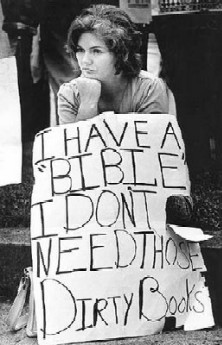
The raucous 1974-1975 school year in this county surrounding Charleston saw a burst of public controversy over the teaching in its public schools.  Protesters vilified a set of textbooks adopted by the school district.  At its peak, the protest and school boycott included a sympathy strike by the area’s miners and even a spate of gunshot attacks and the bombing of a school-administration building.  The fight in Kanawha County, as argued by both protesters and historians, can correctly be seen as the birthplace, or at least the midwife, of an emerging populist conservative movement.

The controversy has attracted its share of recent attention from scholars such as Carol Mason and journalists such as Trey Kay.

Thanks to the energetic activist Karl Priest, we now also have an account of the controversy written from a prominent member of the movement itself.  Priest’s 2010 book Protester Voices offers a view from inside the textbook protest movement.

Priest’s story is unabashedly partisan.  The tone and style of his book are those of a bare-knuckled culture warrior rather than those of a disinterested academic.  Priest has achieved a reputation as one of today’s leading anti-evolution internet brawlers.  In addition to his anti-evolution work, Priest is also currently active in Exodus Mandate.  This organization promises “to encourage and assist Christian families to leave government schools for the Promised Land of Christian schools or home schooling.”  Those who hope to explore the worlds of conservative Christian activism in twenty-first century America will soon run into the work of Karl Priest nearly everywhere they turn.  Indeed, when ILYBYGTH first starting imagining how intelligent, educated people could embrace creationism (see, for instance, here, here, here, here, and here), we were accused of being merely a front for Priest.

In his 2010 book, Priest takes other writers to task for their anti-protester bias.  He dismisses Carol Mason, for example, as someone who “concentrate[s] on the exception to the rule” (37).  The protest movement, Priest insists, must not be understood as an irruption of racism or vigilante violence.  The protesters themselves cannot fairly be dismissed as “wild-eyed ignoramuses” (xiii).  Such accusations, Priest insists, demonstrate the bias of left-leaning scholars more than the lived reality of the protest itself.  The leaders of the movement, in Priest’s view, “suffered financial loss. . . . [and] endured snide remarks and mocking.”  They did so in order to defend their schools and community against the imposition of taxpayer-funded textbooks that included aggressive racism and sexual depravity.  Priest defends the rank and file of this movement, also slandered mercilessly by other writers, as “Norman Rockwell Americans” (63).

Priest agrees with other commentators that this textbook controversy provided the launching pad for a new kind of conservative activism.  Kanawha County attracted national leaders such as Mel Gabler and Max Rafferty.  The fledgling Heritage Foundation sent legal advisers.  The 1974 protest, Priest claims, heralded the new generation of populist conservatism that continues in today’s Tea Party movement.

For anyone hoping to understand Fundamentalist America, this book is an important resource.  Not only does Priest’s account offer a staunch defense of the fundamentalist side of one of the most significant controversies of the late twentieth century, he also includes a reflection on the meanings of fundamentalism itself.  Though he prefers the term “Bible-believing Christian,” Priest insists that “Being a fundamentalist, contrary to what liberals have propagandized, is nothing to be ashamed of just by the attachment of the term” (3).