Left or Right; SJW or TPUSA; the news from Washington shows that campus activism is hitting higher education where it hurts. Activists should forget about inviting Milo or occupying quads. Instead, they should recognize their true power and consider what target they want to point it at.
That sort of dollars-and-cents bottom line is the kind of thing school administrators can’t ignore. By and large, they can endure endless accusations of racial insensitivity from the left. They can blithely listen to accusations of biased “totalitarian” campus climates from the right.
But if colleges lose enrollments, they wither and die. And if they lose lawsuits, they can’t function.
So here’s the question for this generation of student activists: What is your real target? Just as in the SDS years, students need to be strategic about their aims, because they have the ability to inflict serious damage if they choose.
We’ve heard the stories from the teachers’ strikes. Teachers in Oklahoma, West Virginia, Colorado, North Carolina, Kentucky, and Arizona walked off their jobs to protest low salaries and weak funding of public schools. One of the common complaints was that teachers had to work two or three jobs just to make ends meet. They were Uber drivers, bartenders, and tutors in addition to their day jobs. Are things really so bad for teachers?
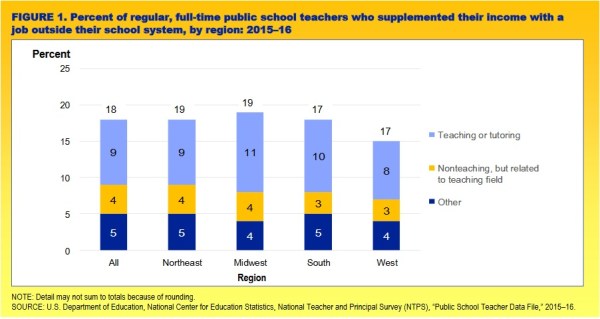
New survey data puts some numbers behind those anecdotal claims. A report from the National Center for Education Statistics for 2015-2016 finds that significant numbers of teachers are working at least one additional job to earn a few thousand extra dollars. As I’m finding in my current research, teachers have always needed to work outside of school to make ends meet.
Two hundred years ago, for example, Joseph Lancaster’s daughter and son-in-law moved to Mexico to start some Lancasterian schools. They hoped at least to be able to make ends meet, but it turned out not to be so easy. Back then, son-in-law Richard M. Jones assumed he’d be able to set up a few income streams. He hoped to get a regular salary from a fully enrolled school. But he also counted on earning even more money teaching individual students on the side.
Unfortunately for Jones, he couldn’t find any students to tutor. No one seemed to want to hire Jones to teach their children English. As he wrote wryly to Lancaster in 1826,
so much for the desire to learn the English Language in the Great City of Mexico.
Of course, Jones was blind to the likely effect of his own attitude. As he had written to Lancaster in March,
You have can have [sic] no idea of the miserably priest-ridden state of nine tenths of these people, the extreme disposition to indolence rob, gamble . . . without one speck of honor, love of country, or a due proportion of pride, rather beg than do the least thing for a livelihood.
Not the kind of attitude I would want in my kid’s tutor if I were an affluent Mexican parent!
How about these days? The survey data from NCES shows that just about one in five public-school teachers work at least one additional job. The largest segment work as tutors. Let’s not forget, too, that these jobs are only the ones taken outside of the district system. Most teachers I know also take additional jobs INSIDE their districts. Athletic coaches, for example, can earn a little extra money while building good connections with students and helping school spirit.
bid adieu to the System and teaching and all connected with it and turn my attention to business in some shape or other.
In the meantime, lots of teachers are working 5 to 9 to make ends meet. What do you think? Is it outrageous that so many teachers need to take on outside work to make a living?
I guess we shouldn’t really call it an “exposé” because it doesn’t tell us anything we didn’t expect. Still, it can be eye-opening to see the sorts of things voucher programs can do. This week, the Orlando Sentinel explores the content of fundamentalist textbooks used at area private schools. The story prompts us to ask a tough question about voucher programs: Is it fair to limit voucher programs only to religions we like?
Should taxes pay for these textbooks?
As I’ve argued in a couple of academic articles, the history of fundamentalist textbook publishing is key to understanding both the “Christian-school” movement and the subsequent evangelical homeschooling exodus.
Plus, no one should think that these fundamentalist textbooks are static or monolithic. As I explored in a chapter in AJ Angulo’s terrific book Miseducation, ACE, A Beka, and Bob Jones are all very different from one another, and all have radically changed their treatment of topics such as US History.
As the Orlando Sentinel explains, voucher programs in Florida are sending tax dollars to schools that use textbooks by the “big three” fundamentalist school publishers. As the investigators discovered, the textbooks are full of creationism, ethnocentrism, and historical denialism. As OS puts it,
[Investigators] found numerous instances of distorted history and science lessons that are outside mainstream academics. The books denounce evolution as untrue, for example, and one shows a cartoon of men and dinosaurs together, telling students the Biblical Noah likely brought baby dinosaurs onto his ark. The science books, they added, seem to discourage students from doing experiments or even asking questions. . . .
The social studies books downplay the horrors of slavery and the mistreatment of Native Americans, they said. One book, in its brief section on the civil rights movement, said that “most black and white southerners had long lived together in harmony” and that “power-hungry individuals stirred up the people.”
We have to ask: Is this sort of thing okay for a tax-funded school? After all, there is nothing in this story that should come as a surprise. If we want to allow voucher programs that send tax money to private schools, we should expect some of those dollars to pay for curricula we disagree with. Is that okay?
Hard-hitting curriculum for Florida’s third-graders. This sample comes from an Accelerated Christian Education reader.
Or, to put it in nerdier terms: How should policy-makers decide if religious schools qualify to participate in tax-funded programs? It can’t be simply on the basis of our own personal religious views. For example, I believe the ACE, BJU, and Abeka textbooks are terrible and I would never want my kid to use them in school. But my personal preferences can’t suffice to dictate policy. How can we decide which religious schools qualify for tax-funded voucher programs?
One option would simply be to make ALL religious schools off-limits for voucher-funded students. In some cases, though, that would seem to keep deserving kids from getting a higher-quality education than their local public schools can provide.
Another option would be to rule out schools that limit their students’ life chances. As one of the OS investigators argued, for example, using these creationist textbooks would hurt students. As the article explains,
“Students who have learned science in this kind of environment are not prepared for college experiences,” said Cynthia Bayer, a biology lecturer at the University of Central Florida who reviewed the science books. “They would be intellectually disadvantaged.”
But WOULD they? Anyone who knows the real story of American higher education knows that creationist students have plenty of creationist colleges they can attend. Is it fair to say that students can’t study creationist books because they don’t agree with mainstream science? Isn’t that the whole point of private schools in the first place?
Please don’t get me wrong: I’m firmly against using tax dollars to fund private religious schools. I think we should nix ALL religious schools from that sort of public funding. But we can’t do it only for some religious schools and not for others, based on the fact that we don’t like some of the religions. And we should not be surprised to find out that voucher programs are doing precisely what they were designed to do: Fund religious schools.
First, my full confessions: I have progressive prejudices that are hard to shake. I want public schools to make society better. I believe that better educational opportunities for all people will help achieve that goal. And…and this is the one that matters this morning…I think what goes on in classrooms matters. As John Dewey argued a century ago, if we want a democratic society we need to start by creating democratic classrooms.
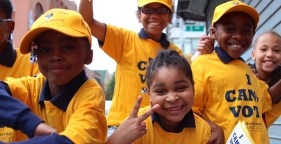
I can’t vote, and I can’t speak when I want to, and I can’t put my pencil where I want to, and I can’t get out of my seat when I want to…
As one thoughtful former Democracy Prep teacher noted, it’s hard not to think that the way students are educated matters. As he puts it,
schools are invariably where students go to experience the civic engagement of others. No child thinks of it this way, but surely, he or she picks up clear signals about their place in the world, how they are regarded by authority figures who are not their parents, and how much — or how little — is expected of them. If the relationship a child has with a school is coercive, punctuated by frustration and failure, leading to no good end, then there is no reason to expect strong civic outcomes.
And yet, as Prof. Cuban points out, students at Democracy Prep feel the heavy hand of authority at all times. As one visit to a DP school revealed, students’ actions were constantly tracked and dictated. As the visitor found,
Almost everything on a recent visit to a Democracy Prep charter was highly disciplined. Students spoke only when their teachers allowed them. They could lose points for talking out of turn, or chatting in the halls between classes.
I’m skeptical. Surely a school culture that eliminates any possibility of student leadership will have a depressing effect on student political participation. At least, that’s what makes sense to me. Or is it really possible that schools can control their students all the way to active citizenship?
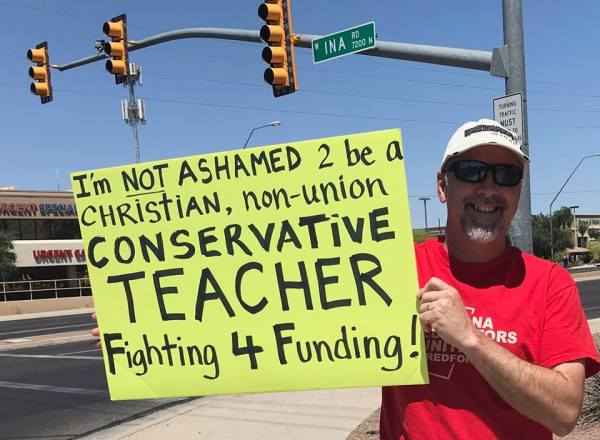
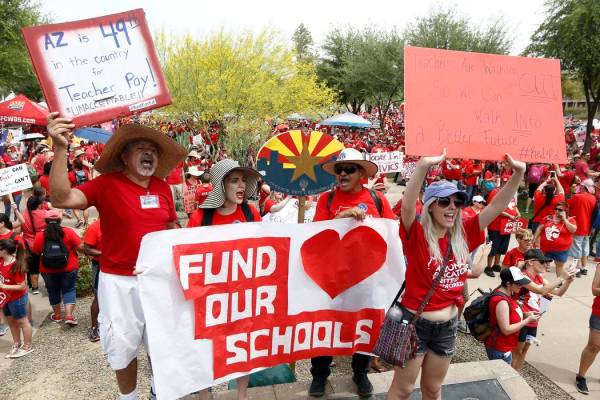
I’m no conservative. But if I were, images like this would make me very nervous. I’m starting to wonder if Paul Krugman’s warning might be more than just wishful liberal thinking. The recent spate of teachers’ strikes might be pushing the GOP into a very dangerous position electorally.
Is Arizona’s Jay Bertelsen putting the handwriting on the wall for the GOP … ?
Don’t get me wrong: I understand that there has long been a chicken-little element to American conservative thinking, especially among religious intellectuals. Things seemed dire for conservatives in 1925, then again in 1962, then again in 2015. Conservative intellectuals like Rod Dreher have created a cottage industry of alarmism.
This time, though, the threat to conservatism is coming from a different direction. As The Economist reports, when even self-identified Christian conservative teachers are out on strike, the long, productive marriage between conservatism and the Republican Party looks mighty shaky. Could recent triumphs for conservative Republicans lead unexpectedly to a deepening, divisive schism between conservatives and the GOP? Could it push conservatives back out into the electoral cold, split between the two major parties?
As The Economist argues this week, conservatives and the whole Republican Party would be smart to worry. As they explain,
states where teaching unions are weaker now have more politically active teachers. Ms. Marohn, one of the demonstrators in Phoenix, says that when parents ask her mother, also a teacher, what they can do to help, she tells them to vote. That should worry Republicans. There are 3.2m public-school teachers in America. Giving them a financial reason to head to the polls could spell trouble for some Republicans running in states with teacher unrest. Arizona, North Carolina and Colorado are all battleground states. Republicans had also fancied that they could flip the West Virginia Senate seat held by Joe Manchin, a conservative Democrat. For want of more chalk could the Senate be lost.
When conservative Christian teachers take to the streets in demonstrations against GOP administrations, I can’t help but wonder what the electoral future will bring. If it turns significant numbers of self-identified Christian conservatives against Republican candidates, we might just see a big shake-up at the polls.
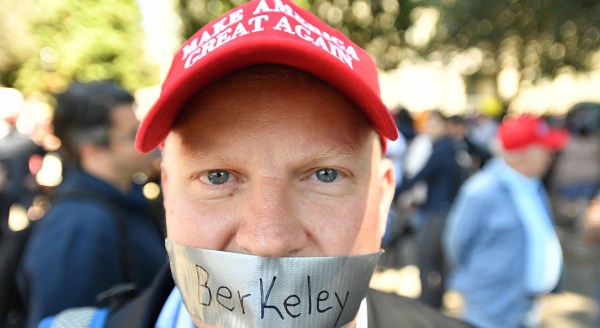
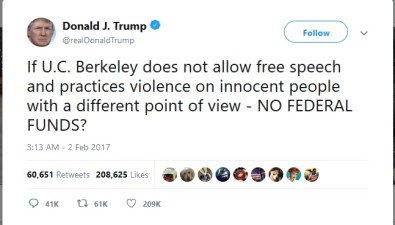
Christ spoke to the University of California this week. Chancellor Carol Christ, that is. And according to Politico she gave her support to a new internal study of the terrible speech riots that plagued Berkeley in 2017. The report’s conclusions make sense to me, but not to Milo.
I know SAGLRROILYBYGTH are divided on questions of campus free speech. We all should be; it’s a complicated issue that deserves more than sound-bite attention and one-size-fits-all solutions.
IMHO, a recent report from Berkeley hit the nail on the head. To wit: Speech must be protected, especially on university campuses—double-especially on public university campuses. But intentional provocateurs forfeit their access to some free-speech protections with their cynical manipulation of our fondness for free speech.
At Berkeley, you may recall, planned speeches by right-wing pundits Milo Yiannopoulos and Ann Coulter provoked violent, riotous protests. A committee of faculty, students, and staff concluded recently that their campus is still a tolerant place. Most students support free-speech rights on campus even for people with whom they disagree strongly.
Provocateurs provoking…
But the committee defended the notion that some speech and some speakers deserved to be banned. Yiannopoulos and Coulter were singled out by name. How could the committee say so? In their words,
Although those speakers had every right to speak and were entitled to protection, they did not need to be on campus to exercise the right of free speech. . . . Indeed, at least some of the 2017 events at Berkeley can now be seen to be part of a coordinated campaign to organize appearances on American campuses likely to incite a violent reaction, in order to advance a facile narrative that universities are not tolerant of conservative speech.
Not surprisingly, Milo took affront. As he retorted, the committee was made up of
Marxist thugs … criticizing people they don’t listen to, books they haven’t read and arguments they don’t understand.
I’m no Marxist thug, but I think the Berkeley committee has the better end of this argument. The tricky part, IMHO, is that the committee’s conclusion rests on the shaky foundation of their interpretation of Milo’s intent. If he intended to talk politics, they imply, he should have been welcomed. But he didn’t. As they put it,
Many Commission members are skeptical of these speakers’ commitment to anything other than the pursuit of wealth and fame through the instigation of anger, fear, and vengefulness in their hard-right constituency.
In most cases, I’d be nervous about relying on the gut feelings of a few committee members. In this case, though, even thoughtful conservatives fret about Milo’s brainless bluster. In the end, free-speech decisions can and must rely on an informed decision about a speaker’s intent. It’s not easy, but it is necessary.
create an environment . . . that encourages students to explore scientific questions, learn about scientific evidence, develop critical thinking skills, and respond appropriately and respectfully to differences of opinion about controversial issues, including biological and chemical evolution.
Sounds good, right?
You don’t have to be a Marxist thug to conclude, however, that the intention of this bill is to water down evolution education. The intention is to promote a certain creationism-friendly environment in public-school science classes.
The way I see it, speech acts that deliberately hope to manipulate free-speech protections for other purposes create a new category of speech. Do people have a right to speak such ideas? Sure! But universities do not need to fork over huge sums of money to provide a home for those speeches. K-12 schools do not need to accommodate speech that intentionally weakens science education for religious purposes.
For one thing, many of Arizona’s teachers wanted more than a pay raise. As the legislators voted on the new budget that included their pay raises, the crowd of striking teachers applauded the “no” votes, not the yeses. As one striker told USA Today,
This was never about teachers’ salaries. This was about the future of our kids and the future of education in Arizona.
Striking teachers didn’t only want increased salaries. They wanted a vastly increased budget for public education in general. They wanted funding restored for programs and staffing.
As another strike leader told Jacobin magazine, the new budget—including promises of salary raises—is really only a stopgap, a half-measure meant to distract attention from the state’s real educational funding problems. As she put it,
We’re opposed to this budget, it does not give us what we want. It does not put $1.1 billion back in the funding. What it does give us is a tiny piece of the puzzle, $400 million dollars. Which means we’re responsible for going and getting that other $700 million. We’re going to pivot and go fight to get that money ourselves. We need to fight for the money for our kids and colleagues, because they’ve been left out — and that’s one of the main reasons why we don’t support this budget.
I didn’t hear any strikers mention it, but I can’t help but think that some striking teachers are also peeved at the way they are being talked about by some conservative politicians. I know I would be. For example, even as the budget was being passed, one republican legislator tried to cram in three anti-teacher amendments.
The first would have banned any school closures, except in case of non-political emergency. The second would have allowed lawmakers to call for an investigation of any school district that seemed to be too sympathetic to teachers. The one best calculated to provoke the ire of striking teachers, though, would have prohibited teachers from spouting political ideology in their classrooms, including possible fines of up to $5,000. As this conservative legislator fumed,
It’s far beyond time we rein in indoctrination in our public schools.
As I argue in my book about the history of educational conservatism, this notion that sneaky subversive teachers are using their positions to warp students’ minds has a long and bitter history. Conservative pundits and politicians have long assumed that left-wing teachers were out to corrode children’s faith in America and capitalism. And for most teachers, those sorts of accusations are not only bizarre, but profoundly insulting.
In addition, then, to feeling shorted on their real goals of increasing school funding and reining in charters, I imagine some Arizona teachers must be chagrined to be subjected to this sort of continuing casual slander from their state leaders.
As historian John Fea commented, Falwell’s use of “Christian” to mean only those few conservative-evangelical universities that grew out of the fundamentalist movement seems stunted.
I certainly agree. When former Liberty President Pierre Guillermin bragged in 1982 that his evangelical school planned to become “the Notre Dame of the Christian world athletically and the Harvard of the Christian world academically,” it’s difficult not to wonder what all those Notre Dame Christians might have thought. For Guillermin, Falwell, and many other conservative-evangelical leaders, the use of “Christian” to denote only their own conservative-evangelical faith seems presumptuous indeed.
However, if we accept for the sake of argument Falwell’s definition of “Christian” universities as limited only to conservative-evangelical schools, his complaint makes a little more sense. As I noted in my recent book about the history of evangelical higher education, requiring faculty annually to sign a statement of faith really HAS been a hallmark of these schools, and GCU really has abandoned that requirement in its effort to attract more students and retain more faculty.
As GCU pointed out, they require faculty to sign a statement saying they “understand” the school’s mission, but that is a far cry from the “ironclad” attempts of fundamentalist schools to ensure all faculty members agreed with their schools’ religious beliefs without any mental reservation. In contrast to that strong fundamentalist tradition, GCU claims to be a “missional community” that welcomes “students, faculty and staff from all walks of life, some of whom may experience Christianity for the first time at the university.” Unlike the conservative-evangelical schools that grew out of the fundamentalist movement—and the many denominational schools that generally consider themselves part of the conservative-evangelical network—GCU does not require faculty to “commit to affirming and practicing the same faith.”
How did capitalism, Christianity, and college combine?
So when Falwell complains that GCU isn’t really following the same playbook, he’s not wrong.
But ditching the required faculty statement of faith is not the most shocking innovation GCU attempted. When its enrollment numbers plummeted at the start of this century, GCU adopted a for-profit business model. It became Grand Canyon Education, Incorporated and focused on in-demand majors such as nursing and education. These days, with for-profit schools under scrutiny, GCU has attempted to move back to non-profit status.
So here’s my question: If Falwell wanted to prove that his “Christian” school was the biggest, why didn’t he say that GCU shouldn’t be considered “Christian” because it was a for-profit business?
And here’s my hunch: Since at least the late 1800s, American cultural conservatives have assumed that capitalism is the best sort of social system. Many conservative Christians have argued that free-enterprise systems are somehow God’s preferred way of organizing an economy. In the twentieth century, a lot of the connections between capitalism and Christianity came from the shared opposition to communism.
God = Capital
The tight connections between free-market principles and evangelical ones were usually simply taken for granted. To cite just one example, the president of Gordon College promised in 1967 that his school was a place in which
youth is encouraged to have faith in the historical validity and continuity of the principles of competitive free enterprise.
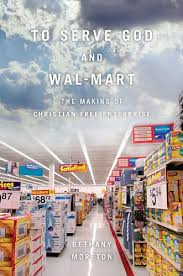
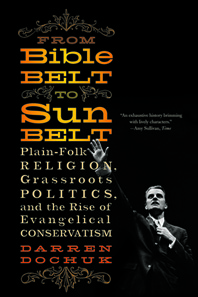
As historians Darren Dochuk and Bethany Moreton have explored, some schools such as Harding College and John Brown University raised the principle of “Christian free enterprise” to an all-encompassing mission.
So it doesn’t seem crazy that President Falwell wouldn’t even wonder if adopting a for-profit status might push his rival GCU out of consideration as a real “Christian” school. At least, that’s how it looks to this reporter.
Am I missing something? Is there any other reason why Falwell would ignore the huge, obvious fact that GCU wasn’t really “Christian” if it peddled its mission for mere lucre?
They’re out there. In twenty-plus years of teaching and hanging around schools, I can say from experience that some of my friends and colleagues match the stereotype of the ardent, left-wing teacher, seeing their mission as introducing students to the disgusting excesses of capitalism. And maybe wearing scarves. And just as certainly, some teachers embody the tough-talking stereotype of the conservative teacher, pooh-poohing fads and frills and hoping to reach kids with the glories of self-sacrifice and flag waving. As the recent rash of teachers’ strikes has shown us, though, trite stereotypes of left and right don’t really help if we want to understand the cultural politics of teaching.
There shouldn’t be any doubt about the real reasons for these teacher strikes. In Oklahoma, West Virginia, Kentucky, and now Arizona and Colorado, teachers and public schools have faced crummy salaries and crummy conditions. Oklahoma’s teachers have shared pictures of their classrooms, textbooks, and paychecks. It’s not pretty.
I’m not so sure. But I can’t help but notice that pundits from both left and right have always assumed too quickly that teachers are somehow naturally politically progressive. In my research into the twentieth-century history of educational conservatism, for instance, I found that conservative activists assumed without even thinking about it that teachers tended to be soft on socialism.
The problem with schools and textbooks, many conservatives believed, was that too many teachers wanted to use their platform to push their students to the left. As one editorialist wrote in my local paper in 1940,
we don’t think it is fair to use taxpayer money in a democracy to teach the glory of collectivism to the budding citizens of a democracy.
Similarly, an American Legion activist at the time warned that too many teachers
will flavor their teaching with a bias in favor of the new collectivism which will subtly determine the content and method of their teaching.
We all know, of course, that some teachers really are politically progressive. Just dip a toe into the blogosphere and you’ll find plenty of examples. Some teachers really do hope to shake children free of the cruel thinking that undergirds capitalist society.
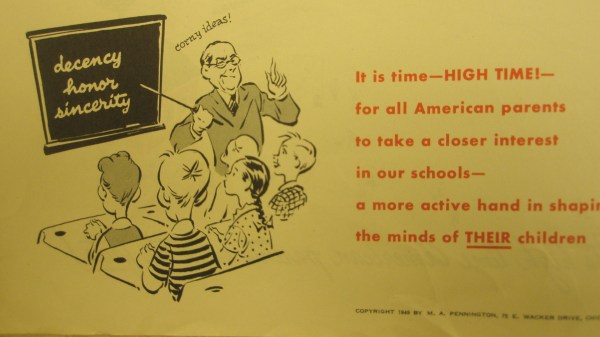
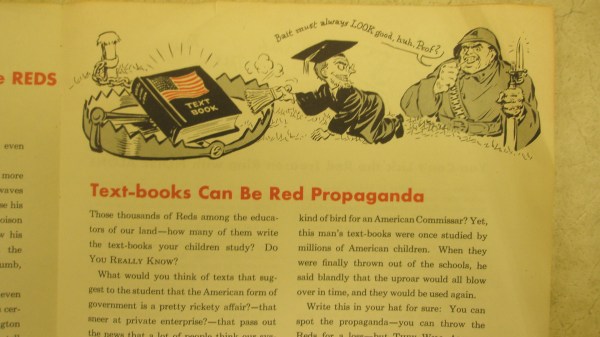
Watch out for socialist teachers, c. 1949…
With all the attention to teachers in the recent spate of strikes, though, it’s more and more clear that political stereotypes and labels just don’t help much if we want to understand the way schools and teachers really work. Are today’s striking teachers really hoping to lead a comeback of organized labor? Maybe some are. Most of them are probably trying to pay their mortgages and teach their students.
As reporters in Arizona found out when they interviewed non-striking teachers, there is no simple way to categorize teachers’ politics. Are the teachers who voted against the walkout “conservative?” Maybe. Sort of. Kinda. But that label doesn’t begin to capture the mix of reasons teachers gave for opposing the walkout.
More socialists in the schoolhouse, c. 1949…
One teacher and football coach, for example, seems like he was sent straight from culture-war central casting to fulfill the stereotype of the “conservative” teacher. He told reporters he felt he needed to show his students that he honored his contract. As he put it,
Life is about not getting what you want and finding a way to get it while you continue to fulfill your obligations and for me, my obligation is my contract.
As I argued in my book about the history of educational conservatism, this notion of teaching students tough lessons about traditional morality has always been central to conservative thinking about schools and education. And of course he’s the football coach.
Other strike-opposing teachers don’t seem quite so easy to put in one box or another. As one explained, she voted against the walkout for a mix of reasons. Primarily, she couldn’t stand to leave her students in the lurch. She told reporters,
The kids that I work with are at-risk kids … (the walkout) also puts them behind. A lot of them come from homes where it’s safer for them to be at school. A lot of kids I work with have severe and profound learning disabilities and their parents both have to work to provide for them. Now they can’t.
Plus, at age 57, she can’t afford not to work. Does she want to be paid more? Sure. She currently works three jobs to make ends meet. A walkout, though, puts her finances and her students’ well-being at risk.
Is that “conservative?” To this reporter, these walkouts help show once again that teachers are just as complicated as regular people.
Whether you call yourself a conservative, a progressive, or something else, if you’re like me you’ve probably got it all wrong. As I was reminded in a discussion last night, those of us who try to shape schools usually make a huge mistake—one we could recognize if we just thought about it for half a second.
Here’s the background: I was happy last night to talk with some graduate students at the University of Hawaii. (No, I didn’t get to go there in real life. I wish. We used cutting-edge interwebs technology to talk.) They had read my book about the history of educational conservatism and they had some great questions, ideas, and experiences to share.
As I argue in the book, it’s difficult to generalize about conservative activists. Just like progressives, conservative thinkers and doers come from a dizzying array of backgrounds and they are motivated by a huge spectrum of ideas and beliefs. But one thing they do share—at least the ones I studied—is an unexamined faith that school shapes society. I hate to quote myself, but this is how I put it in the book:
Educational conservatives have insisted, in short, on two central ideas. First, schools matter. Conservatives, like their progressive foes, have rarely questioned the notion that the schools of today generate the society of tomorrow. Second, because schools matter, their content and structure must be guarded ferociously. Ideas that challenge inherited wisdom must not be crammed down the throats of young, trusting students. And teachers must not abdicate their roles as intellectual and moral authorities. Educational conservatism, in other words, has been the long and vibrant tradition of defending tradition itself in America’s schools. Without understanding this tradition, we will never truly understand either American conservatism or American education.
One idea on which everyone can agree, in other words, is that schools shape society. The reason so many of us spend so much energy on school reform is precisely because we think it matters. For some conservatives in the twentieth century, teaching kids evolution was dangerous because it threatened to take away their moral and religious compass. For others, teaching kids about sex was a bad idea because it tended to unhinge their self-control. And for yet others, teaching kids socialist ideas was obviously terrible because it would lead to the corruption of their morals and of the entire society.
You can fix schools all you want, but you can’t fix the outcomes…
Last night, the Hawaii students shared stories that helped puncture those school-reform assumptions. One student, for example, reported that he came to the realization that he was conservative in high school. He was guided to that realization by his favorite teacher. At first, I assumed that the teacher was a conservative, too, and inspired the student by reading Hayek and Burke and smoking a pipe. In fact, the student told us, his favorite teacher was a heart-on-her-sleeve liberal. She taught social studies in a progressive way, one that hoped to help students examine their own ideas and decide questions for themselves. In the student’s case, that meant he came to the realization that his ideas were apparently “conservative.” The left-y teacher, in other words, didn’t indoctrinate this student into leftism, but precisely the opposite.
Another Hawaii student told a very different story. She only realized that she was a liberal when she was teaching Sunday school at her church. The goal was to help young people deepen their religious faith, but it had the opposite effect on her. Instead of becoming more religious, teaching Sunday school convinced this student that her church was full of hooey.
What’s the takeaway? Once we hear the stories, it seems pretty obvious. School doesn’t really work the way we sometimes think it will. No matter what our politics, we can’t control the future of our students by teaching them X or Y or by keeping them away from Z or A. Students are not predictable, programmable outputs. They have their own ideas and backgrounds and sometimes our best-laid plans at shaping America’s future will come out in ways we didn’t predict.









 I Love You but You're Going to Hell