A Liberal Leader Pushes Religion in Public Schools

They say only Nixon could go to China. Maybe now they’ll say that only de Blasio could get religion back into New York’s public schools. According to the New York Times, Mayor de Blasio has been irking his liberal allies by his repeated efforts to chip away at the wall of separation between church and state. With greater success than many conservative activists, this liberal mayor has been able to push religion in the Big Apple.

Public religion: Texas style

Public-school religion: Texas style

No one doubts de Blasio’s left-of-center politics. The Washington Post called his leadership “a laboratory of sorts for modern progressivism.” Yet this progressive politician has done more to integrate religion and public schools than many of the conservative politicians we’ve studied in these pages.

For example, in his quest to expand pre-kindergarten classes to all of New York’s children, de Blasio has included religious schools. As the New York Times relates, the Mayor has welcomed the participation even of very conservative religious schools, as long as they agree to include children of all religious backgrounds. This plan, of course, would funnel tax dollars directly to religious organizations.

Similarly, Mayor de Blasio has added two Islamic holidays to the New York City public school calendar, precisely because they are religious holidays. Muslim leaders celebrated, but civil libertarians point out that this act violates a long-standing principle of church-state separation.

The Mayor has long supported the use of school buildings by religious groups for services, though conservatives accuse him of reversing himself. One case might soon end up before the Supreme Court. If SCOTUS bans this traditional practice, will de Blasio protest? Will the Mayor take the side of religious groups against a constitutional clarification of the required wall between religious groups and public education?
Public-school religion, New York style

Public school religion, New York-style

New York Times writers Michael M. Grynbaum and Sharon Otterman call New York a “famously secular city.” But we need to be careful when we say such things. As Grynbaum and Otterman note, de Blasio’s success has come partly with support from conservative religious New Yorkers, “a substantial portion of the city.” As we’ve explored in these pages, New York, like many big cities, is not secular, but rather riotously religious.

Indeed, that ferociously diverse religiosity might be the key to Mayor de Blasio’s success. Conservative activists have tried time and again to push evangelical Protestantism in the public schools of places such as Kansas and Kountze, Texas. In New York City, on the other hand, the Mayor can make a good case that he is not pushing any one sort of religion. In his efforts to improve public schooling for all, he has the liberty to open the door to religious groups in ways a more conservative politician might not.
Fundamentalist University Can’t Stay Afloat

Looks like the world of fundamentalist higher education will be shrinking at the end of this semester. Chattanooga’s Tennessee Temple University will be closing its doors, merging with nearby Piedmont International University. In spite of accusations by some critics, this closing does not prove that fundamentalist colleges can’t make it in today’s society. After all, these kinds of closings are all too common among all sorts of schools.

On their Last Crusade...

On their Last Crusade…

Officially, TTU will close due to the lack of financial support from alumni. Instead of the needed three to five million dollars trustees hoped for, TTU alumni coughed up a meager $65,000.

Critic David Tulis blamed the closure on the insular theology of the school. Leaders had grown too fond of their own dispensational truths and “Christian Zionism,” Tulis charged. TTU had allowed itself the unaffordable luxury of inbred intellectualism and backwater academics.

There may be truth in such charges, but anyone familiar with the shaky history of higher education will know that all sorts of schools close for all sorts of reasons.

Most recently, the closing of Virginia’s Sweet Briar College has sent tremors through the world of higher education. If a storied institution with a fat endowment can be run out of business, who is safe?

Among evangelical colleges, too, these sorts of closings and mergers are not unique to the more conservative fundamentalist type. In the 1980s, Barrington College merged with nearby Gordon College. Financial pressures can obviously become overwhelming, irrespective of theological positions.

In the case of Barrington and Gordon, as I’m finding in my current research, these two (relatively) liberal evangelical schools had long been rivals. As late as 1961, the president of Barrington declared that he would never consider joining with Gordon in any sort of money-saving merger. The only way for Barrington to succeed, President Howard Ferrin insisted twenty-five years before the schools’ eventual merger, was by “stressing its differences from Gordon.”

We must remember also that colleges from this fundamentalist Baptist tradition can do very well financially. Most obviously, Virginia’s Liberty University makes more money than it knows what to do with. By making savvy investments in online education, the leaders of Liberty have proved that a fundamentalist school can thrive in today’s turbulent higher-education market.

But not every fundamentalist school. The leaders of Tennessee Temple have promised that current students will be able to finish their academic programs, one way or another. Also, as President Steve Echols ruminated,

countless lives have been forever changed and will continue to be changed through the heritage of Tennessee Temple University.

In spite of what some pundits might assert, this news from Chattanooga does not mean that fundamentalist higher education is on the way out. The financial struggles at TTU, after all, serve as more proof that fundamentalist universities and colleges often have more in common with non-fundamentalist schools than their leaders might like to admit.

Anti-Semitism at UCLA and the Anti-Christian University

Can a qualified student be barred from a student organization because she is Jewish? That is the awkward debate from UCLA that has attracted national attention recently. Here at ILYBYGTH, we have to ask a different awkward question: How is this debate different from the one about conservative evangelicals on campus? UCLA’s student leaders have apologized for the anti-Semitic slant of this incident, but many universities have intentionally de-recognized Christian organizations due to their Christian beliefs.

As the New York Times reported, Rachel Beyda’s confirmation hearing on February 10 turned into a painful debate about her Judaism and her affiliation with campus Jewish groups. Beyda is a sophomore pre-law student, hoping for a place on the student judicial council. At the February 10 meeting of the Undergraduate Students Association Council, her qualifications were questioned. One councilwoman asked Beyda,

Given that you are a Jewish student and very active in the Jewish community … given that recently … [inaudible] has been surrounding cases of conflict of interest, how do you see yourself being able to maintain an unbiased view … [inaudible]?

Eventually, Beyda was voted in, but the agonizing back-and-forth about Judaism and bias has caused the university and the student group to apologize. They had not meant to imply that Jewish students have a special sort of bias; they did not mean to say that Jewish students have divided loyalties. Such ideas, they affirmed later, have a long and ugly history in American history.

As the New York Times points out, this sort of anti-Jewish attitude has become more common on college campuses, largely due to protest against Israel’s politics. The Boycott, Divest, and Sanction movement in support of Palestinian rights has attracted widespread support among college leftists. It has become increasingly difficult for students to separate their anti-Israel ideas from anti-Semitic ones.

As the New York Times’s Adam Nagourney writes, this incident

has set off an anguished discussion of how Jews are treated, particularly in comparison with other groups that are more typically viewed as victims of discrimination, such as African-Americans and gays and lesbians.

What about the anti-evangelical bias of many universities? As we’ve seen here at ILYBYGTH, evangelical groups such as Intervarsity Christian Fellowship have been de-recognized at many pluralist colleges, including the Cal State system.

First, a few caveats: I’m no evangelical myself. I’m not asking this question as an apologist for conservative Christianity. Indeed, I vehemently disagree with most conservative evangelical political and theological positions. Nor am I unaware of the fact that these are different situations. I understand that Intervarsity has been derecognized not because of its ethnic background, but because of its discriminatory beliefs. Intervarsity members are not barred from leadership in campus activities because they might have “divided loyalties,” to use the ugly rhetoric of the recent UCLA discussion. Rather, the group as a whole is pushed out because it does not allow non-evangelicals to take leadership positions in its own group.

Having said all that, I think the Intervarsity case is another prime example of the ways “discrimination” is often used in conflicting and short-sighted ways on today’s college campuses. The student council members at UCLA insisted that they did not mean to imply that Jewish people somehow could not be full members of the university community. In short, the student-council members suffered from an overzealous interpretation of discrimination. Some council members apparently believed that there was something “discriminatory” about being Jewish.

Similarly, Intervarsity has been de-recognized because its leadership policy is discriminatory. It really is. Only those who affirm Intervarsity’s statement of faith can be leaders. This rules out students engaged in active homosexual relationships, not to mention Jewish students, Muslims, Catholics, and even liberal Protestants.

The awkward result, of course, is that Intervarsity itself has been discriminated against. Can’t some student groups engage in some forms of discrimination? Isn’t it fair for a religious group to insist that its leaders be part of its religion? Yes, such policies are frankly discriminatory. But is all discrimination necessarily beyond the bounds of proper campus thinking?

Let me repeat: I do not think the two situations are identical. I’m no member or fan of conservative evangelical student groups. But it does seem as if the zeal to purge campuses of any group that might be “discriminatory” has led to weird and troubling sorts of discrimination. Like the confused student council members at UCLA, some zealous campus voices seem to overcompensate in their desire to purge discrimination.

A Strange Poll Question for Conservatives

What would “Christian America” look like? No one really knows, but plenty of Republicans want to make it official. At least according to a new poll from the Public Policy Polling firm, significant majorities of likely GOP primary voters—57%–want to make Christianity the official religion of the USA. This brings us to a tough question: Do today’s religious conservatives intend to make a break with conservative tradition? Or are they just unaware of their own history?

The PPP poll gives some intriguing breakdowns. For those GOP voters who prefer Governor Mike Huckabee, a whopping 94% support the notion. Even those who support the more secular Rand Paul like the idea, by a margin of almost two to one.

Younger GOP voters are MORE likely to back the proposal. Among 18-45-year-olds, 63% say they support the idea. Only 51% of those over 65 do.

There are other intriguing aspects to this poll. For example, among supporters of Huckabee and of Paul, we see a neat flip-flop when it comes to evolution. Only a tiny margin (7%) of Huckabee backers say they “believe” in evolution, while a whopping 85% of Paul supporters do. Clearly, there’s a lot of daylight between the notions of “conservatism” and “creationism” these days.

But that’s not nearly as compelling, IMHO, as this weird question of establishing Christianity as the national religion. What would that mean? Would public schools nationwide all look a lot more like the ones in Greenwood, Indiana? Would other religions have to pay some sort of tax?

Perhaps most interesting from an historical perspective, do these likely GOP voters know that conservative Protestants—especially Baptists—have always been the leaders in making sure that the government was kept entirely separate from religion?

My hunch is that most of these respondents think of “Christian America” as a conservative concept, something along the lines of David Barton’s Wallbuilders and Representative Fisher’s Black Robe Regiment. In short, this strain of conservative thought emphasizes that the United States was founded by Christians, for Christians. The Founding Fathers, that is, were guided explicitly by Christian ideas and they never intended for any sort of wall of separation to be built. Judges should be free to have the Ten Commandments prominently displayed in their courtrooms. Town meetings and football games should be free to start with a prayer. Currency should continue to Trust in God. And so on.

Was America founded as a Christian nation?  Should we make it official?

Was America founded as a Christian nation? Should we make it official?

As I argue in my new book, this kind of Christian patriotism has had a long and strong pull on the conservative imagination. In the 1930s, for example, big-business groups such as the National Association of Manufacturers trumpeted the connection between religiosity, democracy, and free enterprise.

Traditionally, however, conservative Christians have always taken the lead on maintaining a strict separation between government and religion. In the aftermath of the Supreme Court’s 1962 Engel v. Vitale decision, for example, many conservatives jeered, but conservative evangelicals cheered. Secular conservatives like Herbert Hoover declared that the Court had just killed public education. But religious conservatives like William Culbertson of the Moody Bible Institute thanked the Supreme Court for its “protection in this important area.”

In that decision, of course, SCOTUS ruled that state governments could not impose a prayer on public schools. For some conservatives, that meant that the Court had kicked God out of the public square. For religious conservatives, it meant that religious belief and practice could never be dictated by a government body.

Which brings us back to this curious recent poll. Among the front runners for the GOP nomination, Governor Huckabee leads, along with Dr. Ben Carson, as the most religious of the conservatives. One might think that Huckabee’s supporters would be horrified at the idea of establishing a national religion. ANY national religion. But that is clearly not the case. As the demographics suggest, younger conservatives seem more comfortable with the idea of establishing Christianity as the national religion.

Maybe they know something we don’t. My guess, though, is that these young conservatives have a new understanding of “Christian America.” Unlike their grandparents and great-grandparents, conservative Baptists today do not seem convinced that their first job is to keep the government at arm’s distance.

Jesus and American Sniper

HT: SD

Every smart Christian knows that real religion is bigger than any one country, any one patriotic tradition. But in the United States, conservative evangelicalism has become so tightly bound with traditions of patriotism and national pride that it can be difficult to separate the two. Just ask Randy Beckum.

Until Monday, Dr. Beckum served as both University Chaplain and Vice President for Community Formation at Mid-America Nazarene University, a small-ish holiness school in Kansas. After a controversial chapel talk, Beckum found himself out of a job. Beckum had wondered aloud if America’s fascination with the film American Sniper meant that “our culture is addicted to violence, guns, war, revenge and retaliation.”

Evangelical Christians need a reminder, Beckum said, that

We have to be very careful about equating patriotism with Christianity.   We never say God and…anything.  God is above all, everything else is underneath. I love my country and am thankful for freedom. But the earliest Christian creed was very politically incorrect and dangerous. Jesus is Lord and Caesar is not. We have put “our way of life”/freedom on the top rung.

For those of outside of the world of MidAmerica Nazarene University, these seem like rather unremarkable sentiments. But at that school, they sparked a firestorm of controversy. As one MNU student tweeted, “So your [sic] saying that my long list of family members in military [sic] are not good Christians?”

MNU President David Spittal denied that Beckum’s removal from the VP job had anything to do with the patriotism controversy. But Blake Nelson, a “resident educator” at MNU, objected. As Nelson wrote in an open letter to the MNU community,

When one exercises his or her right to wrestle with big questions, and is demoted the next week, it feels as if we have all been demoted. If someone’s job security isn’t safe in the aftermath of their wrestling with the Word of God, none of us are safe. No matter what language it is couched in, a demotion like this creates fear where there should be freedom. Whether or not it was intended to be, this is an implicit attack on free expression. If it looks like a duck, and quacks like a duck, it’s probably a duck. The message is clear. This is a censure.

For conservatives throughout the twentieth century, too, it has been difficult to separate patriotism from religious sentiment. As I argue in my new book, educational conservatives have long blended the two into an organic whole. Conservative Texas leaders Mel and Norma Gabler, for example, always linked creationism, traditional Protestantism, patriotism, and free-marketism in an seamless conservative fabric.  As an admiring biographer wrote in 1986,

They understood why the new history, economics, and social study texts trumpeted Big Brother government, welfarism, and a new socialistic global order, while putting down patriotism, traditional morality, and free enterprise. Simply stated, Mel and Norma realized that the Humanists in education were seeking to bring about the ‘social realism’ which John Dewey and other ideologues had planned for America.”

Dr. Beckum and the MNU community are finding out just how hard it can be for conservatives to separate out their love for Jesus with their love for America.

OK: AP not OK

What does creationism have to do with the Continental Army? What does George Washington have to do with the Genesis Flood? This week the news from Oklahoma gives us an example of the ways conservative ideas influence every classroom, not just the science labs.

We will have more success understanding those ideas if we see them as part of a conservative notion of proper education. These are not just ideas about science, or the Book of Genesis, or George Washington at Valley Forge, but they combine all these things into a powerful educational impulse. As I argue more extensively in my new book, in order to make sense of any aspect of educational conservatism, we need to look at it as a whole, not just as a series of separate incidents.

First, let’s look at the goings-on in the Sooner State. Representative Dan Fisher has introduced a bill that will challenge the teaching of Advanced Placement US History in Oklahoma’s public schools. Why? As do many conservatives, Fisher believes that APUSH teaches a warped, slanted, leftist view of America’s past. The new APUSH framework, Fisher explains, emphasizes “what is bad about America.”

Fisher wants to blast progressive history out of Oklahoma's schools.

Fisher wants to blast progressive history out of Oklahoma’s schools.

Fisher is not alone. As we’ve explored in these pages, conservative activists have lashed out at the new APUSH framework. I’ve argued also that many conservatives see these AP standards as only the latest efflorescence of a vicious left-wing assault on real American history. These conservative notions about sneaky progressive subversion in history classrooms have a long history themselves, as I describe in the book. At least since the 1920s, conservative thinkers and activists have lambasted history curricula as hopelessly skewed. Children learn that the USA has been built on a legacy of greed and genocide. Children learn that traditional heroes such as George Washington and Thomas Jefferson have feet of clay, or worse.

Representative Fisher, for instance, is a member of the Black Robe Regiment, according to the Tulsa World. As do many religious conservatives, this group ties together a romantic history of the United States with conservative attitudes about Scripture and religion. In those connections we catch a glimpse of the ways conservative thinking about education can link creationism with US History.

I want to be careful about what I’m saying here. I’m not arguing that there is some sort of vast underground conservative conspiracy connecting creationism with Fisher’s anti-APUSH activism. Nor am I saying that Fisher’s brand of religious conservatism is somehow the most real sort of conservative attitude about education. There are plenty of conservatives who will have no truck with this kind of religious and traditionalist interpretation of America’s past. But I do believe that deeply held attitudes about proper education fuel both creationism and Fisher’s sort of historical revanchism.

What’s the connection? At its heart, I suggest that this sort of conservatism springs from a notion that real education must come from a delivery of correct information from authoritarian sources to learners. That is, many conservatives—perhaps a better word would be “traditionalists”—believe that education must be a transmission of truth from top to bottom. That truth, if we back it up to its source, must come from God as the ultimate authority.

Perhaps this definition of proper education as the delivery of truth to each new generation seems unobjectionable. It is not. For about a century, educational thinkers have suggested that this “transmission” method is not good education. These “progressive” reformers have tried to impose instead an idea that students must construct knowledge on their own, not merely accept it or download it from authoritarian sources.

In the specific case of the new APUSH framework at issue in Oklahoma, historians have insisted that historical learning does not simply mean transmitting facts to children. And smart conservatives acknowledge that real education includes much more than just telling young people things that are true. But at its core, we might separate “traditionalist” from “progressive” ideas about education along these lines: Traditionalists think of education primarily as moving information from authoritative source to learners. Progressives think of education primarily as having learners construct knowledge.

With this sort of general attitude about education and knowledge, it’s easy to see the connections between creationism and the Continental Army, between George Washington and the Genesis Flood. For some religious conservatives, including apparently Representative Fisher of Oklahoma, knowledge about any subject must rely on traditional truths. Those truths have been delivered to us from on high. Proper education, in this mindset, consists of passing those truths along, not subjecting them to smarmy and self-satisfied criticism.

In the News: Atheist Hate Crime

Three people are dead, shot in the head by a murderous thug. That thug was an outspoken atheist, and the victims were publicly identified as members of a religious group. Does this count as an atheist hate crime?

To be fair, many of the facts are still up in the air, but it does not seem disputed that Craig Stephen Hicks shot three of his neighbors dead. The neighbors were all Muslim, and Hicks was an outspoken atheist.

According to a story on Yahoo News, Hicks had posted the following rant on his Facebook page:

There’s nothing complicated about it, and I have every right to insult a religion that goes out of its way to insult, to judge, and to condemn me as an inadequate human being — which your religion does with self-righteous gusto, . . . the moment that your religion claims any kind of jurisdiction over my experience, you insult me on a level that you can’t even begin to comprehend.

Is this an escalation of culture-war polemics to real-war violence? ILYBYGTH readers will recall the episode from August, 2012, when Floyd Lee Corkins shot a security guard in the office of the conservative Family Research Council. Is this another example of anti-religious terrorism?

For their part, leading atheists are scrambling to make sense of these charges. The Wisconsin-based Freedom From Religion Foundation has issued a statement blaming mental instability, not atheism, for the atrocity. Yet as Hemant Mehta (my personal favorite atheist pundit) has charged, if this shooter had been a member of any religion, leaders of that religion would be called onto the carpet to separate themselves publicly from the act.

Is it fair to ask if militant atheism somehow contributed to this heinous murder?

Walker Takes on the Professoriate

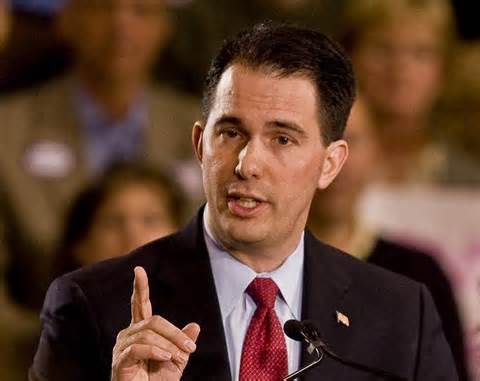
Want to get elected president? If you went to middle school, you know how it’s done: Find an unpopular group and attack them. Last week, Wisconsin Governor Scott Walker tried to pave his path to the Oval Office by attacking lazy good-for-nothing university professors. It might backfire. Walker’s plan has a long and spotty record among conservative politicians and activists. But in general, it’s a safe bet that Walker won’t lose conservative support by standing up to the professoriate.

Get to work, nerds!

Get to work, nerds!

In his new budget proposal, Governor Walker made huge cuts to the University of Wisconsin. The university could make up the shortfall, Walker suggested, by having faculty teach more classes. In short, Walker told reporters, this was nothing more than the core conservative principle of efficiency. The cuts will make the university

do things that they traditionally have not done. Like I said, things like maybe looking at the use of faculty and staff a bit more efficiently like others have done in government in the last four years at both the state and local level.

Naturally, Walker’s proposal has raised hackles among Wisconsin’s academics. History professor John Sharpless argued that he works at least as hard as anyone else. And after all that, Sharpless complained, he will retire with a smaller salary than a Madison bus driver. Walker’s implication that faculty are a bunch of “fat cats who are getting rich off the taxpayer,” Sharpless said, amounted to nothing more than a “crock of cow poop.”

Poop aside, Walker’s attack on the professoriate joins a long tradition among conservative politicians. As I recount in my new book, throughout the twentieth century conservative leaders blamed a leftist academic elite for America’s cultural decline.

In the 1930s, for example, conservative anti-communist leader Hamilton Fish insisted that faculty at leading colleges had become public enemy number one. The faculties at schools such as Wisconsin, Fish charged, had been packed with “socialists, near Communists and Communists.”

University professors make an easy target. As we’ve explored in these pages, many conservatives assume that academic types are overwhelmingly liberal. Governor Walker may be banking on the fact that any attack on college professors will be seen as a win for conservatism.

Jesus at the SuperBowl: A Drinking Game

To my fellow Americans who plan to watch the Superbowl today: please join me in a fun culture-war drinking game. Every time you see or hear a coach or player wax theological, take a drink. If today’s game is anything like previous events, we will probably get good and sloshed by the end.

Everyone who watches sports knows that big-league sports is one of the most common places for conservative religion to pop into mainstream media. It’s different from other types of entertainment. If you watch Jeopardy or the Big Bang Theory, for example, you will never hear characters or contestants offering Bible verses to explain their victories.

In bigtime sports, however, it is not at all unusual to see players, coaches, and commentators invoking the wrath of Jesus as part of their pre-game planning or post-game wrap up. In today’s game, we are invited to wonder if Tom Brady will finally turn to Jesus. We know that Russell Wilson already has.

Schools Can’t Solve Terrorism

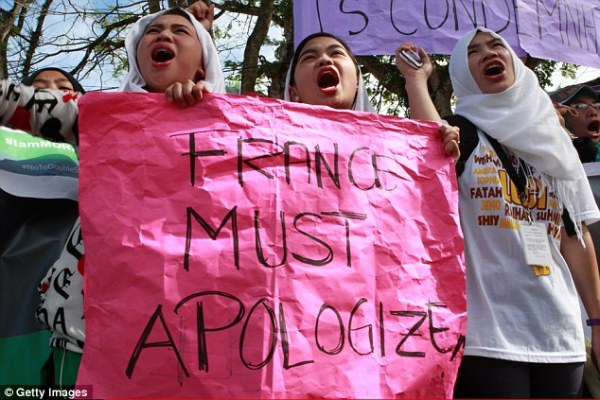
Did you see the story? IMHO, one of the scariest aspects of the murders at Charlie Hebdo was the support given to the shooters by dissident French schoolchildren. Understandably, French society was horrified. Sadly, though, they’ve resorted to an ineffectual tradition of pass-the-buck education reform to address the problem.

We are not all Charlie...

We are not all Charlie…

As reported in the New York Times, significant numbers of kids in French schools refused to honor a moment of silence for the shooting victims. Teacher Eric Bettancourt reported that three-quarters of his class protested in favor of the murderers. One student told Bettancourt that the murders were justified.

What to do?

As have generations of well-intentioned reformers in the USA, the French seem to be engaging in the ineffective and counterproductive symbolic politics of educational culture wars. From now on, the education minister insists, students who sympathize with these kinds of attacks will be punished. About 1,000 teachers will get extra training in the tenets of secularism, or “laicite.” Schools will now have an official day of celebration for laicite. And students will endure a new program of “moral and civic training.”

I don’t know much about French education. But I do know that in the United States, this same impulse toward culture-war educational symbolism has proven useless for generations.

As I argue in my new book (now available), throughout the twentieth century conservative activists have imposed similar cultural symbolism on America’s public schools. If only students recite the Lord’s Prayer and Pledge of Allegiance, many conservatives have felt, society as a whole would magically become more reverent and patriotic.

Progressives, too, share this myopic understanding of the relationship between social norms and educational programs. Ever since the glory days of John Dewey at Chicago’s Lab School, progressives have assumed that putting students into cooperative groups will transform America into a true democracy.

French politicians seem to share these simplistic ideas.

I sympathize. It’s easy to want to do something to fix a bad situation. But slapping new punishments and programs on dissenting schoolchildren won’t do the job.

As have generations of American school reformers, these French fixes assume that opposition to laicite stems, at root, from ignorance, rather than dissent. If students can have an annual assembly in which the benefits of secularism are clearly laid out, reformers might suggest, then anger toward the secular order will wither.

In the American case, some earnest school reformers have had similarly naïve ideas about creationism. As political scientists Michael Berkman and Eric Plutzer argued so convincingly, opposition to evolution does not in fact correlate neatly with ignorance about evolution. Rather, as they put it (emphasis added),

it appears that anti-evolutionists choose not to accept evolution, choose to ignore scientific arguments demonstrating evolution, or express skepticism . . . as a hedge between what they have been taught in school and seen in museums on the one hand, and what they may have heard in church, on the other.

French support for terrorist attacks on Charlie Hebdo does not result from a simple lack of knowledge.  Punishing it will only make it stronger. Canned speeches and skits for schoolchildren will only make dissenting children laugh.

It does not take professional academic studies of education and schools to understand this point.  All it takes is any experience with schools themselves.  If a teacher told you something and you disagreed, how did that make you feel? If she went on to punish you for disagreeing, did that make you likely to agree with her?