Burning Bibles at Public Schools

Can a public school have Christian books in its library? Are religious books coming under fire? The latest story comes from Temecula, California. But religious activists have worried for generations that public schools have become aggressive book-burners.

In the current case, the Pacific Justice Institute has accused Temecula’s River Springs Charter School—apparently one of three schools in the Springs Charter School network—of anti-Christian bias. A parent complained to PJI that the school library had purged any book with a Christian bent. According to a report in Christian News, the parent told PJI that the librarian had been told to get rid of religious books. As conservative commentator Todd Starnes tells the story, the school librarian was instructed to remove “all books with a Christian message, authored by Christians, or published by a Christian publishing company.”

As Starnes concluded darkly,

The way I see it – book banning is just one step away from book burning. And I don’t mean to pour gasoline on the fire, but we all know what regime did that.

When the conservative activist group complained, the superintendent, Kathleen Hermsmeyer, responded that the school did not permit “sectarian materials on our state-authorized lending shelves.”

This episode reminds me of an extraordinary rumor I stumbled across in my research for my upcoming book on conservatism in twentieth-century American education. Investigating the 1974 school blow-up in Kanawha County, West Virginia, I found one conservative activist who insisted that the school district had recently removed all the Bibles from the schools. Even more shocking, this conservative reported that the secularizing zealots in charge of the public schools had dumped the Bibles unceremoniously in a dumpster. When pressed, this activist could not provide details or evidence for his story. He said he had heard it from another conservative leader.

But most important, the story seemed true and likely to him. As a religious conservative, he thought it was believable that a public school leader would purge the school of Bibles. And other conservatives at the time agreed.

We could take it even further back. In the 1925 Scopes Trial, anti-evolution celebrity William Jennings Bryan argued that public schools must ban evolution, since they already banned the Bible. That kind of argument has a good amount of gut political appeal. But it has one glaring problem: It just wasn’t true. In fact, as I noted in my 1920s book, Tennessee had actually passed a mandatory Bible-reading law in 1915. But as far as I could tell, no defender of evolution ever called Bryan on his mistake. On both sides, school activists in the past have believed that religious books had been kicked out of public schools.

Today’s story from California is more credible. In this case, the school leader admitted that the policy had been put into effect. Nevertheless, to this observer, it seems the case from Temecula will be another tempest in a teapot. The Pacific Justice Institute likely sniffed an easy win, since of course public schools are not under any legal compulsion to remove all Christian reading materials from their libraries. Indeed, the US Supreme Court has been very clear that public schools can and should teach about religions.

As Justice Tom Clark wrote in the landmark 1963 Abington v. Schempp decision, “Nothing we have said here indicates that such study of the Bible or of religion, when presented objectively as part of a secular program of education, may not be effected consistently with the First Amendment.” Indeed, Clark had just specified that public schools must not exclude religion from public schools, “in the sense of affirmatively opposing or showing hostility to religion.”

So it seems to me that Superintendent Hermsmeyer has indeed blundered. In a publicly funded school, there is absolutely no constitutional mandate to remove sectarian reading materials. The school itself must not preach any religion, but the library can and should be a place where students may encounter religious ideas.


Heavy Hitters Take on the Common Core, Sort of…

What is a conservative to think? Are the Common Core Learning Standards a threat? A blessing? As we’ve discussed recently in these pages, some conservative intellectuals have argued that the standards are a triumph of conservative activism. But tonight, the Family Research Council hosts a star-studded slamfest to explain all the reasons why conservatives should fight the standards. Yet it seems to me that this group will conspicuously leave out some of the most obvious reasons for conservatives to oppose the new standards.

They Are Coming for Conservatives' Children...

They Are Coming for Conservatives’ Children…

What’s the FRC’s beef with the standards? The name of tonight’s event says it all: “Common Core: The Government’s Classroom.” As have other leading conservatives including Phyllis Schlafly, Glenn Beck, conservative Catholics, and libertarians such as JD Tuccille, the heavyweights at tonight’s event will likely condemn the standards as another example of leftist government overreach.

For tonight’s roundtable, the FRC has assembled folks such as Louisiana Governor Bobby Jindal and University of Arkansas scholar Sandra Stotsky. Governor Jindal has taken the lead among conservative state leaders with his endless legal wrangling over the new standards. Professor Stotsky has become the academic leader of the antis. Her work with the standards’ development left her convinced that the Common Core was rotten. As Stotsky argued in a video jeremiad produced by the anti-Core Home School Legal Defense Association, the intellectual weakness of the standards presents as much of a threat as does the sneaky way they were introduced.

What is a conservative to think about the Common Core? Tonight’s video roundtable apparently hopes to convince more conservatives to fight it.

It will raise key questions about conservatism and educational politics. For example, from time to time, the anti-Core fight is tied to anti-evolution. As we noted a while back, Ohio’s now-defunct House Bill 597 pushed IN creationism as it pushed OUT the Common Core.

To this observer, it seems natural for conservatives to use the political muscle of creationism to fight against the Common Core. In some cases, conservatives have done just that, since the Next Generation Science Standards would likely push for more evolution and less creationism in America’s classrooms.

But this FRC event doesn’t mention evolution or creation. It doesn’t mention literature, history, or math, either, for that matter. Instead, the focus of tonight’s event seems to be on the federal-izing dangers inherent in the new standards.

But why not? Why wouldn’t the Family Research Council want to use every intellectual weapon at its disposal to discredit the standards in conservatives’ eyes? Maybe they will, of course.  The different panelists might emphasize different aspects of the standards.  One or some certainly might note the connection between evolution education and centralized power.  I’d love to watch and find out.

Unfortunately, I won’t be able to. If anyone has the time tonight to spend with this all-star conservative panel, I’d love to hear your thoughts…

Creation and the Ice Bucket Challenge

What does a young earth have to do with pouring a bucket of ice over your head?  According to Georgia Purdom of Answers In Genesis, the popular ice bucket challenge might not be the innocent do-gooderism it seems to be.

Unless you’re living under a rock, you’ve seen images of people pouring buckets of ice over their heads.  The idea is to spread the word about the work of the ALS Association.  And it’s working.  Celebrities from all over the media map have done the deed, including former POTUS George W. Bush.

So why would AIG be against it?  According to Answers In Genesis, the Ice Bucket Challenge funnels money and attention to an immoral organization.  In the words of AIG’s Georgia Purdom,

the ALS Association that is promoting the frigid challenge promotes an unethical search for a cure. Many researchers are willing to use embryonic stem cells and cells taken from “electively aborted” fetuses to search for a cure.

Does this imply that President Bush is not pro-life?  That Bush and all the Ice-Bucketeers are somehow making a political statement in favor of embryonic stem cell research?


Creationism, Conservatism, and the Common Core

What does creationism have to do with the newish Common Core Learning Standards? Some conservative activists and politicians are rejecting both in a knee-jerk attack on educational reform. In one new educational bill in Ohio, conservatives simultaneously threw out the Common Core and opened the door to creationism. But this isn’t just a question of creationism. Rather, this is a symptom of a broader conservative attitude toward public schooling.

Not just science, but history and literature are also targeted in this conservative educational power grab.

We first became aware of this new bill in Ohio thanks to the watchdoggery of the folks at the National Center for Science Education. The NCSE, naturally, worried first about the apparent opening of Ohio’s public-school science classes to intelligent design and creationism. Ohio’s House Bill 597 would insist on new standards that specifically “prohibit political or religious interpretation of scientific facts in favor of another.”  The sponsor of the bill, Andy Thompson of Marietta, told the Cleveland Plain Dealer that he included that language to allow school districts the freedom to include a variety of ideas about evolution, not to mandate that districts include intelligent design or creationism.

Representative Thompson wants the Common Core OUT and conservative curricula IN.

Representative Thompson wants the Common Core OUT and conservative curricula IN.

But the anti-Common Core bill also includes a broad-spectrum attack on the purportedly progressive nature of school curricula in other subjects as well. The original draft of the bill specified that 80% of the literature taught must be from American or British authors before 1970, though Thompson quickly backpedaled from that goal. But why was such a target included in the first place? As I detail in my new book, conservatives since the 1970s have looked skeptically at the trend toward “multicultural” literature. Conservative leaders from Max Rafferty to Bill Bennett have insisted that proper education—conservative education—must be based on the classics of our Western civilization. Anything else, they insisted, dooms children to a savage unawareness of their own cultural heritage.

In history, too, the Ohio bill insisted that history instruction include

the original texts and the original context of the declaration of independence, the northwest ordinance, the constitution of the United States and its amendments with emphasis on the bill of rights; incorporate the Ohio constitution; define the United States of America as a constitutional republic; be based on acquisition of real knowledge of major individuals and events; require the study of world and American geography; and prohibit a specific political or religious interpretation of the standards’ content.

Here also we hear echoes of long-time conservative worries. From Lynne Cheney to Dinesh D’Souza, it has become a commonplace of the conservative imagination that leftist history has taken over public education. As I argued recently in a commentary in History News Network, conservatives assume that students are taught that American history is the record of cruel white hate crimes against Native Americans, women, and African Americans. The Ohio bill hopes to rectify this America-bashing by mandating “real knowledge,” not just hate-filled Zinn-isms.

As we’ve seen time and again, conservatives are not united in their thinking about the Common Core. Some conservatives love them….or at least like them. Others blast the standards as yet another attempt at sneaky subversion from Washington.

In this new Ohio legislation, we see how some conservatives combine their loathing of the Common Core with a grab-bag of other conservative educational goals: Less evolution in science class, more America-loving in history class, and less multiculturalism in literature class. Taken together, conservatives such as Ohio’s Andy Thompson hope to broaden the anti-Common-Core juggernaut into a more ambitious conservative panacea.


College Helps Christianity

Watch out, Christians!  Sending your kids to college may mean sending them to hell.  That has been the standard wisdom since the 1920s.  One sociologist now suggests that this is no longer true.

The notion that college might lead children to abandon their faiths has been a staple of conservative thinking for a long time.  In the 1920s, conservative leader William Jennings Bryan warned of the dangers of mainstream higher education.  Bryan drew on the work of scholar James H. Leuba.  Leuba’s 1916 book The Belief in God and Immortality suggested that eighty-five percent of college freshmen described themselves as believers.  Only fifty-five percent of graduates did.  The conclusion, Bryan warned, was clear.  College was turning children away from God.

As usual, fundamentalist firebrand T.T. Martin expressed the idea more colorfully.  In a 1923 book, Martin quoted one former college student’s complaint: “My soul is a starving skeleton; my heart a petrified rock; my mind is poisoned. . . . I wish I had never been to college.”

As I argued in my 1920s book, this sort of anxiety about the results of mainstream higher education led fundamentalists to open their own network of colleges, universities, and seminaries.  My current research looks at the twentieth-century history of these schools.  How did they hope to give students a “college experience” different from the kind on tap at Harvard, Yale, and State U?  How did they hope to educate students who were conservative about the Bible, about evolution, and about gender roles?  Certainly, since the 1920s, these concerns have remained central to conservative evangelical Protestants.  Such folks have continued to hope that righteous colleges can crank out righteous Christians.

But according to a story in Religion News Service, one recent sociological study suggests that the college trend may have turned.  Sociologist Philip Schwadel has argued that people born between 1965 and 1980, “Generation X,” no longer have a correlation between college education and abandoning faith.  Because so many more people are going to college, Schwadel argues, there is no longer a correlation between higher education and personal secularization.

In other words, college no longer seems to be turning people away from their faiths.  For people born in the 1970s, those WITHOUT a college degree were more likely to abandon their faiths.  That’s right: for folks born in the 1970s, having a college degree made them more likely to retain their youthful religion.

Of course, as with any academic study, Schwadel’s is carefully wrapped in layers of caveats.  This study does not say anything about people born in the 1980s or later.  They simply haven’t had enough time to form their adult identities.  Nor does it claim that it has firmly proven the fact that college no longer moves people away from their childhood faiths.

But the correlation is fascinating.  Schwadel offers a few suggestions about why this change may have taken place.  First of all, more and more people in this age cohort went to college.  That means there is less and less elitism associated with a college degree.  Also, there is more religion on college campuses, Schwadel writes.  People can combine their “educated” adult identities with a “religious” identity firmed up in religious student groups.  Finally, as more and more college-educated people attend church, those without college degrees might feel socially unconnected.  Beyond theology, that sort of mundane social-connection may contribute to people leaving their churches.


Leading Historian Would Vote for Hitler

He just flew in from New York...

He just flew in from New York…

HT: MM

Would you vote for Philip Hitler? Jonathan Zimmerman would. At least, that’s what he told the funny man on The Daily Show the other day.

It’s a pretty funny bit. But more important, it’s great to see our leading educational historian getting to yuk it up with Jon Stewart’s minions.

If you’re not up on the world of educational history, you may not know Jon Zimmerman’s work. But for historians, Zimmerman’s the king. Kind of like the Derek Jeter of educational historians, except Zimmerman shows no signs of quitting.

When I started my graduate work, Zimmerman’s book Whose America pointed me toward the study of culture-war issues in educational history. And now, as part of Zimmerman’s book series on the history and philosophy of education, I’m working with philosopher Harvey Siegel on a volume about the ups and downs of evolution education. So Zimmerman has been hugely influential in my career, and I’m sure every other ed historian out there could say something similar.

And now it looks as if he’s moving into the comedy business. Fantastic.


The Movie that Will Save Our Children

A Florida lawmaker has offered a new definition of a summer must-see movie.  According to the Hollywood Reporter, State Senator Alan Hays has promised a bill that would force all public high-schools and middle-schools to screen Dinesh D’Souza’s America: Imagine the World without Her.

As I’ve argued elsewhere, D’Souza’s film seems to be another conservative exercise in shadow-boxing.  The film assumes that American history teachers are pushing an ideologically inspired hatred against the United States.  Historically, that just hasn’t been the case.  As I argue in my upcoming book, conservatives have exerted outsized influence over the kinds of history their kids learn in public school for decades.  The notion that schools have been taken over by a scheming cabal of sneaky progressive educators and historians just doesn’t match the historical record.

Nevertheless, it is a notion that resonates strongly with conservatives.  As Senator Hays put it,

I’ve looked at history books and talked to history teachers and the message the students are getting is very different from what is in the movie.  It’s dishonest and insulting. The students need to see the truth without political favoritism.

Ironically, Senator Hays’ plans might just prove the case.  As the Hollywood Reporter points out, Hays’ bill might actually pass, given the political landscape in Florida.  If it did, or even if it made a strong showing, it would demonstrate the continuing influence of conservative activism on public education.


America: Schools Taken over by Scheming Progressives

What sorts of history did you learn in school?  As I argue in a recent commentary published on History News Network, conservative thinkers and activists have often insisted that school history has been taken over by a scheming, America-hating, progressive history cabal.

It looks as if Dinesh D’Souza’s new film dives headfirst into that tradition.  In America: Imagine the World without Her, D’Souza denounces American education as woefully slanted.

In a recent interview about the film, D’Souza accuses even the best schools of teaching a “doctored account” of history.  Young people, D’Souza believes, have all been taught a skewed leftist history.  In his film, D’Souza hopes to counter this horrible history with a heroic counter-argument.

But as I found when I researched the twentieth-century history of conservative activism in the United States, I found that conservatives have exerted just as much influence over the nature of American education as have progressives.

So why do conservatives like D’Souza continue to insist that schools have been taken over by dunderheaded progressives?  If you want to read my humble opinion, you’ll have to check out the HNN essay.

Conservative College Cheapskates

Cheap college for all!  That’s the call of the conservative American Legislative Exchange Council (ALEC).  ALEC members will consider a proposal to mandate public university education for under $10,000.  So why is this a “conservative” idea?

The conservative group’s annual meeting agenda just came out.  Members will be asked to consider several model bills about education, including two that support expansion of charter schools.  No surprise there.  Many free-market conservatives, way back to the 1950s work of free-market guru Milton Friedman, have wanted to reform education by introducing market principles.

ALEC's Get-Together

ALEC’s Get-Together

But I’m puzzled by the higher-ed model bill.  ALEC proposes the “Affordable Baccalaureate Degree Act,” a model bill that will require public universities to offer cheaper college educations.  In the words of the proposed bill,

The Affordable Baccalaureate Degree Act would require all public four-year universities to offer bachelor’s degrees costing no more than $10,000, total, for four years of tuition, fees, and books.  The Act would require that ten percent of all public, four-year university degrees awarded reach this price-point within four years of passage of this act.

To achieve this price-point, universities would be instructed to capitalize on the opportunities and efficiencies provided by (1) web-based technology and (2) competency-based programs.

Simple enough.  There has been oodles of talk lately about the problem of burgeoning student debt.  This proposal would at least introduce a new way to talk about the price and value of college education.

I don’t know the history of ALEC’s model bill, but it looks to be modeled on a similar bill in Texas.  Two years ago, Texas Governor Rick Perry—a decidedly and self-consciously “conservative” politician—introduced a similar affordable-college law.

But here’s my question: What is “conservative” about this proposal?  I know there are conservatives and then there are conservatives, but ALEC has traditionally been a champion, in its words, of “Limited Government, Free Markets, [and] Federalism.”

On first glance, it isn’t clear how this college model bill would limit government or help free markets.  Isn’t the price of college education part of a free market?  Wouldn’t a government imposition of a price cap increase the role of government and decrease the fluidity of the free market?

Here’s my hunch: The key to understanding the “conservative” elements of these bills lies in two important words, “efficiencies” and “competency.”  As I argue in my upcoming book about the history of conservative activism in education, conservatives have long looked skeptically at the way higher education has been run.  Just as conservatives have often insisted that teachers’ unions exert an unhealthy stranglehold on K-12 schooling, they have also often insisted that higher education has been taken over by sclerotic bureaucracies and leftist ideologues.

By forcing colleges and universities to offer credit for “competencies,” free-market conservatives might hope to shatter the grip of college bureaucracies.  Too often, conservatives might argue, college rules have insisted that students spend a certain amount of time in seats, parroting back academic drivel instead of learning real skills.  If students can demonstrate competency in life skills—running a business, maybe, or opening a charter school—those “competencies” should get college credit.

Similarly, by promoting “efficiencies” in higher education, free-market conservatives might hope to force lazy and pampered college faculty to use new technology to deliver information and skills more quickly and cheaply.  Since public universities are funded at least in part by government money, forcing them to run more quickly and cheaply could be seen as crucial part of conservatives’ desire to slim down big government.

That’s my guess, in any case.  To those who know their higher-education history, though, it is surprising to hear cheap public education promoted as a “conservative” cause.  During the late 1960s and early 1970s, after all, accessibility and affordability were hallmarks of leftist activism in higher education.

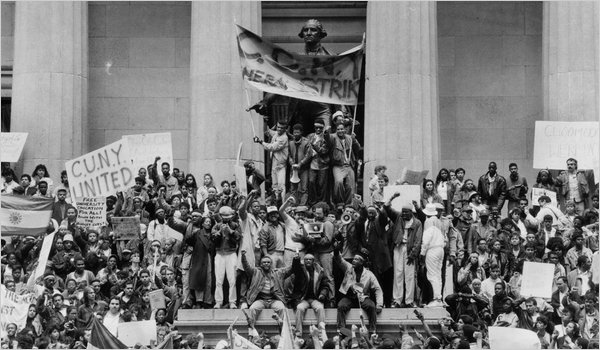
Perhaps the best example of this is the history of City University of New York.  During the 1920s and 1930s, CUNY, especially City College of New York, was known as the “Ivy League of the Proletariat.”  Top students crowded into CCNY, especially Jewish students excluded from Ivy League colleges.  It was an elite institution, admitting only the most qualified students.  Back then, it was also free.  If you could get in, you could go.

Do these CUNY tuition protesters look "conservative" to you?

Do these CUNY tuition protesters look “conservative” to you?

In the late 1960s, student activism forced a change in admissions policy.  To fight elitism and cultural prejudice, leftist activists pushed through an open admission policy.  Back then, it was leftist student radicals who called for cheap college for all.

Does ALEC’s model bill signal a shift?  Is it now a “conservative” cause to limit the cost of public higher education?


Orange Is the New Blah…

Okay, I admit it. I’ve been watching Orange Is the New Black. And I like it. But one episode I saw the other night included a painful example of what I’ve been calling the “missionary supposition” of anti-religious folks.

Orange Is the New Hack

Orange Is the New Hack

First, a short introduction for those readers with better things to do: The show follows the prison career of a privileged woman as she serves her time. At first, I didn’t want to watch it. It sounded too much like the terrible genre of ‘brave excursions outside the gated community,’ ignorant self-righteous claptrap along the lines of Barbara Ehrenreich’s Nickel and Dimed.

But after a couple of episodes, I was hooked. The protagonist’s story of elite woe is not as central as I feared. Each of the incarcerated women has her own story and the show makes the most of each.

**SPOILER ALERT: The following contains info about the end of season 1. And some bad language.**

Just because I watch, though, I can’t help but protest some of the stupid blunders incorporated into the story. In a couple of episodes, the protagonist, Piper Chapman, goes a few rounds with fellow inmate Tiffany “Pennsatucky” Doggett. In the show’s depiction of Doggett and in Chapman’s high-handed attitude toward Doggett’s religiosity, we see the worst sort of anti-religious bigotry and ignorance.

Religious = Psychopathic

Religious = Psychopathic

I don’t have much of a problem with the show’s scathing depiction of conservative evangelical religion. We see this most frighteningly in the character of Doggett. Doggett is the unofficial leader of the charismatic Bible group at the prison. She leads deluded healing services and peppers her speech with Biblical references. Not only is Doggett portrayed as a snaggle-toothed, closed-minded, ignorant hillbilly with a heavy penchant for krazy, she actually only won her role as religious prophet by shooting an abortion-clinic worker out of petty spite.

Now, if this show wants to depict religious people that way, fair enough. It is embarrassingly biased, but if the show wants to take that kind of anti-conservative-religion slant, so be it.

But it’s harder for me to swallow the wildly ignorant understanding of religion from one unfortunate scene in the episode “Fool Me Once” [season 1, episode 12, about 55 minutes in]. Pennsatucky wants to baptize Chapman in the laundry sink. At that point, Chapman unleashes her real opinion about the whole thing. IMHO, the following scene demonstrates a terrible misunderstanding of the nature of religious belief, non-religious belief, and the nature of America’s culture wars, not just on the character’s part, but by the makers of this show:

Chapman: Okay, nope, see, I can’t do this. I’m sorry. I really want us to get along. I do. But I can’t pretend to believe in something I don’t. And I don’t.

Pennsatucky: Chapman: We’ve all had our doubts.

Chapman: No, see, this isn’t ‘doubts.’ I believe in Science. I believe in Evolution. I believe in Nate Silver, and Neil deGrasse Tyson, and Christopher Hitchens, although I do admit he could be kind of an asshole. I cannot get behind some supreme being who weighs in on the Tony awards while a million people get whacked with machetes. I don’t believe a billion Indians are going to hell, I don’t think we get cancer to learn life lessons, and I don’t believe that people die young because God needs another angel. I think it’s just bullsh*t, and on some level I think we all know that, I mean, [addressing other Christians] don’t you?

Other Christian #1: [sheepishly] The angel thing does seem kinda desperate…

Pennsatucky: [threateningly, to OC#1] I thought you was a Christian.

OC #1: [defensively] I am, but I got. . . some questions. . .

Whooch! Didja see that? Again, I don’t have a beef if this show wants to malign religious conservatives, if it wants to depict anti-abortion activists as cynical, stupid, self-serving sociopaths. It’s an awkward hack job, IMHO, but not as bad as the wildly ignorant fantasy depicted in the scene above.

As I’ve argued in the pages of the Reports of the National Center for Science Education, too many anti-creationists show this same sort of ignorant “missionary supposition.” They think, along with Piper Chapman and the makers of this show, that the truths of anti-religion are so blindingly obvious that any (thinking) religious person must secretly share them.

Now, to be fair, I should point out that I do (roughly) share those beliefs.  I believe in science.  I believe in evolution.  I like Neil deGrasse Tyson and I don’t think anyone is going to hell.  But just because I agree doesn’t mean I can stomach the weirdly ignorant assumptions in which those statements are wrapped.

When Chapman recites her sophomoric list of village-atheist taunts, the gathered Christians are only kept from agreeing by the bullying of their psychopathic religious leader. In this sort of atheist fantasy, the truths of science only fail to conquer when hearers are not free to acknowledge their obvious awesomeness.

This attitude mirrors nothing so much as the overweening confidence of early religious missionaries. Many Bible missionaries in the early part of the twentieth-century, for example, assumed that the truth of the Bible was so overwhelming that anyone who caught a glimpse of its pages must be supernaturally converted. As a result, Bible missionaries spent a great deal of time and treasure to distribute the Gospel around the world.

At Chicago’s Moody Bible Institute, for example, evangelists distributed printed tracts and gospels throughout the nation and the world, based on this assumption about the supernatural power of Holy Print. As William Norton of the MBI’s Bible Institute Colportage Association related in 1921,

A man was given a tract by the roadside; simply glancing at it, and coming to a hedge, he stuck the tract into the hedge; but it was too late; his eyes had caught a few words of the tract which led to his conversion.

In this understanding of salvation and conversion, some truths have such power that the merest exposure to them is enough to convert the unwilling. Ironically, folks at places such as the Moody Bible Institute have gotten much more sophisticated in their understanding of conversion, while self-satisfied atheists like the makers of Orange Is the New Black apparently have not.

Among conservative evangelical Protestants these days, the difficulties of missionary work are more thoroughly appreciated. As conservative Christian educator David Harley wrote in 1995, missionaries must begin with a “sensitive appreciation of other cultures.” Missionaries who try to plunk down in the midst of a non-Christian population and simply begin spreading Truth amount to nothing more than “evangelical toxic waste,” Harley argued.

Actual missionaries no longer think they can convert without effort. They no longer tell each other to shout out the Gospel and count on it to spread itself. Rather, religious people show a more nuanced understanding of the ways people change their minds.

But there still seem to be people out there so ignorant of other cultures that they think they can convert the heathen with a simple exposition of the Truth. Folks who think that by declaiming a few holy names, such as Christopher Hitchens and Neil deGrasse Tyson, the scales will fall from the eyes of the benighted Christian multitudes.

Pish posh.