Comedy & Conservatism

–Knock knock.

–Who’s there?

–A smaller government, a vigorous military presence abroad, and traditional values.

Get it?  According to Frank Rich, no one does.  Conservatism just isn’t funny.  In a terrific essay last week in New York Magazine, Rich explores the tortured relationship between conservatism and comedy.

Rich wonders why there are no big conservative comedians out there, no flipside to the Jon Stewarts and Stephen Colberts.  He mentions a couple of contenders, such as Dennis Miller and even South Park.  But they are either not very funny or not very conservative.  And, as Rich points out, it seems like there would be plenty of funding for a vigorous conservative comedy effort.  But the few that have been made, such as the lamentable ½ Hour News Hour, are only embarrassing for us all.

Rich doesn’t make the case, but it seems as if conservatism, as a rule, should have the upper hand when it comes to laffs.  After all, as Hannah Arendt argued long ago, conservatives in general have the easier job in cultural polemics.  They can joke about each new innovation.  They can skewer new trends and rely on long-standing traditions to pillory liberal excesses.

But, as Rich points out, they don’t.  Why not?  Why aren’t conservatives funny?

Rich argues that too many conservative comedians are conservatives first and comedians second.  After all, “liberal” jokesters such as Jon Stewart don’t hesitate to joke about liberal heroes.  Stewart puts the jokes first and the politics second.

More Preachy than Funny

More Preachy than Funny

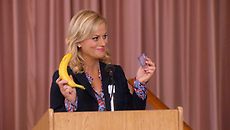
When liberals forget this simple rule, they are just as unfunny as conservatives.  Remember Leslie Knope’s (Amy Poehler’s) stilted attempt at sex-education humor?  It just wasn’t funny.

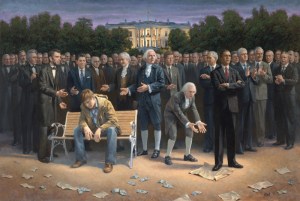
This rule applies outside of comedy, of course.  Some conservative intellectuals embrace the paintings of the late Andrew Wyeth, for example, as “conservative” masterpieces.  Consider the vast difference, though, between Wyeth’s brand of painting and the conservatism-on-his-sleeve style of Jon McNaughton.

As Rich notes about comedy, art of any sort seems to suffer when pundits put ideology first and art second.

Wyeth's "Christina's World" (1948).  Is this good art?  Or just good "conservative" art?

Wyeth’s “Christina’s World” (1948). Is this good art? Or just good “conservative” art?


Jon McNaughton's "The Forgotten Man." Politics first, art second.

Jon McNaughton’s “The Forgotten Man”

Take the Creation Museum Challenge

We can gnash our teeth.  We can pull our hair.  But no matter what we do, the Creation Museum of Answers In Genesis has pulled it off.  With its new $1.5 million dinosaur exhibit, the flagship museum of young-earth creationism has successfully mimicked the outward appearance of mainstream scientific museums.

Big Valley Creation Science Museum

Big Valley Creation Science Museum

It used to be easy.  Creationist museums used to be only sad little affairs.  They used to look like this one from Alberta, Canada.  The Big Valley Creation Science Museum, pictured here, may do a great job in spreading the creationism gospel.  But no idle tourist would be likely to confuse it with mainstream museums such as the Smithsonian’s Museum of Natural History or Boston’s Museum of Science.

It used to be easy for outsiders like me to mock the lame pretensions of the many creation museums that dotted our great land.  And Canada.  As one angry visitor noted, even the bigger creation museums used to have strange, sad displays like this one from San Diego’s Creation and Earth History Museum.

Not a Lot of Big Bang for your Buck

Not a Lot of Big Bang for your Buck

But here’s the new challenge: Can you tell which of the three pictures below comes from Kentucky’s Creation Museum display and which come from the Smithsonian and Boston’s Museum of Science?  As arch-creationist Ken Ham explained gleefully recently, this new display of a million-dollar Allosaurus fossil puts Ham’s Creation Museum in the same league as those mainstream museums.  As Ham put it,

For decades I’ve walked through many leading secular museums, like the Smithsonian in Washington, D.C., and have seen their impressive dinosaur skeletons. But they were used for evolution. Now we have one of that class, and it will help us defend the book of Genesis and expose the scientific problems with evolution.

So take the Creation-Museum challenge.  Just by looking, can you tell which of these images comes from a young-earth creationist museum and which come from mainstream ones?  (Don’t cheat.  But once you’ve given it a try, you can click on each image to see its provenance.)

Is this "real" science?"

Is This “Real” Science?”

Or Is It This One?

Or Is It This One?

Millions of Years?  Or Millions of Dollars?

Millions of Years? Or Millions of Dollars?

This successful mimicry is important.  In creationism’s twentieth-century struggle to establish alternative educational institutions to rival those of mainstream science, young-earth creationists often wrestled with significant disadvantages.  Not least of these were questions of funding, as historian Ron Numbers described in his must-read book The Creationists and I detailed in my 1920s book.  In the case of this priceless fossil, rich creationists Michael and Stephen Peroutka donated it to help the Creation Museum with its work.

It would be nice to think that America’s public would make its decisions about the age of the earth and the origins of humanity by weighing evidence and considering counter-claims.  To people like me, the Creation Museum’s claim that this well-preserved fossil serves as proof of a worldwide flood 4,300 years ago seems absurd.

But I don’t think we need to be very cynical to guess that appearance matters.  As Dan Kahan argues, what people believe about creation and evolution usually has more to do with their cultural identity than it does with scientific evidence.  If Answers In Genesis can make their museum LOOK like the Smithsonian, many visitors will assume it is just as good.  And if Answers In Genesis can crank out peer-reviewed science publications that attest to the scientific veracity of their claims, many readers will assume their science is just as good.

So take the Creation Museum challenge.  If you can’t tell the difference, how can you expect anyone else to?


Christian College Leader Admits Wrongdoing

Dinesh D’Souza broke the law.  He recently admitted it.  Some conservative pundits insist that his prosecution is politically motivated.  Is this the end for a spectacular conservative career?

Wunderkind Admits It

Wunderkind Admits It

The conservative Christian writer and celebrity has always had something of a tin ear when it comes to conservative evangelical culture.  A couple of years ago, for instance, he was ousted from his post as president of The King’s College when he appeared in public with a woman who was not his wife.

Nevertheless, D’Souza’s brand of high-sounding punditry has made him hugely popular among American conservatives.  His books and films, such as What’s So Great About Christianity and 2016: Obama’s America, have secured D’Souza’s place as a top name among conservative activists.

This week, D’Souza pleaded guilty to illegal campaign contributions.  In order to help the ailing fortunes of Republican Senate candidate Wendy Long, D’Souza set up “straw donors” in order to exceed legal limits on campaign donations.  In his plea, D’Souza agreed that this action was “wrong” and “stupid.”  He admitted that he knew his actions were illegal.  But he also complained that he was the victim of selective prosecution.

Other conservative pundits agree.  An editorial in the Washington Times lamented,

Whether guilty or not, the fact that Mr. D’Souza has been singled out for prosecution while others skate past freely reveals President Obama’s thumb on the famous lady’s scale.

Some conservative writers take a different line.  Writing in The American Conservative, Rod Dreher insisted that D’Souza must take his lumps.  As Dreher argued,

I have no trouble believing that D’Souza may have been selectively prosecuted. But even if he was, that does not justify his knowingly breaking the law. Does this really have to be explained to conservatives, of all people?  We can’t call for law and order, but carve out special exemptions for our political allies.

Does this spell the end for D’Souza’s career?  As a non-conservative, I would be surprised if any conservative institution were to clamor to be associated with D’Souza after this.  But I’ve been surprised before.


Bryan College and the Grey Lady

Bryan College is in the news again. A recent New York Times article describes the hullabaloo over creationism and college creeds. But here’s the problem: journalist Alan Blinder seems all too willing to cast today’s struggles as only warmed-over reiterations of the 1925 Scopes trial. That doesn’t do justice to the history nor does it help today’s readers understand the kaleidoscopic world of evangelical higher education.

ILYBYGTH readers will remember that Bryan has been back-and-forth on the issue of Adam and Eve. The school has always been friendly to young-earth creationism. But President Stephen Livesay pushed through a clarification of the school’s traditional creed. From here on out, faculty members must affirm their belief in a literal, historic Adam and Eve. Most recently, the college has been sued by two faculty members who have refused to sign the clarified statement of faith.

I’m glad to see that journalist Alan Blinder has paid some attention to the controversy in the pages of the New York Times. But I can’t help but complain about Blinder’s framing of today’s story. For instance, Blinder calls today’s fight a “similar debate” to the 1925 Scopes trial. He says, “The continuing debate at Bryan College and beyond is a reminder of how divisive the issues of the Scopes trial still are…”

I’m not complaining because Blinder does not name the two professors who are actually suing Bryan—Stephen Barnett and Steven DeGeorge. I’m not complaining because Blinder focuses instead on Brian Eisenback, who had become controversial due to his evolutionary creationism.

No, I’m complaining because this sort of coverage implies that the issue at hand is the teaching of evolution or the teaching of creationism. I’m complaining because so many writers—not just Blinder—feel a need to call every new example of evolution/creation controversy “Scopes II” or something similar.

It would be entirely plausible, I think, for a casual reader to walk away from Blinder’s article thinking that Bryan College is becoming a religious school that teaches creationism, when it used to be a more secular school that taught evolution. It would also be plausible for readers to think that the issue at Bryan College today is the same issue that motivated the Scopes trial so many years ago. Both of these are woefully misleading implications.

First of all, Bryan College is now and has always been a friendly environment for young-earth creationism. Until recently, Bryan hosted the Center for Origins Research and Education. This center was lead in turn by prominent YEC intellectuals such as Kurt Wise and Todd Wood. Today’s controversy at Bryan College is decidedly not between a “creationist” mindset and a “secular” one. Today’s controversy is between a pluralist sort of big-tent creationism and a stricter young-earth-only vision. The school may be tightening its definition of acceptable sorts of creationism, but that is a very different thing than imposing creationism on a pluralist school.

Also, the controversy in 1925 was about whether or not evolution could be banned from public schools. As I argued in my 1920s book and in my upcoming Other School Reformers, due to such controversies, many conservative Christians founded schools like Bryan College. But today’s debate is vastly different. The debate today is over what sort of creationism counts as creationism at a private evangelical college.

Just because it brings journalists from New York down to Dayton again, there is no need to imply that this is somehow a return engagement for Clarence Darrow, H.L. Mencken, William Jennings Bryan, and John Scopes. What we’re seeing today is worlds apart from what Dayton saw in 1925.


The Creation Debate We Need

Ken Ham, creationist debater extraordinaire, has again thrown down the gauntlet. This time, Ham has challenged conservative evangelist Pat Robertson. More than watching Ham battle Science Guy Bill Nye, America needs to hear this debate between conservative evangelical Protestant creationists.

Apparently, according to Mr. Ham and the folks at Right Wing Watch, Robertson has been taking pot-shots at young-earth creationism lately. On his television show The 700 Club, Robertson recently announced, “You have to be deaf, dumb and blind to think that this Earth that we live in only has 6,000 years of existence.”

As he has done recently with other conservative colleges such as Calvin and Bryan, Ham wondered pointedly if Robertson’s colleagues at Regent University really support Robertson’s old-earth position. Ham asked if the school followed Robertson in “compromis[ing] the Word of God with the pagan ideas of fallible men.”

Ham offered to debate these issues with Robertson. As Ham put it,

I wonder if Pat Robertson would be prepared to discuss these issues with me or one of our AiG scientists on the 700 Club? Or maybe in some sort of debate format at Regent University? We are certainly willing to do that…. I wonder if Pat Robertson, who is allowed to state these things so publicly through CBN will agree to have his statements publicly challenged and tested!

Both conservative religious folks and outsiders like me would benefit from such a debate. We outsiders would learn more about the issues that matter to creationists. None of us were particularly surprised by the arguments Bill Nye put forward. But many of us would be enlightened to hear the reasons for and against belief in a young earth, since both sides would be arguing from a relatively similar religious perspective. We outsiders could learn about the kaleidoscopic world of creationism. For some people, this might be the first time they heard that not every creationist embraces the idea of a young earth.

And evangelicals would benefit enormously. After all, belief in a young-earth as creationist orthodoxy is a very recent phenomenon. As historian Ron Numbers demonstrated so powerfully, until the second half of the twentieth century, belief in a young earth was restricted to a relatively small percentage of conservative evangelicals. At the time of the Scopes trial in 1925, for example, leading fundamentalists differed in their beliefs about the age of the earth. At that time, no one looked askance at anti-evolutionist leaders such as William Jennings Bryan who believed in an ancient earth. Only with the publication of Henry Morris’ and John Whitcomb’s creationist blockbuster The Genesis Flood did young-earth creationism become a dominant theme in conservative American evangelical thought.

Many young evangelicals these days don’t know this history. They often assume they must either accept the doctrine of a young earth or abandon their religion entirely. A debate between two conservative evangelical leaders would demonstrate the possibilities.


Children Prefer Conservatives

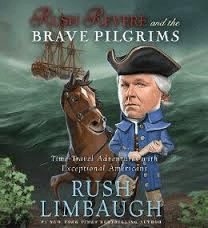
Don’t take my word for it.  Check out the rankings from the Seventh Annual Children’s Choice Book Awards.  You’ll see that this group voted Rush Limbaugh their “author of the year” for his Rush Revere and The Brave Pilgrims: Time-Travel Adventures with Exceptional Americans.

Talk Radio and Talking Horses

Talk Radio and Talking Horses

What’s the book about? A substitute teacher and his talking time-traveling horse travel back to the Mayflower to travel with the Pilgrims. As Limbaugh introduces it to young readers, he wants “to try to help you understand what ‘American Exceptionalism’ and greatness is all about.” It does not mean that other countries aren’t just fine, too. But as Limbaugh puts it for his young readers, “American Exceptionalism and greatness means that America is special because it is different from all other countries in history. It is a land built on true freedom and individual liberty and it defends both around the world.”

Limbaugh has made efforts to introduce his vision of heroic history to schoolchildren everywhere. As of early 2014, Limbaugh claimed to have donated over 15,000 copies of his book to schools across America. As he told the conservative news site World Net Daily,

The mission is to connect with people that normally wouldn’t and don’t listen to a program like this but who someday will, and maybe their parents and grandparents do. I’m very proud of what I do, and I want as many people to be aware of it as possible. I’m very proud of what I believe. I’m very proud of my country. I want everybody to be. I really do. It may sound like pie-in-the-sky, but I want everybody to love this country as I do.

Academic historians might pooh-pooh this sort of thing. But America’s kids seem to like it. At the annual meeting of the Children’s Book Council, young attendees cast over 1,261,000 votes, and Limbaugh’s effort to introduce children to the wonders of America’s historical greatness came out on top.


Does Fundamentalism Promote Sex Abuse?

Do conservative Protestant evangelicals have a problem with sex abuse? Does evangelicalism suffer from an overabundance of “Christian cesspools” of abuse?

I’ve been chastised for asking whether this is a specifically fundamentalist problem—that is, a problem of theology—or rather an institutional problem. That is, is it specifically fundamentalist theology and “purity culture” at fundamentalist schools that encourages rape and sexual assault? Or do we see the same sorts of systemic abuse in non-fundamentalist colleges and universities? At big football schools, for example, administrators protect rapists to protect the football program. Could “party culture” be just as conducive to rape and sexual assault as “purity culture?”

In an article about the sex-abuse travails at Bob Jones University, Boz Tchividjian says this is not a question of theology, but of “authoritarianism.” Tchividjian argues that church structures lend themselves to sex abuse, but that this sort of abuse could happen “in any culture, elevating leaders beyond accountability, leaving victims’ rights to their whim, and sidelining critics who challenge their rule.” Yet Tchividjian’s work has illuminated the gruesome world of sex abuse and rape in evangelical and fundamentalist institutions.

As Kathryn Joyce describes in a recent essay in American Prospect, Tchividjian’s anti-abuse group GRACE was called in to Bob Jones University in 2012 to investigate accusations of widespread institutional neglect of charges of rape and sex abuse. Tchividjian, grandson of evangelist Billy Graham and former law professor at Liberty University, has long campaigned for more transparency about sex abuse among evangelicals. In Joyce’s AP piece, Tchividjian made his case for the terrible evangelical record with sex abuse. “One study,” Joyce writes,

has found that 93 percent of admitted sex offenders describe themselves as religious. Offenders who report strong church ties abuse more often, with younger victims. That’s not because Christians are inherently more abusive, he said, but because they’re more vulnerable to those who are. Tchividjian repeated what one convicted sex abuser told clinical psychologist Anna Salter in her book Predators: Pedophiles, Rapists, and Other Sex Offenders: “Church people”—always looking to see the best in people, to welcome converts, to save sinful souls—are “easy to fool.”

“When something does surface, all too often the church leadership quiets it down. Because they’re concerned about reputation: ‘This could harm the name of Jesus, so let’s just take care of it internally.’

Tchividjian rattled off ways in which Christians’ openness can allow abuse to go unchecked: Perpetrators tend to use scripture to coerce, justify, and silence. If they’re clergy, they will exploit their positions; if they’re laypeople, they will take advantage of a church hungry for volunteers and rely on the trust given to members of a church family. “The reason why offenders get away with what they do is because we have too many cultures of silence,” Tchividjian said. “When something does surface, all too often the church leadership quiets it down. Because they’re concerned about reputation: ‘This could harm the name of Jesus, so let’s just take care of it internally.’

In case after case, Tchividjian and his colleagues unearthed terrible and terrifying stories of abuse and cover-ups. Of students like Katie Landry at Bob Jones University. When Landry reported her rape to Dean Jim Berg, Berg allegedly told her that there was a “sin in your life that caused your rape.”

Tchividjian says this is a question of organizational structure, not of theology. But his own work seems to make the case that fundamentalist culture seems particularly prone to this sort of victim-blaming. As in this story from BJU, it seems fundamentalist cover-ups have the ability to use theologically inflected language to cow victims into silence.

I’m certainly sensitive to charges of fundamentalist-bashing. Indeed, my first take on the recent spate of “exposes” of sex abuse at fundamentalist colleges was to wonder if this was just another attempt to dismiss dissenting colleges. But there does seem to be a connection between fundamentalism—both theology and culture—and this climate of sex-abuse cover-up. It might not generate higher numbers of abuse victims than other opaque institutions—ask anyone at Penn State, Florida State, or a host of other non-fundamentalist institutions—but it seems fair to say that fundamentalism has generated a sick culture of abuse.



Charles Murray, Extremist?

No one doubts that scholar Charles Murray is controversial.  Best known for his book The Bell Curve, Murray ruffled feathers by asserting that some sorts of people are naturally less intelligent than others.  Though he denies every accusation of racism, Murray’s reputation has caused the administration of Asuza Pacific University to abruptly cancel Murray’s upcoming campus talk.

Has Murray’s reputation as a racist caused him to be seen as too extreme even by administrators at conservative Christian colleges?  The leaders of APU, for example, worried that Murray’s talk might be hurtful to “our faculty and students of color.”

Scholar?  Or Racist?  Can He Be Both?

Scholar? Or Racist? Can He Be Both?

After all, Murray has been labeled as a “white nationalist” by the Southern Poverty Law Center.  Murray, the SPCL charged, uses

racist pseudoscience and misleading statistics to argue that social inequality is caused by the genetic inferiority of the black and Latino communities, women and the poor.

For his part, Murray accuses Asuza Pacific of pusillanimity and closed-mindedness.  In an open letter to APU’s students, Murray challenged them to think for themselves.  Murray invited students to explore his website and read some of his publications.  The more you know about me, Murray suggested, the harder it will be for you to take these accusations of extremism seriously.  “The task of the scholar,” Murray told APU students,

is to present a case for his or her position based on evidence and logic. Another task of the scholar is to do so in a way that invites everybody into the discussion rather than demonize those who disagree. Try to find anything under my name that is not written in that spirit. Try to find even a paragraph that is written in anger, takes a cheap shot, or attacks women, African Americans, Latinos, Asians, or anyone else.

There is no reason, Murray concludes, why students should not listen to talks by “earnest and nerdy old guys” like Murray.

This cancellation of Murray’s talk raises key questions.

First of all, does the goal of intellectual diversity on college campuses include the inclusion of unpopular conservative ideas?  We’ve seen recently examples of speakers protested against at Montana Tech for their support of creationism, pro-life student groups at Yale being refused fellowship in a social-justice club, and Steven Hayward’s lonely life as a token conservative campus intellectual at Colorado.

Second, what does it mean that this cancellation comes from a relatively “conservative” campus?  APU is one of the oldest evangelical universities in the country.  No one could safely accuse the leadership of APU of pandering to the traditional secularist campus leftism run amok.  Yet this school’s leadership saw fit to cancel Murray’s speaking appointment due to worries about Murray’s reputation.

Finally, who decides which ideas are extreme?  By any measure, Charles Murray’s work has been part of recent mainstream American conversations about race, class, and society.  His 2012 book, Coming Apart, for example, was prominently reviewed by such leading publications as the New York Times, Wall Street Journal, and the New York Review of Books.  It does not make sense to suggest that Murray has only some sort of fringe status as a scholar.  Yet in this case, even a conservative Christian school saw Murray as too controversial to speak on campus.


Theology in the U.K.

H/T: EB

Thanks to Our Man In Scotland, we hear of a developing flap in Britain over religion and the public square.  Normally the purview of ILYBYGTH runs only to the US borders, but this case seems so relevant we felt obliged to comment.

Yesterday a collection of fifty high-brow British intellectuals signed a public letter.  They objected to Prime Minister David Cameron’s repeated assertion that Britain is a “Christian country.”  A few days back, Cameron wrote in Church Times, an Anglican newspaper,

I believe we should be more confident about our status as a Christian country, more ambitious about expanding the role of faith-based organisations, and, frankly, more evangelical about a faith that compels us to get out there and make a difference to people’s lives.

In Britain, such comments led to much public gnashing of teeth.  Some pundits assumed Cameron was hoping to shore up his rightward flank against the cultural traditionalism of the UK Independence Party.  Other public figures rushed to defend Cameron’s bold assertion of public faith.

To be frank, this British kerfuffle has us scratching our heads.  In the US of A, nearly all public figures vying for national office make loud and proud attestations of their personal faith.  Even President Obama, no conservative, repeatedly publicizes his Christian practice.  As OMIS pointed out,

if you want to be in public office in America, you have to say [that this is a Christian country], but over here it’s considered a “row.”

Even more puzzling, a quick google search netted similar statements from Cameron going back at least as far as December 2011.  In a speech back then, Cameron seemed to say the same sorts of thing that are causing such consternation today.  “We are a Christian country,” Cameron told an audience at Oxford on 16 December 2011,

and we should not be afraid to say so. . . . the Bible has helped to give Britain a set of values and morals which make Britain what it is today.

So how is his recent statement any different?  Why did people complain now, and not then?


The OTHER Hobby Lobby Case

You’ve been following Hobby Lobby’s case for religious freedom before the US Supreme Court.  But did you know Hobby Lobby’s Steve Green has also prepared an ambitious Bible curriculum for use in America’s public schools?

According to Religion News Service, the school board of Mustang, Oklahoma has voted to use the Bible curriculum in its public schools.  Of course, despite some rumblings to the contrary, there is nothing unconstitutional about teaching the Bible in public schools.  The US Supreme Court’s ruling in 1963’s Schempp decision specified that the Bible can and should be taught in public schools, as long as it is not taught devotionally.  That is, children can learn about the Bible, about religion, but not be drilled in any particular religious belief.

But it often seems as if the folks who want to see more Bible in public schools have a decidedly devotional bias to their activism.  As Mark Chancey of Southern Methodist University found in his study of Texas Bible classes, a significant proportion of them end up teaching religion, not just teaching about religion.

In this case, no one questions Steve Green’s ardent religiosity.  As the Religion News Service article points out, Green has admitted in public statements that he hopes the Bible curriculum will show that the Bible is “good,” that it’s “true,” and that the Bible’s impact,

whether (upon) our government, education, science, art, literature, family … when we apply it to our lives in all aspects of our life, that it has been good.

It seems evident that Green hopes this Bible curriculum will lead students toward faith, at least incidentally.  For that reason, the Freedom From Religion Foundation has promised to “scrutinize” the Bible curriculum.

More evidence, it seems, of the uselessness of talking about “America’s public schools” in general.  Schools in some communities, such as Mustang, Oklahoma, may welcome evangelical Protestant curricula into their class schedules.  In other places, Green’s Bible curriculum will not be an issue.  Local school boards make decisions that fit with the cultural politics of their local communities.