Trump’s S-Word 2020 Gamble

Will it work? Personally, I hope not. As a historian of American conservatism, however, I think it could turn out to be a winning strategy. And I’ll hazard an easy prediction right now: Schools and rumors about schools will continue to play a key role.

Here’s what we know. In his SOTU speech this week, President Trump harped on the dangers of socialism. As he put it,

Here, in the United States, we are alarmed by new calls to adopt socialism in our country. America was founded on liberty and independence—not government coercion, domination and control. We are born free, and we will stay free. Tonight, we renew our resolve that America will never be a socialist country.

SAGLRROILYBYGTH might be scratching their heads and asking why Trump is taking on a dead issue. Who worries about socialism anymore? The Soviet Union collapsed, China is careening forward with its some-pigs-are-more-equal-than-others capitalism, and Cuba seems poised to renounce its long socialist practice.
OLYMPUS DIGITAL CAMERA

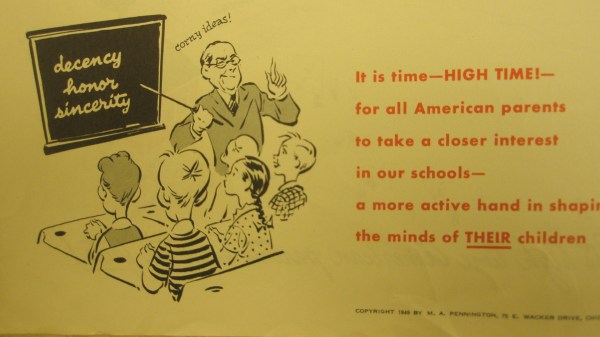
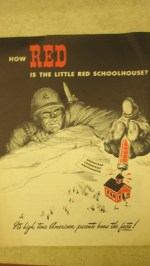
Unreasoning s-word school terror, c. 1949.

Indeed, the socialist pressure these days comes from a different direction, from the likes of Senator Bernie Sanders and Representative Alexandria Ocasio-Cortez, both loud and proud democratic socialists.

Some lefties think Trump is making a big mistake by focusing on the s-word. As John Nichols wrote in the Nation,

while Trump may think “socialism” is a scare word, and while many prominent Democrats may get scared when it is referenced, Sanders is comfortable discussing the ideology.

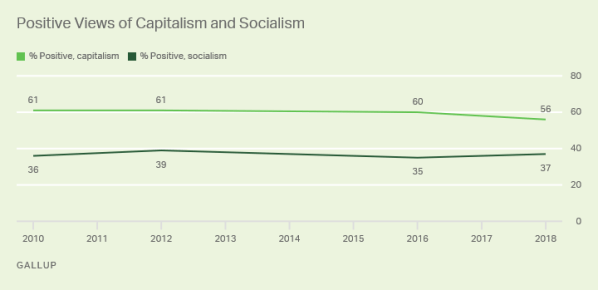
Nichols and other hopeful progressives look at recent Gallup poll results for encouragement. It seems more and more young people are expressing confidence in socialism.
gallup socialism

Changing attitudes…?

Let me be as clear as I can about this: I hope it’s true. I hope new majorities of American voters see the wisdom of policies such as health care for all, affordable college tuition, and aggressive economic policies to help lower-income Americans. I hope that the s-word has lost its enormous power to stop useful policies dead in their tracks.

But I don’t think it has. Any candidate—including Trump—can win instant and powerful support by screaming about the dangers of socialism. Maybe I’m scarred by my time in the archives, but I can’t help but remain impressed by the powerful emotions generated by the s-word.

For example, in the middle of the twentieth century anti-socialist conservative activists in the Daughters of the American Revolution went to great lengths to sniff out any traces of socialist subversion in America’s public schools. Their intense investigations would be hilarious if they weren’t so destructive.

In the early 1960s, for example, Mississippi DAR leader Edna Whitfield Alexander warned of the dangers of Bobby Squirrel. The BS incident took place in a popular kids’ book used in schools, Ask For It.
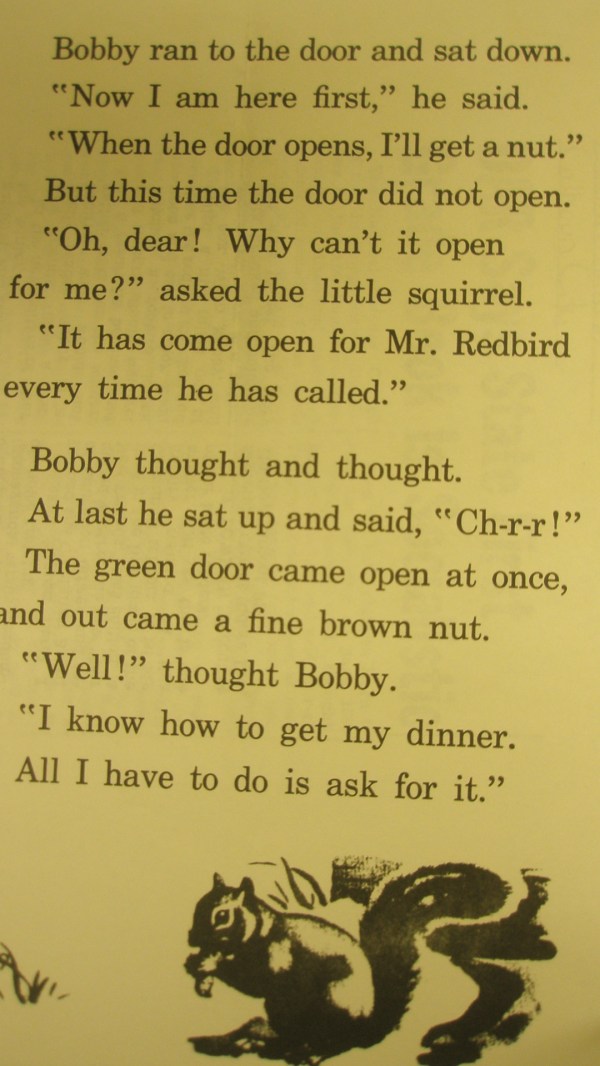
OLYMPUS DIGITAL CAMERAAs Alexander asked in the pages of the Monitor Herald (Calhoun City, MS), January 3, 1963, “Have you ever heard or read about a more subtle way of undermining the American system of work and profit and replacing it with a collective welfare system?”

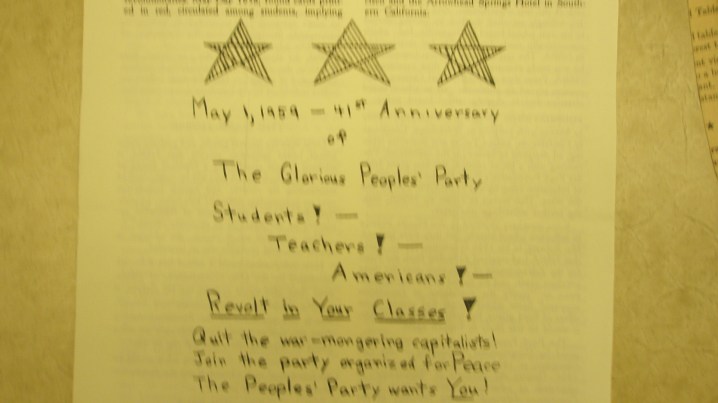
In that period, as well, conservative activists used their newsletters and mailing lists to spread terrifying rumors of socialist intrigue in the nation’s public schools. As this flyer warned, students nationwide were planning socialist revolts in school.
OLYMPUS DIGITAL CAMERA

Conservative activists reprinted flyers like this and included them in newsletters, c. 1959.

It was a ridiculous thing to panic about. Its ridiculousness, however, does not take away anything from its incredible political power. To a depth that progressives can’t hope to fathom, Americans have always been terrified of the prospect of socialism in our country.

It hasn’t gone away. As one conservative pundit wrote recently,

By making resistance to socialism a lynch pin of his 2020 campaign, Trump will be helping to right this extremely dangerous situation, giving cover to students being indoctrinated in our classrooms and to their increasingly alarmed parents.

Maybe it doesn’t need saying, but I’ll say it anyway. There IS NO “extremely dangerous situation” in American classrooms due to creeping socialism. It just doesn’t exist. The real dangers in American public school classrooms come from inadequate funding, cruel and imbalanced disciplinary practices, and rampant economic segregation.

Nevertheless, though I hate to say it, I think the sort of knee-jerk terror many Americans feel at any whisper of the s-word will prove Trump right. If he continues to portray himself as the bold defender of American freedoms against creeping socialism, he stands a chance of victory.
Swirling Round the Superbowl

Okay, nerds, here are some greatest Superbowl hits from the ILYBYGTH archives so you can feel involved in today’s festivities.

1.) What’s the deal with football and fundamentalism? Liberty University’s recent coaching hire has us all wondering once again what really matters at evangelical universities.

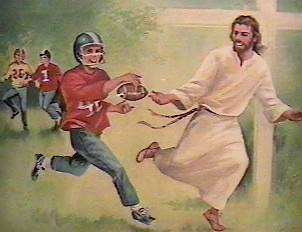
jesus_football

…to the ten…to the five…JESUS CHRIST with the TOUCHDOWN!!!!!

2.) The teams aren’t the same, but this culture-war drinking game idea from 2015 should still work.

3.) Why is school reform pricier than two entire Superbowls? The question came up back in August, 2017, but it is still sort of depressing.

4.) Tommy Brady and Bill Belichick help explain why school reform is so difficult.

Vermont Really Does Discriminate against Religious Schools

Hot off their Colorado no-gay-weddings baker case, the Alliance Defending Freedom (ADF) is at it again. This time, the target is the state of Vermont. ADF alleges that the state discriminates against religious schools. They’re absolutely right, but until now ADF wouldn’t have had a chance. They’re hoping a recent SCOTUS win has put a crack in the wall between church and state wide enough to pull the state of Vermont through. The case comes down to one tricky question: Is a college class the same as tire mulch?

The Simpsons Lemon GIF - Find & Share on GIPHY

Here’s what we know: Three high-school students from a Catholic school wanted to participate in a dual-enrollment program. In this program, the state pays tuition for students to take college courses for advanced credit. Because they attended a religious private school, they weren’t allowed to participate. According to the Burlington Free Press, Vermont’s Supreme Court ruled in 1999 that state funds could not sponsor students at religious schools.

ADF says such laws are discriminatory. As they complained,

The Dual Enrollment Program statute discriminates against students attending religious high schools not because of the content of college courses they wish to take, but instead because of the religious status of the high schools they attend.

As SAGLRROILYBYGTH are aware, two SCOTUS cases are most relevant here. Lemon v. Kurtzman (1971) established the three-prong “Lemon Test.” This case decided whether or not Rhode Island and Pennsylvania could financially support religious schools.

  1. Any law, SCOTUS ruled, must have a secular purpose. So, for example, a state government COULD pay for children to go to religious schools if the government was mostly interested in the secular goal of providing a basic education for children.
  2. Second, any law’s primary effect must not be one that supports or inhibits religion. If a religious school is part of a church’s religious mission, for example, the government can’t pay for it, because the primary effect would be to support that religious mission.
  3. Trickiest of all, any law must avoid “excessive government entanglement with religion.” But what constitutes “excessive?” IMHO, this is where things get really tricky.

Because last year, SCOTUS ruled that a church could not be excluded from a grant program that had a secular purpose. Trinity Lutheran complained that it was being discriminated against by not being allowed to participate in a program for its playground. The church wanted an equal chance to get government-sponsored tire mulch for its playground.

In its new case, ADF is undeniably absolutely correct in its primary assertion. The state of Vermont really does discriminate against students from religious schools. That discrimination, however, is intentional and seems to be in line with the Lemon Test tradition.

The way I see it, ADF deserves to lose this case. A college class is not the same as tire mulch. To be able to offer college course credit, IMHO, would be a big bonus for any high school. It would promote the mission of the school. If that mission is religious, as it certainly is in the case of Catholic schools, then government money would constitute excessive entanglement. Moreover, funding this important educational experience would mean supporting the Catholic diocese’s religious mission.

But if it helped students in religious schools take college classes, would Vermont’s PRIMARY purpose be to support the Church? Or merely to help all its citizens further their educations? And how would a judge decide what constitutes “excessive” entanglement?

What do you think?

Why Are Conservatives Still Paranoid about Teachers?

In South Dakota, they wouldn’t be able to support “the separation of church and state” or “family farmers and ranchers.” In Virginia, they couldn’t endorse “strong, sustained, shared economic growth.” In Arizona, if a bill became law, teachers wouldn’t be allowed to advocate for

individuals’ freedom to speak their mind, assemble without fear, have access to information, worship as they please, and be treated equally among all people; and to have equal access to a representative democracy and the fair and equitable administration of justice.

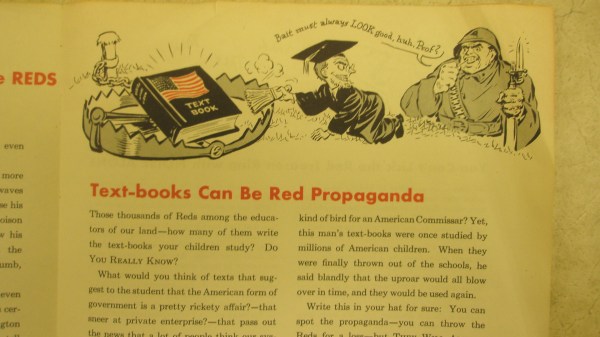
Batty, right? Of course it is. But unfounded suspicions about teachers and teacher-training colleges run deep.

OLYMPUS DIGITAL CAMERA

Those ed school professors…c. 1949.

A batch of new bills in those states hopes to constrain teachers–in the words of the Virginia resolution–from

Advocat[ing] for any issue that is part of a political party platform at the national, state, or local level.

The platforms of the state Democratic parties of South Dakota and Arizona endorse such radical notions as family farms and freedom of assembly, and the national party platform, which the Virginia state party follows, comes out boldly in favor of economic growth. Now, no one really wants to keep teachers from supporting such mainstream notions.

So why these bills?

All of them are part of today’s conservative political theater surrounding public schools. Like Virginia’s resolution, they proceed from the premise that

many teachers in public elementary and secondary school classrooms are abusing taxpayer resources and abusing their ability to speak to captive audiences of students in an attempt to indoctrinate or influence students to adopt specific political and ideological positions on issues of social and political controversy.

In the eyes of the irate Virginians, the teachers themselves are not the only ones to blame. Teachers have been themselves brainwashed by

some teacher training institutions, teacher licensing agencies, state education agencies, and professional teacher organizations [that] have condoned such attempts to indoctrinate or influence students under the guise of “teaching for social justice” and other sectarian doctrines.

Rumors about radical leftist teachers, trained in subversive ivory towers, have a long and lamentable history. As I argued in The Other School Reformers, conservative activists have always been skeptical of teachers and positively paranoid about teacher-training programs.

In my experience, there is and has long been a grain of truth to these conservative suspicions. Schools like my alma mater really do try to teach teachers to embrace social-justice values. Ed professors like George Counts have long advocated for left-wing teacher activism.

OLYMPUS DIGITAL CAMERA

Sneaky red teachers, c. 1949.

The kicker, though, is that those efforts have never been as successful as people like me have hoped. Most teachers share the values of their local communities, not the values of their left-leaning education professors. In the limited case of teaching creationism, for example, political scientists Eric Plutzer and Michael Berkman found that teachers tend to teach what their communities want them to teach, because most teachers share those same ideas and values.

So why do conservatives  persist in pushing these impractical bills and resolutions? Partly for the same reason the Arizona Democratic Party supports “comprehensive and rigorous public schools”. It’s about goals, dreams, and intentions. These bills and platforms aren’t about political reality. They are about making a political statement.

I just wish the statements would avoid insulting and suspecting teachers.

Trump Scores Better Than Us on GREs

It wouldn’t work. It’s not even new. But Trump’s tweeted support for school Bible bills shows that he understands what grass-roots evangelicals (GREs) really think.

At the Atlantic, Jonathan Merritt took Trump to task for a nonsensical and self-defeating policy. As Merritt wrote,

If conservative Christians don’t trust public schools to teach their children about sex or science . . . why would they want to outsource instruction about sacred scripture to government employees?

From a theological point of view, Merritt’s absolutely right. Moreover, conservative evangelical intellectuals have always agreed. That’s why so many of them supported SCOTUS’ 1962 ruling in Engel v. Vitale. In that ruling, SCOTUS decided that a state couldn’t impose a prayer in public schools, even a bland ecumenical prayer that seemed acceptable to people of many faiths.

The National Association of Evangelicals supported Engel, as did fundamentalist activists such as Carl McIntire. Why? Because they agreed with Merritt. They didn’t want public schools telling children how to pray. As William Culbertson of the Moody Bible Institute wrote,

The public as a whole and Christians who sense the necessity for safeguarding freedom of worship in the future are always indebted to the Court for protection in this important area.

For a long time now, conservative evangelical intellectuals have recognized the distinction Merritt’s making. And, as leading school-Bible scholar Mark Chancey noted at WaPo, there’s really nothing new or constitutionally challenging about teaching the Bible in public schools. There’s no need for new bills or laws, because academic study of the Bible has always been constitutional.

In these pages, too, we’ve looked at the nonsensical curricular plans of these types of school-Bible bills. In Indiana, for instance, Senator Dennis Kruse has slapped together a MAGA stew of Bible, “In God We Trust,” and creation science. It wouldn’t pass constitutional muster. It wouldn’t teach kids their parents’ faiths. It wouldn’t change anything at all.

But for all of our rational superiority, Trump’s Bible tweet still makes sense, on both a religious and a political level. Religiously, grass-roots evangelicals (GREs) have long seen the Bible as a supernatural book, a uniquely magical book that has power to change lives and save souls. For all Merritt’s reasoned counterargument, no one will shake GREs from this bedrock faith. Simply getting the Bible into public schools, many GREs think, will be enough. The Bible can take it from there.

bicabooks

Recipients of MBI’s school outreach, c. 1940.

For instance, a while back I studied the Bible outreach programs of Chicago’s Moody Bible Institute. Among its other goals, the MBI missionaries tried to get Bibles and tracts into schools in the Appalachian region. To the missionaries, the words of the Bible—even in tract form—had the power to convert people by the merest glance. As head of the program described in 1921,

A man was given a tract by the roadside; simply glancing at it, and coming to a hedge, he stuck the tract into the hedge; but it was too late; his eyes had caught a few words of the tract which led to his conversion.

For many GREs, the Bible maintains this sort of power. Regardless of what wonks like Merritt might say, GREs think the Bible can never do wrong, even in the hands of secular public-school dupes.

Far beyond religious considerations, Trump’s Bible tweet nails once again the angry nostalgia among white GREs. These bills aren’t about making real change in public schools, as Prof. Chancey has made abundantly clear. Instead, they are about—in Trump’s words—“Starting to make a turn back”. Part of the imagined MAGA past of GREs is a world in which their faith ruled America’s public spaces. Not in a theologically pure form, but in a symbolic way.

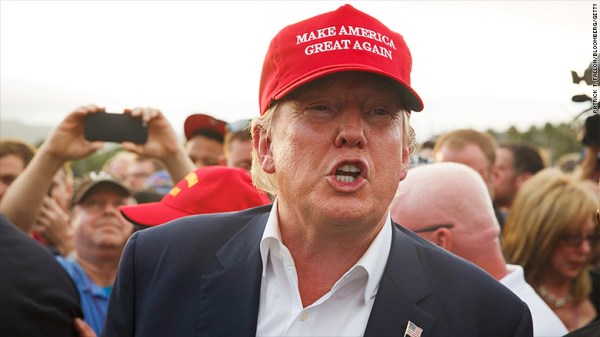
So we nerds can say what we want. We’re not wrong. Trump’s support for today’s batch of school-Bible bills is nonsensical at best, anti-conservative at worst. None of that really matters, though. Trump is not trying to convince us or actually save children’s souls. He is only trying to placate white GREs who love his hat.

Trump make america great again

GRE’s: About the hat as much as the Bible.

The Real Promise of Teachers’ Unions

It’s not that they’ll get everyone to “eat the rich.” It’s not that they will manage to unite all teachers in a progressive political wave that will sweep through America’s 2020 elections. They won’t. Teachers are now and have always been a mixed bag, ideologically. But in today’s divided polis, a group like the unions still has enormous potential for good.


Pundits who dream that today’s wave of teacher strikes will bring a progressive millennium are fooling themselves. Anyone familiar with real teachers can tell you: We’re not easy to pin down. Sure, some teachers like me have a deep progressive political streak. But just go to any teachers’ lounge and you will hear a dizzying variety of political opinions.

As I argued in my book about twentieth-century educational conservatism, America’s teachers have ALWAYS been ideologically divided. The popular image of united left-wing teachers has never matched reality. Here are a few snapshots of conservative teachers throughout the years:

1939: One leader of a conservative campaign against left-leaning textbooks, Bertie Forbes, liked to tell a story: He was minding his business as a magazine editor when he was approached by teachers from his local New Jersey school district. These teachers, Forbes liked to recount, begged Forbes to get involved in educational politics. The teachers hated the lefty textbooks and wanted political support to teach old-fashioned patriotism in their local public schools.

1950: As Pasadena, California reeled over alleged progressivism in its classrooms, one teacher took to the editorial pages of the local paper. We teachers, she insisted, are not “in full accord with the tenets of progressive education.” She wanted old-fashioned tradition in the classroom, including corporal punishment. The progressive slop on offer, she wrote, led only to “arrogance, hostility, and defiance, even vandalism.” Teachers like her were on the front line against socialist “Pressure and propaganda” and they wanted the support of the conservative public.

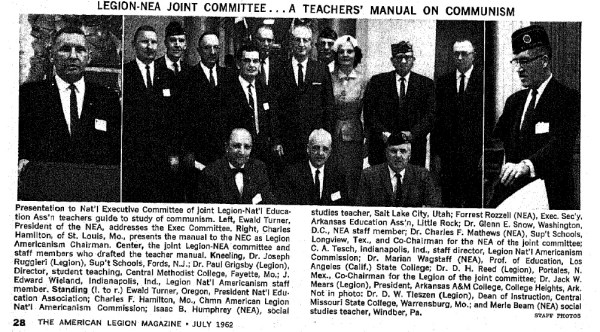
1962: Who led the fight to battle communism? It wasn’t only the conservative American Legion. Throughout the cold war, including in this 1962 mash-up, National Education Association members teamed up with the Legion to purge left-wing propaganda from the nation’s public schools.

anti communist teachers

Find the left-wing teacher in THIS photo:

1974: In Kanawha County, West Virginia, a new set of textbooks sparked violent culture-war protests. One teacher took the opportunity to voice his ideas about proper public education. On December 12, 1974, public-school teacher Karl Priest reminded the National Education Association that its policy was always to combat discrimination. The new textbooks, Priest insisted, were “in fact, anti-Christian.” [Emphasis in original.] Teachers like him, Priest argued, were correct in their conservative fight against such discriminatory claptrap.

These days, too, teachers are hardly politically united. Even those who support today’s strikes cannot be assumed to be unified on any other political issue. Teachers, in other words, won’t become the left-wing vanguard that activists have dreamed of for decades.

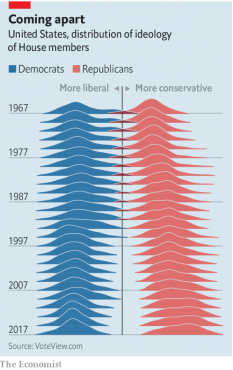
But that doesn’t mean that today’s teachers’ unions won’t have a huge impact. As politicians are split more and more toward the far edges, any group that can unite disparate people toward specific goals can serve as a beacon of hope.

coming apart

What if politicians could act more like teachers’ unions?

The promise of the teachers’ unions doesn’t come from the fact that teachers are becoming more politically homogenous. The promise, rather, is that teachers’ unions are able to take action toward important goals in spite of the fact that their constituencies disagree on almost everything else.

Why We’re Doomed

We all knew it was going to be ugly and stupid. I’m still surprised, though, when people say these things with a straight face. Conservative pundits lump middle-of-the-roaders like me into a vast, scheming “secular Left . . . who cannot stand the presence of religion in everyday  life.” Lefties blast middle-of-the-roaders like Cory Booker into the conspiratorial Right. No wonder we can’t have a decent convo.

First, my alleged anti-religiosity. After my recent commentary about Karen Pence in the Washington Post, Ben Shapiro took to the tube-waves to rebut. At about 19:30 in this segment, he hoped to redefine Ms. Pence’s ordeal. Instead of an old-fashioned fight between religious groups, Shapiro insisted, what we’re facing now was an outright fight by powerful secular forces against traditional religion as a whole.

Shapiro argued that people like me assume that there is no legitimate traditional religion anymore. People like me, Shapiro said, see conservative religion as only

a basket of bigotries masquerading as religion.

I won’t rebut Shapiro’s rebuttal, though I will point out that SAGLRROILYBYGTH have offered much more powerful and insightful counterarguments to my Pence commentary in these pages.

The point this morning is bigger and it’s not only about my hurt feelings. It’s not even about conservatives alone. Pundits on the left tend to shoot their mouths off just as wildly. For example, though I’m not a fan of Senator Cory Booker’s (fading?) support for charter schools, I can acknowledge that he often endorses traditional progressive political positions.

Yet, as Molly Ball noted a few years back in The Atlantic,

Booker has faced a steady drumbeat of criticism from sites like Daily Kos, where a contributor asserted last year that he “would actually be much more at home in the Republican Party.” Booker’s team has grown all too familiar with the rap that he is “some sort of Manchurian candidate for the right,” as his campaign spokesman, Kevin Griffis, put it to me with a sigh.

The problem is bigger than Cory Booker or Karen Pence. It’s even bigger than Ben Shapiro. In a sensible system, pundits on both sides would rush to include as many people as they can on their team. Ben Shapiro would notice that my argument wasn’t really against traditional religion at all. Cory Booker would be welcomed into a big-tent Left and encouraging to squeeze every possible progressive drop out of his role.

That’s not what happens. Instead, as pundits on both sides try to get clicks by excoriating their natural allies, the left-right divide only gapes ever wider.

Karen Pence Falls into the Scopes Trap

SAGLRROILYBYGTH have likely been following the story: Second Lady Karen Pence has taken some heat for going back to work at Immanuel Christian School, an evangelical school with explicitly anti-LGBTQ beliefs. As they rush to defend her, I’m arguing this morning, Pence’s conservative allies are actually stumbling into an old culture-war trap.

shapiro pence

…ouch.

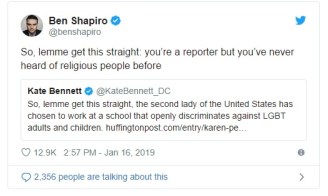
Understandably, some of her conservative defenders are taking the path of least resistance. Opposing any sort of non-hetero, non-married sexual activity, they say, has ALWAYS been a standard Christian belief. As Ben Shapiro put it most bitingly, Pence’s critics seem to have “never heard of religious people before.”

Thanks to the Made By History series editors, this morning I’m arguing in The Washington Post that Pence’s defenders are making an old mistake in their hasty counter-attacks. I won’t give away the details–you’ll have to click over to read the whole thing–but I will say I work in some of the biggest names in twentieth-century creationist history: Henry Morris, Bernard Ramm, and William Jennings Bryan.


Not #ThemToo

I’m flabbergasted. Why did the Kavanaugh hearings convince so many GOP women of a certain age that past sexual harassment was no longer cause for prosecution?

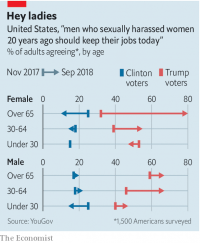
sister sledging chartHere’s what we know. The Economist is reporting from its YouGov survey. Between November 2017 and September 2018, the percentage of female Trump voters over age 65 who believe “men who sexually harassed women 20 years ago should keep their jobs today” leaped from about 30% to near 80%.

What gives?

The article suggests a couple of explanations. Perhaps this group of mature women worries about the professional status of their grown sons. They don’t want teenage peccadillos held against their “boys” in their adult careers. But that would apply equally to female Clinton voters of the same age, and that group has swerved in the opposite direction.

Or, The Economist wonders, do older GOP women have a “we survived it, so will you” attitude toward sexual harassment? Something we might call MMSS (Mad Men Survivor Syndrome)? That seems equally sketchy to this reporter. Even if some Trump voters feel that way, it doesn’t seem like it would be enough to push the needle so far.

Finally, The Economist suggests that this demographic is merely parroting the attitudes of their domineering husbands. They cite one observer from the Midwest who reported watching GOP husbands filling in ballots for their wives as well. Could that really be such a widespread phenomenon? And, even if so, why were the numbers so different as recently as November 2017?

In the end, none of the explanations offered make sense to me. They don’t adequately explain why so many GOP voters embraced this “water-under-the-bridge” attitude toward sexual harassment.

Any suggestions out there? Any GOP-voting women have a better explanation for us?

I Love You but You Didn’t Do the Reading: Teachers’ Strike Special Edition

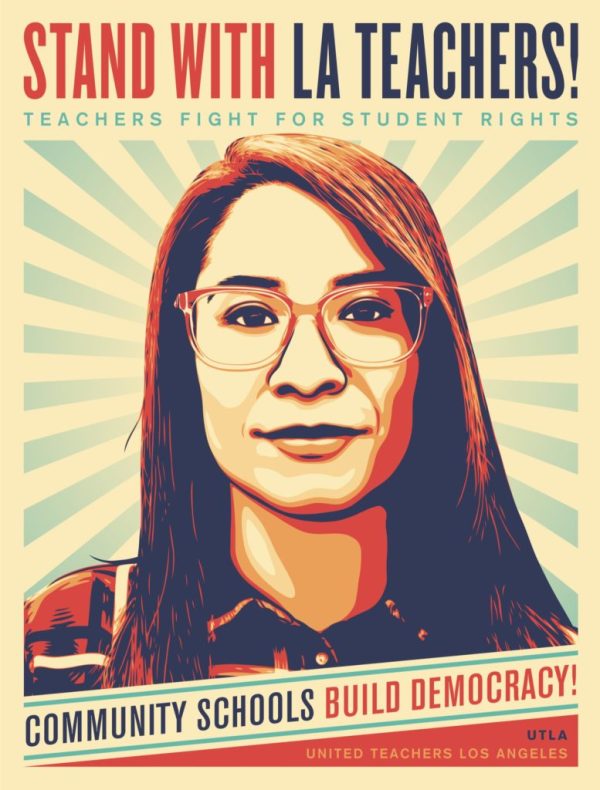
Maybe I’m just too close to see it clearly, but to my eyes the LA teachers’ strike is pushing last year’s teacher walkouts in new directions, directions that will shape our conversations about public education for years to come. Here are a few of the most compelling commentaries to come out so far:

When we lambaste the charter schools that urban parents may choose as undermining public education, but say nothing of the urban private schools and exclusive suburban public schools that enable affluent parents to exit struggling districts, we not only apply a dangerous double-standard, but we also place the blame for low-performing schools on those who must attend them.

these modern walkouts are about the very idea that public schools should be kept healthy at all.

What inspires well-paid teachers to deny the needs of kids they love in exchange for angry strikes they loathe? Union deception and brutality.

Numerous Latino teachers repeatedly told me that a sense of solidarity with their students is what’s driving them to the picket lines—a profoundly personal connection to those children, and a fear that current school conditions are not serving them.

My advice to the district: Hold strong. Replace them all. If they want a dramatic impact on education, fire the union and begin to repair the schools, just like Reagan fired the air traffic controllers.