Pre-Orders Now Available!

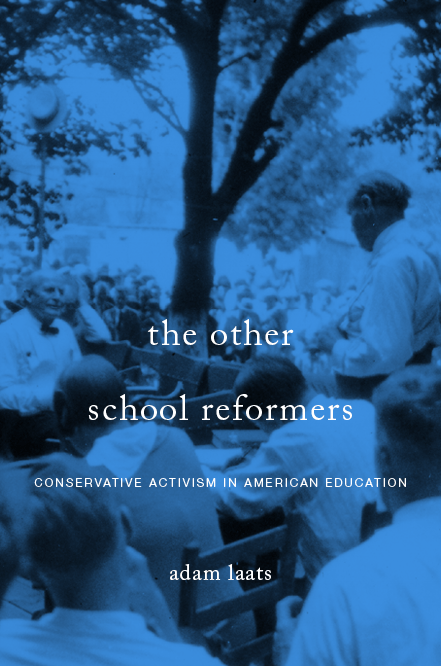
Want to be the first on your block to get your copy of The Other School Reformers?  Then pre-order your copy today!

Pre-order your copy today!

Pre-order your copy today!

As I was happy to announce recently, Harvard University Press will be releasing the book in early 2015.  But the pre-order just became available on sites such as Amazon.  The hardcover won’t be available until January 12, 2015, but if you pre-order today, you’ll be sure to WOW your friends and family by getting your hands on it first.

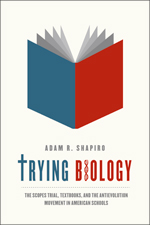
Required Reading: Adam Shapiro, Trying Biology

[Editor’s note: This review is an extended version of a review published in the most recent edition of the  Register of the Kentucky Historical Society.  It is reproduced with permission.]

The Scopes Trial gets all the attention.  Still.  In popular histories of evolution controversies, and even in some academic histories, Scopes still hogs the stage.  As Adam R. Shapiro rightly notes, the trial itself needs to be put in context of a much broader set of cultural, scientific, and educational issues (p. 11).

Trying Biology

Trying Biology

In Trying Biology: The Scopes Trial, Textbooks, and the Antievolution Movement in American Schools, Shapiro offers an indispensable new argument about the crucial issues at play in evolution education in the 1920s.  The Scopes trial, Shapiro argues, must not be understood simply as an epochal, inevitable clash of cultures.  Rather, the trial and its environment can only be understood in the context of the nitty-gritty history of textbook publishing.

And that is a profoundly dirty history, deliberately obscured by textbook sales agents themselves (p. 42).  As Shapiro relates, textbook sales agents routinely engaged in bribery, illegal snooping, and political chicanery (p. 18).  It is no wonder that self-styled progressive school reformers often lamented the power of the “book trust.”  Indeed, in its heyday in the 1920s, the American Book Company conglomerate controlled up to eighty percent of the textbook market (p. 20).

This is more than just a lament about sharp monopoly practices.  As Shapiro argues, the publishing business “provides a striking example of how scientific knowledge has been produced and distributed to nonspecialists” (p. 43).  Two starkly different communities bumped along in the high-stakes work of textbook production.

Textbook authors, Shapiro writes, tended to work collaboratively, in a culture dominated by science teachers from New York.  These authors wanted sales, but they also hoped to spread the gospel of evolutionary science.  In many cases, authors tied that message to “progressive solutions to economic, public health, and social problems” (p. 71).

Textbook sales agents, on the other hand, cared little about the content of their product.  Instead, they lived in a world of cutthroat competition, their eyes fixed squarely on the bottom line.  Shapiro convincingly demonstrates the way the influence of these sales agents often determined editorial decisions (p. 113).

The tension between salesmen and authors is not the only complicating factor in Shapiro’s book.  Issues of science and religion in the 1920s, he argues, often took a back seat to political questions of textbook cost and quality.  Issues of creation or evolution came as secondary considerations to more basic questions, such as the expansion of compulsory education.  In Tennessee, for instance, Shapiro notes the maneuvering that went on to pass the famous 1925 anti-evolution Butler Act.  Governor Austin Peay, Shapiro argues, signed the anti-evolution law as part of a grand compromise.  Conservatives got their anti-evolution law, while progressives finally passed their General Education Act.  This new law got more young people into schools for longer.

As Governor Peay noted at the time, this seemed like a no-brainer for progressives.  Compulsory education laws had long been anathema to conservatives.  By passing the new compulsory education law, Peay hoped to change the educational and economic landscape of Tennessee for decades to come.  In contrast, at the time, an anti-evolution law seemed to hold only symbolic value.

Of course, the tumultuous Scopes Trial proved Peay wrong.  The conflict in Dayton, Tennessee made Tennessee the symbol of rural creationist revolt.  Afterwards, as Shapiro explores, textbook publishers rushed to revise their textbooks to make them more palatable to anti-evolution conservatives.  Historians have long assumed that such revisions took out evolution content, content that was not replaced in American textbooks until the 1960s.  Shapiro tells a more nuanced story.  Using the example of George Hunter’s Civic Biology—the book at issue in the Scopes Trial—Shapiro reconstructs the complex process of textbook revision.

As Shapiro shows, Hunter himself insisted on keeping evolution as a prominent theme.  Such a focus, Hunter believed, would increase sales among science-minded education leaders (pp. 114, 131).  Given the number of influences involved in textbook production, however, revised editions of the book carefully excised the word evolution.  As did other leading science textbooks, new editions of Hunter’s biology kept much of the content in place.  But editors and sales agents cynically removed the word evolution from the text and from the index.  In most cases, that simple change passed political muster.

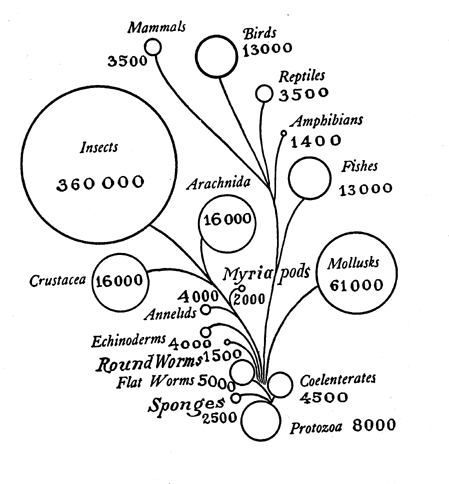
A page from George Hunter's Civic Biology.  Bryan objected to this page at the Scopes Trial.  By putting humans in among a small circle of "Mammals," Bryan objected, this chart misrepresented the central place of humanity in God's plan.

A page from George Hunter’s Civic Biology. Bryan objected to this page at the Scopes Trial. By putting humans in among a small circle of “Mammals,” Bryan believed, this chart misrepresented the central place of humanity in God’s plan.

Those interested in the tangled history of creation/evolution debates will be well advised to consider Shapiro’s careful argument about the relationships between science, education, and textbook publishing.  As Shapiro notes, the antievolution movement must not be reduced to a Scopes-Trial caricature.  In order to make sense of the tumultuous culture of educational politics in the 1920s, we must understand the nascent field of biology education and the convoluted process of textbook production.

Further Reading: Trying Biology: The Scopes Trial, Textbooks, and the Antievolution Movement in American Schools.  By Adam R. Shapiro. (Chicago: University of Chicago Press, 2013.  Pp. 193.)

Stuff It, Perfesser…

Ouch.  This is what biologists and geologists must feel like when young-earth creationists get aggressive. In the past, I’ve chided mainstream scientists for their unwillingness to sympathize with creationists.  Now that the topic is US History and I’m the one under attack, I feel more sympathetic to the biologists in the room.

Here’s the story: A couple days ago I posted a short essay in the pages of the History News Network.  I compared the history of neo-Confederate attacks on mainstream US history to the decades of creationist attacks on mainstream science.  Why do textbooks still include hackneyed old myths, I asked.  Why insist that slavery was not a leading cause of the Civil War?  Why claim that thousands of slaves fought loyally for the Confederacy?  Such things just aren’t true, and I reminded my history colleagues (and myself) that we must remain active supporters of real history in America’s classrooms.    

A few commenters took me to task for swallowing the myths of false history.  “Whoever this Laats character is,” one James Bendy remarked,

he’s definitely drinking the Kool-aid of the history revisionists. What he calls “revised history’ is actually the unvarnished truth. Yes, there were thousands of free blacks who fought FOR the South, along with thousands of Asians, Spaniards, Jews, Italians, all kinds of Europeans, and several entire tribes of Native Americans. It’s all documented and proven beyond any doubt.

Another commenter accused me of “egotistical presumption and condescension” along with “narcissism and moral blindness.”

Really?

I hadn’t meant to be provocative, really.  I hoped to remind other historians that they needed to remain actively involved in history education in their local communities.  It was an historian from William and Mary College, after all, who discovered woeful mistruths in a textbook used by fourth-grade public-school students in Virginia.  All of us need to serve as this sort of watchdog.   

My surprise reminds me of the ways generations of mainstream scientists felt after engaging for the first time with anti-evolutionists.  As I note in my 1920s book about the first generation of Protestant fundamentalists, when University of Wisconsin President Edward Birge disputed the scientific accuracy of anti-evolutionism in 1921, he found himself under political attack by the wily William Jennings Bryan.  President Birge went on to warn Princeton biologist Edwin Conklin, if you mention evolution, “you will receive an enormous number of letters and much fool printed stuff.”  

President Birge was one of the first mainstream scientists to tangle with anti-evolutionists.  His lesson to Conklin has been repeated by generations of mainstream scientists who engage with the issue of creationism.  Lamentably, in these durable culture-war controversies, conversation has always taken a backseat to accusations.

The same certainly seems to be true in this case.  There really isn’t a controversy here; not a real one.  Neo-confederate histories rely on half-truths and outright fabrication to “prove” their preferred stories.  Activists rely on political pressure to crush out dissent and promote politically palatable myths instead of real history. 

To be fair, I don’t dispute the notion that this sort of anti-historical meddling goes on from the left, as well.  There’s also not much disagreement among historians that the leftist history peddled by the late Howard Zinn is full of misleading half-truths and exaggerations as well.  Yet Zinn’s People’s History continues to be used by activist teachers in America’s schools.  That’s a shame as well. 

So what’s an historian to do?  Do I have to swallow these insults in order to build bridges across culture-war divides, as I have suggested mainstream scientists need to do?  Or is it more important to fight back, to take on neo-Confederate historians and activists on a point-by-point refutation?

What would Bill Nye do?


150 Years Without History Are Enough!

It’s not a “conservative” thing, really.  Or a “progressive,” “liberal,” or “traditionalist” thing.  But I’ve mounted up on my high horse in the pages of History News Network to complain about the sad state of American history education.

Specifically, I’m stumped and saddened by the continuing prevalence of neo-Confederate histories in America’s public schools.  Or, at least, by the continuing desire of some activists and authors to keep neo-Confederate histories alive.

In the HNN essay, I argue that there are clear parallels between this sort of history education and the long campaign against the teaching of evolution in public-school science classes.   Just as in that case, I think there are plenty of conservative intellectuals who will agree with me that neo-Confederate myths shouldn’t be taught as real history, just as there are lots of conservative evangelicals who dispute the young-earth style of creationism peddled by Ken Ham.  Just as I wouldn’t want history teachers to use Zinn’s woefully slanted leftist People’s History of America in their classrooms, I bet there are plenty of conservatives who don’t want American kids to learn that the Civil Rights Movement was no big deal, or that lots of slaves fought FOR the Confederacy in the Civil War.

Take a look and offer your comments over there.  Bonus points if you can make sense of my oh-so-clever title BEFORE reading the essay on HNN!


Shelfies II: Electric Boogaloo

Keep those shelfies pouring in!  Send ILYBYGTH a snapshot of your bookshelf.  What is on there?  Why?

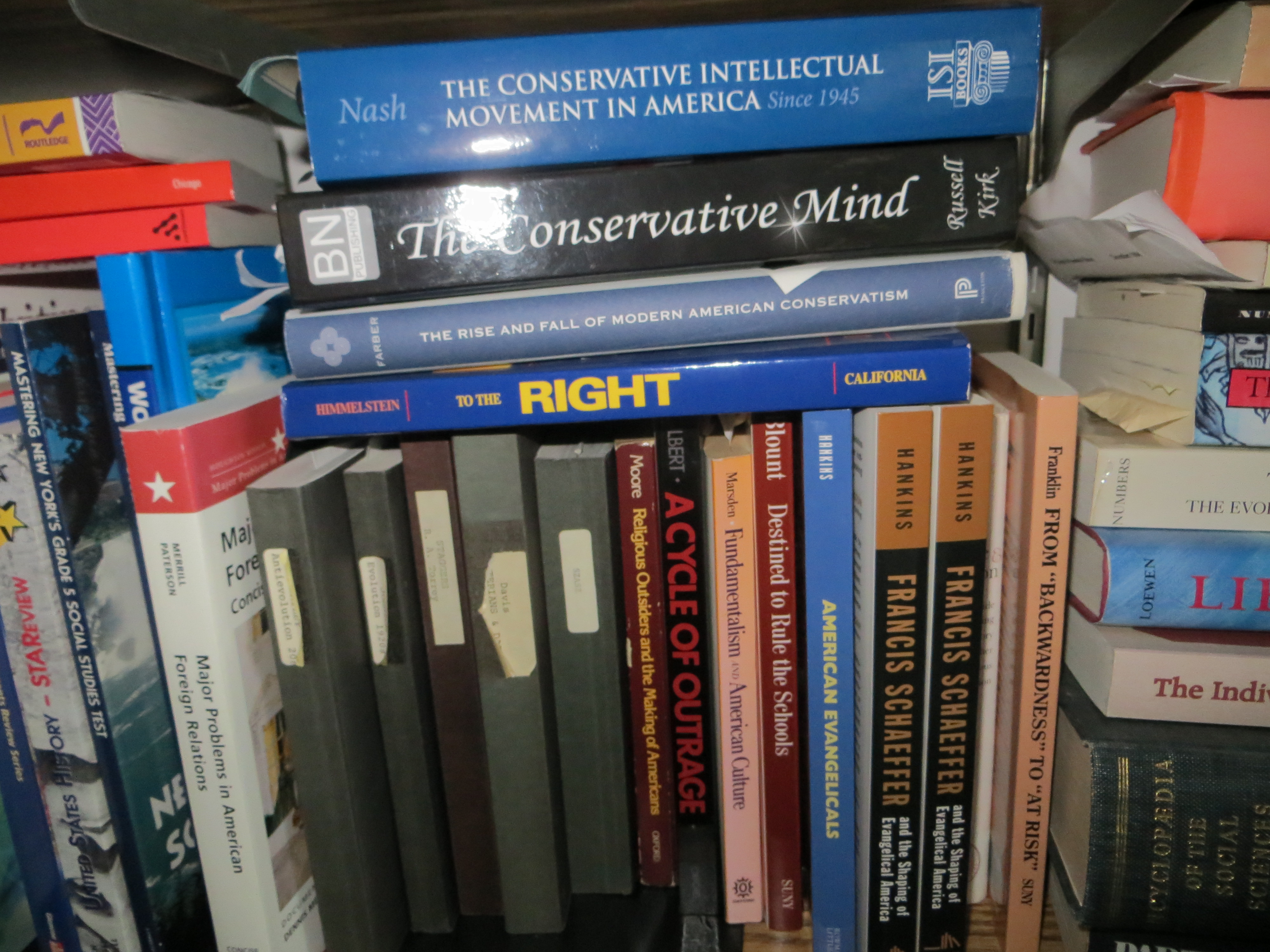
Today we’re sharing our second shelfie.  Last time we posted our front-and-center pile of books.  This time, we’re going just to the left.

What's on YOUR shelf?

What’s on YOUR shelf?

Starting at the top, we have George Nash’s crucial 1976 Conservative Intellectual Movement in America.  Everyone who hopes to understand American conservatism should read this volume.  Nash famously argued that the postwar conservative intellectual movement brought together disparate strains of conservative thinking into a consciously fusionist effort.  Burkean traditionalists allied with libertarians and anti-communists to make a newly powerful movement.  The book itself is terrific, though some later readers have assumed that Nash was speaking more broadly than he was.  See below.

Russell Kirk’s The Conservative Mind has been just as potent a book as Nash’s among conservative nerds.  Writing in the 1950s, Kirk attempted to establish a long and unbroken chain of conservative intellectualism from Edmund Burke through the mid-twentieth century.  Along the way, Kirk emphasizes an idiosyncratic group of writers and politicians as leaders of conservatism, and repositions conservatism as a central tradition of American life and letters, rather than as a collection of fringe loudmouths.

I also like David Farber’s The Rise and Fall of American Conservatism.   Last spring, I taught a senior seminar for history majors in the history of American conservatism.  I waffled on whether to make Farber’s book the central narrative.  In the end, I chose to have students read Kirk instead.  Why?  Unlike Kirk, Farber writes from outside the movement.  He defines conservatism more narrowly, and in a way that would not challenge the thinking of the undergrads, I decided.  For Farber, conservatism consists mainly of a political fight against “liberalism.”  Conservatism got its start, Farber argued, with Robert Taft’s fight against the New Deal’s big-government approach to social welfare.  To many of the students I worked with, Reagan-esque anti-government conservatism is the only kind they know.  Farber’s book is a great history of that sort of conservatism.  But I wanted to get smart sophisticated students to make the definition of conservatism their central intellectual challenge.  Farber’s book made it too easy for students to think that Reagan’s style of conservatism was the ONLY definition of conservatism.

Jerome Himmelstein’s To the Right is a sociological look at the boundaries of American conservatism.  It is worth reading.  IMHO, though, it takes Nash’s definition too glibly as its starting point.  Himmelstein assumes too comfortably that “conservatism” is nothing more nor less than the definition William F. Buckley and his comrades gave it in the 1940s and 1950s.  Too simple.

Starting with the blue-bound dissertations on the left, I recommend two: Kenneth K. Bailey’s Anti-Evolution Crusade of the Nineteen-Twenties (PhD dissertation, Vanderbilt University, 1954); and Ferenc M. Szasz, “Three Fundamentalist Leaders: The Roles of William Bell Riley, John Roach Straton, and William Jennings Bryan in the Fundamentalist-Modernist Controversy ,” (PhD dissertation, University of Rochester, 1969).  Historians of religion will likely know Szasz’s name; he went on to a glorious academic career.  His dissertation study of these three leaders is still worth reading.  Bailey’s dissertation suffers from a simplistic understanding of the nature of fundamentalism, but his collection of newspaper accounts is still unbeaten.  I relied on both of these dissertation while writing my dissertation book.  For everyone interested in 1920s fundamentalism and anti-evolution, they are worth hunting down.

Laurence Moore’s Religious Outsiders is also required reading.  Though these days no historian of religion would say that Moore’s “outsiders” don’t get academic attention, at the time Moore’s book came out it pushed the field in healthy new directions.

I don’t know why James Gilbert’s A Cycle of Outrage doesn’t get more attention.  It is one of my favorite academic histories.  Gilbert takes a look in this book at a central question for all of us interested in education and culture.  Why was there such an explosion of anxiety in the mid-twentieth century about crime and criminality among young people?

Of course, I have the old dog-eared copy of Marsden’s Fundamentalism and American Culture relegated to a side position now that I’ve finally purchased the 2006 revised edition.

Educational historians out there will recognize Jackie Blount’s Destined to Rule the Schools.  Among educational historians, one of the most studied and fruitful lines of questioning has been the complicated relationship between femininity and schooling.  On the one hand, the systematization of public schooling often put men principals and superintendents in charge of female classroom teachers.  Women were seen as “naturally” more fit for caring for young people; men were seen as more fit for running the show.  But as Blount explores, many women were able to use stereotypes of femininity to build a professional network as school administrators as well.

Next up, two of Barry Hankins’ titles, American Evangelicals and Francis Schaeffer.  For people with an interest in the history of American evangelicalism, I can’t recommend the first title strongly enough.  Hankins is a terrific writer and a keen historian.  In this book he combines readability with academic thoroughness, which is hard to do.  And, as readers are aware, there are few intellectual figures as central as Schaeffer to the mind of evangelical America.  As you can see, I ended up with an extra copy somehow.  If anyone would like it, just let me know; I’ll be happy to put it in the mail for you if you send your land address.

It’s almost impossible to see hidden in there, but I also like Stephen Pyne’s Voice and Vision: A Guide to Writing History and Other Serious Nonfiction.  There are a lot of “so-you-want-to-write-a-dissertation” books out there, and I’m sure every nerd has his or her favorite.  I like Pyne’s book for its combination of nitty-gritty advice and head-in-the-clouds ambition.  It’s not easy to remember how difficult it can be for beginners to write academic history.  I always recommend Pyne’s book for graduate students with whom I work.  They never have any free time for extra reading, but I think Pyne’s guide is worth their time.

Last but not least, I’ve got Barry Franklin’s From ‘Backwardness’ to ‘At-Risk.’ I got this book to use with my doctoral history-of-ed class.  In the end, it got bumped from the syllabus.  But the book is still very much worth reading for those interested in educational history.  As the title suggests, it looks at the history of what we now call “special education.”  In addition to telling this story, though, Franklin offers insights into the way educational policy has been framed and the ways students have been defined.

OK, nuf sed!  Send in your shelfies so we can all get a sense of what you’ve got on your shelf and why.


Introducing: Shelfies!

What’s on your shelf?  What do you read to help you figure out questions about conservatism and American education?

I Love You But You’re Going to Hell is happy to introduce a new feature: Shelfies.  Readers are invited to send pictures of their bookshelves with annotations.  You can send them to the editor: alaats@binghamton.edu  Make sure the titles are legible.

Here’s a shelfie from our editor’s office:

What's on your shelf?

What’s on your shelf?

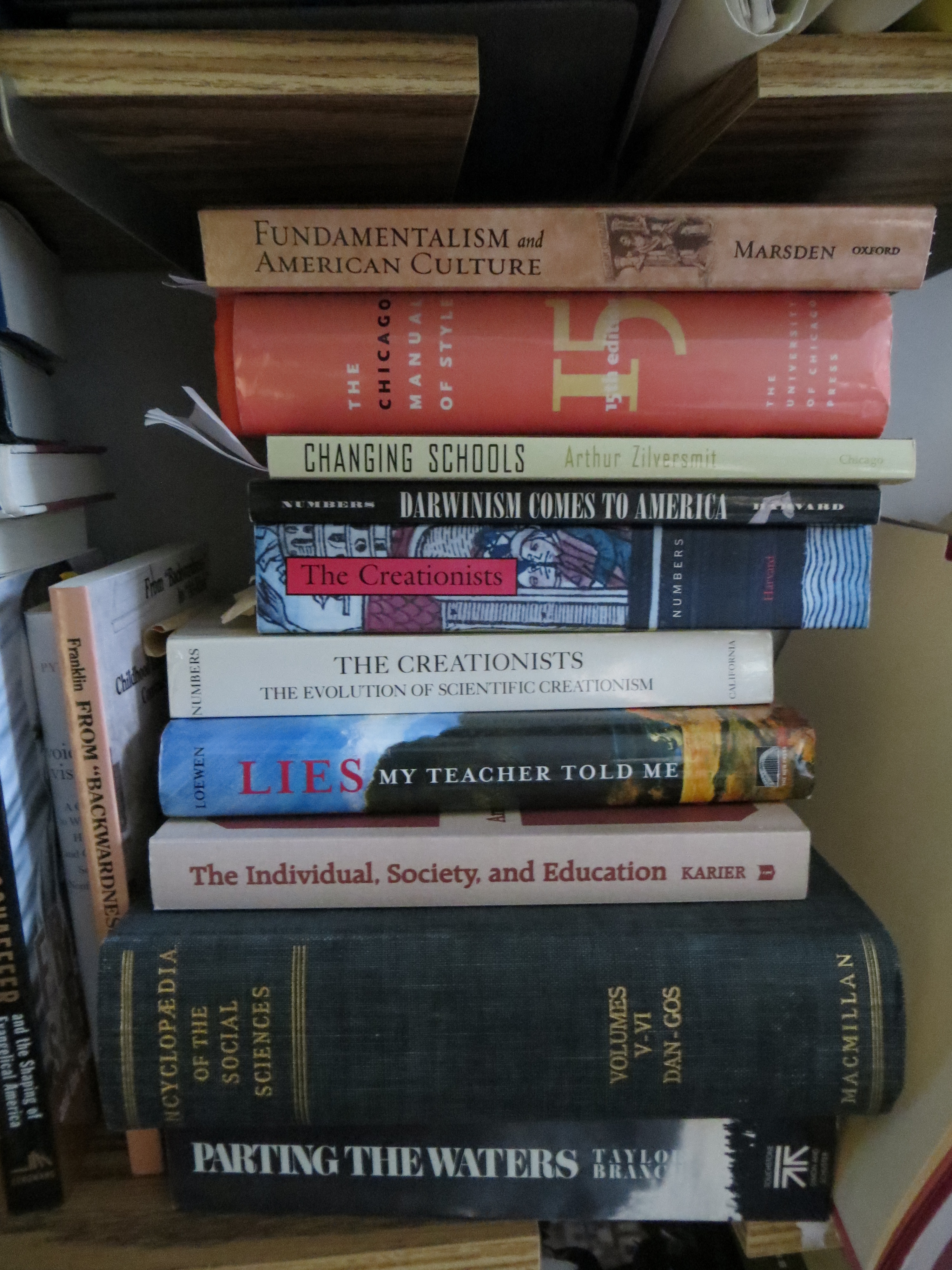
This is one of my go-to piles in my current work.  Here’s the breakdown:

1.) George Marsden’s Fundamentalism & American Culture.  It was this book (in an earlier edition) that first got me interested in the culture and activism of conservative evangelical Protestants.

2.) Arthur Zilversmit’s Changing Schools.  I refer to this book regularly.  It looks at the slippery nature of “progressivism” in American schools in the crucial period of 1930-1960.

3, 4, & 5.) The Ron Numbers Collection: Ron was my mentor in grad school at Wisconsin.  His work on creationism has been the bedrock reference for my historical research.

6.) James Loewen, Lies My Teacher Told Me.  I use this book regularly with my students who are going into history education.  Loewen’s tone is always a little too strident for my tastes, but this book is always good for those who are thinking about teaching history for a living.

7.) Clarence Karier, The Individual, Society, and Education.  This is a good book.  Not enough people seem to read it these days.  Karier looks somewhat idiosyncratically at the long history of education in the United States.

8.) Encyclopedia of the Social Sciences, 1935.  In this volume, historian Richard Niebuhr (brother of theologian Reinhold) offers an early and skewed definition of “fundamentalism.”  Niebuhr concluded, without much evidence, that fundamentalism was a rural phenomenon, an outgrowth of ignorance and isolation.  Though this definition doesn’t match the historical record, it proved enormously influential.  For decades, non-evangelical scholars accepted Niebuhr’s slanted definition without demur.

9.) Taylor Branch’s Parting the Waters. This well-known civil-rights history is there because I needed something to cover the gap in my bookshelves.  I can’t say I’ve ever read it, though I’ve always meant to.

So how bout it?  Send in some shelfies, tell us about what you’re reading.

Required Reading: Molly Worthen on the Intellectual Civil War among American Evangelicals

What does it mean to be an “evangelical” in America?

Molly Worthen of the University of North Carolina—Chapel Hill discussed her latest book recently with Tiffany Stanley of Religion & Politics.  The interview is sprinkled with gems that make me look forward to reading Worthen’s new book, Apostles of Reason: The Crisis of Authority in American Evangelicalism.

apostles of reason

Of course, for those of us interested in the intersection of conservative politics and American education, the meanings of “evangelical” are always of intense interest.  Controversies over sex education, prayer in schools, and creationism often feature conservative Protestant evangelicals as main players.

What does it mean to be “evangelical?”  In this interview, Worthen suggests three central questions that define the boundaries of the evangelical experience.  As she explains them,

First, how do you reconcile faith and reason? How do you maintain one coherent way of knowing? Second, how do you become sure of your salvation? How do you meet Jesus and develop a relationship with him, to use the language that some evangelicals prefer. And third, how do you reconcile your personal faith with an increasingly pluralistic, secular public sphere?

Worthen also suggests some useful insights into the complex interaction between evangelicalism and education.  For example, how does the historically defined divide between white and black evangelicals play out in schools?  As Worthen puts it,

If you really grilled black or Latino Protestants on this question [of creationism], many of them would say, “I prefer the Genesis narrative to Darwin’s account, but do I get worked up about it? No. I’m more concerned about educational opportunities for my kids and more concerned about structural injustice.”

And of creationists in general, Worthen hits on the deeper intellectual divide at the heart of the evolution/creation trenches.  “I think it’s a mistake,” Worthen told Religion & Politics’ Stanley,

to understand creationists as “anti-science,” at least if we want to understand how they see themselves. The reality is that the creationist movement comes out of a tradition of Biblical interpretation that understands itself as deeply rationalist, deeply scientific, that rests on the premise that God’s revelation is all one, that God is perfect and unchanging, and therefore his revelation must be perfect and unchanging too. Our two modes of encountering his revelation, in scripture and in the created world, cannot contradict each other. . . . To understand reality accurately, they say, you must take as your founding assumption the truth of God’s revelation. I think that is crucial for understanding the frame of mind of creationists and how they view their project.

Of course, as Dr. Worthen knows, it meant very different things to assert this “creationist” way of knowing in 1877 than it did in 1977.  As she points out, one of the main features of the American evangelical experience has been a profound and continuing tension between the claimed authority of religious leaders and that of the wider secularizing society.

In schools, this evangelical “crisis of authority” has often played out as a continuing tension between a lingering desire to assert Protestant authority over “our” schools and a lamentation that “God has been kicked out” of American education.

One of the continuing dilemmas of religious historians has been to reconcile the mixed bag of evangelical intellectual life.  On one hand, American evangelicalism has included many of the great thinkers of the American tradition.  On the other hand, it has included in its big revival tent some of America’s most fervently anti-intellectual personalities.  I’ll look forward to reading in more detail about the ways Worthen wrestles with these perennial questions.

Creationists Are Right, Leading Atheist Concludes

Sorry for the overly dramatic headline. But that really is one of the conclusions of atheist mathematician Jason Rosenhouse.

They are not right that the earth is some 6,000 years old.  Nor are they correct that humans are the special beloved product of God’s magic touch.  But in his book Among the Creationists, Rosenhouse concludes that young-earth creationists are correct that the foundational idea of evolution poses a threat to the very core of Christian belief.

Get your copy today!

Get your copy today!

Rosenhouse’s book is required reading for any outsider who hopes to understand the world of American creationism in the twenty-first century.  Rosenhouse deliberately eschews the simple, satisfying approach of most outsiders.  He does not belittle or deride these ideas or their adherents, though he does forcefully argue against them.

As Rosenhouse describes, he is a mild-mannered mathematician with an unusual hobby.  For the past several years, he has attended creationist conferences and pored through creationist publications.  This experience did not soften Rosenhouse’s intellectual opinion about the scientific illegitimacy of creationism. But it did open his eyes to the galaxy of different types and approaches to creationism. And it convinced him of the overriding need to maintain civility, especially in these difficult discussions.

Indeed, some of the most illuminating parts of the book are the vignettes Rosenhouse includes.  In one story (pages 8-11), he describes an impromptu conversation in a Subway restaurant outside of one of the creationist conferences he attended.  Rosenhouse overheard a group of Christian creationists—a woman and some teenagers—talking about the strangeness of atheism.  He offered his conversational services as a real live atheist.  The young people seemed interested and willing to talk cordially. A nearby woman soon interrupted and warned the teenagers away from Rosenhouse, who she suggested had “been educat[ed] beyond [his] intelligence” (10).  In the end, though, the Christian busybody warmed up to Rosenhouse and even prayed for him.

Did anyone convince anyone else?  No.  But was this conversation worth having?  I think so. Rosenhouse reported feeling that the adults were occasionally rude in their obvious opinion that he was some sort of “zoo animal” (10).  But he also noted that creationists like the ones at Subway almost always remained cordial and even welcoming.  Was he likely to convert to creationism or conservative Protestantism?  Not at all.  But his understanding of the entire dilemma did change in important ways.  How about the people he spoke with? Were any of them likely to embrace the obvious truths of mainstream science? Also not likely.  But my hunch—and Rosenhouse’s—is that such friendly conversations with a real live atheist do a great deal to keep open the minds of creationists everywhere.  As Rosenhouse states, “any hope of doing long-term good comes from being scrupulously polite” (10).

Indeed, Rosenhouse occasionally takes “our side” to task for its own brand of ignorance. As he points out, “Insularity is a two-way street” (15).  If some of the ferocious anti-creationists out there took some time to find out more about the real world of American creationism, they would without a doubt be surprised at what they found. For one thing, with a few exceptions, Rosenhouse’s loud-and-proud scientific atheism was welcomed to these creationist conclaves with politeness and even intellectual excitement.  Second, creationism is a bigger tent than many outsiders understand. One creationist conference organizer, for instance, complained to Rosenhouse about the “piles of garbage” that passed as scholarship among creationists (14).

Throughout the book, Rosenhouse succeeds at illuminating the intellectual world of creationism.  He takes such beliefs seriously, while never granting them legitimacy as scientific ideas.  For example, Rosenhouse laments the “tiresome” assumptions of some of his non-creationist colleagues about the biblical beliefs of creationists (43). Rosenhouse carefully explains some of the ways creationists interpret the Bible.  The label “Literalism” does not do justice to this tradition.  For most creationists—or at least for the “mainstream” tradition of young-earth creationism—passages in the Bible should be taken at their obvious meaning.  If something is clearly meant as a parable, it should be read that way.  But readers should not add in baroque interpretive schemes to warp the Bible’s clear meaning into more culturally palatable explanations. As Rosenhouse concludes, Genesis really does support a YEC interpretation. There is not much in the text to suggest that these passages were meant to be read as anything but real descriptions of real historical events.  More provocatively, Rosenhouse challenges us non-creationists to grant creationists their fair treatment. If creationists’ dismissal of all evolutionary science is absurd, so it is arrogant and self-serving for us simply to dismiss such a widely held belief (159, 167).

For those who have not yet read this book, all this might make it sound as if Rosenhouse fell in love with creationism as he falls all over himself to find the tiniest points of agreement.  Nothing could be further from the truth.  Rosenhouse never grants the truth claims of creationists.  He sternly and repeatedly opposes both their notions and their tactics.  For instance, Rosenhouse revisits some of the oldest anti-creationism arguments.  Where did Cain get his wife? (164) Why do creationists only insist on some parts of Genesis, and not others?  Why, for example, do creationists not insist the earth is flat, with a dome-shaped covering? (163)  Just as a literal six-day creation seems to be the obvious interpretation of the Bible’s first lines, so a flat earth is the most near-to-hand interpretation of the text.  These old chestnuts, Rosenhouse argues, still have more than enough punch to deflate the most self-satisfied creation scientist.  More important, Rosenhouse points out that most creationist science is based on utterly false interpretations of basic concepts.  Even worse, creationists often suggest that evolution is only dominant due to a wide-ranging conspiracy, a claim Rosenhouse justly dismisses as pathetic (36).

Yet in spite of his firm opposition, Rosenhouse concludes that creationist reactions to the challenge of evolution are more intellectually respectable than those who try to marry creation and evolution. It makes no sense, Rosenhouse argues, to pretend that evolution does not fundamentally challenge traditional faith (219).  Some creationists respond in a way that makes sense; they reject evolution.  They may be entirely and sometimes cruelly wrong, Rosenhouse believes, but at least they have recognized the magnitude of the challenge posed to traditional Christian belief by evolution.

So stop reading this tripe and go get yourself a copy of Rosenhouse’s book.  For those of you who are creationists or recovering creationists, the volume will give you a sense of how the movement appears to a socially pleasant but intellectually hostile outsider. To us outsiders—liberals, scientists, and others who have only tangential knowledge about American creationism—this book is an absolute must read.  It joins other indispensable books in this field, such as Ron Numbers’ The Creationists, George Marsden’s Fundamentalism and American Culture, and Edward Larson’s Summer for the Gods as starting places to understand this durable culture war battlefield.

Summer Reading List

Summer is here…or close enough.  What are people planning to read?  Seems like everyone and their brother are publishing their summer reading lists.  Hoping to beat Oprah’s 2013 list to the punch, here are a few from ILYBYGTH’s idiosyncratic dream library:

1.)    Jason Rosenhouse, Among the Creationists.

This is one I’ve been excited about for a long time.  Rosenhouse is an atheist mathematician with a familiar hobby.  For years he has traveled to creationist conferences and interacted with creationists and their ideas.  From the publisher’s description:

After ten years of attending events like the giant Creation Mega-Conference in Lynchburg, Virginia, and visiting sites like the Creation Museum in Petersburg, Kentucky, and after hundreds of surprisingly friendly conversations with creationists of varying stripes, he has emerged with a story to tell, a story that goes well beyond the usual stereotypes of Bible-thumping fanatics railing against coldly rational scientists. Through anecdotes, personal reflections, and scientific and philosophical discussion, Rosenhouse presents a more down-to-earth picture of modern creationism and the people who espouse it. He is neither polemical nor insulting, but he does not pull punches when he spots an error in the logical or scientific reasoning of creationists, especially when they wander into his own field, mathematics.

Right up my alley.  I’ve got the book on my table, top of my list.

2.)    Amy Binder and Kate Wood, Becoming Right: How Campuses Shape Young Conservatives.

As we noted here earlier, this book suggests that higher education is a more ideologically complicated place than many pundits suggest.  Many self-identified conservative intellectuals have panned the book as “patronizing.”  Bruce Bawer at Minding the Campus skewered the title as an example of “the insularity and obtuseness of the academic left.”  I’m looking forward to reading the book more carefully myself.  Do these criticisms hold water?

3.)    Charles J. Holden, The New Southern University: Academic Freedom and Liberalism at UNC .

For my next book project, I’m considering a look at conservative Protestant higher education through the twentieth century.  Holden’s new book examines the flagship “Southern” university in Chapel Hill during the formative decades between the World Wars.  As reviewer Wayne Urban noted in an H-Net review, Holden focuses on the ways UNC served as a bastion of “liberal” thinking and culture during these decades.  In my study of conservative evangelical Protestantism in the 1920s, I found that UNC did indeed often lead the charge for a politicized vision of what it meant to be both “intellectual” and “Southern.”  As I think about diving deeper into the world of “fundamentalist” university life, I hope Holden’s work will help broaden my understandings of the meanings of higher education in this period.

4.)    Hubert Dreyfus and Sean Dorrance Kelly, All Things Shining: Reading the Western Classics to Find Meaning in a Secular Age .

This title is not particularly new, nor is it focused tightly on the areas I usually read about. That’s why I think it will make good summer reading.  According to a gushing review in the New York Times, Dreyfus and Kelly begin with the assumption that “The gods have not withdrawn or abandoned us.  We have kicked them out.”  Since I spend so much of my time reading arguments for the continuing centrality of ferocious, doctrinal monotheism, this argument looks like an intriguing counterweight.

What else are people planning to read this summer?  Books from outside your usual “work” fare?  Books recommended long ago but put on the ever-growing “to be read” pile?

Scientists Are Dumb

What do elite scientists know about religion?

Not much, according to sociologist Elaine Howard Ecklund.  Asking these out-of-touch elite scientists for advice about religion is akin to asking residents of a nudist colony for advice about fashion.

If anyone would know, it would be Ecklund.  In her study of scientists, between 2005 and 2008, she surveyed 1700 scientists from what she called “elite” schools (157-158).  She announced her goal in her 2010 book Science vs. Religion: to give voice to “the scientists whose voices have been thus far overlooked in the science-and-religion debates” (x).

To this reader, Ecklund seems to have made a strange decision to include social scientists—economists, political scientists—in her sample.  It seems a better fit to call her sample elite “academics” instead of elite “scientists.”  Other reviewers have pointed out different complaints.

But whatever the merits or faults of the study as a whole, it tells us something about the connection between some elite academics and the rest of America.  As Ecklund describes, the religious affiliation of her sample does not match that of Americans as a whole.  Among her sample, only two percent identified as “evangelical Protestant,” compared to twenty-eight percent among the general population.  Only two tenths percent as “Black Protestant,” compared to the general public’s eight percent.  Nine percent identified as Catholic, compared to twenty-seven percent of the public.  Sixteen percent were Jewish, compared to the general population’s two percent.  Perhaps most interesting, given recent attention to the rise of the “nones,” a full fifty-three percent of Ecklund’s sample claimed no religious affiliation, compared to sixteen percent of the rest of us. (15).

The same trend was true when it came to professing atheism or agnosticism.  In Ecklund’s sample, just over one-third called themselves atheists, compared to a mere two percent of the American population.  Thirty percent called themselves agnostic, compared to the general four percent.  And a relatively meager nine percent agreed with the statement “I have no doubts about God’s existence,” compared to a whopping sixty-three percent of the general public (16).

These elite academics, then, certainly do not match the rest of America in religious ideas or identity.  That really doesn’t come as much of a surprise.  But Ecklund argues more provocatively that this religious quirkiness among elite academics also creates a sort of self-perpetuating echo chamber.  It creates what Ecklund calls three “myths scientists believe” (152).

First, Ecklund charges, elite academics tend to think that if they ignore religion, it will go away.  Second, they too often equate all religion with an imagined bogeyman of “fundamentalism” (153).  And elite academics tend to think that “All evangelical Christians are against science” (155).

The utter lack of evidence for all these myths does not stop elite academics from feeling correct, even intellectually superior to those who question their blundering assumptions.  As Ecklund argues, non-religious academics often have little idea even about the working of religion on their own elite campuses, “much less about what drives a typical American worshipper” (8).

Ecklund depicts an environment on some elite college campuses that encourages, or at least allows, growths of strange ideological excess.  One physicist she interviewed—admittedly one extreme end of Ecklund’s sample—described religion as a “virus” to which he is “immune” (13).

Most of her interviewees did not express such virulent hostility, but many of the traditionally religious folk still expressed a felt need to live a “closeted faith” (43).  Even when they had some religious colleagues, these elite academics often felt surrounded by angry anti-religion.  One self-identified “Christian” academic told Ecklund about a conversation with a colleague about their students’ poor academic preparation.  The fault, this Christian was told, was with “stupid intelligent design.  It’s stupid Christianity” (45).  Her colleague had not meant to offend, but had simply assumed that such comments could not be considered offensive.

In this self-reinforcing world of arrogant ignorance, many of the academics in Ecklund’s study made strange and unwarranted assumptions.  One biologist, for example, assumed that “mature” students would not consider creationism.  Advanced students, this biologist explained, “are just not religious in the first place.”  But this biologist, Ecklund points out, really had no idea about the religious ideas or backgrounds of his students (78).

Even on their own campuses, most of Ecklund’s sample reported woeful ignorance of attempts to promote dialogue between science and religion.  “The reality of university life,” Ecklund argued, “does not match these scientists’ ideal” (98).

Yet this ignorance among elite academics did not create a questioning or humble attitude.  One social scientist, for instance, explained how she began her classes.  “You don’t have to distance yourself from religion,” she told her new students, “and think about it from an outside perspective, but you do if you want to succeed in this class.  And if you don’t want to do that, then you need to leave” (84).

How can such smart people say such dumb things?  How can elite academics profess such blinkered ideas without even recognizing their own biases?  As a product of two of the “elite” schools in Ecklund’s sample (Washington University in St. Louis and University of Wisconsin—Madison), I can attest to the fact that the environments in such places can lead to a perception of a single, right, “progressive” orthodoxy.  But even academics should be allowed their own opinions, right?  Even if they are grossly out of line with popular notions?

The real question, to my way of thinking, is this: How can people who have purportedly dedicated their professional lives to increasing their knowledge allow themselves such lamentable ignorance when it comes to religion?