The Revisionaries

I don’t often wish I lived in a bigger city.  But with the limited release of a new documentary, I’m wishing I had a chance to see it.

The Revisionaries has been released in a few cities and film festivals.  According to its producer, this documentary focuses on the intellectual and political worlds of Don McLeroy.

A short review in the New York Times emphasizes the “startling” way conservatives such as McLeroy and Cynthia Dunbar injected partisan and sectarian ideas into the curriculum of Texas in 2009-2010.

As I noted in an article in Teachers College Record a little while back (behind a paywall, unfortunately, but the executive summary is public), Dr. McLeroy cared about more than just creationism.  As Russell Shorto pointed out in a New York Times article, McLeroy insisted that Texas schoolchildren be taught “two basic facts about man.  He was created in the image of God, and he is fallen.”  According to amendments proposed by McLeroy, Texas students should also learn more about Ronald Reagan’s “leadership in restoring national confidence”
and about the positive contributions to American history from such conservative icons as “Phyllis Schlafly, the Contract with America, the Heritage Foundation, the Moral Majority and the National Rifle Association.”

I am looking forward to seeing the film.  I have a couple of worries.  Though this morning’s NYT review insists that producer Scott Thurman is “admirably evenhanded,” the clips available on the film’s website suggest that the documentary is yet another breathless expose of the deeply conservative ideas of McLeroy and his allies.

I hope not.  I think those of us outside of the intellectual world of activists such as McLeroy and Dunbar will benefit from a sincere attempt to truly understand their worldview.  After all, it is a vision of American culture and education that is enormously popular.  Another piece of journalism or filmmaking that hopes simply to mock or deride those ideas won’t help at all.  We KNOW we don’t agree with these ideas.  We don’t need to be reminded that some people hold these ideas.  What is really interesting, in contrast, are the arguments folks like McLeroy might make to support their beliefs in a young earth.

So, for those in Pasadena, NYC, Denver, Sarasota, or other screening locations, make some time to check out the film.  Be sure to send your thoughts, reviews, and comments to us here at ILYBYGTH.  Out here in the boonies, we’ll only wait for the film to get around to our neck of the woods.

Required Reading: Evolution, Creationism, and the Battle to Control America’s Classrooms

For those who care about creationism, evolution, and America’s schools, stop reading this shine-ola and go get your hands on a copy of Michael Berkman’s and Eric Plutzer’s Evolution, Creationism, and the Battle to Control America’s Classrooms (New York: Cambridge Univ Press, 2010).  Not only is this the best “street-level” analysis about the way real teachers teach evolution and creationism, but the authors’ approach sheds light on schooling and culture far beyond the bounds of biology instruction.

Image source: Cambridge University Press

The same authors released some of their survey data in an article in Science in January 2011.  That National Science Foundation-funded survey of 926 high-school biology teachers from across the United States offered dramatic results.  A full 13% of respondents taught creationism or intelligent design in their public-school biology classrooms.  Twenty-eight percent taught recognizably evolutionary biology.  The rest, roughly 60%, muddled through in the middle, teaching neither or both evolution and creationism.  This book is built around the same survey responses, but it contains much more.

The authors argue compellingly that the evolution/creation deadlock involves three moving parts.  Berkman and Plutzer label these the procedural issues, the substantive issues, and the issues concerning the autonomy of teachers.  In other words, the tangle of evolution includes issues of who decides what gets taught, the science and religion involved, and the final decisions of teachers themselves.

Not surprisingly, these political scientists conclude that the real question here is political.  More than simply science, more than just religion, the contest is at heart “a political struggle over who decides, a question central to democratic politics” (31).

Perhaps the most attention-grabbing part of the authors’ Science article in January 2011 was the sheer volume of anti-evolution education that went on in American public-school biology classes.  As they argue in the pages of the book, their 13% number as a mark for the number of teachers who actively teach creationism or intelligent design is actually a lowball.  The real number may surge more toward 21% (138).

For those like me who want more evolution taught in America’s schools, Berkman and Plutzer’s findings may be profoundly disheartening.  For instance, in addition to the very high numbers of teachers who omit evolution, teach both ideas, or teach explicit creationism, the authors conclude that teachers don’t care too much about changing state standards in science (160).  Thus, while evolution promoters may work hard to improve those standards, the authors here suggest that actual classroom practice will likely not be much affected.

The most important factor in teachers’ choices about evolution education, Berkman and Plutzer conclude, remains teachers’ personal opinions.   Although some factors, such as a full-semester college course devoted to evolutionary biology, may tend to improve the quality and amount of evolution education offered by teachers, such changes pale in significance compared to teachers’ beliefs.  Dwarfing every other factor, if teachers don’t believe evolution, they don’t teach it (186).

Another powerful contribution of the book is the authors’ application of the notion that teachers function as what political scientists call “street-level bureaucrats” (149).  Like other such functionaries, teachers often teach what their communities want them to teach.  In the United States, despite the chagrin this causes among evolutionary scientists, large majorities want their public schools to teach both evolution and creationism, or even creationism alone (49).  This is true even among those American adults who agree that mainstream scientists have agreed on the veracity of evolution.  Berkman and Plutzer analyze a fistful of polls and surveys to conclude that, even among the 52% of adults who agree that mainstream science has embraced evolution, only 20% want only evolution taught in their local public schools.  You read that right.  Even when Americans acknowledge the scientific consensus in favor of evolution, they still favor teaching both evolution and creationism, or even creationism alone.

As “street-level bureaucrats,” teachers tend to fit in with their local communities.  Among the 926 teachers who responded to Berkman and Plutzer’s survey, most agree with the attitudes in their area.  For instance, among the 136 “most cosmopolitan” school districts, only 4% of teachers taught young-earth creationism.  On the flip side, among the 139 “most traditional” school districts, a whopping 37% of teachers taught young-earth creationism (198).

The book contains chapter after chapter of survey analyses like these.  If you’re like me, you’ll want to buy a copy to keep on your desk as a reference for all the different surveys and multivariate regression charts the authors include.  But the survey and polling data are not the only strength of the book.  Also extremely helpful is the authors’ sketch of the structure of the durable evolution/creation controversy.  As they point out, we will never make heads or tails of it if we understand it as mainly a scientific or religious dispute.  Those “substantive” issues are very important, but they are not the whole problem.  This is why, for instance, many mainstream scientists will insist that there is no controversy over the teaching of evolution.  They mean, of course, that the scientific community does not dispute whether or not evolution should be taught.  If we end there, however, we will remain hopelessly flummoxed over the nature of the continuing controversy.  Because, of course, there is a controversy.

The authors suggest two other important dimensions.  First, we need to get our heads around the “procedural” elements at play.  Where do decisions about teaching get made?  By courts, to protect minorities?  By legislatures, to represent majorities?  By professional bodies such as the American Academy for the Advancement of Science, to ensure superior expertise?  If we ignore these crucial questions we’ll never understand the nature of the impasse.

Also, Berkman and Plutzer inject a new element into these discussions.  Unlike the generations of historians, scientists, theologians, and political scientists that have preceded them, the authors emphasize the critical importance of the “autonomy of teachers” (29).  Teachers can and do consistently make daily decisions about the kind of instruction that goes on in America’s public schools.  Without looking at the impact of those decisions, we will never be able to wrap our heads around the true contours of this culture-war debate.

The authors conclude that these questions remain, at root, a fundamental “political struggle over who decides” (31).  This insight alone makes a significant contribution to stale discussions over the nature of evolution/creation.  Some of our brightest minds have foundered over this simple truth.  In a recent book, for instance, philosopher Philip Kitcher implies that the conflict has lasted so long primarily because the two sides have not adequately understood one another.  In Living with Darwin (2007), Kitcher writes, “detailed replies” to creationist challenges have calmed the controversy temporarily (3).  Yet, due to lack of understanding by creationists, Kitcher suggests “we shall not escape the cycle of controversy until it is completely clear what lies at the bottom of it all” (xi).  Clearly, Kitcher knows the science involved.  He knows the theology involved.  But his implication that a clear enough explanation will somehow clear the air ignores Berkman and Plutzer’s convincing point: this is not about understanding, this is about power.

No matter how brilliant and erudite Kitcher’s explanations of evolution, no matter how clear and cogent his arguments, Kitcher and his ilk will ultimately have little effect on the course of the creation/evolution debates.  Of the teachers who teach creationism in Berkman and Plutzer’s survey, 32% had completed a college-level semester-long course devoted entirely to evolutionary science, 55% held a bachelor’s degree in science, 13% held a graduate degree in science, and 49% had earned 40 or more college credits in biology courses.  It is not that teachers of creationism don’t know the evidence for evolution.  They simply reject it (186).  After all, how clear and convincing would an argument based on the Old and New Testament have to be to convince Kitcher of the truths of creationism?

For all its explanatory power, Evolution, Creationism, and the Battle to Control America’s Classrooms includes a few minor hiccups.  First of all, the authors insightfully note that the essence of the evolution/creation struggle has been a struggle for control of educational decisions.  But among the groups involved–“Federal judges, scientists, education policy makers, and teachers” (13)—the authors curiously omit parents as direct curricular decision-makers.  Since at least the 1920s, activists have insisted on the rights of parents to control the curriculum for their own children.  Recently, in places such as New Hampshire and Missouri, as I’ve argued in these pages and in the Washington Post’s Answer Sheet, state laws have changed the playing field.  These new laws have finally introduced what Berkman and Plutzer might call direct curricular democracy.  Not only can judges, scientists, policy makers, and teachers take part in this durable battle, but parents can and have successfully exerted their significant political influence.  The authors’ failure to include parents as interested and influential parties is a puzzling omission.

In addition, as political scientists, the authors overlook some simple historical errors.  They date the end of the American Civil War, for instance, to 1869 (66).  In a similar slip, they refer to the leading creationist Seventh-day Adventist Church as the Seventh Adventist Church (91).

But such minor quibbles do not detract from the overall argument.

The authors will likely continue to attract the most attention for their original survey data of biology teachers.  And those data are indeed compelling.  But far more important to understanding the nature of the creation/evolution debates are the authors’ arguments about the inherently political and deeply local nature of those debates.  They are not decided in state houses, but in school houses.  They are not decided in courtrooms, but in classrooms.


“Awash with the intolerance of enthusiasm:” Michael Ruse Takes on the New Atheists

I don’t think I’d like to be Richard Dawkins in a dunk tank.  The provocative and prolific New Atheist, though, seems to relish his role as cultural provocateur.  Dawkins is well known for his biting and vicious jabs against faith.  One of his most famous books derides “The God Delusion.”  In 1996, Dawkins told one audience, “faith is one of the world’s great evils, comparable to the smallpox virus but harder to eradicate.”  Elsewhere, Dawkins opined, “I think there’s really something very evil about faith.”

A recent article by philosopher of science and anti-creationist Michael Ruse takes Dawkins to task for being so fanatically religious in his atheism.  Ruse argues that the virulent anti-religion of Dawkins and his followers awkwardly conceals “the enthusiasm of the true believer, and this encourages a set of unnerving attributes: intolerance, hero-worship, moral certainty and the self-righteous condemnation of unbelievers.”

Ruse himself claims to be more atheist than Dawkins, more Darwinian.  Ruse has fought tirelessly against creationism in schools and culture.  Yet he insists that Dawkins’ brand of in-your-face atheism misses the point.  Instead of condemning religion as fit only for the ignorant or insane, as Dawkins likes to do, Ruse insists, “I think my religious friends are mistaken, but I don’t think they are stupid or crazy or ill or evil simply because they are religious.”

Though Ruse claims this is not a personal issue, his feelings have clearly been hurt.  Dawkins and allies such as Jerry Coyne have made it personal.  As Ruse complains,

“I, and others of my ilk, am reviled in terms far harsher than those kept for the real opponents like the Creationists. We are labelled ‘accommodationists’ for our willingness to give religion a space not occupied by science.”    

Ruse makes a powerful argument that the “enthusiasm” of the New Atheists resembles nothing so much as religious sectarianism.  But he strangely conflates the New Atheism of Dawkins and his allies with a far broader Humanist movement.  There are certainly connections, but it does not make sense to use the two terms interchangeably.

And, as Ruse must certainly be aware, his diatribe will likely be most celebrated by the very creationists he and Dawkins both condemn.  The notion that humanism itself is a religion has long been a central strategic point of conservative religious activists.  For example, in the early 1980s, evangelical Protestant theologian Francis Schaeffer condemned “humanism” as a set of ideas that placed humanity at the center of all things, and made humans the “measure of all things.” Fundamentalist school activists Mel and Norma Gabler similarly denounced humanism as “a religion with an anti-biblical, anti-God bent.”  And as blockbuster fundamentalist author Tim LaHaye insisted in his 1983 book The Battle for the Public Schools:

“Don’t be deceived into thinking that humanism is merely a philosophy.  That is a masquerade humanists have utilized for over three centuries to deceive millions in the Western world.  And don’t be duped into thinking that because religious people believe in God, those who do not believe in God are not religious.”(pg. 75).

My hunch is that Ruse would not relish the intellectual company.  All the more since such arguments about the essential religiosity of humanism have long been at the core of conservative strategies to transform public schooling.  Most famously in the 1980s case Mozert v. Hawkins County, religious conservatives had initial strategic success portraying humanism as a religion.

If humanism counts as religion, the argument went, then public schools have no Constitutional business promoting it.  Textbooks with an evolutionary perspective, books that promote a notion of material origins of humanity, schoolbooks that teach the primary importance of human reason, such things smack of government instruction in the religion of humanism.

Strange bedfellows.

As Professor Ruse notes in his essay, his anti-creationist credentials are impeccable.  Yet just as sectarian disputes among religious folks have provided some of the most profound and influential arguments against religion in general, so the clash between these atheistic Darwinists will likely provide the very best reasons to include more creationist-friendly ideas in public schools.


Deneen on Bloom, Conservatism, and Multiculturalism

What does it mean for schools to embrace “multiculturalism?”

One of the sternest and most popular condemnations of the implications of multicultural ideology was Allan Bloom’s The Closing of the American Mind (1987).

Political philosopher Patrick Deneen recently evaluated the book and its legacy.  Deneen concludes that the book could have done much more to condemn the pernicious influence of “multiculturalism.”

As Deneen notes, Bloom explicitly refused the label “conservative.”  Nevertheless, his book became a favorite of those culture-war activists who battled over the cultural content of higher education.  Should colleges teach Plato, Locke, and Shakespeare?  Or should they instead teach Fanon, Derrida, and Gloria Anzaldua?

Bloom plaintively argued that American higher education had abandoned its central mission.   In order for young people to doubt, Bloom argued, they must have some ground from which to question.  They must understand themselves as inheritors of a cultural tradition.  Higher education, Bloom argued, had willfully denied its central role as caretakers of students’ souls.  Instead of teaching young people to explore and question Truth, higher education shamefully evaded its responsibility and taught students instead that Truth was an illusion.

It is easy to see how this argument endeared Bloom to many conservative activists.  Yet Bloom himself did not argue for any specific tradition.  He was not a religious man himself, nor did his book insist that any religion embodied the truth.  Rather, he argued that students must be recognized as yearning souls, rather than transformed into indifferent spiritual husks.

Deneen’s critique raises many intriguing points and is worth reading in its entirety.  Deneen wishes Bloom might have pursued the analysis of multiculturalism to its logical conclusion.  As Deneen writes,

The stronger case would have been to expose the claims of multiculturalism as cynical expressions from members of groups that did not, in fact, share a culture, while showing that such self-righteous claims, more often than not, were merely a thin veneer masking a lust for status, wealth and power. If the past quarter century has revealed anything, it has consistently shown that those who initially participated in calls for multiculturalism have turned out to be among the voices most hostile to actual cultures, particularly ones seeking to maintain coherent religious and moral traditions.

If Bloom could have seen the current state of American higher education, Deneen argues, Bloom would have seen that his 1987 book underestimated the scope of the problem.  In the late 1980s, Deneen believes, advocates of multiculturalism shared Bloom’s sense of the importance of curriculum.  These days, even that awkward defense of multiculturalism has been eclipsed by what Deneen calls “an age of indifference.”  The cultural left no longer insists on a left-leaning set of counter-readings.  Instead, Deneen points out,

not only is academia indifferent to whether our students become virtuous human beings (to use a word seldom to be found on today’s campuses), but it holds itself to be unconnected to their vices—thus there remains no self-examination over higher education’s role in producing the kinds of graduates who helped turn Wall Street into a high-stakes casino and our nation’s budget into a giant credit card. Today, in the name of choice, non-judgmentalism, and toleration, institutions prefer to offer the greatest possible expanse of options, in the implicit belief that every 18- to 22-year-old can responsibly fashion his or her own character unaided.

Whatever Bloom’s personal views, the notion that schools at every level must teach a set of core values has been and remains central to conservative thinking about schooling and education.  The central issue remains the question of the function of schooling.  Conservatives embraced Bloom the skeptic because he made a powerful argument in favor of school as a transmitter of cultural values.  “Multiculturalism,” in contrast, became a label for a very different vision.  For multiculturalists, the purpose of school was to help students overcome their inherited cultural values, clearing the way for a logical, tolerant, reasonable set of beliefs.

CS Lewis on Science and Evolution

Did Aslan evolve?

Aslan and friends. Image source: WikiNarnia

Not according to a new book about Narnia-creator C.S. Lewis’ philosophy of science. Editor John G. West pulled together a fascinating collection of essays in The Magician’s Twin: C.S. Lewis on Science, Scientism, and Society.

The Discovery Institute’s West hopes to claim Lewis’ legacy for the intelligent design movement; the essays argue that Lewis was profoundly skeptical of what Lewis called “error scientism.”

As evolution skeptic Tom Bethell notes in a review for American Spectator, some evolutionists have claimed Lewis as an ally. But the authors in The Magician’s Twin paint a very different portrait. Among Lewis’ intellectual protests against evolutionary thinking, Bethell argues, was a deeply held concern with Darwin’s naive progressivism.  A nineteenth-century optimism about humanity’s natural tendency to improve, Lewis believed, had been thoroughly discredited by both Christianity’s vision of original sin and the twentieth century’s horrors.

Intelligent design advocate Michael Flannery agrees that this collection of essays captures Lewis’ deep anxiety about the cosmological claims of naive evolutionism.  In a long review for Evolution News and Views, Flannery extols the essays for recognizing Lewis’ appreciation for medieval thought, Lewis’ denunciation of the plausibility of natural selection as an evolutionary mechanism, and Lewis’ worry about the anti-human and anti-Christian implications of evolutionary thinking.

C.S. Lewis remains one of the most popular Christian authors for Christian and non-Christian audiences alike.  His Screwtape Letters , not to mention his wildly popular Narnia books, keep Lewis a household name in all kinds of households.  Claiming Lewis’ legacy for the intelligent design movement would be a major coup for West and his co-authors.

For those of us trying to understand cultural conflicts over education, these essays offer key insight into the intellectual depth and range of the intelligent design movement.  Especially for those evolutionists who dismiss intelligent design as simply “Ken Ham warmed over,” this collection of essays will illuminate the very different tone, style, and intellectual ethos of the movement.

Required Reading: Assemblies of God on Faith/Science

Can Pentecostals embrace science?  Can they find a way to love both God and Gould?

For those of us trying to understand the conservative vision of education from the outside, the newest edition of the Assemblies of God’s Enrichment Journal is a treasure trove.  This edition offers a series of articles for the denomination’s readers about the proper relationship between faith and science.  As General Superintendent George O. Wood explains, the dangers for young people in the church are stark.  He quotes “Mike,” who declared, “I knew from church that I couldn’t believe in both science and God, so that was it.  I didn’t believe in God anymore.”  Wood hopes that this volume will help Assemblies of God members negotiate a more profound and religious relationship between science and faith.

For those unaware of the distinctions among conservative Bible-based Protestant groups, the Assemblies of God, very briefly, is the largest denomination of Pentecostal believers, claiming 65 million members worldwide.  Pentecostalism, also very briefly, is a form of conservative evangelical Protestant belief that came into existence in the early 20th century.  It combines conservative Bible-based theology with an emphasis on baptism by the Holy Spirit.  Pentecostal services are typically vibrant, dramatic events that can include speaking in tongues and divine healing.  As historian Grant Wacker argued in Heaven Below (2001), the attraction of early Pentecostal churches derived from their combination of a powerful “primitivist” theology with a comfortable cultural “pragmatism.”

In an opening piece, Amos Yong of Regent University encourages Pentecostal readers to “work to overcome the history and culture of anti-intellectualism that persists in some segments of the Pentecostal church.”

Perhaps the most interesting section of this issue for those of us outside the conservative tradition is its forum on the variety of evangelical positions for the age of the earth.  Kurt P. Wise makes the case for a young earth, Hugh Ross for six long ages, and Davis A. Young for an old earth.

With each article, we see the very different intellectual playing field for evangelical intellectuals.  Among mainstream scientists, the first question is usually whether any new approach offers better insight into the natural world.  Among evangelical thinkers, the first question is whether any scientific approach offers better insight into the natural world while allowing Christians to maintain an authentic faith.

As Kurt Wise argues in his pitch for a young earth, “believers” enjoy a more promising guide to the natural world.  Wise insists, “We should look at the eyewitness account from God before we begin inferring the meaning of circumstantial evidence.”

Everyone interested in the creation/evolution debate will be well served by reading through these articles.  Some of the most fervent young-earth creationists such as Answers in Genesis’ Ken Ham have condemned such forums.  Any consideration of an old earth, Ham blasted in a blog post, results in a “dogmatic, intolerant stand against those who take the position we do at AiG.”

But for those of us outside of evangelical circles, an understanding of both the different evangelical views of science and the ways evangelicals construct their scientific arguments will go a long way to decoding the stubborn controversy over evolution and creationism.


Required Reading: David Long and an Ethnography of Creationism

Gallup polls are what they are.  The numbers can be misleading from time to time.  As Homer Simpson scornfully concluded, “Facts!. . . pffft.  Facts can be used to prove anything that’s even remotely true.”

Image source: Dead Homer Society

But when polls keep saying the same thing, it makes sense to listen.  According to Gallup, from the mid-1980s through today, nearly half of American adults agree that the earth was created in “pretty much its present form within the last ten thousand years or so.”

Evolutionists like me tend to be shocked by this number.  How is this possible?

As David E. Long argues in his book Evolution and Religion in American Education: An Ethnography (Springer, 2011), the old evolutionists’ answers don’t hold up anymore.  Some evolutionists tend to assume that creationism, especially young-earth creationism, is similar to a public-health problem.  As soon as enough people are exposed to the saving truth of evolution, this argument goes, creationists will quickly realize the errors of their ways.  This assumption doesn’t match the historical facts, but it still has its share of true believers.  As we noted here recently, Bill Nye “The Science Guy” attracted a lot of attention when he endorsed this sort of fallacy.

Another problem, Long argues, is an implicit “deficiency model” among evolution educators.  These educators, Long asserts, would not be likely to blame students from households without a lot of books for being somewhat behind in their reading skills.  Yet they do blame students from creationist households for resisting evolution.

Long hopes to challenge these approaches to understanding creationism in America.  As he puts it, too many educators act as if learning evolution were a simple matter of “being shown discrete points of Truth and adding these bits to our respective Truth-piles” (14, emphasis in original).  If this were the case, Long argues, “there simply would be no societal issue over evolution.”  Obviously the deadlock over such issues as evolution, scientific creationism, and intelligent design proves that much more is going on here.

Long’s study joins others in offering a new approach.  As did Michael Berkman and Eric Plutzer in their study of biology education, Long hopes to get inside the heads of those who are somehow avoiding evolution education.  Berkman and Plutzer found that anti-evolutionists had not necessarily been isolated from the truths of evolution.  Instead, many anti-evolutionists “choose to ignore scientific arguments demonstrating evolution.”[*]  Knowledge of evolution, according to their large study funded by the National Science Foundation, is often relatively high among those who dispute it most fervently.  This does not match the fantasies of science fans such as Bill Nye.  Long’s study, like that of Berkman and Plutzer, promises to unravel this apparent mystery.

Instead of asking, even implicitly, “what’s wrong with these creationist students?”, Long wants to ask, “what in fact do Creationists have that makes the study of evolution troublesome or even dangerous?” (15, emphasis in original.)

Long himself grew up in a conservative Protestant family.  He remembers his mother telling him sadly that he was going to hell (11).  But this book is neither an apology for creationism nor an attack on creationists.  Instead, Long offers an ethnography of creationism in action.  He conducted interviews with thirty-one students at a state university along the Ohio River.  The results make for arresting reading.

One student, a non-traditional student who grew up as a child of missionaries, reported that she had not learned any evolution before she got to college.  Sitting in the large lecture halls, she told Long that a professor made her feel distinctly inferior.  She remembered the lecturer’s attitude:  “If you believe in God creating the earth, then pretty much you’re an idiot.  And he obviously didn’t use those words, but that’s pretty much what he said.  And I remember thinking . . . What is he talking about?. . . like, he should just go around and ask people to raise their hands ‘who believes in this and who doesn’t’!” (36).

This student, “Esther,” told Long that she had no problem with the academic challenge of evolution.  In her words, “I take those really big classes, because it’s really easy to excel in those huge classes.  I mean, I got like a hundred on every test.  You have to be an idiot pretty much not to.  If you just sit, and you listen to what they’re saying, and you know how to take tests, it’s very easy to do well in those classes” (36).  Long wrestles with the important questions this sort of testimony evokes.  For students like Esther, what does it mean to “know” evolution?  What does it mean to feel belittled for one’s background, even if it is done unintentionally?

Another thoughtful creationist interviewee told Long that accepting the truth of evolution would mean “a lot of work for me to change my worldview, a lot of time, a lot of alienation from friends” (41).  Long asked what it would mean if somehow this student—who had been homeschooled into his creationist views—what it would mean if somehow this student found out that humans had really evolved.  The student replied, “It would be a complete crisis.  It would be really tough” (41).  As Long notes, this is more than a scientific situation.  This is an entire life wrapped up in creationism.

Long argues that evolution educators have not sufficiently wrestled with the existential anxiety at stake for some creationist students.  Accepting the truth of evolution, for some, would be more than simply changing one’s mind.  It would be a radical change, and more often, the “positive, commonsensical, and affirmed” path is to simply reject evolution (47).

In most cases, Long concludes that no amount of education really threatens to change students’ worldviews.  Of his batch, only three experienced any sort of profound change, including in their attitudes toward evolution.  These three cases form the basis of Long’s fifth chapter, a chapter that’s worth the price of admission all by itself.  Long describes the case of “Cindy,” a student from a staunchly anti-evolution small town.  Cindy ended up open to the notion of human evolution, but only because she challenged her entire upbringing.  It was not the eye-opening scientific evidence for evolution that convinced her.  Rather, Cindy got pregnant and had an abortion in high school.  The gossipy and cruel reaction of her church drove her away from that worldview.  The entire experience left Cindy open to the idea of human evolution.

Equally fascinating is the case of Renee.  Renee came from a non-religious family, sort of.  She was a biology major with plans on graduate work in pharmacology.  Her non-religious worldview was shattered not by the saving words of Jesus, but rather by pair of bitter divorces.  Renee herself divorced her husband, and her father divorced her mother.  Partly as a result, Renee’s father embraced the creationist-centered conservative Protestantism of his youth.  Though Renee’s mother continued to insist on the family’s atheism, Renee embraced creationist Christianity during a trip with her father to the Creation Museum outside of Cincinnati.

These brief summaries can’t do justice to the fascinating case studies Long explores in this book.  The book itself is a must-read for any outsiders who really want to understand the evolution/creation stalemate in America.  Long’s interviews and analyses offer unmatched insight into the reasons why evolution and creation both create such durable and impermeable worldviews.

Unfortunately, unless and until a paperback edition comes out, Long’s publisher has priced this out of range for most non-institutional buyers.  At $140, it is targeted more at university libraries than interested lay readers.  Hopefully, that will not restrict the number of readers this book attracts.  Joining other nuanced studies like Berkman’s and Plutzer’s, Long’s book promises to make an end run around some of the conceptual difficulties that have stymied so many efforts to understand the durability of creationism in the United States.


[*] Michael Berkman and Eric Plutzer, Evolution, Creationism, and the Battle to Control America’s Classrooms (Cambridge: Cambridge University Press, 2010), 78.  Emphasis in original.

Is the War between Science and Religion Over?

Here’s one we missed: among the year-end top-ten lists was Paul Wallace’s list of “Top Ten Peacemakers in the Science-Religion Wars” at Religion Dispatches.

Looking back at 2011, Wallace offered this cheering prediction:

“This year has marked, I believe, the beginning of the end of the war between science and religion. Creationism cannot last. The New Atheists are now getting old. And between these camps the middle ground continues to expand.”

Wallace’s article lists ten leading voices from the broad middle ground.  Included are evangelical scientist Karl Giberson and irenic atheist Chris Stedman.

We missed Wallace’s list at the time.  Looking back at the progress of 2012 so far, it doesn’t seem as if the culture wars have abated noticeably.  But perhaps we need to look more at trends than headlines.  As one of Wallace’s top-ten peacemakers, Rachel Held Evans, put it,

“My generation of evangelicals is ready to call a truce on the culture wars. It seems like our parents, our pastors, and the media won’t let us do that. We are ready to be done with the whole evolution-creation debate. We are ready to move on.”

The goal at ILYBYGTH has always been to promote a true and lasting peace in these culture wars, not merely an angry and demilitarized standoff.  A more profound and sympathetic understanding of Fundamentalist America among us outsiders could lead to a greater willingness to work together.  Or at least to an ability to understand what the other side is saying.

Was Wallace right?  Has 2012 produced a new crop of peace-makers?  It is not too difficult, after all, to stretch beyond Wallace’s list to point out other hopeful signs of a new generation of writers and activists willing to reach across the cultural trenches to work with the other side.  Just a few that have attracted wide notice lately:

Starting long before Pat Buchanan’s famous 1992 invocation of the “culture-wars,” it has seemed that the boldest headlines have been made by those who attack their opponents relentlessly.  Perhaps we can see here a broadening of interest in the peaceable middle, those who want to speak civilly and productively with those on the opposite sides of these culture-war trenches.  One can always hope.

ILYBYGTH at RiverRead Books

…and you’re invited!  Everyone in the Binghamton area is welcome at a book talk I’ll be

giving at RiverRead Books in downtown Bingo.  Mark your calendars: September 20 at 6:30 PM.

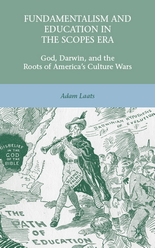
I’ll be talking about the subject of my first book, Fundamentalism and Education in the Scopes Era: God, Darwin, and the Roots of America’s Culture Wars.  I’ll start by making my case for why we need to understand the 1920s if we hope to get a handle on today’s culture wars.  Then we’ll open up a discussion on any and all topics of interest to ILYBYGTH readers: the meanings of fundamentalism, the nature of the creation/evolution stalemate, the proper role for religion in public life, and so on.

So come on down!  Even if you can’t make this event, be sure to stop by RiverRead.  It’s a great place to buy books.


Required Reading: Who’s Afraid of Evolution?

Stop me if you’ve heard this story before.  I started this blog when I discovered many of my secular, liberal friends and family shared my ignorance about the complexities of life in Fundamentalist America.  One academic acquaintance once asked me regarding young-earth creationists, “What’s wrong with these people?”  She didn’t mean to be patronizing, but she dismissed a huge group of Americans with one sarcastic comment.

As we’ve noted here before, American creationists embrace a wide variety of beliefs.  Calling oneself a “creationist” doesn’t necessarily mean one believes in a six-thousand-year-old planet, or a literal six-day creation.  But it might.

Venema. Image source: Trinity Western University

Dennis Venema of Trinity Western University recently shared some of his experiences teaching evolution at an evangelical Protestant university.  Writing on The BioLogos Forum, Venema discusses the thrill he experiences when he shares his evidence for evolution with his evangelical students.  As he describes, some of his students resist accepting the evidence.  Even when they do recognize the power of chromosomal similarities, students still reach individual conclusions about how this science impacts their faiths.

Venema’s reflections demonstrate the complexities of creationism within the borders of Fundamentalist America.  We outsiders must be careful not to lapse too glibly into a simple evolution/creation binary.

As Venema relates,

“For me personally, the most difficult circumstances to watch are students who feel torn between the evidence and their faith. In some cases these are extremely bright students, who easily see the strength of the evidence, but feel the need to remain unengaged and uncommitted because they fear a backlash from their churches, or (especially) their parents.  While an evangelical university can be a wonderful, safe environment for students to explore these issues, that environment doesn’t follow them home. These struggles are painful to watch, and I’ve spent more than a few hours in prayer for students facing them.”

This experience is different at an evangelical university than it would likely be at a mainstream school.  For starters, the assumptions about students’ home lives would not be the same.  No matter how caring and sympathetic a professor might be at a mainstream college, he or she would not likely assume that evolution would cause such struggles for his or her students.

Students who learn about evolution at my institution, for example, would do so under the auspices of David Sloan Wilson’s EVoS program.  This is a wonderful and powerful academic experience for undergraduates.  But the students in the program generally assume that anyone who does not embrace the science of evolution is trapped somehow in a bizarre and archaic subculture.  My chat about the intellectual culture of creationism with a group of bright and talented students in the EVoS demonstrated the intense secular bias of the program.  (You can listen to a podcast of that conversation here.)

As Venema continues, at an evangelical college, the situation is vastly different.  Many students come from churches and families in which the word “evolution” has long been associated with every sort of rank sin.  At Venema’s school, for instance,

“evolution matters. That intensity of student engagement is invigorating, and the students feel it too. Regardless of where students ultimately decide to “land” on the issue, many report that they enjoyed the process – the exchange of ideas, the discussions and debates, and the new understandings gained.”

So who’s afraid of evolution?  Many of my secular friends and family would likely assume that students at evangelical colleges are taught simply to hate and fear the truths of modern science.  As Venema shares, the real experience is a much more complicated thing.