The Ink Is Dry!

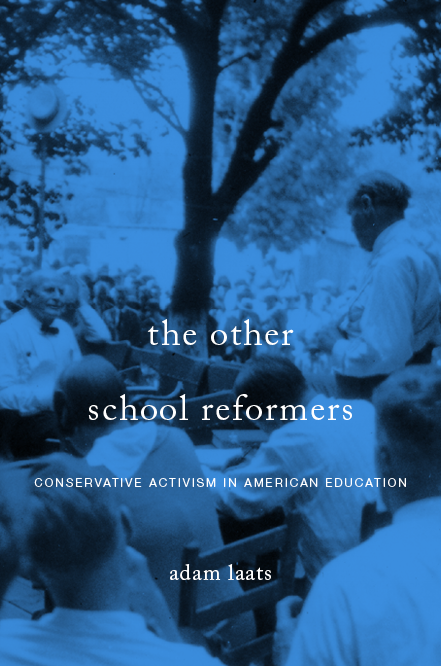
I’m tickled pink to announce I’ve signed a deal with Harvard University Press to publish my next book.  The subject?  No surprise to ILYBYGTH readers: the book takes a historical look at educational conservatism in America’s twentieth century.  What did conservatives want out of schools?  How did they work to make that happen?

I’m extremely pleased to have the book join HUP’s top roster of educational histories.  All my favorite books are on that list: David Tyack & Larry Cuban’s Tinkering Toward Utopia, Jon Zimmerman’s Whose America?, Jeffrey Moran’s Teaching Sex, and now Bill Reese’s Testing Wars.

I’m honored to join this all-star lineup.  My book—which at this point I’m calling The Other School Reformers: The Conservative Tradition in American Education—takes a look at the four most explosive school controversies of the twentieth century.  My approach has been to examine these four culture-war fights to see what sorts of educational reform conservatives wanted in each case.  At first, I thought I’d pile up histories of leading conservative organizations and individuals: the American Legion, Max Rafferty, the Gablers, etc.  But I couldn’t find a way to decide whom to include and whom to leave out.  Did the White Citizens’ Councils count as educational conservatives?  Did the Institute for Creation Research?  Did Arthur Bestor?

Instead of imposing my own definitions on the outlines of educational conservatism, I took more of a naturalist’s approach.  I set up my blind, so to speak, at the four most tumultuous fights over the content of American schools and watched to see what kinds of conservative activists showed up.

The school controversies were all very different.  First I examine the Scopes Trial of 1925.  Then the Rugg textbook controversy of 1939-1940.  After that, the firing of Pasadena’s progressive superintendent in 1950.  Finally, the literally explosive fight over schools and textbooks in Kanawha County, West Virginia, in 1974 and 1975.

What did I dig up?  In short, I argue that there is a coherent tradition linking conservative school reform across the twentieth century.  Not that these different activists had any sort of conscious organization or program.  Conservatives differed—often differed widely—about key issues such as public religion, race, and the role of government and experts.  More than that, the consensus among conservatives changed over time, as American culture and society changed.  For example, racial attitudes among white conservatives changed enormously between 1925 and 1975.  But in spite of all this change and difference, a recognizable tradition of educational conservatism linked these disparate school reformers.  Conservatives usually agreed with progressive school reformers that good schools were the key to a good society.  But unlike progressives, conservatives wanted schools to emphasize traditional knowledge and beliefs: patriotism, religion, and the benefits of capitalism, for example.

In addition, my book makes the case for the importance of understanding these conservative activists as school reformers in their own right.  Too often, the history of American education is told as the heroic tale of progressive activists fighting bravely against a powerful but vague traditionalism.  My book argues instead that educational conservatism is more than just a vague cultural impulse; conservatism has always been a raft of specific policy ideas for specific historical contexts, fought for by specific individuals and organizations.

So be sure to save some space in your holiday gift list for next year.  The book is slated to appear just in time for Christmas/Hannukah/Kwanzaa/Festivus 2014.


Required Reading: Molly Worthen on the Intellectual Civil War among American Evangelicals

What does it mean to be an “evangelical” in America?

Molly Worthen of the University of North Carolina—Chapel Hill discussed her latest book recently with Tiffany Stanley of Religion & Politics.  The interview is sprinkled with gems that make me look forward to reading Worthen’s new book, Apostles of Reason: The Crisis of Authority in American Evangelicalism.

apostles of reason

Of course, for those of us interested in the intersection of conservative politics and American education, the meanings of “evangelical” are always of intense interest.  Controversies over sex education, prayer in schools, and creationism often feature conservative Protestant evangelicals as main players.

What does it mean to be “evangelical?”  In this interview, Worthen suggests three central questions that define the boundaries of the evangelical experience.  As she explains them,

First, how do you reconcile faith and reason? How do you maintain one coherent way of knowing? Second, how do you become sure of your salvation? How do you meet Jesus and develop a relationship with him, to use the language that some evangelicals prefer. And third, how do you reconcile your personal faith with an increasingly pluralistic, secular public sphere?

Worthen also suggests some useful insights into the complex interaction between evangelicalism and education.  For example, how does the historically defined divide between white and black evangelicals play out in schools?  As Worthen puts it,

If you really grilled black or Latino Protestants on this question [of creationism], many of them would say, “I prefer the Genesis narrative to Darwin’s account, but do I get worked up about it? No. I’m more concerned about educational opportunities for my kids and more concerned about structural injustice.”

And of creationists in general, Worthen hits on the deeper intellectual divide at the heart of the evolution/creation trenches.  “I think it’s a mistake,” Worthen told Religion & Politics’ Stanley,

to understand creationists as “anti-science,” at least if we want to understand how they see themselves. The reality is that the creationist movement comes out of a tradition of Biblical interpretation that understands itself as deeply rationalist, deeply scientific, that rests on the premise that God’s revelation is all one, that God is perfect and unchanging, and therefore his revelation must be perfect and unchanging too. Our two modes of encountering his revelation, in scripture and in the created world, cannot contradict each other. . . . To understand reality accurately, they say, you must take as your founding assumption the truth of God’s revelation. I think that is crucial for understanding the frame of mind of creationists and how they view their project.

Of course, as Dr. Worthen knows, it meant very different things to assert this “creationist” way of knowing in 1877 than it did in 1977.  As she points out, one of the main features of the American evangelical experience has been a profound and continuing tension between the claimed authority of religious leaders and that of the wider secularizing society.

In schools, this evangelical “crisis of authority” has often played out as a continuing tension between a lingering desire to assert Protestant authority over “our” schools and a lamentation that “God has been kicked out” of American education.

One of the continuing dilemmas of religious historians has been to reconcile the mixed bag of evangelical intellectual life.  On one hand, American evangelicalism has included many of the great thinkers of the American tradition.  On the other hand, it has included in its big revival tent some of America’s most fervently anti-intellectual personalities.  I’ll look forward to reading in more detail about the ways Worthen wrestles with these perennial questions.

Battle Map!

Where have Americans fought over public schooling?

The libertarian Cato Institute has put together a clickable Battle Map to help readers locate educational controversies.  Readers can search by state, by year, or by the type of conflict.  The Cato folks broke down school battles into such categories as curriculum, freedom of expression, gender equity, human origins, moral values, racial/ethnic diversity, reading material, religion, and sexual diversity.

Of course, the folks at Cato aren’t just providing a nerdy public service for those of us interested in studying cultural controversies.  The point of this exercise, from Cato’s perspective, is to prove that public education “divides [people], forcing them into conflict over whose values and histories will be taught, and whose basic rights will be upheld . . . or trampled.”

To this outsider, Cato’s argument seems a little strained.  After all, just because many family dinners turn into shouting matches, does that prove that dinner is a bad thing?


Racism Doesn’t Pay

What would this look like in the United States?

A story in today’s New York Times describes the court case against Japan’s Zaitokukai, in which the far-right group had to pay a hefty fine for shouting its racist ideology at a Japanese school.

Image Source: Wikipedia

Image Source: Wikipedia

The school apparently served young people of Korean ethnicity.  The far-right group protested outside the school, calling the children “spies and cockroaches.”

Is this sort of Asian race-baiting translatable?

In other words, what would this sort of racism look like in the United States?

Unfortunately, it is all too easy to see the woeful results of structural racism in America’s schools.  Schools are still often segregated by race.  Those with mostly African American students often lack the resources of schools for mostly white students.  And the educational legacy of white supremacy has often been part of America’s official educational policies, as historians such as David Blight have argued.

Even granting all that, however, I have a hard time imagining this sort of vicious race-baiting in any American city.  Maybe I’m naïve, but I can’t picture any group these days picketing a majority-African American school and shouting racial epithets.  Would the equivalent be something like the infamous Westboro Baptist Church rallies?  Even those, however, cling not to America’s racist past, but rather to an extremist religious vision.  I say again, I can’t imagine any large group shouting racist taunts at African American children.

Is this another case where my suburban liberal upbringing has left me painfully unaware of the realities of American schooling?


What Color Are Your Fundamentalists?

Who are the “fundamentalists” who hope to keep America’s public schools religious?

Some of us may picture a Saddleback-type white suburban evangelical, driving around in a Biblically-sized SUV, worrying in equal measure about sin and soccer.

New!  School Prayer Barbie!

New! School Prayer Barbie!

But as Peter Berger reminds us this morning on The American Interest, that image of conservative evangelicalism might represent the past more than the future.

Berger notes the dramatic effects of immigration on the nature of American Christianity.  New immigrants tend to be Christian, and their Christianity tends to lean conservative.  As Berger concludes,

Both in their theology and religious practice, non-Western Christians are more conservative. Their worldview is strongly supernaturalist: The spiritual world, both benign and sinister, is very close—the Holy Spirit, the Virgin and the saints, miracles of healing—but also the devil and other malevolent spirits. This supernaturalism is strongest in the Pentecostal and charismatic movements, but it is also very visible in Catholic and mainline Protestant churches. But non-Western Christians are also more conservative in their moral convictions—very little sympathy here for the feminism, let alone the agenda of the gay movement, that has become so prominent in mainline Protestantism in America—and, I suspect, would be more prominent in American Catholicism, were it not for surveillance and intervention from Rome.

The implication of all this is simple and exceedingly important: Immigration will strengthen the conservative forces in American Christianity.

In the future, the fight over religion in America’s public schools may have a very different tone.  Instead of a ring of white conservative suburbs around every ethnically diverse urban core, we may see a shift to immigrant-led demands for more vibrant religion in schools.  Instead of whitebread traditionalism resisting a multicultural liberalism, we might have an ethnically diverse group of conservatives battling to keep morals pure in public education.

Do White Conservatives Hate Black People?

What is the connection between conservatism and school segregation?  A new “retro report” in the New York Times about the desegregation project in Charlotte, North Carolina assumes that “conservatives” obviously opposed desegregation.  Is that connection really as obvious as it seems?

The desegregation documentary describes Charlotte’s experience.  In the 1970s, Charlotte and surrounding Mecklenburg County became the focus of a newly aggressive court-ordered busing program.  Schools and school districts, the Supreme Court ruled, must do more to ensure racial balance in public schools.

The initial reaction in Charlotte was furious, but the program eventually became the poster child for busing.  So much so that a federal judge ruled in 1999 that the district had fulfilled its deseg obligations.  At least partly as a result, the Charlotte-Mecklenburg schools are now resegregated by race and income level.

For historians of race and education, the story is not news.  But for those of us trying to understand the meanings of “conservatism” in American education, the way it is told is important.  The New York Times piece includes comments by journalist B. Drummond Ayres Jr. In that “Reporter’s Notebook,” Ayres offers an explanation for the winning campaign to resegregate America’s schools.  As Ayres explains,

White parental anger was the most obvious cause of this rollback. But an equally important factor was the election of two conservative Presidents, Richard Nixon and Ronald Reagan. They did not oppose the nation’s move toward racial equality, but as conservatives they favored a slower, more measured approach to desegregation and underscored that approach by appointing staunch conservatives to the Supreme Court and lower Federal courts. Concurrently, Congress took a more measured approach to desegregation, too, as voters began sending more and more anti-busing conservatives to Capitol Hill. [Emphasis added.]

In this telling, “conservatives” have been the brake on the progress of racial desegregation.  Politicians who considered themselves conservative had a prescribed opinion toward school desegregation.

Is that a fair accusation?  Did conservatives as a rule really push for slower desegregation?  More interesting, how did conservatism come to be perceived as the side of white racial status-quo-ism?

In my current book, I explore two twentieth-century school controversies in which race and school deseg played leading parts.  The first took place in Pasadena, California, in 1950, the second in Kanawha County, West Virginia, in 1974.

In Pasadena, a “progressive” school superintendent added racial desegregation to his list of progressive reforms.  Conservatives kicked him out.  In Kanawha County, a new textbook series included provocative excerpts from black militants such as Eldridge Cleaver.  Conservatives boycotted to demonstrate their dissatisfaction with the books.

Each time, the conservative side became the side of anti-black racism.  But in each case, conservatives insisted they were not racist.

In Pasadena, for example, one woman stood up at a heated school-board meeting and denied all charges of racism.  She opposed the desegregation plan but said she could not be racist, since one of her closest friends was African American.

In Kanawha County, too, book protesters often insisted they were not racist.  Teacher and activist Karl Priest, for example, has insisted for decades that the conservative protesters embodied the true anti-racist position.

But evidence contradicts these conservative anti-racist claims.  In Pasadena, conservatives rallied political support based on opposition to race mixing in public schools.  Conservatives accused the progressive superintendent of raising taxes and dumbing down white schools by including students of other races.  If that’s not racism, what is it?

And in Kanawha County, as documentarian Trey Kay has shown, conservatives really did see the book protest as a race war.  Steve Horan remembered in 2010 that a rumor spread among white conservatives in 1974: African Americans planned to invade.  The men readied their guns.   Women and children took shelter in church basements.  If that’s not racism, what is it?

There seems to be at least some justification for journalists’ assumptions that “conservatism” stands staunchly opposed to racial integration in schools.

But it is also important to recognize the complexity of conservative attitudes toward race and schooling.  It is not enough to simply say that “conservatives” block school desegregation because they dislike black people.

The case of Kanawha County helps make this more complicated point.  Many of the conservative leaders of the protest, such as Karl Priest and Avis Hill, belonged to conservative churches with a thoroughly biracial membership.  If that’s not anti-racism, what is it?

And conservative leader Alice Moore built her anti-textbook arguments on the work of African American activist Stephen Jenkins.  Jenkins had argued that textbooks that included only violent writings by African Americans actually represented the true anti-black racism.  Those who wanted to oppose the depiction of African Americans as violent anti-American criminals, Jenkins argued, needed to oppose the wrong-headed push for “multiculturalism.”  If that’s not anti-racism, what is it?

Across the country, “conservative” anti-busing protesters made similar claims to be the true anti-racists.  In Boston, for example, as Ron Formisano has shown, “conservative” anti-busers in the 1970s accused “liberal” federal judge Arthur Garrity of being the true racist.  Garrity had ordered busing to achieve racial balance in Boston’s schools, yet he lived in the affluent lily-white enclave of Wellesley, where his children would attend all-white schools.  Who was the racist in that scenario?

Did conservatives oppose busing and forcible school desegregation?  In most cases, yes.

Will we understand conservatism in schooling if we explain that position as simple racism?  In most cases, no.

White conservatives seem, in many cases, to have been motivated by anti-black racism.  But in almost all cases, that racism was only one component of a complex conservatism that also included issues of school funding, textbook content, religious rights, classroom practice, and a host of other issues.

Calling it “racism” and walking away doesn’t do enough.  Ayres deserves credit for noting that leading conservatives often supported anti-racist policies.  Conservatives often insisted that they opposed forcible busing and forcible integration.  They did so as part of a complicated conservative worldview, one that looked toward the status quo–including but not by any means limited to the racial status quo–for support.

So did white conservatives hate black people?  Did conservatives oppose school desegregation out of disdain for non-whites?

In some cases, probably.  But it is not very useful to assume that such racist attitudes are the end of our discussion.  Rather, understanding the complex attitudes toward race among conservatives–as among Americans as a whole–requires a more careful understanding of a complex conservative ideology.


It’s Your Own Fault

It’s your own fault if you’re bored this fall.

Binghamton University is hosting some events that will certainly be of interest to all ILYBYGTH readers.

For those in the area, there will be some great ways to think and discuss the possible meanings of American educational conservatism.

I’ll keep the list updated, but so far there are three talks of note.  All of them are free and open to the public.

1.) September 11, noon-1:30, IASH conference room, Library North 1106: Adam Laats, “‘Democracy’ and American Education, 1930-1960.”

Yours truly will be presenting some ideas from my current book about American educational conservatism in the twentieth century.  Specifically, I’ll be talking about the ways conservative activists in groups such as the American Legion framed “democracy” in strikingly different ways than did progressive educational thinkers such as John Dewey.  The talk will be part of the series of faculty fellows’ talks at Binghamton’s Institute for Advanced Studies in the Humanities.

2.) September 24, 5-6:15, specific topic TBA: Mario Rios Perez.

I’m not sure what he’ll be talking about, but Professor Perez (of Syracuse University) has done some great work with the history of schooling in Chicago.

3.) November 18, 5:00: Warren Douglas Allmon, “Creationism in 2013: Not in the Headlines but Never Far Away.”

Professor Allmon will be talking as part of the EVoS series of Monday seminars.  He is a paleontologist at Cornell, our neighbor to the north.  When I heard he was coming to our friendly campus, I looked up his sort-of recent article about the culture of creationism in Evolution: Education and Outreach.  In that article, Professor Allmon makes the powerful point that resistance to evolution is about more than just the knee-jerk “religion vs. science” clichés that we hear so often.  He argues that Americans’ resistance to evolution comes from five distinct categories.  As Allmon argues, “this multiplicity of causes is not sufficiently appreciated by many scientists, educators, and journalists, and the widespread rejection of evolution is a much more complicated problem than many of these front-line practitioners think it is.”

Hear hear!  Can’t wait to hear his talk in November.

Hope to see you there…


Jesus Yes, Honey Boo Boo No

Southern Cross, Bible Belt, Hillbilly Heaven…you’ve heard the stereotypes of the American Deep South.

Thanks to the National Center for Science Education’s blog, we see some confirmation of the old chestnuts in a recent poll from Georgia.  On a second look, however, we also see some surprises.

A poll of 520 Georgia voters from the Public Policy Polling group finds strong support for creationism.  As the NCSE notes, 53% of respondents said they believed more in creationism than in evolution.  Among the (self-identified) “very conservative,” the number skyrocketed to 77%.

That is strong support for creationism.

For some folks, this might serve as just more proof that there’s nothing really “new” about the “New South.”  Folks in Georgia love their Bibles.

For us here at ILYBYGTH, two things jump out.

First, it demonstrates the stubbornness of region as a category for understanding culture and religion.  Since even before the Civil War, the Deep South has been accused of retrograde politics, reactionary culture.  When “fundamentalism” reared its head as an influential movement in the 1920s, both opponents and supporters used ideas about “Southernness” to either bolster or discredit it, as I argue in my 1920s book.

Other historians, too, have skewered the overly simple notion that conservative Christianity is somehow simply a Southern thing.  George Marsden and William V. Trollinger, for example, demonstrated the power of early fundamentalism in places such as Chicago and Minneapolis.

Nevertheless, as this poll suggests, there is yet stronger creationist support in a state like Georgia than there might be elsewhere.  No matter what the nerds might say about the complexity of religion, region still plays a hugely influential role in conservative Christianity.

Also, beyond the question of creation and evolution, this poll shows some surprising cultural changes among the Georgians polled.  First off, support for creationism did not vary much between white and black respondents, 54% of whites preferred it, 52% of African Americans.

Second, some Georgia notions that once seemed eternal now seem less so.  For instance, from the nineteenth century, only 28% of respondents said they had an “unfavorable” idea of William Tecumseh Sherman.  Even only among white respondents, only 34% reported an unfavorable opinion of the General credited with the rape, burning, and looting of Georgia.  Apparently, this sea change in Georgians’ public memories mostly represents ignorance.  A significant majority of respondents did not seem to know who Sherman was.

But more recent history also finds some surprises for those who cherish old stereotypes of the Deep South.  An overwhelming majority (73%) reported a favorable opinion of Dr. Martin Luther King Jr., including 65% of white respondents and 67% of the “very conservative.”

Another possible surprise for those of us outside the South: No one likes Honey Boo Boo.  Well, not exactly no one, but only 8% of respondents reported a favorable opinion of her.  The cartoonish reality show, filmed in rural Georgia, likely angers people who actually live there.

What do we know about Georgians?  They like creationism.  In large numbers.

Significantly, especially for those science pundits who like to frame the creation/evolution debate as a matter of scientific knowledge vs. bullheaded religious ignorance, this poll suggests that support for creationism is firmly grounded in a complex conservative cultural identity.

Among those who called themselves “very conservative,” over three quarters preferred creationism.  Among the “very liberal,” just over one third did.  The poll results show a strong correlation between ideology and preference for creationism.  The more conservative one is, the more likely one is to prefer creationism.

Assuming that those creationist beliefs are somehow simply a product of isolation or ignorance ignores the important truth that creationism is part of a coherent and powerful way of understanding the world.


From the Archives: Conservatives, Historical Knowledge, and the Political Process

Guest Post by Kevin B. Johnson

How could American History bother conservatives?

Most people probably believe that sex education and evolutionary biology are the most contentious subjects taught in school.

But conservative activists have also targeted American history.  Why?  Because as historians such as Jon Zimmerman and David Blight have argued, America teeters on a culture-war divide in its understanding of its own history; a culture-war divide no less contentious than questions about sex and God.

Nowhere has this battle over the nation’s history been more bitter or grueling than in Mississippi.

A look at the record of conservative activism in the Magnolia State may shed some light on the continuing battle over the nature of history.  It also demonstrates the ways conservatives have scored their greatest successes.  In Mississippi, at least, conservatives managed to win by promoting one central idea: historical knowledge, properly understood, is static and unchanging.

As the Cold War split nations into the Free, Unfree, and Third Worlds, Americans began scrutinizing their communities in search of suspected communists and subversives. In Mississippi, these searches involved the content in state-approved social studies textbooks. Civic-patriotic organizations such as the American Legion, the Sons of the American Revolution (SAR), the Daughters of the American Revolution (DAR), and the Mississippi Farm Bureau Federation led the charge in exposing objectionable historical knowledge presented in social studies texts.

The civic organizations were not alone in controlling textbook content. In the 1940s Mississippi began providing students with schoolbooks; lawmakers also set up the State Textbook Purchasing Board charged with governing the screening and selection of all texts. In the Cold War context, however, many civic organization leaders believed the state’s education professionals were ill-suited for this job and challenged their role in screening school materials.

A few key figures spearheaded the effort to guard historical knowledge. Mississippi State College education professor Cyril E. Cain, for example, found reading and “doing” history to be a mystical-spiritual experience. In 1949, Cain learned about the California SAR calling for removal from that state’s schools the Building America textbook series. America and its democratic system was not part of a process, the SAR argued. Rather, American democracy had been built and perfected in comparison to rival governments.

Through the Mississippi Patriotic Education Committee, Cain called upon other conservatives guard against the historical knowledge contained in schoolbooks. He wrote to the state regent of the Mississippi DAR—Edna Whitfield Alexander, asking for collaboration between their two organizations “for the common cause of defending America” from textbook authors who espoused “alien ideologies.”

For the next twenty years, Alexander became the South’s preeminent textbook activist. She developed her organizational skills through the Mississippi DAR, which held significant power in the 1950s and 1960s. Many DAR members’ husbands served in state government or were the state’s business leaders; the DAR owned numerous radio stations throughout Mississippi. A segregationist society like other civic clubs, its members naturally opposed perceived egalitarian messages in textbook treatments of history, civics, and economics. History was the DAR’s domain and it held what they believed was magnificent power to order present-day society.

Gaining the attention of Mississippi’s leaders, especially Mississippi House Speaker Walter Sillers, Jr, by 1958, Alexander and DAR activists officially recorded their objection to the content in dozens of state-approved books.

The following are just a few examples:

“Laconic treatment of the South…did not mention Fielding Wright as Vice-Presidential nominee of the States Right party…praises Federal aid to education…Booker T. Washington picture is much later than Thomas Jefferson [sic]” –review of United States History, American Book Company, 1955 reprint.

“This slanted-against-the-South book makes no mention of the fact that Russia offered to help the North [during the American Civil War]” –review of The Making of Modern America, Houghton-Mifflin, 1953.

“…records a good bit of history—some of which we are not too proud, and conspicuously omits some of which we are very proud like religious freedom!” –review of Your Country and the World, Ginn & Company, 1955.

“…advocates creation of a state of social equality…” –review of Economic Problems of Today, Lyons and Carnahan, 1955.

“Formerly history was largely concerned with kings, monarchies, laws, diplomacy, and wars…Today history deals with the entire life of a people. So now were are told that history must change along with this changing world and George Washington, Valley Forge, and the U.S. Constitution are no longer worthy of recognition to be ignored so far as our children’s history books are concerned.” – wrote a DAR reviewer of The Record of Mankind, published by D. C. Heath, 1952.

The DAR, in addition, opposed books citing renowned scholars such as Henry Steele Commager, Charles Beard, Allen Nevins, Gunnar Myrdal, Arthur Schlesinger, John Hersey, in addition to Mississippi writers like Hodding Carter, Ida B. Wells, and William Faulkner.

These comments sent to Sillers demonstrate the DAR’s view of History.  In the DAR vision, History should be dominated by pro-South, segregationist, and patriotic biases. The reason for teaching history in the Cold War context, the DAR and others agreed, was to instill in school children loyalty to state and country.

The DAR, under Alexander’s leadership, began a concerted lobbying effort. In 1959, Alexander informed the Mississippi Superintendent of Education and head of the State Textbook Purchasing Board, Jackson McWhirter “Jack” Tubb, that “youth must be taught Americanism in its purest form if this Republic is to survive.”

The American Legion and the Mississippi Farm Bureau Federation became important DAR allies. These civic clubs conducted official studies of Mississippi’s approved books and found that many “cater to alien ideologies contrary to the Mississippi way of life.” Boswell Stevens, a Legionnaire and president of the state’s Farm Bureau, believed social studies curricula should cultivate among students adoration of quintessential American values like Jeffersonian individualism, capitalism, and patriotism.

During state elections in 1959, the lobbyist coalition collaborated by staging exhibits of objectionable texts in the lobby of the Robert E. Lee hotel in Jackson. After Sillers intervened the DAR moved the exhibit to the lobby of the state capitol in time for the 1960 legislative session.

Lawmaker-members of American Legion and the Farm Bureau dominated the Legislature, passing amendments to state laws pertaining to textbook screening and adoption. The amendment gave the governor, recently elected Ross Barnett, appointment power over the state’s education professionals on these important textbook screening committees.

These conservative victories were not unopposed, however.  Newspapers editorials considered the DAR efforts as a “witch-hunt” and the state’s teachers association believed that textbook reviews were best left to education professionals.

But politics—in this case, staunchly conservative politics—trumped the claims of journalists and teachers.  Conservative activists also managed to stymie complaints from academic historians. In 1975, for example, James W. Loewen and several co-authors of the history text Mississippi: Conflict and Change had to file a federal lawsuit against Mississippi for adoption of their revolutionary new textbook. Loewen even commented at the time that most of the state-approved books were merely “didactic chronologies.”

Loewen’s lawsuit demonstrated the deeply entrenched nature of conservative visions of History in Mississippi.  For decades, conservative activists had succeeded in establishing state sanction for their vision of History: a static, unchanging field of facts, uniquely useful for promoting patriotism and instilling a love for traditional Americanism.


Kevin Boland Johnson is a doctoral candidate in American history at Mississippi State University and a dissertation fellow with the Spencer Foundation. His dissertation, “The Guardians of Historical Knowledge: Textbook Politics, Conservative Activism, and School Reform in Mississippi, 1928-1988,” explores numerous education reform efforts designed either to constrain or improve public school social studies curricula. You can reach Kevin at kbj41@msstate.edu.



Are We Post-Racial Yet? Conservatives and Affirmative Action

It appears the US Supreme Court’s non-decision today about affirmative action won’t settle anything. In its 7-1 ruling in Fisher v. University of Texas, the Court sent the case back down to lower courts to decide.  This doesn’t rule out university use of affirmative action policies in admissions, but it does not exactly endorse it either.

Significantly, Court conservatives including Justices Scalia and Thomas voted with the majority today, but both indicated they would be willing (eager?) to rule such affirmative-action policies unconstitutional.

Legal and higher-ed policy wonks will have plenty to chew over in coming days.

For me, the recent ruling underscores the ways debates over affirmative action in university admissions policies have become a stand-in for conservative sentiment about race and racism in America.  Though it is too simple to say anything about conservatism as a whole, the last forty years have established a new kind of anti-racist conservatism.  These self-described anti-racists, however, have struggled to convince anyone besides themselves of their sincere dedication to fighting racism and traditional preferences that favor whites.

The recent SCOTUS history alone has given the debate over race and schooling a kick in the pants.  In the late 1970s, in the Bakke case, the Supreme Court ruled against the use of any racial quotas in college admissions.

More recently, in Grutter v. Bollinger (2003), SCOTUS decided that race could be used in admissions decisions, as one category among others.  The key element in this decision was that race could be used to further the state’s interest in fostering a diverse learning environment.

One influential strain of opinion among conservatives can be summed up in a pithy statement by Chief Justice Roberts from 2007.  In a case from Seattle, Roberts insisted, “the way to stop discrimination on the basis of race is to stop discrimination on the basis of race.”

Conservative thinking on this issue has, in some ways, remained remarkably constant for the past generation.  In the mid-1980s, for instance, writing for the Heritage Foundation, Philip Lawler articulated a conservative critique of affirmative action admissions policies that sounds fresh today.  Such policies, Lawler argued, effectively promote racism against African Americans and other historically underrepresented college populations.  Affirmative action degrades true achievement and breeds resentment towards all African Americans.  It also leads to a racist dismissal of the true achievements of some African Americans.

Former US Representative Allen West made similar arguments in his amicus brief filed in the Fisher case.  “Race-conscious policies do not advance – in fact, they harm – the most compelling of all governmental interests: protecting and defending our Nation’s security. This is true whether practiced by colleges and universities (which, together with the Nation’s military academies, produce the majority of the commissioned officers in our country’s military), or by the military itself in the selection and advancement of its officer and enlisted personnel,” West argued.  West, a prominent African American conservative, argued that affirmative action policies degraded all applicants, African Americans most of all.

The problem with these kinds of conservative arguments is that they are often dismissed as mere window dressing.  With important exceptions such as Representative West and Justice Clarence Thomas, most African Americans support affirmative action policies.  The NAACP, for instance, has consistently and energetically supported Texas’ race-conscious admissions policy.  The National Black Law Students Association, in its amicus brief in the Fisher case noted the “systematic racial hierarchy that produces and perpetuates racial disparities in educational opportunities and outcomes.”  Affirmative-action admissions policies, the NBLSA insisted, remained necessary to promote a truly non-racist society.  Conservative insistence that such affirmative action policies actually support anti-black racism tends to fall on deaf ears among the majority of African Americans and whites who consider themselves racial liberals.

Conservative activists and intellectuals—white and black—often express what seems like honest surprise when accused of anti-black racism.  Perhaps one episode that illustrates this kind of conservative anti-racism might be that of Alice Moore and the 1974 Kanawha County textbook protest.  In this battle from the Charleston region of West Virginia, conservative parents and activists protested against a new series of English Language Arts textbooks.  Among the many complaints were protests against the inclusion of authors such as Eldridge Cleaver and George Jackson.  Such militant African American voices, many Kanawha County residents insisted, did not belong in school textbooks.  Conservative leaders insisted that this was not because they were black, but because they were violent and criminal, and apparently proud of it.

Conservative leader Alice Moore came to the 1974 controversy freshly schooled in the ideology of anti-racist conservatism.  She had attended a conference in which conservative African American politician Stephen Jenkins blasted the anti-black implications of multicultural literature.  Such literature collections, Jenkins insisted, implied that the violent, angry, criminal voices of militants such as George Jackson and Eldridge Cleaver represented the thinking of African Americans.  Such implications, Jenkins explained, proved that the true racists were the multiculturalists.  By pushing a skewed vision of African American culture, such multicultural textbooks implied that African Americans as a whole were criminal and violent.

Moore embraced this sort of anti-racist conservative ideology.  When she (politely, as always) confronted African American leader Ron English at a heated board of education meeting, Moore seemed honestly flummoxed that the English did not agree with her.  Moore pointed out that voices such as Jackson and Cleaver did not fairly represent the truths of African American life.  But The Reverend English rebutted that such militant voices represented an important part of the American experience, stretching back to Tom Paine.

Moore’s befuddlement in 1974 matches that of anti-racist, anti-affirmative action conservatives today.  Many conservatives feel that their opposition to affirmative action makes them the true anti-racists.  Yet they consistently find themselves accused of racism.  The fight over Fisher never seemed to be changing this dynamic.  Now that the Court has punted, there is even less resolution on offer.  Conservative notions that true anti-racism requires the elimination of race-based considerations in college admissions will likely continue to fall on deaf ears among leading African American advocacy groups.