Missouri Loves Company: Catholics in Fundamentalist America

Missouri’s Catholic Bishops support Missouri’s proposed constitutional amendment.  In a recent statement, the Missouri Catholic Conference supported Amendment 2, which will go before voters on August 7.  The bishops’ statement argued that the amendment would ensure religious people’s rights in the public square.  As they put it:

“Increasingly, it seems, religious values are becoming marginalized in our society. People of faith need assurance that they remain free to exercise and express their religious beliefs in public, provided just order be observed, without threat of external pressure to conform to changing societal ‘norms’.”

For some, this defense of public religiosity by Catholic bishops seems unremarkable.  But from a historical perspective, this Catholic endorsement of religion in public schools signals a shocking turnaround in the history of religious life in America.

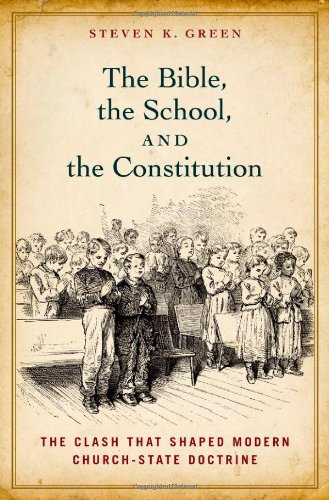
In the nineteenth century, after all, intense Catholic political pressure led to “Bible Wars” in public schools.  For many Protestants, the reading of the King James Version of the Bible in public schools seemed natural.  As Steven Green has argued in his new book, these nineteenth-century battles determined much of the role of public religion long into the twentieth century.

This history of Catholic protest against a Protestant-dominated public religiosity resulted in lingering anti-Catholic animus on the part of many conservative Protestants.  In the 1928 Presidential election, for example, self-described Protestant fundamentalists vehemently opposed Al Smith’s candidacy in the Democratic Party due to Smith’s Catholicism.

Yet even in the 1920s, we can see connections between conservative Catholics and conservative Protestants.  William Jennings Bryan tried hard to recruit Catholic anti-evolution writer Alfred  McCann to testify at the Scopes trial, for instance.  These connections received a boost in the 1950s with the strengthening of anti-communism on the Right.  And Catholics such as William F. Buckley and Phyllis Schlafly assumed new leadership roles in the postwar conservative revival.

By the 1970s, the issue of abortion fused even stronger connections between conservative Catholics and Protestants.  As Daniel K. Williams has argued, abortion politics brought pro-life Catholics into the fold of the “New Christian Right.”

The recent statement by Missouri’s Catholic bishops demonstrates how seamless these connections have become.  Early 1920s fundamentalism in America often included a virulent anti-Catholicism.  But by 2012, we need to include conservative Catholics in any sensible study of conservative religion in American public life.

Some readers have objected to ILYBYGTH’s broad definition of “Fundamentalist America.”  And they are right: “fundamentalism” in the American context usually refers to one subset of conservative evangelical Protestants.  But if we hope to understand the broad sweep of conservative religious activism in America, if we want to talk about the conservative side of America’s culture wars over the proper role of religion in the public square, we need to include a much broader coalition of religious groups.  Not only conservative Catholics, but also Pentecostals, Orthodox Jews, Mennonites, conservative Lutherans, and others who don’t fit within the smaller boundaries of small-f fundamentalism.

The recent statement by Missouri’s Catholic bishops is just further proof of how the times are a-changing.  When conservative Catholics can get behind an amendment protecting religion’s role in public schools, we know the old Catholic/Protestant split has become largely irrelevant.

Leftist Bias in the Academy?

Conservatives have long complained that American higher education faculty displayed an intellectually crippling ideological bias.  This has been called “anti-intellectualism,” but a more precise term would be something like “anti-professoriate.”  In a recent article in the Chronicle of Higher Education, the non-conservative sociologist Christian Smith of Notre Dame’s Center for Social Research argues that conservatives may be right.

The accusation of academic bias has been so durable in the intellectual world of Fundamentalist America that one is tempted to dismiss it as sour grapes.  For instance, in the 1920s, Presbyterian orthodox leader J. Gresham Machen finally left his beloved Princeton Seminary to start his own school, driven out, he claimed, by his colleagues’ growing intolerance of Machen’s Biblical orthodoxy.  Less intellectually gifted 1920s fundamentalists made similar charges, in more colorful language.  For example, Texas fundamentalist minister J. Frank Norris insisted in 1921 that the problem with America all started when some influential young Americans studied “in Chicago University where they got the forty-second echo of some beer-guzzling German Professor of Rationalism.”

Around the time of the Scopes Trial, a cartoon in the Wall Street Journal captured this anti-professoriate feeling among fundamentalists:


Education in the Higher Branches

More recently, in the early 1960s, conservative California State Superintendent of Education Max Rafferty found the main culprit of America’s decline in the progressive, leftist orthodoxy promulgated in America’s institutions of higher education.  Rafferty insisted that colleges had created a new landscape of “temples . . . great universities which marble the land.”  These temples no longer pursued true intellectual endeavor, Rafferty claimed, but only passed along a deadened orthodoxy, “turning out swarms of neophytes each year to preach the gospel of Group Adaptation.  Their secret crypts and inner sanctums are the graduate schools.”

In the twenty-first century, small-f fundamentalist blockbust author Tim LaHaye agreed.  University faculties, LaHaye argued, had placed themselves hopelessly in thrall to the false idols of the cultural Left.  After his huge publishing success with the Left Behind series, LaHaye set out to create a new biblical hero.  In Babylon Rising (2003), LaHaye described the adventures of biblical archeologist Michael Murphy.  In Murphy, LaHaye hoped to create a “true hero for our times,” one who united unwavering biblical faith with scholarly acumen and a dose of two-fisted machismo.  In one telling scene, Murphy is confronted by his smarmy secular dean.  This little episode tells us a lot about continuing fundamentalist attitudes toward the professoriate.

“Hold it, Murphy!”

A bony hand grabbed Murphy by his backpack as he left the hall. “Dean Fallworth.  What a fine example you set for the students by monitoring my lecture.”

“Can it, Professor Murphy.”  Fallworth was as tall as Murphy but cursed with a library-stack pallor that would make some mummies look healthy by comparison.  “You call that a lecture?  I call it a disgrace.  Why, the only thing separating you from a Sunday tent preacher is the fact that you didn’t pass the plate for a collection.” 

“I will gratefully accept any donation you wish to make, Dean.  Did you need a syllabus, by the way?”

“No, Mr. Murphy, I have everything I need to get the university board to begin accreditation hearings for this evangelical clambake you’re calling a class.”

“Temper,” Murphy mumbled to himself.  “Dean, if you feel my work is unprofessional in any way, then please help me to improve my teaching skills, but if you want to bash Christians, I don’t have to stand here for that.”

“Do you know what they’re already calling this silly circus around the campus?  Bible for Bubbleheads, Jesus for Jocks, and the Gut from Galilee.”

Murphy couldn’t help but laugh.  “I like that last one.  I’m intending this to be a quite intellectually stimulating course, Dean, but I confess I did not post an I.Q. requirement for taking it.  The knowledge will be there, I promise you, but I will likely fall short of your apparent requirement that the only acceptable instructional method is to bore your students to an early ossuary.”

“Mark my words, Murphy.  Your hopes of this course surviving and your hopes of tenure at this university are as dead as whatever was in that bone box of yours.”

“Ossuary, Dean.  Ossuary.  We’re at a university, let’s try to use multisyllabic words.  If it doesn’t turn out to be legitimate, maybe I can get it for you cheap and you can keep your buttons in it.  Now, if you’ll excuse me, I have a new artifact to begin work on.”

In this vision of the world of higher education, only fundamentalists have remained true to the original mission.  Fundamentalist intellectuals, this line of reasoning goes, have retained their sense of inquiry and intellectual honesty.  They have not been seduced by the showy appeals of false science, such as evolution.  They have not been lulled by a peaceful-sounding pluralism that in practice degrades human dignity.  And they have not been willing to accept the hidebound leftist, secularist, evolutionist orthodoxy required of the mainstream academic.

Christian Smith’s recent article argues that this leftist orthodoxy is not merely a figment of conservatives’ imaginations.  His article bemoans the attacks on sociologist Mark Regnerus.  Regnerus published an academic article in which he concluded that children raised by same-sex parents have more emotional disorders as adults.  According to Smith, Regnerus followed the guidelines of academic research and publishing.  His conclusions may or may not be correct, but his work followed the traditions of peer review and editing.  Regnerus’ conclusions may be disagreeable to some, but his research methods stand above reproach.

Yet, according to Smith, the attacks on Regnerus demonstrate the problems with today’s left-leaning academy.  As Smith argues,

“The temptation to use academe to advance a political agenda is too often indulged in sociology, especially by activist faculty in certain fields, like marriage, family, sex, and gender. The crucial line between broadening education and indoctrinating propaganda can grow very thin, sometimes nonexistent. Research programs that advance narrow agendas compatible with particular ideologies are privileged. Survey textbooks in some fields routinely frame their arguments in a way that validates any form of intimate relationship as a family, when the larger social discussion of what a family is and should be is still continuing and worth having. Reviewers for peer-reviewed journals identify “problems” with papers whose findings do not comport with their own beliefs. Job candidates and faculty up for tenure whose political and social views are not ‘correct’ are sometimes weeded out through a subtle (or obvious), ideologically governed process of evaluation, which is publicly justified on more-legitimate grounds—’scholarly weaknesses’ or ‘not fitting in well’ with the department.” 

As we have argued elsewhere, this bias is often wrapped in a near-total ignorance about life in Fundamentalist America.  One of the main reasons for this blog has been to introduce the ideas and culture of Fundamentalist America to outsiders who don’t know much about it.  Like Smith, we do not have to actively defend conservative ideas in order to protest against this sort of myopic academic bias.  Rather, we can promote a true diversity of ideas in higher education.  We can push for a true university, one in which the universe of ideas can be discussed calmly, without fear of the vindictive witch-hunts Smith describes.

In order to do so, we need to actively separate the jumble of issues.  The question is not whether children of same-sex parents have a tougher time in life.  The question is whether we will allow that conclusion to be reached in academic journals.  The question is whether researchers will be free to follow their data wherever it may lead, or whether, as Smith concludes, academic life will be governed by a crippling and unnecessary Stalin-lite motto: “Play it politically safe, avoid controversial questions, publish the right conclusions.”


In the News: Missouri Voters Will Vote on School-Prayer Amendment

Fundamentalist America wants its children to feel comfortable praying in public schools.  Since the US Supreme Court’s 1963 Schempp verdict, many religious conservatives have complained that God has been kicked out of public schools.

As Steven Green’s recent book has described, the historical reality is more complicated.  And, as I have argued elsewhere, to understand these questions, we can’t start in the 1960s, we need to look at the battles of the 1920s.

But that does not stop some conservatives from pressing the issue.  In a recent wrinkle, Missouri State Legislature Representative Mike McGhee has succeeded in presenting a Constitutional amendment to the voters of Missouri.  On August 7th, voters will have see the following questions on a special ballot:

“Shall the Missouri Constitution be amended to ensure:

• That the right of Missouri citizens to express their religious beliefs shall not be infringed; 

• That school children have the right to pray and acknowledge God voluntarily in their schools; and

• That all public schools shall display the Bill of Rights of the United States Constitution.”

Opponents note with considerable justification that this amendment will not actually do anything.  Speaking to the Joplin Globe, an official of the state school administration insisted students already have the right to pray.  And C.J. Huff, superintendent of Joplin schools, told the Globe,

“If it passes, it isn’t really going to make a difference in our schools. Students already have rights for volunteer prayer in school. It happens. I think the misperception is that it (prayer) doesn’t happen (in schools).”

But to the amendment’s supporters, the symbolism is intensely important.  As Representative Jeff Grisamore told OzarksFirst,

“This (legislation) is one of the most important pieces of legislation…that we will pass this year, because it is fundamental to protecting the rights of Missourians to pray and express their faith and at the same time, protect Missourians from being coerced or compelled in a way that would violate their faith.”

Missouri politicians seem keenly aware of this symbolic importance.  According to the Lebanon Daily Record, the proposed amendment passed unanimously in the state Senate and triumphed 126-30 in the state House. 

The constitutional issue seems fairly clear.  This amendment, if successful, will clarify a right that public school students already enjoy.  The big question is the political issue.  Clearly, the elected representatives of the great State of Missouri find the bill politically invulnerable.  Will the voters of Missouri agree?

Required Reading: Kicking God Out of Public Schools

We have looked recently at the effects on Fundamentalist America of the US Supreme Court’s rulings in 1962 and 1963.  These decisions ruled against the use of state-sponsored prayer and school-led religious devotions and Bible reading in public schools.  As any observer of Fundamentalist America is aware, many conservatives pinpoint these events as the date when God was “kicked out” of American public schoolsAs we’ve noted, the historical reality was much more complex.

Happily, those interested in these questions now have a promising new book to help them muddle through the mishmash of Constitutional, cultural, educational, and devotional questions raised by this thorny issue.  At Religion & Politics, Michael Waggoner has offered a thoughtful review of Steven Green’s newish The Bible, the School, and the Constitution: The Clash That Shaped Modern Church-State Doctrine (New York: Oxford University Press, 2012).

Waggoner, a scholar of higher education at the University of Northern Iowa and editor of the academic journal Religion and Education, concludes that the most significant contribution of Green’s book is that it moves the discussion away from the 1960s and back to their proper arena: the 1860s.  As Waggoner notes,

“while many Americans believed in 1962—and continue to believe today—that the crisis over the proper relationship between religion and public education arose full blown in the chambers of the Supreme Court, in fact these changes were a century in the making.”

In Green’s telling, the significant struggle over the role of religion and public education took place in the second half of the 19th century.  The linchpin, Green argues in his third chapter, was not only the US Supreme Court’s 1962’s Engel and 1963’s Schempp rulings, but the Ohio Supreme Court’s 1870 Board of Education of Cincinnati v. Minor.*  In that case, the culmination of Cincinnati’s angry “Bible Wars,” the school board successfully defended its decision to remove the reading of the King James Bible from public schools.  The first plaintiffs, John D. Minor and a group of concerned citizens, complained that such a removal was illegal, impractical, and immoral.  One of their reasons was that “large numbers [of city school children] receive no religious instruction or knowledge of the Holy Bible, except that communicated as aforesaid in said schools.”

As Green argues, this case and the cultural controversies that accompanied it nationwide laid the groundwork for the Court decisions of the 1960s.  The “culture wars” of the 1860s and 70s demonstrated the nation’s growing unease with traditional Protestant domination of public life.  Minor’s argument that children would not learn about the Bible if not in public schools did not win over the justices of the Ohio Supreme Court.  Not only that, as Green details, activists who sought to marshal the forces of traditionalism soon realized they faced a fundamentally different political and cultural environment.  A coalition of Protestant ministers first proposed a “Christian Amendment.”  They hoped to answer Cincinnati’s anti-Bible ordinance with a change to the US Constitution clarifying the government’s role in promoting religion.  More successful was the Blaine Amendment.  Largely a move to isolate Catholic schools, Congressman James Blaine proposed an amendment that would clarify: public funds must never support religious schools.

Green’s book will not likely satisfy the critics who insist that God was kicked out of public schools in the 1960s.  But for those of us hoping to understand the long cultural conversation about the changing role of religion in the public square, Green’s book is a great new resource.

* A nerdy detail: as with “Schempp” and “Engel,” this case is usually incorrectly described as Minor v. Board of Education.  That was indeed the name of the original 1869 Cincinnati case that sought to get the Bible back into Cincinatti schools.  However, the Ohio Supreme Court case in 1870 was actually an appeal by the Board of Education against John Minor, thus Board of Education of Cincinnati v. Minor.

FROM THE ARCHIVES: Fundamentalism vs. Communism, c. 1949

In the twenty-first century, it can be difficult to remember the menace once posed to Fundamentalist America by communism.  Of course, it was not only Fundamentalist Americans, but most Americans, who shared a strong anti-communism, at least since the 1930s.  As historian Ellen Schrecker has argued, anti-communism WAS Americanism.

It is too easy to limit our understanding of anti-communism to a narrow campaign against one political group.  In Fundamentalist America, the fight against communism took on a broad array of meanings.  “Communism” itself came to include a vast spectrum of purportedly anti-American ideas, including anti-theism, progressive education, declining manners, anti-capitalism, disrespect for tradition, and so on.  Not surprisingly, the fight against communism came to include such notions as support for more public religion.  It often included support for traditional families and social relationships.  It also included a fight for more traditional teaching, both in content and in method.

To cite just one example, as President General Anne Minor of the staunchly anti-communist Daughters of the American Revolution insisted in 1923, Americans “want no teachers who say there are two sides to every question.”  Teachers must teach a strict patriotic traditionalism.  They must tell their students the correct answer, with the correct social values, every time.  Those “progressive” teachers who waffle and squirm, who infect their students with a crippling moral relativism, would eventually create a generation of insipid, unpatriotic Americans unable to defend against the menace of communism.

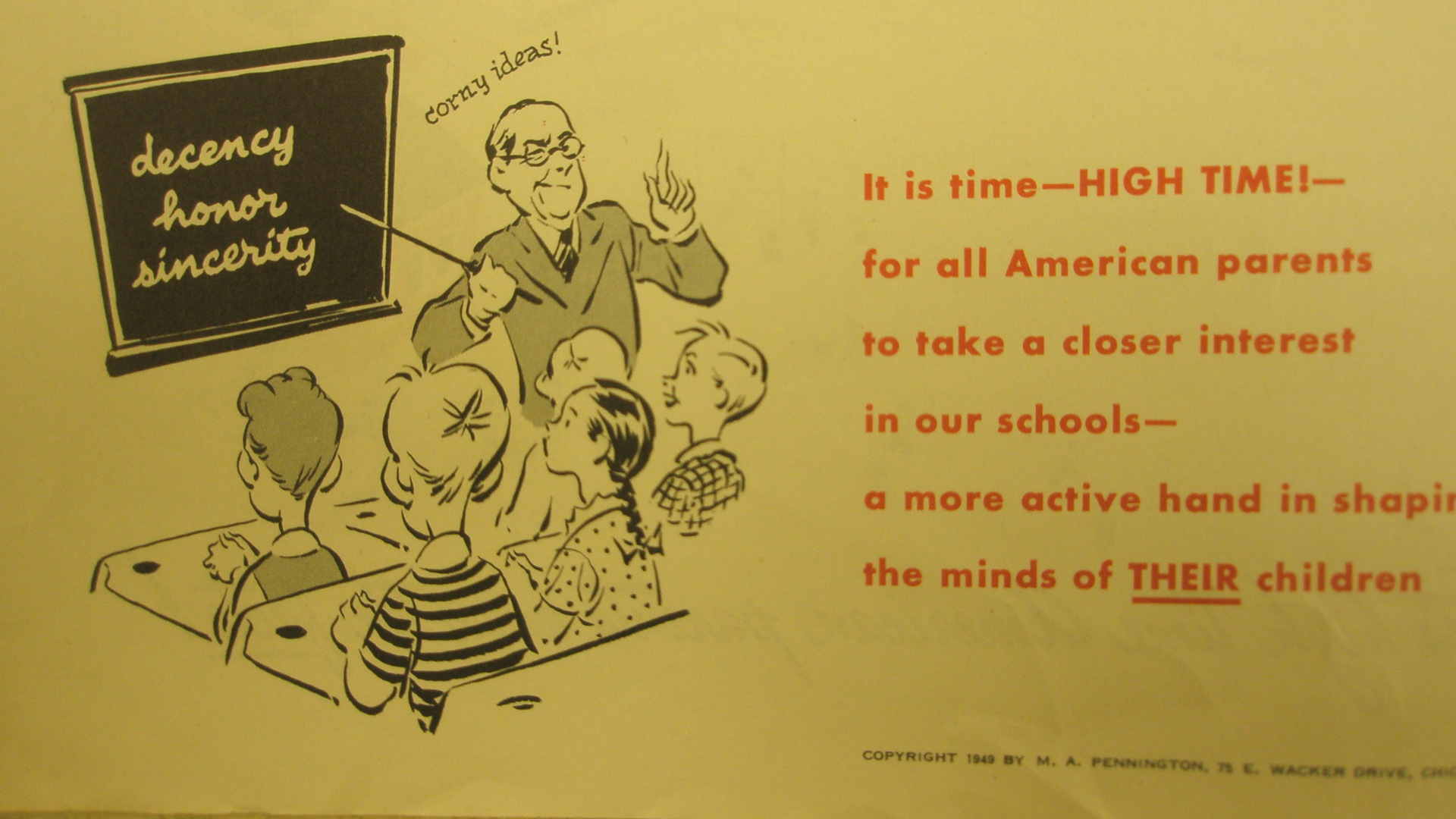
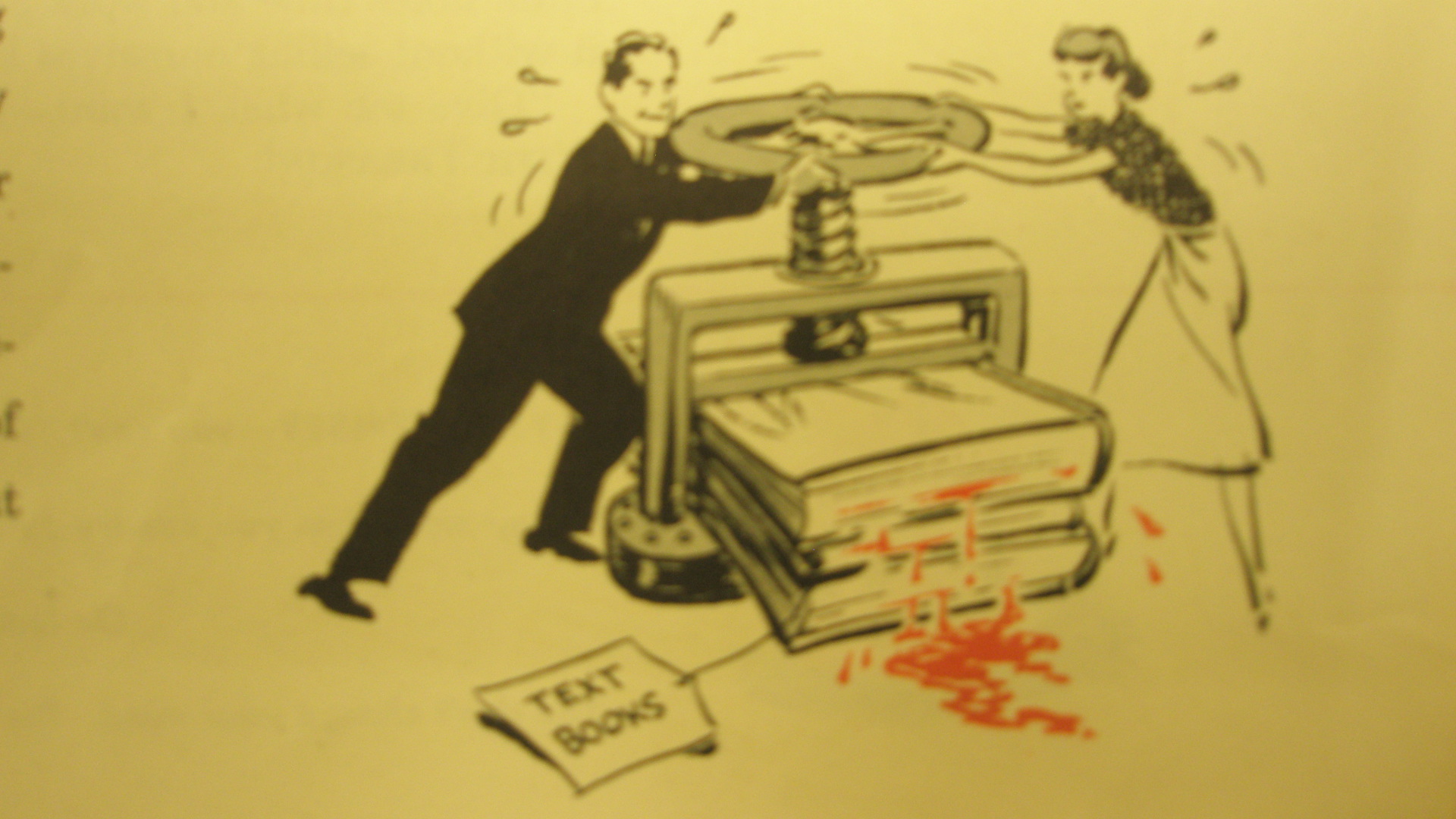
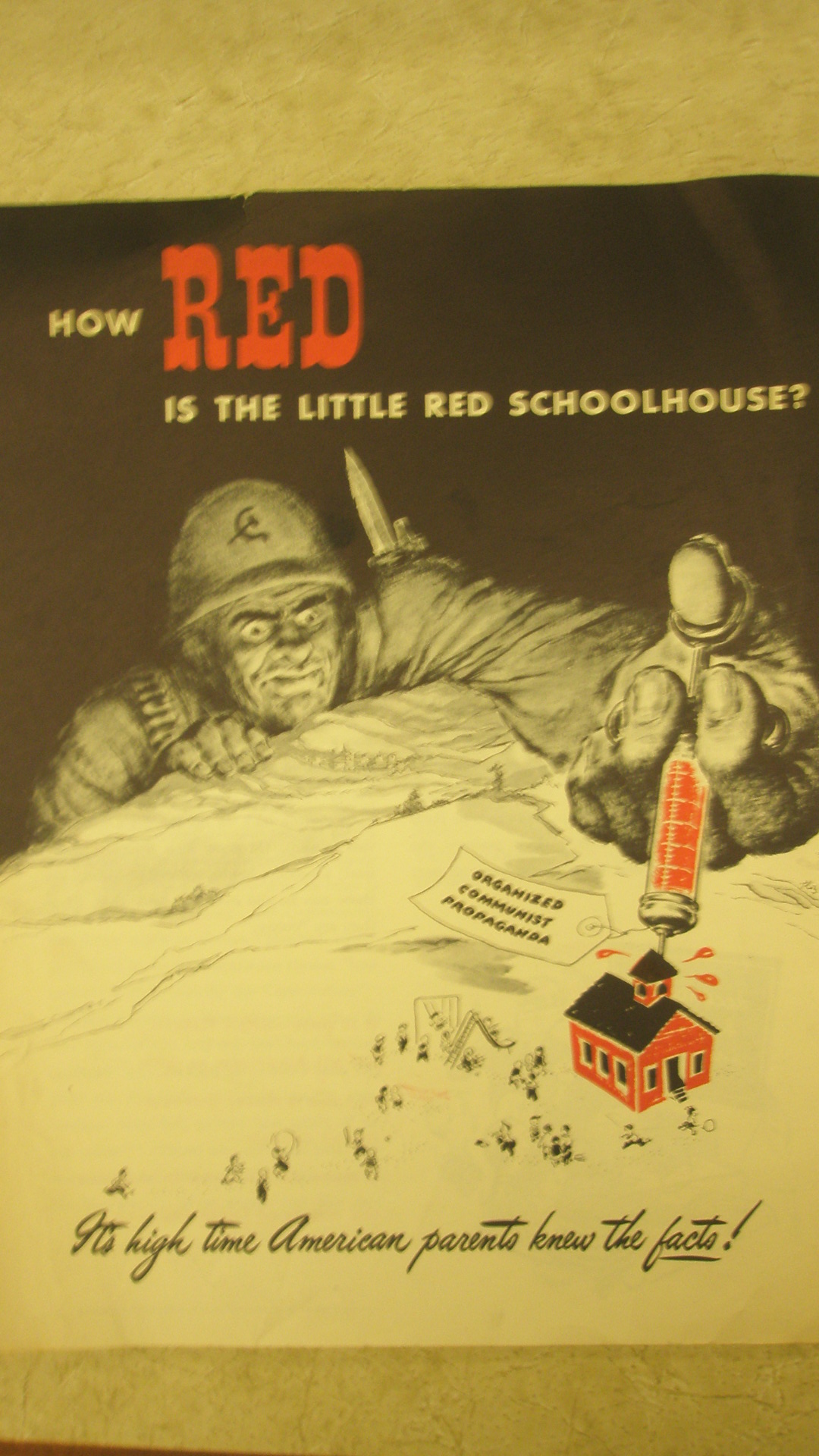
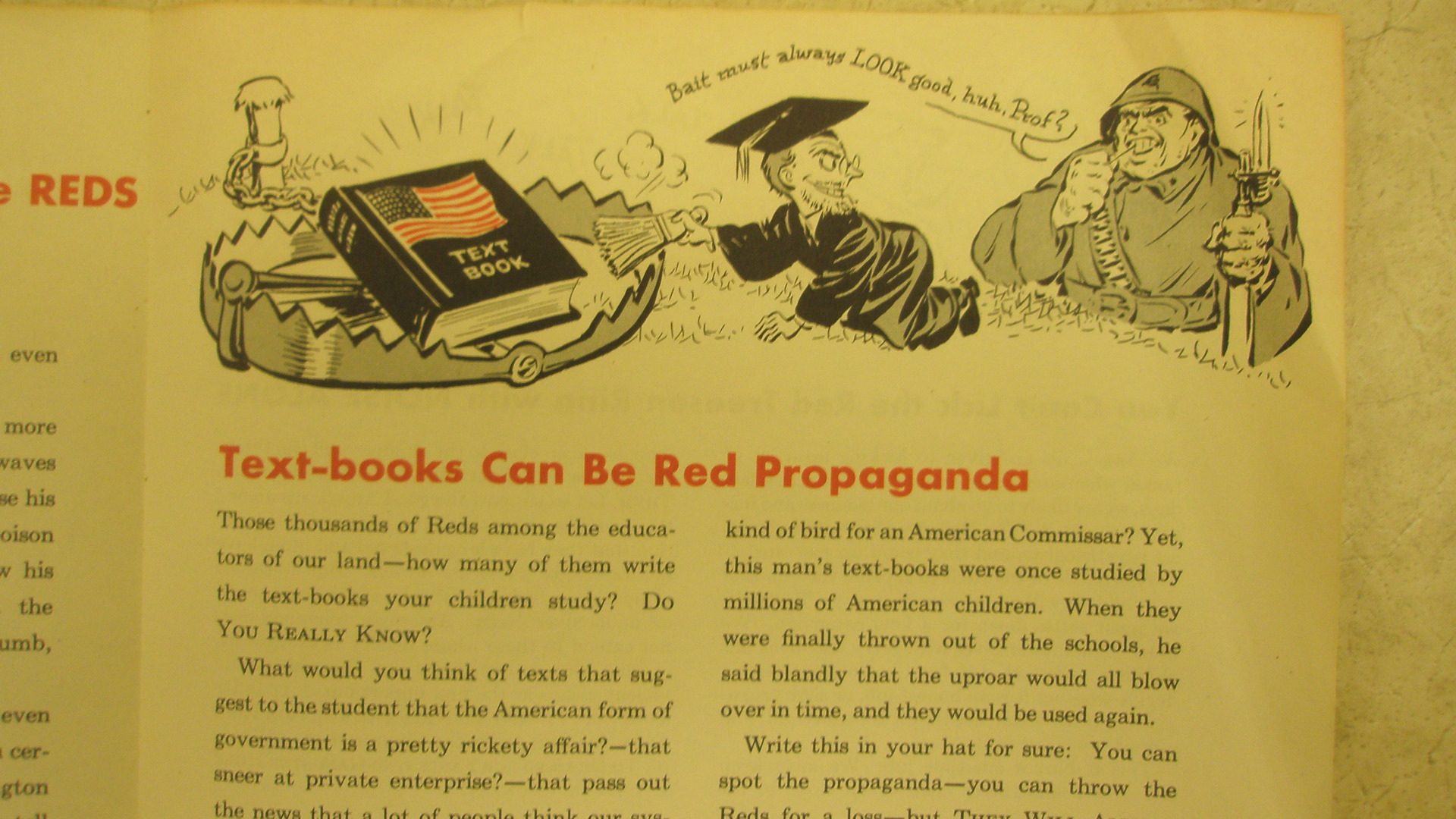
As always, a picture is worth a thousand words.  In this case, I’ll share some cartoons from an anti-communist pamphlet from 1949.  These cartoons demonstrate one common ideological thread in Cold War Fundamentalist America.  At the time, activists like the one who published this brochure felt that Communism threatened a two-pronged attack.  The danger included a military menace from Soviet Russia.  But it also meant internal subversion by dupes who did the work of the Red Army.  Intentionally or not, such subversive activity helped to weaken the resolve of America, making a communist takeover that much easier.

Further Reading: Ellen Schrecker, Many Are the Crimes: McCarthyism in America (Princeton: Princeton University Press, 1998); Jonathan Zimmerman, Small Wonder: The Little Red Schoolhouse in History and Memory (New Haven: Yale University Press, 2009).

This one shows the vast sweep of cultural ideology folded into the fight against communism. Not only must patriots fight communism, they must also fight to uphold traditional values.

Parents squeezing the “Red” out of textbooks.

As historian Jonathan Zimmerman has argued, the image of the “Little Red Schoolhouse” has long been a potent political symbol. In this cover image, the cartoonist makes a connection common in Cold-War anti-communism. “Reds” worked hard to subvert the Red Schoolhouse.

The scheming, bearded academic has long been an object of suspicion in Fundamentalist America. Here, he does the work of the Red Army.

The Bible in America: Thunderbolt, Part III: What Thunderbolt?

As we’ve discussed here lately, some fundamentalists harp on the Schempp and Engel Supreme Court decisions of 1962 and 1963 as the time God was kicked out of public schools.

Some of the reasons for this go beyond the obvious.  First of all, although the 1963 case took the name of Abington Township School District v. Schempp, it was actually a joinder decision with a case brought by the prominent atheist Madalyn Murray O’Hair.  The Schempp family were religious Unitarians.  Murray (later Murray O’Hair) was an outspoken and aggressive atheist.  Partly as a result, the Schempp case took on overtones of a fight of religion vs. atheism.  It took on overtones, in Fundamentalist America, of a last-ditch defense of God.

Such perceived high stakes led to a perception of a profound loss for Fundamentalist America.  As we’ve argued here recently, conservative evangelical Protestants reacted with profound dismay and disillusionment to the court’s 1963 decision.  A Moody Monthly poll in 1964 ranked the decision as the most important social or political event of the year, more important than the church bombings in Birmingham, Alabama.  Presbyterian fundamentalist leader Carl McIntire asked, after more than a decade of struggle to pass a Constitutional prayer amendment, “Why aren’t Christians standing where it counts and saying, ‘I’m for America and I’m for the Bible?’”

But what did the 1962 and 1963 decisions actually do?  What effects did they have in America’s public schools?

In the aftermath of the Schempp decision, a pair of political scientists—Kenneth Dolbeare and Phillipp Hammond—studied the effects.  They first consulted survey data.  Not surprisingly, they discovered that the Schempp and Engel decisions had led to a precipitous drop in the amount of school-sponsored religious activity that went on in public schools.  More precisely, they found that the decisions had led public school leaders to report a sharp drop.  About two-thirds of school districts reported that they stopped school-sponsored devotions.  Teachers reported a sharp decline.  Sixty percent reported that they had lead classroom prayers before the decisions, while only 28% admitted they still led such prayers.

Of course, even these large declines meant that many teachers and school districts continued to lead prayers and Bible readings.  But even that stubborn minority was isolated.  Most of such holdouts were in the South.  Reports from the West—where such in-school religious practice had often already been banned—and from the Plains and Northeast gave a much different picture.  In those regions, survey responses indicated nearly full compliance with the Supreme Court decisions.

We must remember that the South at this time was roiling with anti-Brown sentiment.  The white power structure had nearly unanimously agreed to resist school desegregation in spite of the 1954 Supreme Court ruling.  Many agreed with Alabama Governor George Wallace, who had declared in 1963, “I don’t care what they say in Washington.  We are going to keep right on beating the Bible in the public schools of Alabama.  I wouldn’t be surprised if they sent troops into the classrooms and arrested little boys and girls who read the Bible and pray.”

In such a climate, school leaders in the former Confederacy had a much easier time publicly renouncing the Supreme Court’s ban on school-sponsored prayer.  Indeed, it may have been political suicide for many of them to publicly support the Court.

Outside the South, however, most survey respondents claimed they had stopped teacher-led prayers and Bible readings.  But when Hammond and Dolbeare examined those schools and classrooms more closely, they found that even outside the South, teacher-led prayer and Bible reading went on just as they had before the decisions.  In other words, teachers and school administrators outside the South told surveyors that they had stopped leading religious devotions in their public schools.  They knew that such practices had been prohibited.  But when the classroom doors were closed, they continued to pray and read from the Bible with their students.

Most remarkable, in Dolbeare and Hammond’s opinion, was the fact that throughout the communities they studied in the Midwest, everyone knew what was going on and no one complained.  As long as state-level school administrators could claim that they did not know of any teacher-led devotions, the devotions themselves went on undisturbed.  Teachers led prayers in their classrooms.  School building principals led prayers at school ceremonies.  Bible verses adorned graduation speeches and school hallways.  According to Hammond and Dolbeare, most of the people involved were aware of the Supreme Court’s ruling.  Yet they continued to engage in exactly the sorts of practice the Court had ruled against.

Fast forward to the twenty-first century, and we see a much different picture.  Regional variations in racial desegregation in schools have often flip-flopped, with the most segregated school districts now in places such as New York City, Detroit, and Milwaukee, Wisconsin.  Similarly, in spite of a relatively recent New York Times article that assumed school-sponsored religious practices had been shunted to “some corners of the country, especially in the rural South,” even a casual observer of the news will see that battles over the proper role of religion in public schools continue all over the country.

For example, we noted recently a remarkable law passed recently in New Hampshire, hardly an outpost of the “rural South.”  This law mandated that parents could request alternate textbooks or curricular materials for any reason.  In theory, this could mean that strict vegetarian parents could object to books that portrayed meat-eating in a flattering light.  The intent of the law, however, was clearly to protect the faith of evangelical Protestant children.  The push for the law began when one family objected to the Jesus-bashing of author Barbara Ehrenreich.

Or the continuing case of Bradley Johnson.  Johnson insisted on putting religion-friendly placards on his classroom wall.  His stubborn activism can only be called “Southern” if we include “Southern” California.  And while San Diego is technically one corner of the country, it is hardly an isolated outpost of ‘hillbilly’ culture.

Just as it was for Dolbeare and Hammond in the 1960s, it is nearly impossible for us to know what really goes on in most public-school classrooms.  Cases like Johnson’s don’t tell us much about what most teachers are doing.  As Dolbeare and Hammond concluded, one of the main reasons for the continuing practices of teacher-led prayers and Bible readings was that everyone involved hoped to avoid any controversy.  Parents did not want to stand out as anti-prayer.  Teachers did not want to appear to denigrate religion.  School administrators did not want to crack down on what many perceived to be wholesome traditional American practices.

These days, it is difficult to predict just what practices might pass for non-controversial in America’s public schools.  Local traditions—even down to the level of individual schools and neighborhoods—trump Supreme Court decisions or New York Times reporters’ assumptions.

For conservatives, this means that traditional practices such as prayer or Bible reading might continue in public schools, as long as there has never been a local complaint against the practice.  It also means that conservative activists such as Bradley Johnson might mount a counter-revolution in any part of the country.

For many such activists, public schools have taken on an aura of secular fortresses.  In the rhetoric of many conservatives, public schools are the headquarters of Jesus-bashing, evolution-teaching, sex-teaching, drug-selling liberals.  A more careful look, like what Dolbeare and Hammond did forty years ago, would likely present a much more traditional, religion-friendly picture of life inside those public-school walls.

Homeschooling and Fundamentalist America

As we’ve noted here before, there are many voices in Fundamentalist America who insist public schools are rotten.  One option for parents that has become increasingly popular since the 1980s has been homeschooling.

There’s still a lot we don’t know about homeschooling.  First of all, though it has become associated in many people’s minds with conservative religion, we don’t really know why parents choose to do it.  That is, we don’t know how many of the homeschoolers out there are motivated to do so by a fundamentalist religious or cultural distrust of the dominant ideology of public schooling.  After all, since the 1960s there has been a small but vocal minority of homeschoolers from the cultural left, too.

We also don’t know much about the success of homeschooling.  Do kids learn?  If so, would they learn just as well in traditional schools?  In other words, is it homeschooling that helps kids learn better?  Or is it the fact that they are talented students from homes with involved, active parents–just the type of student who would tend to do well in a public school, too?

Just as with any contested cultural issue, it’s hard to know where to turn for reliable research in these areas.  Many homeschoolers hope to prove that their method is equal to or superior to traditional schooling.  Many public-school advocates want to show that homeschooling is not an acceptable alternative.  We have to look at any “research” promoted by either side with a good deal of skepticism.

This is why we’ve noted with interest a couple of reviews that came across our screens lately.  The first is by Brian D. Ray of the National Home Education Research Institute.  There’s no doubt that Ray is partisan.  His organization promotes the legal rights of homeschoolers.  And he doesn’t hide his delight at the implications of the study he’s reviewing.  The study, by Sandra Martin-Chang, Odette N. Gould, and Reanne E. Meuse, (Martin-Chang, Sandra; Gould, Odette N.; Meuse, Reanne E. (2011, May 30). The impact of schooling on academic achievement: Evidence from homeschooled and traditionally schooled students. Canadian Journal of Behavioural Science/Revue canadienne des sciences du comportement, pp. 1–8) compared students from 37 homeschool families with 37 traditional ones.  The sample size was small, as Ray concedes.  The researchers found that students from “structured” homeschool environments did significantly better on academic achievement than their public-school counterparts.  Students from “unstructured” homeschools tended to do worse.  The most interesting part of this study results from the researchers’ attempt to control for other factors.  That is, they chose families that were similar in all variables except for type of schooling.  In other words, they tried to solve the question of whether homeschoolers performed better because they had other family advantages besides homeschooling.  Of course, as Ray and the study’s authors all acknowledge, this result does not prove much.  The kinds of testing done to ascertain academic performance tend to reward those students who experience “structured” teaching, whether at a homeschool or a public school.

The second review comes from the leading academic historian of homeschooling in America, Milton Gaither.  Gaither teaches at Messiah College in Pennsylvania and blogs about the latest finds in homeschooling at Homeschooling Research Notes.  He noted recently the publication of a rare longitudinal study of homeschoolers.  This study by Linda Hanna of West Chester University in Pennsylvania (Linda G. Hanna, “Homeschooling Education: Longitudinal Study of Methods, Materials, and Curricula” in Education and Urban Society 20, no. 10 (2012): 1-23) looked at hundreds of homeschooling families in 1998, then again in 2008.  Hanna’s results offer some interesting hints about the perennial homeschooling questions.  For example, Hanna finds that an overwhelmingly large percentage of families in her study seem to choose homeschooling due to conservative religion and culture.  Also, the number of families choosing to stick with homeschooling all the way through secondary school increased significantly over the course of one decade.  The most obvious explanation for this change seems to be the rise of computers and internet access during that time.  When more families had better online access to educational resources, more chose to keep their kids at home for middle- and high-school, too.

As always, these kinds of studies leave us wanting more.  We’d like to see larger sample sizes, longer studies, more exhaustive research methods.  But these studies and others like them help make the case that homeschooling is a legitimate alternative to public schools.  For those of us trying to understand Fundamentalist America, this can tell us a couple of things.  First of all, we can acknowledge that those conservative religious folks who choose homeschooling might be making an educationally superior choice.  Second, we can see that some of the hostile stereotypes about Fundamentalist America just don’t hold water.  Just because parents are conservative and deeply religious doesn’t mean they are not willing to embrace alternative cultural institutions.  Many conservative folks jumped headlong into a very experimental form of alternative schooling when they thought public schools were not doing the job.

REQUIRED READING: Protester Voices

For those who hope to understand Fundamentalist America in the twenty-first century, a good place and time to start would be Kanawha County, West Virginia, 1974.

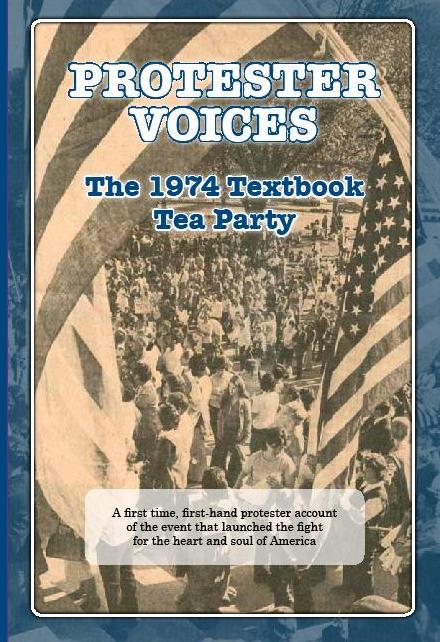
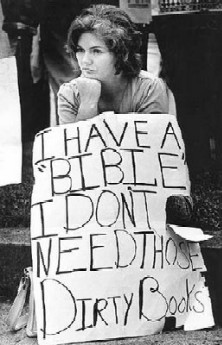
The raucous 1974-1975 school year in this county surrounding Charleston saw a burst of public controversy over the teaching in its public schools.  Protesters vilified a set of textbooks adopted by the school district.  At its peak, the protest and school boycott included a sympathy strike by the area’s miners and even a spate of gunshot attacks and the bombing of a school-administration building.  The fight in Kanawha County, as argued by both protesters and historians, can correctly be seen as the birthplace, or at least the midwife, of an emerging populist conservative movement.

The controversy has attracted its share of recent attention from scholars such as Carol Mason and journalists such as Trey Kay.

Thanks to the energetic activist Karl Priest, we now also have an account of the controversy written from a prominent member of the movement itself.  Priest’s 2010 book Protester Voices offers a view from inside the textbook protest movement.

Priest’s story is unabashedly partisan.  The tone and style of his book are those of a bare-knuckled culture warrior rather than those of a disinterested academic.  Priest has achieved a reputation as one of today’s leading anti-evolution internet brawlers.  In addition to his anti-evolution work, Priest is also currently active in Exodus Mandate.  This organization promises “to encourage and assist Christian families to leave government schools for the Promised Land of Christian schools or home schooling.”  Those who hope to explore the worlds of conservative Christian activism in twenty-first century America will soon run into the work of Karl Priest nearly everywhere they turn.  Indeed, when ILYBYGTH first starting imagining how intelligent, educated people could embrace creationism (see, for instance, here, here, here, here, and here), we were accused of being merely a front for Priest.

In his 2010 book, Priest takes other writers to task for their anti-protester bias.  He dismisses Carol Mason, for example, as someone who “concentrate[s] on the exception to the rule” (37).  The protest movement, Priest insists, must not be understood as an irruption of racism or vigilante violence.  The protesters themselves cannot fairly be dismissed as “wild-eyed ignoramuses” (xiii).  Such accusations, Priest insists, demonstrate the bias of left-leaning scholars more than the lived reality of the protest itself.  The leaders of the movement, in Priest’s view, “suffered financial loss. . . . [and] endured snide remarks and mocking.”  They did so in order to defend their schools and community against the imposition of taxpayer-funded textbooks that included aggressive racism and sexual depravity.  Priest defends the rank and file of this movement, also slandered mercilessly by other writers, as “Norman Rockwell Americans” (63).

Priest agrees with other commentators that this textbook controversy provided the launching pad for a new kind of conservative activism.  Kanawha County attracted national leaders such as Mel Gabler and Max Rafferty.  The fledgling Heritage Foundation sent legal advisers.  The 1974 protest, Priest claims, heralded the new generation of populist conservatism that continues in today’s Tea Party movement.

For anyone hoping to understand Fundamentalist America, this book is an important resource.  Not only does Priest’s account offer a staunch defense of the fundamentalist side of one of the most significant controversies of the late twentieth century, he also includes a reflection on the meanings of fundamentalism itself.  Though he prefers the term “Bible-believing Christian,” Priest insists that “Being a fundamentalist, contrary to what liberals have propagandized, is nothing to be ashamed of just by the attachment of the term” (3).

In the News: Gay Rights, Bullying, and the “Homosexual Agenda”

Thanks again to Charles Haynes of the First Amendment Center for drawing our attention to Missouri’s “Don’t Say Gay” bill.

This bill, Missouri House Bill 2051, would prohibit teachers in public schools from discussing homosexuality with their students.

The impetus for the bill comes from a widespread belief in Fundamentalist America that public schools push what Fundamentalists call a “homosexual agenda.”

Understandably, non-fundamentalists see bills like this as an attempt to limit rights for gay people.  One Missouri activist called this bill “a desperate tactic by frightened, bigoted, cynical individuals who are terrified at the advancement the LGBT community has made.”  Other interweb voices blasted the move as “moronic legislation” by the “elected bullies” in the Missouri legislature.

I agree with the sentiment expressed by these anti-2051 activists.  This Missouri bill, like other bills that seek to control teachers’ ideological performance, promotes a poisonous educational atmosphere in which the best teachers are forced into cynicism or subversion.  Meanwhile, the bulk of public school teachers trudge along in a bland mediocrity, avoiding any topic that might have potential interest or relevance in students’ real lives.

But I wonder if opponents of the Missouri bill understand that the polemic strategy they use actually reinforces the notions of their Fundamentalist opponents.  Here’s what I mean:  The most common defense of discussing sexual orientation openly and frankly in public schools is that such discussions can help limit bullying.  Defenders of the rights of gay people, especially of gay students in schools, point to the dangerous and even fatal bullying of gay students as the threat of gag rules like HB 2051.  To attack HB 2051, gay-rights activists wrap their assertion of rights for homosexuals in the language of a wider, faddish anti-bullying campaign.

In doing so, they confirm the suspicion of anti-gay activists from Fundamentalist America.  Such activists warn of a creeping “homosexual agenda.”  Such an agenda, Fundamentalists warn, focuses on using public schools to promote an idea that all sexual orientations must be considered equal.  A central trait of this “homosexual agenda” in public schools, as this CitizenLink (an offshoot of James Dobson’s Focus on the Family) video emphasizes, is that the homosexual agenda is “sneaky.”  [This video is just under ten minutes long, but well worth the time for those who hope to understand the thinking of Fundamentalist America.]

Fundamentalists warn that homosexual activists will wrap their true agenda in other causes.  And, when gay-rights activists point to bullying as the main reason to oppose 2051, they add more legitimacy to this Fundamentalist claim.

Let me be clear here: I am not in support of 2051.  But arguing that this is a bullying issue, instead of a gay-rights issue, is exactly what Fundamentalist America expects of gay-rights activists.  I suspect a better understanding of Fundamentalist America would allow gay-rights activists to avoid playing into Fundamentalists’ hands in this way.  Using the broader issue of bullying to promote fuller equality in public schools ends up strengthening Fundamentalist arguments, not weakening them.  Equality should be enough.  That is, gay-rights activists and others should keep it simple: Public schools must be places where every student, teacher, parent, staff member, and administrator feels welcomed and valued.  Regardless of race, religion, sexual orientation, gender, or other distinction.  This is sufficient reason to oppose Missouri’s 2051 and similar bills.  Saying that gay students must have equal rights only because they might otherwise be bullied muddies the issue.  It fuels Fundamentalist fears that a “homosexual agenda” is being foisted on public schools, hidden in common anti-bullying campaigns.


Traditionalist Teaching for Progressive Teachers? Lisa Delpit and Fundamentalism in Black and White

Fundamentalists don’t like progressive education.  They may not realize that they have some potential allies deep in the heart of the academic education establishment.

What do fundamentalists mean when they fight against “progressive education?”  For one thing, fundamentalists tend to pooh-pooh reading instruction that allows children to ‘discover’ reading on their own.  And they dismiss the notion that classroom teachers should put authority in the hands of students.  Also, fundamentalists often look askance at education professors who advocate soft-heading, child-centered classroom teaching that fails to deliver basic information and academic skills.

Generally, fundamentalists make these complaints from outside of the academy.  Some historians and other prominent academics—folks such as Arthur BestorRobert Hutchins,  or Arthur Schlesinger, Jr.—have critiqued the claims of progressive education, but most of the effective critics have worked outside of higher education.  But in the past generation, at least one prominent academic educator has critiqued “advocates of any progressive movement” who fail to consider the opinions of those “who may not share their enthusiasm about so-called new, liberal, or progressive ideas.”  The work of this world-famous educational activist is read at every school of education, especially ones in which teachers are trained to use progressive teaching methods.

Then why does she talk this way?  Because she framed the issue not as traditional and progressive, but as black and white.  Her name is Lisa Delpit, and her traditionalist critique of progressive education did not lead to her exclusion from the education academy.  On the contrary, she has received some of the academy’s most prestigious awards for her work, including a MacArthur “Genius” award in 1990 and Harvard Graduate School of Education’s Outstanding Contribution to Education award in 1993.
To be clear, Delpit demonstrated considerable differences from many other traditionalist education activists.  For example, she backs a multicultural approach to education, most conservative traditionalists do not.  (See the ILYBYGTH discussion of traditionalist critiques of multicultural education here, here and here.)  She supports reading in depth and excoriates rote instruction.

But she also pushes a traditionalist ideology of teaching.  She offers withering criticisms of progressive teachers’ justifications.  In one career-making speech and article from the late 1980s, Delpit castigated progressive educators for their misplaced softness toward students.  She cited with approval one African American classroom teacher who described her anger at white progressive teachers as “a cancer, a sore.”  This teacher had stopped arguing against progressive methods.  Instead, she “shut them [white progressive teachers and administrators] out.  I go back to my own little cubby, my classroom, and I try to teach the way I know will work, no matter what those folk say.”  Delpit suggested that a direct-instruction model matched more closely the cultural background of most African American students.  In one model Delpit described favorably, the teacher is the authority.  The goal is to teach reading via “direct instruction of phonics generalizations and blending.”  The teacher keeps students’ attention by asking a series of questions, by eye contact, and by eliciting scripted group responses from the students.  Such traditionalist pedagogy, Delpit noted, elicited howls of protest from “liberal educators.”

In a sentence that could come straight from such conservative traditionalist leaders as Bill Bennett or Max Rafferty, Delpit supported the notion of many African American educators that “many of the ‘progressive’ educational strategies imposed by liberals upon Black and poor children could only be based on a desire to ensure that the liberals’ children get sole access to the dwindling pool of American jobs.”

In another critique, Delpit argued that white, middle-class teachers hid their classroom authority in ways that were confusing to poor and African American students.  Teachers of all backgrounds, Delpit suggested, need to be more explicit about their power and authority in the classroom.  A good teacher, Delpit noted, was seen as both “fun” and “mean” by one African American student.  Such a teacher, Delpit’s interviewee argued, “made us learn. . . . she was in charge of that class and she didn’t let anyone run her.”

More important for fundamentalist activists, Delpit’s voice is not alone.  A call for traditional pedagogy and schooling seems to be gaining adherents among African American parents and educators.  We could look at the deep traditionalism of such prominent schools as the New York Success Academy Charter Schools.  Or we could probe the attitudes of those who run KIPP (Knowledge Is Power Program) Schools, which tend to serve significant numbers of African American students.  In a recent article about school “paddling” in USA Today, one African American school administrator confirmed that she believed in spanking “because I’m from the old school.”

The numbers indicate African American students tend to receive corporal punishment more often than students of other racial backgrounds, but don’t indicate the level of support for such punishment among African American teachers as opposed to teachers of other races.  There are some indications that African American parents tend to use corporal punishment more often than other groups.  This would support Delpit’s assertion that many African American students have different cultural expectations from other students when they get to school.  But the same study asserts that a huge majority of parents of other groups also use corporal punishment at home.  And, indeed, there is a lot of support for corporal punishment at school among white conservative activists.  But such support generally comes as part of a broader traditionalist, anti-progressive ideology of schooling.

Delpit’s argument is different.  She argues for traditional authoritarian teachers within a progressive, multicultural educational system.

What does this mean?  I’ve got a couple of reflections, and I’d welcome more.

For one thing, it tells us something about the current state of education scholarship.  Seen optimistically, we might conclude that the popularity of Delpit’s work proves that education scholars are willing to embrace a true diversity of opinion.  That is, education scholars might not be the petty intellectual tyrants some traditionalists accuse them of being.  To cite just one example, arch-traditionalist Max Rafferty in 1968 accused the “education bureaucrats” of only speaking to regular people “with that air of insufferable condescension.”  Such “educationists,” Rafferty charged, only listened to one another; they only hoped to turn America’s schools into something approaching a “well-run ant hill, beehive or Hitlerian dictatorship.”  Delpit’s example of progressive traditionalism might suggest that education scholars are more open to dissent than Rafferty and others have consistently charged.

In a less rosy light, though, we might conclude that this is yet another example of the ways the mainstream academy is hamstrung over racial ideology.  We might wonder if Delpit’s ideas would be welcomed as fervently if education scholars weren’t so terrified of being considered racially insensitive.  It helps, of course, that Delpit is a wonderful writer and powerful polemicist.  But it is hard to ignore the question: How warmly would a scholar be welcomed who trashed the idea of progressive pedagogy in general?  Not just for one group of students, but for students and schools in general?

One other point jumps out at us: we apparently need to be more careful when we talk about traditionalist education.  I’ll plead guilty.  I am most interested in those traditionalists who act out of what we can fairly call a conservative impulse to transform American schools and society.  Folks like Rousas Rushdoony, Max Rafferty, Sam Blumenfeld, Mel and Norma Gabler.  Groups like the Daughters of the American Revolution and the American Legion.  Activists from these groups have long believed that teaching must be made more traditional so that American society itself can reclaim some of its lost glory.  But there are traditionalists like Delpit who hope that schools will transform school and society in a vastly different way.

Perhaps we need to treat “educational traditionalism” the way we treat “evangelicalism.”  A lot of folks, scholars and normal people alike, tend to treat “evangelicalism” as if it were the sole domain of white, conservative folks such as Billy Graham and Jerry Falwell.  But religious historians are also interested in other forms of evangelicalism.  There have always been leftist evangelicals, for instance, as Raymond Haberski has recently noted.  And, of course, there has always been a strong evangelical tradition among African Americans.

Perhaps the most important notion to think about here is that we have more than one kind of educational traditionalism.  Bashing progressive education has long been the national pastime of educational conservatives.  For the last twenty-five years or so, such conservatives have been joined by an influential cadre of mainstream education scholars.
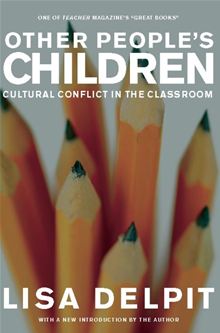
Further reading: Lisa Delpit, “The Silenced Dialogue: Power and Pedagogy in Educating Other People’s Children,” Harvard Educational Review 58 (Fall 1988): 280-199; Delpit, (1986). Skills and other dilemmas of a progressive black educator. Harvard Educational Review, 56(4), 379-386; Delpit, Lisa. (1995). Other People’s Children: Cultural conflict in the classroom. New York, NY: The New Press; Delpit, L & Perry, T. (1998). The Real Ebonics Debate: Power, Language, and the Education of African-American Children (Eds.). Boston, MA: Beacon Press; Delpit, L. & Dowdy, J. K. (2002). The Skin That we Speak: Thoughts on language and culture in the classroom (Eds.). New York, NY: The New Press; Delpit, L. D. (2012). Multiplication is for White People: Raising expectations for other people’s children. New York:The New Press.