I Love You but You Didn’t Do the Reading

Apparently there was some news this week about a whistle blowing in Ukraine or something. In the ILYBYGTH International Offices, though, the stories below were the top ones to grab our attention:

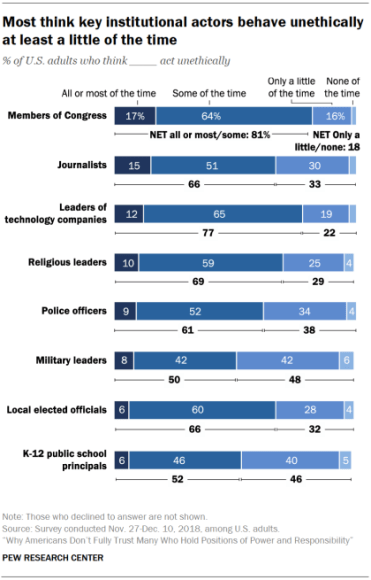
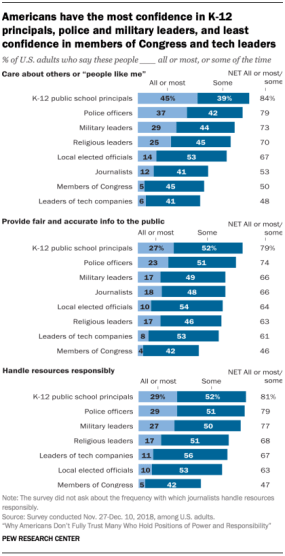
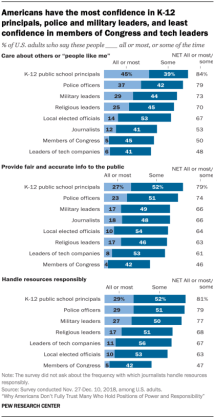
Whom do Americans trust? Well, nobody, really. But they trust school principals more than they trust religious leaders. From Pew.Pew principals or preachers II
What’s wrong with judging teachers by students’ test scores? The view from Florida at TBT.

teachers who don’t even teach math or reading receive VAM scores based on the school’s average, not what they’ve done in the classroom. They are judged on variables they can’t even influence.

The answer is not that complex. Put in place a good principal — a good leader — and let her run the school and build support. If she rates a teacher “highly effective,” the state should trust her judgment and not micromanage by wielding a flawed VAM score as a cudgel. It’s one thing to measure performance in the classroom. It’s another to use a faulty measurement that unfairly punishes some good teachers and deprives students who need them.

So, wait: ARE religious children more generous? A retracted study leads to more questions at PT.

In 2015, a paper by Jean Decety and co-authors reported that children who were brought up religiously were less generous. The paper received a great deal of attention, and was covered by over 80 media outlets including The Economist, the Boston Globe, the Los Angeles Times, and Scientific American. As it turned out, however, the paper by Decety was wrong.

What should evangelicals do about getting kicked off campus? One piece of evangelical advice at RNS.

Today, evangelicals should not take to social media to complain that Christian conservatism is under attack. Rather, we should grieve that our LGBTQ+ neighbors don’t feel safe on our campuses and do something about it.

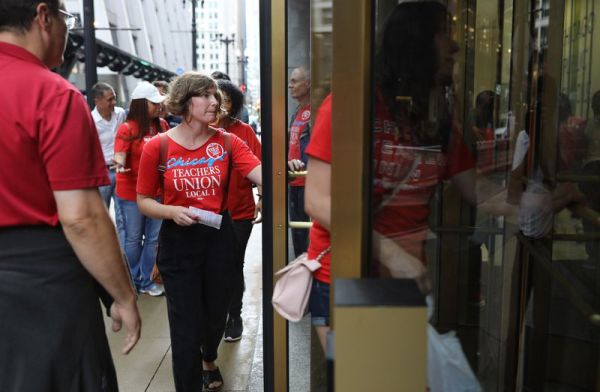
Chicago teachers gear up for another strike, at CT.

The union’s demands boil down to a hashtag, #PutInWriting, which social media users have appended to statements of support for CTU and demands that the city codify certain promises in contract language. The mayor has promised and budgeted for more nurses, social workers and special education staff, but the union wants those commitments made in a legally binding contract.
chicago teachers strike

How many kids are praying at your public school? New app hopes to boost numbers, at CT.

SYATP phone

Does she have a K-12 plan? A look at Sen. Warren’s ideas about schools at CB.

She has been a staunch advocate for holding schools accountable for their test scores and graduation rates, describing that data as a tool to push for racial equity, though more recently she’s criticized “high-stakes testing.” She has also praised charter schools in her home state while pushing for greater oversight of the schools nationally, especially those run by for-profit companies.
Seeing Red at the Big Red University

If you read the culture-war headlines these days, you’d likely conclude that elite universities are citadels of uncompromising and relentless leftism. News from my alma mater today makes that myth a little more complicated.

madison trump protest_LI

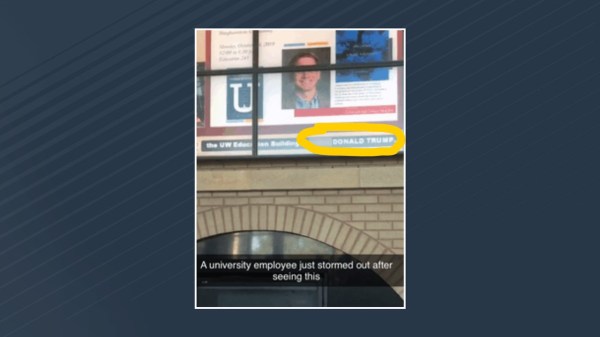
Waitaminit: Who’s that snappy-looking fellow on the big screen?

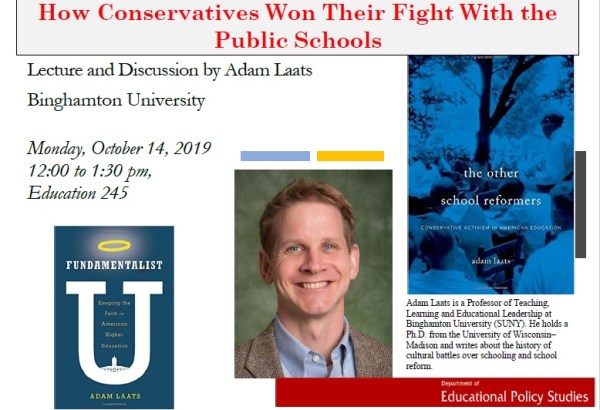
Here’s the story: So apparently there is a big digital display board on Madison’s campus. They use it to announce exciting upcoming events, such as the best lecture ever to take place, coming soon on October 14. If you look closely, you can see that someone typed in a derogatory reference to President Trump.

Apparently, a keen-eyed campus Trump supporter (or maybe just a vigorous devotee of Madison’s political-speech policy) complained and the message was removed. As a university spokesperson explained,

university policy prohibits the use of university resources for political campaigns. On UW-Madison’s website explaining the policy, “political campaigns” are described as an activity that “can include, among other things, solicitation of campaign contributions, service in furtherance of candidates, political parties and political action committees, and advocating a particular position on a referendum.

So is this proof that campuses are hotbeds of leftist thinking? Well, yeah, sorta. Someone in charge of that message board saw fit to insert an anti-Trump message. On the other hand, this story also shows that such leftist activism is officially quashed immediately, and that people are on the lookout for it. It is not tolerated or winked at. It is not universally agreed upon.

Most important, it shows that there is a scintillating event coming up on campus. If you’re in Madison on Monday, October 14, be sure to come to Education 245 at noon to hear my talk about the ways conservatives won their school battles in the twentieth century!

madison talk flyer

Preachers or Principals?

It’s not really good news, I guess. Recent poll results from the Pew folks suggest that Americans don’t trust many kinds of authority figures. pew principals or preachers

There is a glimmer of hope, though. When it comes to our school culture wars, it looks like people tend to trust school leaders a little more than the trust religious or “tech” leaders.

When asked if they think tech leaders or religious leaders act unethically all or some of the time, 77% of respondents said yes for tech leaders, 69% for religious leaders. It’s not a great result, but only 52% of people thought “K-12 public-school principals” did. And only 6% thought school leaders acted unethically “all or most of the time,” compared to 12% for tech leaders and 10% for religious leaders.

So if there is any hope for bridging our divides about teaching evolution, sex ed, and real US history, it’s not likely to come from religious leaders or tech whiz-kids, in spite of the fact that they get a lion’s share of headlines.

Pew principals or preachers II

And the school principals fare even better when the questions are phrased in positive terms. A whopping 84% of respondents said they thought school principals care about others or “people like me” all, most, or some of the time.

Of all the categories (principals, police officers, military leaders, religious leaders, local officials, journalists, members of Congress, and tech leaders), school principals scored highest on this measure.

Not really a lot to celebrate, but at least people still seem to have a high regard for the people who work in public schools. We can’t help but wish that the Pewsters had asked the same questions about public-school teachers. My hunch is that they would have a much better reputation than school principals, even.

The Good News: Teachers Have Always Known What to Do about Culture War Topics

What is a teacher to do? How can she teach her class if parents are always suspicious of her motives? Someone out there in interweb-land has been searching for answers, so today we’ll share the good news about America’s educational culture wars.how to deal with fundamentalist parentsHere’s what we know: Someone has been stumbling across this blog lately searching for answers to the age-old school culture-war question: How can I deal with fundamentalist parents? I don’t know what this person is going through. I don’t know where they are or what they do for a living.

But if the question is about how public-school teachers should “deal with” parents who come from conservative evangelical backgrounds, let me share a little bit of my argument from my upcoming book about creationism.

Let me start with the least-obvious part: The thing Christian fundamentalists most fear about public education has NOT been evolution, or sex ed, or any of those things. After all, even the more-creationist-than-thou folks at Answers In Genesis advocate the teaching of evolution to kids. And plenty of conservative Christian groups have long actively promoted sex ed in public schools.

The big questions in school culture wars have not been WHAT should be taught, but HOW it should be taught and BY WHOM. Fundamentalist Christian parents–like (almost) all parents–want their children to learn how to thrive in the modern world. That means learning about sex and science. But from the fundamentalist perspective, too often sex and science are taught with a dangerous do-what-feels-good attitude. Fundamentalist parents want their kids to learn about sex, but not be encouraged to have premarital sex. They want their kids to learn about science, but not to be encouraged to ditch their religious ideas.

And that brings us to the good news: We can all agree on those things. Public schools shouldn’t be cramming religious ideas down students’ throats. Schools have an obligation to help students learn the best information out there about sex and science, but schools also have an obligation to leave students’ religious ideas to students.

So what should a teacher do about fundamentalist parents? What good teachers have always done: Begin by building trust. Build a positive relationship with students. Reach out to parents to let them see what you are doing.

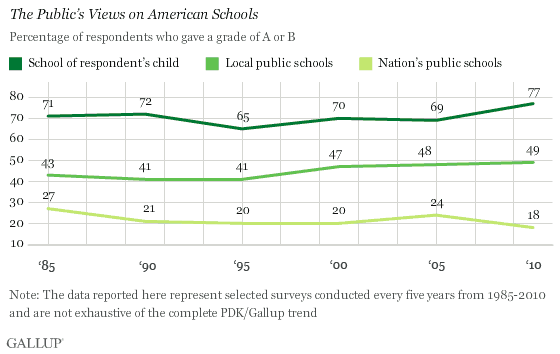
gallup local schools

People LIKE the schools they know.

And here’s the better news: It works. Teachers and parents have been bridging the educational culture-war trenches for a long time now. How do we know? When Gallup asks parents what they think of their kids’ schools, parents usually give positive responses.

Why? Because teachers, parents, and students have been working together, building trust. Fundamentalist parents might be nervous about the kinds of sex ed they read about in newspapers. They might read about science teachers trying to cram atheism down their kids’ throats. But when they meet their kids’ teachers and principals, they like them. They trust them.

And that’s the place all of us should start. So how should teachers “deal with” fundamentalist Christian parents? Just like all parents: Get to know them. Tell them how much you love their kids and want the best for them. Share your lesson plans with them and listen to what they have to say.

When School Prayer Gets Creepy

It’s not because we don’t like conservative Christians. It’s not because we think Christianity is inherently bigoted. It’s not because we misunderstand SCOTUS precedent. But the more we hear this evangelical school group talking, the more likely we are to hear creepy tones of Handmaid’s Tale takeover. I’m hoping there are plenty of evangelicals who agree.

SYATP phone

See You at the Pole, fine. But don’t “Claim My Campus” !

Here’s the latest: Today is See You at the Pole day. That means K-12 students nationwide are encouraged to meet at their schools’ flagpoles to share a prayer.

So far, so good. There’s absolutely nothing wrong with students praying in schools. Teachers, too, as long as they don’t try to impose their religious views on their students.

The problem only comes when the organizers keep talking. The organization in charge partnered with another group to spread the word. This associated group declares its goal to spread prayer groups to every single school in the USA.

Nothing wrong with that, either. The problem only peeks through when we see the name of the sponsoring organization. It’s not “Pray If You Want.” It’s not “We Pray, Okay?” No, the name of the organization is “Claim Your Campus.”

Do we need to spell it out? Non-evangelical people—and I’m guessing most evangelicals, too—don’t want prayer groups to claim our campus! We want them to participate, sure. We want them to feel at home, of course. But we wish that Claim Your Campus and other evangelical groups would realize that they don’t have a right to CLAIM anything.

Stop the Hostage Crisis in Campus Culture Wars

It can be difficult to know what to do on America’s college campuses. Recent cases from Baylor and Duke lead to some difficult questions: Do conservative Christian colleges have a right to discriminate against LGBTQ students? Do liberal schools have a right to discriminate against conservative Christian ones? In all these culture-war tiffs, one fact tends to get lost. Namely, students should not be the ones paying the price for culture-war hostilities.

Houston chronicle Rice LGBTQ

Even if we agree with them, should we be making students fight our battles?

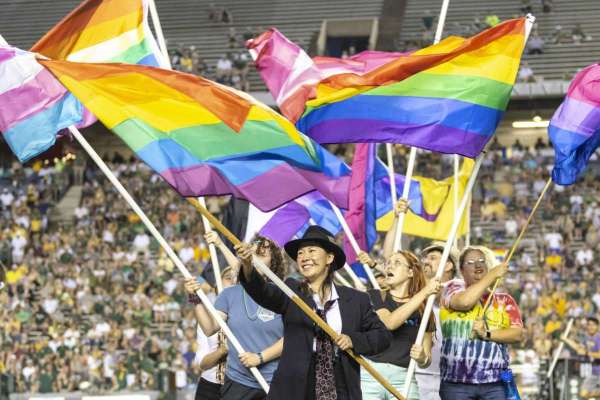
First, a little background: At the recent Rice/Baylor football game, Rice’s band put on a gay-stravaganza to protest Baylor’s anti-LGBTQ student policies. Baylor had recently refused to recognize a campus LGBTQ student group.

Meanwhile, Duke’s student government voted to de-recognize Young Life, an evangelical Christian group. Why? Because Young Life will not allow LGBTQ students to be leaders or volunteers.

We can agree or disagree with the pro- or anti-LGBTQ policies at play. Me, I side with the LGBTQ students—I support efforts to eliminate anti-LGBTQ discrimination. But it’s not really as cut-and-dried a debate as some of my progressive friends seem to think. For example, I also think religious colleges should be free to set policies that accord with their religious views. And I think religious students should have maximum freedom to do the same, wherever they go to college.

While we try to figure out a way to square this circle—a way to allow religious students to express their religion without hurting the right of LGBTQ students to feel included and welcomed—why don’t we consider a tweak of our campus culture-war playbook? Consider a plea for something that should be obvious but seems to get lost in the shuffle?

Here it is: When colleges fight about these issues, why don’t we all agree to keep students out of the firing line? Why don’t we agree to give students maximum ability to experiment with different ideas and identities, instead of punishing them for advocating ideas that are near and dear to them?

Here’s what it could look like in practice: Instead of focusing on kicking off this student group or that student group, ALL student groups could be required to have a faculty advisor. The advisor could represent the student-group’s interests with the school administration. In principle, ALL student groups would be recognized, even if the school did not endorse their ideologies or theologies. It would take a lot to have a student-group de-recognized. The faculty senate—or whatever body represented faculty interests—would have to be agree that the group represented a harm to the university community, not just a disagreement with prevailing policy.

In this set-up, Duke’s student government could not simply vote out a Christian group it didn’t like. Baylor’s administration would be prodded to allow LGBTQ students to organize. It wouldn’t stop the arguments about student groups, but it would make it less likely for students to be penalized for caring about the world around them. It would turn faculty members and administrators into the ones doing the fighting and make it less likely for students to be directly embroiled in bruising culture-war battles.

It would encourage—not discourage—smart, engaged students to get together to make their school and world a better place. And isn’t that what college is supposed to do?

I Love You but You Didn’t Do the Reading

Pumpkins ripened this week and Bernie released a video praising teachers as working from “the bottom up.” Plus bellydancing creationists, protesting students at Liberty U, teaching for Trump, and a whole lot more in our weekly roundup:

Why don’t more kids learn about evolution? At the Atlantic.

The only high-school biology class I took was in ninth grade, and it was apparently so uninteresting to me that I don’t remember my teacher’s name. (My former school district did not return a request for comment.) My teachers were for the most part religious, though they appeared to stay firmly within the bounds of the state-mandated curriculum. In another class, my teacher showed us diagrams of the human eye, then snuck in a remark that the complexity of the eye is convincing evidence that there is a Creator.

Can schools save society? Larry Cuban reflects.

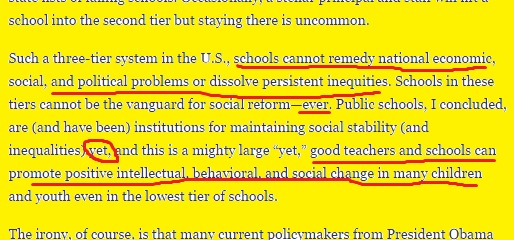
I used to think that public schools were vehicles for reforming society. And now I think that while good teachers and schools can promote positive intellectual, behavioral, and social change in individual children and youth, schools are (and have been) ineffectual in altering social inequalities.

larry cuban reform concHave evangelical colleges avoided the “comfort college” dilemma? At PS.

In my classes and others, in faculty and student research, I see nothing like what Gerrard calls “the devaluing of knowledge” or “social death” for those on the wrong side of “wokeness.” In the humanities at Bethel, I see people continuing to ask complicated questions of themselves, each other, and the authors and audiences of the texts they read, with humility, hospitality, empathy, and in no expectation that things will resolve neatly. We make each other uncomfortable, make mistakes together, apologize to each other, and continue to seek better answers together.

“Evangelical” has lost its meaning, says Alan Jacobs at The Atlantic.

of all the traits that attracted evangelicals to Reagan, perhaps the most important was his sunny and fervent patriotism. Already white American evangelicals had a tendency to associate Christianity closely with the American experiment, and to think of their country as a “Christian nation.” . . . This transformation of evangelical from a theological position to a “racial and political” one is not just bad for serious Christians; it’s also a prime driver of the increasing hostility of liberals to religion in almost any form.

No evangelicals among the Blue Devils: Duke students reject Young Life as anti-LGBTQ. At RNS.

the student government senate unanimously turned down official recognition for the Young Life chapter, because it appeared to violate a guideline that every Duke student group include a nondiscrimination statement in its constitution.

Liberty U students against Falwell Jr. At NPR.

We organized this protest in response to both articles that dropped this week. We really are protesting President Falwell’s habitual behavior of – various allegations of misconduct, especially ones of sexual harassment, and the habitual abuse of his subordinates as well as students and various Christian leaders that he’s attacked on Twitter as well.

Turkish creationist Harun Yahya goes on trial for running a blackmail cult. At NCSE.

https://www.youtube.com/watch?v=7J6tN1nJmkM

How a science teacher should answer a radical creationist, at AU.

“This is science, and science deals with facts. It doesn’t deal with belief. It doesn’t have to be a dilemma or a concern for someone to choose between Christianity and evolution – that’s not what this is about. You can actually embrace both. It’s my duty as a teacher to teach science and not teach religion. That’s the separation of church and state.”

Conservatives win one in the wedding-cake LGBTQ wars. At AZC.

Duka and Koski create invitations and other handmade artwork for weddings and events. The women — who hold the religious belief that marriage should only be between one man and one woman — do not want to design invitations or other custom artwork for LGBTQ couples because they believe it would be the equivalent of endorsing the marriage.

The women are represented by Scottsdale-based Alliance Defending Freedom, a conservative legal group challenging similar laws across the country.

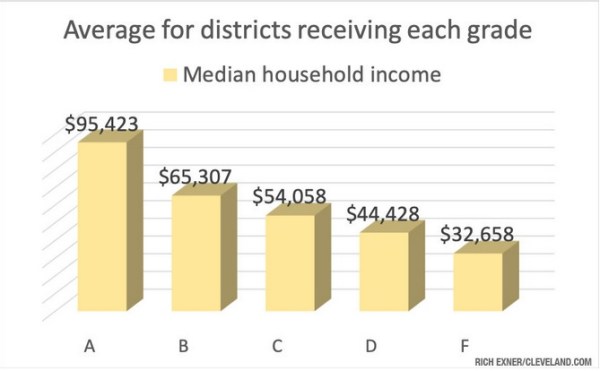
Check out the connection between $$ and quality in Ohio’s public schools. HT: PG.

Ohio schools realHow to get fired in Fort Worth. A teacher loses her job for tweeting to Trump to do “anything you can do to remove the illegals from Fort Worth.” At DN.

Florida Man (and Woman) had one heck of a night, at USAT.

A Florida couple is facing multiple charges after they started having sex in the back of a police car — after they were already under arrest on DUI charges.

How do religious scientists feel about non-religious ones? Insights from Tolstoy at JTA.

The problem is that those of us who have an abiding religious faith also believe in science. . . . We recognize that you present an objective truth, and that your approach is worthy of careful deliberation. But we get little in return. When you look at us, you can barely conceal your contempt. What you see is little more than confusion, superstition and folly.

Bernie releases a video celebrating teachers’ strikes in WV.

What Does “Evangelical” Mean?

This is why we can’t agree on much. Historians and other scholars of American evangelicalism have always had a difficult time agreeing on the simple fact of what it means to be an evangelical. In Alan Jacobs’ recent review of Thomas Kidd’s new book, we get a glimpse of the problem. As Jacobs describes,kidd who is an evangelical

here’s the definition that Kidd offers in his new book: “Evangelicals are born-again Protestants who cherish the Bible as the Word of God and who emphasize a personal relationship with Jesus Christ through the Holy Spirit.” It would be difficult to do much better in a single sentence.

Except…I think it would be easy to do better. If we really want to understand evangelicalism, we can’t start with this kind of religion-centered definition.

Here’s my version:

evangelicals are people who grew up in homes that considered themselves evangelical and didn’t publicly ditch the label, plus a few people—whatever family they grew up in—who made soul-searching decisions to become born-again Protestants who cherish the Bible as the Word of God and who emphasize a personal relationship with Jesus Christ through the Holy Spirit.

Razzing Christian Athletes

The tradition continues. At yesterday’s Rice/Baylor football game, Rice’s band poked one of Baylor’s culture-war soft spots. Will it do any damage?

Houston chronicle Rice LGBTQ

Take that, conservative Christianity!

It’s not the first time. Back in the 1920s, when Des Moines University in Iowa declared its allegiance to the fundamentalist movement, its football foes used to taunt the Des Moines team with chants of

Darwin! Darwin! Darwin!

Now, the Rice band has apparently updated that anti-fundamentalist tactic for the twenty-first century. According to the Houston Chronicle, the Rice band

played pro-LGBTQ song “YMCA” by the Village People as dozens of students and alumni rushed the field with rainbow flags at its football game against Baylor University on Saturday night.

The Rice band was protesting against Baylor’s decision to withhold official recognition for a student LGBTQ group.

Did it work? Well, not on the gridiron. Baylor trounced the Owls 21-13. In the long run, however, I wonder if increasing pressure on LGBTQ issues will force Baylor to change its tune.

What Does Radical Creationism Look Like?

A reminder, if anyone needed one, that radical creationism does not always look like what you might think. This week Turkish arch-creationist Adnan Oktar is heading off to trial. For Americans who think creationists all look like Christian televangelists, the story is worth a look.

https://www.youtube.com/watch?v=7J6tN1nJmkM

Unlike the American stereotype, Adnan Oktar’s brand of firebrand creationism is Islamic, not Christian. And unlike most of America’s radical-creationist leaders–except maybe Jerry Falwell Jr.–Oktar surrounded himself with roomsful of belly-dancing “kittens.”

Adnan Oktar–who wrote under the name Harun Yahya–was arrested last year on a list of charges ranging from sexual abuse of children to blackmail. If the name sounds familiar and you can’t quite remember why, it is probably because of Harun Yahya’s big creationist splash back in 2007.

harun yahya atlas of creation

Proof of creation! Also, bellydancing.

Back then, Harun Yahya sent unsolicited copies of his radical-creationist book Atlas of Creation to scientists and journalists worldwide. Religion and science agreed, according to Harun Yahya. Both had clearly “refuted the theory of evolution. . . . We never underwent evolution; we were created.”

What’s our takeaway? I have no idea if Adnan Oktar is guilty or innocent. I DO know that his expensive distribution of Islamic creationism didn’t seem to pay off. Most of all, this story serves as a reminder that radical creationism is not limited to northern Kentucky or the Texas state school board.