Conservative Christians: More Racist than Pro-Life

HT: JS

Historian Randall Balmer made the case recently in the pages of Politico that the Christian Right did not emerge as a response to loosened abortion laws.  Rather, the “real” roots of the New Right, Balmer argues, were in the defense of racial segregation.  Unfortunately, the argument looks more like punditry than history.

I’m a big fan of Professor Balmer.  In fact, I’m re-reading his book Mine Eyes Have Seen the Glory right now as I begin research for my next book.  And his Politico essay is certainly worth reading in its entirety.  But he makes more of a political argument here than a solid historical one.  If I were to offer a more precise headline, I’d suggest something far less catchy, but closer to the historical truth, something terrible like, “The Real Roots of the Christian Right: Not Biological Reproduction, but Cultural Reproduction.”
The Roots of Racist Academies?

The Roots of Racist Academies?

In other words, in the late 1970s, evangelical Protestants got involved in politics in big numbers because they were worried about preserving their status as a certain sort of favored class in American life.  This included things such as racial segregation, but to say that racial segregationism drove the movement is woefully misleading.  It was a broad sweep of issues, most urgently educational issues, that drove evangelicals back into politics in the 1970s.

Balmer makes the solid case that abortion did not spark the emergence of the New Christian Right.  The timing just doesn’t work.  In the immediate aftermath of the Roe v. Wade decision, evangelicals seemed largely indifferent to the issue of abortion.  For readers who find this hard to believe, a look at Daniel Williams’ book God’s Own Party will help.

What DID motivate conservative evangelicals, Balmer notes, was the increasing pressure on private religious schools from the IRS.  In the wake of decades of desegregation laws, the federal government had begun revoking tax exemptions from private schools that discriminated on the basis of race.  As Balmer correctly points out, this anti-federal animus motivated far more conservative evangelicals in the 1970s than did pro-life campaigns.

Nevertheless, Balmer’s conclusion doesn’t hold water.  “Although abortion had emerged as a rallying cry by 1980,” Balmer insists,

the real roots of the religious right lie not the defense of a fetus but in the defense of racial segregation.

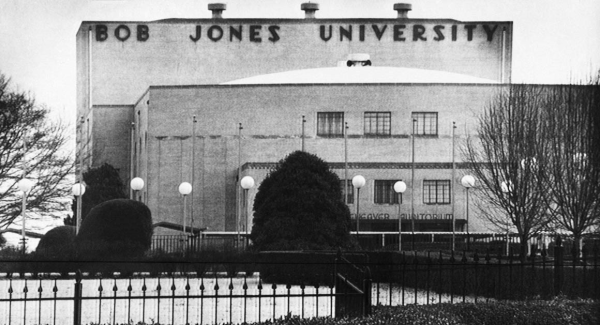
It is true that school segregation played a role in the rise of the evangelical private school movement.  And it is certainly true that Bob Jones University maintained a rigorous white supremacist position long after most other white conservatives had abandoned it.  But to argue that racial segregation somehow formed the “real roots” of the New Christian Right oversimplifies the historical realities.

Please don’t get me wrong: I’m no apologist for racism or for conservative evangelicalism.  I agree that many white conservative evangelicals, like other white Americans, had and have a shameful attitude toward racial equality and racial integration.  My argument is an academic one: If we want to understand the history of conservative evangelicalism, we won’t get far by insisting that racism was the “real root” of their political activism in the 1970s.

That sort of argument is sadly similar to attempts by conservatives to smear all Democrats by citing the radical words of leftists such as Saul Alinsky or Bill Ayers.  It’s not that some Democrats don’t sympathize or even follow Alinsky or Ayers.  But to say that such folks are the “real root” of liberal thinking is just not accurate.

To make a better historical case, Balmer should have argued that issues about schooling motivated evangelicals in the 1970s to get involved in politics.  Those issues included racial segregation, but they also included questions of school discipline, perceived drug use at schools, perceived immorality at public schools, and a host of other issues.  For all these reasons, a burst of new private schools popped up to serve conservative evangelical families.  And the defense of such schools drove many evangelicals into politics in the 1970s.

Were these schools “segregation academies?”  The history is clear, but not simple.  Certainly, some white evangelical parents—along with white non-religious parents—chose private religious schools as safe racist harbors in the days of school desegregation.  The timing proves it.  Though many evangelical parents may have cited 1960s Supreme Court rulings such as Engel v. Vitale (1962) or Abington v. Schempp (1963) as the time when public schools went to hell, the burst of private Christian schools did not happen until the late 1970s.

Not coincidentally, those were the years when large school districts came under pressure for the first time to desegregate by race.  But we commit an intellectual error if we conclude glibly that such schools ONLY represented racist havens.  I’ve wrestled with the question of “Christian day” schools and racial segregation in a book chapter a few years back.  Consider a couple of complicating factors.

The situation in Louisville, for instance, seems at first to confirm the hypothesis of racial integration as a primary factor in the growth of private evangelical schools.  After that city’s court order to bus children in 1974 as part of an ambitious desegregation plan, there was a spike in enrollment at the city’s existing Catholic and secular private schools.  In addition, a crop of new evangelical schools immediately opened to serve white families who did not want to bus their children.  One study found that most of the parents at these new evangelical schools identified desegregation as their primary reason for leaving the public schools.  Another academic study of Louisville’s desegregation history, however, suggests some important qualifications.  At two private evangelical schools that had existed for years before the 1974 court order, only one of sixty-eight fundamentalist families used the schools as a “haven” from busing.  Although whites fled from public schools to a range of private schools, this indicates that at least some of the existing evangelical schools did not take advantage of the surge of white interest in private education.

Another statistic that confounds glib conclusions about the primarily racial motivation for new Christian schools is that the largest recipient of white students fleeing from desegregation was not private evangelical schools but rather the booming suburban public high schools of the 1970s and 1980s.  Contrary to popular impressions, throughout the 1970s and 1980s, the numbers of students attending private schools nationwide dropped from 13.6 percent in 1960 to 9.8 percent in 1990.  Meanwhile, the proportion of white students attending public elementary and high schools nationwide increased markedly.  Those students, however, had moved mainly into suburban public schools.  For instance, the suburban schools surrounding Atlanta served ninety-eight percent of the area’s white students in 1986.

Throughout the twentieth century, conservative evangelicals cared deeply about education.  In the 1970s, savvy political organizers recognized that many evangelicals thought schooling had become threatened.  As Professor Balmer correctly points out, part of that perception came from the perceived “threat” of racial mixing in schools.  But that was only one element of the perceived danger to education.

The real roots of the Christian Right can’t be limited only to racism.  Rather, we will do well to understand how profoundly important educational issues were to the new political mobilization that swept evangelical America in the 1970s.

Comedy & Conservatism

–Knock knock.

–Who’s there?

–A smaller government, a vigorous military presence abroad, and traditional values.

Get it?  According to Frank Rich, no one does.  Conservatism just isn’t funny.  In a terrific essay last week in New York Magazine, Rich explores the tortured relationship between conservatism and comedy.

Rich wonders why there are no big conservative comedians out there, no flipside to the Jon Stewarts and Stephen Colberts.  He mentions a couple of contenders, such as Dennis Miller and even South Park.  But they are either not very funny or not very conservative.  And, as Rich points out, it seems like there would be plenty of funding for a vigorous conservative comedy effort.  But the few that have been made, such as the lamentable ½ Hour News Hour, are only embarrassing for us all.

Rich doesn’t make the case, but it seems as if conservatism, as a rule, should have the upper hand when it comes to laffs.  After all, as Hannah Arendt argued long ago, conservatives in general have the easier job in cultural polemics.  They can joke about each new innovation.  They can skewer new trends and rely on long-standing traditions to pillory liberal excesses.

But, as Rich points out, they don’t.  Why not?  Why aren’t conservatives funny?

Rich argues that too many conservative comedians are conservatives first and comedians second.  After all, “liberal” jokesters such as Jon Stewart don’t hesitate to joke about liberal heroes.  Stewart puts the jokes first and the politics second.

More Preachy than Funny

More Preachy than Funny

When liberals forget this simple rule, they are just as unfunny as conservatives.  Remember Leslie Knope’s (Amy Poehler’s) stilted attempt at sex-education humor?  It just wasn’t funny.

This rule applies outside of comedy, of course.  Some conservative intellectuals embrace the paintings of the late Andrew Wyeth, for example, as “conservative” masterpieces.  Consider the vast difference, though, between Wyeth’s brand of painting and the conservatism-on-his-sleeve style of Jon McNaughton.

As Rich notes about comedy, art of any sort seems to suffer when pundits put ideology first and art second.

Wyeth's "Christina's World" (1948).  Is this good art?  Or just good "conservative" art?

Wyeth’s “Christina’s World” (1948). Is this good art? Or just good “conservative” art?


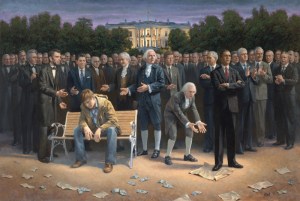
Jon McNaughton's "The Forgotten Man." Politics first, art second.

Jon McNaughton’s “The Forgotten Man”

The Files Are In!

Well, there’s nothing more to be done about it now.  I’ve just sent my final draft of my next book manuscript to the publisher.  There’s a sense of relief at being done, but also trepidation at the impossibility of further revisions.  After years of researching, writing, then revising, revising, revising, it’s hard to believe I won’t be able to keep tweaking and improving.

Pre-order your copy today!

Pre-order your copy today!

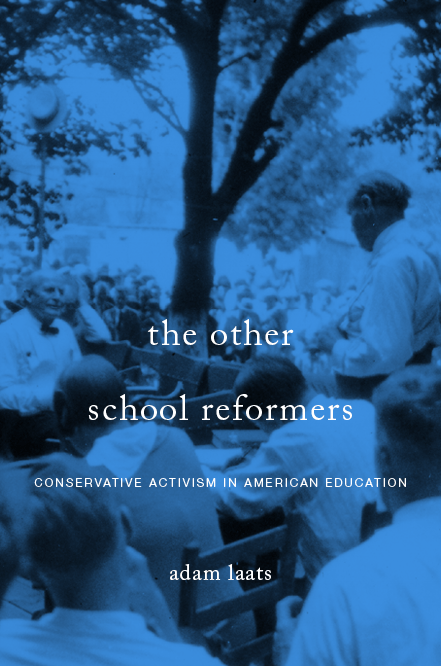
In general, though, I’m extremely pleased with the shape of the manuscript.  In a nutshell, I try to make the case that we’ve seen a potent tradition of educational conservatism in the United States, one that has had a decisive impact on the structure and content of schooling.  And, I argue, that tradition has not been recognized by historians or education scholars.

To make this case, I examine in four looooong chapters the four biggest school controversies in twentieth-century America: the Scopes Trial of 1925, the Rugg textbook controversy of 1939-41, the Pasadena superintendent ouster of 1950, and the Kanawha County textbook battle of 1974-75.  What did conservatives say and do in these controversies?  In each case, the attention-grabbing events attracted conservative participation from both locals and national leaders.  In each case, the issues prompted conservatives to articulate their visions of proper schooling.  To me, that’s the interesting question.

We’re still a ways from final publication.  The publisher will send me proofs in July.  At that stage, I’ll put together the index and fine-tooth-comb the proofs for any typos.  But I won’t be able to make substantive changes at that point, just minor corrections.

During these last weeks, as I’ve been going over the copy-edited chapter files, I’ve been very grateful for the careful work of the editor.  She or he pointed out some embarrassing errors on my part and I’ve been able to make changes in the argument.  Hopefully this draft is as crystal-clear as I can make it.

I’m looking forward to hearing what readers think of the book.  For that, I’ll have to wait until 2015.  The press will release the book on January 12, 2015.  Pre-orders are available!


Take the Creation Museum Challenge

We can gnash our teeth.  We can pull our hair.  But no matter what we do, the Creation Museum of Answers In Genesis has pulled it off.  With its new $1.5 million dinosaur exhibit, the flagship museum of young-earth creationism has successfully mimicked the outward appearance of mainstream scientific museums.

Big Valley Creation Science Museum

Big Valley Creation Science Museum

It used to be easy.  Creationist museums used to be only sad little affairs.  They used to look like this one from Alberta, Canada.  The Big Valley Creation Science Museum, pictured here, may do a great job in spreading the creationism gospel.  But no idle tourist would be likely to confuse it with mainstream museums such as the Smithsonian’s Museum of Natural History or Boston’s Museum of Science.

It used to be easy for outsiders like me to mock the lame pretensions of the many creation museums that dotted our great land.  And Canada.  As one angry visitor noted, even the bigger creation museums used to have strange, sad displays like this one from San Diego’s Creation and Earth History Museum.

Not a Lot of Big Bang for your Buck

Not a Lot of Big Bang for your Buck

But here’s the new challenge: Can you tell which of the three pictures below comes from Kentucky’s Creation Museum display and which come from the Smithsonian and Boston’s Museum of Science?  As arch-creationist Ken Ham explained gleefully recently, this new display of a million-dollar Allosaurus fossil puts Ham’s Creation Museum in the same league as those mainstream museums.  As Ham put it,

For decades I’ve walked through many leading secular museums, like the Smithsonian in Washington, D.C., and have seen their impressive dinosaur skeletons. But they were used for evolution. Now we have one of that class, and it will help us defend the book of Genesis and expose the scientific problems with evolution.

So take the Creation-Museum challenge.  Just by looking, can you tell which of these images comes from a young-earth creationist museum and which come from mainstream ones?  (Don’t cheat.  But once you’ve given it a try, you can click on each image to see its provenance.)

Is this "real" science?"

Is This “Real” Science?”

Or Is It This One?

Or Is It This One?

Millions of Years?  Or Millions of Dollars?

Millions of Years? Or Millions of Dollars?

This successful mimicry is important.  In creationism’s twentieth-century struggle to establish alternative educational institutions to rival those of mainstream science, young-earth creationists often wrestled with significant disadvantages.  Not least of these were questions of funding, as historian Ron Numbers described in his must-read book The Creationists and I detailed in my 1920s book.  In the case of this priceless fossil, rich creationists Michael and Stephen Peroutka donated it to help the Creation Museum with its work.

It would be nice to think that America’s public would make its decisions about the age of the earth and the origins of humanity by weighing evidence and considering counter-claims.  To people like me, the Creation Museum’s claim that this well-preserved fossil serves as proof of a worldwide flood 4,300 years ago seems absurd.

But I don’t think we need to be very cynical to guess that appearance matters.  As Dan Kahan argues, what people believe about creation and evolution usually has more to do with their cultural identity than it does with scientific evidence.  If Answers In Genesis can make their museum LOOK like the Smithsonian, many visitors will assume it is just as good.  And if Answers In Genesis can crank out peer-reviewed science publications that attest to the scientific veracity of their claims, many readers will assume their science is just as good.

So take the Creation Museum challenge.  If you can’t tell the difference, how can you expect anyone else to?


Learning Purity

Where do young Christian girls learn that they are supposed to be sexually pure?  A photographer recently claimed that it was something girls wanted, something not imposed on them by their families.

As usual, your trusty editor at ILYBYGTH is behind the times.  Apparently, this series of purity-ball photographs by Swedish photographer David Magnusson attracted a good deal of attention several weeks ago.  At these balls, girls dress up in elaborate gowns, dance with their fathers, and finally pledge sexual abstinence.

Purity

Not surprisingly, bloggers and journalists reacted with some predictable outrage to this combination of precocious sexuality, gender coercion, and daddy-ism.  For instance, Tom Hawking called the photos “weird” and “terrifying.”  “It’s hard to know where to start with this:” Hawking wrote,

the notion of sex as “impurity,” the fact that it’s all daughters and no sons, the idea of dressing a preteen girl in something that looks awfully like a wedding dress.

The photographer presented himself as an intrigued outsider.  At first, Magnusson said, he thought these purity balls would be nothing more than another American tragedy.  As he remembered, “I imagined American fathers terrified of anything that might hurt their daughters’ or their family’s honor.” But as he learned more about them, he came to a new understanding. The balls represented something initiated often by the daughters themselves. As Magnusson put it,

It was also often the girls themselves that had taken the initiative to attend the balls. They had made their decisions out of their own conviction and faith, in many cases with fathers who didn’t know what a Purity Ball was before first being invited by their daughters.

As we’ve wrestled with before at ILYBYGTH, purity culture can have educational consequences. Some argue that purity culture encourages a culture of sexual victimization on the campuses of conservative Christian colleges.

PurityBut Magnusson’s claim raises new questions. If, as he asserts, girls don’t learn about purity balls from their families, where do they learn about them? More importantly, where do girls learn that they want to take part in this sort of ceremony? We should be skeptical about Magnusson’s claim that girls themselves chose freely to take part in these ceremonies. That sort of “choice” can involve all sorts of subtle and not-so-subtle influence from parents and others. But it seems plausible that some girls embrace these ideas. And it seems plausible that some girls lead their fathers to this event, not vice versa.

If that’s the case, we need to wonder where girls got the idea. Certainly, some schools teach abstinence-only education curricula that promote a “purity” notion of proper femininity. And independent curricular programs such as True Love Waits have had success in reaching young people as parachurch organizations.

As always, these questions demonstrate the infinitely complicated nature of education. It is difficult to imagine a tradition like purity balls succeeding unless young people had been taught to embrace such a thing. Who taught them? And how?


Evolution Rock

I ran into some mysterious evolution-related lyrics in a trademark song by my favorite band ever.

Of course, this is not the first time rockers have messed with evolutionary themes.  ILYBYGTH readers may remember our ponderings about Bruce Springsteen’s muddled ideas about evolution.  And thanks to Jonny Scaramanga we all learned something about the vibrant creation-rock scene.

But I guess I had never listened closely enough to the lyrics of MC5’s “Sister Anne.”  The Detroit outfit’s signature song starts out like this, the best I can decode:

Sister Anne don’t give a damn about evolution

She’s a liberated woman, she’s got her solution

Like a dinosaur, she’s going off the wall

She’s gonna make it her own crusade

It raises two obvious and difficult questions.  First, how much more evolution-rock is out there?  Not to be too nerdy about it, but how deeply do the questions of evolution and creationism sink into the marrow of American culture?  If we hear the echoes of creationism even in the skudjiest of Motor City rock anthems, is there anywhere we won’t find them?

The second question is much simpler: What the *@#% do these “Sister Anne” lyrics mean?  The title character seems to be some sort of soul-saving, evolution-hating, sexy Catholic nun.  I know she can…but can what?


Christian College Leader Admits Wrongdoing

Dinesh D’Souza broke the law.  He recently admitted it.  Some conservative pundits insist that his prosecution is politically motivated.  Is this the end for a spectacular conservative career?

Wunderkind Admits It

Wunderkind Admits It

The conservative Christian writer and celebrity has always had something of a tin ear when it comes to conservative evangelical culture.  A couple of years ago, for instance, he was ousted from his post as president of The King’s College when he appeared in public with a woman who was not his wife.

Nevertheless, D’Souza’s brand of high-sounding punditry has made him hugely popular among American conservatives.  His books and films, such as What’s So Great About Christianity and 2016: Obama’s America, have secured D’Souza’s place as a top name among conservative activists.

This week, D’Souza pleaded guilty to illegal campaign contributions.  In order to help the ailing fortunes of Republican Senate candidate Wendy Long, D’Souza set up “straw donors” in order to exceed legal limits on campaign donations.  In his plea, D’Souza agreed that this action was “wrong” and “stupid.”  He admitted that he knew his actions were illegal.  But he also complained that he was the victim of selective prosecution.

Other conservative pundits agree.  An editorial in the Washington Times lamented,

Whether guilty or not, the fact that Mr. D’Souza has been singled out for prosecution while others skate past freely reveals President Obama’s thumb on the famous lady’s scale.

Some conservative writers take a different line.  Writing in The American Conservative, Rod Dreher insisted that D’Souza must take his lumps.  As Dreher argued,

I have no trouble believing that D’Souza may have been selectively prosecuted. But even if he was, that does not justify his knowingly breaking the law. Does this really have to be explained to conservatives, of all people?  We can’t call for law and order, but carve out special exemptions for our political allies.

Does this spell the end for D’Souza’s career?  As a non-conservative, I would be surprised if any conservative institution were to clamor to be associated with D’Souza after this.  But I’ve been surprised before.


Bryan College and the Grey Lady

Bryan College is in the news again. A recent New York Times article describes the hullabaloo over creationism and college creeds. But here’s the problem: journalist Alan Blinder seems all too willing to cast today’s struggles as only warmed-over reiterations of the 1925 Scopes trial. That doesn’t do justice to the history nor does it help today’s readers understand the kaleidoscopic world of evangelical higher education.

ILYBYGTH readers will remember that Bryan has been back-and-forth on the issue of Adam and Eve. The school has always been friendly to young-earth creationism. But President Stephen Livesay pushed through a clarification of the school’s traditional creed. From here on out, faculty members must affirm their belief in a literal, historic Adam and Eve. Most recently, the college has been sued by two faculty members who have refused to sign the clarified statement of faith.

I’m glad to see that journalist Alan Blinder has paid some attention to the controversy in the pages of the New York Times. But I can’t help but complain about Blinder’s framing of today’s story. For instance, Blinder calls today’s fight a “similar debate” to the 1925 Scopes trial. He says, “The continuing debate at Bryan College and beyond is a reminder of how divisive the issues of the Scopes trial still are…”

I’m not complaining because Blinder does not name the two professors who are actually suing Bryan—Stephen Barnett and Steven DeGeorge. I’m not complaining because Blinder focuses instead on Brian Eisenback, who had become controversial due to his evolutionary creationism.

No, I’m complaining because this sort of coverage implies that the issue at hand is the teaching of evolution or the teaching of creationism. I’m complaining because so many writers—not just Blinder—feel a need to call every new example of evolution/creation controversy “Scopes II” or something similar.

It would be entirely plausible, I think, for a casual reader to walk away from Blinder’s article thinking that Bryan College is becoming a religious school that teaches creationism, when it used to be a more secular school that taught evolution. It would also be plausible for readers to think that the issue at Bryan College today is the same issue that motivated the Scopes trial so many years ago. Both of these are woefully misleading implications.

First of all, Bryan College is now and has always been a friendly environment for young-earth creationism. Until recently, Bryan hosted the Center for Origins Research and Education. This center was lead in turn by prominent YEC intellectuals such as Kurt Wise and Todd Wood. Today’s controversy at Bryan College is decidedly not between a “creationist” mindset and a “secular” one. Today’s controversy is between a pluralist sort of big-tent creationism and a stricter young-earth-only vision. The school may be tightening its definition of acceptable sorts of creationism, but that is a very different thing than imposing creationism on a pluralist school.

Also, the controversy in 1925 was about whether or not evolution could be banned from public schools. As I argued in my 1920s book and in my upcoming Other School Reformers, due to such controversies, many conservative Christians founded schools like Bryan College. But today’s debate is vastly different. The debate today is over what sort of creationism counts as creationism at a private evangelical college.

Just because it brings journalists from New York down to Dayton again, there is no need to imply that this is somehow a return engagement for Clarence Darrow, H.L. Mencken, William Jennings Bryan, and John Scopes. What we’re seeing today is worlds apart from what Dayton saw in 1925.


A Conservative Commencement Address

College is crap.  So says the godfather of the modern conservative intellectual movement.

Though it wasn’t technically a graduation address, Russell  Kirk’s 1978 address to Hampden-Sydney College has the feel of one.  But it’s an idiosyncratic feel.  Kirk told the assembled students that college had gone to hell in a handbasket.  What could save it?  A renewed dedication to the “higher” part of higher education.

Russell Kirk kick-started the modern conservative intellectual movement with his 1953 blockbuster The Conservative Mind.  In that book, Kirk argued for a long and illustrious intellectual history for modern conservatism, reaching back through America’s finest men of letters and founding fathers to Edmund Burke.

In his 1978 address, Kirk bemoaned the state of American higher education.  Most schools had wallowed in the “educational follies” of recent trends.  The proper purpose of college, Kirk argued, was to train leaders in both profession and morality.  Since the end of World War II and new mass enrollments, colleges had lost their sense of purpose.  Kirk offered a four-part explanation of this decadence.

First, colleges no longer knew what they were for.  Instead of keeping their sights fixed on “knowledge and virtue,” universities tried to be all things to all people.

Second, colleges no longer laid out a menu of intellectual growth for students.  Colleges gave up on prescribing a course of knowledge.  Instead, in the name of freedom, colleges offered a vapid “cafeteria-style curriculum.”

Third, colleges had grown recklessly and heedlessly.  As Kirk put it,

Culturally rootless, anonymous, bewildered, bored, badly prepared for higher studies, other-directed, prey to fad and foible, presently duped by almost any unscrupulous or self-deceived ideologue, a great many of the students at Behemoth University came to feel defrauded and lost; only the more stupid did not suspect that anything was wrong with their condition.

Fourth, the decline of primary and secondary education meant that most college students no longer came prepared. Progressive fads had enervated education to such an extent that most students only knew how to fit in, not to stand out.

The central problem has been the rush to enroll, Kirk concluded.  Too many students go to college, with too little sense of purpose and too little preparation.

The cure, Kirk insisted, is to return to proper education for leaders in all professions.  With a core of truly educated people, American society and culture could rebound.  As he put it,

I am suggesting that college ought not to be a degree-mill: that it ought to be a center for genuinely humane and genuinely scientific studies, attended by young men of healthy intellectual curiosity who actually possess some interest in the development of mind and conscience. I am saying that the higher learning is meant to develop order in the commonwealth, for the republic’s sake. I am arguing that a system of higher education, which has forgotten these ends, is decadent; but that decay may be arrested, and that reform and renewal still are conceivable.

Though critics might cry “elitism,” Kirk concluded, his vision was anything but. The current vision of college as processing-plant cranked out cadres of quarter-educated elites. These dimwits moved society in preposterous directions, madly confident all the while that their elite education had prepared them for leadership.

As we wind up commencement season, I can’t help but wonder how Kirk’s lament would have gone over as a graduation speech.  It lacks some of the traditional encouraging rhetoric of that genre.  Would be-gowned professors and deans be able to sit on the stage and nod sagely as Kirk blasted their life’s work?


The Creation Debate We Need

Ken Ham, creationist debater extraordinaire, has again thrown down the gauntlet. This time, Ham has challenged conservative evangelist Pat Robertson. More than watching Ham battle Science Guy Bill Nye, America needs to hear this debate between conservative evangelical Protestant creationists.

Apparently, according to Mr. Ham and the folks at Right Wing Watch, Robertson has been taking pot-shots at young-earth creationism lately. On his television show The 700 Club, Robertson recently announced, “You have to be deaf, dumb and blind to think that this Earth that we live in only has 6,000 years of existence.”

As he has done recently with other conservative colleges such as Calvin and Bryan, Ham wondered pointedly if Robertson’s colleagues at Regent University really support Robertson’s old-earth position. Ham asked if the school followed Robertson in “compromis[ing] the Word of God with the pagan ideas of fallible men.”

Ham offered to debate these issues with Robertson. As Ham put it,

I wonder if Pat Robertson would be prepared to discuss these issues with me or one of our AiG scientists on the 700 Club? Or maybe in some sort of debate format at Regent University? We are certainly willing to do that…. I wonder if Pat Robertson, who is allowed to state these things so publicly through CBN will agree to have his statements publicly challenged and tested!

Both conservative religious folks and outsiders like me would benefit from such a debate. We outsiders would learn more about the issues that matter to creationists. None of us were particularly surprised by the arguments Bill Nye put forward. But many of us would be enlightened to hear the reasons for and against belief in a young earth, since both sides would be arguing from a relatively similar religious perspective. We outsiders could learn about the kaleidoscopic world of creationism. For some people, this might be the first time they heard that not every creationist embraces the idea of a young earth.

And evangelicals would benefit enormously. After all, belief in a young-earth as creationist orthodoxy is a very recent phenomenon. As historian Ron Numbers demonstrated so powerfully, until the second half of the twentieth century, belief in a young earth was restricted to a relatively small percentage of conservative evangelicals. At the time of the Scopes trial in 1925, for example, leading fundamentalists differed in their beliefs about the age of the earth. At that time, no one looked askance at anti-evolutionist leaders such as William Jennings Bryan who believed in an ancient earth. Only with the publication of Henry Morris’ and John Whitcomb’s creationist blockbuster The Genesis Flood did young-earth creationism become a dominant theme in conservative American evangelical thought.

Many young evangelicals these days don’t know this history. They often assume they must either accept the doctrine of a young earth or abandon their religion entirely. A debate between two conservative evangelical leaders would demonstrate the possibilities.