Betsy DeVos Has Saved Public Education

No one expected it. When Queen Betsy first took her position, her Dolores-Umbridge-style floundering was painful to watch and frightening for those of us who care about public education. Two years in, however, it is plain as day: DeVos’s sheer terribleness has forced a political realignment on the issue of charter schools. Charter schools used to be seen by both parties as the next great hope for public education. Now they are seen as a GOP stalking horse.

We’re used to it by now, but think back to DeVos’s shockingly inept interview on 60 Minutes in 2018. She evinced scant understanding or even interest in key educational issues. As Chris Cillizza wrote at the time,

DEVOS: Well, in places where there have been — where there is — a lot of choice that’s been introduced — Florida, for example, the — studies show that when there’s a large number of students that opt to go to a different school or different schools, the traditional public schools actually — the results get better, as well.

STAHL: Now, has that happened in Michigan? We’re in Michigan. This is your home state.

DeVOS: Michi — Yes, well, there’s lots of great options and choices for students here.

STAHL: Have the public schools in Michigan gotten better?

DEVOS: I don’t know. Overall, I — I can’t say overall that they have all gotten better.

STAHL: The whole state is not doing well.

DEVOS: Well, there are certainly lots of pockets where this — the students are doing well and —

If I was a boxing referee, I would have stopped this exchange about halfway through. If you are the secretary of education, you have to know you are going to be asked about the effects of school choice — particularly in your home state. So, if you’re going to argue that school choice has made public schools better, you had had better find a whole hell of a lot better spin that “I don’t know.”

And here’s Colbert’s take:

DeVos’s theory is that if you take money away from public schools and give it to charter schools, that will somehow help the public schools. It’s a system called . . . Stupid.

Before the DeVos era, politicians and pundits of both major parties tended to embrace charter schools as our most promising school-reform idea. No longer. Democratic 2020 hopefuls are scrambling to distance themselves from charter schools. Those who have the closest ties to the charter movement, like Senator Cory Booker, have the most work to do. As The (charter-loving) Economist put it,

Mr Booker is trying to navigate these treacherous waters. His proposed education manifesto for 2020 is to increase funding for educating special-needs children and to pay teachers more. These proposals are fine. Yet Mr Booker is the only candidate with a serious educational achievement under his belt—and the essential ingredients of that turnaround are not what he is promising now. His campaign replies that there is no one-size-fits-all solution for education reform.

It’s not only about charter schools. Other market-y style education reforms have become similarly tainted with DeVosite. Teach For America, another reform plan long despised by progressives but embraced by both major parties, has come under increasing fire. California is considering ditching the program and cities such as Houston already have.
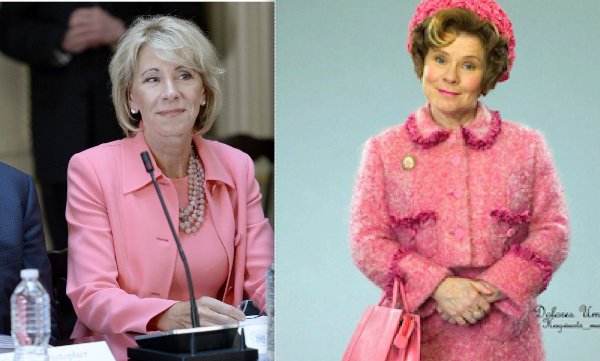
betsy devos dolores umbridge

All Hufflepuffed up.

In a way, it’s a shame. The smart answer when it comes to TFA, charter schools, or any other reform plan is always “It depends.” Some charter schools have offered great educations to low-income students. Some TFA teachers have done great jobs, and sacrificed a lot to do it.

Because of Queen Betsy’s Trumpish cloud, however, charter schools have reached Chernobyl-level toxicity for Democratic politicians. And that means the idea of charter schools will no longer carry the day as it has done for the past thirty years. In the long run, that’s good news for public education as a whole.
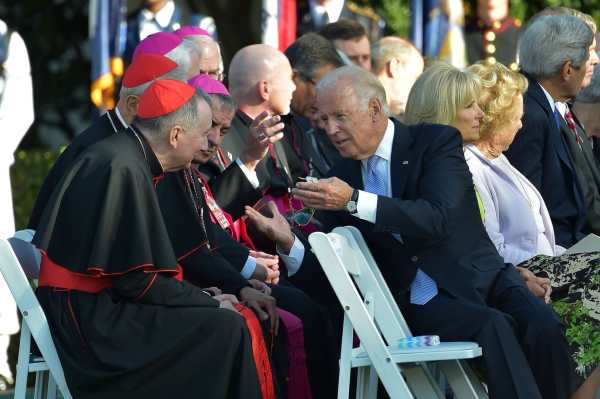
Why Religious Joe Biden Won’t Win the Religious Vote

Okay, so VP Biden is religious. Really religious. However, unlike what GOP consultant Rob Stutzman opined recently in the Washington Post, no matter how sincere Democrats are with their Christianity, it just doesn’t matter. Our culture-war history helps explain why.

biden religious

…I’m serious, you guys…

I’m not doubting any of Mr. Stutzman’s evidence for Biden’s profound dedication to his Catholic faith. As Stutzman writes,

Biden, a Roman Catholic, speaks genuinely about how his faith has been a sustaining aspect of his life through family tragedies, including the loss of his son, Beau, to brain cancer. He wears Beau’s rosary around his wrist, describing it as the connection he keeps daily with his late son. He quotes Soren Kierkegaard — “Faith sees best in the dark ” — to explain how he and his wife’s shared belief in God connects him with tens of millions of Americans who rely on a sustaining faith amid myriad challenges.

But Stutzman makes a Jimmy-Carter-sized mistake when he suggests that religious voters might be attracted more to the very religious Biden than to the clown-car Trump. Stutzman is off base, in other words, when he concludes,

What happens to Christian voters when they see a Democratic candidate living an authentic faith juxtaposed with a Republican president just renting some religion? My guess is that many will think twice.

They won’t. And before any of my progressive friends get high and mighty about the hypocrisy involved among conservative Christians, consider the fact that we do it too. As any historian of American conservatism will tell you, for the past fifty years many conservatives—especially the intellectual sorts—have taken pains to refute the charges that the GOP is the party of white racism. None of us “think twice” about believing them.

As I conducted the research for my book about educational conservatism, I was struck time and time again by the insistence of conservative thinkers and activists that they really weren’t racist. It didn’t matter. The charges of racism stuck, for good reason.

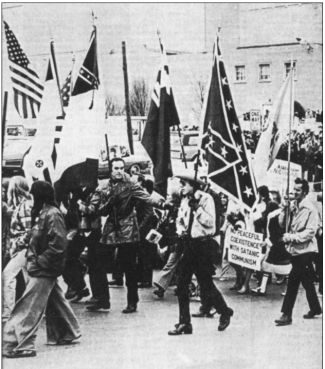
Why? As I found in my study of the explosive school controversy in Kanawha County, West Virginia, in the mid-1970s, many white conservatives considered themselves truly anti-racist, for purely conservative reasons.

Conservative protest leader Reverend Avis Hill, for example, liked to tell reporters that his conservative congregation was evenly mixed between whites and blacks. Conservative teacher and activist Karl Priest told me that he intentionally coached an interracial basketball league, devoting untold hours of his free time to fight the scourge of racism.

Local African-American leaders even voiced their agreement with the conservative protesters. Local NAACP leader Ronald English, for example, told one school-board meeting that most African Americans in Kanawha County were “very conservative,” and they agreed with white conservatives that public schools should not include “anti-Christian . . . unpatriotic” material.

Nevertheless, just as Joe Biden won’t make any headway with conservative Christian voters, white conservatives in Kanawha County never managed to convince African Americans to join their protest. And white conservatives in general have never been able to convince anyone but themselves of the sincerity of their anti-racism. The political logic is too obvious to need spelling out, but I’ll do it anyway.

avis hill kanawha protest

Avis Hill: I’m no racist, but…

In Kanawha County in the 1970s, conservative African Americans didn’t buy the anti-racism claims of white conservative protesters. Their reason was clear. In addition to the anti-racist claims of some white conservatives, everyone also heard other white conservatives denouncing the new controversial textbooks as “those n***er books.” And among the conservatives who flocked to Charleston to take the side of the white conservatives, Ed Miller, leader of the West Virginia Ku Klux Klan, promised to bring in thousands of robed and hooded klansmen to join in.

In short, no matter how sincere the anti-racist beliefs of many GOP-voting conservatives–and I believe that many of them are truly sincere about it–American conservatism as a whole has never been able to shake its well-earned image as the party of white racism. As a result, the GOP—for the past fifty years the party of conservatism—has never had much appeal to non-whites.

Similarly, no matter how devout and sincere is the religiosity of Joe Biden, or Pete Buttigieg, Kirsten Gillibrand, or Barack Obama, the Democratic party is the party of secularism. Even if conservative religious voters believe in the sincerity of individual Democrats, they will still shy away from the Democratic Party as the party of secularism.

I’d like to share Stutzman’s optimism, but no matter how devout they are, no Democrat is going to attract the support of conservative religious voters.

WaPo Needs to Get Its Ears Checked on Charter Schools

Everyone else heard it. Even way up here in the woods of upstate New York we heard it. Every political person except for the editors of the Washington Post seems to have gotten the message loud and clear. As a bi-partisan program, charter schools are dead. There’s no need for Democrats to hug the corpse. Maybe a medical analogy that invokes the late great Gene Wilder will help get the message across.

Here’s what we’re talking about: Today the editors of the Post issued a rebuke to Democratic politicians like Bernie who have turned their collective backs against charter schools. As they wrote,

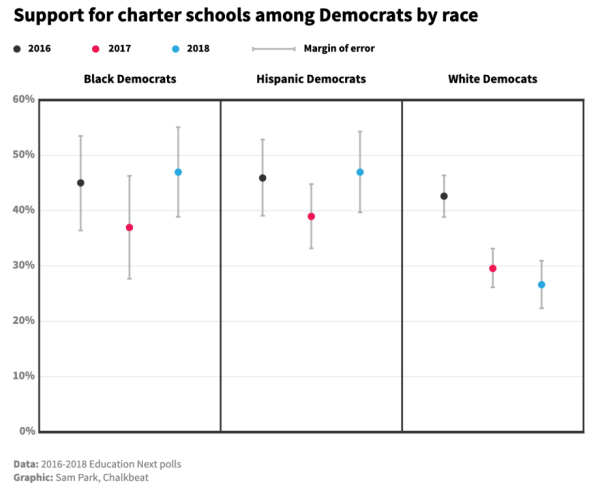
We hope candidates keep in mind the polls that consistently show support for charters among black and Hispanic voters. It’s easy to oppose charters if you are well-off and live in a suburb with good schools.

The editors make a strong point. For students with no decent public schools nearby, the promise of higher-quality charter schools has always been appealing. And for that reason, political progressives have long supported the charter movement.

But no longer. The WaPo editorial team seems to have missed the changes that have swept the education-reform community over the past three years. Leading Democratic contenders like Cory Booker, Elizabeth Warren, and Beto O’Rourke had close ties with charter schools in the past, but they have all backpedaled furiously. (Well, maybe not Senator Booker.)

It’s not just that. Recent teacher strikes in Chicago have driven a broad-shouldered stake through the heart of the charter idea. Similarly, other ambitious school plans from the 1990s have died a shuddering death. There’s one big obvious reason for all this, and I think a medical analogy might help make sense of it.

When the charter-school movement took off in the 1990s, it had amazing success because it managed to do what very few political ideas can do. Namely, it attracted support from left, right, and center. The idea of publicly funded schools without all the red tape of regular public schools appealed to everyone who thought that regular public schools weren’t doing the job. And that’s a lot of people.support-for-charter-scools by raceNevertheless, historically speaking the idea of siphoning tax money away from the public-school network is a radical one, and it only held appeal as long as two factors remained true. First, large numbers of people needed to believe that public schools were in a state of desperate dysfunction. Second, people needed to believe that charters were a shared endeavor, still part of the broader vision of public education for all.

The first part is still true. At least, the WaPo editors continue to believe it. As they wrote this morning,

The most enduring — and unforgivable — civil rights offense in our country today is the consigning of so many poor, often minority children to failing schools.

The second part isn’t. At least, people don’t believe it. The obvious reason for that is the new educational sheriff in town, Betsy DeVos. Queen Betsy has become the public face of the charter school movement. Not Howard Fuller. Not Cory Booker. Not even Arne Duncan. Betsy DeVos.

And when Betsy DeVos becomes the face of charter schools, then the idea of charters takes on all the baggage of Team Trump. No Democrat wants to go to bat for charter schools anymore, you sillies, because they don’t want to buy a ticket on the Trump Train.

Consider this gruesome analogy: When would you agree to let doctors amputate your leg? Things would have to be pretty desperate, right? But if it seemed like the only way to prevent an even bigger health catastrophe, you’d go along with it. Before you did, though, you’d want to hear from a bunch of doctors and surgeons. You’d want to be convinced that the radical procedure was really necessary.

The idea of charter schools is just like that. It is a radical change to America’s public schools, and one with serious negative consequences. Funneling scarce dollars away from low-resource public schools and into charter schools is obviously no one’s first choice, but people were willing to risk it in order to get some students into better schools.

They were willing to try it, in large part, because all the experts lined up behind it. From Howard Fuller to Arne Duncan, Michelle Rhee to Cory Booker, it seemed as if leaders from both parties agreed that the radical plan was the least-worst idea.

Not anymore. Secretary DeVos has managed to combine a striking ignorance about public education with a patent disregard for pressing educational issues. She has managed to unite left and right in opposition to her country-club blundering. And she has associated all her efforts with her fervent pro-charter agenda.

To drive the analogy home, it is like you are considering a radical amputation, and there’s only one doctor who tells you it’s a good idea: Dr. Frankenstein.

When the editors of the Washington Post urge Bernie and the other Democratic contenders to stay true to the charter dream, they are giving terrible advice. They are asking Democrats to stick their necks out for President Trump. They are asking Democrats to ignore the changes in ed-reform thinking of the past two years and pretend not to know which way the wind is blowing.

Should Bernie and the rest continue to support high-quality public schools for low-income people? Absolutely! But there are other ways to do it–ways besides the dead dream of charter schools. For the editors of WaPo to ask Bernie to support charter schools is like asking him to show up at a campaign rally wearing a MAGA hat.

Christian America on the Ropes

You’ve heard about Project Blitz, the MAGA scheme to impose Christianity back on America. More polling evidence from the Harris folks this week shows how desperate such efforts are.

Harris bible classes

…people don’t really care about Christian America.

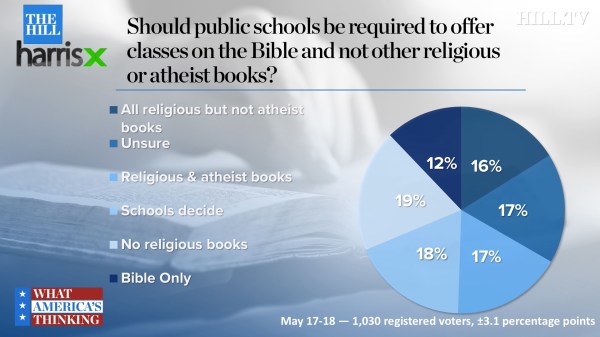
Here’s what we know: In a survey of just over 1,000 adults, Harris pollsters found that a mere 12% thought public schools should have kids read the Bible and not other religious books. By way of comparison, far more respondents (17%) didn’t have an opinion.

Historically speaking, those numbers are pretty astounding. It wasn’t that long ago that large numbers of public schools included devotional Bible reading as part of every school day. In 1960, just before SCOTUS ruled against devotional Bible-reading in public schools, 42% of public-school districts nationwide reported incorporating Bible-reading. The highest proportion was in the South (77%) and East (68%). In the Midwest (18%) and West (11%) the numbers were far lower.

So what? People like me might get anxious when we read the theocratic ambitions of regional politicians such as Indiana’s Dennis Kruse. We get nervous for our public institutions when we hear Kruse say things like,

I’m a Christian person and a religious person. . . . I think we need more Christianity and more religion in our society, in our state.

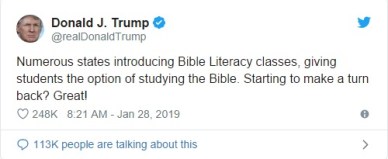
Trump bible tweetWe get even more skeeved when Trump tweets his support for school-Bible laws, as he did a few months back:

Numerous states introducing Bible Literacy classes, giving students the option of studying the Bible. Starting to make a turn back? Great!

In fact, though, the Blitzers, MAGists, and Trumpies who endorse such notions are not the vanguard of a vast right-wing army. Rather, they are the last snarls of a disappearing vision of the proper role of religion in America’s public square.

I Love You but You Didn’t Do the Reading

In honor of the Memorial Day holiday, we’re posting our weekly reading list one day early. From the real roots of the holiday to creationist irony and a whole bunch in between:

How did Memorial Day really start? From Yale’s David Blight at NYT back in 2011:

After the Confederate evacuation of Charleston black workmen went to the site, reburied the Union dead properly, and built a high fence around the cemetery. They whitewashed the fence and built an archway over an entrance on which they inscribed the words, “Martyrs of the Race Course.” . . . The war was over, and Memorial Day had been founded by African-Americans in a ritual of remembrance and consecration. The war, they had boldly announced, had been about the triumph of their emancipation over a slaveholders’ republic. They were themselves the true patriots.

Blight memorial day

What does Memorial Day celebrate?

From the “you-can’t-make-this-stuff-up” department: Ark Encounter sues a contractor for—you guessed it—rain damage, at LC.

Winner of the week: Man shoots himself in the testicles. When he’s at the hospital getting treated, a balloon of weed falls out of his butt. Wow. At KTVU.

Taylor students protest VP Pence’s commencement address, at FA.

The times they are a’changin. Only 12% of Americans want public schools to teach only the Bible and not other religious books, at TH. HT: MC.Harris bible classesWill charter schools feel the Bern?

Surprising results from Religion In Public: Yes, abortion is a polarizing issue. But more Catholics are polarized in favor of abortion rights than against.

RIP abortion polarization

Take another look…

Howard Fuller on segregation and charters, at T74.

the reality on the ground is that, for poor black children and many poor brown children, if we don’t figure out how to get good schools for them in the areas in which they live, they are not going to have them. And I do not foresee how, in the near future, for the vast majority of them, integration is a real option. I think it’s the kind of thing that people talk about on college campuses, that liberals talk about when they get together, or conservatives, who always talk about it. But on the ground, we’ve got to figure out how to get to good schools for most of them in the communities in which they live.

Is “Mayor Pete” Buttigieg bringing us a new religious left?

100 years ago today: Prof. Sutton on the birth of American Protestant fundamentalism, at NYT.

the time was right for a revolution in American Christianity. In its own way, this new movement — fundamentalism — was every bit as important as the modernity it seemingly resisted, with remarkable determination. . . . Although fundamentalists claimed to represent the traditional faith, they were pioneering innovators who remade Christianity for tumultuous times. There was little “conservative” about them.

TFA on the Rocks?

America loves a winner…until it doesn’t. Recent moves in Texas and California against Teach For America have me wondering—has the tide turned? Is TFA joining charter schools as a school reform that used to be popular on both sides of the aisle, but is now for the GOP alone? And if so, why now? There is one obvious reason that deserves more attention.

chicago charter protest

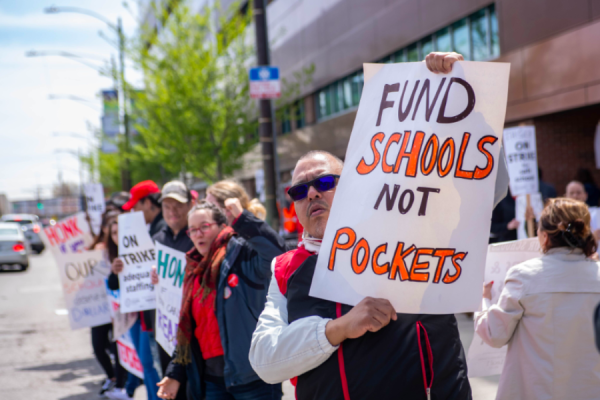
Which side are you on, Democrats?

Here’s what we know: As SAGLRROILYBYGTH are well aware, the idea for Teach For America was to get graduates of elite colleges into low-resource schools. TFA teachers promised to teach for two years. The plan was twofold. First, founder Wendy Kopp hoped to give low-resource schools an infusion of talent and enthusiasm, even if it was only temporary. Second, by experiencing life in low-resource schools, TFA alums—the thinking went—would be better-educated themselves about the challenges of real-life schools.

The program was a big hit for a while. Back in the late 20th century, almost a fifth of Harvard grads applied. School districts offered perks to the program, hoping to attract TFA teachers. Over the years, though, TFA also generated a lot of criticism. How could five weeks of training be enough? Why should no-experience teachers be acceptable in low-resource schools?

And now it seems those criticisms have begun to attract political support. They have moved beyond progressive howls in the wind. Houston has banned TFA teachers. California is thinking about doing the same. As one California lawmaker explained,

Our most vulnerable students are getting our least trained teachers. If they’re good enough for poor, low-income schools, why aren’t they good enough for the Beverly Hillses of the world? . . . Why do low-income schools have to be the guinea pigs?

Such criticisms are nothing new. TFA has always been unpopular among the progressive crowd. But now there seems to be a new political momentum against the program. What happened? Why did TFA suddenly become politically vulnerable?

To this reporter, the political swing against TFA is part of a broader realignment of education politics. For decades now, Democrats and Republicans have agreed on market-based “reforms” of public education. Charters, vouchers, tax-savings accounts, and alternative-certification programs were embraced on both sides of the aisle.

No longer. Democratic contenders for 2020 are scrambling to disavow their charter-loving pasts. Cory Booker, Elizabeth Warren, and Beto O’Rourke are all re-positioning themselves as charter skeptics, when they all enthusiastically promoted charter schools in the recent past.

The obvious culprit? The string of teacher strikes over the last two years has changed things. The strikes and protests have polarized the issue of public education. For Democrats, now, the primary goals are not to tweak TFA and charters to achieve best results, but rather to oppose any programs that stink of anti-teacher free-marketeering.

Did Bernie Just Throw Ed Progressives Under the Bus?

There’s been a ton of good news lately for teachers and for public education. Leading Democratic candidates such as Kamala Harris and Elizabeth Warren are making schools central issues in their campaigns. Now Senator Bernie Sanders has issued his ten-point “Thurgood Marshall Plan” for improving education. Like my progressive teacher friends, I’m thrilled by these developments. However, as a long-time observer of America’s educational culture wars, I have to ask an unpleasant question: Does Bernie really not care about progressive ed?

bernie mashall plan

Progressive politics, but not practices…?

Let me be clear: Compared to the GOP alternatives, I support Bernie’s plan. For that matter, I like Senator Warren’s plan, too, and Senator Harris’s. I could quibble with various details of the plans, but IMHO we should focus on the huge positive fact that our 2020 candidates are talking a lot about schools and education.

From a historical perspective, however, I can’t help but wonder at the way our progressive politicians seem to have abandoned progressive education.

Here’s what I mean: Bernie’s ten-point plan emphasized the need for American schools to fight racial bias and entrenched economic and social inequality. All to the good. However, when it comes to actual progressive classroom practices, Bernie seems surprisingly unaware.

For example, just like Queen Betsy, Bernie assumes the goal of our education system is to produce a competitive “workforce.”  Bernie also assumes that the primary purpose of good schools is to increase America’s competitive economic advantages in a “highly competitive global economy.”

And how does Bernie know America’s schools need fixing? In his words,

Among the 35 countries that are members of the Organization for Economic Cooperation and Development, the U.S. ranked 30th in math and 19th in science. Reading scores for our students are not much better. The U.S. ranked 24th when compared to other highly industrialized countries such as Singapore, Canada and Germany.

For progressive educators, using this kind of standardized-test measure to evaluate our schools is dunderheaded. Making a well-trained “workforce” the main goal of education is backwards. And measuring the quality of schools by the economic advantage they create is absolutely irresponsible. Yet Bernie does not hesitate to do it. Nor does Bernie seem to have his ear to the ground when it comes to identifying the most pressing problems in American education. For example, Bernie laments the fact that

too many Americans end up taking higher-paying jobs on Wall Street or as accountants or as corporate managers simply to pay back their student loans.

…Really? THAT’S what Bernie thinks is the main problem with American higher ed? That too many graduates are taking high-paying jobs?

As progressive ed pundit Alfie Kohn wrote years ago, we shouldn’t confuse progressive politics with progressive education. As Kohn put it,

A school that is culturally progressive is not necessarily educationally progressive. An institution can be steeped in lefty politics and multi-grain values; it can be committed to diversity, peace, and saving the planet—but remain strikingly traditional in its pedagogy. In fact, one can imagine an old-fashioned pour-in-the-facts approach being used to teach lessons in tolerance or even radical politics.

Is that what’s going on here? Is Bernie pushing traditional educational practices in his effort to fight traditional social inequality? Does Bernie not know about progressive pedagogy? Or does he just not care?

Why Liberal Evangelicals Aren’t

I’ve been trying to think of one for a long time and I think I’ve finally found an analogy that fits. Let me know: Does this comparison help you understand the difficult pickle in which politically liberal white evangelicals find themselves? Or did you have to grow up watching hockey for it to make sense?


It’s an old problem, I know, but I started thinking about it again this week talking to a reporter from Inside Higher Ed about the changes and cuts at Gordon College. As a relatively elite, relatively liberal evangelical college, Gordon has long found itself in a tough position. It has been accused of being too liberal, yet its president has also staked out some relatively conservative positions on LGBTQ issues in recent years.

At Taylor University, too, liberal students and faculty have protested against the school’s welcome of VP Mike Pence. Several dozen students walked out when Pence took the podium at their commencement ceremony. At least one student (at the 1:27 mark in the video above) refused to shake Pence’s hand.

As SAGLRROILYBYGTH may recall, I don’t share the optimism of some liberal white evangelicals that we are at the start of a new age in America’s culture wars, one with a vibrant “evangelical left,” one in which evangelical religion frees itself from its pact with conservative politics.

Rather, I think these recent higher-ed dilemmas highlight the ultimate weakness of politically liberal white evangelicalism.

Before I lay out my analogy, I should repeat that I don’t have any skin in this game. I’m no evangelical myself, liberal or otherwise. My personal politics certainly tip toward the progressive, so I’m more in tune with liberal evangelicals than conservative ones, but I myself can’t claim to share in the travails of liberal evangelical friends, though I admire them.

From the bleachers, then, I’ve been wondering why politics has been so difficult for politically liberal evangelicals for the past fifty years. As David Swartz has explored so well, the “evangelical left” has always struggled to gain electoral traction. From Mark Hatfield to Pete Buttigieg, from Jim Wallis to John Alexander, liberal evangelicals have often attracted enthusiastic support, but not huge numbers.

Why?

I think I have finally found an analogy that makes sense. The evangelical left is in a similar position to hockey purists who want to ban fighting.


Think about it: In many ways, the anti-fighting faction has a strong case. They argue that the sport is being hurt by the constant fighting, that brutish “enforcers” are kept on team rosters just to intimidate the opposition. The anti-fight faction can point to decades of expert opinion on their side, including a strong 1988 anti-fight statement from the Canadian Academy of Sport and Exercise Medicine. The constant fights, experts agree, are killing the game of hockey. At the college and youth levels, fighting has significantly decreased.

Yet fighting retains its revered unofficial status in the NHL. Why?

For one thing, fans love it. For many hockey lovers, fights are the big attraction, not an unfortunate exception. Indeed, I would wager than many hockey fans have no idea that one could separate fighting from hockey. And it’s not only the fans who love it. Players, coaches, advertisers, team owners…all of them consider fights to be a central part of the appeal of professional hockey.

And here’s the kicker: People who love the fights support them with their dollars. People who don’t like the fights have an easy option; they can just stop watching. Why would the governing body of the National Hockey League listen to the anti-fight faction—the group that is likely to leave the sport—instead of the pro-fight faction—the group that is invested for the long haul?

So forgive me if I’m stretching this analogy too far, but I think it helps me understand the ticklish dilemma of politically liberal white evangelicalism. Like the anti-fight hockey faction, liberal evangelicals have a very easy door out, but a very difficult, slippery, obstacle-filled uphill climb to change things.

I Love You but You Didn’t Do the Reading

What does the new SAT “adversity” score have to do with mac ‘n’ cheez? What does Islamophobia have to do with Common Core Math? Why should Trump start packing? Read on!

All over for Trump? First GOP lawmaker calls for impeachment, at CNN.

How do “miracle” charter schools do it? It’s not easy, but it is obvious. At Curmudgucation.

The secret formula for “miracle” schools (well, real ones and not the ones that are completely faking it) is the same as always– committed students, committed families, extra time and money, lots of support and resources, high standards, and an open exit door for those who don’t want to meet those standards.

It’s true: Houston just voted to kick Teach For America out of its schools, at HC. HT: MM

Is yoga too religious for public schools? At TC.

Yoga and mindfulness could become the fourth “R” of public education. But up for debate is whether the “R” in this case stands for relaxation or religion. . . . it may be constitutional for yoga and mindfulness to be available on school grounds, but students should be able to choose to get into the programs.

Be afraid, children, be very afraid. At The Atlantic, an examination of lockdown drills as the latest school bogey.

These lockdowns can be scarring, causing some kids to cry and wet themselves. Others have written letters bidding their family goodbye or drafted wills that specify what to do with their belongings. . . . children are being trained to anticipate an outcome that is both terrifying and extremely unlikely to happen to them.

Stained-glass culture wars: Southwestern Baptist Seminary removes chapel windows featuring Jerry Falwell, at Liberty.edu. HT: DS.

liberty stained glass

Not wanted at Southwestern…

Oh, no. A majority of Americans don’t want schools to teach “Arabic numerals.” At DK. HT: TO.

https://www.youtube.com/watch?v=sWgdM9Gdk3k

The conservative case for embracing evolutionary theory, at NR.

evolutionary biology is nothing for conservatives to fear, because it is one of the crowning achievements of modern Western civilization. It should be viewed not as an acid gnawing at the bones of civilization, but as a jewel. The science built upon the rock of Charles Darwin’s ideas is a reflection of Western modernity’s commitment to truth as a fundamental value. And many Christians well-versed in evolutionary science find it entirely compatible with their religious beliefs.

Gordon College announces program cuts, at IHE.

Why the new “adversity score” won’t save the SAT, at Forbes.

You go to the grocery store and buy a box of macaroni and cheese, and as you check out, the clerk says, “You know, that box doesn’t actually have any cheese in it. Let me give you this.” And they hand you a plastic bag with some cheese in it.

You ask, “What kind of cheese is this? How was it made? Where did it come from? How much do I add? And what do you mean the box of macaroni and cheese doesn’t actually contain macaroni and cheese?”

The clerk ignores most of your questions. “Just use the amount that seems right. You know—just kind of eyeball it.”

What Is Pat Robertson Up To?

You heard it here last: Pat Robertson has come out against Alabama’s new anti-abortion law. It is not an isolated incident. As SAGLRROIYBYGTH recall, Robertson has also recently criticized radical creationism. We have to ask: What is Robertson doing?

Here’s what Robertson said:

I think Alabama has gone too far. They passed a law that would give a 99-year prison sentence to people who commit abortion. There’s no exception for rape or incest. It’s an extreme law. They wanna challenge Roe versus Wade, but my humble view is this is not the case we wanna bring to the Supreme Court because I think this one’ll lose.

On its face, this could be a simple strategy statement. Fight abortion rights? Sure—but do it in a way that will win. Given Robertson’s other recent culture-war positioning, however, I can’t help but wonder if there is something else going on.

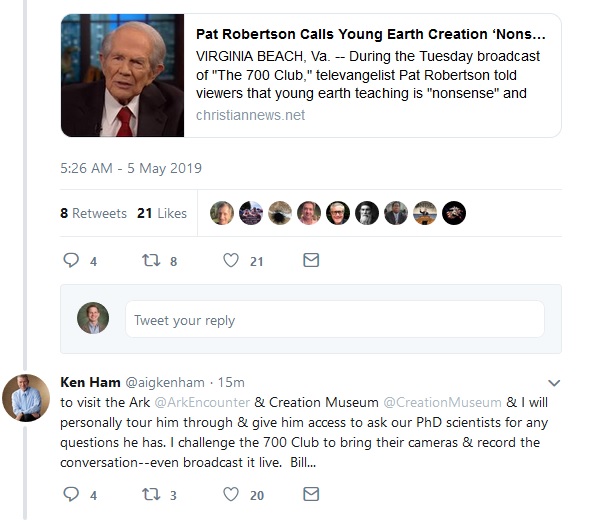
Consider Robertson’s recent statements about young-earth creationism. Not only has he mocked young-earth beliefs as “nonsense” and “embarrassing,” but he has promised to add a class at his Regent University to help conservative Christians combat young-earth ideas.Ham v robertson

Is Robertson trying to situate himself as a reasonable Christian conservative, different from the hard-right folks? Is he willing to bet his culture-war credentials against radicals such as Answers In Genesis’s Ken Ham and Alabama’s Terri Collins? And, if so…do you think it will work? Can Pat Robertson create political space for a not-quite-so-radical Christian Right?