The Real Promise of Teachers’ Unions

It’s not that they’ll get everyone to “eat the rich.” It’s not that they will manage to unite all teachers in a progressive political wave that will sweep through America’s 2020 elections. They won’t. Teachers are now and have always been a mixed bag, ideologically. But in today’s divided polis, a group like the unions still has enormous potential for good.


Pundits who dream that today’s wave of teacher strikes will bring a progressive millennium are fooling themselves. Anyone familiar with real teachers can tell you: We’re not easy to pin down. Sure, some teachers like me have a deep progressive political streak. But just go to any teachers’ lounge and you will hear a dizzying variety of political opinions.

https://www.youtube.com/watch?v=HbiPFhyQ3_U

As I argued in my book about twentieth-century educational conservatism, America’s teachers have ALWAYS been ideologically divided. The popular image of united left-wing teachers has never matched reality. Here are a few snapshots of conservative teachers throughout the years:

1939: One leader of a conservative campaign against left-leaning textbooks, Bertie Forbes, liked to tell a story: He was minding his business as a magazine editor when he was approached by teachers from his local New Jersey school district. These teachers, Forbes liked to recount, begged Forbes to get involved in educational politics. The teachers hated the lefty textbooks and wanted political support to teach old-fashioned patriotism in their local public schools.

1950: As Pasadena, California reeled over alleged progressivism in its classrooms, one teacher took to the editorial pages of the local paper. We teachers, she insisted, are not “in full accord with the tenets of progressive education.” She wanted old-fashioned tradition in the classroom, including corporal punishment. The progressive slop on offer, she wrote, led only to “arrogance, hostility, and defiance, even vandalism.” Teachers like her were on the front line against socialist “Pressure and propaganda” and they wanted the support of the conservative public.

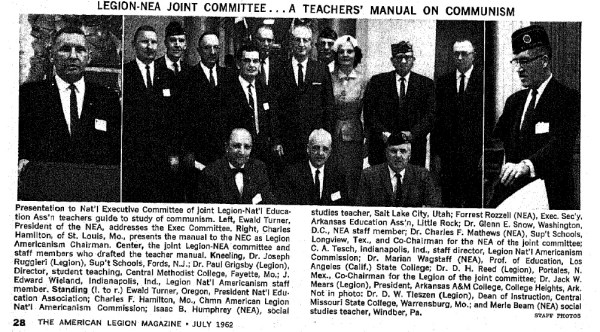
1962: Who led the fight to battle communism? It wasn’t only the conservative American Legion. Throughout the cold war, including in this 1962 mash-up, National Education Association members teamed up with the Legion to purge left-wing propaganda from the nation’s public schools.
anti communist teachers

Find the left-wing teacher in THIS photo:

1974: In Kanawha County, West Virginia, a new set of textbooks sparked violent culture-war protests. One teacher took the opportunity to voice his ideas about proper public education. On December 12, 1974, public-school teacher Karl Priest reminded the National Education Association that its policy was always to combat discrimination. The new textbooks, Priest insisted, were “in fact, anti-Christian.” [Emphasis in original.] Teachers like him, Priest argued, were correct in their conservative fight against such discriminatory claptrap.

These days, too, teachers are hardly politically united. Even those who support today’s strikes cannot be assumed to be unified on any other political issue. Teachers, in other words, won’t become the left-wing vanguard that activists have dreamed of for decades.

But that doesn’t mean that today’s teachers’ unions won’t have a huge impact. As politicians are split more and more toward the far edges, any group that can unite disparate people toward specific goals can serve as a beacon of hope.
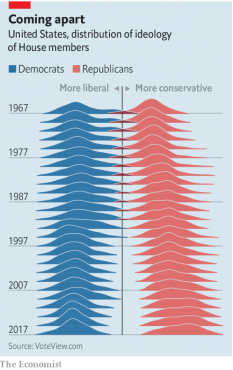
coming apart

What if politicians could act more like teachers’ unions?

The promise of the teachers’ unions doesn’t come from the fact that teachers are becoming more politically homogenous. The promise, rather, is that teachers’ unions are able to take action toward important goals in spite of the fact that their constituencies disagree on almost everything else.
Have Students EVER Been Able to Change Evangelical Colleges?

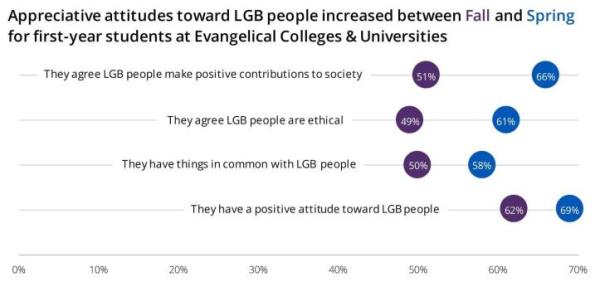
The news might be glum for conservative folks in the world of evangelical higher education. A new survey finds that many students at evangelical schools expect their campuses to be more welcoming of LGBTQ people. Does the history of evangelical higher ed offer any hope that student activism might actually change things?

Here’s what we know: According to data from the Interfaith Diversity Experiences and Attitudes Longitudinal Study (IDEALS),

a whopping 85% of incoming students to evangelical colleges and universities find it at least moderately important that their campuses are welcoming toward LGBT people, with 44% finding it very important.

Now, there are a lot of ifs, ands, or buts here. The evangelical college students included in this survey can’t simply taken to be representative of all evangelical students at every school. Of the 122 institutions included, only a small minority could be considered “evangelical,” even by the broadest of definitions. And though the evangelical participants do seem to include a breadth of types of schools, like the more-liberal Wheaton in Illinois and the more-conservative God’s Bible School and College in Cincinnati, we can’t think they represent the vast diversity of evangelical higher ed.

rip poll lgbtq

Welcoming campuses…?

Plus, unless I’m missing it, these results aren’t broken down by school. So, for example, we can’t tell if huge majorities of pro-LGBTQ students at Wheaton balance out larger percentages of anti-LBGTQ students at God’s Bible School and College. All we get are a lump of “evangelical student” opinion.

Noting all the limitations, though, it seems remarkable that so many students at evangelical colleges seem to want their schools to be more welcoming to LGBTQ students and it raises a question: Have students ever been able to make big changes at their evangelical schools? As I found in the research for Fundamentalist U, in the twentieth century student activism had mixed results.

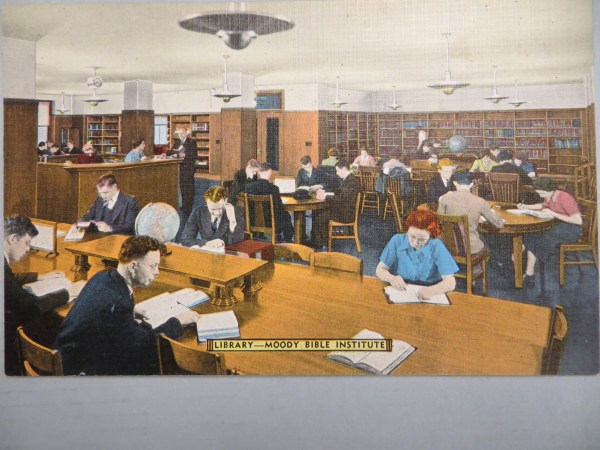
For example, in the 1930s, students at Moody Bible Institute begged their administrators to offer a degree program. On July 27, 1931, a group of students sent the following signed letter to then-President James M. Gray:

We desire the degree, not as an end in itself, but as a means to an end, that we might stand anywhere and everywhere, and preach or teach God’s living Word, full of the Holy Spirit, and at the same time make men know we can ‘give a reason for the hope that is within us’: not only from a scriptural standpoint, but also as to their own high standards of education and be used of God to win the well-educated as well as the less-educated man to Christ.

Did it work? Not really. MBI didn’t introduce its first degree program until October, 1965, and even MBI required degree students to get two years of coursework at a different liberal-arts school.

1940s postcard library

Studying hard for no degree…c. 1940s.

In the turbulent 1960s, evangelical campuses saw their share of student activism. The most successful tended to be anti-racism protests. At Wheaton, for example, in late 1968 a group calling itself the “Black and Puerto Rican Students of Wheaton College” issued a demand for more non-white professors and students, more African-studies classes (called “Black Studies” at the time), and, in general, “a Christian education relevant to our cultural heritage.”

It worked, sort of. By 1971 Wheaton’s administration had put resources into hiring more non-white faculty and offering new courses such as “Black Americans in  American Society,” “Urban Sociology,” and “People of Africa.”

Student pressure didn’t always come from the Left. Conservative students, too, have been able to push their schools in more conservative directions. At Biola, for example, students successfully petitioned in 1969 for a stricter enforcement of women’s dress codes and for a more conservative lean in invited speakers. As the conservative protesters wrote to President Samuel Sutherland,

we are deeply concerned about danger signs showing themselves among some of our conference speakers and members of the student body!  . . . Indications now present seem to point to a trend that the school is moving from its Biblical foundation.  May God prevent such a tragedy! [Emphasis in original.]

For today’s students, the lesson is not crystal clear. In some cases, even the most polite, Bible-passage-stuffed petitions do not bear fruit. In others, though, student pressure has had a decisive impact. In general, as with Wheaton’s move toward more racial diversity or Biola’s tightening of dress codes, student protests worked when they pushed administrators in a direction they wanted to go in already.

Why We’re Doomed

We all knew it was going to be ugly and stupid. I’m still surprised, though, when people say these things with a straight face. Conservative pundits lump middle-of-the-roaders like me into a vast, scheming “secular Left . . . who cannot stand the presence of religion in everyday  life.” Lefties blast middle-of-the-roaders like Cory Booker into the conspiratorial Right. No wonder we can’t have a decent convo.

First, my alleged anti-religiosity. After my recent commentary about Karen Pence in the Washington Post, Ben Shapiro took to the tube-waves to rebut. At about 19:30 in this segment, he hoped to redefine Ms. Pence’s ordeal. Instead of an old-fashioned fight between religious groups, Shapiro insisted, what we’re facing now was an outright fight by powerful secular forces against traditional religion as a whole.

Shapiro argued that people like me assume that there is no legitimate traditional religion anymore. People like me, Shapiro said, see conservative religion as only

a basket of bigotries masquerading as religion.

I won’t rebut Shapiro’s rebuttal, though I will point out that SAGLRROILYBYGTH have offered much more powerful and insightful counterarguments to my Pence commentary in these pages.

The point this morning is bigger and it’s not only about my hurt feelings. It’s not even about conservatives alone. Pundits on the left tend to shoot their mouths off just as wildly. For example, though I’m not a fan of Senator Cory Booker’s (fading?) support for charter schools, I can acknowledge that he often endorses traditional progressive political positions.

Yet, as Molly Ball noted a few years back in The Atlantic,

Booker has faced a steady drumbeat of criticism from sites like Daily Kos, where a contributor asserted last year that he “would actually be much more at home in the Republican Party.” Booker’s team has grown all too familiar with the rap that he is “some sort of Manchurian candidate for the right,” as his campaign spokesman, Kevin Griffis, put it to me with a sigh.

The problem is bigger than Cory Booker or Karen Pence. It’s even bigger than Ben Shapiro. In a sensible system, pundits on both sides would rush to include as many people as they can on their team. Ben Shapiro would notice that my argument wasn’t really against traditional religion at all. Cory Booker would be welcomed into a big-tent Left and encouraging to squeeze every possible progressive drop out of his role.

That’s not what happens. Instead, as pundits on both sides try to get clicks by excoriating their natural allies, the left-right divide only gapes ever wider.

Creationism and the Conservative Vision Board

It was the creationism part that first got my attention. Why would a smart, dynamic politician introduce such an old-fashioned creationism bill for public schools, a bill obviously doomed to failure? As I read the rest of the bill, the answer became obvious. And for anti-creationist campaigners, the lesson is clear.


Indiana State Senator Dennis Kruse has a long record of introducing anti-evolution legislation. Twenty years ago, he began pushing bills that would allow for the teaching of creation science in Indiana’s public schools. When those flopped, he began fighting instead for “academic freedom” for Indiana’s teachers, to allow them to teach a “diverse curriculum.”

This month, however, for some reason Senator Kruse went back to an old-school school bill. Kruse is once again campaigning for schools that include “the teaching of various theories concerning the origin of life, including creation science.”

What gives? Why would a creationist go back to a failed strategy? After all, the inclusion of “creation science” in public schools has been definitively rejected by the Supreme Court. Why would Kruse bother to ask for something (again) when he knows he won’t get it?

The rest of the bill makes the answer painfully obvious. Senator Kruse isn’t really crafting legislation here. He is creating a conservative vision board.


Kruse is asking for a range of educational policies that might or might not be possible. He wants all Indiana public and charters schools to post big “In God We Trust” signs, along with a US and Indiana flag. He wants religious electives, including Bible studies. He wants students to be able to earn public-school credit for religion classes. Creationism—even the outdated “creation science”—is only one of the public-school visions on this Indiana board.

Why does it matter? As I’m arguing in my new book about American creationism, we will never really understand creationism if we think of it only as a fight about science curriculum. In most cases, creationism is only one aspect of a wide-ranging conservative attitude about education.

Yet too often, science teachers and science advocacy groups are left all alone in their fight against creationism in public schools, when the fight is not really about science. It is a fight over the proper nature of public education. Should schools be aggressively pluralist, ditching their historical Protestant baggage? Or should they be staunchly traditionalist, teaching children to be patriotic and Christian?

Karen Pence Falls into the Scopes Trap

SAGLRROILYBYGTH have likely been following the story: Second Lady Karen Pence has taken some heat for going back to work at Immanuel Christian School, an evangelical school with explicitly anti-LGBTQ beliefs. As they rush to defend her, I’m arguing this morning, Pence’s conservative allies are actually stumbling into an old culture-war trap.

shapiro pence

…ouch.

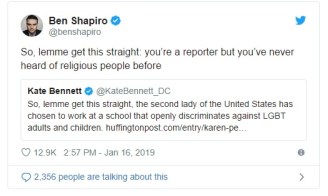
Understandably, some of her conservative defenders are taking the path of least resistance. Opposing any sort of non-hetero, non-married sexual activity, they say, has ALWAYS been a standard Christian belief. As Ben Shapiro put it most bitingly, Pence’s critics seem to have “never heard of religious people before.”

Thanks to the Made By History series editors, this morning I’m arguing in The Washington Post that Pence’s defenders are making an old mistake in their hasty counter-attacks. I won’t give away the details–you’ll have to click over to read the whole thing–but I will say I work in some of the biggest names in twentieth-century creationist history: Henry Morris, Bernard Ramm, and William Jennings Bryan.


I Love You but You Didn’t Do the Reading

Whew! Another big week in hurly-burly. Here are some of the stories that caught our attention while we waited out the snowstorm:

Christian persecution update:

After Trump and his shambling, punch-drunk administration passes into history, the Left in power is going to double down on punishing conservative Christians for having collaborated with Trump. Trump critics like Russell Moore will be treated no better than Trump lovers like Robert Jeffress. It’s coming.

Liberty U CIO: I was expecting $50,000 to rig online polls for Trump. Instead I got a bag stuffed with cash–$13,000 and a boxing glove, at CHE.

Make It Rain Money GIF - Find & Share on GIPHY

David Swartz on convict leasing and $$$ for Southern Baptist Seminary, at AB.

Is this a glimmer of good news? Students don’t want a university without a history major, at NYT.

Can conservatives ever really overcome their legacy of racism? A profile of some who are trying, at R&P.

Diploma mills are alive and well, at HC.

For a mere $180, instantdegrees.com offers Ph.D.s in everything from Gnostic Theology to Tourism and Hotel Management.

Ewww: some companies are paying teachers to serve as “brand ambassadors” in their classrooms, at NEPC.

LA Teacher Strikes—News ‘n’ Views:

When we lambaste the charter schools that urban parents may choose as undermining public education, but say nothing of the urban private schools and exclusive suburban public schools that enable affluent parents to exit struggling districts, we not only apply a dangerous double-standard, but we also place the blame for low-performing schools on those who must attend them.

these modern walkouts are about the very idea that public schools should be kept healthy at all.

Numerous Latino teachers repeatedly told me that a sense of solidarity with their students is what’s driving them to the picket lines—a profoundly personal connection to those children, and a fear that current school conditions are not serving them.

Not #ThemToo

I’m flabbergasted. Why did the Kavanaugh hearings convince so many GOP women of a certain age that past sexual harassment was no longer cause for prosecution?

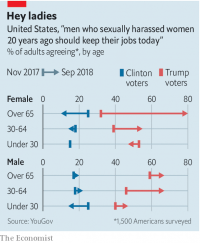
sister sledging chartHere’s what we know. The Economist is reporting from its YouGov survey. Between November 2017 and September 2018, the percentage of female Trump voters over age 65 who believe “men who sexually harassed women 20 years ago should keep their jobs today” leaped from about 30% to near 80%.

What gives?

The article suggests a couple of explanations. Perhaps this group of mature women worries about the professional status of their grown sons. They don’t want teenage peccadillos held against their “boys” in their adult careers. But that would apply equally to female Clinton voters of the same age, and that group has swerved in the opposite direction.

Or, The Economist wonders, do older GOP women have a “we survived it, so will you” attitude toward sexual harassment? Something we might call MMSS (Mad Men Survivor Syndrome)? That seems equally sketchy to this reporter. Even if some Trump voters feel that way, it doesn’t seem like it would be enough to push the needle so far.

Finally, The Economist suggests that this demographic is merely parroting the attitudes of their domineering husbands. They cite one observer from the Midwest who reported watching GOP husbands filling in ballots for their wives as well. Could that really be such a widespread phenomenon? And, even if so, why were the numbers so different as recently as November 2017?

In the end, none of the explanations offered make sense to me. They don’t adequately explain why so many GOP voters embraced this “water-under-the-bridge” attitude toward sexual harassment.

Any suggestions out there? Any GOP-voting women have a better explanation for us?

Should Christians Be Afraid?

SAGLRROILYBYGTH have heard it all before. For the past century, conservative evangelicals have warned that their religious beliefs have made them the target of anti-Christian religious discrimination and persecution. Today we hear the same warning from radical young-earth creationist Ken Ham. So should Christians be afraid?

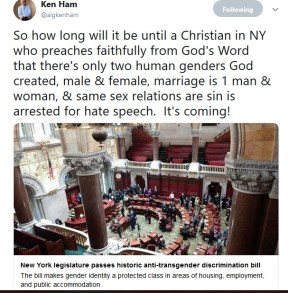
ken ham ny lawFirst, the history: In spite of today’s rosy nostalgia, evangelical Protestants have always felt themselves the targets of creeping secular attack. To pick just one example, when SCOTUS ruled against devotional Bible-reading in public schools in 1963, evangelicals responded with apocalyptic alarm.

In the pages of leading evangelical magazine Christianity Today, for example, the editors intoned that the decision reduced Christian America to only a tiny “believing remnant.”  No longer did the United States respect its traditional evangelical forms, they worried.  Rather, only a tiny fraction of Americans remained true to the faith, and they had better get used to being persecuted.

Similarly, fundamentalist leader Carl McIntire insisted that the 1963 school-prayer decision meant the death of Christian America.  In the pages of his popular magazine Christian Beacon, one writer warned that the Supreme Court decision meant a wave of “repression, restriction, harassment, and then outright persecution . . . in secular opposition to Christian witness.”

From the West Coast, Samuel Sutherland of Biola University agreed.  The 1963 decision, Sutherland wrote, proved that the United States had become an “atheistic nation, no whit better than God-denying, God-defying Russia herself.”

But! We might say that those conservatives were wrong, but today’s might be right. As Ken Ham warned his Twitter followers this morning, perhaps “It’s coming!” Maybe New York’s new gender law really will put conservative evangelical pastors in a legal bind.

After all, it is not only radical young-earthers who are concerned. Conservative pundits such as Rod Dreher have similarly warned of the creeping overreach of today’s secular gender ideology.

And in some ways, as higher-ed watchers like me have noticed, changes really are afoot. Institutions such as universities that rely on federal student-loan dollars to stay afloat might face intense pressure to comply with anti-discrimination guidelines.

But will a preacher ever be pulled out of his pulpit for “preach[ing] faithfully from God’s Word that there’s only two human genders God created”? No. That’s not how religious discrimination works in the USA. Just ask any historically persecuted minority.

For example, the federal government has long shelled out huge subsidies to farmers, including hog farmers. Does that mean that religious preachers who tell their audiences that eating pork is sinful are “arrested for hate speech”? No.

Similarly, the federal government has funded school textbooks that teach basic chemistry. They teach that the core of a substance is determined by its molecular makeup. Does that mean that Roman Catholic priests who tell parishes that wine has been transubstantiated into blood are “arrested for hate speech”? No.

Or, to take the most painful 20th-century example from the world of evangelical Protestantism, when the federal government passed legislation prohibiting discrimination on the basis of race, were white evangelical preachers ever stopped from including racist content in their Sunday sermons? No.

In spite of what alarmist preachers might say, the problem for conservatives won’t be about their pulpits. When they want to refuse service to same-sex couples or refuse admission to transgender students they might have to deal with a new legal reality.

But the idea that the amped-up gender police will storm into churches to arrest pastors is more Thief in the Night than Queer Nation.

https://www.youtube.com/watch?v=8RrXf0zGjxQ

I Love You but You Didn’t Do the Reading: Teachers’ Strike Special Edition

Maybe I’m just too close to see it clearly, but to my eyes the LA teachers’ strike is pushing last year’s teacher walkouts in new directions, directions that will shape our conversations about public education for years to come. Here are a few of the most compelling commentaries to come out so far:

When we lambaste the charter schools that urban parents may choose as undermining public education, but say nothing of the urban private schools and exclusive suburban public schools that enable affluent parents to exit struggling districts, we not only apply a dangerous double-standard, but we also place the blame for low-performing schools on those who must attend them.

these modern walkouts are about the very idea that public schools should be kept healthy at all.

What inspires well-paid teachers to deny the needs of kids they love in exchange for angry strikes they loathe? Union deception and brutality.

Numerous Latino teachers repeatedly told me that a sense of solidarity with their students is what’s driving them to the picket lines—a profoundly personal connection to those children, and a fear that current school conditions are not serving them.

My advice to the district: Hold strong. Replace them all. If they want a dramatic impact on education, fire the union and begin to repair the schools, just like Reagan fired the air traffic controllers.

Where’s the Outrage?

I’m not seeing it, and I’m looking. Since the big LA teachers’ strike started yesterday, I assumed conservative commentators would jump all over it. After all, as I’ve argued here and here, teachers’ unions have long been the boogeyman of conservative thinking about schools and society. So why aren’t conservatives mad now?

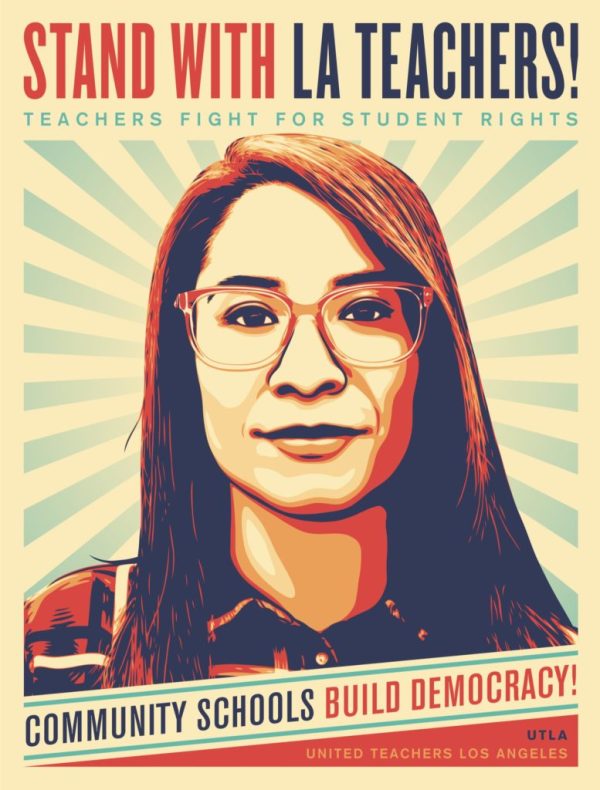
la teachers strike

Why aren’t more conservative madder?

I checked all the usual suspects. National Review offered only a bland review of the strike news. Even more extreme outlets such as The Blaze and WORLD Magazine just sort of regurgitated the facts. I didn’t see anything about the strike in The American Conservative, Flypaper, or any other of the conservative sites that tend to oppose the power of teachers’ unions.

I had to dig all the way down to Breitbart to find the usual anti-union rhetoric. While the other conservative news outlets are giving the story pretty short shrift, Breitbart is breathlessly warning that

the so-called “grassroots” movement fueling the strike is actually a radical organization spreading socialist “propaganda.”

…and THAT’S the sort of thing we’re used to hearing from conservative pundits about teachers’ unions. Why haven’t other conservatives jumped on the usual anti-union bandwagon? After all, as SAGLRROILYBYGTH are painfully aware, opposing the power of teachers’ unions has always been a hallmark of American educational conservatism.

Free-marketeers have always hated the stranglehold unions have held over market-based innovation. Anti-socialists have always decried teachers’ unions as bastions of left-wing subversion. Religious conservatives have always worried that union power forced kids to learn about evolution and sex.

So where’s all that outrage now? I’ve got a couple of guesses and I invite corrections.

First guess: It’s on its way. That is, conservatives simply haven’t gotten around yet to their usual anti-union complaints.

Second guess: The strikes last year convinced most people that teachers had a point. Walk-outs in Oklahoma and North Carolina and elsewhere weren’t led by formal unions and most people tend to agree that public schools really should have decent textbooks and classrooms.

Third guess: By and large, the strike wave of 2018 remained focused on bread-and-butter issues, in spite of lefties’ best efforts to impose broader ideological goals on the strike. Unless and until the strikes become broader lefty efforts, maybe conservatives will not find the strikes so offensive.

Fourth guess: Last year’s strikes were mostly in pretty red states. The teachers were not particularly left-wing. If this is true, it means that the new LA strike will take things in a new direction. In other words, I can picture conservative commentators blasting LA teachers in ways they wouldn’t have blasted OK ones. By this estimate, the LA strike will roil culture-war politics in ways last year’s strikes didn’t.

After all, as historians and journalists are pointing out, the LA teachers’ strike has a very different complexion than did last year’s strikes. Prof. Diana D’Amico noted that the urban/suburban racial divide lurks beneath every issue in LA. And Alia Wong argued that the racial makeup of LA’s strikers is notably different than that of Oklahoma’s teachers. Will that make a difference? I can’t see how it won’t. A bunch of Latinx teachers fighting for justice for non-white city students will probably ignite culture-war anger in ways that Oklahoma strikers never could.