Can Big-Time Sports Do It Again?

I never thought I’d see it, but here it is. Following Brigham Young University’s tentative opening to LGBTQ+ students and issues, could the same spark change things in evangelical higher ed? After all, schools like Liberty have long yearned to follow the BYU path in one crucial area.

BYU LGBTQ

Fighting for LGBTQ+ recognition at BYU…

Here’s what we know: Liberty University in particular has always jonesed for recognition as a leading university, and sports has always been one of its preferred qualifications. As President Pierre Guillermin put it awkwardly in 1982, Liberty wanted to be “the Notre Dame of the Christian world athletically and the Harvard of the Christian world academically.”

Of course, the Catholic leaders of Notre Dame might say that they already ARE the Notre Dame of the Christian world athletically, but let’s move on. The central point is that leaders of evangelical higher education have always wanted recognition as more than just niche colleges; they have always wanted to reclaim their role as the leaders of American higher education overall.

When Liberty brilliantly and ruthlessly capitalized on the possibilities of online education, current president Jerry Falwell Jr. did not invest the money back into Liberty’s online program. No, Falwell tried to make the old Liberty dream come true. He poured money into traditional campus amenities, especially including Liberty’s athletic program.

This year, the investment paid off. Liberty beat top-ranked Baylor in football, triggering a joyous campus-wide freak-out. Which leads us to our question: Will the dream of big-time sports force Liberty to open itself to friendlier LGBTQ+ policies?

After all, that’s what seems to be happening at Brigham Young. As Chronicle of Higher Ed reports this morning, BYU’s recent tentative opening to LGBTQ+ students was sparked by BYU’s lust for athletic recognition.

As CHE recounts,

In 2016, the Big 12 Conference announced it was officially considering expansion. BYU’s administrators and athletic director jumped at the chance to join. But publicly vying to join the conference brought on national criticism of the university, which observers said did not uphold the NCAA’s stated support of inclusivity because of its treatment of LGBTQ students.

After the university’s effort to join the Big 12 failed, Tom Holmoe, the athletic director, suggested that pushback from LGBTQ advocate groups stood in its way. In response, BYU requested an invitation to the NCAA’s annual Common Ground conference, an effort begun in 2014 to provide a place where leaders and students at religious institutions can talk about LGBTQ issues and “begin exploring how to bridge these gaps and find common ground.”

Might Liberty follow a similar path?

Generations of Christian pleading for equality and recognition have scored only minor victories. As I noted in my recent book and in these pages, administrators at evangelical colleges—even the more liberal schools—are under intense pressure not to change their rules about same-sex issues.

Perhaps it will take a different sort of pressure from a different direction to really change things in evangelical higher education.

I Love You but You Didn’t Do the Reading

Jesus on dinosaurs, teachers on strike…it was another busy week here at ILYBYGTH International. Here are a few stories that caught our eye. Thanks to everyone who sent in stories and tips…

“Jesus Rode a Dinosaur:” Christian conference seeks to help youth pastors do a better job talking about science, at RNS. HT: GB.

jesus rode a dinosaur

Where your Templeton money is going…

Could it work? Arne Duncan calls for a school boycott to change gun laws. At TP.

The wrong answer to school shootings: Texas Lt. Gov. Dan Patrick at CNN.

The latest on teacher strikes:

President Carter gently mocks Trump at Liberty commencement, at RNS.

Proof: AZ changed science standards to make room for creationism, at 12NEWS.

Science missionaries confront hostile creationist locals, at BioLogos.

Christian college administrators tend to censor student newspapers, at IHE.

Why do conservatives hate public schools? One conservative’s argument at AP.

Fundamentalist U & Me: Eric C. Miller

Welcome to the inaugural edition of Fundamentalist U & Me, our occasional series of memory and reflection from people who attended evangelical colleges and universities. The history I recounted in Fundamentalist U only told one part of the complicated story of evangelical higher education. Depending on the person, the school, and the decade, going to an evangelical college has been very different for different people.

Miller_2017This time, we are talking with Eric C. Miller, an Assistant Professor of Communication Studies at Bloomsburg University of Pennsylvania, and a contributor at Religion Dispatches and Religion & Politics. His email is emiller@bloomu.edu.

ILYBYGTH: When and where did you attend your evangelical institution?

I attended Grace College in Winona Lake, Indiana from 2000-2001 before transferring to the University of Pittsburgh.

ILYBYGTH: How did you decide on that school? What were your other options? Did your family pressure you to go to an evangelical college?

Grace College is affiliated with the Grace Brethren denomination, a conservative evangelical sect based largely in Pennsylvania, Ohio, and Indiana. I grew up in a Grace Brethren Church where I was active in the youth group. During the summer prior to my senior year, I went on Operation Barnabas, a seven-week missions trip in which 90+ Grace Brethren teenagers travel around the country in blue school buses, visiting churches and encouraging their members through Bible School-style events and performances. I had such a great time and made so many close friends that I couldn’t wait to enroll at Grace and see them again. As expected, many of them did the same. A strong minority of that freshman class had been on OB at some point in the previous three years.

Prior to taking that trip, I had planned to look around and apply to a variety of schools. But in the end I only applied to Grace. My parents didn’t pressure me, but they were glad that I was going to a solidly evangelical college.

ILYBYGTH: Do you think your college experience deepened your faith? Do you still feel connected to your alma mater? What was the most powerful religious part of your college experience?

Yes and no. I recognized from the beginning that the student body was homogenous. Everyone looked, believed, and acted more or less the same. It was an easy place to be a conservative, mid-western, white evangelical, as there was a wide support network and very few temptations. I loved being immersed in that community. At the same time, I found myself feeling a little oppositional. I was critical of George W. Bush, for instance, which was atypical. I also recall a guest lecture by Jerry Falwell, Sr. that I attended begrudgingly. Among friends, I was known as a campus liberal, but I would have remained moderate-to-very-conservative by any objective standard.

When I decided to transfer, I did so for missional reasons. I didn’t think it was good for Christian young people to be sequestered on rural campuses, so I moved to Pittsburgh to help win the world for Christ. Friends and family worried that I was making myself vulnerable to secular ideas and worldviews—which turned out to be correct—but I fancied myself a missionary. (Plus I was a little concerned that my horizons weren’t being broadened, and that I might end up married at twenty.)

Though I do think about making the trip to visit Winona Lake from time to time, I wouldn’t claim to be connected to that campus in any tangible sense. The most powerful religious part of the experience may have been leaving—I considered it a personal sacrifice.

ILYBYGTH: Would you/did you send your kids to an evangelical college? If so, why, and if not, why not?

No. I don’t have kids yet, but if or when I do I will not encourage them to go to an evangelical college. Despite my own positive experiences, I think these schools generally fail—or refuse—to provide some of the basic amenities that a college campus should offer as a matter of course. By restricting their students to a very narrow understanding of the world, policing their behavior within a very narrow moral code, and housing them within a very narrow community of the like-minded, these institutions mold their students into carbon copies of a particular type. There is no doubt that this process can be very comforting for those who participate, as long as they don’t resist. But resisting things is part of real growth, and both students and faculty should be free to stretch.

ILYBYGTH: Do you still support your alma mater, financially or otherwise? If so, how and why, and if not, why not?

No. I’m no longer conservative or evangelical, so I can’t say that I support what they’re doing. Plus they don’t send me letters anymore.

ILYBYGTH: If you’ve had experience in both evangelical and non-evangelical institutions of higher education, what have you found to be the biggest differences? The biggest similarities?

Grace and Pitt are different in just about every respect. I moved from a small, rural, almost uniformly white, conservative, evangelical college to a large, urban, diverse, secular university. They’re so different that I’m not sure the compare/contrast would even be illuminating. But I should note that the adjustment was hard. It was very easy to make close friends at Grace, and very difficult at Pitt. It turned out to be a pretty lonely time in my life.

ILYBYGTH: If you studied science at your evangelical college, did you feel like it was particularly “Christian?” How so? Did you wonder at the time if it was similar to what you might learn at a non-evangelical college? Have you wondered since?

Since I was only there for one year, I only took a collection of general education courses. But it was commonly understood that the faculty were operating on a young earth creationist model, based on a literal reading of Genesis.

Years later I had the opportunity to apply for a professorship at Grace, which I briefly considered. But the faith statement remained very rigid, and there was just no way I could sign it.

ILYBYGTH: Was your social life at your evangelical college similar to the college stereotype (partying, “hooking up,” drinking, etc.) we see in mainstream media? If not, how was it different? Do you think your social experience would have been much different if you went to a secular institution?

My social life at Grace was extremely tame. No parties, no alcohol, no drugs, no sex—any one of these things could have gotten you expelled. There were no fraternities or sororities. If you left the dorm for the weekend or overnight, you had to sign paperwork and let your RA know where you would be. It was a closely monitored environment, and your peers were just as likely as your supervisors to call out your infractions. We all knew it was oppressive, but we didn’t really care. We had signed up for this. Instead there were lots of game nights, organized sports, coffeehouse-style live music, ministry opportunities, and other forms of wholesome fun.

My social life at Pitt was different, and would have been very different if I hadn’t remained mostly the same. I got involved in the campus Christian Fellowship, but found it hard to infiltrate. On most weekends I was either out drinking (and then feeling guilty about it) or not drinking (and so staying in and relatively alone). I actually missed my Grace friends a lot when I got to Pitt. But admitting that would have meant conceding that the move had been a mistake.

ILYBYGTH: In your experience, was the “Christian” part of your college experience a prominent part? In other words, would someone from a secular college notice differences right away if she or he visited your school?

Definitely. It was an extremely prominent part—it was the prominent part. Aside from all the rules and the good clean social life, there were mandatory chapel services, ministry obligations, the curriculum-in-general, and the soft social pressures to do things like attend church weekly, volunteer for local youth groups and organizations, support the approved political propositions and candidates, etc. Grace was—and I’m sure remains—very proud of its Christian identity. That identity infuses everything and is impossible to overlook.

ILYBYGTH: What do you think the future holds for evangelical higher education? What are the main problems looming for evangelical schools? What advantages do they have over other types of colleges?

Evangelical colleges may always have prospective students as long as evangelicals continue having children—which they seem to do quite a lot! These schools are advantaged by a very coherent worldview with strict expectations for behavior and belief. Secular people tend to assume that these are liabilities, and sometimes they may be—especially among independent types, rebels, and racial or sexual minorities, for instance. But most of the straight, white, conservative evangelicals that I met—including, for a time, myself—really loved the inclusion, the accountability, and the sense of purpose that come with membership in that community. You know exactly what to do with your life, how to do it, and who to do it with. Once lost, that unequivocal sense of direction is difficult to recover or replace.

And yet, I think evangelical colleges may be headed for some of the same problems that confront evangelicalism in general. There is a disconnect between evangelical theology and culture, such that the two are very often in direct opposition. While evangelical theology hopes to represent the will of Christ—with all of the faith, hope, and love that he preached—evangelical culture is basically a subset of American conservatism—with all of its standard appeals to fear, nostalgia, and power. When this theology and this culture come into collision, white evangelicals have been far too quick to side with the culture.

When I was a college student in the early aughts, evangelical support for George W. Bush offered the first real challenge to my faith. I struggled to square Bush Administration policy choices with the red letter teaching of Christ, so I found myself both confused and disappointed by friends and family who offered him their uncritical support. But that experience pales in comparison to what I feel today. If evangelical support for Bush left me disappointed, evangelical support for Donald Trump has disgusted me beyond words. When I awoke on Election Day and read that 81 percent of white evangelical voters had gone for Trump, a part of me died. The part of me that always wanted to reconnect with the faith of my youth—that stubborn desire to find my way home that all ex-evangelicals feel to varying degrees—just evaporated in my chest. It was a pivotal moment for me and it has fundamentally changed the way I feel about the movement and the people that I used to love.

If my experience is representative, then evangelical colleges may be confronted with declining enrollments in the years to come. If the Millennial generation is as progressive and as activist as some suggest, then even the devout may opt to avoid these culturally evangelical institutions. For their sake, and for the sake of Christian virtue, and with something like love, I find myself hoping that those numbers implode.

Thanks, Professor Miller!

Did YOU attend an evangelical college? Are you willing to share your experiences? If so, please get in touch with the ILYBYGTH editorial desk at alaats@binghamton.edu

 

What Does a Friendly Atheist Want to Know about Fundamentalist U?

I had a chance to talk with Hemant Mehta, the famous Friendly Atheist. He had great questions to ask about Fundamentalist U.

friendly atheist

FA on FU

For example, Mehta wondered what today’s evangelicals didn’t like to hear about their own collegiate history.

He asked how schools that were dedicated to passing along eternal truths somehow rationalized changing their beliefs. In Mehta’s words, schools essentially had to tell students. “We’re correct NOW, but in the past when we said we were correct we were wrong.” Why would anyone believe such things?

Mehta also wondered how schools can change ONE rule, like racial segregation, without admitting that they might be wrong on everything?

That’s not all. Here are a few other topics Mehta pressed me about:

  • How did Bryan College get away with changing their faculty statement of faith in 2014?
  • Do schools like this “exist in a bubble?” Or do they want to be influential in mainstream culture and politics? How does the history of the CCCU help answer these questions?
  • How have evangelical colleges handled sexual assault and abuse?

It was a real pleasure for me to talk with him. I’ve long been a follower and fan of his blog. Click on over and listen to the whole interview if you’ve got some time to kill.

Bursting the Conservative Bubble about Educational History

How did American public schools get started? Like the rest of us, conservative intellectuals and activists have always told themselves stories that confirmed what they wanted to believe. This morning, we see another expression of century-old conservative myths about educational history.

As I found in the research for my book about educational conservatism, conservatism has always been fueled by a false notion of America’s past. When it comes to schools and schooling, conservative activists since at least the 1930s have told themselves that schools used to be great, but scheming progressive New Yorkers took over at some point and ruined everything.

rafferty what they are doing

Schools USED to be great…

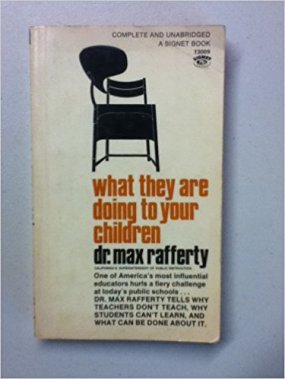
Consider this example from my favorite twentieth-century educational conservative, Max Rafferty. Rafferty was the superintendent of California’s public schools in the 1960s. He was a popular syndicated columnist and almost won the US Senate race in 1968. One of the reasons for Rafferty’s popularity was his persuasive but false vision of educational history. He told readers over and over again that American public schools used to be great, local institutions. The problem came, Rafferty explained, when New York “progressives” took over.

As Rafferty wrote in his 1964 book What They Are Doing to Your Children,

Wherever progressive education was allowed in infiltrate—and this was almost everywhere—the mastery of basic skills began insensibly to erode, knowledge of the great cultures and contributions of past civilizations started to slip and slide, reverence for the heroes of our nation’s past faded and withered under the burning glare of pragmatism.

This morning we stumbled across a 2018 update of this twentieth-century just-so story. Writing from Pepperdine’s American Project, Bruce Frohnen tries to explain why conservatives hate public schools. Along the way, Prof. Frohnen makes big false assumptions about the history of those schools.

First example: Like a lot of conservatives, Frohnen incorrectly assumes that federal and state leaders call the shots in public schools. As Prof. Frohnen puts it,

The problem is precisely that they are run by people and according to rules that are too distant from, and consequently hostile toward, our local communities.

Not really. Most teachers ARE the local communities.  As Stanford’s Susanna Loeb found,

A full 61 percent of teachers first teach in schools located within 15 miles of their hometown; 85 percent get their first teaching job within 40 miles of their hometown. And 34 percent of new teachers took their first job in the same school district in which they attended high school.

Similarly, Penn State political scientists Michael Berkman and Eric Plutzer found that the most important factor driving teachers’ choices about evolution education was local values. If communities wanted evolution taught, teachers taught it. If they didn’t, they didn’t.

gallup local schools

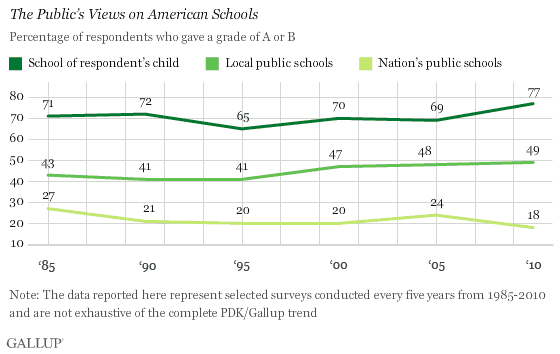
If schools aren’t local, why are so many locals happy with them?

So, yes, the impact of federal funding has increased since 1950. But most of the day-to-day decisions about schooling and education are made at the very local level. This localism might explain why most American parents are actually very happy with their children’s schools. Gallup polls have consistently found that most people grade their kids’ schools highly, in spite of the hand-wringing by pundits like Dr. Frohnen.

Second example: Like a lot of people, Prof. Frohnen mischaracterizes the early history of American public education. As he argues [emphasis added by me],

Today, politicians, professional educators, and administrators all tell us that the federally-regulated public school is essential to American public life—that it is the place where children from widely divergent socio-economic, racial, and ethnic backgrounds come together to learn what it means to be an American. It is understandable that Conservatives harken back to this vision as they face an education establishment determined to undermine our common culture. But we need to remember that historically American schools integrated students, not into some national community defined by ideology, but into local communities defined by tradition, history, and local relationships. Nationalized education got its start with the famous 19th century educator, Horace Mann.

Nope. From the get-go, ed reformers promised that publicly funded schools would serve a national purpose. And those reformers preceded the attention-hogging Horace Mann. Consider just a couple of examples from my recent research into the career of Joseph Lancaster. Starting in 1818, Lancaster swept into Philadelphia, New York, and other cities, promising that his “system” could educate a new nation’s children.

Lancaster and his fellow reformers insisted that their goal was precisely to train NATIONAL citizens, not local ones. As he wrote in a 1817 guide to his system [emphasis added again],

Another inducement to pursue the Lancasterian system, as it respects the state at large, is the uniformity of principles and habits, which would be thus inculcated among the children of those citizens who are the subjects of this kind of instruction, a desideratum essential to the formation of correct national feeling and character.

In all of his early writing, Lancaster explicitly promoted his scheme as a way to foster “NATIONAL EDUCATION” [his emphasis this time]. Indeed, one of the reasons Lancaster’s reform plan was so popular in the 1810s was precisely because it promised to train national citizens—at the time, the security of the new nation was extremely shaky.

So, SAGLRROILYBYGTH, agree with Prof. Frohnen’s ideas about public schools or don’t. Embrace his vision of conservative principles or don’t. But whatever you do, don’t listen to pundits who tell you that America’s public schools are ruled by any distant power. And don’t buy the old line that schools in the old days used to be about purely local values.

It just ain’t so.

What’s Wrong with Safer Schools?

For anyone who thinks Dan Patrick has a solution to school shootings, I have a two-hundred-year-old solution to urban poverty to sell you. As-is.

NYC manual 2 diagrams alphabet wheel

The solution to urban poverty, 1820 style…

You may have seen it by now: In the aftermath to the latest horrific school shooting, Texas’s Lieutenant Governor Dan Patrick has suggested tightening up school architecture. As Patrick put it,

We may have to look at the design of our schools looking forward, and retrofitting schools that are already built and what I mean by that is there are too many entrances and too many exits. . . . There aren’t enough people to put a guard at every entrance and exit.

Let’s be clear: There’s nothing wrong with thinking about school architecture and changing doors. What IS wrong is diverting attention from a real problem by directing conversations toward secondary considerations. In this case, we need to talk about school cultures that coerce and alienate students. We need to talk about gun laws that put deadly weapons in the hands of angry boys.

Along the way, we might ALSO talk about entrances, but it can’t be our main focus. In this case, IMHO, Dan Patrick is trying to wiggle out of a difficult political position by diverting attention from the real problems.

And, as I’m finding in my current research, this sort of diversionary tactic is the oldest trick in the school-reform book. Two hundred years ago, city planners in places such as Philadelphia, Boston, and New York faced a difficult dilemma. They had crowds of children in their streets from low-income families. The families couldn’t afford to send them to school so the children were growing up without being able to read or write.

What could be done? From London, Joseph Lancaster promised a solution. He described his system for educating poor children in meticulous detail. With the right school architecture and equipment, he promised, cities could eliminate the problem of poverty in just a few short years.

It didn’t work.

Just like Lt. Gov. Patrick’s plans to block doors and windows, Lancaster’s supposed solution treated minor symptoms in order to ignore the underlying cause. The right reading strategy is a good thing, but it is not a cure for urban poverty.

The Right Recipe for Science Missionaries

Thoughtful exposition? Or bacon ‘n’ eggs? Rick Potts is trying to spread the word about evolutionary science to America’s creationists. Is he taking the best approach?

As described in the Smithsonian Magazine, Potts hopes his traveling exhibition can reach those “rural, religious, remote” places that the Smithsonian “deemed ‘challenging’—places where the researchers suspected that evolution might still be a contentious subject.”

ephratastatue

Too much for some…

To this observer, Potts seems to be on the right track. I’m arguing in my new book about American creationism that the problem is not knowledge but something else. No amount of yelling or state standards will puncture resistance to mainstream evolutionary science. Rick Potts seems to agree. As the Smithsonian article describes,

Potts was going for something more subtle: Not conversion, but conversation.

“Our goal is to lower the temperature,” he says.

Could it work? One disgusted local from Ephrata, Pennsylvania felt offended from the get-go. She was freaked out by a statue of a naked early-human mother and baby at the entrance to the library hosting the exhibit. As she put it,

Library abortions would probably be more offensive . . . but that would probably be it.

If even this most diplomatic attempt at spreading the word about evolution is too much for some creationists, then are all attempts to converse with creationists doomed to failure? Are some people and some communities so firmly set against mainstream science that even a friendly, caring outreach project like this is too much?

Writing for BioLogos, Brad Kramer points out the obvious problem and suggests a difficult solution. As he explains, no matter how big the smiles were, the science missionaries were still obviously missionaries. And nothing is easier to resist for religious people than sermons from another religion.

So is there no hope? The problem is bigger than science, bigger than religion. The root of the difficulty is TRUST. What can be done? As Kramer argues, the answer isn’t very attractive for those of us who want quick solutions. Kramer suggests bacon and eggs:

If all Rick Potts had done in Ephrata was spend a month eating breakfast with people at local diners, introducing himself as an evolutionary scientist, and explaining that he doesn’t hate Christians, an enormous amount of good would have been accomplished.

I Love You but You Didn’t Do the Reading

I spent the week buried in the Philadelphia archives, but somehow the world kept on turnin. Here are a couple of stories this week that have nothing to do with Joseph Lancaster.

Defending Kanye at NR.

pence at hillsdale

Do they care that we’re conservatives?

Pence at Hillsdale commencement—the conservative collegiate long game, at Politico.

A Canadian university wonders: Can only Indigenous professors teach about First-Nations history? At CBC.

Peter Greene tees off on Florida’s standardized tests for five-year-olds. At Curmudgucation.

Should fans of Wendell Berry forsake social media? Matt Stewart makes the case at FPR.

  • “We can rest assured, bonded by our faith in each other’s commitment to at least forsaking Twitter, that we are closer to being localists than to being hipster localists. The distinction is simple: a localist does not have to keep the Big Ether informed of one’s commitment to localism at all times and in all places.”

Get em young: Sarah Pulliam Bailey rides along on a Christian-nationalist kids’ tour of DC. At WaPo.

Gaza protest

Signs of the apocalypse?

Apocalypticism, Trump, and Jerusalem:

School revolts hold the key to stopping Trumpism: Henry Giroux at BR.

Standardized tests…what could go wrong? The fallout from glitchy tests in Tennessee, at Chalkbeat.

Arizona tried to edit evolution out of its science standards, at KNAU.

Asking uncomfortable questions at SMU—“Why are Black people so loud?”—“What is the difference between white trash and white people?” At CHE.

Dictating Democracy

As I was reminded last week in the Philadelphia archives, it’s the oldest educational idea in the United States. Larry Cuban points out this morning that our dream of educating a new generation of democratic citizens might take us in surprising directions.

First, my full confessions: I have progressive prejudices that are hard to shake. I want public schools to make society better. I believe that better educational opportunities for all people will help achieve that goal. And…and this is the one that matters this morning…I think what goes on in classrooms matters. As John Dewey argued a century ago, if we want a democratic society we need to start by creating democratic classrooms.

Democracy-prep-vote

I can’t vote, and I can’t speak when I want to, and I can’t put my pencil where I want to, and I can’t get out of my seat when I want to…

So I join Professor Cuban in wondering if a school can create democratic citizens by controlling students tightly. Cuban looked at a study of Democracy Prep, a new charter network. The schools make one of their goals the civic education of children, meaning mostly that students learn about government, about public decision-making processes, and about getting out the vote.

As one thoughtful former Democracy Prep teacher noted, it’s hard not to think that the way students are educated matters. As he puts it,

schools are invariably where students go to experience the civic engagement of others. No child thinks of it this way, but surely, he or she picks up clear signals about their place in the world, how they are regarded by authority figures who are not their parents, and how much — or how little — is expected of them. If the relationship a child has with a school is coercive, punctuated by frustration and failure, leading to no good end, then there is no reason to expect strong civic outcomes.

And yet, as Prof. Cuban points out, students at Democracy Prep feel the heavy hand of authority at all times. As one visit to a DP school revealed, students’ actions were constantly tracked and dictated. As the visitor found,

Almost everything on a recent visit to a Democracy Prep charter was highly disciplined. Students spoke only when their teachers allowed them. They could lose points for talking out of turn, or chatting in the halls between classes.

Can it really be feasible, Cuban wonders, that this sort of top-down classroom will produce active citizens? That schools can coerce students into active democratic participation? The charter network has claimed some positive results. A recent alumni study by Mathematica Policy Research found that citizens who had attended Democracy Prep were more likely to register and to vote.

I’m skeptical. Surely a school culture that eliminates any possibility of student leadership will have a depressing effect on student political participation. At least, that’s what makes sense to me. Or is it really possible that schools can control their students all the way to active citizenship?

From the Archives IV: The Handwriting Is Off the Wall

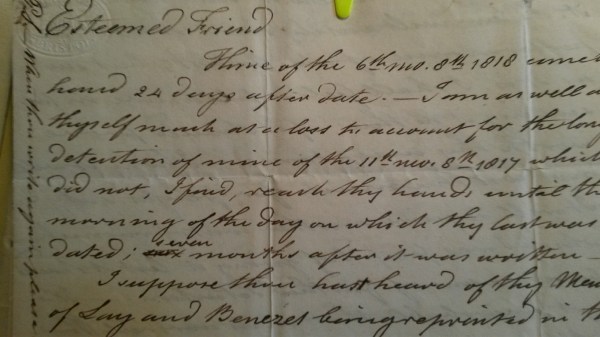
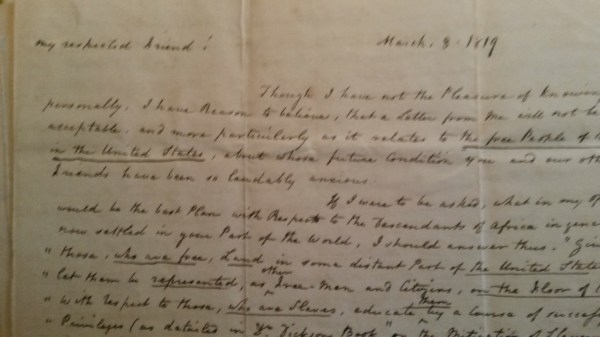
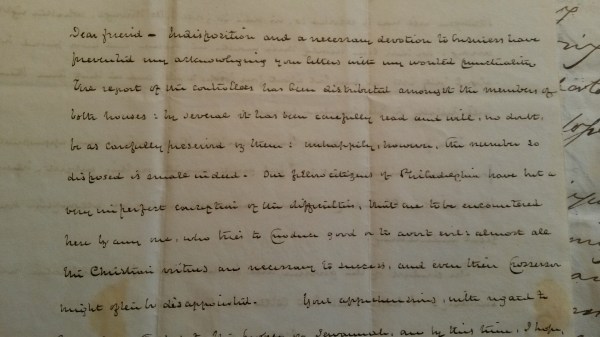
Do you miss handwriting? I thought I did, but my research experience this week has me wondering. As I dug through the Philadelphia archives working on my new book, I’ve been confounded by the arcane art of penmanship.peanuts.1967.04.25

Most of my archive work over the past decade or so has been in twentieth-century collections. As SAGLRROILYBYGTH might recall, I’ve enjoyed leafing through old pages of type-written correspondence. I feel an acute nostalgia for the days of elaborate letterhead.

What I never had to wrestle with, though, is page after page of hand-written correspondence. Some of it is absolutely gorgeous. I have no idea how long it would take to write this way. Some of it is terrible and impossible to read—Charlie Brown level penmanship.

I’ll share a few of the most elaborate bits here for your Sunday morning delectation.

random handwritig 1random handwriting 2random handwriting 3random handwriting 4random handwriting 5