I Love You but You Didn’t Do the Reading

How do the DeVoses spend their money? No surprise, they give a lot to evangelical schools, like a cool hundred grand to the Ionia School of Missionary Aviation Technology, at Politico.

What goes on in Eva’s Success Academies? At the New Yorker, a look at their “repressive” style.

The last of the Roy Moore saga?

What do teachers think? Peter Greene breaks down a survey about teachers’ political beliefs.

Sex and Jay-sus: An interview at R&P with R. Marie Griffith about her new book, Moral Combat.

It’s not as simple as it looks: How course placements at community colleges lead to higher-ed segregation, at Hechinger.Bart reading bible

Are conservative student groups unfairly targeted? The latest from the University of Wyoming.

Koch Brothers funding “Freedom” classes in public schools, at Tucson.com.

What’s wrong with charter schools? The ACLU charges Arizona charter network with excluding students.

Why Schools Will Always Be Segregated

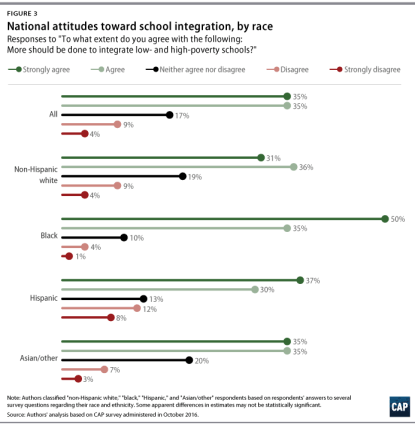
How is this possible? Most of us want integrated public schools, but it’s not going to happen. Why not? As Nikole Hannah-Jones insisted in a recent interview, school segregation isn’t the result only of racist or white-supremacist feelings, but rather of a basic, ugly truth about what schools are really for.

It’s not something we like to talk about. We like to think of our public schools in Horace Mann’s terms. In his famous 1848 report, Mann called schools the “great equalizer.” For Massachusetts and America—Mann argued just as the spectre of communism stalked Europe—common schooling would temper the growing class divide. Instead of a revolution, Mann dreamed, common schools would help America gently rise up, all together. Ever since Mann’s day, politicians insist and assume that public schools can save America. Everyone from Barack Obama to Betsy DeVos harps on the notion that schools can make America more equal, more fair.

There is truth in that dream. We can all recite cases of extraordinary students and families who have used unequal schools to overcome difficult economic circumstances. Public schools really can offer opportunities to talented, hard-working people.

Segregation

70% of us want more integrated schools, but 99.9% of us want something else more.

As Hannah-Jones points out, though, there is another, more powerful purpose for schooling in these United States. Like it or not, this second vision will always trump Mann’s vision of school as the great equalizer. It’s not that white parents don’t want their children to go to integrated schools. They do. As recent poll results suggest, large majorities of parents want integrated schools.

The problem is something different. Hannah-Jones agrees that many white parents in her Brooklyn neighborhood, for example, love the idea of “curated diversity.” They want a smattering of non-white children to share their children’s high-quality schools. And they love the notion that their children will go to school with the children of affluent African Americans.

But they recoil from the prospect of having their children go to schools dominated by low-income non-white children. Why?

Because, as Hannah-Jones puts it,

Even in a community where the schools pretty much suck, if there’s a school with black kids, it’s going to suck worse.

In other words, many white progressives want their children to go to diverse schools. What they won’t abide, however, is that their children will be subjected to the terrible public schools that are the common fate of low-income families.

It comes down to an often unstated but fundamental purpose of American public education: For many parents, For most parents, the primary purpose of education is not actually to make children smarter or better in general. Those might be worthy goals, most people assume, but in fact the primary purpose of education—the way most Americans see it—is to give their children an advantage in the fight for good jobs and sweet lives. As Hannah-Jones says,

if one were to believe—which I believe—that having people who are different from you makes you smarter, that you engage in a higher level of thinking—and there’s been research that shows that—that you solve problems better, there are all these higher-level ways that integration is good for white folks. . . . those are all hard soft-arguments to make to people who fundamentally view education as, how my kid will rise to the top above every other kid and get into Harvard. They don’t actually give a damn about their kid being a better person.

It may sound excessively gloomy, but Hannah-Jones is depressingly right. When we stack up the politically active parents who want to use their children to help make society more equal against the parents who want to help their children squeeze every affordable advantage out of schooling, the equalizers will always lose.

Because…Friday

Feeling low? Culture wars got ya down? Click this one…trust me.

HT: LL

What’s the Deal with White People?

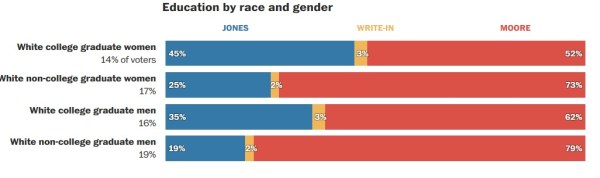
The Roy Moore saga might (or might not) finally be coming to an end. Moore lost the Senate race and he might ride his horse into the sunset. The poll results from Alabama, though, give us some puzzles to think about. We might think we understand why so many white evangelicals voted for Moore. But some other groups just don’t make sense.

As we’ve argued in these pages, a central defining feature of white evangelical history over the past century has been what historian George Marsden called the “establishment-or-outsider paradox.” For many white evangelicals, as I explore in my new book about evangelical higher education, America has been both a shining city on a hill and Babylon.

As a result, white evangelical voters have been prone to cheer candidates like our current president who promise to make America great again. President Trump is not the first leader of questionable personal morality to win evangelical votes by pandering to white evangelical yearning to take the USA back to an imagined Christian past, to return the country to Winthrop’s vision.

So I’m not too shocked to read that 80% of white evangelical voters in Alabama voted for Judge Moore. There is one result that befuddles me, though. A slim majority of white college-educated women also went for Moore. By a margin of 52% to 48%, this group voted for a man credibly accused of preying on teenage girls.

What gives?

We can even extend this question to the 2016 presidential election. The number of white evangelical voters who voted for Trump and Moore is very similar: 81% and 80%. While a slim majority of college-educated white women voted for Secretary Clinton over President Trump, Trump still claimed a surprising 45% of the college-educated white woman vote.

Can someone explain this one to me?Moore election results

Why do so many white college-educated women vote for these candidates? I have a feeling my cultural blinders are making it hard for me to understand this apparent truth about the American electorate.

What Goes on in Fundamentalist Schools?

When does bad school cross the line into child abuse? The depressing answer is that it depends on who’s asking. Jonathan Kozol famously decried the racist and abusive practices in America’s urban public schools. Now Rebecca Klein is warning that tax-funded evangelical schools are doing more than just bad teaching. Are these schools using your tax dollars to abuse children?

Klein’s article focuses on the stories of fundamentalist school survivors such as Ashley Bishop. Bishop tells a story that has become depressingly familiar to SAGLRROILYBYGTH. Like some of the voices on this blog, Bishop’s experience in conservative evangelical schools was beyond terrible. Her schooling left her deeply conflicted and depressed. It took her years to become comfortable with herself and with her sexual identity.

My heart breaks for Ashley and all the other young people traumatized by hostile school environments. We tend to hear about brave survivors like Ashley, but we must remember that there must also be many more students who never escape, who make their lives entirely within a community in which they feel isolated and unworthy. The more attention such students can receive from journalists like Klein, the better.

Klein looks at the number of schools that use fundamentalist textbooks and concludes grimly,

there are thousands of kids receiving an extremist and ultraconservative education at the expense of taxpayers.

For full disclosure, I should point out that I spoke with Klein as she put this article together and she refers to my research. I must also point out that there are a few important points that she leaves out.

Ace hokey

This is terrible stuff. But is it abusive?

First of all, education scholars and historians know that we can’t simply equate textbooks with school curriculum. We certainly can’t look only at textbooks and think we know what kind of learning goes on.

Second, though Klein states that A Beka, Bob Jones, and ACE all share “largely similar educational philosophies,” that’s simply not the case. As I discovered a few years back, there are actually vast differences between the A Beka, ACE, and BJU approaches. A Beka insists on a rigid, traditionalist, teacher-driven classroom. BJU wants the opposite.

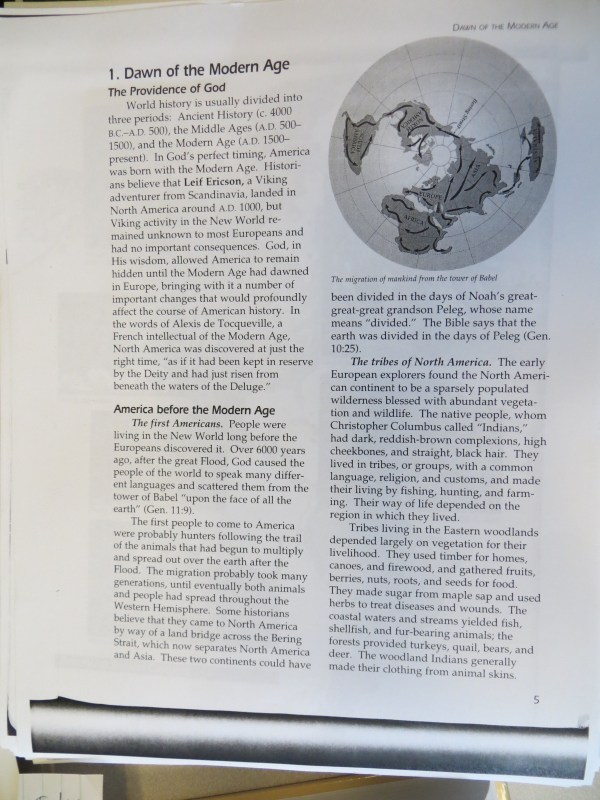
It’s also important to note that these textbooks are not static. In a recent book about education and ignorance, I argued that the treatment of history in A Beka and BJU textbooks has changed dramatically in the past thirty years. In some ways, the textbooks have become more like mainstream offerings. In others, they have become very different. In general, both BJU and A Beka have increased their emphases on the distinctive religious elements of their historical vision. A Beka history books, for example, explain in more recent editions that Native American populations originated from the downfall of the Tower of Babel.

a beka babel big

Textbook apocalypse.

Finally, and most important, we need to remember that abusive schools are not bad only if they use tax dollars. The state has a responsibility to protect all children in any school or homeschool. Even if a school is entirely privately funded, it has no right to enact policies that aren’t in children’s best interests.

In some cases—such as physical abuse or neglect, or sexual predation—that line is fairly easy to discern. When it comes to religious ideas, though, it becomes enormously difficult. Is it abusive to teach children that homosexuality is a sin? Is it abusive to teach children that mainstream science is a cauldron of lies?

If it is, then the state has the right and duty to intervene. It doesn’t matter whether or not the schools receive tax dollars in the form of vouchers. If it isn’t, though, then religious families and schools must be allowed freedom to have schools that we wouldn’t want our children to attend.

I Love You but You Didn’t Do the Reading

Those of us who live our lives in semesters are feeling a dizzying sense of high-speed hoopla as we take the final plunge toward the end of the semester. In all the huff and stuff, here are some ILYBYGTH-related news stories you might have missed:

Why do conservatives hate higher education? At The Atlantic, Jason Blakely offers an explanation.

No more safe spaces—except for conservatives. House higher-ed bill throws some brontosaurus-sized bones to campus conservatives, as reported by Politico.

The conservative National Association of Scholars claims another win. AP European History changes its standards in response to NAS criticism. HT: DR

Selling the naming rights to your local school—Peter Greene objects.Bart reading bible

Is Silicon Valley taking over classrooms? Larry Cuban says yes and no.

The latest crisis in public education: Good News. The graduation rate is at an all-time high.

It’s all Greek to me: At The Atlantic, two opposing ancient concepts of free speech.

Moore-o-mania:

At CHE: Can Sexual Predators Be Good Scholars?

When Did Conservatives Get so Angry at Higher Ed?

When I saw the headline, my nerd spidey-sense tingled. I was excited to read about the history of conservative anti-college feelings. But when I read the whole article, I was struck once again by the half-baked nature of the claim. Once again, a smart, well-informed pundit who claims to be examining culture-war history stops half-way. When will we start looking beyond the 1960s?
OLYMPUS DIGITAL CAMERA

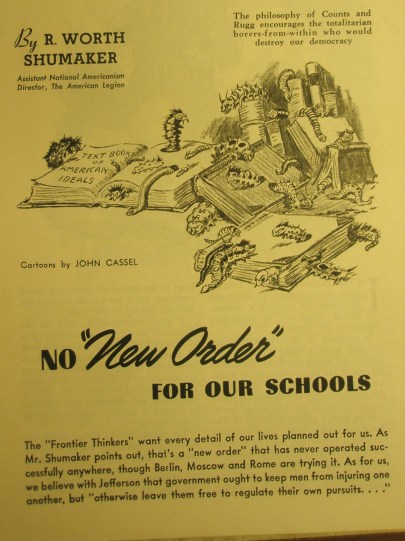
An earlier generation also worried…

Here’s the dilemma: at The Atlantic, Jason Blakely recently promised to explain the history of recent GOP ire against higher education. Looking at the current proposed tax plan, for example, it seems as if some members of Congress are out to punish elite universities.

Blakely argues that this conservative resentment of higher education has historical roots. In his analysis, he makes some vital points. Most powerfully, he notices that conservatives seem to mistake a very small segment of higher education for the higher-educational landscape as a whole. As he wisely puts it,

conservative anxiety is best expressed as being about a small set of marquee positions of honor and prestige in the liberal arts that happen to be largely staffed at present by those whose political commitments lean left.

That’s a vital point that is too often ignored. “College” as a whole is not particularly leftish…or even particularly anything. The crazy-quilt patchwork of colleges, universities, and other post-secondary institutions is wildly disparate. It is an absolutely vital notion that people just don’t seem to want to notice. Kudos to Blakely for emphasizing it. But when he proposes to analyze the history of this conservative anger toward elite universities, he puzzlingly only scratches the historical surface. After a nod to the “deep and complex historical roots” of anti-intellectualism in American culture, he argues that

the trope of portraying American universities as a threat to society emerged with particular intensity in the 1970s and ‘80s.

He looks at the work of neoconservatives such as Irving Kristol and Allan Bloom regarding “what they saw as the moral laxity and corrosiveness of the 1960s counterculture.”

Fair enough. And interesting, as far as it goes. But what Blakely and other writers miss is the longer relevant history of this specific trend in culture-war thinking.

As I argue in my book about educational conservatism, if we hope to make any sense of today’s conservative anger at elite higher ed, we can’t start with the 1970s. We need to begin in the 1920s, when conservative intellectuals had their first experience of exile, when the tropes exploited so powerfully by Kristol and Bloom were first developed.

It was not in the 1970s, but in the 1920s that conservatives developed their deep abiding anxiety about trends in elite higher education. Consider a couple of examples.

In the early 1920s, for example, anti-evolution celebrity William Jennings Bryan railed against trends in American higher education. In one public dispute with University of Wisconsin President Edward Birge, for example, Bryan offered the following memorable proposal. If universities continued to promote amoral ideas such as human evolution, Bryan suggested, they needed to post the following notice:

Our class rooms furnish an arena in which a brutish doctrine tears to pieces the religious faith of young men and young women; parents of the children are cordially invited to witness the spectacle.

Elite schools, Bryan warned, had begun actively to teach “moral laxity and corrosiveness.” Universities needed to warn parents that they no longer taught students right from wrong. This sense of conservative outrage at higher-educational trends was a driving force behind the culture wars of the 1920s.

It wasn’t only Bryan and it wasn’t only evolution. Since the 1920s, conservative intellectuals have voiced “with particular intensity” their sense that elite universities had gone off the moral rails. Consider the case made by some patriotic conservatives in the 1930s and 1940s against the anti-American direction of the elite higher-educational establishment.

In 1938, for instance, Daniel Doherty of the American Legion denounced elite institutions as mere “propagandists.” Universities such as Columbia had taken to “attacking the existing order and [to] disparagement of old and substantial values.”

These intense antagonistic feelings toward elite universities were widely shared among conservative thinkers in the 1930s. Bertie Forbes, for example, syndicated columnist and founder of Forbes magazine, warned that elite schools were “generally regarded as infested” with subversive and anti-moral professors.

When we talk about our culture-war history, we can’t short out these voices from the 1920s and the 1930s.

Why not? If you are purporting to explain the history of an idea, you can’t only focus on the most recent articulation. It implies that these questions began to rankle only in the past fifty years, instead of slow-cooking for about a century now. The radicalism of the 1960s, and the reaction of the 1970s, were not new. They did not create new terms of culture-war angst, but rather only perpetuated existing themes.

This is not only a nerdy quibble but a fundamental part of culture-war politics. Think of it this way: When Irving Kristol and Allan Bloom made their arguments in the 1970s—the ones Blakely thinks inaugurated conservative anger at elite universities—they did not need to convince their conservative audiences of their central point. Conservatives had a vague but powerful sense that elite intellectual institutions had long since turned against truth, goodness, and beauty. Convincing someone of something they already believe to be true is a much easier task.

I don’t mean to single Blakely out. He’s not the only writer to woefully misrepresent America’s culture-war history. Plus, I’m not saying that historians can’t cut off their arguments at some reasonable point. We don’t all need to always write about everything. I get that. In a case like this, however, ignoring the vital and intensely relevant precursors to the 1970s history is not okay. We end up with a misleading notion of the genealogy of conservative outrage. We end up thinking we understand something we haven’t really even begun to understand.

The Headline No One Clicks On

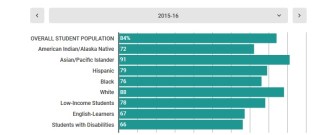
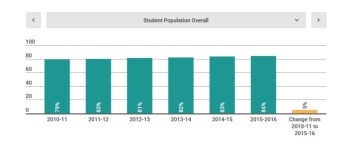
I’ll admit it: I’m a monster. I recently asked my students to take on an impossible task. One of the big questions of our graduate seminar this semester was this: Is American public education “good?” Students came up with several ingenious, nuanced, and insightful answers. But they could be excused for struggling with the question. As recent headlines show, the question is impossible. How can we tell if public schools are doing well?graph from edweek 1

On one hand, we see news every day that should convince us. A report in EdWeek, for instance, reveals the amazing news that high-school graduation rates are up for the fifth year in a row. For all types of students.

Most other headlines about education, though, are pretty rough. We hear that the achievement gap among demographic groups is widening in New York City. We read that American students are losing their number-one spot in reading scores. Queen Betsy tells us that the terrible state of our public schools is “unacceptable. . . . inexcusable. . . . [and] truly un-American.”graph from edweek 2

What we’re looking at here is the old blind-scholars-and-elephant problem. If we look at graduation rates alone, we’d say public schools are doing great and getting better. But if we look at the disparities between different groups of students, we’d agree that the system is woefully unfair and racially biased.

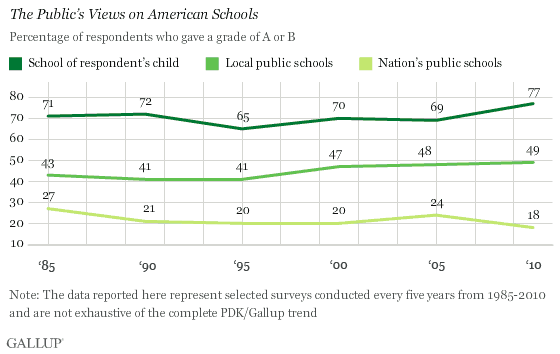
By and large, though, it seems hard to find good news, unless we avoid headlines and look at real schools and real teachers. The Gallup numbers show this consistently. When people describe the schools they know best, they’re very bullish. But asked about public schools in general, people are gloomy.

gallup people like their local schools

I can’t help but think headlines contribute to this situation. Talking about desperate crises appeals to our yen to confirm our fears. Talking about terrible schools allows us to blame the people we dislike for the current crisis. And much of the problem is due to deliberate culture-war obfuscation. In a recent speech, for example, Queen Betsy said,

A recent Gallup poll showed the majority of all Americans are dissatisfied with the overall education system in our country.

That’s true. But it hides the fact that bigger majorities of Americans are happy with the schools they actually have first-hand knowledge about.

We might say the same thing about our teachers. It’s easy to find headlines about bad teachers. Don’t believe me? Try googling “unprepared teachers.” If you have kids in school, you’ll be frightened by the results. But if people could spend a semester with the students in my department preparing to be teachers, they’d share some of my optimism and confidence.

Are there big problems with America’s public schools? Definitely. But we need to be careful with our questions if we want to get good answers.

Are there bad teachers out there? Sure. But the talent and energy going into the profession are overwhelming. It’s just not something we can cram into a clickbait-y headline.

Making Campus Conservative

Wowzers! Having apparently given up on appealing to anyone else, the House GOP has taken to playing Santa Claus to campus conservatives. Their new proposal for the Higher Education Act threatens to make conservative dreams come true.

According to Politico, the big story from the new bill is the sweeping change it will enact in federal student-loan policy. Here at ILYBYGTH, though, we’re more interested in the way it will redraw battle lines in higher-ed culture wars.

As we’ve discussed frequently, conservatives interested in higher education have fulminated ferociously about the recent spate of anti-conservative student protests. As I argued at HNN a while back, conservative legislative moves like the recent one in Wisconsin don’t actually plan to improve things, but rather hope to make political hay. The only effect, as someone once put it so wisely, will be to “write a vague sense of conservative outrage into the law books.”

Speech codes aren’t the only target of the new bill. It also throws a brontosaurus-sized bone to religious conservatives. As we’ve seen, evangelical groups such as Intervarsity have been de-recognized on many campuses. That means they can no longer use campus facilities. Unless they allow a more diverse group of people to be group leaders, they are no longer allowed to be official student groups.

The House bill promises to fix both problems. As Politico explains, the new bill would ban public colleges, at least, from enacting any sort of speech-restricting codes. Plus, no schools could de-recognize religious groups. As the bill’s language puts it, colleges could not deny

a religious student organization any right, benefit, or privilege that is generally afforded to other student organizations at the institution (including full access to the facilities of the institution and official recognition of the organization by the institution) because of the religious beliefs, practices, speech, membership standards, or standards of conduct of the religious student organization.

Will it work? Hard to say. As we all know from Schoolhouse Rock, there’s a long journey from bill to law. House GOP leaders might be willing to give up the evangelical-friendly parts of their bill to get the student-loan parts to succeed. Or they might scrap the provision about free speech to win on their sexual-assault rules.

Let My Children Go

Even the smartest conservatives don’t get it. There’s a big win for conservatives buried in the Senate’s tax plan. If it goes through, though, it will not prove the strength of conservative ideas, but rather the desperate strait they are in.

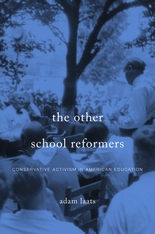
Before we dig into that, let me back up a little bit and tell a story. When my book about the history of educational conservatism came out, I did an interview with National Review’s John Miller. He wanted to know how twentieth-century conservatives had pushed for charters and vouchers.

9780674416710

Things are not always what they seem…

The problem was…they hadn’t. As I have argued elsewhere, when Milton Friedman first proposed charter schools in the 1950s, no one listened. The conservative push for charters and vouchers only gained real steam at the very tail end of the century.

By and large, conservatives didn’t want to escape from public schools in the twentieth century. Why not? It’s obvious: They still hoped to control them.

There were exceptions. After Brown v. Board in 1954, whites in the South massively resisted by privatizing public schools. And yes, the evangelical exodus from public schools took off in the 1970s. Then the second-stage flight from fundamentalist schools to fundamentalist homeschools began in the 1990s.

In the big picture, though, conservatives generally considered public schools their schools throughout the twentieth century. In the Reagan era, conservative intellectuals who cared about schools—most notably William J. Bennett—didn’t want to help conservative parents escape from public schools. Rather, Bennett thought the public schools themselves could be nudged in conservative directions. As we’ve seen lately, though, there’s a huge divide between today’s conservative thinking about public schools and Bennett’s. Most obviously, Bennett’s conservative dream for common state standards met with virulent conservative opposition.

What does any of this have to do with the Senate tax bill? The Senate version contains a clever sweetener for conservatives who want to remove their children from public schools. As reported in Quartz, their proposed tax bill will extend the use of 529 plans to K12 education. In the past, those programs allowed parents to squirrel money away for their children’s college expenses. Any earnings weren’t taxed, as long as the money was spent on tuition.

The new tax bill allows parents to do the same thing with private and charter schools. In effect, the new bill is a modest tax break for conservatives who want to keep their children out of the hands of the public schools.

I should add the usual clarification: SAGLRROILYBYGTH are sick of hearing it, but I’ll say it again. I am no conservative myself. I am deeply concerned about the two terrible tax bills currently under debate. The push to reduce and reroute funding for public education is a cruel and shortsighted effort. IMHO.

As a historian, though, I can’t help but notice that this is yet another example of the ways conservative dreams have deflated in the past century. In the 1920s, as I argued in my book about educational conservatism, religious conservatives hoped for nothing less than to legislate the theocratic control of public education.

These days, as this tax plan demonstrates, conservatives no longer hope to push public schools in conservative directions. Rather, conservative strategy consists of sneaking in tax breaks and incentives for parents who are trying to flee.