The Art Is In!

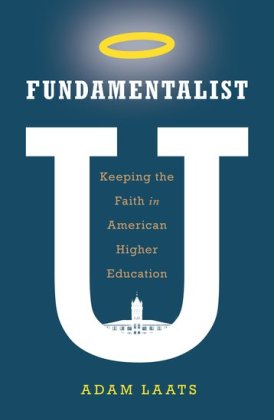
Thanks to the folks at Oxford, we have a terrific cover for my new book about the history of evangelical higher education. We had batted around a few other ideas about cover art, including artsy-fied excerpts from some of the student rulebooks. In the end, my editor thought those looked too busy and hard to read and I think she was right. Especially when I see this snazzy cover.Cover art final

When can you get your hands on a copy? Soon. Pre-orders are available now, and OUP promises to ship on February 1st.

Are Evangelical Colleges Obsolete?

What is the point of sending your kid to a conservative religious college? For almost a century now, many conservative evangelical families have worried that if they didn’t, liberal or secular colleges would steal the faith of their Christian children. New research data suggest that those fears might no longer be realistic. But the new study won’t reassure evangelical parents or college administrators.

As I’m arguing in my new book about the history of evangelical higher education [shameless plug: Pre-orders available now!], a leading reason evangelicals established their own network of dissenting colleges and universities in the 1920s was the fear that mainstream college robbed children of their faith.

As he appealed to fundamentalist parents to send their kids to his new Bob Jones College, for example, evangelist Bob Jones Sr. liked to tell a scary story: A good Christian family scrimped and saved to send their precious daughter to a fancy mainstream college. “At the end of nine months,” Jones reported,

she came home with her faith shattered. She laughed at God and the old time religion. She broke the hearts of her father and mother. They wept over her. They prayed over her. It availed nothing. At last they chided her. She rushed upstairs, stood in front of a mirror, took a gun and blew out her brains.

Never fear, Jones said. Though mainstream colleges had gone to the dogs, new fundamentalist schools like his could be trusted to protect children’s faith in the crucial college years.

Those fundamentalist fears were not left back in the early twentieth century. Today’s conservative leaders, too, warn of the deadly spiritual threat of liberal colleges. A few years back, young-earth creationist pundit Ken Ham defended his insistence on pure creationist colleges. As he put it, too many schools—even nominally evangelical Christian ones—end up putting intellectual

stumbling blocks in . . . children’s way that could lead them to doubt and ultimately disbelieve the Scriptures.

In every century the evangelical assumption has been the same: The college years are a uniquely important and a uniquely dangerous time for young people. If children are raised in conservative evangelical homes, skeptical college professors might turn them away from their family faith.

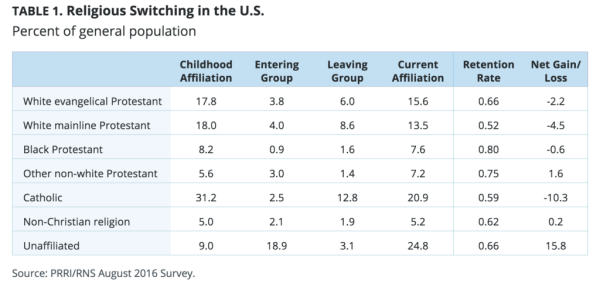
Religious-Switching-Unaffiliated-Table-1-1024x491

Could be worse; could be Notre Dame…

New data from the Public Religion Research Institute (PRRI) suggest that colleges aren’t really to blame when young people ditch their religion. At least, not anymore. PRRI’s Daniel Cox explains that more young people these days are leaving their religions before they enter college. As he writes at FiveThirtyEight,

Seventy-nine percent of young adults age 18 to 29 who have become religiously unaffiliated report having made this decision during their adolescent and teen years. But this was not always the case. Those age 65 or older who left their childhood religion reported doing so much later: Only 38 percent who reported leaving their religion did so during their childhood years. The majority (63 percent) of unaffiliated senior citizens left during their college and post-college years.

In other words, the college years USED TO be a vital time, a time of choosing to leave or stay with one’s childhood religion. It seems like that’s not really true today.

Does this mean that conservative evangelical colleges have become obsolete? If one main purpose of those schools is to nurture and protect evangelical faith, it seems as if they are not useful. Rather, if we accept this data, it would seem that evangelicals should focus on K-12 schools instead.

And we should note that evangelical college leaders might look at this data in a more optimistic way. According to the PRRI study, evangelical Protestants are losing adherents at a much lower rate than other American Christian groups. Evangelicalism is still losing young people, that is, but much slower than Catholicism or “mainline” Protestantism. It could be argued that evangelical colleges have helped stem the anti-religious tide among evangelical young people.

Still and all, I’m glad I’m not president of an evangelical college. If I were, I would wonder what to tell parents of potential students. If I couldn’t promise to help protect students’ faith, I wouldn’t have much else to talk about.

When Should We Punch Nazis?

If you only read the headlines, you could be forgiven for thinking that large majorities of Americans oppose free speech. With Trump tweeting against NFL protests and college students blocking offensively conservative speakers, we might think most Americans agreed that free speech was a dangerous thing. According to new survey data, though, that’s not the case. In The Atlantic recently, Conor Friedersdorf reviewed the survey findings and found some surprising results. For one thing, most Americans want to let even the most offensive speakers have their say.

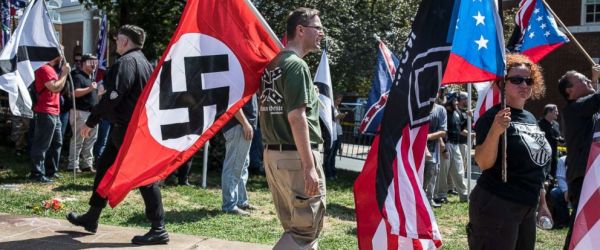
nazi-flag-charlottesville-protest-rd-mem-170814_12x5_992

Punch him? Or protect him?

Should an executive be fired for harboring racist ideas? A majority (53%) said no. Even a slim majority (51%) of African Americans said no.

Should Nazis be violently blocked from expressing their hateful views? Large majorities of minorities said no. Eighty percent of Latinos and almost three-quarters of African Americans wanted to let Nazis speak their piece.

What about on campus? It seems that large majorities of respondents agree that some forms of speech deserve to be blocked. If someone calls for violence, for example, 81% of respondents think their speech should not be protected. Saying the Holocaust never happened? 57% of people think such ideas should be blocked. “Outing” illegal immigrants on campus? 65% said no.

If someone pulls a James Damore, though, 60% of people think his speech should be protected. And small minorities even want to protect other sorts of offensive speech, including accusations that all Christians are “brainwashed” (51%) or even that some racial minorities have lower IQs (52%).

It seems as if there is a lot more agreement about free speech than one might think. Americans in general often don’t know the rules—for example, significant numbers of respondents thought it was already illegal to make racist comments. Overall, however, Americans seem to agree that most speech should be protected, even offensive and possible dangerous speech. If it becomes TOO dangerous, however, we agree it must be stopped. We just don’t agree on where or how to draw that line.

Admissions of Guilt

It’s hard to tell for sure, but it looks like the Justice Department is investigating Harvard’s admissions policies. If Harvard really is cutting out qualified applicants based on their race, it is only continuing the shameful tradition of elite college admissions policies.

Here’s what we know: When pressed for information about its investigation into Harvard’s admissions policies, the Justice Department said that those records can’t be shared. They are part of an ongoing investigation. As Alia Wong describes in The Atlantic, we don’t know for sure, but it certainly looks like the Justice Department is going after Harvard.

The beef is that Harvard allegedly discriminates against Asian and Asian-American students. Would-be students claim that their SAT scores need to be far higher than non-Asian students. They point to schools like MIT and Berkeley that have no racial policies for admission, where there is a far higher proportion of Asian-American students.

Why would Harvard do such a thing? One possibility is that they hope to maintain a balanced student body. They don’t want to admit students solely on the basis of academic track record, but rather on a checklist of desirable qualities. Students from less-represented groups might have a better chance of admission, since the school wants a diverse group of students. For instance, a white girl from a low-income coal-mining family in West Virginia with an impressive academic record and basketball skills might outrank a Korean-American girl from a high-income family in Scarsdale with an even more impressive academic record and even better basketball skills.

It’s not easy to prove but it is easy to believe. Elite colleges have always shaped their admissions policies based on biased and unfair rules.

geiger

Non-WASPs need not apply…

As Professor Roger Geiger describes in his recent history of American higher education, selective admissions policies are a relatively new thing. Only in the 1920s did schools like Harvard, Princeton, and Yale begin to formalize their admissions processes.

It wasn’t pretty.

Back then, the elite colleges wanted to find some way to exclude talented students from non-elite backgrounds. In particular, they worried that too many smart Jewish students would take over their schools.

What to do?

Schools began to ask potential students to take standardized tests. One goal was to find out students’ true intelligence. Admissions officials back then assumed that WASPs were naturally more intelligent, but ambitious Jewish students—they called them “grinds”—worked too hard and made themselves look smarter than they really were.

At Yale, the first use of the Scholastic Aptitude Test in 1926 was intended to weed out such non-traditional students. The test was geared toward the existing curriculum at elite prep schools. Students from those schools would be well prepared. Other students wouldn’t. The idea was to give Yale an objective-looking score they could use to exclude Jewish applicants.

At Princeton, the first selective admissions were even more slanted. Every potential student was given a score between one and four, even before the application was looked at. Students from desirable elite backgrounds were grade one—automatic admits. Students from Jewish backgrounds were classed four—automatic denials. Only after those categories were applied did admissions officials open up the applications and make decisions.

So is Harvard discriminating against Asian and Asian-American students? I have no idea, but as long as there have been selective admissions policies, those policies have been used to exclude hard-working, talented students from non-elite backgrounds.

I Love You but You Didn’t Do the Reading

Campus uproar, SCOTUS deliberations, and a few oddball stories, too. It’s been another whiz-bang week here at ILYBYGTH. In all the fuss, here are some stories we might have missed…

“Like trying to waltz with a wolf:” Jill Lepore in The New Yorker on the history of campus- and NFL free-speech battles.

Things are still weird in Mississippi. Hechinger looks at the ways history textbooks in the Magnolia State still leave out big chunks of uncomfortable history.Bart reading bible

SCOTUS gears up to rule on teachers’ unions. Can non-members really be forced to pay union fees?

Want to play football against the College of the Ozarks? Be sure none of your players take a knee during the national anthem.

Should Virginia Tech fire its alleged white-supremacist teaching assistant? Or is he protected by academic freedom?

Chris Lehmann takes apart the myth that good schools will lead to economic mobility, in The Baffler. HT: D

Why did so many academic historians pooh-pooh Ken Burns’ and Lynn Novick’s new Vietnam War documentary? Jon Zimmerman offers a simple explanation at CHE. HT: NBR

Now they’ve got teachers doing it! Massachusetts substitute kneels during the Pledge of Allegiance. HT: MM

Mick Zais hated the Common Core all the way to the White House.

One liberal college’s attempt to attract conservative students, from Inside Higher Education.

Thanks to all SAGLRROILYBYGTH who sent in stories and tips.

How Not to Woo Conservative Students

They’re not doing it because they’re committed to political diversity. They’re not doing it because of right-wing political pressure. Rather, some left-leaning colleges are trying to attract conservative students simply to keep the lights on. But one school, at least, is going about it the wrong way.

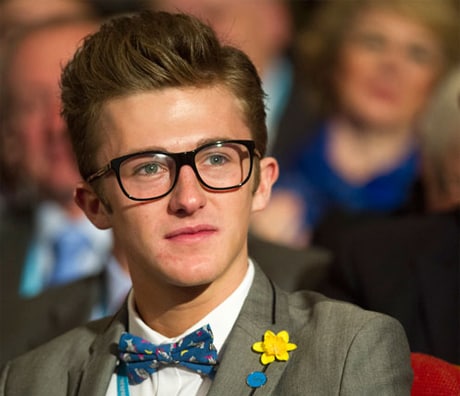
youngconservative_2364114a

What do conservative young people want out of college? Not fiddles and compost.

Your humble editor has attracted some flak for arguing in the past that mainstream colleges should be more welcoming to conservative students. Yet in the aftermath of Trump’s surprise electoral victory, some colleges are feeling a new pressure to widen their pool of prospective students. Not because it would improve the intellectual climate on campus, and not because it would be fair to conservative students, but rather mainly to keep tuition dollars rolling in.

Recently, Scott Jaschik at Inside Higher Ed investigated one such recruiting program at Warren Wilson College in North Carolina. The school is famously liberal and its president worries that conservative students and parents have been frightened off. In an effort to appear more welcoming, Warren Wilson has begun emphasizing two things that it thinks will appeal to conservative families.

They won’t. And the school’s decision to focus on them shows how woefully ignorant many of us progressives are when it comes to understanding conservatism.

Warren Wilson’s first mistake is to think that emphasizing its program in traditional music will attract conservative students. The school’s leaders think that conservative students might not know that Warren Wilson has long nurtured the study of traditional Appalachian music, including fiddling, clogging, and bluegrass.

Second, Warren Wilson is telling potential students more about its farm. The agriculture program has maintained a large farm dedicated to sustainable practices and environmentally friendly husbandry.

Really??? Can the presumably intelligent leaders of Warren Wilson College really believe that conservative families in 2017 are mainly interested in maintaining traditional fiddle music and sustainable agriculture?

It would be harder to blame such dunderheaded misreadings of American culture if there weren’t so many easy ways for school leaders to educate themselves. They wouldn’t have to read academic books such as my history of twentieth century educational conservatism or my new book about one conservative tradition in American higher education. They could, instead, look to things like conservative college guides themselves.

What do conservative students and their families want out of college? Not studies of Appalachian traditional culture or sustainable environmentalism. Such things have long been associated with political and cultural progressivism. Rather, conservative families are looking for colleges that are dedicated to a different approach to teaching, learning, and campus life.

The conservative Intercollegiate Studies Institute, for example, has published a guide to conservative-friendly higher education. What are conservatives worried about? Not a lack of focus on sustainable environmentalism or traditional dancing. Rather, as they put it in their recent edition, conservatives worry about the climate at many colleges, at which

teachers or administrators try to bully or indoctrinate students into towing a narrow, ‘politically correct’ line on intellectual, moral, and religious issues.

Moreover, conservatives want schools that discourage the “party culture” of many mainstream schools. They want their kids to learn about truth, goodness, and beauty. And they want their kids to be well prepared for white-collar jobs. But they don’t want left-leaning ideas shoved down their kids’ throats. And they don’t want their kids lured by the siren songs of booze and “hook-up” culture.

What should conservative students do? Find schools that still study the intellectual tradition of Western Europe, focusing on the contributions of “great works.” Watch out for elaborate but meaningless academic noodling. Beware especially of academic departments that have a record of actively discouraging conservative thinking. And run away from schools that have actively encouraged immoral behavior among their student bodies.

Will Warren Wilson’s new recruiting efforts attract these sorts of conservative college shoppers? Not a chance.

How Do You Know?

It might seem sloppy or even a little slapdash. Historians claim to know things about the past, but most of us don’t have hard-and-fast proof for the arguments we make. This morning I’d like to share one small example of the way the process works, at least in the case of my upcoming book.

I just finished reading John Lewis Gaddis’s Landscape of History with my graduate class. Gaddis is a leading historian of the Cold War. In Landscape of History, he argues that academic historians don’t try to make the same claims as social scientists. And that’s okay.Gaddis landscape
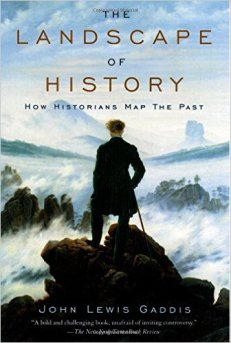
Gaddis uses a painting of a wanderer looking down on a fog-cloaked valley to illustrate his point. Historians can never be absolutely sure of their data; they are like the wanderer—looking into a distance that is cloaked and ultimately mysterious. Some social-scientists might object that the process makes claims it can’t back up with real data. Gaddis describes one such encounter:

Some years ago I asked the great global historian William H. McNeill to explain his method of writing history to a group of social, physical, and biological scientists attending a conference I’d organized. He at first resisted this, claiming that he had no particular method. When pressed, though, he described it as follows:

“I get curious about a problem and start reading up on it. What I read causes me to redefine the problem. Redefining the problem causes me to shift the direction of what I’m reading. That in turn further reshapes the problem, which further redirects the reading. I go back and forth like this until it feels right, then I write it up and ship it off to the publisher.”

McNeill’s presentation elicited expressions of disappointment, even derision, from the economists, sociologists, and political scientists present. “That’s not a method,” several of them exclaimed. “It’s not parsimonious, it doesn’t distinguish between independent and dependent variables, it hopelessly confuses induction and deduction.”

Gaddis liked the method anyway, and so do I. As I’m reviewing my research files for my upcoming book about the history of evangelical higher education (available for preorder now!) I came across a few items that didn’t make the final cut, but they do help illustrate the way I came to make the arguments I’m making.

One of the central arguments of the book is that evangelical and fundamentalist colleges have always been subjected to furious scrutiny from the national network of fundamentalists. There has always been a strong sense among the evangelical public that evangelical colleges must be held to a high standard of religious purity. Naturally, parents and alumni of every sort of college watch their schools closely. After all, they might be spending big bucks to send their kids there. In the case of evangelical higher education, even unaffiliated busybodies feel entirely justified—even compelled—to intrude.stenholm notes in controversial Kodon
Another key argument of the book concerns the feud between the fundamentalist and evangelical branches of the conservative-evangelical family. Beginning in the 1940s and 1950s, the fundamentalist network split into fundamentalist and new-evangelical camps. Some historians have called this a “decisive break” or an “irreparable breach,” but at institutions of higher education, it always felt more like a continuing family feud. At least, that’s the argument I make in the book.

How do I know?

As Professors McNeill and Gaddis insist, it is mostly a question of time. I spent long hours and days in the archives of various schools. I read everything. As I did so, ideas about these themes developed. As they did, I went back and reread everything. Did the idea seem to match the historic record? Over and over again, I noticed that school administrators fretted about the eternal and invasive fundamentalist scrutiny to which they were subjected. Over and over again, I noticed the tones of betrayal, hurt, and intimate outrage that characterized the disagreements between “fundamentalist” and “evangelical” schools.

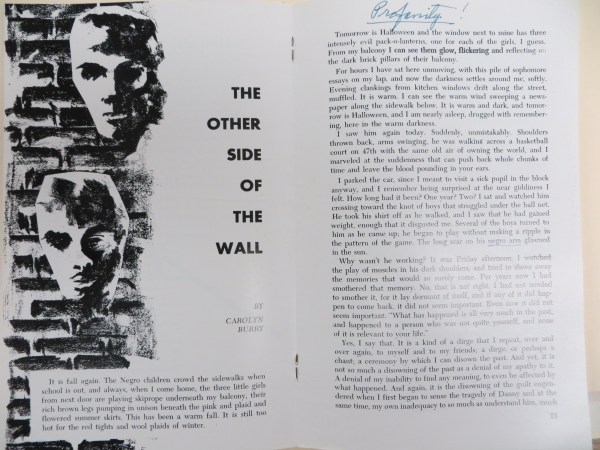
Not all the evidence made it into the book. One episode I do discuss is a controversial student publication from Wheaton College in Illinois. Back when he was an earnest evangelical student in the early 1960s, Wes Craven—yes, the Nightmare on Elm Street guy—was the student editor of Wheaton’s literary magazine. As part of his intellectual revolt against fundamentalism, Craven published two stories that he knew would ruffle fundamentalist feathers. In one, an unmarried woman wonders what to do about her pregnancy. In another, a white woman is sexually attracted to an African American man.

A quirk of the archives helped me see the ways the controversy unfolded. At the time Craven’s magazine came out, Gilbert Stenholm had been working at fundamentalist Bob Jones University for quite some time. He kept everything. His archive files are full of unique documents that helped me see how fundamentalist higher education worked in practice.

For example, he saved his copy of Craven’s controversial student magazine. His notes in the margins helped me understand the ways fundamentalists were outraged by their new-evangelical cousins. Along the edges of one story, an outraged Stenholm penned in one shocked word: “Profanity!” Elsewhere, Stenholm filled the margins with exclamation points.

What did this one-of-a-kind archival find tell me? It helped me see that fundamentalist schools like Bob Jones University had never really washed their hands of evangelical schools like Wheaton. For Stenholm, at least, the goings-on at Wheaton were always of intense interest. And it helped clarify to me the ways members of the far-flung fundamentalist community watched one another. They were always nervous about slippage—always anxious that trustworthy schools could slide into the liberal camp.

Stenholm’s outrage in the case of Craven’s student magazine didn’t make the book’s final cut, but this copy of Wheaton’s student magazine in Stenholm’s collection told me a lot. It doesn’t serve as the kind of “parsimonious,” independent-variable method that Gaddis’s social scientists would prefer. But taken all together, bits and pieces of archival gold like this one guided me to the argument I finally “ship[ped] . . . off to the publisher.”

Always Look for the Union Label

It’s back. The US Supreme Court has agreed to hear another teacher-union case. As SAGLRROILYBYGTH are painfully aware, the conservative sport of teacher-union-bashing has a long history. The current case will likely redefine the landscape of school unionism.

OLYMPUS DIGITAL CAMERA

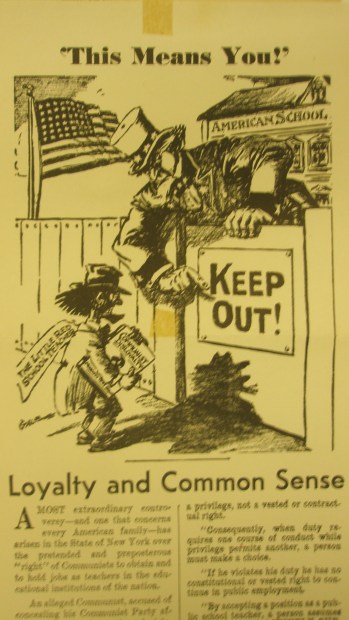
Commies, unions, and teachers, c. 1938

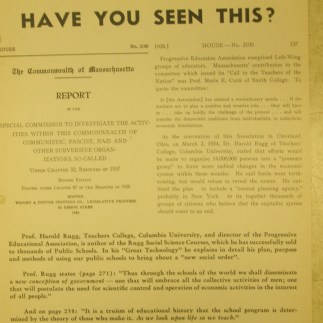
As I explored in my book about educational conservatism, beginning in the 1930s conservative activists attacked teachers’ unions as dangerous fronts for communist subversion. Conservative patriotic groups exposed the connection of unions to leftist academics such as Harold Rugg. They pushed successfully for loyalty laws to sniff out subversive teachers.

In cities like New York, during the 1940s and 1950s, such union-bashing achieved great political success. Fueled by the testimony of former-communist-turned-witness Bella Dodd, the New York City School Board declared war on communist-affiliated teachers’ unions.

In her 1954 book School of Darkness, Dodd explained that communists actively sought influence—secret influence—in teachers’ unions. They fought for innocuous-sounding perks such as teacher tenure. They screened their subversion, Dodd claimed, by using intentionally misleading labels such as the “Friends of the Free Public Schools.”

In reality, Dodd warned, the Communist Party

establishes such authority over its members that it can swing their emotions now for and now against the same person or issue.

Teachers might be well-meaning folks, Dodd wrote, but at best they served as dupes for mind-controlling communist spies and sneaks. Such warnings carried great political weight. As historian Clarence Taylor has pointed out, by 1955 239 teachers and board personnel had been forced out of New York City schools, accused of subversion.

OLYMPUS DIGITAL CAMERA

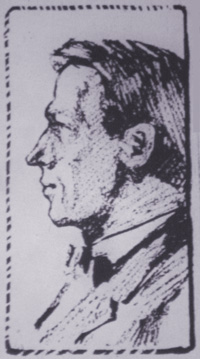
From Hearst’s New York Journal-American, July 7, 1948.

No one these days is going to stand in front of SCOTUS and accuse teacher unions of communist subversion. The issue is still one of left-leaning political influence, though. The most recent case before this one, Friedrichs v. California, hoped to give teachers freedom to refuse to pay union dues. In many states, even if they don’t join the union, teachers have to pay a portion of the union’s dues, since the union bargains collectively for all teachers.

Justice Scalia’s death forced that case into a 4-4 deadlock.

Plaintiffs in the new case, Janus v. American Federation of State, County, and Municipal Employees, hope the new court will give them a decisive win. The plaintiffs are hoping to be allowed to opt out, since, as Rebecca Friedrichs argued in the previous case, union support is “quintessentially political.” Forcing teachers or other workers to pay for political activism, plaintiffs insist, violates their rights.

With Neil Gorsuch filling Justice Scalia’s seat, it’s likely they’ll win. No one’s saying “communist subversion” anymore, but the long legacy of conservative anxiety about teachers’ unions remains politically potent.

Is the Creationist Purge Coming?

You’ve heard the hype: Mainstream colleges are fanatically biased against dissenting academics, especially conservative religious ones. The reality seems to be a little more complicated. News from a few mainstream schools seems to show that many institutions really do protect the academic freedom of conservative dissenters, but there seem to be fuzzy and inexact lines professors aren’t allowed to cross. Is creationism one of them?

If you asked George Yancey or Mary Poplin, you’d hear that mainstream higher education is blinded by “Christianophobia” or “secular privilege.” You’d think that conservative academics, especially religious ones, are common targets of institutional purges.

EPSON DSC picture

First they came for the communists…

Recent reporting from Inside Higher Ed, however, shows a more complicated picture. Virginia Tech is under pressure to fire a teaching assistant who has been accused of harboring white-supremacist feelings. Northwestern, meanwhile (my Evanston alma mater, that is, not the Minnesota fundamentalist redoubt), refuses to fire a professor for denying the Holocaust. In both cases, from what I can tell, the politically abhorrent ideas seem to have nothing to do with the accused academic’s teaching. In other words, neither of the teachers taught anyone white supremacy or Holocaust denial.

If they did, I bet the situation would be different. Consider, for example, the case of Crystal Dixon at the University of Toledo. Dixon argued publicly that discrimination against homosexuals might be acceptable. Toledo said such notions weren’t in line with Dixon’s job as a human-resources administrator. She was out.

As far as your humble editor can discern, the awkward and unclear rule of thumb seems to be that the right of professors, administrators, and students to harbor extremely unpopular ideas will be defended. Unless those ideas interfere with the written job description of the person involved. Or unless the person doesn’t have tenure protection. Or unless the idea is really really unpopular.

Where does that leave academic creationists?

I can see how the average non-creationist might think it would be a no-brainer. It might seem that protecting professors who disagree with central tenets of their own discipline would be absurd. How could a young-earth creationist teach a mainstream geology class? How could someone who disbelieves in “macroevolution” teach a mainstream biology class?

Yet in case after case, dissenting creationist scientists keep their jobs. Consider Eric Hedin at Ball State. He was granted tenure even after being accused of pushing creationism in the classroom. And what about Michael Behe at Lehigh? The prominent intelligent-design proponent has kept his job, even though his colleagues posted a disclaimer against Behe’s work on their website.

For what it’s worth, I think those strategies are correct. Purging professors for their opinions sets a terrible precedent. But I won’t be surprised if the alleged white-supremacist at Virginia Tech loses his job. For one thing, he doesn’t have tenure. For another, white supremacy is such a despised idea that I’d be hard pressed to imagine any administrators fighting too hard to defend it.

So here’s the ILYBYGTH prediction: The Virginia Tech TA will lose his job, in spite of the fact that he should seemingly enjoy the protection of academic freedom. And creationists will continue to wonder if their institutions are scheming to replace them. I don’t blame them. Ask Scott Nearing—all too often, academic freedom is only granted to those with whom we already agree.

I Love You but You Didn’t Do the Reading

This week the interweb’s series of tubes heated up with plenty of ILYBYGTH-related material. Here are some of the stories we might have missed:

It’s not just segregation. In NYT, John Rury and Derrick Darby on the history of racial imbalances in the rate of harsh school punishments.

Leo Ribuffo at HNN on Trump, Nixon, and anti-Semitism in the Oval Office.

Evangelicals for Obamacare.Bart reading bible

Inside the mind of school-choice maven Eva Moskowitz. Why do teachers call the NYC charter-school leader “Evil” Moskowitz?

Why is young-earth impresario Ken Ham mad at Princeton University?

AG Sessions: Free speech for campuses, not for NFL sidelines.

“Why in the hell would I pay 60 grand a year to have my child’s life ruined?” Mary Poplin at Christianity Today on the dangers of “secular privilege” in higher education.

Can an academic journal nowadays publish a defense of colonialism? The latest on the Third World Quarterly hullabaloo from CHE.

What will make conservative parents happy? Michael Petrilli looks at school choice at National Affairs.

Harvard, Queen Betsy, and school choice: Peter Greene tears apart Devos’s Harvard speech.