How Schools Can Save America

How can schools save America? The answer is clear, but nobody wants to hear it. New research piles on more evidence that our deeply cherished notions about schooling and social fairness just don’t match reality.

birch tree on a boulder REAL

If a tree grew in the forest and there was no one around to hear it, could it still serve as an awkward metaphor?

Try it yourself: Whatever your politics, don’t you think every kid deserves a good education? I do. And part of the reason is because a good education can help children secure better jobs. For children from low-income homes, those jobs can pull families out of poverty into the middle class.

It’s not just a myth. We all know people for whom this story has proven true. Like a lot of people in the aftermath of World War II, my father came to this country with nothing. Because he went to good, free public schools in New York City, including City College of New York, he was able to become an electrical engineer and send me to college, too.

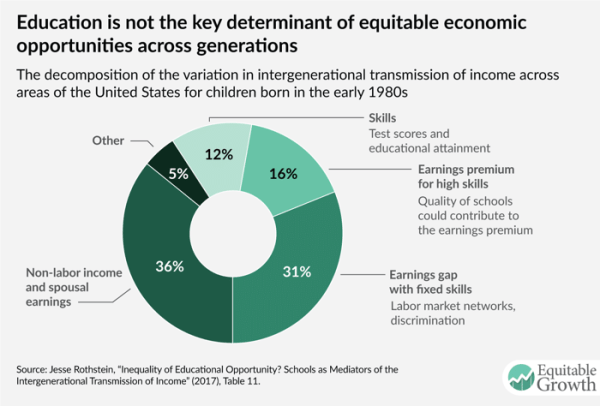
As Rachel Cohen describes in the new Atlantic, however, research from Berkeley’s Jesse Rothstein suggests that these rags-to-richer-through-school stories are not the norm. As Rothstein describes,

There is thus little evidence that differences in the quality of K-12 schooling are a key mechanism driving variation in intergenerational mobility.

For people like me, this conclusion is hard to hear. We go into teaching and education, after all, because we hope to contribute our mite to making the world a better place. We work hard with kids from lower-income homes to help them succeed in school and get into and through college. And we do it all in the hopes that students might be able to get good jobs. Long term, we hope today’s striving students will build tomorrow’s stable, prosperous communities.

Is it all a myth?

According to Rothstein, factors besides formal education have more to do with economic mobility. As he concludes,

most of the variation in CZ [“commuting zones”] income mobility reflects (a) differences in marriage patterns, which affect income transmission when spousal earnings are counted in children’s income; (b) differences in labor market returns to education; and (c) differences in children’s earnings residuals, after controlling for observed skills and the CZ-level return to skill.

In other words, good schools can help people move up, but they’re not the main factor. More important factors include the number of single-parent families in a neighborhood, the availability of jobs, the presence of unions, and hiring discrimination.Rothstein
No doubt we’ll be able to have some unproductive culture-war shouting matches over these findings. Cultural conservatives will point to the importance of traditional marriage patterns. As Professor Amy Wax did recently, they might urge people to embrace “bourgeois culture” as a ticket out of poverty.

Progressive types like me will underline the primary importance of non-discriminatory hiring practices and strong unions.

All of us, though, will probably miss the central point. Focusing on school reform instead of social reform is backwards. We might think of this as the “birch-on-boulder” dilemma. Around these parts, a five-minute walk in the woods will show you plenty of examples of bold birch trees growing out of big boulders. The tree’s roots heroically scramble to reach scanty soil. Even though the baby trees started on top of rocks, they were able to somehow overcome those conditions and grow up tall and strong.

There is no doubt that some trees can thrive even in the most difficult conditions. If we want to grow trees, however, we wouldn’t plant all of them on top of boulders and offer some of them a little more soil or fertilizer. Instead, we would start by clearing out the boulders, preparing rich soil beds for all the trees.

Similarly, if we want to help young people rise above their difficult social conditions, we shouldn’t just put a few more computers in a couple of schools or tinker with a couple of difficult-to-find programs that might help a few students get an advantage in their educations. Instead, we need to make it so that all students have good conditions for growth. We need to clear away the “boulders” of hiring discrimination, job deserts, weak unions, and reduced family resources.

In the end, we face a sobering answer to the question. How can schools save America? They can’t. At least not by themselves.
Will the Real Educational Conservative Please Stand Up?

No one can say Michael Petrilli doesn’t understand educational conservatism. As head of the free-marketeer Fordham Institute Petrilli has long championed aggressive conservative activism in schools and educational bureaucracies. In a recent piece at National Affairs, though, Petrilli tries once again to impose an ill-fitting definition of “conservatism” onto America’s educational landscape. This strategic attempt at a flattering self-image for conservatives might help conservatives sleep at night, but it doesn’t fairly depict historical realities.

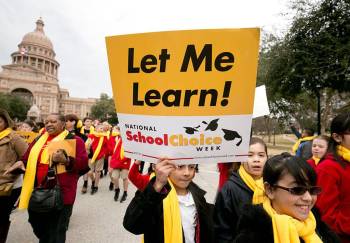
school choice march

Is this conservative?

This isn’t the first time Petrilli has tried and failed to convince conservatives of what they should think. A few years back, when then-new Common Core State Standards reared their heads, Petrilli struggled to convince conservatives that the Common Core was conservative. He failed then and he’ll likely fail in his current attempt as well.

This time around, Petrilli is hoping to impose an image of educational conservatism as split between “accountability-plus-choice” and mere “choice.” All conservatives, Petrilli writes, make school choice a “paramount objective.” “Conservatives believe,” according to Petrilli,

that parents should be able to choose schools for their children that match their educational priorities and moral values. This principle stems from our deep respect for the family as the building block of a free society.

The split, Petrilli writes, is between conservatives who are happy with expanding choice and conservatives who also want to force traditional public schools to improve. Smart conservatives should want both, Petrilli thinks. As he puts it,

If we care about economic growth, upward mobility, and strong families, we should make improving America’s educational outcomes a priority. Education is both a private good and a public good, and a society has a legitimate interest in the education of its next generation — the more so when public dollars pay for it.

In short, Petrilli is hoping to convince conservatives that they should work to improve public schooling for all. He wants conservatives to see themselves as the true guardians of American values and prospects, the side of the future.

If we could all agree on improving public schools for everyone, we could likely skip much of our culture-war shouting and have drinks together on the patio. The problem is that Petrilli’s flattering definition of educational conservatism doesn’t match reality.

For example, Petrilli wants to convince his fellow conservatives that they have always been on the side of social justice for the least powerful members of American society. He writes,

Conservatives view upward mobility as a key objective of social policy, and want to empower poor families to choose schools that can catapult their children into the middle class.

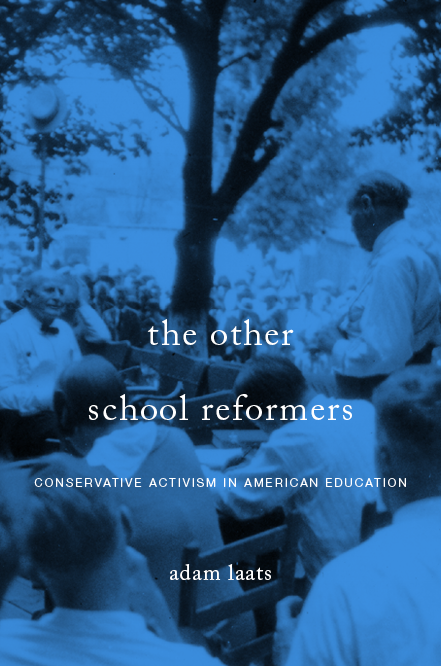
Now, I’m happy to grant that Mr. Petrilli himself truly values such things, but it is more than a stretch to say that such lofty social goals have ever been a primary motivating factor for conservative educational activists. As I argue in detail in my book about educational conservatism in the twentieth century, the primary goals of conservatives have been starkly different.

From Grace Brosseau of the Daughters of the American Revolution to Norma Gabler of Longview, Texas; from Homer Chaillaux of the American Legion to Max Rafferty of California’s State Department of Education; from Bertie Forbes to Alice Moore…conservatives have wanted a bunch of different things out of schools, but elevating the economic prospects of “poor families” has never been their primary motivation.

What have they focused on? I hate to quote myself, but here’s how I put it in the 2015 book:

Educational conservatives have insisted, in short, on two central ideas. First, schools matter. Conservatives, like their progressive foes, have rarely questioned the notion that the schools of today generate the society of tomorrow. Second, because schools matter, their content and structure must be guarded ferociously. Ideas that challenge inherited wisdom must not be crammed down the throats of young, trusting students. And teachers must not abdicate their roles as intellectual and moral authorities. Educational conservatism, in other words, has been the long and vibrant tradition of defending tradition itself in America’s schools.

Of course, Mr. Petrilli is happy to offer any definition he wants for conservatism and his fans are welcome to agree with him. The rest of us, though, should understand that educational conservatism has been mostly about protecting kids from progressive trends in school and society.

And that leads us to Petrilli’s second big goof. Much as he might dislike it, school “choice” has never been anything but a convenient tactic for conservatives. Most conservatives have been decidedly blah about the notion of school choice unless that choice seemed like the best way to achieve their real goals of insulating their kids.

If we need proof, we don’t need to look any further than the mottled history of the idea of school choice itself. When Nobel laureate Milton Friedman proposed the notion of charter schools back in 1950, it met with a profound fizzle. Conservatives back then—everyone back then—mostly ignored the idea, as Friedman himself admitted.

It took nearly fifty years for conservative activists to embrace school choice as their number-one go-to plan for saving their kids from America’s schools. And even then, notions of school choice often take pride of place only in the wonky visions of brainy conservatives like Petrilli himself. Many more conservatives these days look instead to their traditional havens of private schools and the exciting new world of homeschooling.

Looked at one way, Mr. Petrilli might be right. The world of educational conservative activism might really be split in two. The sides, however, aren’t the ones Petrilli imagines. Instead of a split between conservatives who are happy with expanding charter schools and conservatives who also want to improve public schools for all, it might really just be a split between idealistic conservative reformers like Petrilli and almost all the rest of the conservatives out there.

What’s Wrong with Princeton?

Why is young-earth impresario Ken Ham mad at Princeton University? It doesn’t have anything to do with creationism…unless we really understand creationism.

You’d think Ken Ham wouldn’t give a fig about the goings-on at elite Princeton University. After all, Ham—the brains behind Kentucky’s Creation Museum and Ark Encounter—won’t even recommend evangelical colleges such as Wheaton. You’d think he’d have given up on no-longer-evangelical colleges like Princeton a long time ago. Yet Ham is furious at Princeton.

What’s Ham’s beef?

As Ham laments on his blog, Princeton’s Office of Religious Life co-sponsored an event supporting Planned Parenthood. As he puts it,

When universities like Princeton back Planned Parenthood, they abandon a commitment to dialoguing about healthcare or women’s rights. Rather they show a commitment to the violent ending of a life—the life of the unborn. And that is a commitment that harms women, families, and children. We need to stand up for those without a voice and encourage women to choose life for their babies. Abortion is nothing less than the sacrifice of children to the god of self.

SAGLRROILYBYGTH are sick of hearing it, but some folks might be wondering what any of that pro-life stuff has to do with creationism. Isn’t creationism about the ways humans came to be? Why are creationist activists talking about abortion, much less the activities of a purportedly untrustworthy university like Princeton?

As I’m arguing in my current book, if we really want to understand creationism, we have to come to grips with a couple of points highlighted by this story.

First, creationism as a whole doesn’t necessarily have anything to do with abortion. There are plenty of people out there who believe that God created humanity AND support the work of Planned Parenthood. When we talk about the tight connections between creationism and anti-abortion activism, we’re only talking about one type of creationism, the sort of creationism on offer at Ham’s Creation Museum.

foundations AIG

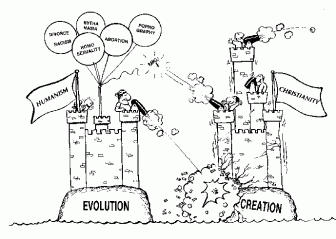
The REAL battle, as seen from Kentucky.


Second, as Ham is fond of pointing out, evolutionary thinking is not only about science, but about an all-enveloping worldview that undercuts true Christian belief. Creationism, as Ham sees it, is about more than young-earth science. It is about a deeply conservative sort of faith, one in which same-sex marriage, abortion, drug use, premarital sex, and a host of other social ills are the flowers of a poisoned evolutionary seed. For Ham and his young-earth creationist allies, the issues of abortion and evolution are intimately joined, even if they are not for other types of creationist.

Seen in this light, it makes perfect sense for Ken Ham to be mad at Princeton. For Ham, abortion IS a creationism question.

Ready for Pre-Order!

I know, I know, a lot of eager readers were planning to dress up as their favorite evangelical university president and camp out at their local bookstore when the new book was released.

harry potter camp out

I’m pretty sure she’s dressed as Wheaton’s Hudson Armerding…

I’m happy to say that’s not necessary. You can put in pre-orders now for Fundamentalist U. Oxford is saying the books will ship February 1, 2018.

I Love You but You Didn’t Do the Reading

Hard to believe another week has come and gone so fast. It has been difficult to keep tabs on all the ILYBYGTH-related stories out there. Here are a few that SAGLRROILYGYBTH might find interesting:

If you were the principal, what would YOU do? This South Carolina teacher got suspended for having her kids defend the Klan. HT: MM

Five Wheaton College students face charges in a violent hazing assault, as reported by the Chicago Tribune.

Ben Shapiro on the problem with college protesters, the “idol of self.”

What should a science booster-club leader do when a parent questions his religious beliefs? One story from the National Center for Science Education.

Did the right wing come from outer space? David Auerbach looks at the sci-fi roots of radical conservatism.Bart reading bible

“More…than just big hair and money.” An interview with John Wigger, author of a new history of Jim and Tammy Faye Bakker.

What are historians saying about Ken Burns’ and Lynn Novick’s new Vietnam War documentary? At HNN, Professor Bob Buzzanco offers a few criticisms.

What do standardized history tests tell us? Not so much, argues Sam Wineburg and his colleagues.

Why so few conservative professors? George Yancey says there’s more to it than self-selection.

A portrait of a culture-war powerhouse: Daniel Bennett on the history of conservative legal activists Alliance Defending Freedom.

Want to Understand the Culture Wars? Start Here…

Even if you don’t share ILYBYGTH’s obsessive fascination with America’s culture wars, you probably noticed a few of its recent battles. Can a baker refuse to make a cake for a same-sex wedding? Can cheerleaders at a public school cheer for Jesus? As a recent article reminds us, if we really want to understand these fights, we need to look beyond Bibles and bakeshops. The behind-the-scenes power of legal activist groups has always fueled these culture-war battles.

kountze-cheerleaders

The culture-war trenches. But not the culture-war Pentagon.

It has been this way from the very beginning. Back in 1925, the furious creation/evolution fight in Tennessee would never have happened if it weren’t for the influence of the American Civil Liberties Union. Sure, proto-creationists had passed a sweeping anti-evolution law. And, yes, plenty of people had noticed the goings-on in state legislatures. (I flesh out the full context in my book about educational conservatism.) But only when the ACLU offered to sponsor a legal challenge did the Scopes Trial actually gain momentum.

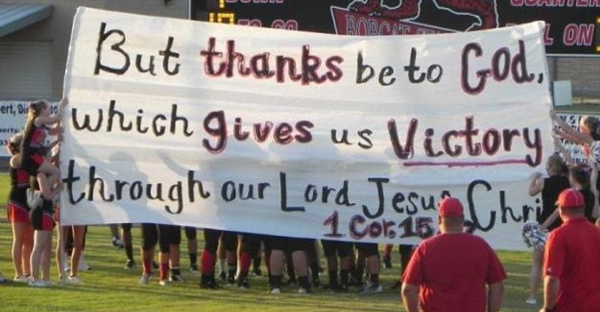
In our century it has been the same. SAGLRROILYBYGTH remember the case from Kountze, Texas. Starting in 2012, cheerleaders at the high school began displaying huge banners with Christian Biblical messages. It’s easy to see how such outright religious preaching at a public school might ruffle feathers. But it was only when the Wisconsin-based Freedom From Religion Foundation intervened that the case became a national sensation.

This sort of legal activism has not been limited to the liberal side. As Daniel Bennett describes at Religion & Politics, the conservative religious Alliance Defending Freedom has scored impressive legal victories over the past decade. As Professor Bennett notes, ADF has repeatedly made its case at the US Supreme Court, in favor of the right of bakers to discriminate against homosexual weddings or in favor of the right of religious schools to receive tax money.

adf logo

A culture-war army of well-dressed lawyers…

These days, as Bennett describes, ADF employs forty full-time attorneys, sniffing out ways to project the power of conservative religious values in the public square. ADF takes in tens of millions of dollars per year to stake out the legal rights of conservative Christians in a secularizing society.

Headlines talk about creationism, public prayer, and transgender issues. Time and time again, it has been the Alliance Defending Freedom who has pushed these cases into the limelight, defending the rights of radical creationist scientists, anti-transgender pastors, or Christian prayer leaders at public town meetings.

Cheerleaders and bakers matter, of course. In order to understand how these cases move from local controversies to national symbols, though, we need to recognize the influence of legal activist groups.

Felony Football Assault at Fundamentalist U

The world of evangelical higher education is reeling at the revelations from Wheaton College in Illinois. Five football players have been charged with felony assault in a brutal hazing incident. The incident reminds us of the long tensions between aggressive, win-at-any-cost college athletics and the behavioral rules of evangelical colleges.

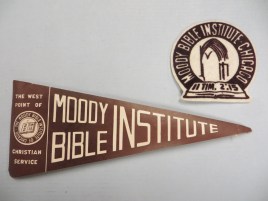
1940s MBI banner and patch
Rah rah.


It’s easy enough to forget nowadays, when big evangelical schools like Liberty are making their mark in the competitive world of college athletics. Since the beginning, however, as I detail in my new book, thoughtful evangelicals wondered if the pressures that inevitably accompanied sports success threatened the mission of their religious institutions.

The story from Wheaton is gruesome. A freshman football player was attacked in his dorm room by senior teammates. His wrists were duct-taped together and he was thrown into the back of a car. His teammates piled in on top of him, threatening him with sexual assault. As Chris Gehrz has pointed out, the language they used—crudely blaring that Muslims commonly engaged in bestiality and sexual aggression—points out the deep structural flaws that can cocoon students at evangelical schools. Even worse, Wheaton seemed to be willing to sweep this assault under the rug, letting the players keep playing after they performed some community service and wrote apologetic essays.

The victim ended up abandoned half-naked in a field with torn muscles in both shoulders. He immediately left the school.

Sadly, there’s nothing unique about this sort of brutal collegiate assault, done under the banner of team-building “hazing.”

Schools like Wheaton, however, have built their reputation as different sorts of schools, schools that hold their students to a higher standard of conduct. As long as there have been evangelical colleges and universities of this sort, however, there have been deep tensions about athletic programs. For many schools, hosting winning sports programs are an intrinsic part of being a “real” college.

Back in 1944, for example, one Wheaton student wrote home in excitement that the new sports program (it only started in 1939 at Wheaton) gave her school a tradition to embrace. As she prepared to head to the weekly football game, she told her mother that the game against rival North Central College was a big deal on campus. “You see,” she explained to her mother,

Wheaton is to N.C. what Army is to Navy, or Harvard is to Yale.

Even in the sequestered world of the Moody Bible Institute, students glowered at their relative lack of athletic success. In 1945, one student complained that MBI teams should earn more wins. In spite of their large student body and their good athletic facilities, this student wrote in the student paper, the MBI “A” team still lost at basketball to the Wheaton “Bs.”

There had always been anxiety about the behavioral implications of athletics. In its first years, for example, Bob Jones College (it became Bob Jones University only in 1946) fielded teams under the name the “Swamp Angels.” The school’s leaders soon canceled the athletic program, however. As Bob Jones Jr. later remembered,

We found the people were betting on our games, littering our campus with whiskey bottles.

Even in that first generation of evangelical higher education back in the 1920s, critics charged that school leaders cared more about sports success than soul-saving. The short-lived and ill-fated fundamentalist experiment at Des Moines University demonstrated this conundrum better than any other school. When Toronto’s fundamentalist firebrand T. T. Shields stormed into town and took over the school, he fired all the faculty and forced them to reapply. Every potential faculty member went through an intrusive personal interview regime to get their jobs back. The entire faculties of the science and math departments quit in disgust. But not the football coach. Observers quickly noted that the coach was welcomed back in spite of his open cynicism about evangelical religion. When asked if he had been converted, for example–“born again”—the coach reputedly sneered, “Yeah, lots of times.”bju banner

Even elite Wheaton can’t claim innocence about questions of athletic influence. As soon as it started its athletics programs in the 1930s, critics on and off campus charged that football coach Fred Walker was not an appropriate evangelical role model. Walker was accused of a non-Christian tough-guy approach to coaching, cussing at players and using foul language to belittle them. In spite of all the charges, Wheaton kept Walker on.

Even back then, the college wanted to be seen as a real college. It wanted students to think of Wheaton as more than just a dumpy second-rate church school. Part of the package, since the very beginning, was a game-winning athletics program.

The behavior of students and administrators in this recent assault are nothing new. They only remind us of the ever-present tension at evangelical colleges like Wheaton. Like every school, Wheaton gives its athletes too much leeway. The results are often criminal and catastrophic.

Blurbed!

I was never much of a baseball player, but there was a brief time in the late 1970s when I would have totally plotzed if Carl Yastrzemski told me I had a good swing.

Carl_Yastrzemski_at_Fenway_Park_2

He’s no Roger Geiger or Joel Carpenter, but Yaz was my hero for a while…

That’s about what I’m feeling like today, reading the blurbs for my upcoming book.

I don’t know how they did it, but the folks at Oxford Press have cajoled some heavy hitters in the fields of higher-educational and evangelical history into writing a few words for the book jacket.

Roger Geiger is the undisputed Grand Pooh-Bah of higher-ed history. His recent book The History of American Higher Education has become the new go-to source on the topic. Joel Carpenter packs a double punch as author and academic organizational wizard. He now works at Calvin College as director of the Nagel Institute for the Study of World Christianity. He’s also a prolific author, and his book Revive Us Again defined the parameters of the study of twentieth-century evangelical history in the USA.  Daniel K. Williams is a younger historian, but he has already distinguished himself as a leading scholar of our generation. His two best-known books are God’s Own Party and Defenders of the Unborn. I lean heavily on God’s Own Party in Fundamentalist U and Dan helped me a great deal as I was writing and revising my book.

Here’s what these three larger-than-life nerd heroes had to say about my book:

“Adam Laats’s history of the development of evangelical and fundamentalist higher education reveals a complex interaction between religious and academic values. The colleges, universities, and Bible Institutes that he examines contained deep differences regarding both spheres. As a sympathetic observer and an objective reporter, Laats captures the conflicts and the abiding strengths of faith-based institutions as they wrestle with the challenges of modernity and their own internecine quarrels.” –Roger L. Geiger, author of The History of American Higher Education: Culture and Learning from the Founding to World War II

“Fundamentalist and conservative evangelical colleges face unique tensions. They represent volatile movements plagued by internal struggles and ever-shifting boundaries. They pursue higher learning on behalf of a movement that accused America’s universities of betraying God’s truth and righteousness. And they function as halfway houses for evangelical students who are called to be in the world, but not of it. Adam Laats went deep into the archives of Bob Jones University, Wheaton College, Moody Bible Institute, Biola University, Liberty University and Gordon College, and he tells their stories with great integrity. The result is a major contribution to the history of Christian higher education and to the understanding of fundamentalism and evangelicalism in America.” –Joel Carpenter, Director of the Nagel Institute for the Study of World Christianity, Calvin College

“Adam Laats’s nuanced, detailed, and exceptionally well researched history of twentieth-century conservative Protestant higher education offers a plethora of fascinating information and perceptive insights. It is essential reading even for those well versed in American evangelical history, because it offers a fresh analysis of the complex ways in which fundamentalist colleges reflected (and shaped) their religious movement’s tenuous balance between the demands of the world and the tenets of faith.” –Daniel K. Williams, author of God’s Own Party: The Making of the Christian Right

Almost makes me want to read it myself!

I Love You but You Didn’t Do the Reading

Leaves are falling and campus speakers are speaking. What else is going on out there? Here’s our ILYBYGTH collection of stories of interest:

Almost two-thirds of colleges/universities missed their enrollment targets this year.

The Wall Street Journal agrees with Ed Stetzer. There is no call for anxiety about religious judges or other officials, they note.

Ben bucks Berkeley boos: What happened when Ben Shapiro brought his in-your-face conservatism to California?

What does it mean for a public school to be “public?” Sarah M. Stitzlein of the University of Cincinnati wonders in the pages of EdWeek.Bart reading bible

“Is this heaven?” Some Iowa schools lock bad kids away in “little dungeons,” from The Progressive.

Should we defend Professor Wax’s right to be wrong? That’s Jonathan Zimmerman’s argument at IHE.

Across the (other) pond: South Korean ministry nominee and professor of engineering testifies about his belief in a young earth.

Free-Marketeer Arthur Brooks in the NYT: Universities need to “form communities that do not just tolerate conservatives but actively embrace ideological diversity.”

Is fundamentalism roaring back? John Fea looks askance at recent developments at Southern Baptist Seminary.

Who blocks campus speakers? A reminder from IHE that progressive speakers are being shouted down, too.

The Real Face of Radical Creationism

Smart people keep saying it, but it’s just not true. And for people like me who want more and better evolution education, the news gets even worse.

You’ve heard it before and you’ll hear it again. Even the best-informed science pundits think radical creationism is somehow uniquely American.

If we needed any more evidence that radical creationism is not at all “unique to the United States,” as Bill Nye asserts, we see news this morning from the besieged nation of South Korea. United Press International reports on the confirmation hearing of Park Seong-jin. Like many of his compatriots, Mister Park believes that this planet was created by divine fiat at some point about 6,000 years ago. Park is an engineering professor and nominee for the ministry of small businesses.

Moon-Jae-in-nominee-sparks-uproar-over-creationist-views

Park’s creationism is a complicated post-modern affair.

Park is not alone in his beliefs. As SAGLRROILYBYGTH are well aware, Turkey’s government has passed some radical anti-evolution laws in the recent past. Even here in the US of A, our leading radical creationist is an Australian import.

So don’t listen next time someone tries to tell you there is something uniquely American about radical creationism. It’s just not true.

And the news for secular people like me gets worse.

You’ll also hear people tell you that radical creationism is a vestige of ancient hypocrisies, destined to wither in the face of modernity and the march of science.

Turkish education minister cuts evolution

Durmus’s is a little more straightforward.

Alas, also not true. Radical creationism is profoundly modern, only really emerging into its own in the 1960s. And, though we might gnash our teeth and pull our hair about it, radical creationism is actually a very reasonable response to the changes in church and society that went on in the 1960s.

Let me be clear here: I don’t think radical creationism is true, or based on good evidence, or anything like that. But I am convinced that radical creationists often (not always) have decent reasons for their beliefs, at least as reasonable as most non-creationists’ belief in the truth of evolutionary theory.

Ken Ham

Only Ken Ham’s includes ziplines…

As I argue in my upcoming books (you’ll be able to get Fundamentalist U sometime soon. Why Is Jesus on a Dinosaur is still simmering), conservative evangelicals faced a tough choice in the late 1950s, and even if you don’t agree with it—I certainly don’t—the choice of radical young-earth creationism makes perfect sense.

That’s why it is not confined to hillbilly hollers and Kentucky amusement parks. Radical creationism is a global phenomenon, unintimidated by its lack of mainstream scientific credibility. It is not an ancient truth clinging on in pockets of know-nothingism, but a reasonable (if false and unnecessary) way to make sense of life in our modern world.