Can We Talk about Charter-School Politics without Using the “BD Word”?

It seems like a big omission. It’s like talking about immigration policy without mentioning Trump. Or reviewing the history of impeachment without using the phrase “Talk to Rudy.” Yet in a recent piece about the politics of charter schools, two New York Times journalists left out the most important fact of all. Why?

NYT charters

We ALL want ALL kids to have awesome schools.

Here’s what we know: The New York Times article gave compelling testimony to the emotional power of the charter-school issue. As one parent and charter-school founder told the reporters,

We look at it as a burning ship going down with thousands of kids in it, and we’re trying to get kids on lifeboats.

And as another charter-school leader put it,

“It shouldn’t be about what’s better: charter schools or neighborhood schools,” he said. “It should be about what schools will help our children succeed.”

At the school’s campus in southeast Washington, where more than 90 percent of students are black, Eagle Academy seeks to provide the same resources that white, affluent children have: a swimming pool, a chef who serves fruits and vegetables and a “sensory room” modeled on private medical facilities where students can calm down.

With appeals like this, it is hard to see how anyone but a moral monster could oppose expanding charter schools. Yet as the article correctly points out, all but one of the leading Democratic 2020 candidates have turned their back on charter schools. Why? The journalists say only that

the leading Democratic candidates are backing away from charter schools, and siding with the teachers’ unions that oppose their expansion.

True enough, but the article leaves out the most important explanations for this sudden shift in Democratic Party thinking. As SAGLRROILYBYGTH are sick of hearing, it was not at all unusual for leading Democrats to support expanding charters and vouchers as recently as last year. Yet now even St. Obama has agreed that charters and other market-based “reforms” are not a “cure-all.”

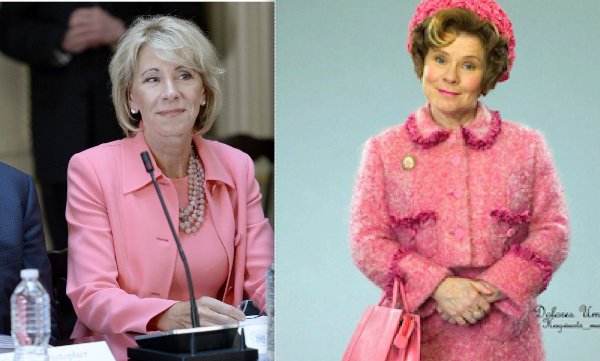
We could get all complicated and talk about the long history of greater conservatism among African-American Democrats than white ones. We could talk about the changed political landscape since the teacher walk-outs of the past few years. But if we want to understand the political shift about charter schools, there is one glaring fact that we absolutely can’t leave out: Betsy DeVos has become the public face of charter schools. And that changes everything.

betsy devos dolores umbridge

The elephant in the classroom…

I don’t mean to criticize journalists for not writing the story I wanted to hear instead of the one they needed to write. In this case, however—a story about the changing politics of charter schools—it seems oddly misleading to leave out the huge obvious fact of Queen Betsy’s school-reform revolution.

I Love You but You Didn’t Do the Reading

What happened this week? Looks like charter-school questions are back on the docket for 2020. Also some stories about racist professors . . .  and of course anti-LGBTQ chicken. Enjoy!

Sen. Booker bucks the trend, jumping back on the charter-school train, at NYT.

So it is largely up to Democrats — especially those of us in this presidential primary race — to have a better discussion about practical K-12 solutions to ensure that every child in our country can go to a great public school. That discussion needs to include high-achieving public charter schools when local communities call for them.

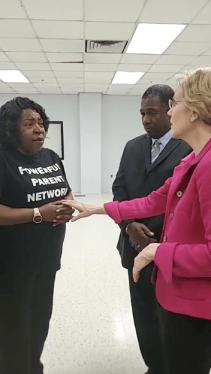
WARREN AND CHARTERSSen. Warren talks with charter-school protesters, at Chalkbeat.

In that meeting, [Howard] Fuller, former Milwaukee schools chief and advocate for private school vouchers, told Warren that her language is helping anti-charter efforts across the country. A number of states, including California, Illinois, and Michigan, have recently moved to limit charter schools or cut their funding. . . .

“Your plan starts out with an attack on charter schools,” he tells Warren.

“What you may see as an attack is designed to say everybody’s got to meet the same standards,” Warren counters.

Indiana University makes a tough call: Condemning a professor’s racist comments while defending his right to free private speech. At IHE.

“We cannot, nor would we, fire Professor Rasmusen for his posts as a private citizen, as vile and stupid as they are, because the First Amendment of the U.S. Constitution forbids us to do so,” [Provost Lauren] Robel said. That’s “not a close call,” either.

rasmusen postLeading historian describes the long tradition of conservative evangelical politics, at WaPo:

White evangelicals’ pragmatic and self-serving approach to political power has been consistent for at least a century, dating to fundamentalists’ adoration for Warren G. Harding in the 1920s. . . . Harding and Trump have much in common. They are among the most allegedly corrupt presidents in U.S. history. Their Cabinet teams have been racked by scandal. Like Harding, Trump’s personal morals are the antithesis of what religious Christians profess to demand. But, like Harding, Trump maintains the support of the faithful because of his policies and the attention he lavishes on Christian voters and their faith leaders.

saint-donald1Does Jordan Peterson save the internet from racism? Or does he serve as a “gateway drug?” At HxA:

these data support the notion that those who are already affiliated with the alt-right eagerly engage with and promote Peterson’s content. . . . participants in Peterson’s comments sections on YouTube migrate twice as quickly to alt-right YouTube channels over time relative to controls (see Figure 2). In other words, it appears that participating in Peterson’s YouTube channel predicts increasing flirtation with alt-right content.

Chik-fil-A stops funding anti-LGBTQ allies, at NBC.

“Staying true to its mission of nourishing the potential in every child, the Chick-fil-A Foundation will deepen its giving to a smaller number of organizations working exclusively in the areas of education, homelessness and hunger,” the organization announced Monday.

The conservative response:

How does Chik-fil-A’s decision echo evangelical anti-racism efforts from the 20th century? Here at ILYBYGTH.

chik fil a protestFuller Seminary gets in hot water for expelling non-heterosexual student, at LAT.

Though the college does allow same-sex relationships, it does not allow “homosexual forms of explicit sexual conduct” and has made clear that it believes sexual intimacy is reserved for a marriage between a man and a woman….

Student reporters at Brigham Young University—Idaho pressured to squelch a story, at RNS.

Two days before BYU-Idaho formally announced the change on Nov. 15, the school’s student newspaper, the Scroll, published an article highlighting frustration among students whose requests to use Medicaid as an alternative to the student health plan were rejected by the school. Students are required to have insurance or use the student health plan in order to enroll in classes.

In-depth articles on the controversy at the Scroll then abruptly stopped, with coverage mostly limited to the school’s official statements on the matter as BYU-Idaho was beset with backlash over the decision.

Squaring the LGBTQ Circle

I thought I understood it, but this story has me stumped. I’ve wrestled with the complicated history of LGBTQ issues at evangelical universities, but I just don’t understand recent news out of evangelical flagship Fuller Seminary.

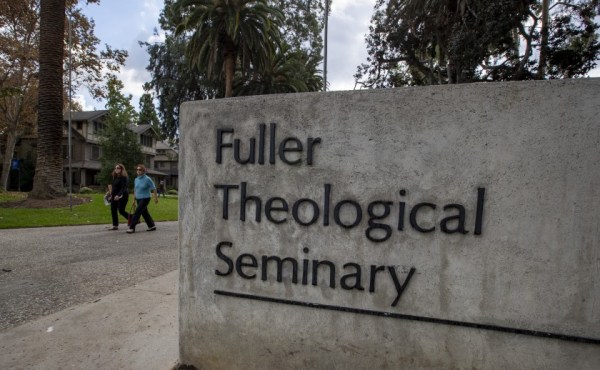
Fuller entranceHere’s what we know: The storied seminary is facing a lawsuit from a former student who was kicked out for being married to another woman. As SAGLRROILYBYGTH know, I personally support greater LGBTQ rights at all institutions, civil and religious. But I also sympathize with the position of conservative religious schools for whom this issue poses an authentic moral conundrum.

In the twentieth century, evangelical universities had a shameful history of dealing with LGBTQ students, but so did non-evangelical ones. As historians Maggie Nash and Jennifer A.R. Silverman have argued, all sorts of universities conducted vicious purges of non-heterosexual students in the middle of the twentieth century.

In this century, many evangelical institutions have come to an uneasy and awkward position on LGBTQ rights. At many universities, for example, LGBTQ identity is welcomed, but LGBTQ “practice” is not. To my mind, this is not a very sustainable position. It feels like a temporary holding plan until institutions decide whether to support LGBTQ rights or to oppose them.

I don’t support that compromise, but at least I understand it. What I don’t understand is the position taken by Fuller Seminary. According to the LA Times,

Though the college does allow same-sex relationships, it does not allow “homosexual forms of explicit sexual conduct” and has made clear that it believes sexual intimacy is reserved for a marriage between a man and a woman….

What is the distinction here? Did the reporter maybe just muddle the explanation of Fuller’s true position? Or maybe does Fuller allow students and faculty to be engaged in non-sexual same-sex relationships? That would explain the distinction between “same-sex relationships” and “homosexual sexual conduct.” In effect, that would be just another, more complicated way of stating the distinction between identity and practice made by several universities.

But even if that’s the explanation, it doesn’t seem to make sense in this case. How would Fuller know that the expelled student was engaged in “explicit sexual conduct” with her wife? According to the article, the student was expelled when her same-sex marriage was discovered by Fuller’s administrators. As everyone knows, however, there have been plenty of celibate marriages. That leads me to wonder if there is some other distinction being made in this case. Perhaps the problem comes from the student’s marriage. Maybe by Fuller’s definition, a “marriage” automatically implies “sexual conduct.” . . . ?

I’m honestly stumped. Can anyone explain it?

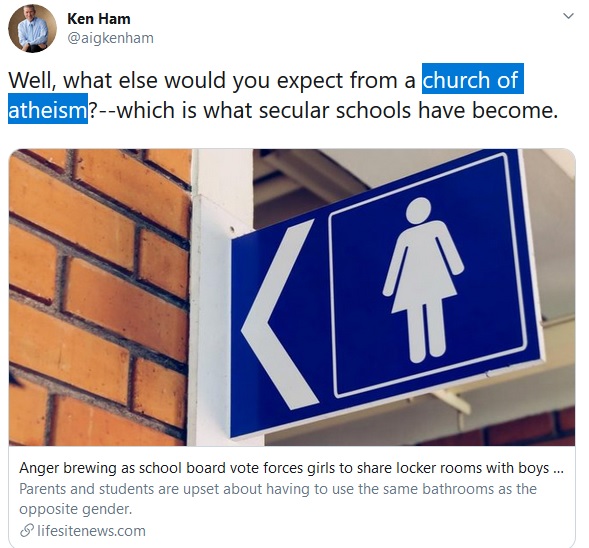
Are Public Schools “Churches of Atheism?”

Once again, I totally agree with radical creationist Ken Ham about something. Not that the earth was created only about 7,000 years ago. Not that a real worldwide flood wiped out everything except Noah’s Ark. But I agree with him 100% that public schools should not serve as churches of atheism. However, as I know, you know, and large majorities of Americans know, public schools aren’t churches of any sort. How can we tell? Americans LIKE their local schools. They don’t like church.ham tweet churches of atheism

Mr. Ham has not grasped that fact. He is fond of warning his followers that public schools are not community resources, controlled and paid for by the community based on democratic processes, but rather sinister institutions—“churches of atheism”—dedicated to stripping children of their faiths, to belittling any religious viewpoint, and to cramming sexual immorality down children’s throats.

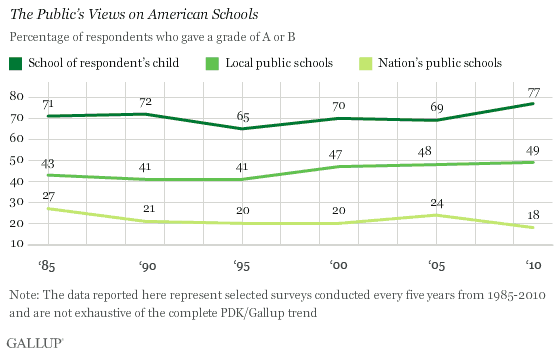
gallup school a or b

People tend to give high grades to their children’s schools.

The problem is, that’s not what public schools do in real life. I know because I spend my days visiting public schools in my area. I don’t see the kinds of mind-control efforts Mr. Ham is so nervous about. I see hard-working teachers who help their students become the best versions of themselves.

It’s not just me. The most careful surveys of public-school science teaching don’t find huge majorities of teachers cramming atheism down students’ throats. As political scientists Michael Berkman and Eric Plutzer found in their huge survey of high-school science teachers, the biggest determining factor for the way teachers teach is community sentiment. If the local community wants more mainstream science, teachers teach it. If they want it watered down with creationism, teachers tend to oblige.

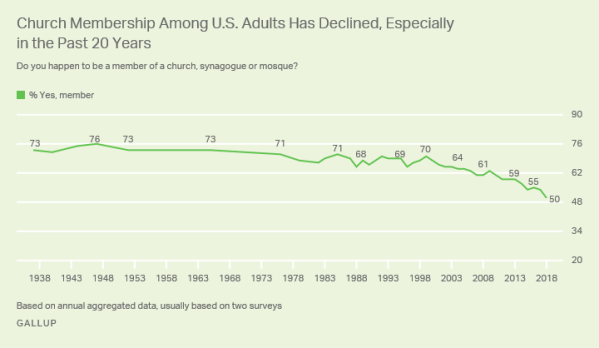
Worst of all for Mr. Ham’s radical Chicken-Little-ism, most Americans understand that. Gallup pollsters have asked Americans what they think of their public schools. By and large, people LIKE the public-schools their kids attend. What don’t people like? Church.

gallup church attendance

Americans are voting against church–with their feet.

So if public schools were really “churches of atheism,” as Mr. Ham contends, you’d think more people would be dissatisfied. You’d think more people would stop going. That’s not what is happening. It’s good news for the rest of us, even if it is not good news for Ken Ham and his radical allies.

The OTHER Myth about Evangelical History

Thanks to leading historian Matthew Avery Sutton, we see a reminder this morning that Trump is nothing new. Conservative evangelicals have always backed morally besmirched leaders. The idea that evangelical voters previously preferred “clean” candidates joins the myth that evangelicals retreated from politics in the twentieth century. It’s just not true. Weirdest of all, though, white evangelicals have long tended to pretend—maybe even believing it themselves—that their immoral candidates somehow personally embody Christian virtue. Why?

saint-donald1

St. Donald the Orange?

Professor Sutton, author of field-defining books such as American Apocalypse and now Double Crossed: The Missionaries Who Spied for the United States during the Second World War, points out that conservative evangelicals have a long history of supporting Trumpish crooks. Back in the 1920s, for example, prominent institutions like the Moody Bible Institute gave cigar-puffing, booze-swilling, corrupt wheeler-dealer Warren Harding their full-throated support. As Prof. Sutton relates,

The editors of the leading fundamentalist periodical Moody Monthly routinely praised Harding for his leadership. “We are thankful just now for a Federal administration,” they acknowledged, “which seems honestly disposed to do its best for the nation.” They insisted that “it is generally admitted that the President has gathered around him an efficient cabinet with a genius for team work.”

Conservative evangelical support for the train-wreck presidency of Warren Harding was not the exception. As Prof. Sutton writes, conservative evangelicals also picked divorced actor Ronald Reagan over Sunday-school teacher Jimmy Carter in 1980. They ignored Eisenhower’s meh attitude toward organized religion. Support for Trump among white evangelicals is just more of the same. As Prof. Sutton concludes,

Fundamentalists in the 1920s separated Harding’s personal morality from his pro-fundamentalist policies. Evangelicals in the Trump era do the same. If politicians champion white evangelicals’ proposals on immigration, foreign policy and religion in the public square, they are willing to forgive many, many personal sins. And when Trump’s nonvirtuous behavior serves their political goals by boosting his political power — for example, by accepting election interference from the Russians or by allegedly trying to pressure the Ukrainian president by withholding aid — they may see these acts as advancing a virtuous cause.

And evangelical support for dodgy politicians is often more than merely a pragmatic political decision. As Professor Sutton reminds us, white evangelicals have talked about their support for moral monsters in odd terms. As some evangelical leaders are doing these days with Trump, evangelicals have tended to lavish praise on their chosen political leaders, as when they hailed President Harding as “the Christian president,” or as “‘an earnest Christian man’ who ‘in all his speeches … advocated a return to the Bible and to Bible righteousness.'”

Support for Trump among white evangelicals is not an exception. It is the rule—white evangelicals have always done more than just hold their noses and vote for candidates based on hard-nosed policy considerations. In every case, some evangelicals will pretend to themselves that their candidates are actually good Christians.

Can anyone explain that one to me?

From the Archives: Why Chik-fil-A’s LGBTQ Decision Feels a Lot Like Evangelical Anti-Racism

It’s different. I get that. But this week’s furor over Chik-fil-A’s decision to defund anti-LGBTQ Christian groups feels a lot like the debates about race and racism among white evangelicals back in the late 20th century. This morning, I’d like to share one episode from 1970-71 that feels eerily familiar to this week’s Chik-fil-A story.chik fil a protest
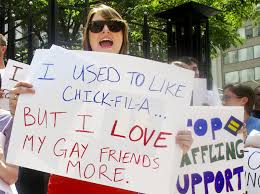
Here’s what we know: The chicken chain is doing great, apparently. Chik-fil-A is now the world’s third biggest fast-food chain, after Starbucks and Micky D’s. But its anti-LGBTQ reputation has limited the chain’s growth. As a result, Chik-fil-A announced this week that it will no longer donate to the Salvation Army or the Fellowship of Christian Athletes. They will direct their philanthropy instead to groups with no anti-LGBTQ reputation.

Conservatives have reacted with predictable outrage. As crunchy conservative Rod Dreher put it,

I love Chick-fil-A, but it’s going to be a while before I go there again. This is nothing but gutless surrender.

Former Governor Mike Huckabee agreed, tweeting,

Today, @ChickfilA betrayed loyal customers for $$. I regret believing they would stay true to convictions of founder Truett Cathey. [sic] Sad.
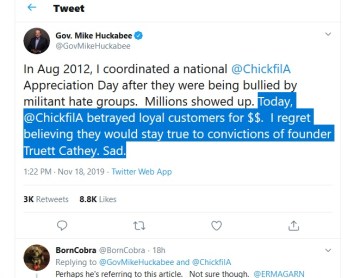
huckabee chik fil a tweetConservative pundits are not wrong when they complain that moral orthodoxy about LGBTQ rights has changed rapidly. They can claim to agree with President Obama, c. 2008, when he still opposed same-sex marriage. They can insist, like Rod Dreher, that their recently moderate opinions have turned them suddenly into “pariahs.”

That’s all true enough, but from a historical perspective the current LGBTQ debates sound hauntingly familiar. Conservatives won’t relish the comparison, but today’s rapidly shifting mainstream attitudes toward LGBTQ rights feel very similar to shifting racial attitudes after World War II. As I found in the research for Fundamentalist U, evangelical universities scrambled to keep up with those changes.

This morning I’d like to share more of a story that I didn’t have room to include in the book. One episode in particular seems relevant to today’s battle over the moral status of LGBTQ rights among conservative Christians.

The institution was the Moody Bible Institute, the year was 1970, and the moral question was racial segregation. MBI had invited fundamentalist celebrity John R. Rice to be a featured speaker at its annual Founder’s Day celebration. Rice had attracted notoriety recently for supporting the racial segregation at Bob Jones University.

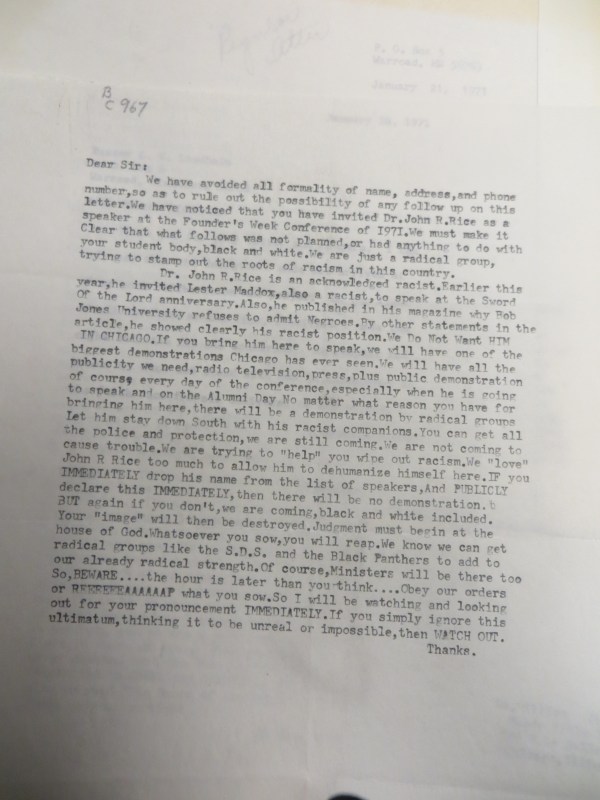
Members of the MBI community protested. As one anonymous letter put it,

Dr. John R. Rice is an acknowledged racist.  Earlier this year, he invited Lester Maddox, also a racist, to speak at the Sword of the Lord anniversary.  Also, he published in his magazine why Bob Jones University refuses to admit Negroes.  By other statements in the article, he showed clearly his racist position.  We Do Not Want HIM IN CHICAGO.  If you bring him here to speak, we will have one of the biggest demonstrations Chicago has ever seen.  We will have all the publicity we need, radio, television, press, plus public demonstration of course every day of the conference, especially when he is going to speak and on the Alumni Day No matter what reason you have for bringing him here, there will be a demonstration by radical groups Let him stay down South with his racist companions.  You can get all the police and protection, we are still coming.  We are not coming to cause trouble.  We are trying to ‘help’ you wipe out racism.  We ‘love’ John R Rice too much to allow him to dehumanize himself here.  IF you IMMEDIATELY drop his name from the list of speakers, and PUBLICLY declare this IMMEDIATELY, then there will be no demonstration.  BUT again if you don’t, we are coming, black and white included.

What did MBI do? After consideration, the administration of William Culbertson agreed. They canceled Rice’s invitation. The manuscript of Culberton’s public statement shows how fraught the decision was. He went over and over the wording, cutting out sections that he thought would be too provocative. The things he cut are telling. Why, for example, might he have cut the phrase “of any kind?” Here’s the next-to-final draft, with edits included:

The Moody Bible Institute has for eighty-five years welcomed young people of all races and nationalities to its tuition-free training in the Bible.  Through times of changing social mores the policy has always been to emphasize the salvation from God by which all men who believe are made one in Christ.  We have sought, and do seek, to apply the spiritual principles set forth in the Word of God to the practical problems of our culture.  We believe that there is nothing in the Bible that forbids interracial relationships of any kind.

                In the present period of surging change we are grateful that among our racially mixed student body there seems to be little or no dissent, though some former students recently involved in civil rights activities have felt that we might have taken a more leading role than we have.  We are absolutely opposed to injustice and exploitation of any kind.  We are dedicated to the proposition that we are debtors to all men.

Just as with Chik-fil-A’s recent decision, MBI’s decision to disinvite a fundamentalist segregationist did not end the matter. The archival files are full of passionate letters in support of Rice and in support of MBI’s decision to disinvite him.

As one alum protested,

In cancelling Dr. Rice from this Conference you have robbed the Founder’s Week guests from great blessings, insulted a great man of God, and lost an opportunity to re-affirm the posture of Moody Bible Institute…[sic ellipsis in original] which by the way is in some question already, and more so now. … Last March, while attending a Pastor’s Conference in Hammond, I had dinner in the sweetshop at Moody.  To my surprise the students for the most part were mop-headed and unkept and were hardly what one would think of as Ambassadors of Christ. . . . I know that your action has alienated me, my wife and my church.

Other members of the expansive MBI community celebrated. As one faculty member wrote,

I have never been prouder to be a member of the Moody Bible Institute faculty.

The files in Culbertson’s archives are full of similar pro- and anti- letters about the decision to ban John R. Rice. The controversy proved so heated that MBI ended up canceling its entire Founder’s Day celebration for 1971. There just was no way they could continue without an embarrassingly public dispute about their moral commitment to racial integration.
anti john rice demonstration warning letter

Evangelical anti-racism, c. 1970. Does this smell like today’s Chik-fil-A?

It’s impossible not to hear echoes of the 1970 debate at MBI in today’s debate at Chik-fil-A.

We need to be careful, of course. The history of racism and segregation cannot be simply equated to today’s LGBTQ debates. The process by which evangelical institutions make these decisions, however, seems remarkably similar.

When mainstream moral values change, conservative evangelical institutions have difficult decisions to make. Do they go along with the changes? Do they re-examine their own moral assumptions in the light of changing social mores? Or do they stick to their guns, deciding that traditional ideas about issues such as racism and sexuality are in fact part of their compromise-proof religious commitment?


I Love You but You Didn’t Do the Reading

From Satan at the polls to Jack London in Alaska–this was a humdinger of a week. Here are a few of the stories that caught our eye:

Ha: From the “Christian Onion.” New poll results say that a majority of conservative evangelicals would vote for Satan, at BB.

A new LifeWay Research poll confirmed Wednesday that a majority of conservative evangelicals would vote for Satan, the Prince of Darkness, should he run for public office as a Republican candidate. . . . “Lucifer? Yeah, I’d vote for him, as long as he claims to be a Republican,” one member of a study focus group said. “He’s got some character flaws, sure—who doesn’t—but we’ve got to remember that ensuring we Christians get some fleeting political power is far more important than whether our chosen candidate does a little soul-devouring on the side.”

More evidence: (Some) liberal parents will fight against school integration, at NYT.

The virulent opposition in an area that its founder once declared to be “color blind” shows that the issue remains deeply divisive among liberals when it comes to their own children.

Not easy: Can you listen to the hard truths from the other side? At The Atlantic.

When women are urged to “shout your abortion,” and when abortion becomes the subject of stand-up comedy routines, the attitude toward abortion seems ghoulish. Who could possibly be proud that they see no humanity at all in the images that science has made so painfully clear? When anti-abortion advocates speak in the most graphic terms about women “sucking babies out of the womb,” they show themselves without mercy. They are not considering the extremely human, complex, and often heartbreaking reasons behind women’s private decisions. The truth is that the best argument on each side is a damn good one, and until you acknowledge that fact, you aren’t speaking or even thinking honestly about the issue. You certainly aren’t going to convince anybody.

Donald Trump Jr. heckled off stage at UCLA…by conservative protesters.

Ohio bill would allow students to be wrong, if their religion said they were right.

if a student submitted biology homework saying the earth is 10,000 years old, as some creationists believe, the teacher cannot dock points.

The rise of Catholic fundamentalism? At RNS.

why not? Since the late 1970s, conservative Catholics and evangelicals have been allies in the culture war that has shaped American partisan politics.

Hong Kong protests turn colleges into citadels, at NYT.

NYT hong kong

When parents had to choose between integrated schools and bad schools, they chose the bad ones. Memories from white students at “segregation academies,” at Slate.

The stories up so far represent segregation academies as chaotic, understaffed, and underplanned. The point, it’s clear, was not education but separation. Bridget Smith Pieschel, who went to the all-white Winston Academy in Louisville, Mississippi, starting in 1969, reported that at first, there was “no art; no foreign language; no science lab; no band; no chorus” at her school. But, as a child, she said, “I took everything at face value. I believed that my school was ‘better,’ more ‘refined,’ ‘safer.’ ” Alan Huffman, who went to one of the many Southern seg academies founded by the “respectable” white supremacist Citizens’ Councils, remembered that it had a “mix of brilliant and horrible teachers.” “Anyone, it seemed, could get a job teaching in one of its pre-fab classrooms,” he remembered, “including a woman who admonished us for acting up in class by saying, ‘Y’all should be grateful—if it weren’t for teachers like me, y’all would be going to school with n—–s.’ ”

Nikki Haley’s new book doubles down on Trumpism, at The Guardian.

She clearly sees a future in which bigotry and populism will continue to define the Republican brand, and believes that her personal survival requires her to toe the party line as closely as possible.

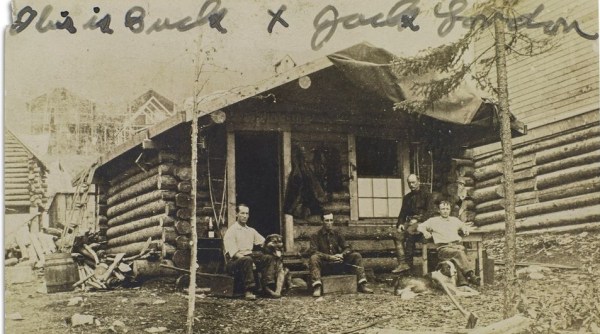
Jack London’s Alaska gold rush, at Smithsonian.

Jack london buck

The inspiration for Buck is the dog on the left.

There are still evangelicals who aren’t “evangelical,” at RNS.

They might be wrong or crazy. But one thing they obviously are not is Trumpy. Tell that to the next person who equates “evangelical” with right-wing, knuckle-dragging Neanderthal and think instead of a certain rabbi from Palestine.

Are students “helots?” One Detroit teacher gets in trouble for comparing students to Greek slaves, at Chalkbeat.

History nerds: Is the new Midway movie any good? History review at HNN.

Military buffs will adore it, but the average person will sit through, liking certain parts very much and frowning at others. . . . Midway is far better than the recent staid and slow Pearl Harbor that starred Ben Affleck. I just wish that Midway was a sturdier historical movie and explained the battle, and that part of World War II, better. Despite its drawbacks, Midway is a rip-roaring military saga and a testament to the men who won it. The Americas are seen as brave and heroic in the film, but so are the Japanese.

What’s Wrong with Teacher Raises?

Should public-school teachers earn more? Sure. But if we’re going by the recent recommendation for a “Grand Bargain” from Hoover’s Eric Hanushek, we should pump the brakes. Because talking about increasing salaries for some teachers is ultimately not the primary conversation we should be having about America’s public schools. We’ve been talking about the history of teacher pay on the Tweeter and I’ll adapt some of the conversation here.

SAGLRROILYBYGTH are tired of hearing me say it, but I’ll keep saying it anyway: Teachers are not the problem when it comes to school performance. Discussions about “merit pay” and “underperforming teachers” have long distracted attention from the main issue in America’s divided public-education system.

Historically, the first curve ball in teacher pay comes from our assumption that teachers have always received (relatively) low pay. Dr. Hanushek (and others) assume that teaching attracts high-quality candidates “for love of kids, for feeling of social purpose, or for what-have-you.”

But in the first half of the 1800s, teachers expected to make a lot of money. Famous teachers–mostly men, but some women too–would open entrepreneurial schools, usually based on some sort of proprietary method of teaching. They would try to attract tuition-paying families.

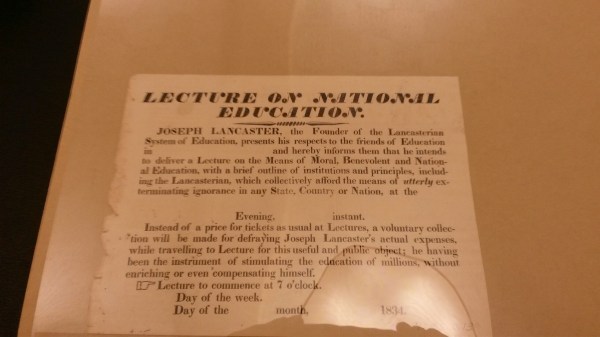
For example, the most famous teacher in the early 1800s, Joseph Lancaster, assumed that his teaching would make him rich. As he told his daughter in a letter from Boston on July 14, 1819, he would soon buy a “small estate for thee” because his teaching would make him “rich and independent.”

Lecture flyer 1

Lancaster still hoped to make a pile in 1834.

What happened? The low quality of the teaching was not the thing that drove down teacher pay. The uncomfortable historic truth is that teacher pay was driven down by the inclusion of low-income students in publicly available tuition-free schools.

Once tuition was taken out of the picture, public schools struggled to find ways to pay teachers enough. First they tried to get children to do the teaching for free. It didn’t work, because as soon as children got some teaching skills, they took paid jobs as teachers.

In the early 1800s, New York tried to solve this problem by FORCING children to teach for free until they were 21, pushing them into indentured servitude. (I know some teachers these days will say this sounds familiar…)

The problem historically has NOT been that most teachers have been willing to work for less. Rather, the problem has always been that governments—with good reason—wanted to provide education for all kids, regardless of their ability to pay.

That’s why Secretary DeVos’s recent pronouncements about public-school funding have been so grating, especially to historians.

Which gets us to Dr. Hanushek’s “Grand Bargain.” Historically, the bargain is flawed because it’s built on a faulty premise. Dr. Hanushek writes,

if the United States is to improve its schools, the available research indicates that the only feasible solution is to increase the overall effectiveness of our teachers.

That’s just not the case. Historically and today, the most obvious way to improve schools has not been to “increase the overall effectiveness of our teachers.” That’s not a bad goal, obviously, but it distracts attention from the proper conversation we should be having. Namely, the most obvious place to start–if we want to make public schools more effective–has been and will be to increase the overall affluence of our students.

When it comes down to it, the problem with Dr. Hanushek’s approach is not in the details. Rather, it is in the big picture. Too many reformers–smart ones and not-so-smart ones alike–try to tweak schools in order to make society more fair and equitable. I appreciate their goal and share it.

But schools alone cannot fix society. Schools ARE society. If we want a fair society, we cannot tweak schools, we need to heal society.

Pay teachers more? Yes, for sure. That makes sense if we want to attract and retain high-quality candidates. But if our first goal is to improve society, we should start with the more fundamental problem.

Campus Radicals De-Platform Trump…but It’s Not What You Think

Didja see this one? Conservative campus pundits may have thought they had figured out the provocation playbook. But the treatment of Donald Trump Jr. at UCLA confounded their expectations.

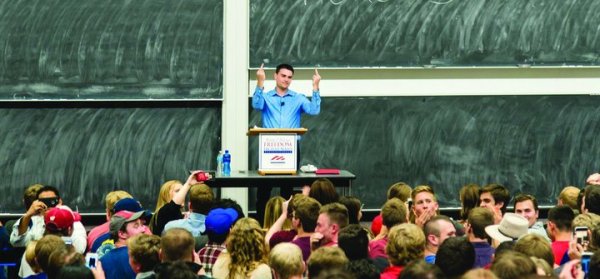
SAGLRROILYBYGTH know the usual story: Conservative provocateurs have had easy pickings so far. Organizations such as Turning Point USA have been able to dictate the terms of many campus confrontations, turning their activists into willing “punchbait.” Attention-seekers like Ben Shapiro have had a field day poking the intellectual soft spots of leftwing campus activists.

shapiro-by_katie_cooney_720

Conservative pundit Ben Shapiro speaks freely at the University of Wisconsin.

This time, however, the usual script just didn’t work. Speaking at UCLA, Donald Trump Jr. trotted out the usual accusations. “Name a time,” Junior accused,

When conservatives have disrupted even the furthest leftist on a college campus. It doesn’t happen that way. We’re willing to listen . . .

Junior probably expected cheers from his conservative crowd, but instead he got shouted down. The even-more-conservative activists in the crowd demanded a question-and-answer session with Junior. He would not oblige, and the angry conservatives wouldn’t let him finish.

Watch the clip. Then ask yourself: Has the short-sighted strategy of conservative groups such as Turning Point USA finally come back to bite them on the behind?

Why Do Scientists Defend Some LGBTQ Rights and Not Others?

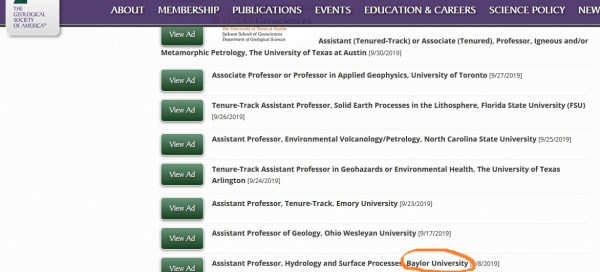
Okay, all you science nerds—what do you make of this story? It raises a couple of big questions. First: among mainstream scientists, is anti-LGBTQ Christianity really more objectionable than anti-mainstream-science Christianity? And are some kinds of anti-LGBTQ religion more objectionable than others?GSA baylor adHere’s what we know: Two professional scientific organizations recently pulled job ads from Brigham Young University. According to the Salt Lake Tribune, the American Geophysical Union and the Geological Society of America yanked the ads because BYU discriminates against LGBTQ students and faculty.

I have my own strong opinions about this sort of move.* This morning, though, we’re not talking about me. Rather, we need to examine a couple of questions raised by this move. The first question is the most obvious, and it was raised by some faculty members at BYU. Namely, why is Brigham Young University being singled out for exclusion? The GSA, at least, still apparently welcomes ads from other universities that discriminate against LGBTQ students.baylor creationism

By accepting an ad from Baylor University—which has an explicit anti-LGBTQ “practice” policy—the GSA seems to be differentiating between types of anti-LGBTQ discrimination. Why?

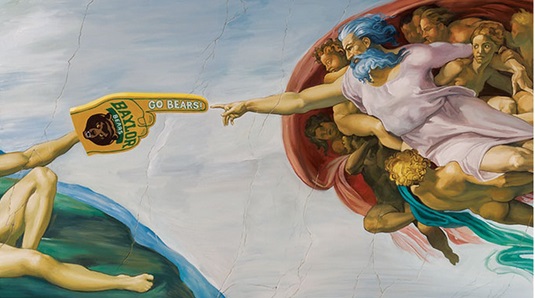
The decision to nix the BYU ads raises another troubling question: Would these science organizations take ads from institutions that dispute mainstream science itself? Though Baylor quickly reversed course, in the early part of this century it established a creationist science center on its campus. According to at least one report, President Robert Sloan tried to impose a religion litmus test on new faculty. As one participant later recalled,

Jim Patton, a professor of neuroscience, psychology, and biomedical studies and former chairman of his department, remembers sitting in on an interview with Sloan and a candidate for a psychology position. The young scholar was asked whether he went to church and read the Bible. When he answered yes, he was then asked the topic of that week’s Sunday school lesson and which theology texts he was currently reading. “If precise answers weren’t acceptable,” Patton told me, “folks weren’t allowed to work here.” Many professors came to feel that Sloan was filtering out everyone but the fundamentalists.

Baylor may have changed course in terms of creationism. But when the university was pushing a different kind of science, would the GSA or AGU have accepted ads from Baylor? Or would these professional organizations have made the same protest against alternative-science institutions that they make against (one) anti-LGTBQ one? And what about now?

These problems lead us to our questions of the day. What do you think:

  1. Should professional organizations discriminate against discriminating colleges?
  2. Should they be more consistent and ban Baylor, too? (And other anti-LGBTQ schools)?
  3. Should they defend mainstream science with the same vim that they use to defend LGBTQ rights?

____________________________________________________________________________________________

*In general, I support this sort of professional activism. I agree that anti-LGBTQ policies put institutions outside the realm of mainstream thinking. If religious institutions want to engage in anti-LGBTQ policies, that is their right, but such policies should not be supported by public money. And other institutions, such as these professional societies, are well within their rights to exclude discriminatory colleges. I personally would support such a move by my closest professional organization, the History of Education Society (US). But just to make sure everyone dislikes me, I also advocate more freedom for students to participate in discriminatory student groups.