The Real Intelligent Designer

Does it matter? Who cares if a gold-medal-winning engineering breakthrough came from a young-earth creationist? When it comes to understanding our creation/evolution debates, I think it matters a lot, especially for those of us who want more and better evolution education in our public schools.

Here’s what we know: Recently, young-earth impresario Ken Ham has crowed about the accomplishments of Professor Stuart Burgess. According to Ham, Prof. Burgess helped design a bike chain that was used by a gold-medal-winning UK cycling team. And, guess what: Professor Burgess is a committed young-earth creationist.

team-great-britian-olympic-bicycle-display

Reducible Complexity

SAGLRROILYBYGTH and others who share my obsession with all things creationist may wonder why we have to bring up this old chestnut yet again. We all know the script here. Young-earthers will trumpet the few engineers and doctors who hold young-earth beliefs. Mainstream scientists will point to the National Center for Science Education’s Project Steve. If there are a few science-y creationists, there are bajillions more science-y non-creationists.

We’ve all been around and around this debate before, but I think it’s worth bringing up again. As I’m arguing in my current book, if we really want to understand American (and UK) creationism, we have to abandon the satisfying but false notion that creationism is a product of mere ignorance.

Or, to be more precise, we need to wrap our heads around the fact that there are vastly different forms of ignorance. In some cases, people simply don’t know things. In other cases, though, some types of knowledge are blocked by competing types of knowledge.

Creationists can certainly display both sorts of ignorance. Some of them might just have never heard the arguments of mainstream evolutionary science. But the fact that there are any young-earth creationists who have scored big successes in science-y fields helps prove that the real difficulty results from the second type of ignorance. Creationists can be very successful in society, even in science-related fields, even if they “know” that mainstream evolutionary theory is bogus. Even if we don’t want to admit it, Ken Ham is correct in boasting that “Professor Burgess is definitely both a real scientist and a creationist!”

We don’t need to tangle with the endless debate about whether creationism is real science, dead science, or zombie science. We don’t need to gnash our teeth and exclaim that Burgess’s scientific accomplishments happened in spite of, not because of, his creationist beliefs. The point here is different. The fact that engineers like Dr. Burgess are both successful mainstream practitioners and convinced young-earth creationists matters for different reasons.

Why does it matter? Because it reminds us that creationism is not simply the product of isolation from modern knowledge. Creationists aren’t people who simply haven’t heard about evolutionary theory or modern science. Since that’s the case, we won’t spread knowledge of evolutionary beliefs merely by making it available. We won’t successfully teach evolutionary theory to Americans unless and until we recognize the fact that creationism is more than a deficit hoping to be fixed, an emptiness waiting to be filled, a naïve lack of knowledge seeking the best modern knowledge.

As I’ve argued in my recent book (co-written with philosopher Harvey Siegel), if we really want to teach evolution in this creation nation, we need to start by understanding this central fact about American creationism.

The fact that creationist engineers like Dr. Burgess can have outstandingly successful technical careers serves as more proof that creationism is something other than a lack of knowledge about evolution. When we’re designing bike chains, it doesn’t really matter how old the earth is. It doesn’t matter that mainstream evolutionary theory offers by far the best current explanation of the ways species came to be different from one another.

What does matter—at least for those of us who are trying to understand creationism as it really is—is that creationism is not a leftover from hillbilly isolationism. Creationism isn’t the result of a lack of exposure to modern ideas. Creationism, rather, is a different way of being modern.

Created in Nothing Flat

Okay, I’ll bite: What is the difference? News from Denver brings us back to an old chestnut: What is the difference between young-earth creationists and other dissident-scientists such as flat earthers? Certainly, there are differences in political power—we have a young-earther in the White House these days—but is there anything more than that? Or is it all just an accident of history?

The story from Denver’s flat-earth community points out some of the obvious superficial differences. At least in Denver, flat-earthers tend to be far more about government conspiracies than biblical hermeneutics.

And prominent creationists have always insisted that their beliefs have nothing to do with a flat earth. Back in the 1920s, for example, fundamentalist leader William Bell Riley fumed and fussed that his anti-evolution activism had nothing to do with “‘a flat earth’ . . . ‘an immovable world’ . . . [or] ‘a canopy of roof overhead.’” Those outdated scientific ideas, Riley insisted, were only used to poke fun at people who rejected the false science of evolution.

These days, too, young-earth creationists at Answers In Genesis insist that their scientific ideas have nothing to do with a flat earth. AIG’s Danny Faulkner admits that there are some similarities between the two views, since both have been ridiculed by people who don’t understand them. In the end, though, Faulkner concludes that most flat-earthers are either kooks or insincere.

Officially, AIG contends that since the spherical nature of the earth can be observed directly, the question of the earth’s shape belongs in the realm of “observational science.” That is, we can trust the mainstream facts in this case, even if we can’t trust scientists who speak ignorantly about “historical science.”

For those who know the history, though, the idea of a flat earth has had a remarkably similar history to the notions of a literal worldwide flood and a six-day creation.

As creationist-history guru Glenn Branch has described, in the 1920s the two movements had enormous similarities. Back then, most anti-evolution activists did not believe in a literal six-day creation. They did not insist that the earth was only about 6,004 years old. But a vocal minority did. Spearheaded by the indefatigable activism of George McCready Price, the ideas of a young earth and “flood geology” grew until they became in the 1960s key litmus tests for fundamentalist faith. (For more on that story, check out Ron Numbers’s masterpiece, The Creationists.)

As Branch describes, back in the 1920s flat-earthers also represented a small minority of the anti-evolution crowd. Like the young-earthers, flat-earthers could claim an energetic and charismatic spokesperson, Glenn Voliva. Voliva crusaded against the notion of a spherical earth. Like George McCready Price, Voliva insisted that he had the Truth, a truth evolutionists and round-earthers were too prejudiced to admit.

At the time of the Scopes Trial, Voliva hustled to Dayton, Tennessee to help prosecute John Scopes. Voliva’s hope, according to author Christine Garwood, was to “eliminate the twin heresies of evolution and a spherical earth.”flat earth garwood

But that’s where the two ideas went their separate ways. Whereas the outlandish notion of a literally young earth came to be accepted as true by large minorities of Americans, the outlandish notion of a flat earth became an internet quirk adopted by basement-dwelling conspiracy theorists.

So I ask again: What is the difference? I have a few ideas that I’m including in my current book about American creationism. In short, I think the answer lies not in dissident science, but in the mainstream world. By the 1960s, fundamentalist Protestants faced a new choice: Embrace mainstream evolutionary thinking and find a way to reconcile it with evangelical belief, or reject mainstream evolutionary science utterly and create a new creationist science.

When it came to evolution, the choice seemed simple, to many fundamentalists at least. Either kowtow to secular science or remain steadfast to young-earth beliefs.

Flat-earthers, though, never offered such a stark and simple choice. Belief in a flat earth (or a geo-centric solar system, for that matter) had always been embraced by some Biblical conservatives, but it never became a litmus test of orthodoxy.

At least, that’s the argument I’m trying to make in my new book.

What do you think?

Wait…WHAT Is “A” For?

A is for Activist. Or…no wait, turns out A is for Apologetics. No matter what your cultural politics, it seems everyone wants to indoctrinate the children. As SAGLRROILYBYGTH know, that’s just not how education really works.

Here’s what happened: I couldn’t help but notice the odd coincidence I stumbled across recently. From the progressive-y-est progressives to the staunchest fundamentalists, everyone seemed to be shilling similar sorts of books for young people—books meant to inoculate children politically or theologically against their environments.

a is for activist

A recent story in the New York Times describes the trend among lefties. Board books such as A Is for Activist have sold tens of thousands of copies. As one bookseller noted, prog parents seem to want to protect their children from Trumpism. As she put it,

When racist, misogynistic and hateful rhetoric has become mainstream, offering affirming and respectful messages to my children seems more urgent than ever.

The books offer cute lines for young readers, stuff like this:

‘F’ is for Feminist. For fairness in our pay.

‘J’ is for Justice! Justicia for all.

L-G-B-T-Q! Love who you choose.

Who buys such stuff? Progressive parents who worry that their children might not come to these conclusions on their own. As one mother told the Times,

Because we are a white, heterosexual, cisgender family living in a racially homogeneous area…we strove to have people of color in our books, or families, maybe, with two dads or two moms.

Will it work? Not really. But that doesn’t mean it isn’t shared across culture-war trench lines.

Among his summer outreach projects, for example, creationist impresario Ken Ham announced a new set of books for fundamentalist youth. Instead of A being for Activist, though, Ham’s books make A for Apologetics. (B, by the by, is for “Biblical Authority.” C is for “Chronological.”)AIG ABC

If we ignore the content of his warnings, Ham’s attitude sounds almost identical to that of the nervous progressive parents. Why do parents need new ABC books? Because, Ham warns, his “national research” has determined that too many fundamentalist children end up abandoning their faith. In these perilous times, Ham warns, parents and churches need new resources to help keep their children on the straight and narrow.

On both sides, parents are nervous about the future beliefs of their toddlers. Both sides worry that their environments are politically or religiously dangerous. And both sides hope that a well-placed book will make the difference between faith and failure.

And, of course, both sides are wrong. Books matter. But no book can turn any child into something he or she is not. No kid today, for example, would turn into a Puritan if he or she stumbled across the New England Primer.

NewEnglandPrimerAtoM

Whoops! Turns out “A” is actually for “Adam’s Fall.”

Rather, books—like formal schooling itself—are only a small part of the education of young people. If progressive parents raise their children in a homogenous, anti-diversity community, their children will probably think those values are right on. And if fundamentalists raise their children to inquire deeply into their faith, those children will probably grow up to do so.

College Has Gone to the Dogs

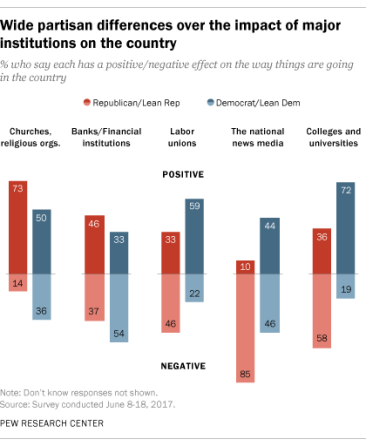
Who hates college? Nobody, really. But if you squinted your eyes a little when you read the recent Pew poll results, you might be fooled into thinking conservatives had suddenly turned against higher education.PP_17.06.30_institutions_lede_party

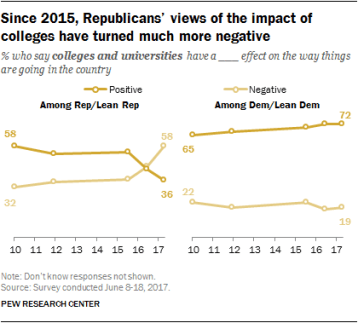
Here’s what we know: Since 2010, Pew has surveyed American adults about their feelings toward major institutions. In just the last few years, more and more respondents who identify as Republican or Republican-ish say that higher education is having a negative overall effect on American society. In 2010, only a third of Republicans thought so. Today, it is up to 58%.

What’s going on? As always, Pew wisely doesn’t jump to hasty conclusions. My guess is that many of us chatterers will rush to say that conservatives in general are anti-intellectual, or that conservatives think college is a waste of time. Or, given the sudden shift in numbers, maybe that conservatives are dismayed by the snowflake protests that seem to be sweeping American campuses.

Maybe, but I think there’s more to it.

First of all, obviously, we can’t equate “conservative” with “Republican.” True enough, these days most conservatives’ votes have been captured by the GOP. Not all, though. And certainly not all Republicans are conservatives.pp second graph

I think there’s also something more important going on. As SAGLRROILYBYGTH are sick of hearing, I’ve been up to my eyeballs for the past few years in research about American higher education. The group of conservative dissenting college founders I’m studying was often accused of being anti-intellectual and anti-college. They were neither.

As I’m arguing in my upcoming book, Protestant fundamentalists cared a lot about ideas and about college. They loved college. But if you only listened to their rhetoric, it would be easy to assume too quickly that they were somehow opposed to higher education.

Consider, for example, one apocryphal story that made the rounds among 1920s fundamentalist pundits. It was supposed to be a letter home from an evangelical college grad. As he supposedly told his mother,

My soul is a starving skeleton; my heart a petrified rock; my mind is poisoned and fickle as the wind, and my faith is as unstable as water. . . . I wish that I had never seen a college.  I hope you will warn the young men of the impending danger just ahead of them.

For fundamentalists in the 1920s, college was a terrible spiritual danger. But that didn’t mean they were against college. Rather, they were fervently against college done wrong. They were against the trends that they correctly perceived to be driving mainstream trends in higher ed.

What did they do? They didn’t stop sending their kids to college. Rather, they founded their own institutions, reliably fundamentalist colleges such as Bob Jones College (now Bob Jones University) and Bryan University (now Bryan College). They also flocked to existing reliably fundamentalist institutions such as Wheaton College and the Moody Bible Institute.

My hunch is that today’s Pew respondents are similar. When they tell pollsters they don’t trust college or “the media,” it doesn’t mean they don’t like higher education or newspapers. Rather, it means they don’t trust the smarmy elites that they think run such institutions.

Here’s what I wish I could do: Have the Pewsters add some follow-up questions. When people say they don’t trust colleges, ask them if they want their kids to go to college anyway. And then ask them what would restore their trust in higher education.

Here’s what I think people would say: Even if they don’t trust college, they want their children to attend. But they would prefer to find a school that reflected their own values, instead of the radical leftism that many people think dominates colleges today.

I Love You but You Didn’t Do the Reading

A few stories from the interwebs this week that might be of interest to SAGLRROILYBYGTH:

Can a public university have a Christian chapel? East Central University in Oklahoma goes back and forth.

Culture-war category bashers: Pro-life feminists.Bart reading bible

Historian Chris Gehrz: Don’t forget about America’s tradition of Christian communism.

Celebration or segregation? A skeptical look at separate graduation ceremonies.

What do high-school students want? The Fordham Institute’s study of student types.

Ole Miss takes the plunge: Changing the name of Vardaman Hall & putting up slave-labor historical notices.

When Queen Betsy asked for suggestions, people listened. Politico tallies the comments so far.

Hobby Lobby Bible Museum hits a snag: Forced to return artifacts to Iraq.

Who was the first American philosopher to tackle creationism? Glenn Branch finds a new historical clue.

A week late, but still worth reading: Cara Burnidge compiles great takes on “America.”

Why Does America Stink?

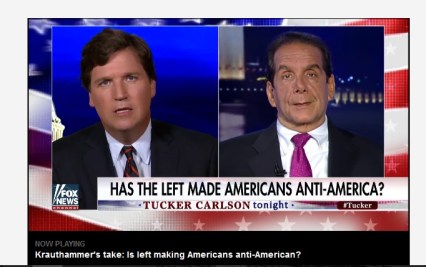
It’s those damn teachers. At least, that’s the crusty old complaint revived for the Fourth of July holiday by crusty conservative commentator Charles Krauthammer. Whether you’re a flag-waver or a flag-burner, there are two big problems with Krauthammer’s sorts of accusations.

Krauthammer was responding to a Fox News poll that says only a bare majority of Americans are proud of America. And a huge majority think the Founding Fathers would be saddened by the way things are today.

Why the funk?

Krauthammer blames a long march of leftists. “Starting in the Sixties,” he told Tucker Carlson,

the counter-cultural left had a strategy…[they] went into the professions – the teaching professions, and they’ve essentially taken over. That generation of radicals runs the universities, they run the teachers’ unions, they run the curricula.

The left-wing teachers, Krauthammer insisted, had taught defenseless kids “abnormal, anti-American, and destructive” ideas. Since the 1960s, Krauthammer explained, the Left’s long game had undermined American patriotism.

Krauthammer Kommentary

Can you spot the two blunders…?

Let’s put to one side the most obvious problem with Krauthammer’s Fox-usations. The Fox poll found—surprise!—that Democrats tended to be less proud of the current state of the county. Well…duh. Of course a majority of Democrats are not “proud” of the current state of the United States. Of course a lot of Americans are feeling sketchy about the current direction of America’s leadership.

And, to be fair, that is the first place Krauthammer looked. He started by saying that people’s feelings about Trump are the most likely culprit for the poll results. But then he goes on to make two common assumptions that drive teachers and historians bonkers.

First, he inflated the power of schools and teachers. He related a story of his own family’s school. He had to protest, he said, to get his children’s school to teach any European history at all. Left to their own devices, the teachers would have utterly ignored anything European in their fervent quest to teach children about the rest of the world.

Ask any teacher, though, and they’ll tell you how it really is: Kids’ politics are shaped by their families and friends, not by their forty-five minute social-studies lessons. All of us who try to teach US History have had experiences similar to the one related by Stanford’s Sam Wineburg. Wineburg studied a history teacher who tried to teach his class about the Vietnam War. To his chagrin, he found that his high-school students had already made up their minds about it. For some students, the moral quandaries of the war had been settled at home around the dinner table, long before the school bell rang.

Moreover, Krauthammer repeats the wrong-headed assumption made by pundits both left and right. He assumes that the tension over patriotism and schooling began in the 1960s. As I argued in my book about the history of educational conservatism, Krauthammer’s jeremiad about leftist teachers could have come from almost any decade. Conservatives have ALWAYS assumed that left-wing teachers had taken over the schools. There’s nothing “Sixties” about it.

If you switched the dates around, in fact, it would be difficult to tell them apart, whether they came from the 1930s, the 1960s, or today. Consider the punditry of B. C. “Bertie” Forbes. Forbes built up his business journalism into the magazine that bears his name. Long before Fox News, long before the “Sixties,” Forbes was out-Krauthammering Krauthammer with his accusations against sneaky left-wing infiltration of the teaching professions.

Forbes complaint

Cranky before cranky was cool…

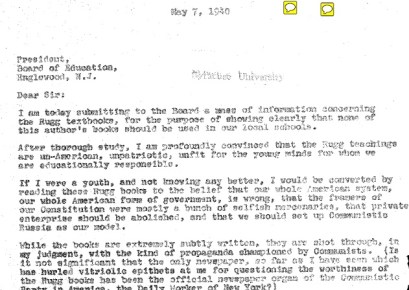
The problem, Forbes explained in his syndicated newspaper column, was that universities had been “infested” with “radical professors.” Those left-wingers, Forbes charged, had taken over the teaching profession. A set of textbooks by Harold Rugg, especially, set a dangerous tone. And, just like Krauthammer, Forbes assumed that those books had the power to instantly convert and confuse America’s schoolchildren. “If I were a youth,” Forbes wrote to his local school-board president,

I would be converted by reading these Rugg books to the belief that our whole American system, our whole American form of government, is wrong, that the framers of our Constitution were mostly a bunch of selfish mercenaries, that private enterprise should be abolished, and that we should set up Communistic Russia as our model.

Just like Krauthammer, Forbes relied on his own experiences to prove his accusations. Forbes visited a junior-high school, for example, and asked students if they loved America. They told him they weren’t allowed to. Their teacher—reading dronishly from her left-wing textbook—had informed them that “There are several other countries that have as good a form of government as ours.”

Forbes was shocked. He couldn’t blame the “Sixties,” but he didn’t need to. He took to the pages of his syndicated column to share his outrage. “Do American parents,” Forbes asked,

want their children taught such ideas? Do they want them to be inculcated with the idea that the United States is a second-rate country, that its form of government is open to question, that there are other countries more happily circumstanced and governed than ours?

For Forbes in 1939, just as much for Krauthammer today, the danger was real and immediate. Leftist teachers hoped to warp the minds of their pupils with their anti-American ideas.

So, SAGLRROILYBYGTH, let’s keep two things in mind as we celebrate the Fourth of July. First, whatever pundits might say, teachers and schools don’t have the power to dictate patriotism. Even if they wanted to—and they have wanted to!—schools couldn’t cram pro- or anti-American feelings down kids’ throats. In the end, schools only have a smallish influence on what people really think.

Second, if you share Krauthammer’s pessimism about schools today, don’t share his short-sighted historical blunders. We can’t blame or praise the “Sixties” as the roots of today’s culture wars. The Sixties were just another round of a conflict that had started long before.

HT: MM

I Love You but You Didn’t Do the Reading

As we Americans get ready to celebrate our nation’s heritage by blowing up some small portion of it, here are a few stories you might have missed:

A new plea for an old idea: Nobel laureate explains how to improve science education in colleges.

SCOTUS decides in favor of religious schools. Government can be forced to include churches in grant-funding schemes. Blaine Amendments are out.

What could a religious conservative dislike about “worldview” education? Rod Dreher thinks it misses the point of true education.

How can we encourage career-changers without allowed untrained teachers? Curmudgucrat Peter Greene makes his case for high-quality alternative teacher certification.Bart reading bible

Historian Daniel K. Williams explains the “Democrats’ religion problem” in the NYT.

Amy Harmon follows up on her story about teaching climate change. What are real teachers doing?

Historian John Fea blasts the “Christian Nation” rhetoric of Trump’s “Court evangelicals.”

Do “evangelicals” oppose same-sex marriage? Or only old evangelicals? In WaPo, Sarah Pulliam Bailey looks at new survey results.

What does it mean to learn something? Daniel Willingham wrestles with a definition.

Who is protesting on campuses? It’s not “liberals,” Jacques Berlinblau argues.

Peter Berger, RIP. D. Michael Lindsay eulogizes Berger’s influence among evangelical academics.

SCOTUS Decision: Who’s the Bigot Here?

The script isn’t new. In every culture-war battle these days, both sides like to call each other bigots. The recent landmark SCOTUS ruling is no different. When the Court ruled this week that a church school cannot be prevented from receiving public funds, both sides insisted they are on the side of the anti-bigotry angels. From this historian’s perspective, one side has the much better case. Am I off base?

If you’ve been following the Trinity Lutheran case, you’ve heard all about “Blaine Amendments.” Yesterday, SCOTUS ruled 7-2 that Missouri could not exclude a religious school from receiving public funds for its playground. The school had applied for a grant to re-surface its playground. The state of Missouri, though, rejected the otherwise successful application because its state constitution prohibits funding religious schools, in a clause popularly known as a “Blaine Amendment.”

So far, so good.

The majority in this case fulfilled the dreams of conservatives such as Clarence Thomas. Blaine Amendments, Thomas has long argued, have their roots in anti-Catholic prejudice. As a product of 1870s bigotry, they deserve to be consigned to the scrapheap of historical justice. In his opinion in Mitchell v. Helms (2000), for example, Justice Thomas excoriated such doctrines as “born of bigotry.”

Is he right? The other side insists that the real bigots are the ones who want to erode the goal of a secular government. The true bigots, they’d say, are the folks like Clarence Thomas who hope to chip away at the post-World-War-II SCOTUS consensus that there should be a firm wall of separation between church and state. The ultimate goal of such SCOTUS scheming is to take away the hard-won rights of religious and non-religious minorities, to cram majority Christianity down the throats of Americans of all backgrounds.

Who has the better argument?

On one hand, Justice Thomas isn’t totally wrong. Although savvy historians such as Benjamin Justice of Rutgers have made a good case against him, the Blaine Amendments really do have roots as relics of anti-Catholic populist bigotry.

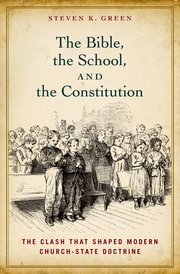
In his terrific book The Bible, the School, and the Constitution, Steven K. Green describes the context in which the Blaine Amendments took off. From Green’s perspective, Justice Thomas’s argument is far too simplistic. Senator Blaine himself wasn’t an anti-Catholic bigot. His mother was Catholic and he sent his kids to Catholic schools. Moreover, as Green points out, there was not a single “Blaine Amendment” and the supporters of such amendments had a variety of motivations, not just anti-Catholic bigotry.green bible school constitution

However, just because Blaine wasn’t an anti-Catholic bigot, his amendment certainly played to the popular anti-Catholic bigotry of his day, as Green also relates. In the years following the Civil War, the Republican Party used popular anti-Catholic sentiment as a campaign tool. Leaders such as Blaine and Grant inflamed the anti-Catholic prejudices of voters in order to discredit their rivals in the Democratic Party, the traditional political home of Irish Catholics.

Blaine’s proposed Constitutional amendment was at least in part a House-of-Cards-style attempt to inflame anti-Catholic bigotry. According to Green, contemporary newspapers recognized Blaine’s proposal as fueling “the excitement of Protestant fanaticism.” Rallies in support of the Blaine Amendment made no secret of it. They insisted the anti-Catholic measure would guarantee the victory of “the promulgation of the doctrines of true religion” in America.

So, although Justice Thomas distorts the history of the Blaine Amendments by over-emphasizing this bigoted anti-Catholic support, he is not wrong to suggest that supporters often did react out of knee-jerk Protestant chauvinism. Though the Blaine Amendment failed, its language was incorporated in one way or another into several state constitutions, including Missouri’s.

In this historian’s opinion, however, there is a more important flaw lurking in Justice Thomas’s use of the history of Blaine Amendments, due either to surprising ignorance or profound cynicism. If bigotry lurked at the heart of the Blaine Amendment, precisely the same bigotry has fueled a generation of conservative attempts to wedge religion—a certain form of religion—back into America’s public schools. When Justice Thomas fights against Blaine-ist bigotry, he is promoting the very same.

The dangerous, bigoted implication—in Blaine’s day or in ours—is that there is one type of religion that is somehow more American than others. To my mind, this is the big danger in this debate, and it is a danger that has worried conservative religious people as much as secular progressives like myself.

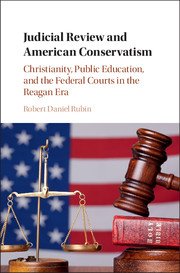
As Robert Daniel Rubin argues in his terrific new book Judicial Review and American Conservatism, since the 1970s religious conservatives have fought against the separation of church and state in order to restore Christianity to its place as America’s de facto religion. As part of this campaign, since the days of Senator Jesse Helms and Justice William Rehnquist, conservatives have pushed to wedge more and more Christian prayer and Bible-reading back into schools.rubin book

Moral-Majority types have always valued the privileges of Christian majorities over the rights of religious (or non-religious) minorities. Justice Rehnquist, for example, thought the primary goal of courts should be to defend the rights of majorities to promulgate their doctrines in public institutions, including public schools. As Rubin puts it (pg. 214), Justice Rehnquist felt

solicitude toward the majority and its capacity to fashion policies embodying its moral and political preferences. To honor dissenters’ rights more jealously than states’ laws was to disgrace the democratic process.

Just like Senator Blaine and Justice Thomas, Justice Rehnquist wouldn’t have called this solicitude “bigotry.” In the end, though, if we have to play the bigotry card, I can’t help but think that Thomas has the weaker case.

Why? The most dangerous, bigoted notion in these cases, IMHO, is the implication that there is a real American religion, that Christianity (or Protestantism, or evangelical Protestantism) have somehow a better claim to government support. In this idea lurks the true and dangerous bigotry in this perennial conflict. It is a bigotry, to be fair, that has been strenuously opposed by plenty of religious conservatives themselves. As we’ve noted in these pages, many conservative evangelicals are horrified by the notion that theirs is somehow a merely “American” religion.

Among conservative evangelicals, however, it has proven difficult to oppose moral-majoritarianism. And so we come to our culture-war battle over the proper role of Christian religion in public schools. One on side, we have conservatives who fight to include Christian sentiment and activity in government-funded activities, including schools. On the other, we have progressives who favor a strict secularity in government funding.

Ideally, we could have these discussions without calling each other bigots. When it comes right down to it, though, if we are going to start flinging mud, the balance seems clear to me: In this case the bigger bigots are those who hope to cram Christianity back into public schools. They ignore the rights of minorities; they insist that their ideas are right for everybody.

Many SAGLRROILYBYGTH will likely disagree. What do YOU think? Is it fair to call pro-Christian activism “bigotry?” Or do Christian groups have a right to legal protection from anti-religious “bigotry” such as the so-called Blaine Amendments?

I Love You but You Didn’t Do the Reading

Another rip-roaring week has come and gone in the offices of ILYBYGTH. Here are some stories you might have missed:

Anti-Muslim? Or pro-secular? School-prayer debates in Ontario.

Forget about free speech and violent protests for a second. At WaPo, Jeffrey Selingo argues that there are much bigger problems to worry about in the world of higher education.Bart reading bible

Southern evangelical churches wonder what to do about their Confederate monuments.

Summer vacation is here. From the Fordham Institute, Christopher Rom says we need to get rid of it. And it’s not because we’re not all a bunch of farmers anymore.

Jerry Falwell wants in. But other university leaders want out. Queen Betsy’s Ed Dept is having trouble filling its ranks.

The more things change…Southern Baptist Convention debates an anti-racism resolution.

More Trumpian tragedy: Cabinet meeting relives the opening of King Lear.

Helicopter parenting and the authoritarian personality: Pratik Chougule makes the case at the American Conservative.

Teaching climate change: A rundown of the latest developments.

DeVos’s Ed Dept. closes a sexual-assault investigation at Liberty University.

What do we do when a religion is all about racial violence? The question of Odinism.

Will vouchers help? Only at the edges, two researchers claim. Positive effects from vouchers are due to something else.

The Surprising History of Turkey’s Creationism

A devilish Jewish conspiracy? A beloved Christian import? Recent news from Turkey builds on the surprising evolution of creationism in that country.

Here’s what we know: Alpaslan Durmus, the Turkish education minister, denounced evolution as “beyond their [students’] comprehension.” It will be removed from K-12 textbooks. Durmus explained that the government thought evolution was too “controversial;” that students “don’t have the necessary scientific background and information-based context needed to comprehend.”

Turkish education minister cuts evolution

Evolution’s out

That’s not the surprising part. After all, even when Turkish official textbooks did discuss evolution, they were hardly fair, balanced, or free of religious bigotry. According to The Financial Times, earlier Turkish textbooks warned students that Darwin “had two problems:  first he was a Jew; second, he hated his prominent forehead, big nose and misshapen teeth.” The books mocked Darwin’s lack of formal education, noting strangely that he preferred to spend his time with monkeys in the zoo.

For a while, then, Turkey’s public schools have catered to popular bigotry about evolutionary ideas. Turkey is hardly alone. Evolution is deeply unpopular in many Muslim-majority countries. According to Salman Hameed of Hampshire College, fewer than a fifth of Indonesians, Malaysians, and Pakistanis say they think evolution is true. Only eight percent of Egyptians do. Turkey is no exception. Just as in the United States, evolutionary theory is widely denounced, even if it is not widely understood. Anxious leaders curry favor with conservative religious populations by throwing Darwin under the bus.

It is not news, then, that Turkey’s government is trying to win support among religious voters by eliminating evolution from textbooks. We might be surprised, however, by the history of cross-creationist connections that have long linked Turkey’s Islamic creationists to San Diego’s Christian ones.

The_Creationists_by_Ronald_Numbers

A worldwide flood of creationism

As historian Ronald Numbers described in The Creationists, in the mid-1980s the minister of education in Turkey wrote to the San-Diego based Institute for Creation Research. Turkey’s schools, the minister wrote, needed to “eliminate the secular-based, evolution-only teaching dominant in their schools and replace it with a curriculum teaching the two models, evolution and creation, fairly” (pg. 421).

The relationship between powerful Turkish creationists and American creationists thrived. In 1992, a Turkish creationism conference invited ICR stalwarts Duane Gish and John Morris as keynote speakers.  Professor Numbers also describes the founding in 1990 of the Turkish Science Research Foundation (Bilim Arastirma Vakfi, or BAV).  In Numbers’ words, “For years BAV maintained a cozy relationship with Christian young-earth creationists, feting them at conferences, translating their books, and carrying their message to the Islamic world” (pg. 425).

However, Numbers concluded, “the partnership between the equally uncompromising Christian and Muslim fundamentalists remained understandably unstable” (425). Numbers cited the rhetoric of American creationist leader Henry Morris: “Mohammed is dead and Jesus is alive!” As Numbers noted acerbically, such talk was “hardly calculated to win Muslim friends” (425).

It’s not shocking, then, that Turkish and American creationists keep one another at arm’s length, in spite of American outreach to Turkey and lavish and expensive efforts by Turkish creationists to woo American scientists.

Here’s the last question: Will Turkey’s recent move finally convince pundits to stop saying that the United States is the only country in which creationism thrives? Will creationism finally be seen as the world-wide conservative impulse that it really is?

HT: V(F)W; JC