Can We Vote on Evolution?

Is there a democratic way to decide difficult technical questions? Last week, voters in Greece soundly defeated a complicated economic proposal. For those of us interested in educational culture wars, it raises an interesting question: Could we vote on evolution?
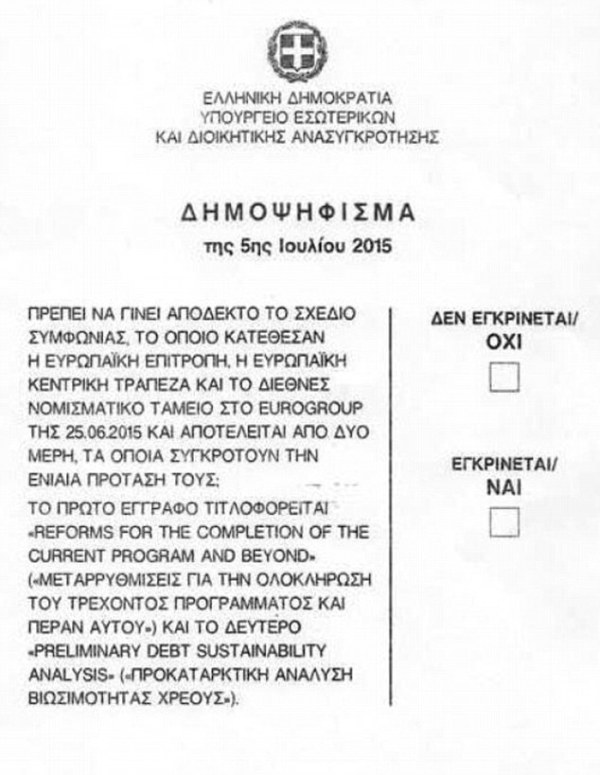
It's all Greek to me.  Except for the parts in English...

It’s all Greek to me. Except for the parts in English…

In Greece, voters faced a dauntingly worded ballot. In English, it read as follows:

Should the deal draft that was put forward by the European Commission, the European Central Bank and the International Monetary Fund in the Eurogroup of June 25, 2015, and consists of two parts, that together form a unified proposal, be accepted? The first document is titled ‘Reforms for the Completion of the Current Programme and Beyond’ and the second ‘Preliminary Debt Sustainability Analysis.’

Hrm? What would an “oxi” vote mean in this case? “Nai?”

Of course, the SAGLRROILYBYGTH will say that voters could simply look up the two documents and decide intelligently if they deserve support. But to think that most voters would do that seems woefully naïve, or perhaps refreshingly optimistic. In the United States, after all, poll data suggest that large numbers of Americans think that humans and dinosaurs lived side-by-side, and, as Rick Shenkman has pointed out, most of us don’t know basic facts about our government and society.

Many Greek voters, similarly, seemed to have only a tentative grasp on the question at hand. Instead of voting on the specifics of either of the reform plans, Greeks likely voted based on their impressions about the two sides of the issue. Voting “yes” was generally perceived to be a vote in favor of the euro, and against the leftist policies of the ruling Syriza party. A “no” vote, in contrast, was often seen as a vote against economic austerity and in favor of Syriza.  Even more confusing, some voters seemed to think that a “yes” vote meant taking pride in Greece’s place as a European nation, while others thought a “no” vote was the way to express Greek national pride.

Even after the vote, the results are confusing. Will the government now negotiate for an economic bailout? Will the government accept austerity measures after all as a condition?

One thing seems clear: many Greek voters used the referendum as a way to express something about who they were, whom they believed, rather than as a way to make a specific policy choice.

When it comes to evolution and creationism, we see similarly confusing commitments. Support for creationism remains high, not because people have not heard of evolutionary science, but because people want to show their support for traditional religion.

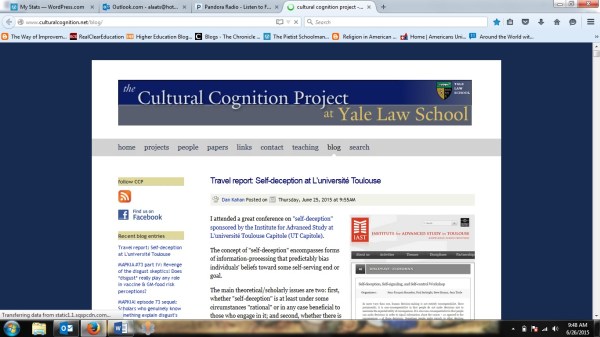
As Dan Kahan of Yale Law School puts it so well,* our positions on evolution/creation tell us about who we are, not about what we know. People who say they “believe in” evolution do not actually know any more about it than people who say they do not.

With all this in mind, could we imagine a scenario in which America voted on evolution? What would such a referendum look like?

These are preposterous questions in many ways, but bear with me for a minute. We’ve seen time and time again that large percentages of Americans believe that humanity has been created fairly recently. We’ve also seen that large percentages of Americans favor teaching evolution and creationism/intelligent design side-by-side in public schools. What if we tried to agree upon our school curriculum in a democratic way, by holding a national referendum on the issue?

It seems to me the wording of such a ballot might be crucial. If we asked voters, for instance, to vote on whether they thought evolution was true, we’d likely have a huge negative result. Americans just don’t want to agree to that, for a host of religious and cultural reasons.

But what if we asked voters if they wanted public schools to teach the best available science? And what if we asked voters if they believed most scientists thought evolution was the best scientific explanation of the development of life?

As I argue in an upcoming book, the wording could make a big difference. What do we really want our public schools to teach about evolution? Do we need children to believe that evolution is true? Or, rather, do we want to insist that children have a deep understanding of the science of evolution?

We can do more than guess. In 2012, the National Science Board experimented with two similar questions about evolution. When they asked respondents if “human beings, as we know them today, developed from earlier species of animals,” just under half (48%) said “true.” But when they changed the wording, that percentage leaped. When they asked people if “according to the theory of evolution, human beings, as we know them today, developed from earlier species of animals,” a whopping 72% of respondents agreed.

What if we were to vote on evolution? To my mind, if we did something like that, the ballot should have two simple questions:

1.) Do you want public schools to teach the best available science? And

2.) Do you think that scientists say humans evolved from other species?

With questions like that, we would get a whopping public voice of support for teaching evolution in public-school science classes.

*Exciting update! Professor Kahan has firmed up the date for his visit to our scenic campus. He’ll be giving his talk to our Evolution Studies Program on Monday, February 22, 2016. Good seats still available!
Does Your School Smell of BO?

Conservative intellectuals these days are talking a lot about the “Benedict Option.” The idea is to create intentional communities that preserve traditional values as mainstream culture hurtles ever-faster toward anti-Christian values. In the wake of Supreme Court rulings in favor of same-sex marriage, will such ideas catch on?

Short answer: No. If history is any guide, conservative evangelicals, at least, will continue to feel quite at home in their local mainstream communities. A quick burst of community-founding might happen, but it will likely ebb once conservatives realize how un-alienated they are from the mainstream.

Blogger Rod Dreher seems to have sparked the recent discussion of a “Benedict Option.” Dreher profiled intentional lay communities in Clear Creek, Oklahoma and Eagle River, Alaska. He asked if more conservative Christians would follow suit:

Should they take what might be called the “Benedict Option”: communal withdrawal from the mainstream, for the sake of sheltering one’s faith and family from corrosive modernity and cultivating a more traditional way of life?

As Dreher has developed the idea, it has naturally come to focus on educational goals. Even in staunchly Christian communities, Dreher has argued, the public schools lack any sense of guiding values. Kids in fifth grade share porn; they have no beef with same-sex marriage. Even in such apparent Christian havens as small-town Louisiana, Dreher believes, kids and their parents have embraced a bland, therapeutic religiosity. The Benedict Option, Dreher thinks, offers conservatives their only hope. As he put it,

There are no safe places to raise Christian kids in America other than the countercultural places we make for ourselves, together. If we do not form our consciences and the consciences of our children to be distinctly Christian and distinctly countercultural, even if that means some degree of intentional separation from the mainstream, we are not going to survive.

Dreher has taken some heat from fellow conservatives for culture-war pessimism. Not every conservative wants to turn inward. But as Dreher recently noted, many prominent evangelical thinkers such as Russell Moore seem to be adopting a BO approach to mainstream culture.

Similarly, Thomas Kidd of Baylor University has recently endorsed a BO attitude. Earlier this week, Kidd wrote,

for “paleo” evangelicals the Benedict Option is unquestionably the route we’ll need to take in the coming days. It is the way of fidelity for Christians, as the world around us sloughs off what remains of our quasi-Christian culture.

As Dreher and other BO-friendly conservatives repeat, BO does not mean Amish. It does not mean turning away entirely from mainstream culture. In some BO communities, for instance, families make their money from internet telecommuting. They insist on remaining engaged in mainstream politics and local affairs, even as they insist on retaining more control over their children’s upbringing.

Will the Benedict Option attract more and more support from conservative Christians? If history is any guide, the likely answer is no. As Dreher, Kidd, and Moore all realize, the tension among conservative Christians between engagement and withdrawal is as old as Christianity itself. In recent American history, as I’ve argued in academic articles about Christian schools and school prayer, evangelical Protestants have tended to wax and wane in their enthusiasm for BO approaches to schooling.

In 1963, SCOTUS decided that the Lord’s Prayer could not be recited in public schools, nor could the Bible be read devotionally. This decision caused some conservative evangelicals to conclude that they had been kicked out of public school and American society.

In the pages of leading evangelical magazine Christianity Today, for example, the editors intoned that the decision reduced Christian America to only a tiny “believing remnant.” No longer did the United States respect its traditional evangelical forms, they worried. Rather, only a tiny fraction of Americans remained true to the faith, and they had better get used to being persecuted.

Similarly, fundamentalist leader Carl McIntire insisted that the 1963 school-prayer decision meant the death of Christian America. In the pages of his popular magazine Christian Beacon, one writer warned that the Supreme Court decision meant a wave of “repression, restriction, harassment, and then outright persecution . . . in secular opposition to Christian witness.”

From the West Coast, Samuel Sutherland of Biola University agreed. The 1963 decision, Sutherland wrote, proved that the United States had become an “atheistic nation, no whit better than God-denying, God-defying Russia herself.”

These attitudes helped fuel a burst of new Christian schools in the 1970s. But as Christian-school leaders are painfully aware, many of those new schools couldn’t survive. Why? At least in part, because not enough conservatives feel alienated from their local mainstream communities. Why should they?

As I argue in my new book, public schools are far more conservative places than most pundits acknowledge. There is a lot of talk among both progressives and conservatives about the progressive takeover of public education, but for most Americans, their local schools remain fairly conservative places.

At the very top, leaders such as Arne Duncan embrace free-market approaches to education reform. In places such as Texas, creationist homeschoolers—folks who might fairly call themselves BO activists—have risen to the top of the state public educational hierarchy.

Why would conservatives think that they no longer had any pull in public schools? As Dreher is fully aware, many conservatives do not object to mainstream culture; they feel no yearning to give their children a radically different upbringing. If that’s the case, talk of BO in schools will not be a more than a minority sentiment.

Just as relatively few progressives abandon public schools for purer options, so too only a handful of conservatives will make the sacrifices necessary to give their children a BO education.

Is THIS the Future for Christian Colleges?

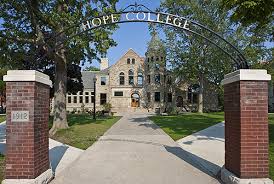
Now what do we do? That is the question plaguing conservative college administrators nationwide. Since the Supreme Court decision in favor of same-sex marriages, many evangelical schools have wondered if they will have to change the way they do things. In Michigan, Hope College has announced its accommodation with the ruling. Will other Christian colleges do the same thing?

The gateway to the future?

The gateway to the future?

As the Sophisticated and Good-Looking Regular Readers of I Love You but You’re Going to Hell (SAGLRROILYBYGTH) are well aware, questions of homosexuality and same-sex marriage have long bedeviled evangelical colleges. For non-evangelicals, it might come as a surprise to hear that the issue is contentious. After all, at most evangelical schools, the official doctrine clearly and resolutely condemns homosexual activity.

Yet at all sorts of schools, the campus community is much more welcoming. At Gordon College recently, the president’s reminder that the school officially bans “homosexual practice” brought furious protests from students and faculty. Even at the far more conservative Liberty University, faculty members do not always take the harsh tone we progressives might expect.

As our Supreme Court decided the constitutionality of state bans on same-sex marriage, many evangelicals fretted that their decision would trash traditional rules on their campuses.

At Hope College in Michigan—a school in the Reformed Church tradition—the leadership and campus has experienced similar turbulence on the issues of homosexuality. In 2010, for example, the administration provoked protests when it banned the film Milk. More recently, the campus has welcomed homosexual student organizations, though the administration has continued to endorse the Reformed position on homosexuality.

In its most recent announcement, the school’s leaders have declared their intention to abide by the SCOTUS decision. From now on, same-sex married partners of college employees will be eligible for the same benefits as heterosexual partners. The administration again affirmed its respect for the Reformed Church’s official doctrine that homosexuality is a sin. That does not mean, however, that the school will contravene the law.

Is this the path other schools will follow? Unlike pluralist colleges, evangelical schools face intense pressure to stay true to traditional beliefs and norms. As Professor Michael Hamilton wrote in his study of Wheaton College,

The paradigm that has dominated Wheaton through the century holds that colleges, more than any other type of institution, are highly susceptible to change, and that change can only move in one direction—from orthodoxy toward apostasy. . . . The very process of change, no matter how slow and benign it may seem at first, will always move the college in a secular direction, inevitably gathering momentum and becoming unstoppable, ending only when secularization is complete.

Hope College may find itself the front line for this debate within the Reformed Church in America. The church as a whole has gone back and forth for decades about the proper Christian reaction to homosexuality. Is it better to embrace the sinner? Or to drive out the sin? Conservatives within the RCA will doubtless take this announcement as proof that Hope has gone soft. Progressives will celebrate it as a small step towards equity.

Other evangelical schools will face similar scrutiny. If they openly welcome homosexual students, faculty, and staff, they will be subject to withering condemnation from conservatives. If they don’t, however, they’ll risk being sidelined, branded as anti-gay bigots.

Postcards from Christian America

Is America a “Christian” nation? What do we even mean by that question? Historically, as I argued in my recent book, even secular conservatives have tended to assume that the United States needs Christianity. Is that still the case? Will it be the case for the foreseeable future? A couple of new polls offer contradictory impressions.

LifeWay, an evangelical research organization, asked 1,000 Americans if they thought God and America had a “special relationship.” Most did. Fifty-three percent overall agreed. In different categories, the percentages went up. Just over two-thirds of self-described evangelical Protestants thought America and God had a special bond. African Americans believed it (62%) more commonly than white Americans (51%). Tellingly, among the highest percentages of agreement were from white evangelicals over 45, seven of ten of whom agreed (71%).

Special friends?

Special friends?

Perhaps this demography helps explain a seeming paradox. Another Fourth of July-timed research report from the Public Religion Research Institute asserted that the numbers of Americans who think the USA is a “Christian nation” is declining, fastest among the young. Only about a third of respondents agreed that the USA is now and has always been a Christian nation. Older people tend to believe it more often.

What does it mean to think of the country as a “Christian” nation? These polls are tricky, since different respondents can think different things, even if they check the same boxes. For some respondents, the idea of a Christian nation likely evokes a tight bond between public spaces and evangelical religion. In a properly Christian nation, some think, public schools and meetings ought to be guided by Christian prayers and ideas.

Other people might simply mean that the USA has a majority of Christians. If we understand “Christian nation” in this sense, it means public spaces can still be secularized, even if a majority of citizens share a Christian faith.

As I’ve argued in the past, it is a mistake to try to pinpoint one point in time when America turned into a secular society. It is a mistake to try to understand the history of evangelicals in America as having changed at a specific point in time from an unchallenged majority to a beleaguered minority. We hear these sorts of claims all the time, of course, especially when the Supreme Court issues a seemingly anti-Christian decision.

Booming with boomers...

Booming with boomers…

From an historical perspective, evangelical Protestants have always held enormous influence over the entirety of American society. Over the long haul, certainly, evangelicalism’s influence in public life has waned.

Does that mean America is moving away from its history as a “Christian” nation?

Or does it only mean that the United States is now and has always been a pluralistic society, with evangelicals battling for control with all kinds of other religious and non-religious groups?

What I Did on my Summer Vacation

By Adam L.

I hope you choke on your sunscreen. While you are out and about doing summer fun stuff, I’ll be in the office putting together the index for my upcoming book.

Okay, okay, I’m being a little melodramatic. I actually enjoy the process of writing an index. It helps me get into the manuscript in a detailed way. It helps me think over what the main points are. And it helps me imagine what future readers might be looking for.

If you poke your head out the window and crane your neck, you still can't see the beach from here...

If you poke your head out the window and crane your neck, you still can’t see the beach from here…

Not to mention the fact that writing an index has its own share of intellectual challenges. For example, I’m wondering which subheading to use under “Darwinism.” Should I list anti-evolution protests as “Darwinism: equated with atheism, 7, 14—15”? Or should it be more general: “Darwinism: critiqued by anti-evolutionists, 7, 14—15”?

In any case, enjoy your dog days at the beach, or the mountains, or wherever it is that normal people spend their summer time. I’ll be festering in air-conditioned office comfort. When the snow flies in January, this book should be ready to share.

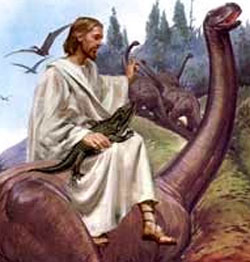
So Jesus WAS on a Dinosaur…?

We just don’t know what we’re talking about.

Could've happened...?

Could’ve happened…?

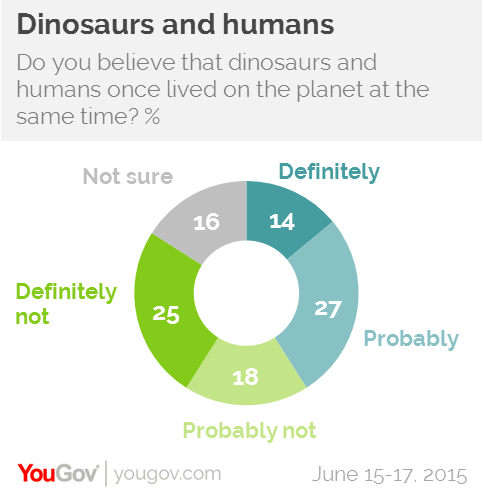
A new poll inspired by the hit movie Jurassic World suggests that Americans don’t know much about much. Thanks to the ever-watchful folks at the National Center for Science Education, we see some startling responses to a simple question: Did humans and dinosaurs live at the same time?

As YouGov explained,

YouGov’s latest research shows that 41% of Americans think that dinosaurs and humans either ‘definitely’ (14%) or ‘probably’ (27%) once lived on the planet at the same time. 43% think that this is either ‘definitely’ (25%) or ‘probably’ (18%) not true while 16% aren’t sure. In reality the earliest ancestors of humans have only been on the planet for 6 million years, while the last dinosaurs died out 65 million years ago.

Ouch.

For evangelicals, the numbers are even more skewed. A clear majority (56%) of evangelical Protestants think humans and dinosaurs co-existed. Only 22% of evangelicals thought that dinosaurs and humans did not.

...doh!

…doh!

As the National Center for Science Education points out, there are a couple of possible wrinkles in this poll. Most scientists these days consider birds to be dinosaurs. Is that what the respondents meant? The NCSE charitably suspends judgment, but it seems obvious to your humble editor that most of us just don’t know what we’re talking about.

Gay Marriage and Christian Resistance

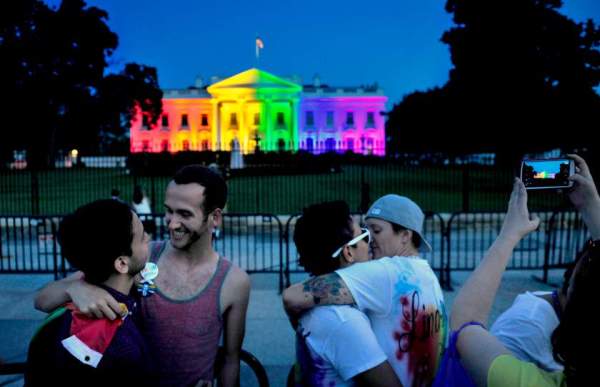
What is a conservative Christian to do? The US Supreme Court’s decision in favor of gay marriage has sent shock waves across America. Will conservative Christians accept this decision? Or, as some have warned, does this move our culture war over sexuality one step closer to real war?

More rainbows than a box of Lucky Charms...

More rainbows than a box of Lucky Charms…

Of particular interest at ILYBYGTH these days, the new ruling will likely meet its first test at conservative religious colleges. As we’ve noted (and as the New York Times eventually noticed) the SCOTUS ruling has brought up questions about the limits of acceptable dissent in higher ed. Can schools discriminate against homosexual “practice?” As I’m writing about in my current book, the same tension played out in the 1970s, when Bob Jones University insisted on its religious right to racial discrimination. It seems colleges will be the first institutions to feel pressure to accommodate demands to end institutional discrimination against homosexuals.

The reaction to the SCOTUS decision has been fast and furious among conservative evangelicals and other Christians. Rick Scarborough of Vision America told the New York Times that the decision must be resisted. “If they change the playing field and make what we do out of bounds,” Scarborough said,

we will disobey; we will disrespect this decision. . . . We’ll treat it like Dred Scott and other decisions courts have handed down over the years that counter natural law. God made a male and a female, and no amount of surgery is going to change that.

Similarly, Robert Jeffress told the Christian Post that the decision proves America’s persecution of Christians. As the Rev. Jeffress put it,

I think today’s decision is just one more step in the marginalization of conservative Christians. I made this argument and have been ridiculed for doing so, but I think it is very legitimate. The Nazis did not take the Jews to the crematoriums immediately. . . . The German people would not have put up with that. Instead, the Nazis begin to marginalize the Jewish people, make them objects of contempt and ridicule. Once they changed the public opinion about the Jewish people, then they engaged the [Holocaust]. . . . Once secularists have made Christians objects of contempt, I think it will be very easy to revoke other rights that they have as American citizens.

And in the pages of World Magazine, Ryan Shinkel advocated Christian resistance to an overweening state and society. “The movement for marital restoration is beginning,” Shinkel wrote just before the SCOTUS decision,

and the chance for moral courage and a life daring to be countercultural is at hand. By continuing to speak up for religious freedom, the restoration of a marriage culture, and dignity of the family in the face of potential setbacks at the Supreme Court, we can become the Nietzscheans who hammer the libertine and atomistic idols of our age.

Secular folks like me, progressive people who celebrate the SCOTUS decision, might blanch at these dire warnings. Some of my friends and colleagues might take these statements as proof that conservative Christians will never admit to marriage equality. But folks like us need to listen also to the other voices of conservative Christians.

In the Washington Post, for example, Russell Moore of the Southern Baptist Convention suggests Christians calm down. It is a terrible ruling, Moore agrees. And it does indeed push conservative evangelicals into a dissenting position that might seem “freakish” these days. But so what? Moore wants conservatives to “embrace a freakishness that saves.”

Similarly, Mark Galli of Christianity Today worries that evangelicals will react badly. “The temptation,” he writes,

is to go off and sulk in our holy corner. Or to dig in our heels and fight harder. Or to lash out in anger. Or to despair. We can do better.

The goal for Christians, Galli writes, is to take confidence that they are on the right side, God’s side. This decision provides another healthy—if intensely uncomfortable—opportunity for Christians to re-engage with important questions above love, marriage, and the proper relationship between Church and society. Though some conservatives might offer extreme rhetoric, Galli warns, evangelicals in America “are far from living at the margins.”

If we are to make sense of the culture-war rhetoric surrounding this SCOTUS decision, we need at least to remember some historical precedent. As I’ve argued elsewhere, for generations evangelical Christians have been battered by landmark SCOTUS decisions that seem to kick them out of public life. In every case, evangelical pundits have insisted that each new SCOTUS decision changed America from a Christian nation to a persecuting Babylon. In every case, however, evangelicals have continued to wield enormous cultural and political power.

Will this decision be any different? Will this decision really change the balance of power in America’s continuing culture-war debates?

Good Seats Still Available!

The 2015-2016 lineup at Binghamton University is looking like another winner. Dan Kahan of Yale Law School has just agreed to come up in the spring for a talk about his work with science communication.

We had a very exciting year last year, too. Michael Berkman visited from Penn State. Professor Berkman gave a great talk to our Evolution Studies program about his work with evolution education. Then in May, Jonathan Zimmerman from New York University delivered our annual Couper Lecture. Professor Zimmerman blew our minds with some of the most provocative ideas from his new book, Too Hot to Handle.

Are you a Kentucky Farmer?

Are you a Kentucky Farmer?

Folks who spend a lot of time with science, creationism, and public perceptions will be familiar with Professor Kahan’s work. His Cultural Cognition Project has explored exciting new directions in the tricky field of science communication. As Professor Kahan will tell you, we’re all Pakistani doctors; we’re all Kentucky farmers.

Details of Professor Kahan’s talk to follow. It will likely be a Monday evening in the early months of 2016. As always, the seminars hosted by Binghamton’s stellar Evolution Studies Program are free and open to the public.

Can’t wait.

Creationism Then & Now

Do you read Ted Davis? For folks interested in the creation/evolution debates, Professor Davis has long produced essential historical analyses of the various voices of creationism in all their befuddling complexity. I was reading one of Professor Davis’ essays on the Biologos Forum recently and it raised some perennial questions: Can we compare the dissenting science of today’s creationists to the scientific ideas of long ago? Can today’s creationists claim a long legacy of prestigious scientific antecedents?

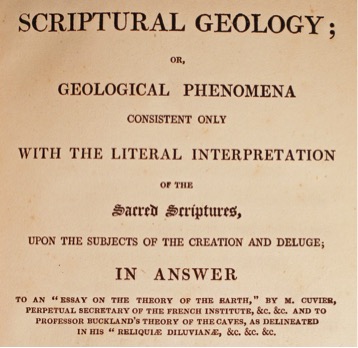
Cutting-edge creation science, c. 1827

Cutting-edge creation science, c. 1827

Davis is writing these days about science and creationism in antebellum America. In this post, he explains the school of “Scriptural Geology” that attracted religious scientists in the early 1800s. Scholars such as Princeton Seminary’s Samuel Miller and Anglican minister George Bugg rebutted new(ish) ideas of an ancient earth.

Professor Davis pointed out the remarkable similarities of their 19th-century arguments with the 21st-century arguments of today’s young-earth creationists. As Davis put it,

Readers familiar with Henry Morris or Ken Ham will find many of their ideas, expressed in substantially the same ways and for the same reasons, in the pages of Bugg’s book.

Now, Professor Davis would be the last person to ignore historical context or to misunderstand the historical changes that have wracked the world of creationist scientists. Yet his comparison to the Scriptural Geologists to Answers in Genesis or the Institute for Creation Research points out the radical changes that have taken place in the realms of creationism and science.

In the 1820s, discussions of the age of the earth still had some fading legitimacy among mainstream scientists. Even as late as the 1920s, when American politicians such as William Jennings Bryan insisted that “Darwinism” was losing scientific prestige, their claims made some sense. In the 1920s, for example, mainstream scientists had not yet cobbled together the modern evolutionary synthesis. They had not yet figured out how to reconcile the mechanism of natural selection with the maintenance of beneficial mutations.

As I describe in my upcoming book, mainstream science has changed enormously over the course of the twentieth century. Positions that made some scientific sense in 1827, or 1927, lost those claims as the 20th century progressed.

As an obvious result, there yawns an enormous gulf between the work of George Bugg and that of Ken Ham or Henry Morris. Today’s young-earth creationists are forced to take the role of utter scientific outsiders. They are forced to dismiss the entirety of mainstream evolutionary science as deluded.

Of course, as Professor Davis explains, earlier “creationists” such as Miller and Bugg also felt like scientific outsiders. But their position was radically different. Saying nearly the exact same thing, as always, can mean very different things, depending on when one says them.

Did Fundamentalism Make Her Do It?

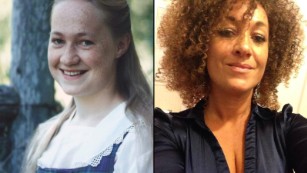
Okay, enough already about Rachel Dolezal and her weird tale of cross-racial activism. But before we let it go, let’s consider one new angle: Did Dolezal’s strange behavior result in part from her upbringing in an abusive fundamentalist homeschooling family?

A fundamental flaw?

A fundamental flaw?

That’s the charge leveled by the folks at Homeschoolers Anonymous. Worried that their coverage seemed to be excusing Rachel Dolezal’s behavior, they have since retracted their argument. (You can still read their original article here.) But it seems to me they raised an important question.

For those of us outside the world of fundamentalist homeschooling, Rachel Dolezal’s life history seems simply bizarre. Why did she list “Jesus Christ” as a witness to her birth? Why did she claim to have been beaten with a “baboon whip” as a child? Most important, why would someone go to such extreme and unnecessary lengths to alter her appearance and life history?

I do not want to excuse anyone’s actions, but I think Homeschoolers Anonymous has a right to point out Dolezal’s extreme evangelical upbringing. It doesn’t prove anything, but it adds background information.

The family was active in young-earth creationism. They apparently subscribed to the abusive philosophy advocated by Michael and Debi Pearl. Last year, Rachel Dolezal’s brother published a shocking memoir of their childhood. As HA summarized,

In his memoir, Joshua recounts growing up in the Dolezal’s conservative, Pentecostal home and church. He recounts a raging father, a mother with extreme suspicions of medicine and doctors, home-birthing with birth certificates listing Jesus as witness to the births, and much more.

Now, we need to add some of the usual caveats:

1.) Behavior that seems odd to secular folks like me does not equal child abuse.

2.) Many conservatives use corporal punishment in a loving, caring way.

3.) It does not excuse Rachel Dolezal’s apparent lies to point out her parents’ extreme beliefs.

4.) Homeschoolers Anonymous certainly has an axe to grind with this expose.

Even taking all those factors into consideration, however, knowing a little bit about Rachel Dolezal’s childhood helps me understand how someone might be driven to immoral extremes in order to separate herself from her past.

Nuf sed.