Pre-Orders Now Available!

Want to be the first on your block to get your copy of The Other School Reformers?  Then pre-order your copy today!

Pre-order your copy today!

Pre-order your copy today!

As I was happy to announce recently, Harvard University Press will be releasing the book in early 2015.  But the pre-order just became available on sites such as Amazon.  The hardcover won’t be available until January 12, 2015, but if you pre-order today, you’ll be sure to WOW your friends and family by getting your hands on it first.

Should the Poor Study Philosophy?

Why do people need an education?  In the memorable words of Chris Farley, kids need to learn a profession, or they’ll end up living in a van, down by the river.

But that’s not the whole picture.  As Scott Samuelson argues in The Atlantic, education must do more than help people get a job; education should help people be more human.  Samuelson raises a question at the heart of conservative educational thinking.

Too often in American educational history, the sort of education Samuelson’s talking about has been reserved for an economic elite.  As historian James Anderson argued in his 1988 book, for example, African Americans have been told time and again to educate their kids for the kinds of jobs they could get: laborers, maids, carpenters, doormen.  It was cruel and a waste of time, well-intentioned white philanthropists insisted, for African American youth to study Latin, Greek, and higher mathematics.  Such things would only expose them to a world in which they could not survive economically.

Samuelson agrees that liberal-arts education has traditionally been reserved for the upper crust.  As he describes,

There are three big reasons for this. First, it befits the leisure time of an upper class to explore the higher goods of human life: to play Beethoven, to study botany, to read Aristotle, to go on an imagination-expanding tour of Italy. Second, because their birthright is to occupy leadership positions in politics and the marketplace, members of the aristocratic class require the skills to think for themselves. Whereas those in the lower classes are assessed exclusively on how well they meet various prescribed outcomes, those in the upper class must know how to evaluate outcomes and consider them against a horizon of values. Finally (and this reason generally goes unspoken), the goods of the liberal arts get coded as markers of privilege and prestige, so that the upper class can demarcate themselves clearly from those who must work in order to make their leisure and wealth possible.

Samuelson insists that America’s tradition of preserving this sort of education for the already privileged gets the equation exactly backward.  In order for a society to remain free, he writes, all members must have the chance to study the basic ideas of freedom and humanity.  As Samuelson puts it,

there are among future plumbers as many devotees of Plato as among the future wizards of Silicon Valley, and that there are among nurses’ aides and soldiers as many important voices for our democracy as among doctors and business moguls.

Samuelson is not making a “conservative” argument, but his essay raises questions of perennial interest to conservative educational thinkers.  What does it mean to be “conservative” about education?  Leading conservatives push both for traditional visions of education that expose students to the great thinkers of our tradition.  But leading conservatives also fight for an education that will improve test scores of low-income students, an education that will leave no child behind.


The Other School Reformers

Clear your calendars! We have a release date. The Other School Reformers will be hitting store shelves in February.  I know that’s a long time to wait, so I’m suggesting everyone dress up as their favorite conservative educational activist and camp out outside their local bookstore.

Coming January 2015.

Coming January 2015.

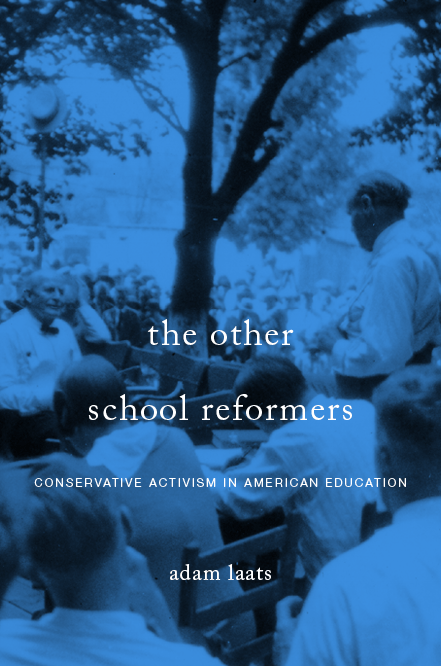
Thanks to the Smithsonian for this terrific cover image.  That’s Clarence Darrow (standing) facing William Jennings Bryan at the Scopes Trial.  In this book, I examine four epochal school controversies from the twentieth century.  In each case, I ask what conservative intellectuals and activists wanted out of schooling.  My goal is to find out what it meant to be “conservative” when it came to education.

The catalog listing just went up.  Here’s how the talented folks at Harvard University Press describe the book:

The idea that American education has been steered by progressive values is celebrated by liberals and deplored by conservatives, but both sides accept it as fact. Adam Laats shows that this widely held belief is simply wrong. Upending the standard narrative of American education as the product of courageous progressive reformers, he calls to center stage the conservative activists who decisively shaped America’s classrooms in the twentieth century. The Other School Reformers makes clear that, in the long march of American public education, progressive reform has more often been a beleaguered dream than an insuperable force.

Laats takes an in-depth look at four landmark school battles: the 1925 Scopes Trial, the 1939 Rugg textbook controversy, the 1950 ouster of Pasadena Public Schools Superintendent Willard Goslin, and the 1974 Kanawha County school boycott. Focused on issues ranging from evolution to the role of religion in education to the correct interpretation of American history, these four highly publicized controversies forced conservatives to articulate their vision of public schooling—a vision that would keep traditional Protestant beliefs in America’s classrooms and push out subversive subjects like Darwinism, socialism, multiculturalism, and feminism. As Laats makes clear in case after case, activists such as Hiram Evans and Norma Gabler, Homer Chaillaux and Louise Padelford were fiercely committed to a view of the curriculum that inculcated love of country, reinforced traditional gender roles and family structures, allowed no alternatives to capitalism, and granted religion a central role in civic life.

Almost makes me want to read it myself.  For me, the next steps will be to review and copy-edit the full manuscript next month.  Then in July I’ll put together the index, with help from a talented graduate student.

Charles Murray, Extremist?

No one doubts that scholar Charles Murray is controversial.  Best known for his book The Bell Curve, Murray ruffled feathers by asserting that some sorts of people are naturally less intelligent than others.  Though he denies every accusation of racism, Murray’s reputation has caused the administration of Asuza Pacific University to abruptly cancel Murray’s upcoming campus talk.

Has Murray’s reputation as a racist caused him to be seen as too extreme even by administrators at conservative Christian colleges?  The leaders of APU, for example, worried that Murray’s talk might be hurtful to “our faculty and students of color.”

Scholar?  Or Racist?  Can He Be Both?

Scholar? Or Racist? Can He Be Both?

After all, Murray has been labeled as a “white nationalist” by the Southern Poverty Law Center.  Murray, the SPCL charged, uses

racist pseudoscience and misleading statistics to argue that social inequality is caused by the genetic inferiority of the black and Latino communities, women and the poor.

For his part, Murray accuses Asuza Pacific of pusillanimity and closed-mindedness.  In an open letter to APU’s students, Murray challenged them to think for themselves.  Murray invited students to explore his website and read some of his publications.  The more you know about me, Murray suggested, the harder it will be for you to take these accusations of extremism seriously.  “The task of the scholar,” Murray told APU students,

is to present a case for his or her position based on evidence and logic. Another task of the scholar is to do so in a way that invites everybody into the discussion rather than demonize those who disagree. Try to find anything under my name that is not written in that spirit. Try to find even a paragraph that is written in anger, takes a cheap shot, or attacks women, African Americans, Latinos, Asians, or anyone else.

There is no reason, Murray concludes, why students should not listen to talks by “earnest and nerdy old guys” like Murray.

This cancellation of Murray’s talk raises key questions.

First of all, does the goal of intellectual diversity on college campuses include the inclusion of unpopular conservative ideas?  We’ve seen recently examples of speakers protested against at Montana Tech for their support of creationism, pro-life student groups at Yale being refused fellowship in a social-justice club, and Steven Hayward’s lonely life as a token conservative campus intellectual at Colorado.

Second, what does it mean that this cancellation comes from a relatively “conservative” campus?  APU is one of the oldest evangelical universities in the country.  No one could safely accuse the leadership of APU of pandering to the traditional secularist campus leftism run amok.  Yet this school’s leadership saw fit to cancel Murray’s speaking appointment due to worries about Murray’s reputation.

Finally, who decides which ideas are extreme?  By any measure, Charles Murray’s work has been part of recent mainstream American conversations about race, class, and society.  His 2012 book, Coming Apart, for example, was prominently reviewed by such leading publications as the New York Times, Wall Street Journal, and the New York Review of Books.  It does not make sense to suggest that Murray has only some sort of fringe status as a scholar.  Yet in this case, even a conservative Christian school saw Murray as too controversial to speak on campus.


Abortion and Social Justice at Yale

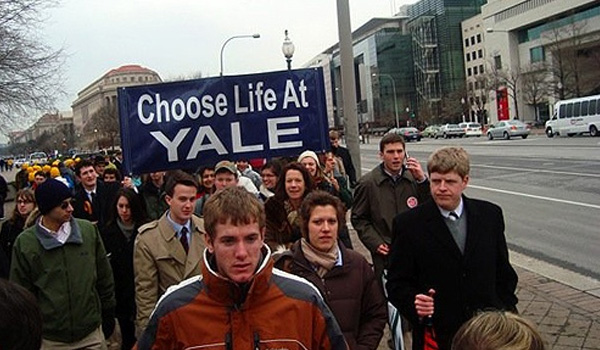
A pro-life student group at Yale University has been refused membership in a “social justice” organization.  Why?  Because, in the words of one student leader, “The pro-life, anti-choice agenda stands in the way of gender equity, and thus in the way of social justice.”

The controversy raises difficult questions: Is conservative religion still seen as a legitimate force for good?  For “social justice?”  Or has conservatism become irredeemably trapped by accusations of bigotry?  At least in the effete environs of Yale, it seems pro-life thinking has been stripped of its moral legitimacy.

Well-dressed Activists

Well-dressed Activists

The student group, Choose Life at Yale (CLAY), had been a provisional member of Dwight Hall, an umbrella group of student social-justice clubs.  Membership in Dwight Hall would have given CLAY access to meeting rooms and a sense of campus legitimacy.

Is pro-life a “social justice” cause?  Former CLAY president Michael Gerken thinks it is.  As he explained in the pages of First Things, CLAY members

realized that abortion has never been solely a matter of a baby’s life and liberty. It’s about the desperation and hopelessness of the mother that walked into the clinic. It’s about the grandfather who will never put that little girl in his lap. It’s about the classmates who will never sit next to her, and the boy who will never work up the courage to write her that awkward poem. It’s even about that friend who she would drift away from over the years, the successful sister who would make her insecure, and the God she’d curse when she lost her job and then her mortgage. The biggest lie in all this is that the choice to end (or to save) a life is a solitary one.

Of course, Yale will always have a special place in the history of conservatism and education.  It was William F. Buckley’s precocious expose of the godless atmosphere on campus that launched his career, and in many ways signaled the start of the modern conservative movement.

And college campuses have become leading forums to debate whether or not conservative religious ideas are legitimate traditions or vestiges of bigotry.  ILYBYGTH readers may remember a case at Tufts University a while back.  In that case, the evangelical student group Intervarsity was stripped of its official student-group status.  Other student groups complained that the prominent evangelical group represented an inherently bigoted worldview, one that did not recognize the full equality of homosexual students.

The current controversy at Yale represents a similar conundrum.  Do conservative religious groups automatically lose the right to participate in campus life?  Is it inherently bigoted to fight against abortion or gay marriage?  Perhaps most important, who gets to define “social justice?”


Women against Woman

What counts more: The fact that you’re a conservative or the fact that you’re a woman?  In Texas, conservative women seem to vote as conservatives first and women second.

A new poll from Public Policy Polling reveals that Texas women prefer conservative (male) gubernatorial candidate Greg Abbott over liberal (female) candidate Wendy Davis.

There’s no doubt about the relative ideology of the two candidates.  Attorney General Abbott has consistently run as the conservative choice.  So much so that the liberal Texas watchdog group Texas Freedom Network refers to Abbott as an “extremist.”  And Davis has been called a “liberal folk hero” for her inspiring personal story and ferocious filibustering of an anti-abortion bill.

But when it comes to voting, more Texas women prefer Abbott.  According to a poll of 559 registered voters conducted between April 10-13 (margin of error +/- 4.1%), Abbott has a 49 to 41 percent lead among women.  About a third of women had a favorable image of Davis, while almost half had an unfavorable opinion.

Of course, this might not be a simple matter of conservatism trumping gender.  Abbott has a much longer record in Texas politics.  It would make sense for him to crush any opponent, no matter what gender.  And it’s silly to think that there is a single “women’s” position on issues such as abortion, education, or the economy.

Nevertheless, conservative politicians have struggled to fight the image that they are conducting a “War on Women.”  It doesn’t help when blundermouthed GOP leaders such as Todd Akin represent conservatism in the minds of many voters.

This news from Texas shows that conservatives can win among female voters.  In Texas, it seems, women voters put their conservatism first, their gender second.


Conservative Politicians Need an Education

If you want to be President, go to college.  Eventually.

Wisconsin Governor Scott Walker has announced his intention to return to college to finish his bachelor’s degree.  The conservative Walker dropped out of Marquette University as a senior and never looked back.  Until now.

With presidential aspirations on the table, Governor Walker has decided to complete his undergraduate education.  He’ll use a program for working adults at the University of Wisconsin.

Makes us wonder: Would his opponents have used Walker’s incomplete college education against him?  Called him just another ignorant conservative?  As I’ve argued in the pages of the Chronicle of Higher Education and elsewhere, “ignorance” is one of the go-to accusations made against conservatives.

Doesn’t seem like good politics, with the vast majority of adults in a similar boat.  Only about one in five adults in the United States has a college degree.  Nevertheless, Governor Walker seems to think it’s not worth the risk.  These days, part of the resume for POTUS must include higher education.  But don’t tell that to G-Wash and Honest Abe.


School Is Not the Place for Education

What does it mean to be educated?  This morning at The Imaginative Conservative, Steven Jonathan Rummelsburg blasts public schools for punting on this central question.

Rummelsburg relates his long quest to dig into the basic philosophy of public education.  No one he’s asked, he tells us, is able to answer the simple question: What is an education?

Rummelsburg, a veteran public-school teacher himself, asked public-school teachers, students, and administrators.  Most of the respondents, according to Rummelsburg, hemmed and hawed with answers about mastering standards and earning a diploma.  One math teacher, he tells us, paraphrased Steve Forbes.  What is an education?  This teacher answered, “Replacing an empty mind with an open one.”

When he asked his county superintendent’s office, he got a list of four points:

  1. You will get as many definitions of education as the number of people you ask.

  2. To be educated means to have learned enough language and math to be a good citizen.

  3. It is not about the subject being taught, but what the teacher does with her audience. It is all about the student teacher relationship and what she can get them to do.

  4. That is the answer today, the answer tomorrow will be different.

[I assume this was Rummelsburg interpretation of the superintendent’s office’s answers.  The language sounds a little too frank to come from a public official.]

What should the answer have been?  Rummelsburg wants teachers and schools to hew closer to GK Chesterton’s definition of education.  Education must not be thought of as a simple thing, but as a “method.”  It should be a transmission of all that is best in our culture.  The only way to do that properly, Rummelsburg concludes, is to separate out the unfairly conjoined notions of “school” and “education.”

As he concludes,

It is a terrible crime to hand the formation of our children over to an enormous class of uneducated teachers, yet that is what we have done. As it stands, there is nothing redeemable about the public schools or the lies they instil in our children. . . . Let us take our children back and assume our responsibility as their first teachers and teach them as they ought to be taught.

Certainly, Rummelsburg’s argument that today’s public schools have utterly lost their way resonates with intellectuals on both the cultural right and left. And I have a deep sympathy for his insider’s critique of public education. I work with many public-school teachers and administrators, and nothing makes me more pessimistic about our public schools than the number of teachers who choose to homeschool their own children.

But is Rummelsburg’s method sensible? If we can’t get an adequate philosophical definition of education from teachers and school administrators, does that mean that schools are not educating students?

Would this work for other institutions? For example, if I asked everyone who worked in my local supermarket to explain “the market,” would I get a coherent answer? An answer that captured the essence of social and economic exchange? Probably not. But does that mean that my supermarket is not functioning as a market?


“Conservative Thought” or “Bigotry”? A Conservative Professor Makes Waves

Is it “conservative” or “bigoted” to express skepticism toward sensitivity training about transgender people? About sexual-harassment investigations?

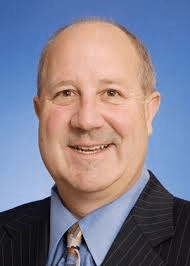
Steven Hayward finds himself facing these questions as he completes his one-year position as visiting professor of conservative thought at the famously left-leaning University of Colorado at Boulder. ILYBYGTH readers may remember the program that brought Hayward out to Boulder. Conservative critics of the university had complained that the school did not include any conservative intellectual presence. As a result, outside political pressure pushed through the program to welcome a series of one-year visiting professors to the campus. The hope was that these prominent conservative intellectuals would spark debate and a more profound sense of intellectual diversity.
Steven Hayward

Steven Hayward

Predictably, the sparks have begun flying. Hayward has been accused of bigotry. His representations of conservative thought, he has charged, have been said to “‘border’ on ‘hate speech.’” In response, Hayward declared, “they’re welcome to fire me if they want.”

What’s the issue? Hayward publicly questioned university policies about sexual harassment and gender sensitivity training. In an interview and an editorial a few weeks back, Hayward asked if the CU philosophy department was really guilty of sexual harassment. In his editorial, Hayward compared the investigation to a witch hunt:

Unquestionably philosophy is among of the most male-dominated disciplines in universities today, but inviting outside review by the American Philosophical Association’s (APA) Committee on the Status of Women was guaranteed to produce a finding as predictable as the Salem Committee to Investigate Witchcraft in 1691. The irony of this situation is the unacknowledged reversal of the presumption of “privilege” that was at the heart of the original (and justified) feminist complaint about sexism a generation ago. While it may still be justified in the case of academic philosophy, it should not be beyond question whether mere statistical “underrepresentation” should be regarded as prima facie evidence of guilt, and therefore allowing the APA report to assert damning findings about the whole department while disclosing virtually no concrete facts.

And recently, Hayward poked fun at campus sensitivity trainings. New faculty at Boulder, as at many college campuses, must attend a session geared toward increasing their awareness about transgender sensitivity. What pronouns should we use when addressing students? How can we avoid unintentional offense to those who do not fit into neat traditional gender divisions? Hayward dismissed this sort of training as “gender-self-identification whim-wham.”

Students reacted with predictable fury. “Bigotry is not diversity,” proclaimed student editorialists Chris Schaefbauer and Caitlin Pratt. In Hayward’s breezy dismissal of the complaints of sexual harassment in the philosophy department, Schaefbauer and Pratt charged, he engaged in the worst sorts of “victim-blaming.” In his dismissive comments about sensitivity toward gender-identity issues, Hayward “invalidate[d] the lived realities of transgender individuals and mock[ed] the LGBTQ community as a whole.”

The kerfuffle has raised some important questions about intellectual diversity and culture-war politics. Is it possible for a university to include a diversity of opinions? Or is there a need for inclusive environments to police any ideas that challenge that sense of inclusivity?

As we’ve seen recently with the case of Brendan Eich at Mozilla, some issues seem to include less wiggle-room than others. It is widely considered “bigotry” these days to oppose same-sex marriage. But I would suggest, in spite of what some conservative intellectuals have asserted, that it is not seen as bigotry to oppose abortion. It might be seen as “bigotry” to make fun of non-traditional attitudes toward gender identity, but it is generally not seen as bigotry to press for lower taxes or more free-market solutions to social problems.

Can a university include a diversity of opinions about sexual-harassment policies? About gender-sensitivity training? Or, to paraphrase one pithy conservative commenter on Hayward’s blog, have birkenstocks become the new jackboots?

It wasn’t a tough call to predict this sort of situation. Back when Hayward was announced as the first Visiting Professor of Conservative Thought at Boulder, your humble editor made the following guess:

this experiment seems certain to degenerate into the most fruitless sort of culture-war grandstanding.

It’s not very satisfying to be proven right when the case was so clear. It can be depressingly difficult to engage in discussions that cross culture-war trench lines.

Conservative thought has always struggled with accusations of bigotry. By framing themselves as defenders of tradition and traditionalism, conservative intellectuals have put themselves in the position of defending the gender and racial hierarchies that were part and parcel of those traditions. Perhaps most famously, conservative intellectual guru William F. Buckley supported segregationism in the 1950s. Though Buckley later repudiated those views, we must ask a difficult question: Will conservative intellectuals always have to defend yesterday’s traditions?

And, on the other side, student leftists have struggled with accusations of hypersensitivity. It is not difficult to lampoon campus activists. Students preach diversity while sometimes demonstrating a stern intolerance toward ideas that ruffle their feathers.

Is this just a question of irreconcilable cultural politics? Will conservative intellectuals continue to outrage leftist sensibilities? Or is there some way to find agreement about the definition and value of intellectual diversity across the culture-war trenches?

 

Building the Machine: Conservatives Debate the Common Core

She’s in a hurry.

Balancing a crate of oranges in one hand, a purse and bag of groceries in the other, a stylish, affluent, and beautiful mom hustles to answer a call on her iPhone from a friend. “Calling to see if you’re going to the special PTA meeting,” the friend asks as creepy music deedles in the background, “the school is changing the tests next Spring . . . something about the Common Core Standards?”

That’s the opening of a new short film about the Common Core Standards produced by the Home School Legal Defense Association. The forty-minute film, Building the Machine, examines conservative arguments for and against the new standards. As we’ve noted in these pages [check out ILYBYGTH coverage here, here, or here, for instance], conservatives have wondered about the implications of these new standards. I’m told by watchful members of the ILYBYGTH community that the film has made a big splash among conservative homeschoolers. What are conservatives supposed to think about the new standards? What do they need to know about them?

The conservative HSLDA certainly wants to portray the CCSS in a negative light. As HSLDA leader Michael Farris makes clear in the documentary, he feels the standards make a fetish of centralization, systematization, and data collection. But the film gives ample time for pro-CCSS conservative intellectuals to make their cases.

Most prominently, Michael Petrilli of the conservative-leaning Fordham Institute tries to allay conservative worries. The standards, Petrilli argues, resulted from an open and public process. They were not imposed top-down by grasping central elites. Best of all, they will improve education. They will hold teachers, unions, administrators, and students to higher standards. Are they perfect? Not according to Petrilli. But they are the nation’s best shot at renewing academic rigor in public education.

Petrilli is joined by conservative standards-boosters such as Mike Huckabee and Chester Finn. But most of the screen time is devoted to CCSS dissidents Sandra Stotsky and Jim Milgram. Both were part of the original validation committee in charge of the standards, and both refused to sign off on the final product. Why? Both Stotsky and Milgram assert that the new standards are not offering the rigorous academic benchmark that they claim to be. And both insist that their dissent was swept under the rug.

The HSLDA documentary also features conservative critics from the Heartland Institute and Pioneer Institute. The new standards, conservative intellectuals complain, were crafted in a secretive manner, rammed through by the federal government, and do not make academic sense. By aiming at the broad middle, by promising to make all students “college and career ready,” these standards fail to prepare students for either college or careers. More troubling, the standards represent a dictatorial overreach by central government. Mega-rich donors such as Bill Gates greased the slide and snuck this project past the complacent American public.

Perhaps more than the messages delivered by the talking heads, the film’s fast-cut montages and sinister musical background send a clear message: Take your kids and run for the hills. We can’t all be as hip, rich, and beautiful as the mom in the opening montage. But the film makes it clear. All of us—beautiful moms and the rest of us alike—need to wake up and smell the Common Core.