Who will conservative evangelicals vote for? Over the past forty years, it has become a common assumption that the “Religious Right” can make or break a presidential campaign. Among some evangelical pollsters and opinion-makers, a new “ABT” attitude—anyone but Trump—seems to be emerging.
For lots of WORLD’s evangelical insiders, it’s ABT…
and I would use what little influence I have to stop him from being elected president. If that means that Hillary Clinton or another Democrat gets elected by default, I am fine with that.
We should also count the cost of following Donald Trump. To do so would mean that we’ve decided to join the other side of the culture war, that image and celebrity and money and power and social Darwinist “winning” trump the conservation of moral principles and a just society.
Ann Coulter accused the WORLD survey of being an anti-Trump set-up. Only Trump, Coulter fumed, displayed “real Christian courage.”
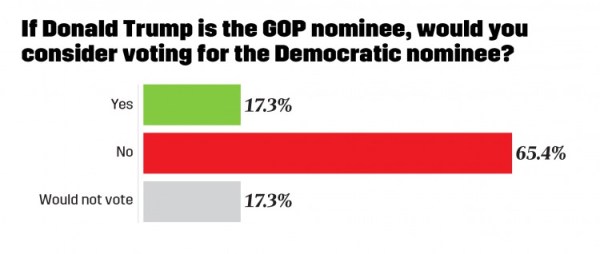
WORLD’s evangelical insiders disagreed. These days, they prefer Marco Rubio. Most telling, more than a third of respondents said they would either vote Democrat or stay away from the polls if Trump were the GOP candidate.
I don’t get out much. So when I was invited to participate in a panel at the annual meeting of the History of Education Society, I jumped at the chance. Especially when it gave me the chance to rub shoulders with some nerd all-stars.
Meet me in Saint Looey…
Our panel will include four authors of books familiar to SAGLRROILYBYGTH. First, Jon Zimmerman will tell us something about global sex ed from his new book, Too Hot to Handle.
Then, Natalia Mehlman Petrzela will keep the sex-ed ball rolling while adding in some bilingual ed as she talks about her book, Classroom Wars.
Next, Andrew Hartman will share some insights about education and culture wars from his blockbuster War for the Soul of America.
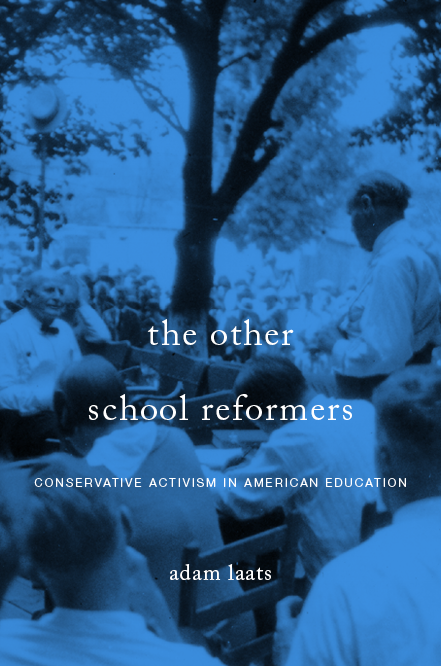
Last, I’ll talk a little bit about what it has meant to be “conservative” when it comes to education, from my new book.
What will we talk about? Hard to say until we get there, but the theme that ties these books together is that of educational culture wars. What have Americans (and people worldwide) seen fit to teach their kids about touchy subjects such as sex and God? Who has been allowed to make decisions about school?
One disagreement we might have could be about the winners and losers. If there are such things as educational culture wars, we all have different conclusions about who has won. Jon Zimmerman argues that kids overall—especially in the United States—get very little sex ed, due to consistent activism against it. I think, too, that conservatives have been able to exert veto power over many big educational programs. Both Andrew and Natalia, though, say that by and large progressive ideas have come out the winner in these battles.
What do you think:
Are there such things as educational culture wars?
If so, are they all in the past?
And, maybe most interesting to most people…who won?
It might not be air-traffic control, but writing academic books has its own nerve-wracking qualities. For years, we nerds research and write, honing the argument, polishing the draft, visiting and revisiting the archives. And we do it without much sense of direction. Is the argument solid? Does it make sense to normal people? When we’re up to our eyeballs in it, it can be difficult to get a clear view of the big picture. Given all this prolonged anxiety, it is a real thrill when someone we look up to likes the book.
First of all, I’m delighted that Petto finds the book worthwhile. He kindly calls it
a must-read for anyone interested in or hoping to effect educational reform—whether in the sciences or in other disciplines.
Woo! By my count, that’s within spitting distance of my ultimate career goal: someone calling a book of mine a “tour-de-force.”
Even better, Dr. Petto understands that my book, in many ways, is targeted at progressive types. Yes, it is a book about conservative school activism during the twentieth century. At heart, though, I hoped to introduce said conservatives to progressives like my younger self who did not understand them, who feared and loathed them…or rather caricatures of them.
As Dr. Petto puts it, for progressives,
The implications are clear: if progressive reforms are going to succeed in public education, then progressives need to address the real concerns of conservative parents and activists.
In the specific case of evolution and creationism, as I also argue in my upcoming book co-authored with philosopher Harvey Siegel, this means that evolution-education types need to spend more time learning about creationism and less time denouncing it as wicked, ignorant, and abusive.
Petto says it better than I ever could. As he concludes,
Conservative activism in education is part of a long and deep tradition, not a series of impromptu protests. To understand that history and the concerns that drive it, according to Laats, is to understand the state of public education in the US. And for those who hope to change things in the public schools, this is an important place to begin.
It wasn’t hard to predict. As I argued a few months back in the pages of Time Magazine, this round of GOP primaries would be full of threats to the Education Department. In a recent interview, front-runner Donald Trump made the usual accusations. But I wonder if there is another, more obvious reason why conservatives like to take potshots at the Ed Dept.
Don’t trust anyone under 37…
In his recent interview with Chris Wallace, Trump made the usual conservative noises: The Ed Department is trying to replace local control of schools with control by “Washington bureaucrats.” Trump blasted competitor Jeb Bush as supporting the sinister Common Core. Trump’s solution? Get rid of the Education Department entirely. It is home to egregious “waste, fraud, and abuse.” [You can find Trump’s education comments starting just before the five-minute mark in the video clip.]
As I’ve argued in my recent book, things weren’t always this way. Attacking federal influence in education only became the default “conservative” position in the late 1930s or early 1940s. At that time, conservatives horrified by New Deal growth lambasted any exertion of federal influence. Before then, however, influential conservatives eagerly embraced the possibilities of federal control over education. Such control, conservative leaders in the 1920s insisted, could force new immigrants to become Anglicized and “Americanized” at a faster clip. Such control, conservatives hoped, could cram traditional values down the throats of leftist teachers nationwide.
Only after the New Deal equated federal power with progressive politics–in the minds of many conservative activists, at least–did “Big Education” come to be equated with “Left-wing Influence.”
I wonder, though, if there’s a simpler psychological reason why today’s conservatives hate the Ed Dept. The department is a novelty. As education nerds are well aware, the Ed Dept recently celebrated its thirty-sixth birthday. 36! It was created only in 1979 by President Jimmy Carter.
So here’s my hunch: Conservatives have many reasons to promise to cut the Education Department. In The Donald’s case, he can use the Common Core to attack rival Jeb Bush. He can appeal to voters’ sense of distrust of “Washington bureaucrats.” He can make it look as if he has concrete plans to slim government and eliminate waste.
But he also can imagine a time without such a department. Indeed, neither he nor anyone else of a certain age needs to imagine it at all. The Education Department is so brand-spankin new that conservatives have no trouble concluding that we will get by just fine without it.
Does he like it? If my translation can be trusted, then yes indeed. He raises central questions and offers some helpful ideas.
With his Continental perspective, Boser points out a fair criticism. My book really does focus on the experience of American activists and traditions. As he suggests, we would all profit from comparative cross-national studies. As he asks, how have conservative ideas formed European educational policies? How have different nations struggled to determine the content of their curricula? Such comparisons would indeed offer a more comprehensive definition of what it has meant to be “conservative,” about education or any other issue.
I’m grateful for Boser’s claim that my book succeeds in giving conservatism and conservative activists a more accurate place in educational history. (At least, that’s my understanding of this section:
dem es den Konservativen einen Platz im grand narrative der US-amerikanischen Schulgeschichte einräumt. Dieses grand narrative wird von Laats durch die Verknüpfung der vier zeitlich und örtlich unabhängigen Einzelfallstudien und durch den Einbezug der Konservativen als wichtige Akteure ausgebaut und gestärkt und nicht etwa in Frage gestellt.
Maybe the SAGLRROILYBYGTH can offer a clearer translation. As I read it, though, Boser generously says that I’ve succeeded in incorporating conservatism into the “grand narrative” of American educational history. For me, after all, the primary motivation for the book was to find out why conservatives show up in so many educational histories as merely pesky gadflies, roadblocks in the inevitable progress of progressive education. In my experience, at least, conservatives have played a much stronger leading role in shaping the course of American education.
At the end, Boser notes my sloppy style and predilection for puns (“seinen Hang zu Wortspielereien und Alliterationen – beispielsweise in den Kapitelüberschriften – und den manchmal etwas saloppen Stil.”) Ouch. In spite of such flaws, though, Boser concludes that my book is overall entertaining (“unterhaltsame”).
As SAGLRROILYBYGTH are aware, if I can’t be punny, I won’t bother. I wouldn’t like to be thought of as a sloppy writer, though.
In the end, I’m extremely gratified to hear that I managed to make a potentially dry and jargon-y book more pleasant to read, at least in Dr. Boser’s opinion.
To be fair, it goes both ways. As I’ve argued here, there, and everywhere, conservative intellectuals have long disputed the influence of the federal government in education. Now, President Obama jabs back: A new college scorecard simply left leading conservative schools off its list. The message is clear, and creepy even for non-conservatives like me.
Naturally, the schools themselves didn’t like it. According to the Washington Post, Paul McNulty of Grove City College issued the following statement:
However well-intentioned, the Scorecard as it exists now is incomplete and does not fully disclose comprehensive data that families need to make informed decisions. For now, the Department should, at the very least, include a disclaimer that the Scorecard is not comprehensive or reflective of all college and universities.
I’m no conservative, but I think these schools have every right to complain. To my mind, the creepy part of this story comes on two different levels.
First, I worry about any ranking of higher education based mainly on economic factors. I don’t think anyone intended for this scorecard to be the only measure of educational quality, but President Obama made no secret of the values inherent in this scorecard. As he put it,
You’ll be able to see how much each school’s graduates earn, how much debt they graduate with, and what percentage of a school’s students can pay back their loans…
That’s helpful information, but I don’t like the implication that such factors are the proper way to measure higher education. Even worse, any scorecard that claims to rank all colleges really should. By leaving out conservative schools who have not played ball with the federal government, this scorecard seems to be making a crude power play.
Again, I don’t agree with the guiding philosophies of any of these schools, but I think they have every right to be included in any list of “every” college out there.
Governor Scott Walker dropped fast. According to the conservative Weekly Standard, Walker led the field of GOP presidential hopefuls in April, dropped to second in August, then plummeted to last place in no time flat. Why? Perhaps his campaign collapse proves that conservative voters do not hate the devils of public education as much as Walker (and I) thought.
Make no mistake. As a voter and a teacher and a lazy college professor, I’m glad to see Walker crumble. But as an historian, I’m surprised. Whatever his faults, I thought Walker had shown some savvy in following a conservative script with nearly a century of success behind it.
SAGLRROILYBYGTH know the story, but for new folks, here’s a quick history lesson: When Governor Reagan was elected president, his first decorating move was to put a large portrait of Calvin Coolidge in the Oval Office. Reagan, after all, modeled himself after Coolidge’s brand of small-government conservatism.
Coolidge had come to national prominence for his stern opposition to a police strike in Boston. Reagan, too, made his bones by combatting an air-traffic controllers’ strike.
I thought Walker could win by using the Coolidge playbook. I thought his union-bashing policies were terrible, but I thought they would win.
Why? There might be education-related reasons other commentators have missed. Maybe GOP voters really don’t hate public-school teachers as much as people think they do. Maybe GOP voters expect their candidate to have a college degree. Could it even be—perish the thought—that voters don’t hate university professors as much as Governor Walker thought they did?
Conservative pundits offer different reasons. Jonathan Last at the conservative Weekly Standard found Walker’s collapse “shocking.” Unlike other meltdowns, Walker’s campaign had suffered no embarrassing gaffes or scandals. Walker had real credentials, so his early front-runner standard was not a fluke. Last concluded that Walker’s loss was likely due to the weirdly broad field of candidates this year and to Donald Trump’s “disruption” of the nominating process.
A lot of Republican voters work for a living, and a substantial number of them are union members. While grassroots conservatives have been instructed by corporate America’s amen corner in the media to be angry with unions and living wages and teachers and public employees, they have never been so enthusiastic in that anger as the billionaires who seek to build their empires on a foundation of income inequality and wage stagnation.
So Walker’s core message—union busting—never really resonated to the extent that the governor and his strategists imagined it would.
But don’t forget that Walker’s union-busting was only one leg of a broader strategy based in educational culture-war thinking. He loudly and proudly fought against teachers’ unions, certainly, but also aggressively went after lazy college professors. Even his own story of dropping out of college to do something more important shows a long-term dedication to bucking the educational status-quo.
I admit it. I thought Governor Walker had hit upon a winning program, even if it was a program I didn’t like. In my last book, I argued that Walker’s brand of educational conservatism had proven politically unbeatable time and again. Throughout the twentieth century, it became a winning strategy among conservatives to bash teachers in no uncertain terms.
I thought it would still work, especially in the howling scramble of this year’s GOP presidential contest. But maybe I got it as wrong as Governor Walker did. Maybe that time has passed.
Get yr copy today! The book one person is talking about!!
SAGLRROILYBYGTH are sick of hearing about the book. But new readers might not know that I looked closely at four of the most famous school controversies of the twentieth century. I wanted to figure out what had gone into making someone “conservative” when it came to education.
It would not have been kosher, I thought, simply to pick some of the best-known conservative groups and chronicle their activism. To do so, I would have had to impose a definition of what it meant to be a true “conservative.” By looking at school battles and examining instead what the conservative side wanted in each case, I was able to extract a definition of conservatism without imposing one from the outside.
That was the goal, anyway. Did it work? Dr. Wakeford thinks so:
Laats’ case-study approach is sound, effectively accomplishing his stated purpose of avoiding falling into easy stereotypes and generalizations (5).
Whew! My second goal in this book was to avoid imposing twenty-first-century connotations of “conservatism” onto earlier generations. I worked hard to get into a broad array of archives in order to get a handle on what conservatives themselves really cared about in the decades from 1920 to 1980. I was enormously gratified to read that Wakeford appreciated my labors. As he put it, my approach
also required that he dip into a remarkably eclectic source base, which ends up as one of the book’s strengths. Given the public nature of educational debates, national and local newspapers from Tennessee to Pasadena to West Virginia provide the core. But the study is enriched by Laats’ use of state legislative records and evangelical publications from the 1920s, the archival and published record of the American Legion and other conservative groups, local school board records, and, in the case of Kanawha County, author interviews with key figures.
In the book—and in my work here on ILYBYGTH—I worked hard not to impose my own progressive assumptions or stereotypes on conservative activists. I did not want to write a book simply damning the work of conservatives. Rather, I wanted to try to understand their goals and evaluate their strategies. Wakeford evaluated those attempts kindly as well:
To his credit, Laats rarely questions his subjects’ sincerity or the authenticity of their curricular visions, crediting them as meaningful participants in an important civic conversation about the purpose of schooling. But he is no sympathizer, and asks difficult questions about what has really made the movement tick.
Almost makes you want to read the book! Many thanks to Dr. Wakeford and the US Intellectual History blog.
But deBoer accuses his allies of a curious blind spot. They tend to mock conservative students on Facebook and other social-media outlets. DeBoer comes to the smart conclusion:
People are really, really invested in consistency and fairness. And if academics don’t make a huge improvement in projecting them, they will be the razor with which our throats are slit.
many academics I know have reflexively, unthinkingly laughed off these conservative complaints. They’ve bombarded social media with “lols” and “wtfs.” They’ve mocked these students as rubes. They’ve given every outward appearance of not even attempting to evaluate these students’ claims with the same care, sensitivity, and fairness that they evaluate the claims of progressive students invoking the language of trauma and triggers. In other words, they’ve rushed to confirm every complaint conservative critics of the academy have made, and the most damning one in particular: that we treat our progressive students with more kindness and approval than our conservative students, and that we use the formal procedures of the university to do it.
I wholeheartedly agree with Dr. DeBoer’s warnings, but I think he could take it one step farther. Not only do my fellow progressive academics tend to assume too much about their campuses and their social-media worlds, but they do so out of a woeful and widespread ignorance. Some of us assume that young people will somehow naturally sympathize with left-leaning ideas. We couldn’t be more wrong.
If the campaign against microaggressions has any moral heft, it is because it is at heart a campaign against ignorance. Yet as sociologists such as Elaine Howard Ecklund have argued, many scholars display shocking ignorance about their own students.
Even if we progressive professors are polite to our conservative students, are we guilty of microaggressions that only the students themselves notice? Do we betray our own ideals by failing to learn more about our students’ backgrounds? Are there things we don’t even notice about our classes that might make conservative students feel unwelcome?
That’s the question that fuels most of our culture-war animosity. Instead, the question we should all be asking is this: What’s the right thing to do? In the case of same-sex refusenik Kim Davis, some conservative intellectuals and pundits are willing to break ranks and see the bigger picture.
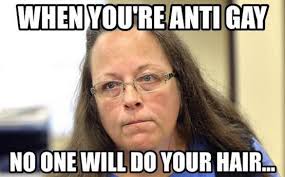
Governor Huckabee’s shameful pandering to frustrated Christian voters should be an embarrassment for every conservative out there. But progressives also could stay a little classier in this case. For those like me on the progressive side of things, the furor and venom over the Kim Davis case burst onto our Facebook feeds like a sweaty middle-school pimple. I don’t agree with Davis’s refusal to do her job, but I also think it is counter-productive and petty to attack Davis’s hairstyle.
Missing the point…
We could all learn a lesson from a few conservatives who refuse to conform to their culture-war scripts. Fox News anchor Shep Smith, for example, earned the ire of conservative viewers for pointing out the obvious hypocrisy in the case. Critiquing the Huckabee rally, Smith commented,
They set this up as a religious play again. This is the same crowd that says, ‘We don’t want Sharia law, don’t let them tell us what to do, keep their religion out of our lives and out of our government.’
It’s clear that there are many Christians who support Kim Davis because she’s doing something, even if that something is arguably counterproductive. This is unwise. . . . If the public comes to think of religious liberty as the constitutionally guaranteed right to ignore the Constitution whenever it suits us, the cause of religious liberty — which is guaranteed by the First Amendment — is going to suffer tremendously. Conservatives are supposed to understand the difference between the vice of cowardice and the virtue of prudence. If religious liberty means that even officers of the state can defy the law without consequence, then it makes every individual a potential tyrant.
Writing from the conservative bastion of the Southern Baptist Convention, Russell Moore and Andrew T. Walker made a similar point. While Moore and Walker bemoaned the “judicial overstep” and “government inaction” that led to this situation, they did not excuse Davis’s reckless behavior. “We must recognize,” they note,
the crucial difference between the religious liberty claims of private citizens and government officials. Let us be clear: Government employees are entitled to religious liberty, but religious liberty is never an absolute claim, especially when it comes to discharging duties that the office in question requires. While government employees don’t lose their constitutional protection simply because they work for the government, an individual whose office requires them to uphold or execute the law is a separate matter than the private citizen whose conscience is infringed upon as a result of the law. It means the balancing test is different when it comes to government officials because of their roles as agents of the state. Government officials have a responsibility to carry out the law. When an official can no longer execute the laws in question due to an assault on conscience, and after all accommodating measures have been exhausted, he or she could work for change as a private citizen, engaging the democratic process in hopes of changing the questionable law.
We must be very clear about the distinctions here between persons acting as an agent of the state and persons being coerced by the state in their private lives. If the definition becomes so murky that we cannot differentiate between the freedom to exercise one’s religion and the responsibility of agents of the state to carry out the law, religious liberty itself will be imperiled.
For these brave conservative commentators, agreement with Davis’s opinion of same-sex marriage did not mean an automatic endorsement of Davis’s actions. All of us could learn from their example.
Those of us who consider ourselves progressives should commit to examine every case with the same gimlet eye. Just because we agree with someone’s position in general does not mean we must agree with their actions in every case.
Conservatives should be reminded to differentiate between today’s headlines and the big picture. Civil disobedience is a right and duty of us all, at times. But not every act of civil disobedience is equal, and civil disobedience has never meant simply flouting the laws we don’t like.
More important, we must all be willing to speak up against our own “side” when it is in the wrong. The first question should not be “Which side are you on?” but always “What is the right thing to do?”










 I Love You but You're Going to Hell