I Love You but You Didn’t Do the Reading

Another week come and gone–here are some ILYBYGTH-themes headlines you might have missed:

Should colleges ban the laptop?

Trump Trump Trump! More news this week from the land of Lord Dampnut:

Reza Aslan and Lawrence Krauss go head to head: Is religion a good thing?

Could the Museum of the Bible have thwarted Roy Moore-philia? George Weigel connects the dots at National Review.Bart reading bible

Why do school reformers charge in without thinking first? Curmudgucrat Peter Greene offers an explanation.

If Roy Moore wins his election, he still won’t be the worst senator Alabama has ever sent to Washington.

Let’s segregate our schools better, from Rann Miller at Salon.

Is this a “Sputnik moment” for civics education? Robert Pondiscio and Andrew Tripodo make the case at Flypaper.

How did we get the bajillion-dollar Bible Museum? At IHE, Scott McLemee reviews Bible Nation: The United States of Hobby Lobby.

From the Creation-Museum-watching Trollingers: How does the Bible relate to creationism and vice versa?

Why Is It So Hard for Us to Teach Civics?

We should be freaking out. It’s not just that Americans don’t know about basic democratic principles. In increasing numbers, we don’t seem to care. Pundits lately have hoped we might be in a rock-bottom crisis of civics education, a “Sputnik moment” that drives Americans to re-invest in basic education in democratic ideas. We’re not. Our civics stand-off is even more hopelessly rancorous than our never-ending fights about creation and evolution.

Last year, Richard D. Kahlenberg and Clifford Janey hoped that the ugly, bizarre emanations from Trump’s White House might scare America straight when it came to civics education. It wasn’t only Trumpism that alarmed them. The numbers seemed truly shocking and getting worse. As they explained,

Civics literacy levels are dismal. In a recent survey, more than two-thirds of Americans could not name all three branches of the federal government. . . . Far worse, declining proportions say that free elections are important in a democratic society.

When asked in the World Values Survey in 2011 whether democracy is a good or bad way to run a country, about 17 percent said bad or very bad, up from about 9 percent in the mid-1990s. Among those ages 16 to 24, about a quarter said democracy was bad or very bad, an increase from about 16 percent from a decade and a half earlier. Some 26 percent of millennials said it is “unimportant” that in a democracy people should “choose their leaders in free elections.” Among U.S. citizens of all ages, the proportion who said it would be “fairly good” or “very good” for the “army to rule,” has risen from one in 16 in 1995, to one in six today. Likewise, a June 2016 survey by the Public Religion Research Institute and the Brookings Institution found that a majority of Americans showed authoritarian (as opposed to autonomous) leanings. Moreover, fully 49 percent of Americans agreed that “because things have gotten so far off track in this country, we need a leader who is willing to break some rules if that’s what it takes to set things right.”

More recently, Robert Pondiscio and Andrew Tripodo offered a few specific suggestions about how teachers can “seiz[e] the moment to improve civics education.”

I share their concern and Pondiscio and Tripodo offer some smart concrete steps to start making improvements. As all these authors are surely aware, though, civics education faces an impossible challenge.

Consider the Sputnik analogy: Back in 1957, Americans were rightly dismayed that the Soviet Union had taken the lead in space technology. Among the many results was a new burst of funding for new science textbooks, books that no longer truckled to the political power of creationists. The BSCS series included robust information about evolution, and by the end of the 1960s those books were being widely used in American classrooms. (If you’re looking for a quick guide to this history, check out Teaching Evolution in a Creation Nation.)

We aren’t facing a similar situation when it comes to our shoddy civics education.

Why not? Much as creationists might not like it, by 1957 the mainstream scientific community had reached a powerful consensus about the basic outline and importance of the neo-Darwinian synthesis. There is no similar mainstream establishment that can satisfactorily define the proper aims of civics education.

Consider the example I included in my book about educational conservatism. Back in the late 1930s, a set of widely used social-studies textbooks became intensely controversial.  Harold Rugg’s books had been used by millions of students, but in just a few short years they were mostly all yanked from classroom use.

OLYMPUS DIGITAL CAMERA

Watch out: Your school might be teaching civics…

The problem was that Rugg was pushing his vision of civics education. It was a vision that conservatives such as the founder of Forbes Magazine and leaders of the American Legion found subversive.

What did it mean in the World War II years to educate citizens? Harold Rugg thought it meant teaching them the dangers of authoritarianism. He thought it meant teaching them that the United States was one country among many, and that citizens needed to be rigorously skeptical of big business and back-room government deals.

Conservatives thought it meant teaching students to honor and cherish the best American traditions. They wanted children in school to learn to be proud Americans, not weak-kneed socialists. Bertie Forbes explained his beef in one of his popular syndicated columns. He was chatting one day with a group of middle-school students, Forbes related, and they told him about their experience with their Rugg books. When their teacher asked them if the United States was the best country in the world, many of them had answered “Yes.” The correct answer, their teacher read from their Rugg teachers guide, was “No.” In his column, Forbes teed off on that sort of civics education:

Do American parents want their children taught such ideas?  Do they want them to be inculcated with the idea that the United States is a second-rate country, that its form of government is open to question, that there are other countries more happily circumstanced and governed than ours?

Maybe I’m getting too cynical in my old age, but I don’t think we have evolved very far from this 1940s level. When it comes to civics education, we face a stark and glaring divide about the fundamental purposes of such a class. Are students getting a good civics education if they learn how to properly, reverently, fold a flag? Are they getting a good civics education if they can rattle off the correct structure of federal government? Or are they getting a good civics education when they learn how to stage a Black Lives Matter protest?

We can’t agree. And until we can, we will continue to have shameful outcomes in our attempts to teach civics in public schools.

Missing the Boat on Creationism at the New York Times

It’s more than just a couple of minor goofs. A recent “retro” report about creationism and evolution education in the New York Times makes the usual huge mistakes in its description of American creationism.

SAGLRROILYBYGTH know I’m no creationist myself. I want more and better evolution education in America’s public schools, as I argued recently in my book with philosopher Harvey Siegel. But we won’t achieve that goal as long as we keep telling ourselves these comfortable/scary myths about creationism. If we want to fight the political influence of creationism, it is far better to understand creationism as it really is, instead of the clumsy monstrosity we usually imagine.
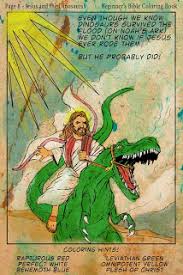
Jesus on a dinosaur.jpg 1

Kicking ass for creation.

Let me start with the positives. The report did a good job of describing the basic history of anti-evolution legislation and court battles from the 1920s to today. As they describe, anti-evolution laws have been struck down by SCOTUS and other courts time and time again. They also did well to include the voices of both the smartest pro-evolution pundit—Brown’s Kenneth Miller—and leading creationists, including Answers In Genesis’s Georgia Purdom and a panel from the intelligent-designing Discovery Institute.

The problems with the report are not mere details or minor interpretative mistakes. No, the danger is that too many of us non-creationists woefully misunderstand the world of American creationism. As with this report from the New York Times, we will repeat misleading notions to ourselves and think we have a better picture of creationism. The real danger, of course, is that we will traipse off with our non-knowledge to make plans and policies, without a whiff of a sense that we are building on the wrong foundation.

As I’m arguing in my current book about American creationism, the first goof most non-creationists make is to treat creationism as a large, scary, undifferentiated mass. In the NYT report, for example, the young-earth Georgia Purdom is cited alongside the intelligent-designing Stephen Meyer as if there is not an enormous difference between their two beliefs.

Why does it matter? For one thing, the suggestion that a huge army of creationists are massing to take control of public schools is scary. But the idea of a fractured and disputatious set of cranky creationists isn’t. And that’s much closer to the truth. Consider, for example, Dr. Purdom’s criticism of intelligent design. While some evangelicals might like the notion at first, Purdom has argued, in the end, in an ID universe,

God appears sloppy and incompetent, if not downright vicious.

For the young-earthers at Answers In Genesis, ID is not an ally but rather another danger to be confronted. In the end, there is no such thing as “creationism”—at least not the way the New York Times article suggests. Rather, there are many creationisms. And those different visions of science and religion often fight one another far more viciously than they fight against mainstream science.

Here’s my second beef. As always, this article and its expert talking heads refer to creationism as “anti-science.” It’s not. All of us love science. As anthropologist Chris Toumey put it in his underappreciated book, God’s Own Scientists, creationists are like all Americans. We all have deep faith in the

plenary authority of science; that is, the idea that something is more valuable and more credible when it is believed that science endorses it.

In other words, whether people are shilling toothpaste, NASA budgets, or creation science, they always dress up in lab coats to make their pitch.

Why does that matter? If there are two simple sides to these culture war fights—science on one side and anti-science on the other—then we would have a much simpler time convincing the antis to get on board. Instead, as we saw so excruciatingly in the Ham-on-Nye debate a while back, what we end up doing instead is wasting time with each side trying to prove just how much it loves science. We don’t need to have that talk again. If we all love science, we can have more productive conversations—even if we disagree—about how to teach science in public schools.
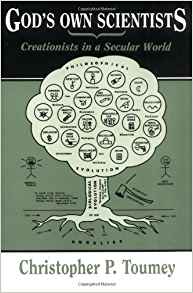
toumey

Read this!

Last and most important, we need to acknowledge the false and misleading myths about creationism’s history. This article is especially egregious in suggesting that creationism is making a bold new political advance, that fundamentalist armies are sweeping state legislatures in a frightening new show of creationist strength.

For example, the NYT report says that creationists haven’t scored a victory since the Scopes trial in 1925, until now. It describes menacingly that a “growing skepticism about science has seeped into the classroom.” I understand the reasons for alarm, but the notion of a huge uptick in creationist political power simply does not match the historical record.

The career of anti-evolution agitation has been one of steady decline in ambition and reach. For nearly a century now, anti-evolution activists have fought for a set of ever-shrinking goals. As I found in my first book, anti-evolution laws in the 1920s wanted nothing less than the imposition of theocratic rule on American public schools. In Kentucky, for example, a 1922 bill would have banned not only evolution, but atheism and agnosticism. An amendment would have pulled any book from a public library that might lead a student to question her religious beliefs.

Compare those bills to creationists’ efforts today. Please don’t get me wrong. I am in full agreement with Kenneth Miller and Zack Kopplin; today’s anti-evolution laws are terrible. But that doesn’t mean that they represent a bold new surge of strength for anti-evolutionism. They don’t. Rather, they are just the latest strategic grab at scraps of influence and power by anti-evolutionists.

Why does it matter? Well, I think I probably don’t need to spell it out, but I will. If creationism is 1.) united, 2.) anti-science, and 3.) surging to greater and greater power, those of us who oppose religious imposition in public schools need to take drastic action. We’d need a wholesale reorganization of the decision-making process in public-school curricula. We would need to come up with radical ways to intervene in local educational decisions, as the US did with racial segregation to such mixed results.

If, on the other hand, creationism is shrinking, fragmented, and in agreement about the fundamental intellectual power of capital-S science, we face a much different environment. It won’t generate as much attention, but it would be better policy to simply continue our efforts. We should continue to do what we’ve been doing: Advocate tirelessly for more and better evolution education; explain and explore the real contours of American creationism; repeat that evolution is not a religious idea—it won’t hurt students’ religious faiths.


From the Archives: Take the Creation Museum Challenge

The Challenge: Can you tell creationism apart from mainstream science just by looking?

[Editor’s note: As SAGLRROILYBYGTH are sick of hearing, I’m almost finished with my book manuscript about American creationism. In this book, I’m trying to help my fellow non-creationists understand the complexities of real creationism. For example, in my final chapter I’m arguing that creationists–whether they are radical young-earthers or mild-mannered BioLogians–can’t fairly be accused of being anti-science. Yet smart, well-informed outsiders keep insisting that they are.

[As I polish up this final chapter, I stumbled across the following ILYBYGTH post from a few years back. I thought I’d run it again to see if anything has changed. So here’s the question once again: Whether you’re a creationist, anti-creationist, or other, can you tell radical creationism apart from mainstream science just by looking?

[Please…take the challenge and let us know how you fared!]

Take the Creation Museum Challenge

We can gnash our teeth.  We can pull our hair.  But no matter what we do, the Creation Museum of Answers In Genesis has pulled it off.  With its new $1.5 million dinosaur exhibit, the flagship museum of young-earth creationism has successfully mimicked the outward appearance of mainstream scientific museums.

Big Valley Creation Science Museum

It used to be easy.  Creationist museums used to be only sad little affairs.  They used to look like this one from Alberta, Canada.  The Big Valley Creation Science Museum, pictured here, may do a great job in spreading the creationism gospel.  But no idle tourist would be likely to confuse it with mainstream museums such as the Smithsonian’s Museum of Natural History or Boston’s Museum of Science.

It used to be easy for outsiders like me to mock the lame pretensions of the many creation museums that dotted our great land.  And Canada.  As one angry visitor noted, even the bigger creation museums used to have strange, sad displays like this one from San Diego’s Creation and Earth History Museum.

Not a Lot of Big Bang for your Buck

But here’s the new challenge: Can you tell which of the three pictures below comes from Kentucky’s Creation Museum display and which come from the Smithsonian and Boston’s Museum of Science?  As arch-creationist Ken Ham explained gleefully recently, his new display of a million-dollar Allosaurus fossil puts Ham’s Creation Museum in the same league as those mainstream museums.  As Ham put it,

For decades I’ve walked through many leading secular museums, like the Smithsonian in Washington, D.C., and have seen their impressive dinosaur skeletons. But they were used for evolution. Now we have one of that class, and it will help us defend the book of Genesis and expose the scientific problems with evolution.

So take the Creation-Museum challenge.  Just by looking, can you tell which of these images comes from a young-earth creationist museum and which come from mainstream ones?  (Don’t cheat.  But once you’ve given it a try, you can click on each image to see its provenance.)

Field museum exhibit

Is this “real” science?

Or Is It This One?

Or Is It This One?

dinosaur hall smithsonian natural history museum t rex 550

Millions of year? …or millions of dollars?


This successful mimicry is important.  In creationism’s twentieth-century struggle to establish alternative educational institutions to rival those of mainstream science, young-earth creationists often wrestled with significant disadvantages.  Not least of these were questions of funding, as historian Ron Numbers described in his must-read book The Creationists and I detailed in my 1920s book.  In the case of this priceless fossil, rich creationists Michael and Stephen Peroutka donated it to help the Creation Museum with its work.

It would be nice to think that America’s public would make its decisions about the age of the earth and the origins of humanity by weighing evidence and considering counter-claims.  To people like me, the Creation Museum’s claim that this well-preserved fossil serves as proof of a worldwide flood 4,300 years ago seems absurd.

But I don’t think we need to be very cynical to guess that appearance matters.  As Dan Kahan argues, what people believe about creation and evolution usually has more to do with their cultural identity than it does with scientific evidence.  If Answers In Genesis can make their museum LOOK like the Smithsonian, many visitors will assume it is just as good.  And if Answers In Genesis can crank out peer-reviewed science publications that attest to the scientific veracity of their claims, many readers will assume their science is just as good.

So take the Creation Museum challenge.  If you can’t tell the difference, how can you expect anyone else to?

Read This Before You Freak Out…

Conservatives might be shooting their guns in the air to celebrate. Progressives might be shedding a tear in their IPAs. Whether it’s a triumph or an apocalypse, it’s not a surprise: The Ed Department is filling its ranks with more and more conservative, creationist leaders. Before we freak out, though, let’s take stock of the real situation.

zais

He’s coming for your public school…

First, the creationism part. The new pick for the education department’s undersecretary has made no bones about his creationist sympathies. As head of South Carolina’s schools, Dr. Mick Zais supported the removal of the idea of natural selection from the state’s science standards. As Zais told a local newspaper, “We ought to teach both sides and let students draw their own conclusions.”

It’s not only creationism. Queen Betsy’s pick for undersecretary of education will make conservatives happy for a lot of other reasons as well. Zais comes to the nomination fresh off his post as South Carolina school superintendent. As Politico reports, Dr. Zais became a conservative ed hero for refusing to truckle to the Obama administration’s carrots and sticks.

In South Carolina, Zais pushed hard for vouchers. Time and time again, vouchers are embraced by conservatives who hope to shift public-school money to private schools, often religious schools.

When Zais’s zeal is added to DeVos’s enthusiasm, it might seem to progressives and conservatives alike that conservatives have finally triumphed in the world of educational politics. If ILYBYGTH cared about clickbait, we would certainly write something that exploited that sort of attitude. But we don’t and we won’t. Because, in historical perspective, this moment of conservative triumph looks much less triumphant than it might seem at first.

First, let me repeat the caveats SAGLRROILYBYGTH are sick of hearing: My own politics skew progressive. I think creationism has no place in public-school science classes. I am horrified by Queen Betsy and I think President Trump’s leadership is a blight on our nation that won’t be easy to recover from.

Having said all that, I’m not interested this morning in fighting Trumpism but rather in understanding it. And when we see Queen Betsy’s reign from the perspective of the long history of conservative activism in education, we see just how wobbly her throne really is.

First, as I noted in my book about twentieth-century educational conservatism, today’s conservative push for charters and vouchers is both a novelty and a concession. Milton Friedman promoted the idea of charter schools way back in the 1950s, and nobody listened. Even the free-marketiest of Reaganites didn’t care much about promoting alternatives to traditional public-school funding.

Take, for example, Reagan’s second ed secretary, William J. Bennett. He was far more interested in pushing traditional moral values and classroom rules in public schools than in gutting public-school funding.

What happened? Only in the 1990s did conservative education pundits embrace the notion of charters and vouchers. They did so not as a triumph, but as a grim concession to the obvious fact that they had been stumped and stymied by their lack of influence in public schools.

So when conservative heroes like Queen Betsy and Superintendent Zais push for alternatives to traditional public schools, progressives should fight back. But we should also recognize that the conservative drive to fund alternatives results from conservatives’ ultimate failure to maintain cultural control of public schools.

Plus, the language used by conservatives these days represents another long-term progressive victory. In his public argument for voucher schools, for example, Superintendent Zais voiced his agreement with progressive ideas about the purposes of schooling and public policy. Why should we have more vouchers? Quoth Zais, vouchers will provide “more options for poor kids stuck in failing schools.”

I understand Zais may be less than 110% sincere in his zeal to promote social equity through public school funding. Nevertheless, the fact that he felt obliged to use that sort of progressive reasoning shows how dominant those progressive ideals have become.

In other words, if even South Carolina’s conservatives adopt the language—if not the authentic thought processes—of progressive thinking about the goals of public education, it shows that progressive ideas have come to dominate our shared beliefs about public education.

On the creationist front, too, Zais’s conservatism shows the long-term decline of conservatism. It wasn’t too long ago, after all, that creationists fought and often won the battle to have evolution utterly banned from public schools. These days, all Zais can dream of is maybe wedging some worse creationism-friendly science into public schools alongside real science.

Science educators won’t like it. I don’t like it. But once again, before we freak out, we need to recognize the long-term implications of our current situation. The dreams of creationists are so far reduced they no longer preach the abolition of evolution. If you ask creationist leaders these days what they want in public schools, they’ll tell you they want children to learn evolution, “warts and all.”

We don’t agree about that. And we don’t agree about the value of vouchers. I’m not even ready to concede that Dr. Zais and I agree on the best ways to use public schools to help alleviate poverty and improve the economic life chances of kids in lower-income families.

And I’m perturbed. I’m frightened by Queen Betsy. If he’s confirmed, I’m guessing I’ll be alarmed by Dr. Zais’s work.

I also know, though, that the seeming strength of conservative thinking these days is an illusion.

How Roy Moore Put Jesus on a Dinosaur

It’s ugly. And weird. The accusations against Roy Moore in the Washington Post are hard to read without shuddering. It got even uglier and weirder when some evangelical leaders actually supported Moore’s alleged actions. Yet those familiar with the history of American fundamentalist institutions see a familiar pattern in this depressing story. And maybe I’m too deep in my new book about American creationism to think clearly, but it seems to me these sorts of attitudes help explain radical young-earth creationism.

If you haven’t seen the story, it’s grim. The Washington Post shared allegations by women that Roy Moore had groped and kissed them back in the 1970s, when they were young teenagers and he was a thirty-something lawyer. To complicate things, Judge Moore has always been a controversial figure, insisting on keeping a 10-commandments monument in his courtroom even when ordered to remove it. Moreover, Moore just won a contentious GOP primary election in the US Senate race. He’s facing a tough battle with his Democratic opponent.

That history helps explain the continuing support for Moore among conservatives. Almost 40 percent of Alabama evangelicals say they are MORE likely to support Moore after these accusations. Only 28 percent say they’re less likely to do so.

We might be understandably tempted to see the whole thing as just another episode in today’s bare-knuckled political free-for-all. Judge Moore defended himself in those terms, after all. He claimed the whole story was just a cynical smear campaign against him. Real conservatives, he tweeted, needed to see through the fake news. In his words,

The forces of evil will lie, cheat, steal — even inflict physical harm — if they believe it will silence and shut up Christian conservatives like you and me. I believe you and I have a duty to stand up and fight back against the forces of evil waging an all-out war on our conservative values!

From Liberty University, President Jerry Falwell Jr. took Moore at his word. The accuser, Falwell intoned, was not as “credible” as Moore. The same thing happened to President Trump, Falwell noted, yet Trump heroically triumphed.

The story, according to Moore and Falwell, is one of brave conservatives fighting false accusations. In today’s climate, it makes some sense to me that people on both sides would rally around someone who they thought was falsely accused by the “forces of evil.”

But nitty-gritty politics don’t really explain the way some evangelical leaders seem to actually condone Moore’s alleged actions. They don’t just deny the allegations. They deny that there’s anything wrong with them. Alabama State Auditor Jim Ziegler noted that Joseph and Mary had a similar age difference when they married.

Jesus on a dinosaur

If mainstream science says it couldn’t have happened, it must be true.

“Mary was a teenager and Joseph was an adult carpenter,” Ziegler told the Washington Examiner. “They became parents of Jesus. There’s just nothing immoral or illegal here. Maybe just a little bit unusual.”

Other evangelical leaders rushed to disagree. At Christianity Today, for instance, Ed Stetzer emphasized that evangelicals are not okay with Moore’s alleged actions. As Stetzer put it,

Christians don’t believe the message that is coming from some of Moore’s supporters. Actually, most of us find it really creepy.

Those of us who live outside of the charmed circle of American evangelicalism might have a difficult time understanding why Stetzer even needs to make such a statement. Of course it’s creepy!

As I finish up my book manuscript about American creationism, I can’t help but see enormous parallels between Ziegler-style rationalizations and radical young-earth creationism. As I detail in the book, by the late 1950s America’s conservative evangelicals faced a difficult situation. Unlike their fundamentalist parents in the Scopes generation, by 1960 evangelicals had to cope with the fact that mainstream scientists had generally agreed on the outlines of modern evolutionary theory. They had a few options: Reject creationism altogether along with their evangelical beliefs; accept the scientific strength of mainstream evolutionary thinking but claim that it didn’t change their evangelical religion; or reject mainstream science utterly.

Following the lead of theologian John Whitcomb Jr. and engineering professor Henry Morris, thousands of earnest evangelicals chose the third option. They believed Whitcomb and Morris that mainstream scientists had followed Satan’s red herring and abandoned true science. As Whitcomb and Morris put it in their 1964 preface,

extrapolation of present processes into the prehistoric past or into the eschatological future is not really science.

In order to have true biblical faith, Whitcomb and Morris argued, Christians needed to reject radically the claims of mainstream science. There was a better science out there, a biblical science, that insisted on a young-earth and a literal interpretation of the “days” in the Bible’s six-day creation story.

genesis flood 1961 ed

Why would (false) scientists lie?

Before the 1960s, not many evangelical Christians believed those things. After that, however, young-earth creationism became a mainstream belief among conservative evangelicals.

What does any of this have to do with Alabama’s Senate race? Then and now, conservative evangelicals have nurtured a unique sense of persecution, of their role as a beleaguered minority, unfairly ejected from their rightful role as America’s conscience and moral guardians, usurped and despised. A mainstream society that can treat good Christians that way, the thinking goes, must be following a false trail. When challenged or threatened, then, it is not very difficult for some evangelicals to reject huge swathes of mainstream thinking. Such mainstream thought, after all, had been led astray by the “forces of evil.”

In Moore’s case, we see how quickly some supporters wrapped Moore’s alleged actions in a sheaf of pages from Scripture. And in the case of rejecting mainstream science, it was relatively easy for thousands of evangelicals to believe outrageously radical scientific ideas.

When you assume that mainstream thinking is from the devil, it becomes very easy to accept ideas that the rest of us find bizarre. It becomes easy to think that sexual predation has Gospel roots, or that Jesus could have cavorted happily with Brontosaurus.

HT: MM

I Love You but You Didn’t Do the Reading

Happy Monday the 13th! I hope you have good luck today. Here are a few of the stories and trends that passed across our desk this week:

Scales and schools: How do well-meaning reformers keep goofing? Why do they insist on “scaling up” good schools when it never works?

Red Dynamite: At Righting America at the Creation Museum, Carl Weinberg untangles the connections between creationism and anti-communism.Bart reading bible

Education culture-war news from the midterm elections: School board vote in Colorado dings vouchers.

Ahhh…Thanksgiving. The holiday to gather around a table and yell culture-war insults at our friends and family. At 3 Quarks Daily, Scott Aikin and Robert Talisse reflect on “familial angst” on Turkey Day.

Why are college students so touchy about free speech? As reported by IHE, a new survey says it’s because they’re Americans.

Arica Coleman looks at the career of neo-confederacy in American textbooks, at Time.

What’s wrong with charter schools? The Progressive examines the debates in North Carolina.

…and what’s wrong with “personalized learning?” EdWeek listens to three critics.

John Oliver takes on Ken Ham. Should Kentucky’s Ark Encounter receive tax incentives?

Creating Jobs

Is it worth it? Ken Ham says heavens yes. John Oliver says hell no. This week on Last Week Tonight (5:42-8:12) Oliver rips into tax incentive schemes in general, and the Kentucky uber-creationist Ark Encounter project in particular.


Oliver’s accusations aren’t new. Critics such as Americans United for the Separation of Church and State have long criticized Kentucky’s willingness to forego sales tax revenue as part of an incentive program for the huge Ark project.

After all, as AU points out, Kentucky’s goal is the creation of “jobs, jobs, jobs.” To work at Ark Encounter, though, potential employees must be conservative evangelical Christians. And not just any sort of evangelical. They have to embrace Answers In Genesis’s specific vision of true creationism. They are encouraged to love non-fundamentalist Christians, but they must agree that all non-fundamentalists are going to hell forever. Ark employees can’t be gay. And if they’re single, they must agree to a chastity clause in their contracts. AU thinks such beliefs should never be supported with tax incentives.

John Oliver, as always, is more interested in zingers. As he points out, Ark Encounter includes some stuff that is just pure wackiness, such as a section devoted to the question of manure. Where did all the poop go?

Moreover, Oliver skewers the notion of signing a chastity pledge when the entire purpose of the Ark was to encourage sex, sex, sex, among the animals. As Oliver puts it, they didn’t get on the Ark two-by-two so that every animal would have a “swim buddy.” I’m too embarrassed to repeat Oliver’s most hilarious name for the Ark (it rhymes with “duck boat”), but if you watch to the end of his clip you’ll see how he ties together the Ark Encounter, the Entourage movie, zebras drowning in feces, and masturbation.

It’s hilarious, but it raises important questions. Should religious groups enjoy tax privileges? Ken Ham’s answer is that saying no would be pure discrimination. He points out that his group is not receiving any money from the state, but is rather simply not paying some taxes that would never have been paid in the first place if he didn’t bring hordes of creationist tourists to the area.

Oliver says no. He thinks ALL tax-incentive programs need to be held to higher standards.

Americans United says no, too, but for different reasons. They argue that tax money and tax incentives should not be allowed to fuel divisive, sectarian religious programs.

What do you think? Should creationists be allowed to profit from tax programs that other groups use? Or should tax incentives be restricted to less-controversial organizations?

I Get the “Racist” Part…but Why Is It “Creationist”?

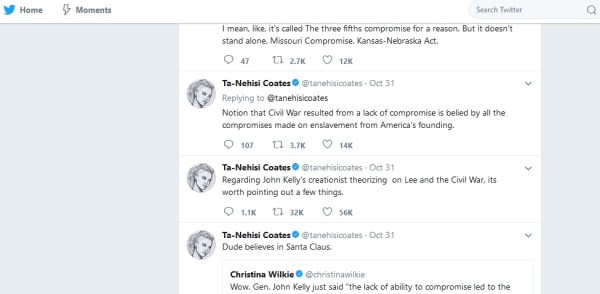
We history nerds are a-flutter. Trump’s Chief of Staff John Kelly got us riled up by stating that General Lee was an “honorable man” and that more “compromise” could have avoided the Civil War. To many of us, such arguments are a cruel attempt to whitewash the deep racism that fueled the war and today’s culture war over Confederate monuments. I’ve been putting in my two cents and following the debate closely. In general, I feel like I understand the various positions involved, but recent comments by one of my favorite pundits have me stumped.

https://www.youtube.com/watch?v=rOgrVKSvUfI

Some of my friends and family generally agree with General Kelly. They don’t see why academic historians are so determined that support for heroes back then implies support for racism now. The common charge is that progressives and historians are trying to “whitewash” history by disrespecting monuments to our shared past.

To academic historians like me, it seems obvious: Most of the General Lee monuments didn’t go up right after the Civil War. They went up much later, in a blatant attempt to assert a heroic history for the slave regime of the Confederacy. They were an attempt by later white-supremacist state governments and organizations to whitewash history, to prove that the Confederates were the good guys, not really traitors after all.

The back and forth can be exhausting, but at least I feel like I (sort of) understand both positions. When Ta-Nehisi Coates offered a recent condemnation of General Kelly’s remarks, though, he flummoxed me. As Coates put it, “Regarding John Kelly’s creationist theorizing on Lee and the Civil War, its worth pointing out a few things.”

ta nahesi coates general kelly creationist tweet

…am I missing something???

As you can imagine, this is the line that stumps me. Why is Kelly’s defense of General Lee “creationist”? I agree that it’s bad history. I agree that at root it supports a white-supremacist-derived vision of American history, even if I understand that many people who agree with Kelly don’t think of themselves as racist.

But why, oh why, did Coates call this “creationist” thinking? As SAGLRROILYBYGTH know, I’m fascinated with all things creationist. And I could imagine some reasons why someone would lump together Christian-history activists like David Barton with creationist activists like Ken Ham.

Is that what Coates is doing? Or do people in general just use “creationist” as an all-purpose adjective meaning “wacky” or “incorrect?” I looked over his twitter feed and I couldn’t find any explanation. Can you?

History, not Faith

Why do so many white evangelicals support President Trump? Not just in a passive, least-worst, anyone-but-Hillary sort of way, but actively and even enthusiastically? Why have some white evangelical leaders become what historian John Fea calls “court evangelicals?” After all, President Trump is no one’s idea of a Christian. One recent argument ties evangelical Trumpism to faith, but not surprisingly, I think it has a lot more to do with historical imagination. For people who fantasize about a lost American “Shining City upon a Hill,” Trump’s “take-back-America” rhetoric punches important buttons.

Trump make america great again

It’s the hat, stupid.

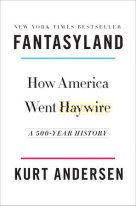
Over at Religion Dispatches, Eric C. Miller interviews Kurt Andersen about Andersen’s new book Fantasyland: How America Went Haywire. I haven’t read the book yet, but I’ve got it ordered. It sounds fantastic and I’m looking forward to reading the whole thing.

I can’t help but spout off a little, though, about some of Andersen’s arguments in this interview. Andersen describes his explanation of the odd relationship between the starchy moralists of America’s evangelical subculture and the wildly careening leadership of President Trump. Andersen makes connections between charismatic belief and Trumpism, but I think there’s a much more obvious and important explanation. Trump appeals powerfully not to anyone’s ideas about God and worship, but rather to white evangelicals’ implicit vision of American history.

On a side note, I couldn’t help but shudder at one of Andersen’s other statements. Like a lot of pundits, he makes some major goofs about the nature of creationism these days. As Andersen puts it,

Just in the last 15 years, it has become Republican orthodoxy to disbelieve in evolution and to challenge evolution instruction in the public schools. This is a uniquely American phenomenon, and it is a product of a religious tradition that, starting about a half a century ago, decided to make that stand in favor of creationism.

I added the emphasis to point out the problem. Andersen’s not alone on this point, but he is deeply wrong. Radical creationism’s political oomph is not at all uniquely American. To cite just one example, Turkey’s government has made even more aggressive moves in favor of creationism. This is not a minor error, but a major misreading of the nature of modern creationism. As I’m arguing in my current book, following in the footsteps of the great historian of creationism Ron Numbers, radical young-earth creationism is not “uniquely American,” but rather a popular and politically potent response to the dilemma of post-modern life, worldwide and across many religions.fantasyland

That’s a big intellectual problem, but it is not my major beef with Andersen’s argument this morning. No, the real question today is about the relationship between America’s politically active white evangelical Protestant community and the shoot-from-the-hip political style of President Trump. How could it happen?

For Andersen, the connection can be tied in part to one wing of evangelical belief. For charismatic Christians, Andersen explains, belief in the unbelievable is part and parcel of their culture of dissent. Here’s how Andersen made his point, with emphasis added:

[Miller]: Then I have to ask you about Donald Trump. He is now America’s Conspiracy-Theorist-in-Chief, a position that he attained with support from 81 percent of white evangelicals. Does this research help account for that?

[Andersen]: It’s bizarre. It’s interesting, because he is not, in any meaningful sense, a Christian. So why is it that our most fervently Christian fellow citizens support him so strongly? Well, as you say, our most fervently Christian white citizens. I think there is something there—it suggests that there are other reasons, cultural and economic reasons, together with the religious motivations that are driving that support.

But for my purposes, within this Fantasyland template, I think that they have some things in common beyond resentment of the elites and some of these other traits that are not necessarily connected to belief in the untrue—a lack of respect and all that. But Trump has shown a unique willingness to embrace claims that are demonstrably untrue—that Barack Obama wasn’t born here and a conspiracy covered that up; that Ted Cruz’s father was involved in the JFK assassination; that five million illegal immigrants voted against him in the 2016 election; and on and on and on. The fact that he is so indifferent to empirical reality and so willing to stand up and embrace explanations that simply confirm his pre-existing ideas or are convenient for him because they make him seem better or his enemies worse—it’s somewhat unkind, I understand, to say that he shares that tendency with religious people, but I think that is shared.

There is no evidence that people who speak in tongues are speaking a holy language. There is no empirical evidence that faith healing works. There is no real evidence that Jesus was resurrected. I could go on. So, if believing these sorts of things as a matter of faith is central to your identity, then you might identify with a guy who is willing to take strong stands on unprovable claims. If he also shares—or pretends to share—your cultural biases and resentments, then you’re going to like him! That’s about as close as I can come to explaining this strange embrace. Certainly in terms of his lifestyle, his brutal disdain for the least among us, he is so, so unchristian. I haven’t entirely figured that out—it’s another book.

Now, I agree with a lot of what Andersen has to say. I agree that “cultural biases and resentments” are the key to understanding white evangelical Trumpism. But I disagree that we can best explain Christian Trumpism by invoking “religious motivations.”

Not that there aren’t plenty of white evangelicals who justify their Trumpism in religious language. Some leaders like to say that Trump is their modern David or Cyrus. But they wouldn’t say or even allow themselves to think that they can support Trump because they already believe in unbelievable things. I get what Andersen’s saying: If you are accustomed from your religious background to a conspiratorial or fantastic mindset you are more likely to choose and support a conspiracy-theorist president. However, it’s misleading to suggest that such religiously driven beliefs are a leading explanation for Christian Trumpism.

If it’s not mainly due to their religious beliefs, why DO so many white evangelicals actively support Trump? I think Andersen is on the right track when he talks about “cultural and economic reasons,” and “cultural biases and resentments.” As I’m arguing in my new book [have you pre-ordered your copy yet?] about evangelical higher education, a leading theme in evangelical intellectual life has been the story of evangelical exile, of being kicked out of the centers of political power. Among white American evangelicals, a unique historical vision of themselves as the true Americans has fueled a century of culture-war vitriol.

From the 1920s through today, white evangelicals have been goaded and guided by this unique sense of usurpation. Unlike other powerful religious minorities, such as American Catholics, white evangelicals tell themselves over and over again that the United States used to be solidly theirs. Unlike other religious groups—even groups that are closely connected to them by theology such as African-American evangelical Protestants—white evangelicals have been sure that they deserve to claim or reclaim their role as America’s religious voice.

In short, we can’t look to theology or faith to understand evangelical Trumpism. It’s tricky, because evangelical Trumpists will explain their decisions in the language of faith. But if we listen only to such biblical justifications, we’ll miss the far-more-important real reasons for evangelical Trumpism.

For almost a century now, white evangelicals have wanted to “take back America.” Their college campuses have been seen as both citadels and havens for an imagined real America, the kind of America from which the rest of America seemed to have strayed. When a political candidate comes along and declares his wish to “make America great again,” it resonates powerfully. Just ask Reagan.

It is this history of resentment, of a sense of historical exile, of usurpation, that best explains white evangelical Trumpism.