“Science Buff” Pushes Creationism in Missouri

H/T: Sensuous Curmudgeon

Why does dreamy Missouri legislator Rick Brattin want Missouri schools to teach both evolution and intelligent design?  In his words, because “I’m a science enthusiast. I’m a huge science buff.”

Image Source: Riverfront Times

Image Source: Riverfront Times

In an interview last week with St. Louis’ Riverfront Times, the Republican lawmaker explained that he had introduced a new “equal time” bill because true science demanded it.

Those of us hoping to understand conservatism and creationism in America’s schools should pay attention to Brattin’s rationale.  In this interview, Brattin articulated a vision of science, religion, and education that resonates among many creationists and their allies.  Evolution, Brattin claimed, actually played the role of obstructionist religion.  Brattin told the paper, “I’ve had numerous college professors within biology, school science teachers…who say they are not allowed to teach any type of theory [like intelligent design]…. They are banned from the science community.”

As we’ve noted here before, not only creationists but conservatives of various types often complain that they have been excluded from intellectual debate.  These arguments seem to convince Representative Brattin.  As Gallup polls have suggested, calls for equal treatment and fair play do very well among the general populace, as well.

A Visit to a Creationist Homeschool Science Fair

What would a creationist homeschool science fair look like?

Greg Laden at ScienceBlogs described his recent trip to one in Minneapolis-St. Paul.

Laden offered more than just a snarky blanket condemnation of the creationism and science on display.  Some of the exhibits, Laden wrote, were actually pretty good.  In one exhibit, students created and explained plant tissue batteries, for instance.

Some students, though, conducted experiments that disappointed the mainstream scientists.  One student, for instance, made salt stalactites to prove that they could form more quickly than some mainstream scientists believed.  According to Laden, mainstream science already knew that even limestone stalactites could form fairly quickly.  Another student retreated from science to explain animal behavior.  Faced with a question he or she could not answer, one student told Laden that “a certain problem would be solved because ‘God put something in the animal to make that happen.'”

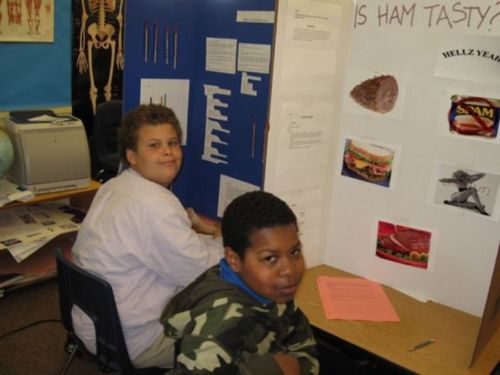
Non-creationist science fair...

Non-creationist science fair: “Is Ham Tasty? Hellz Yeah”

Best of all, IMHO, Laden recognized that some of the weaknesses of student presentations were not due to religious belief, but rather due to the age of the presenters.  As Laden put it, “many of the limitations and shortfalls of the less than stellar posters were typical of small scale school science fairs in general, not peculiar to these students.”

This point is clearly one that could use more study.  We observers of creationism and evolution education often lament the fact that relatively few students learn any real evolutionary science.  But we must remember the broader point: relatively few students learn any real anything in too many of America’s schools.  It is not fair to assume that students’ generally weak grasp of evolutionary concepts is necessarily due to religious dissent.  Rather, we should measure the successful teaching of evolutionary concepts alongside other basic concepts such as the appreciation of literature, the history of the founding of the country, or algebra.  My hunch is that the “shocking” weakness of most American adults in mastering the basic concepts of evolutionary theory might not look so shocking compared to the weakness of American adults in mastering other basic concepts.

Evolution for Christians

How are evangelical Christians supposed to understand evolution?  This morning at BioLogos, evangelical scientist Dennis Venema begins a series that hopes to explain why evolutionary ideas do not conflict with a Bible-based evangelical faith.

One of the trickiest aspects of understanding American creationism is that there are potentially as many “creationisms” as there are creationists.  Many outsiders like me tend to use the term “creationist” as a catch-all term, when in fact the differences among and between types of creationism are perhaps the key to bridging many of our evolution-creation culture-war divides.

Some “creationists,” for instance, embrace the young-earth creationism promulgated by organizations such Answers in Genesis or the Institute for Creation Research.

Others might find an old-earth version more compelling, one such as that defended by Hugh Ross and Reasons to Believe.

Yet others might prefer the big-tent creationism of the intelligent-design movement, promoted most assiduously by the Discovery Institute.

Still others might prefer the sort on offer by Dennis Venema in this series.  BioLogos calls its brand of creationism “evolutionary creationism.”  In general, BioLogos’ creationism embraces the tenets of evolutionary science.  Such evolution, many evolutionary creationists insist, is simply God’s method of creation.
I’m looking forward to following Venema’s series.  Venema describes it this way:

“The goal of this course is straightforward: to provide evangelical Christians with a step-by-step introduction to the science of evolutionary biology. This will provide benefits beyond just the joy of learning more about God’s wonderful creation. An understanding of the basic science of evolution is of great benefit for reflecting on its theological implications, since this reflection can then be done from a scientifically-informed perspective. From time to time we might comment briefly on some issues of theological interest (and suggest resources for those looking to explore those issues further), but for the most part, we’re going to focus on the science.”     


Teaching the Bible, Texas Style

A new report from the Texas Freedom Network warns that some public schools in Texas are teaching religion.  Not all religions, but the Bible-loving, apocalypse-watching, evolution-denying type of conservative evangelical Protestantism.

How do these public schools justify it?  According to the TFN report, public schools fold these sectarian doctrines into their Bible courses.  Public-school courses about the Bible are explicitly constitutional.  US Supreme Court Justice Tom Clark made very clear in his majority opinion in Abington Township v. Schempp (1963) that public schools can teach the Bible, if they did so in a non-devotional way.  As Clark specified,

“Nothing we have said here indicates that such study of the Bible or of religion, when presented objectively as part of a secular program of education, may not be effected consistently with the First Amendment.”

However, the TFN report argues that many of the Texas school districts are using Bible classes to teach religious doctrine, including the notion that the Bible demands a young earth.  The report’s author, Mark A. Chancey of Southern Methodist University, reports that the courses are generally poorly taught, with low academic rigor, by underprepared teachers.

Professor Chancey includes excerpts from some of the teaching materials.  In the Dalhart Independent School District, for example, one student information sheet included the following information:

“Since God is perfect and infallible, an inspired book is absolutely infallible and errorless in its facts and doctrines as presented in the original manuscript” (pg. 28).

In the Bible courses of Lazbuddie, Texas, students will read the following:

“We should have an understanding of what happened in Noah’s day if we are to know when the coming of our Lord is near.  What are the similarities between the days of Noah and the days preceding the coming of Jesus Christ (Matthew 24:37-39)?” (pg. 32)

In Dayton schools, students watch the Left Behind movie, fundamentalist author Tim LaHaye’s dramatization of the rapture and final days (pg. 19).

As Chancey points out, these doctrines are intensely sectarian.  They teach a specific interpretation of the Bible as eternally true.  Students in these public school classes would be told that the doctrines of conservative evangelical Protestantism are the correct and only interpretation of the Bible.

Are we shocked?

We shouldn’t be.

Here’s why not:

First of all, the numbers of schools and students involved is very small.  Professor Chancey found 57 districts plus three charter schools who taught Bible courses in 2011-2012, a small percentage of the 1037 districts in Texas.  Not all of these districts taught the Bible in such heavy-handed sectarian ways.  And of the districts that reported their student numbers, only three had more than fifty students enrolled in Bible class.  Six districts had fewer than five students in Bible (pg. 5).

Second, the practice of teaching sectarian religion in public-school Bible classes has a long and surprisingly uncontroversial history.  As I explored in my 1920s book, while public attention was focused on anti-evolution laws, between 1919 and 1931 eleven states quietly passed mandatory Bible-reading laws for public schools.

Finally, even after the anti-Bible SCOTUS ruling in 1963, many public schools simply continued the practice.  As political scientists Kenneth Dolbeare and Philip Hammond found in their survey of schools in a Midwestern state, the Supreme Court rulings against public-school Bible reading made absolutely no difference in school practice.  Where students had read the Bible before, they continued to do so, without raising any controversy.

So Professor Chancey’s findings that a few students in a few public schools in Texas learn a sectarian interpretation of the Bible should come as no surprise.  As Chancey notes, similar Bible classes go on in several other states as well (pg. v).  Moreover, as political scientists Michael Berkman and Eric Plutzer have convincingly argued, public school teachers usually teach ideas that are locally uncontroversial.  In some places, that means teaching creationism as science.  In others, it means teaching the Bible as history.


Creationists: Randy Moore Wants Your Children!

There is no doubting Randy Moore’s evolution-education credentials.

A professor of biology at the University of Minnesota, Professor Moore has received the National Center for Science Education’s Friend of Darwin award, and the National Association of Biology Teachers Evolution Education award.

Randy Moore, in short, has long been one of the most engaging and engaged voices in the campaign to get more evolution education into America’s schools.

And what is Moore’s most recent argument to make America’s schools more evolution-friendly?

In a remarkable article in the “evolutionary-creationist” BioLogos Forum, Moore and colleague Sehoya Cotner offered two recommendations for improving evolution education:

1.) Let Jesus teach it!

2.) Catch creationist kids young!

Here are their actual words:

“We know of no evidence that the availability of such solely science-focused workshops, seminars, and other forms of evolution-related education will significantly affect what creationism-based biology teachers teach. Since the impediments to better teaching of evolution are primarily the philosophical and religious views of biology teachers, programs that do not address the more personal, ‘non-science’ issues of science educators directly and effectively are likely to have little impact on what students learn in high-school biology classrooms. Instead, if further fact-based instruction in evolution is part of the answer, it is likely to be most effective with young children, who are developmentally primed to seek explanations for natural phenomena. However, evolution instruction is essentially absent prior to high-school biology; by high school, a student’s teleological demands have likely been met by supernatural explanations, creating a cycle of adults who know little about evolution and teach creationism-flavored biology.”

In other words, as Moore and Cotner convincingly demonstrate, simply assuming that the scientific evidence for evolution will convince creationist teachers has not worked, and will not work.  They rely heavily on the research of Penn State political scientists Michael Berkman and Eric Plutzer.  Instead, evolution education needs to get away from the delusion that the scientific evidence alone will do the job.  With adults, effective evolution education, as Moore and Cotner contend, must address “philosophical and religious” issues involved.  This conclusion makes eminent sense.  However, it brings us to an awkward realization: science education must range far beyond science education to be effective science education.  Are creationist teachers to be taught that Jesus wants them to accept evolution?  That seems to be Moore’s and Cotner’s implication, and it raises a host of thorny issues.

The second prong of their policy argument is equally radical.  If “fact-based” evolution education is to work, Moore and Cotner argue, it must reach young students before their families’ influence has become decisive.  In other words, effective evolution education must evangelize aggressively to counter the “supernatural explanations” offered young people by their parents and church leaders.  Effective evolution education must seek to replace those family influences with the influence of scientific evidence.

Randy Moore has long been one of the smartest voices in the field of evolution education.  And his logic in this article seems uncontrovertible.  Yet it raises disturbing questions.  Can evolution educators discuss “philosophical and religious” implications of evolutionary theory?  Doesn’t that amount to sectarian religious education?  In other words, if science educators try to teach that Jesus is not against evolution, isn’t that making a strictly religious argument?

And we need to ask tough questions about targeting young minds:  Can a campaign to reach young creationist kids work?  Is it the place of public education to target family culture and religion?

Revisionaries on PBS

The Revisionaries is coming next week to PBS.

In conjunction with Binghamton University’s Evolutionary Studies Program, we screened the film not too long ago.  At our screening we had a spirited discussion about the nature of science and the politics of education.  Now folks beyond the major metropolitan areas of New York, LA, and Binghamton will have a chance to see it.

Why would you want to, you ask?

For anyone interested in the teaching of American history, evolution/creation, the nature of American conservatism, or even just the functioning of educational and cultural politics, this film is a must-see.  Director Scott Thurman followed the goings-on at the Texas textbook review hearings of 2009-2010.  He spent time with conservative leaders such as Don McLeroy and Cynthia Dunbar.  Thurman gave each of them a chance to explain their educational ideology.  The film shows the campaign for non-evolution to be included in science classes.  Viewers can watch the fight to change the standards for social studies, to include more Reagan and less hip-hop.

According to the National Center for Science Education website, The Revisionaries will be shown as part of PBS’ Independent Lens series, during the week of January 28, 2013.  Check your local listings!

The Trauma of Evolution

Can we educate by banning ideas?  For one group of conservative Christian homeschoolers, proper education means banishing lots of ideas.  How can progressive educators like me understand this impulse to put up intellectual walls around young people’s minds?  I wonder if some creationists view exposure to evolutionary ideas as a form of trauma, an entirely harmful experience.

The Finish Well homeschooling conference, in the words of its organizers, “is designed to equip homeschooling families to confidently homeschool the high school years for the glory of God!”

One of the ways the conference promises to help attendees is by purging the atmosphere of any hint of evolution.  In order to secure a table at the conference, vendors are required to agree to the following statements:

“1) Scripture teaches a literal 6 day creation week, a young earth of approximately 6,000 years, and a literal understanding of Adam and Eve, the Fall, and the world-wide Flood of Noah’s day. 2) The Bible is the verbally inspired Word of God. It is inerrant and our ultimate authority in what we believe and how we live. Any speakers who contradict these two truths during their speaking session will be immediately asked to leave.”

Clearly, the goal of Finish Well is not only to keep out evolution.  Any other explanation about humanity’s origins will be verboten as well, including the evolutionary creationism of folks such as Darrel Falk or the big-tent creationism of the intelligent-design movement.

This notion of proper education is one of the hardest intellectual nuts for progressive educators like me to crack.  How are we to understand this idea that good education means hiding important ideas away from young people?  My first reaction, my gut reaction, is that this is precisely the sort of totalitarian impulse that kills any real education.  This sort of intellectual protectionism smacks of Nazi Germany or Stalinist Russia.  To me, and to lots of people, one of the first rules of true liberal education means opening intellectual doors, not bricking them up.  Real education, in my opinion, means allowing young people to explore a variety of ideas, to make up their own minds.

But in the conservative tradition, an important aspect of improving education has long consisted of the effort to remove “dangerous” ideas from the educational mix.  For generations, various types of conservative activists have insisted that simple exposure to certain ideas represented a danger—something from which young people had to be protected.

This idea played a big part in the first “creationist” controversies in the 1920s, as I explored in my 1920s book.  One of the public leaders of the anti-evolution movement of that decade was populist politician and former US Secretary of State William Jennings Bryan.  Bryan condemned the notion that good education meant a willy-nilly exposure to perfidious ideas.  In a battle with the University of Wisconsin over the teaching of evolution on campus, Bryan offered this sarcastic advertisement for the college:

“Our class rooms furnish an arena in which a brutish doctrine tears to pieces the religious faith of young men and young women; parents of the children are cordially invited to witness the spectacle.”  [SOURCE: William Jennings Bryan, “The Modern Arena,” The Commoner (June, 1921): 3.]

For my current book, I’m exploring the longer history of conservative educational activism.  This notion of proper-education-as-protection echoed throughout the twentieth century.  For instance, Grace Brosseau, President General of the Daughters of the American Revolution, argued that young children ought not be harmed by “the decrepit theory that both sides of the question should be presented to permit the forming of unbiased opinions.”  Such modern theories of education, Brosseau insisted, fundamentally misunderstood the nature of childhood and the responsibilities of education.  As she explained in 1929,

“One does not place before a delicate child a cup of strong black coffee and a glass of milk; or a big cigar and a stick of barley candy; or a narcotic and an orange, and in the name of progress and freedom insist that both must be tested in order that the child be given the right of choice.”

Instead, parents and teachers must give students only what students need to develop the “delicate and impressionable fabric of the mind.” [SOURCE: “The 38th Continental Congress, N.S.D.A.R.,” DAR Magazine 63 (May 1929): 261-271.]

More recently, the late Mel and Norma Gabler echoed this notion that proper education meant protecting young people from dangerous ideas.  In their 1985 book What Are They Teaching Our Children, the Gablers compared modern teaching to letting young children float in dangerous seas in flimsy lifeboats.  Modern teachers, the Gablers argued, too often allowed children to drift near sharp reefs and crashing waves, without offering any sort of guidance.  The teachers knew the rocks were there, the Gablers argued, yet these ‘progressive’ teachers did not see fit to warn the students.  Better for the students to ‘discover’ such dangers for themselves.  The Gablers asked, “Has the instructor gone mad?” (pg. 99).

For the Gablers, as for Bryan, Brosseau, and the organizers of the Finish Well conference, the notion that some ideas must be hidden from children made perfect sense.  For those like me who don’t agree, perhaps one key to understanding might come from the school controversies of the 1920s.  During that decade, many state lawmakers proposed bills that promised to keep certain ideas out of children’s paths.  One 1927 bill in Florida would have banned “any theory that denies the existence of God, that denies the divine creation of man, or that teaches atheism or infidelity, or that contains vulgar, obscene, or indecent matter” [Florida House Bill 87, 1927].

To the authors of this bill, evolution and atheism could be treated the same way as “obscene” material.  To those 1920s legislators, it made sense to keep obscene materials out of the hands of school children.

I agree that young people ought not be exposed to “obscene” materials.  And maybe this is the way for folks like me to understand the conservative impulse to keep some ideas out of schools.  After all, all of us—not just conservatives or fundamentalists—agree that some things must be kept from children.  No one wants young people to view a lot of hard-core porn at school, for instance.  Nor do we think that children should see graphic violence.  Exposure to such things seems traumatic.

Is this the key to understanding the conservative insistence on keeping certain ideas out?  For some young-earth creationists, mere exposure to evolutionary ideas represents a danger to their young children.  It might be that such conservatives view exposure to evolutionary ideas as an intellectual trauma, a theological trauma.  Such ideas might be ‘out there’ in the world, just like genocide, rape, and lynching might be ‘out there,’ but that does not imply that education must include graphic exposure to them.

Is this the way to understand Finish Well’s prohibition of any hint of evolution?  I’d love to hear from those who believe that young people should be protected from such ideas.

Truth and Science in Louisiana

What is Truth?  The question is as old as Pilate, and still as troublesome.

As anti-creationist activist Barbara Forrest notes in a perceptive article in the Louisiana Coalition for Science blog, anti-evolutionists in that state have made a telling error in their reading of mainstream science education.

In a struggle to impose a two-model evolution/creation curriculum in Central, Louisiana, creationists misquoted the Louisiana Department of Education’s (LDOE’s) 1997 Louisiana Science Framework (LSF).  In that framework document (see page 12), the LDOE offered a carefully worded articulation of the mainstream vision of the nature of science.  As Forrest notes, the LDOE explicitly demanded that true science should be taught “as a human enterprise and a continuing process for extending understanding, instead of the ultimate, unalterable truth.”

When creationists of the Louisiana Family Forum crafted their argument for teaching both creationism and evolution as science, they misrepresented this statement.  The Louisiana Family Forum’s proposed resolution contained the following assertion:

“WHEREAS, the Louisiana Science Content Standards at page 12 indicate that science should be ‘presented as a . . . [ellipsis in the LFF document] continuing process for extending understanding of the ultimate, unalterable truth’(7);”.

As Forrest points out, there is a world of difference between what the Louisiana standards demand and what the LFF said the standards demand.  Forrest notes that this slip could be due either to dishonesty or carelessness.  True enough.

But I think this mistake also tells us a great deal about the yawning chasm that separates the two sides’ understandings of the nature of education.

For science educators such as Barbara Forrest, the notion that a state standards document would define science education as a quest for “ultimate, unalterable truth” seemed immediately, obviously bizarre and suspicious.  That is simply not the way mainstream science educators talk.  Indeed, the paragraph from which that line came says a great deal about mainstream understandings about education.

Here is that paragraph in full:

“The purpose of science education is not for students to memorize the ‘right’ answer, but for them to move along a learning continuum toward a deeper understanding of science concepts and processes.  Current research indicates that it is best for understanding to be constructed actively by the learner.  This learning style offers a new role for the science teacher as a facilitator of learning versus an imparter of knowledge.  Instruction should minimize rote learning and focus on in-depth understanding of major concepts and topics, with students actively exploring those ideas through activities they can relate to their own lives.  Students often work cooperatively in small groups to exchange and critique their own ideas, with the teacher facilitating discussion rather than providing answers.  Science is presented as a human enterprise and a continuing process for extending understanding, instead of the ultimate, unalterable truth.”

Now THAT is the way mainstream education folks talk!  Note the emphasis on teacher as facilitator, the role of student as an active constructor of knowledge.  Note the emphasis on cooperative learning and the de-emphasis on the traditional delivery of information from teacher to student.

This is how many mainstream education researchers understand the process of learning and teaching.  This is NOT the way most conservatives and traditionalists understand education.  Though I don’t know the LFF and certainly can’t speak for them, many conservatives and educational traditionalists have a very different understanding of the nature of education.  For many conservatives, education—whether it’s about evolution, the American Revolution, or any other topic—is precisely about transmitting “ultimate, unalterable truths” from one generation to the next.

So whether the Louisiana Family Forum made a mistake in reading the Louisiana science standards or whether the LFF deliberately misrepresented those standards, the LFF ended up articulating a vision of education much closer to the understandings of most American conservatives.  Education, in the conservative view, must be about “ultimate, unalterable truth” in order to have any meaning at all.


Creation Colleges

Where did you go to school?  Did you learn about evolution?  WHAT did you learn about it?

Non-creationists like me are often dumbfounded by the notion that so many educated Americans believe in a young human species.  But a quick look at the large number of young-earth-creationist colleges shows us how easy it is to earn a college degree without leaving the intellectual boundaries of young-earth creationism.

As recent Gallup polls consistently demonstrate, almost half of American adults agree that humanity was formed in “pretty much its present form” within the past 10,000 years or so.  And of those young-earth creationist adults, the same proportion went to college as non-creationist adults.  That is, believers in a newish human species are just as likely to have a college degree as believers in a long history for the species.

As always, it’s vitally important for outsiders like me to recognize the many different sorts of creationist belief.  Young-earth creationism, the notion that the earth has only been in existence for about as long as is described in the Bible’s Book of Genesis, is only one version.  Intelligent design theorists, like those of the Discovery Institute, or evolutionary creationists, like those of Biologos, also oppose mainstream evolutionary science, but without insisting on a young earth.

And, to be fair, this Gallup question only asks about the age of the human species, not the age of the earth.

Nevertheless, the notion that such large percentages of educated Americans agree that humanity is so new, and so un-evolved, always makes me wonder what kind of education Americans are receiving.

The leading young-earth creationist organization Answers in Genesis provides a handy guide.  To be fair, the map of creationist colleges provided by AiG makes no claims to be an exhaustive guide to all creationist institutions of higher education.  Rather, this map only includes those schools whose presidents have signed AiG’s statement of faith.

A quick glance at the map shows how easy it will be for most college-bound young people to find a college that affirms young-earth beliefs.  Even in my neighborhood of sunny Binghamton, NY, two schools made the AiG map, Davis College and Baptist Bible College.

The sponsoring schools include such fundamentalist heavy-weights as Bob Jones UniversityLiberty University, and Pensacola Christian Colleges.  Other sponsors include smaller schools such as Jackson Hole Bible College and Ohio Christian University.

For those of us trying to understand creationism from the outside, this thriving culture of creationist higher education provides a crucial clue.  We can’t know what all the students, or even all the professors at these schools believe, but the schools themselves devote themselves to promulgating the notion of a young human earth and divine creation by fiat, as described in Genesis.

Strange Bedfellows: Creationists and the “Cults”

Here’s a stumper: Why do proudly orthodox Protestant young-earth creationists embrace non-orthodox writers?

If anyone were to be touchy about the theological bona fides of their friends, it would seem to be the YECs, the defiantly literalist readers of Genesis.

But for generations, creationists have enthusiastically promoted the work of anti-evolution writers from outside the world of conservative Protestantism.

These days, the best example is the work of Jonathan Wells.  Wells’ 2000 Icons of Evolution received an enthusiastic reception even among the fiercest and most combative young-earth creationists.

Wells has credentials to back up his frontal assault on the scientific establishment.  In addition to his PhD in theology from Yale, Wells earned a doctorate in molecular and cell biology from Berkeley.  He currently holds a fellowship at the intelligent-design mothership Discovery Institute.

It’s not surprising that the big-tent anti-evolutionists of the Discovery Institute would welcome Wells.  But it may come as a shock to see him embraced by the fiercer separatists at the young-earth Answers in Genesis.  Yet, in its review of Wells’ Icons, AiG only describes Wells as follows:

“Wells is a man with indisputable intellectual gifts who does not bow to intimidation. Having been opposed to serving with the American armed forces in Vietnam, he chose jail rather than compromise his convictions. He then went on to earn a Doctorate in Theology (Yale) and a second Doctorate in Molecular and Cell biology (Berkeley).”

Fair enough.  But conspicuously unmentioned is Wells’ leadership role in Rev. Moon’s Unification Church, the once-booming religion often called “the Moonies” by outsiders.

Wells himself makes no secret of his Unification belief.

At best, most conservative evangelical Protestants would likely agree that the Unification Church lies somewhere outside the borders of true Christianity.  One evangelical theologian defined the Unification Church as “a pseudo-Christian cult.”  Less prominent evangelical bloggers have called the Unification Church “the anti-Christ,” and a dangerous, greedy, opportunistic organization peddling “wacky theology.”

Most intriguing, this orthodox embrace of the non-orthodox is nothing new.

As I argued in my 1920s book, the first generation of Protestant fundamentalists eagerly snapped up the anti-evolution writings of authors from far outside the pale of acceptable theology.  Most prominently, early American fundamentalists read the work of Catholic authors such as Alfred McCann.  McCann’s God or Gorilla earned him an invitation from William Jennings Bryan to come to the 1925 Scopes Trial as an anti-evolution expert.

Though Bryan himself had a tetchy relationship with fundamentalism, Bryan saw no reason not to publicly embrace the Catholic McCann.  McCann, however, did not want to play along.  He told Bryan privately in June, 1925 that a big public trial would not solve the problem.  Likely, McCann did not feel comfortable on the side of the prosecution.  In that era, Protestant fundamentalists regularly denounced the Pope as the anti-Christ, and Catholicism as a deadly soul-crushing abomination.

For those like me outside the intellectual world of conservative religion, it might make perfect sense for anti-evolutionists to ally with anyone who fights evolutionary theory.  After all, the enemy of my enemy is my friend.

But when we get inside theological logic, such pragmatism is often denounced as moral compromise and sinful truckling.  Consider, for instance, Answers in Genesis’ recent denunciation of conservative Protestant leader Pat Robertson.  Over the course of his career, Robertson has proven himself to be a staunchly conservative, thoroughly dedicated evangelical Protestant.  Yet when he repudiated the notion of a young earth, the young-earth creationists pounced on him.  In the words of AiG pundit Tommy Mitchell, “It is compromisers like Robertson who actually lead our children astray.”  If creationists accept an ancient earth due to the mainstream scientific evidence, Mitchell asked,

“Why not adopt the views of the secular world about abortion, about marriage, about homosexual behavior, about premarital sex, about child-rearing, and about morality? After all, if the secular world is wise enough to tell us how to interpret our Bibles, it must be wise enough to guide us in other areas, too.”

To my mind, this is the puzzle: Among some young-earth creationists, a thoroughly heterodox Jonathan Wells can be lauded as an exemplar of correct thought.  But a deeply conservative Protestant leader like Robertson can be denounced as leading children into abortion and homosexuality by insisting that Biblical belief does not mandate belief in a young earth.

How are we outsiders to make sense of this?

The first obvious answer is not satisfying.  We might say that young-earth creationists care only about protecting their “brand,” the notion of a young earth.  Any evidence from any source that confirms this will be lauded; any argument from any source that denies it will be attacked.  To believe this, however, we would have to deny that young-earth creationists have a theological reason for insisting on a young earth.  We’d have to think that YECs don’t really care about the wider theological implications of an ancient earth.  That doesn’t fit the evidence.  Leading YECs often argue that only a young-earth allows for true orthodox belief.  Only a literal reading of Genesis, they insist, solves the problem of death before the introduction of sin into the world.  Only a literal reading of Genesis solves the problem of Jesus’ vouching for the veracity of the Genesis account.  The arguments for a young earth consistently point toward the promotion of orthodox Christian belief.  If we think that YECs don’t care about such broader issues of Biblical orthodoxy, we don’t really understand YEC belief.

The second obvious answer also does not work.  Some outsiders might glibly conclude that YECs don’t know about the non-orthodox nature of Jonathan Wells’ Unification Church.  Maybe some don’t, but leading YEC intellectuals are trained to sniff out heresy.  The notion that someone with a proud public history of leading the Unification Church might sneak past YEC heterodoxy detectors doesn’t make sense.

So what is it?  I don’t believe for a minute that many Protestant YECs accept the theological legitimacy of the Unification Church.  Nor do I find the notion of a conspiratorial political pragmatism among YEC leaders plausible.

So why is it okay to follow the Reverend Sun Myung Moon, but not the Reverend Pat Robertson?