Bill Nye Doesn’t Get Creationism

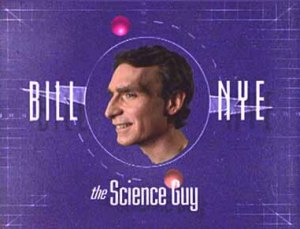
Thanks to Our Man in Scotland, we recently read some comments on American creationism from “The Science Guy,” Bill Nye.  Though we at ILYBYGTH don’t defend young-earth creationism, we do hope to understand it on its own terms.  In that task, mainstream scientists like The Science Guy often seem uniquely unhelpful.

Bill Nye The Science Guy. Image Source: Educational Communications Board

In a bit from February on Big Think, the well known TV science popularizer had some harsh words for those who believe in a young earth.  Only when we understand the extreme age of the universe, Nye charged, does the story of life on Earth make sense.  Those who try to stick to a young earth make things “fantastically complicated,” Nye insisted.  “The idea of deep time,” Nye explained, “of this billions of years, explains so much of the world around us.  If you try to ignore that, your world view just becomes crazy, just untenable, itself inconsistent.”

Let’s take this accusation apart a little bit.  As I read it, America’s favorite nerd is not quite calling young-earthers crazy, the way Richard Dawkins likes to do.  Instead, Nye is saying that trying to frame a conception of the universe that takes all the evidence into a account is crazy, unless we assume an extremely long timeframe.

Nye makes other statements about creationism that are just plain wrong, though.  First, Nye ends his diatribe with a familiar “progressive” fallacy.  Nye asserts that young earth belief will wither away.  “In another couple centuries,” Nye states, “. . . it just won’t exist.  There’s no evidence for it.”  But that is not how things have worked historically.  Young earth belief was far less prevalent in 1920 than it became in 1980, for instance.  Some evolutionists fall into this trap of assuming that young-earth belief is strictly a matter of ignorance and isolation.  As more and more people are exposed to the evidence for evolution, the assumption goes, young earth belief must surely die out.  But young-earth belief has grown along with America in the twentieth century.  As more and more people get more and more education, a significant minority of them are educated into young-earth belief, not away from it.  As I describe in my 1920s book (Now in paperback!) anti-evolutionists in the 1920s set up a durable and influential network of schools and colleges to educate American toward young-earth belief, not away from it.

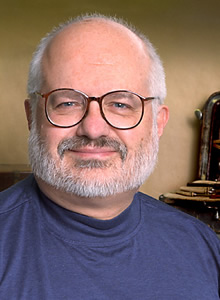
Ronald Numbers. Image Source: University of Wisconsin Madison

The second error Nye makes is in his opening statement.  “Denial of evolution,” Nye insists, “is unique to the United States.”  That is simply not true.  Strong creationist movements thrive world wide, especially in Australia and New Zealand.  As my mentor Ronald Numbers has explored in the new edition of his classic book The Creationists, young-earth belief is also strong in countries such as Turkey.

Like a lot of evolutionists, Nye seems to be a particularly bad guide to the world of young-earth creationism.  Perhaps because from his position firmly within the scientific mainstream, the ideas of creationism look particularly outlandish.  Nye and his mainstream scientific colleagues have no ability to understand something that builds its intellectual structure upon a radically different foundation.  To Nye and his ilk, the only explanation is that such thinking is crazy, etc.  We at ILYBYGTH hope to understand it more profoundly.

Required Reading: Who’s Afraid of Evolution?

Stop me if you’ve heard this story before.  I started this blog when I discovered many of my secular, liberal friends and family shared my ignorance about the complexities of life in Fundamentalist America.  One academic acquaintance once asked me regarding young-earth creationists, “What’s wrong with these people?”  She didn’t mean to be patronizing, but she dismissed a huge group of Americans with one sarcastic comment.

As we’ve noted here before, American creationists embrace a wide variety of beliefs.  Calling oneself a “creationist” doesn’t necessarily mean one believes in a six-thousand-year-old planet, or a literal six-day creation.  But it might.

Venema. Image source: Trinity Western University

Dennis Venema of Trinity Western University recently shared some of his experiences teaching evolution at an evangelical Protestant university.  Writing on The BioLogos Forum, Venema discusses the thrill he experiences when he shares his evidence for evolution with his evangelical students.  As he describes, some of his students resist accepting the evidence.  Even when they do recognize the power of chromosomal similarities, students still reach individual conclusions about how this science impacts their faiths.

Venema’s reflections demonstrate the complexities of creationism within the borders of Fundamentalist America.  We outsiders must be careful not to lapse too glibly into a simple evolution/creation binary.

As Venema relates,

“For me personally, the most difficult circumstances to watch are students who feel torn between the evidence and their faith. In some cases these are extremely bright students, who easily see the strength of the evidence, but feel the need to remain unengaged and uncommitted because they fear a backlash from their churches, or (especially) their parents.  While an evangelical university can be a wonderful, safe environment for students to explore these issues, that environment doesn’t follow them home. These struggles are painful to watch, and I’ve spent more than a few hours in prayer for students facing them.”

This experience is different at an evangelical university than it would likely be at a mainstream school.  For starters, the assumptions about students’ home lives would not be the same.  No matter how caring and sympathetic a professor might be at a mainstream college, he or she would not likely assume that evolution would cause such struggles for his or her students.

Students who learn about evolution at my institution, for example, would do so under the auspices of David Sloan Wilson’s EVoS program.  This is a wonderful and powerful academic experience for undergraduates.  But the students in the program generally assume that anyone who does not embrace the science of evolution is trapped somehow in a bizarre and archaic subculture.  My chat about the intellectual culture of creationism with a group of bright and talented students in the EVoS demonstrated the intense secular bias of the program.  (You can listen to a podcast of that conversation here.)

As Venema continues, at an evangelical college, the situation is vastly different.  Many students come from churches and families in which the word “evolution” has long been associated with every sort of rank sin.  At Venema’s school, for instance,

“evolution matters. That intensity of student engagement is invigorating, and the students feel it too. Regardless of where students ultimately decide to “land” on the issue, many report that they enjoyed the process – the exchange of ideas, the discussions and debates, and the new understandings gained.”

So who’s afraid of evolution?  Many of my secular friends and family would likely assume that students at evangelical colleges are taught simply to hate and fear the truths of modern science.  As Venema shares, the real experience is a much more complicated thing.

What Do Missourians REALLY Want?

Everyone interested in what we’re calling Fundamentalist America should be following Missouri’s Amendment 2.  The debate about the nature of religion in public schools and institutions gets right to the heart of many culture-war controversies.  But it appears that the amendment might pack a much heavier culture-war punch than it seems to.

There are plenty of places to go to catch up on the story.  ILYBYGTH has introduced the upcoming vote, discussed the results, and noted Catholic Bishops’ support for Amendment 2.  The St. Louis Post-Dispatch offered a very helpful introduction in late July.  For anyone interested in the viewpoint of amendment supporters, a Baptist congregation in Odessa published an hour-long video of Representative Mike McGhee explaining his vision for the amendment, frankly and openly.

For those who don’t like clicking on stuff, here’s the story in a nutshell:  On August 7, 2012, Missouri voters overwhelmingly (83%) approved an amendment to their state constitution.  The amendment was promoted as a school-prayer amendment.  Supporters such as legislative sponsor Mike McGhee called it a clarification of the rights of religious people to pray in public, so long as their prayers did not disturb others.  McGhee claimed that such rights are often disrespected.   Opponents such as Americans United for Separation of Church and State insisted it was at best unnecessary, since such rights are already protected in the US Constitution.  At worst, opponents insist, this amendment threatens to undermine the barrier between church and state.

Given a closer look, however, this amendment does much more than clarify students’ rights to pray in public schools.  It does that, but the amended Constitution now includes two other rights for students.  These new rights go far, far beyond protecting the rights of public schoolchildren to pray quietly.  The new rights satisfy the long-standing desires of important constituencies in Fundamentalist America.  For all parents who have worried that their children might be taught unwholesome moral, sexual, or religious lessons in public schools, the Missouri Constitution now offers an easy escape route.

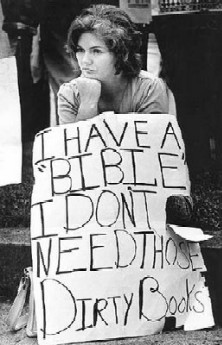
The first added phrase, “students may express their beliefs about religion in written and oral assignments free from discrimination based on the religious content of their work,” opens the door for conservative families to include their beliefs in all parts of the school curriculum.  For example, creationist parents and students could now use their beliefs to answer questions about evolution.  This has long been a sticking point for creationists.  Consider the words of Avis Hill, a pastor from Kanawha County, West Virginia.  Hill rose to national prominence in 1974 when assumed a leadership role in a controversy over adopted textbooks.

From Trey Kay, “The Great Textbook War”

Hill told interviewers that his daughter was given a failing grade for her report on evolution.  According to the Reverend Hill, the young Miss Hill, fifth grader, told her teacher, “‘Mrs. So-and-So’—whose name I’ll not use—‘I’ll not give that report, and I’ll not read that book in class.’  She said, ‘I have a book I will read,’ and she opened her Bible—and I did not coach her because it didn’t bother me that much at that time—she opened her Bible, and she began in Genesis 1, ‘In the beginning God—‘ and the teacher failed her.” [Interviewed by James Moffett, included in Moffett’s Storm in the Mountains (Southern Illinois University Press, 1988), pg. 90].

This sentiment echoes throughout Fundamentalist America.  Fear that students will be forced to learn evolution, or about the use of condoms, or about the moral ambiguities of modern life have long dominated conservative rhetoric about public education.  Missouri’s new Constitution fixes that perceived problem.

The second telling phrase in the new Constitution underlines the point.  “No student,” the amendment reads, “shall be compelled to perform or participate in academic assignments or educational presentations that violate his or her religious beliefs.”  The implications are clear.  Sex ed, evolution ed, “situation ethics,” all have loomed large in the imagination of Fundamentalist America for generations.  This amendment guarantees that no student shall be forced to learn about such things.

Missouri’s amendment is not the only place to find this sentiment in political action.  New Hampshire’s state legislature recently passed a very similar law.  As I argue in my 1920s book,  conservatives have struggled to protect conservative religious students from public-school curricula since the 1920s.  In the last generation, the fight in Hawkins County, Tennessee, might have generated the most attention.   In that case, conservative religious parents ultimately lost their lawsuit against the school board.  Parents had claimed that anti-religious messages in school textbooks forced their children to learn messages inimical to their religious beliefs.  In 1987, the US Court of Appeals for the Sixth Circuit disagreed.

Lawmakers in New Hampshire and now voters in Missouri found a way around this legal precedent.  However, it is not clear that Missouri voters knew just what they were voting for.  Consider the wording of the ballot measure:

“Shall the Missouri Constitution be amended to ensure:

“That the right of Missouri citizens to express their religious beliefs shall not be infringed;

“That school children have the right to pray and acknowledge God voluntarily in their schools; and

“That all public schools shall display the Bill of Rights of the United States Constitution.

“It is estimated this proposal will result in little or no costs or savings for state and local governmental entities.

“Fair Ballot Language:

“A “yes” vote will amend the Missouri Constitution to provide that neither the state nor political subdivisions shall establish any official religion. The amendment further provides that a citizen’s right to express their religious beliefs regardless of their religion shall not be infringed and that the right to worship includes prayer in private or public settings, on government premises, on public property, and in all public schools. The amendment also requires public schools to display the Bill of Rights of the United States Constitution.

“A “no” vote will not change the current constitutional provisions protecting freedom of religion.

“If passed, this measure will have no impact on taxes.”

No mention of creationism, sex ed, condoms in schools, or other implications.  Nothing about guaranteeing students the right to opt out of any instruction they deem pernicious.  The ballot measure emphasized the amendment as a clarification of students’ rights to pray.  Yet the amendment itself makes the other meanings crystal clear.

Missouri voters approved the amendment by overwhelming margins.  But it appears that the implications of that ‘yes’ vote might not have been entirely apparent.  So what DO Missouri voters want?

Barton and Evolution

You might be tired of hearing about David Barton.  I know I am.  But how about just one more point?  This morning, History News Network ran an essay of mine asking a new question about Barton.  In the essay, I ask what might happen if Barton was defending the notion of a young earth, rather than the notion that Thomas Jefferson was a devout Christian.

Thanks to the History News Network for running that piece.  Since I submitted to their editor, the Barton story has developed in ways that make me even more intrigued in the comparison between (some) conservative Christians’ views of history and creationists’ views of biology and geology.

In a piece that ran in the August 13 online edition of Glenn Beck’s Blaze newsletter, Barton defended his work.  According to the Blaze article,

“Barton seemed anything but shaken by the controversy when he spoke via telephone with TheBlaze. He freely answered questions about the controversy and explained that he’s prepared to respond to some of the critiques, while dismissing what he believes is an ‘elevated level of hostility that’s not really rational in many ways.’

David Barton Responds to Jefferson Lies Controversy and Warren Throckmorton

“While he stands by his central arguments about Jefferson, Barton isn’t pretending to be immune from error. The historian said that the book has already gone through three or four printings and that there have been word and text changes based on spelling or grammar errors along the way. Also, he addressed a willingness to amend historical items, should they be pointed out and proven wrong by other academics.”

What’s intriguing to me in this defense is the way it echoes the challenges posed by 1920s creationists.  Note the phrase “other academics.”  Barton here defends his position as one academic historian among others.

It has been a very long while since scientific creationists insisted that they were part of of the mainstream scientific establishment.  As Ron Numbers described in his classic The Creationists, after the Scopes trial in 1925 leading creationist scientists still fought for creationism’s acceptance in mainstream science.  But they quickly learned that such debates did not offer a real chance to convince mainstream scientists of creationism’s superiority.  Seventh-day Adventist George McCready Price, for instance, left one debate in London shocked and demoralized by the reaction of the crowd.  “Do not confine your reading wholly to one side,” Price pleaded in response to one scornful outburst from the audience.  “How can you know anything about a certain subject if you read only one side of the case? There is plenty of evidence on the other side, and this evidence is gradually coming out.”  After this debate, Price left the stage feeling humiliated, and he never engaged in another public debate. (Numbers, ed. Creation-Evolution Debates, pg. 186).

This does not mean, of course, that creationists gave up.  No, it demonstrates that creationists moved in the 1920s, in fits and starts, away from fighting for acceptance by mainstream scientists.  Instead, they built their own powerful institutions: schools, publishers, and research organizations.  By 2012 no politician needs to retreat from creationist belief.  Similarly, no creationist feels a need to prove his or her claims to an audience of mainstream scientists.

David Barton, on the other hand, is giving us what might be a new Scopes moment.  Forced to endure the public humiliation of having his book withdrawn, Barton has taken a defiant posture.  He has insisted, like Price in 1925, that readers do more than “read only one side of the case.”  He continues to claim his credentials as one academic historian among others.  I wonder if soon historians like Barton will embrace their outsider status.  If so, as I argue in the History News Network piece, we might be seeing another sort of 1925.

Art Attack in the Culture Wars

“Holy Rollin Poultry on a Cross” (2012), used with permission of Dreg Studios

Jon McNaughton’s art is a favorite of the Tea Party set.  Brandt Hardin paints from the other side of the culture war trenches.  He has painted and written about such current topics as Chick-fil-A and traditional marriage, Tennessee’s continuing struggle with evolution/creation, and the power of Mitt’s money in conservative politics.

“Forty-six and 2” (2012), used with permission of Dreg Studios

As we noted about McNaughton, perhaps his popularity with conservatives is bolstered by an implicit appreciation for realistic art, for art that avoids distortion and irony.  If so, Hardin’s pop-surrealistic style provides a stylistic, as well as a cultural, counterpoint.

“Mitt Romney’s Magic Mormon Underwear” (2012), used with permission of Dreg Studios

Required Reading: The Big Tent of Creationism

Creationism ruffles feathers.  As the belligerent atheist Richard Dawkins memorably quipped, those who do not believe in evolution must be “ignorant, stupid or insane (or wicked, but I’d rather not consider that).”  There is comfort in Dawkins’ dismissal.  An insightful article in the most recent Christianity Today, however, probes deeper into the complexities of creationism.

I still remember my first introduction to the world of creation science.  I was a staunch outsider, having had little interaction with creationism until my mid-30s.  In graduate school, reading Ron Numbers’ The Creationists, I was astounded to learn that nearly 50% of American adults agree with a young-earth creationism, according to Gallup polls.  And one-quarter of those creationists have college degrees.

Much of my academic research has been devoted to puzzling out how such a thing is possible.  Since the 1920s (my Scopes book now available in paperback!), creationism has entrenched itself in schools, colleges, and alternative scientific organizations.  It has become a viable way for millions of Americans to understand the origins of life on Earth.

Glib dismissals like those of Richard Dawkins do not help us understand this cultural phenomenon.  What will help are thoughtful, sympathetic explorations like that of Tim Stafford in July’s Christianity Today.  In “A Tale of Two Scientists,” Stafford explores the lives and careers of two evangelical scientists, Darrell Falk and Todd Wood.  Falk is an evolutionary creationist, Wood a young-earth creationist.

Falk describes his falling away from his upbringing in the Nazarene Church.  As a graduate student, he had fallen in love with the beauty of genetics, and soon found himself estranged from the church.  When he watched his two daughters growing up, he knew he wanted to find them a church home like the one he had known.  He was worried about a cold reception from church members, but as a tenure-track scientist at Syracuse University, he looked for a church he could join.  At first, he was nervous.  As Stafford tells the story,

“Falk went alone, like a spy, into the church for a worship service.

“After the service, he found himself surrounded by friendly faces. They seemed delighted that he was a professor at Syracuse. Falk went home and told his wife, ‘We might have a church after all.’

“So it proved to be. Though the church certainly didn’t believe in evolution, and came to know that Falk did, they never bothered about it. ‘That church, God’s gift to us, built a bridge to us and welcomed us just as we were, gradual creation perspective and all.’ The pastor helped Falk as he found his way to a fuller, more robust faith, eventually asking him to teach a Sunday school class for young adults.”

Wood had a very different upbringing and career.  As he explains in the article, he never moved away from the assumption that the Bible’s description of a six-day creation tells the real story of the origins of life.  But that did not mean that he was somehow ignorant of evolution.  As Stafford writes,

“The first human genome sequence was published the year that Wood began graduate school, providing strong evidence for evolution. The DNA for chimps and humans was virtually the same. Traces of common origins were everywhere: Humans even possessed a broken version of the gene that lizards and birds use to produce eggs. Wood remained fully committed to a six-day creation—he says he never doubted it for a minute—because he saw no other way to read the Bible. But that didn’t keep him from recognizing that evolution had powerful attestation.”

The two men have very different ideas about the origins of life.  Yet they can both describe themselves as “creationists.”  And, unlike the harsh denunciations of critics like Dawkins, neither scientist is stupid, insane, or ignorant.  Rather, their relationships to mainstream science have been profoundly shaped by their religious beliefs.  This does not mean they have been brainwashed or indoctrinated.  Nor does it mean they are anti-science.  Rather, they came to very different conclusions about the need to reconcile science and religion, all within the big tent of creationism.

We do not have to agree with their conclusions in order to recognize the intellectual complexities of their positions.  If we hope to understand Fundamentalist America, it will help to dig deeper than Dawkins’ brand of simplistic denunciation.

Transubstantiation: Faith, Science, and the Public Square

“Catholics are crazy.”

Why don’t we hear people saying that?  Richard Dawkins accused anyone disbelieving evolution of being “ignorant, stupid or insane (or wicked, but I’d rather not consider that).” Does he accuse Catholics of the same thing?  Or why don’t we hear skeptics comparing the Catholic liturgy to a Flying Spaghetti Monster?

After all, one of the central features of Catholic liturgical tradition and theology is at least as radically anti-science as any kind of young-earth creationism.  But nobody seems to mind.

For purposes of full disclosure, I must note: I’m a big fan of Catholicism.  As the saying goes, ‘Some of my best friends . . .”  But even close friends must acknowledge the elephant at the altar, the rigid anti-science that lurks uncomfortably at the heart of the Catholic Eucharist.

We’re talking here about the Catholic doctrine of transubstantiation.  In Catholic doctrine, when a priest completes a special ceremony over bread and wine, the bread and wine are literally transformed into the body and blood of Christ.  Not symbolically, but substantially changed.  Of course, to all outward appearances, the bread and wine maintain their accidental attributes.  The senses, and even the most careful scientific detection, will see/hear/taste them only as bread or wine.  But in substance they have been transformed into the Real Presence, the living body and blood of the Christ.  I’m no theologian, and I invite correction on this subject, but as I understand the doctrine, the substance changes while the accidental outward properties do not.  Thus, for example, my body has two hands.  But the substance of my body does not change if I cut off one hand.  It is still my body, though the accidental properties change.  With the bread and wine, the substance transforms into the actual substance of blood and flesh.  But the accidental properties remain the same.  It will not taste like blood or flesh.  (If it did, I imagine this issue might be a little more controversial.)  It will continue to have all the outward appearances, down to the microscopic level, of bread and wine.  Yet it will not be.

This is a profoundly antiscientific notion at the heart of Catholic belief.  Instead of believing in the clear evidence of their senses, Catholics are supposed to believe that they are eating and drinking real flesh and real blood.  This notion is at least as antiscientific as more controversial doctrines such as young-earth creationism.  After all, creationists are not asked to disbelieve their own senses.  They are not required to contest the scientific measurements of things.  Instead, young-earth creationists are told that they have a superior science worked out, a true science that accords with the version of creation described in the Bible.  Catholics, on the other hand, officially believe that bread tastes like bread, smells like bread, looks like bread, has all the chemical properties of bread, and yet is not bread.  That must be difficult to swallow, pardon the pun.  Yet we don’t hear any complaints against it or attacks upon it from skeptics and anti-fundamentalists.  Why not?

There are two obvious reasons.  First, this doctrine doesn’t impinge on the public sphere the way creationism does.  After all, if it somehow mattered what public schools taught about the nature of bread, wine, and liturgical practice, then we could expect the notion of transubstantiation to become more controversial.  When the nature of the substance of the Eucharist was part of a public debate, as in the time of Martin Luther, then the doctrine of transubstantiation was indeed intensely controversial.  These days, in subjects such as contraception and abortion, where Catholic doctrine impacts public policy, we do hear a great deal about the nature of Catholic belief.  Since the doctrine of transubstantiation remains important only within the religion itself, skeptics may feel no need to challenge its inherent antiscientific nature.  After all, much religious belief is antiscientific.

Second, even many Catholics don’t embrace this doctrine enthusiastically or aggressively.  Catholics are not forced to defend the anti-science of transubstantiation the way creationists are forced to defend their Bible-based anti-science.  Catholics are assumed to agree with this foundational theological premise, but they are not put in a position to defend it publicly.  Allow me to give one example.  At the Catholic Church I attend, during harsh flu seasons parishioners are asked not to drink from the communal chalice if they have symptoms.  That makes great scientific sense, but little liturgical sense.  If the wine had actually been transformed into the substance of Christ’s blood, it doesn’t seem right that the H1N1 virus could attach itself.  Perhaps a Catholic apologist would reply that such things as viruses are only part of the “accidental” features of the wine.  The point here, though, is that to many Catholic parishioners, at least at my church, the transubstantiated blood is still regarded as very similar to wine.

So are Catholics crazy?  Do they cling to anti-scientific notions?  Does the core belief of Catholicism mean that ideas taken on nothing but faith must trump all evidence of the senses?  And if so, why don’t anti-fundamentalists seem to mind?


In Search Of . . . Love in an Age of Culture War

Can a creationist and an evolutionist be in love?  I’ve got no idea.  I’m sorry to the searcher who came by ILYBYGTH in search of an answer to this timeless question.

This touching search, though, brought to mind a memory from my wasted youth.  Readers of a certain maturity may remember the other gig Leonard Nimoy enjoyed.

This episode: Nimoy In Search Of . . . Atlantis!

Every week, Nimoy hosted a smarmy pre-cable show about the search for the paranormal: Atlantis, Roswell, etc.Managing this blog has opened my eyes to some of the searching that goes on these days.  As we’ve noted here before, Google Trends offers all of us a way to take the intellectual temperature of Fundamentalist America.

The editing tools of this blog offer additional perspectives.  We can see some of the search terms that direct people here.  Some of them are just pathetic, such as one about plagiarizing “What the Bible Means to Me.”  Some of them are encouraging, like the many searches for “I Love You But You’re Going to Hell.”  Some of them tell us something about what people care about.  We see a lot of searches, for instance, for “traditional schools vs. progressive schools.”  We see searches for “Richard Dawkins is going to hell.”  And we see various permutations of searches like, “Why are fundamentalists so resistant to evolution?”

A lot of the search terms we see are puzzling.  Consider a few recent gems:

  • “Tim Tebow is going to hell”
  • “Santorum loves Satan”
  • “Smart people become professors”
  • “Mounted patrol Horace Mann”

What were these anonymous searchers looking for?  Why do they dislike Tim Tebow so much?  And how did Horace Mann get a horse?  We will likely never know, and that’s what makes it so intriguing.

Along these lines, we have a new all-time favorite for poignancy:

  • Can a creationist and evolutionist be in love?

Somewhere, out there, two star-crossed lovers gaze longingly at one another, one from his Bible college dormitory, the other from the mean streets of secular public education.

If there’s hope for this culture-war Romeo & Juliet, there’s hope for us all.

War and Culture War

What is a Culture War?  In America, it generally means an angry squabbling over such issues as the proper role of religion and traditional culture in the public square.  Should public schools teach evolution?  Does a fetus have equal human rights?  Should homosexuals be allowed to marry?

Recent headlines demonstrate the terrifying possibilities of other forms of culture war.  In central Nigeria, for instance, Islamic militant group Boko Haram has sharpened a bloody conflict between Muslims and Christians.  The organization has bombed Christian churches and killed Christians who would not convert to Islam.

BBC: “Who Are Nigeria’s Boko Haram Islamists?”

Could such atrocity result from America’s milder culture wars?  After all, America is no stranger to intensely violent civil war.  It’s not hard to imagine a new breakout.  Jonny Scaramanga of Leaving Fundamentalism has argued recently how easy it is to envision a Bible-Christian theology of suicide bombing.  And unfortunately we don’t even need to imagine.  With shootings of abortion providers and murders of homosexuals, not to mention generations of lynchings and white-supremacist violence, Fundamentalist America has proven itself capable of war, genocide, and atrocity.The Left, too, has shown its teeth.  When the Students for a Democratic Society splintered in the late 1960s, the Weather Underground faction devoted itself to a nearly suicidal campaign of bombings.   More recently, too, angry anti-fundamentalists such as Dan Savage have demonstrated their willingness to demean and belittle their Christian audiences.

Now, we need to be careful here.  There is a vast gulf between Dan Savage’s culture-war anger and the bombing of churches.  There is also, thankfully, a huge divide between ardent advocacy for a more thoroughly Biblical public culture and pogroms.  The point, though, is that the aggressive bombast of America’s culture warriors makes it depressingly easy to imagine an America in which culture war turns into real war.

At the risk of sounding apocalyptic, let’s imagine some of the ways America’s culture wars might escalate into something far more horrific.

1.)    Geographic contiguity.  If two or more regions developed a sense of beleaguered cultural identity, those identities could form the bases of separate warring nations.  For instance, when the eleven states of the Confederacy determined that their interests were no longer defended in the Federal government, they seceded.  Similarly, during the War of 1812, the Hartford Convention nearly led to the secession of the Northeast.  In today’s politics, we can see some sense of a sharpening coastal/flyover divide, a red state/blue state antagonism.

2.)    Connection of culture issues to existing racial/ethnic/religious divisions.  These divisions have often proved the most explosive in American history.  Wars and riots among groups such as Native Americans, Irish-Catholic Americans, and African Americans have burned America’s cities and bloodied America’s plains.  Were similar connections be made between ethnic status and religious affiliation, similar violence could certainly emerge again.

Our hopes, of course, remain high that America’s culture wars will mitigate, not escalate.  The purpose of this blog is to build intellectual bridges between Fundamentalist America and its critics.

Nevertheless, the depressing norm from history and current world events is for culture wars to attach themselves like lampreys to other sorts of conflicts, escalating the bloodshed as each side sees itself as holy warriors in a righteous cause.

REQUIRED READING: Protester Voices

For those who hope to understand Fundamentalist America in the twenty-first century, a good place and time to start would be Kanawha County, West Virginia, 1974.

The raucous 1974-1975 school year in this county surrounding Charleston saw a burst of public controversy over the teaching in its public schools.  Protesters vilified a set of textbooks adopted by the school district.  At its peak, the protest and school boycott included a sympathy strike by the area’s miners and even a spate of gunshot attacks and the bombing of a school-administration building.  The fight in Kanawha County, as argued by both protesters and historians, can correctly be seen as the birthplace, or at least the midwife, of an emerging populist conservative movement.

The controversy has attracted its share of recent attention from scholars such as Carol Mason and journalists such as Trey Kay.

Thanks to the energetic activist Karl Priest, we now also have an account of the controversy written from a prominent member of the movement itself.  Priest’s 2010 book Protester Voices offers a view from inside the textbook protest movement.

Priest’s story is unabashedly partisan.  The tone and style of his book are those of a bare-knuckled culture warrior rather than those of a disinterested academic.  Priest has achieved a reputation as one of today’s leading anti-evolution internet brawlers.  In addition to his anti-evolution work, Priest is also currently active in Exodus Mandate.  This organization promises “to encourage and assist Christian families to leave government schools for the Promised Land of Christian schools or home schooling.”  Those who hope to explore the worlds of conservative Christian activism in twenty-first century America will soon run into the work of Karl Priest nearly everywhere they turn.  Indeed, when ILYBYGTH first starting imagining how intelligent, educated people could embrace creationism (see, for instance, here, here, here, here, and here), we were accused of being merely a front for Priest.

In his 2010 book, Priest takes other writers to task for their anti-protester bias.  He dismisses Carol Mason, for example, as someone who “concentrate[s] on the exception to the rule” (37).  The protest movement, Priest insists, must not be understood as an irruption of racism or vigilante violence.  The protesters themselves cannot fairly be dismissed as “wild-eyed ignoramuses” (xiii).  Such accusations, Priest insists, demonstrate the bias of left-leaning scholars more than the lived reality of the protest itself.  The leaders of the movement, in Priest’s view, “suffered financial loss. . . . [and] endured snide remarks and mocking.”  They did so in order to defend their schools and community against the imposition of taxpayer-funded textbooks that included aggressive racism and sexual depravity.  Priest defends the rank and file of this movement, also slandered mercilessly by other writers, as “Norman Rockwell Americans” (63).

Priest agrees with other commentators that this textbook controversy provided the launching pad for a new kind of conservative activism.  Kanawha County attracted national leaders such as Mel Gabler and Max Rafferty.  The fledgling Heritage Foundation sent legal advisers.  The 1974 protest, Priest claims, heralded the new generation of populist conservatism that continues in today’s Tea Party movement.

For anyone hoping to understand Fundamentalist America, this book is an important resource.  Not only does Priest’s account offer a staunch defense of the fundamentalist side of one of the most significant controversies of the late twentieth century, he also includes a reflection on the meanings of fundamentalism itself.  Though he prefers the term “Bible-believing Christian,” Priest insists that “Being a fundamentalist, contrary to what liberals have propagandized, is nothing to be ashamed of just by the attachment of the term” (3).