I Love You but You Didn’t Do the Reading

Another busy week: Here are some ILYBYGTH-themed stories that came across our desk recently:

Can a creationist parent successfully sue a school district for teaching evolution? Not in PA, at NCSE.

READING

Words, words, words…

Are international students a higher-ed security threat? FBI director says yes, at IHE.

Conservative college professor to conservative UCLA students: Don’t invite Milo, at WS.

“Any reasonable person will agree…” At HXA, Musa Al-Gharbi points out that reasonable people are actually better at disagreeing, with three suggestions for better cross-culture-war communication.

How Protestantism shaped the modern world: An interview with Alec Ryrie at R&P.

Was this the most gruesome battle in human history?

RIP Billy Graham, at CNN.

What’s wrong with Black History Month? At The Progressive.

School shootings:

Ted Cruz: The Democrats are the party of Lisa Simpson. GOP is for Homer, Marge, Bart, and Maggie. At USA Today, HT: BM.

What’s wrong with standardizing student assessment at colleges? Molly Worthen tees off at NYT.Bart reading bible

West Virginia teachers go on strike, at CNN.

How Liberalism Failed: Albert Mohler interviews Patrick Deneen.

Conservatives need to confront campus radicalism, by Noah Rothman at Commentary.

When Conservative College Students Cancel Campus Speeches

Should they or shouldn’t they? At UCLA, conservative students invited Milo Yiannopoulos to campus. A conservative professor advised them against it. His reasons for doing so highlight another fundamental question buried beneath our campus-free-speech shouting match.

milo yiannopolous

A “legitimate” conservative? Or just a “despicable asshole”?

Like everyone else, we at ILYBYGTH have been pondering questions of campus free speech lately. As SAGLRROILYBYGTH will recall, last week we wondered if arch-creationist Ken Ham could legitimately be disinvited from an Oklahoma university. Then we wondered if conservative student groups could be forced to accept leaders who don’t agree with them.

The issues from UCLA might seem vastly different at first. The College Republicans had issued a speaking invitation to right-wing bomb-thrower Milo. He planned to talk on the topic, “Ten Things I Hate About Mexico.” In an open letter published at Weekly Standard, one of their few conservative faculty mentors, Gabriel Rossman, advised them to cancel the invitation, for conservative reasons. And they did.

Why?

Professor Rossman condemned Milo as nothing but—using the words of Charles Murray—“a despicable asshole.” If UCLA conservatives were really dedicated to promoting conservative ideas and principles, inviting Milo was a bad idea. As Rossman put it,

You need to ask yourselves, what is your goal as an organization? If you’re in it for the lulz and just want to see the world burn, then I guess go ahead and bring in a vapid provocateur.

But if your mission is to spread conservative ideas, you should recognize that hosting Yiannopoulos will only render your organization and our ideas toxic.

Prof. Rossman’s advice—which the students heeded—raises another central underlying question in our debates over campus free speech. Last week in these pages, Agellius noted that the real question was not just creationism or homosexuality or nationalism. The real question, he wrote, was this:

It’s all about who gets to define “discrimination” isn’t it?

If Ken Ham’s version of Christianity is considered ipso facto discriminatory, then it makes some sense that he wouldn’t be invited to speak at a school dedicated to fighting against anti-homosexual discrimination. But if it isn’t, then it doesn’t.

Prof. Rossman’s advice raises a related question. He encourages UCLA’s conservative students to invite provocative conservative speakers. He lauded the decision to bring “War on Cops” author Heather MacDonald to campus. As he explained,

I can understand why some people were offended by Heather Mac Donald’s ideas when she spoke on campus last year. But reasonable people can disagree about whether all Americans, and especially African Americans, on net benefit from aggressive policing. More to the point, Mac Donald expresses her pro-police position without animus, so sponsoring her talk was an entirely legitimate and honorable thing to do.

Milo is different, Rossman thinks. His goal is only to push leftist students into vulgar displays of coercive thuggery. Rossman’s against it; against the entire “epater les SJWs performance art model” that Milo represents. [Editor’s note: SJW = “Social Justice Warrior.”]

We might say that Professor Rossman considered some so-called conservative speakers beyond the pale of legitimacy. Did College Republicans have the right to invite him? Rossman says yes. But was it good conservative strategy to do so? Rossman says no.

The central question, though, is not about Milo or Ken Ham or any single speaking invitation. The central question, it seems to me—following Agellius—is this: Who decides what “extremism” and “legitimacy” are?

Is it “illegitimate” to oppose same-sex marriage? The Oklahoma student protesters said yes. Ken Ham says no.

Is it “extreme” to deride Mexico? To try to provoke UCLA students into wilder and wilder displays of speech-blocking ferocity? Professor Rossman says yes. The College Republicans, apparently, agreed.

Can Science Oppose Heresy?

In a sense, it’s as old as Galileo. In another, though, our question today shows the uniquely modern state of our current culture-war climate. Can someone stand up for science by opposing heresy? If we really want to understand culture-war thinking, we need to make sense of the ways they can, even if we don’t agree with them.
ramm science scripture

MUST science denial be heresy?

A conservative lament about gender-bending school policy brings this question to our attention. Ideas about gender fluidity, Margot Cleveland argues, turn otherwise intelligent people into thugs and morons. In her view, insisting that young people can and should be able to identify their own genders is both “science denial and heresy.”

I don’t agree, but that’s not the main point here. More important, I want to know how any idea can do those do things at once. How can an idea—any idea—claim to be both religiously and scientifically orthodox?

For secular people like me, it seems like a contradiction, a paradox. Yet for conservative religious intellectuals, this notion has long been both obvious and vitally true.

After all, in the street-level, Bill-Nye sense of the word, “Science” can’t really care about heresy or orthodoxy. As Neil deGrasse Tyson defines it, “Science” means the opposite of such things. In his words,

Science discovers objective truths. These are not established by any seated authority, nor by any single research paper. . . . Meanwhile, personal truths are what you may hold dear, but have no real way of convincing others who disagree, except by heated argument, coercion or by force. . . . in science, conformity is anathema to success.

Before we talk about Cleveland’s claims about heresy and science, let’s acknowledge a few things to start.

  • First, for the past fifty years or so, philosophers and historians have challenged Tyson’s simplistic definition of science. One person’s voodoo might be another’s science, and so on. Fair enough.
  • And some pundits might say that Cleveland was talking about a merely coincidental agreement between her idea of religious orthodoxy and science. That is, she might be saying that religious orthodoxies about eternal, unchanging, God-assigned gender identities happen to be biologically true as well. She might only be saying people are born with a certain set of sex characteristics and it is not scientifically nor religiously true that they can change their gender identity at will.

Those things make sense to me, but they don’t get to the heart of our dilemma. The interesting question, the difficult question is whether or not heresy and science denial can really go together as a general rule.

When it comes to the questions of evolution, climate change, sexuality, and now gender identity, conservative religious thinkers have long argued that they can. Indeed, that they must. To my mind, it is this point that is most important. If secular people like me want to really understand conservative religious thinking, we need to try harder to understand this logic. To me, it seems obviously false. To many people, though, it is compelling.

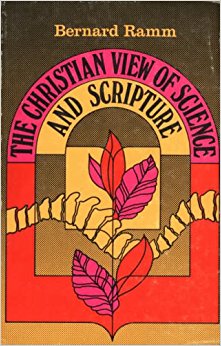
It is not only fundamentalist young-earthers who have made this case. Consider the most famous creationist dissenter from young-earth thinking, Bernard Ramm. In the 1950s, Ramm shattered the complacency of fundamentalist science with his blockbuster book, The Christian View of Science and Scripture.

In some ways, Ramm’s anti-young-earth work can be said to have sparked the modern young-earth renaissance. After all, it was in furious response to Ramm that John Whitcomb Jr. penned the young-earth counter-blockbuster The Genesis Flood in 1961.

Ramm denounced young-earth fundamentalist thinking in no uncertain terms. Young-earthers, whom Ramm called the “hyperorthodox,” missed the point of both science and scripture. Ramm explained,

If the theologian teaches that the earth is the center of the solar system, or that man first appeared on the earth at 4004 BC, or that all the world was submerged under water at 4004 BC and had been for unknown millennia, he is misinterpreting Scripture and bringing Scripture into needless conflict with science.

Instead, Ramm argued religious thinkers needed to reclaim their roles as scientific leaders. Real science, decent science, productive science, Ramm insisted, needed to be guided by the “light of revelation.” Without it, science could only be either “cheap or ironical.”

What does any of this have to do with gender-identity curriculum in California or Indiana? The way I see it, we have two ways to interpret arguments like the one made by Margot Cleveland. Either she is saying that religious truth and scientific inquiry happen to agree about gender identity, or she is making the much stronger case that religious truth and scientific truth must always agree about everything.

For those of us outside the world of conservative religious thinking, this second argument is very difficult to comprehend or even to recognize. Many of us default to Neil deGrasse Tyson’s heresy-promoting vision of true science. If we want to understand our religious friends and neighbors, though, we need to understand a world in which heresy is the very heart of science denialism.


We Don’t Disagree about Evolution—We Just Hate Each Other

Why can’t we stop fighting about evolution and creationism?  As I put the final touches on my new book about American creationism, one obvious but counterintuitive point keeps presenting itself: Creationists love science and want their kids to learn evolutionary theory. So why the endless battle? This morning at Heterodox Academy, Musa Al-Gharbi makes some points about culture-war confrontation that help explain the problem.

ebenezer-exhibit

We all love science, we just hate each other.

Al-Gharbi reviews some of the literature on the futility of culture-war shouting matches. We might think a reasoned, sensible argument will convince anyone who isn’t absurdly prejudiced. It seems the opposite can be true. Studies have found that stubbornness and intractability can increase when people are moreintelligent, educated, or rhetorically skilled.”

Why? Intelligent, informed, sophisticated people are more likely to be committed to ideas and ideologies. They are more experienced at the kinds of mental gymnastics that can help justify and rationalize seemingly illogical positions.

What can be done? Al-Gharbi suggests three general suggestions for improving real communication:

#1: LOWER THE PERCEIVED STAKES OF THE DISAGREEMENT OR CONFLICT

#2: APPEAL TO YOUR INTERLOCUTOR’S OWN IDENTITY, VALUES, NARRATIVES, FRAMES OF REFERENCE WHEN POSSIBLE

#3 LEAD BY EXAMPLE. MODEL CIVILITY, FLEXIBILITY, INTELLECTUAL HUMILITY, GOOD FAITH IF YOU WANT OTHERS TO DO THE SAME

Could these suggestions help creationists and non-creationists talk to each other more productively?

Consider a few obvious points.

First of all, it may seem like a tired old idea to SAGLRROILYBYGTH, but some people out there still don’t get it. Creationists aren’t anti-science. Not even the most extreme sorts of young-earth creationists are. As we’ve seen in these pages, young-earth creationists spend millions of dollars to give their creation museums the look, feel, and intellectual heft of mainstream science museums.

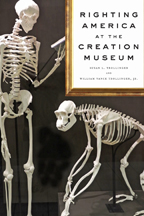
And, as trenchant critics Bill and Sue Trollinger point out, the Creation Museum doesn’t oppose science. To the contrary, the creationists at Answers In Genesis took pains to create something that looks like a “cutting-edge, state-of-the-art natural history museum.” In Kentucky, at least, radical creationists might not agree with me about the definition of good science, but they definitely love science itself.

righting america at the creation museum

We don’t have to agree with creationism to do a better job of understanding it.

Even when it comes to the science of mainstream evolutionary theory, creationists and non-creationists agree on big questions. Here at ILYBYGTH, we’ve heard from creationist homeschool moms who read Richard Dawkins to help teach their kids about evolution. And we’ve noticed ardent Texas creationists who want schoolkids to read the latest evolutionary science.

If we all want the same things—though maybe for different reasons—why do we keep fighting about evolution?

At least in part, we non-creationists need to take a good hard look in the mirror and see if we’ve been following Al-Gharbi’s advice. Have we tried to lower the perceived stakes of our conflict? Have we tried to really understand creationism and creationists? And have we spoken civilly and humbly to our creationist neighbors?

Too often, the answer is an angry no.

Consider just a few of the most famous examples.

Our most famous evolution mavens tend to speak angrily and ignorantly about creationism. They tend to do what they can to increase the stakes of our disagreements.

Richard Dawkins, for example, repeatedly blasts creationists as nothing but ignoramuses or worse. He tells anyone who listens that a profound understanding of modern evolutionary theory is the best way to cure religious people of their “god delusion.” As he promised about his book of that title, “religious readers who open it will be atheists when they put it down.”

It’s hard to imagine a better way to raise the perceived stakes in our creation/evolution disagreements than to insult all creationists and promise that evolutionary theory will lead them to atheism.

It’s not just the irascible Dawkins, though. The friendlier Science Guy Bill Nye also tends to muff his chances at better communication. In his recent book Undeniable, for example, Nye lambastes creationists as people “casting doubt on science and unbelievers.”

As we’ve seen, though, creationists love science. It’s the unbelievers they’re chary about.

What’s the takeaway here? When it comes to our creation/evolution battles, those of us who want more and better evolution education will be wise to avoid these sorts of unnecessary and unhelpful blunders. We should work hard to understand creationism better. We should try to build on our vast areas of agreement instead of focusing on the things we won’t agree about. And we should avoid preaching to our own choir with gratuitous and inaccurate insults of our creationist neighbors and friends.

Free to Discriminate?

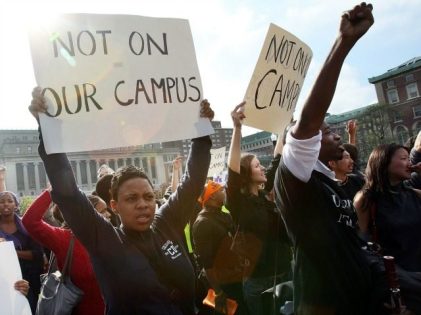
Does a creationist have the right to free speech? That’s the question we’ve been wondering about here at ILYBYGTH lately, ever since arch-creationist Ken Ham got bumped from a talk at the University of Central Oklahoma. News from state legislatures brings up another campus challenge: Do student groups have the right to discriminate?campus-protest-getty-640x480

First, the update, thanks to Donna: According to Ken Ham’s Answers In Genesis organization, he has been re-invited to UCO. Apparently, Ham will talk on campus, then move to a nearby church for a Q&A.

Today, we’ve got an even trickier free-speech/free-assembly question to examine. Should student groups be forced to abide by university anti-discrimination rules? Even for their own leaders? Americans United for Separation of Church and State lists a burgeoning new crop of state laws that would force campuses to make exceptions.

In Virginia, for example, a state senate subcommittee unanimously approved a new bill that would allow student groups to discriminate in their leadership choices. Emphasis added below:

Establishes several provisions for the protection of expressive activity on the campus of each public institution of higher education, including (i) permitting any individual who wishes to engage in noncommercial expressive activity on campus to do so freely, as long as such expressive activity does not materially and substantially disrupt the functioning of the public institution of higher education and (ii) prohibiting any public institution of higher education from (a) denying a student organization any benefit or privilege available to any other student organization, or otherwise discriminating against a student organization, on the basis of the expressive activity of the members of such organization or (b) restricting a student organization’s ability to require any leader or other member of such organization to affirm and adhere to the organization’s sincerely held beliefs, comply with the organization’s standards of conduct, or further the organization’s self-defined mission or purpose.

Why do some conservatives see the need for such bills? As SAGLRROILYBYGTH may recall, evangelical groups on campus have been under fire for the past few years. Intervarsity, for example, has been derecognized on many campuses. Why? Because the group requires its leaders—not members, but leaders—to agree to its statement of belief. And that statement of belief includes traditional definitions of sexual morality.campus-free-speech-720

Conservative religious folks have long fretted about these definitions of discrimination and inclusion. Why can’t conservative evangelical student groups insist that their leaders share their ideas?

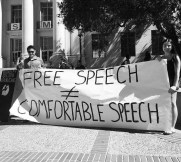
The rub comes once again with the question of university support. Speakers on campus are generally free to do whatever they want, short of issuing threats or starting riots. People can talk their heads off in public areas. There have been important exceptions, as when one professor physically attacked an anti-abortion speaker on the campus of UC-Santa Barbara. campus free speech berkely republicansIn Ken Ham’s case, he wasn’t merely speaking on campus. He was sponsored and promoted by the student government. Some student groups objected to university sponsorship of a speaker that they saw as beyond the pale of legitimate public speech.
Liberal critics make the same case against these student-group laws. In AU’s opinion, such laws are a travesty. As they put it,

Religious freedom is the right to believe—or not—as we see fit. It doesn’t include a right to discriminate—and especially not while using taxpayer dollars or using the tuition fees of the very students who are being excluded. Religious student groups, of course, still have First Amendment rights on campus. They have been able to access school facilities for their meetings and use school bulletin boards to advertise their events like any other group. But they don’t have the right to force public universities to subsidize discrimination. If student groups want to discriminate, they shouldn’t receive public university recognition, tuition fees, or state taxpayer money to do so.

What do you think? Should student groups be free to discriminate? Should public money support student groups that discriminate?

Is Creationism Hate Speech?

It wasn’t about evolution or creationism. When a student group at the University of Central Oklahoma rescinded a speaking invitation for radical-creationist impresario Ken Ham, it wasn’t the biology or geology departments that had protested. Rather, it was women’s groups and LGBTQ+ organizations that objected to Ham. The controversy in Oklahoma points to a central problem for religious conservatives, one that all the bluster about “free speech” only obscures.

20171228_090906

Ken Ham’s organization makes no secret of its anti-homosexuality opinions.

I’m no conservative, but if I were I would not care as much about college speaking invitations as I would about the much-more-important real reason why Ham’s talk was canceled.

Before we get into that, though, let’s clear out a few of the distracting issues. Ham has protested that he had a contract in place and that the university “reneged.” The university says no contract was in place, only an invitation. We can remain agnostic on that question—the central issue here isn’t one of legal contracts, but of moral and social commitments.

Let’s also remember that this case doesn’t involve creationism as a whole, but only one form of creationism. Ham’s organization promotes a specific young-earth version that I’ve been calling “radical” creationism. As I argue in my current book, too often pundits equate radical creationism with creationism as a whole. It’s always important to remember what creationism really is and what it isn’t. As a whole, creationism certainly can’t be equated with Ken Ham’s ideas. For now, though, let’s move on to the central issues in this particular case.

Ham insists that his free speech rights were denied. But were they? Ham still plans to give a speech in the same town, at a nearby church. No one took away Ham’s right to speak, only an invitation to appear at a university-sponsored event. To use an intentionally inflammatory analogy, pornography is not allowed in public-school libraries, but that does not mean pornographers have lost their rights to free speech.

Today, though, such questions of contracts and free speech rights are not what we’re going to focus on. Instead, let’s look at a tougher question. Let’s examine the confusing language at the center of this case. Ham has protested with justification that his banishment violates the university’s stated goal of “inclusivity.”

The local creationist pastor who had invited Ham to Oklahoma quoted angrily from the university’s policies:

UCO claims that it “is committed to an inclusive educational” environment, and in its “Campus Expression Policy,” the university declares that it “is committed to fostering a learning environment where free inquiry and expression are encouraged. The University is a diverse community based on free exchange of ideas.”

If the tax-funded university is committed to diversity and inclusion, the pastor asked, why did it exclude the different ideas of Ken Ham?

For its part, the university and affiliated student groups would likely explain (and for the record I’d agree) that “inclusivity” on a pluralist public campus must always exclude certain notions. Those who do not agree to the fundamental ideas of social equality can’t be included. If someone at an open public meeting refuses to let other people speak or to acknowledge other people’s rights as citizens, that person will be ejected. His or her rights to be included have always been premised on the condition that he/she recognize the same rights for all other members of the community. Whether you agree with it or not (I do), that exclusionary rule has always been central to the idea of “inclusivity.”

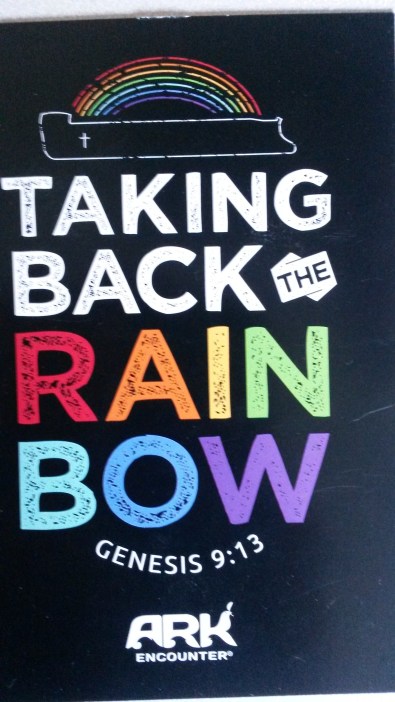
In the end, it was not creationist science that moved Ken Ham beyond the pale of civil speech, but rather his ideas about sexuality. As I was reminded recently on my trip to the Ark Encounter, a primary commitment of Ham’s creationist ministry is an insistence on the illegitimacy of homosexuality. In the eyes of Oklahoma protesters, Ham’s stance against same-sex marriage removes Ham from the circle of legitimate civic participants. By hoping to take away other people’s rights to participate equally in society, the argument goes, Ham has torn up the social contract and pushed himself out of the circle of civic rights, including the right to have his speech welcomed at a pluralist public institution.

If I were a radical creationist—and I’m not—I wouldn’t join Ken Ham and his allies in protesting about free speech rights. There is a larger issue that conservative Christians are losing—the right to have their ideas about sexual morality included in the list of legitimate opinions for public forums and institutions.

The free-speech issue, IMHO, is only a symptom of a much more profound loss by religious conservatives. In this case, Ken Ham didn’t have his rights to speak freely taken away. He still plans to speak in the same town. He is free to invite whomever he likes. He is free to say whatever he likes.

The big question, I think, is not whether or not radical creationists are allowed to speak freely. The big question, rather, is whether or not conservative Christian ideas about sexuality are still included in the list of legitimate political opinions. In this case, at least, they are not…not even in Oklahoma.

I Love You but You Didn’t Do the Reading

Happy Monday! Another week come and gone and nothing to show for it except a handful of headlines:

Does college push students to the left? Not really, a new study finds. At IHE.

A Catholic view: Radical creationism suffers from “an impoverished theology,” at America.Bart reading bible

What does a conservative Koch-funded school look like? Now we know, at Wichita Eagle.

Schools don’t teach much about slavery, at WaPo.

What goes on in evangelical study centers on college campuses? At RNS.

Who’s afraid of institutional life? An interview with an evangelical college president at CT.

New bill would ban South Dakota schools from teaching about gender identity, at MN Star-Tribune.

Florida takes the lead on privatizing public education, at AP.

Why Don’t We Tell Children the Truth about Slavery?

A sad new report offers proof of something history teachers have long lamented: Most students don’t learn much about slavery in their history classes. This terrible failure of our school network isn’t just about slavery; it’s a profound and depressing fact about our schools: We don’t dare to tell kids the truth.

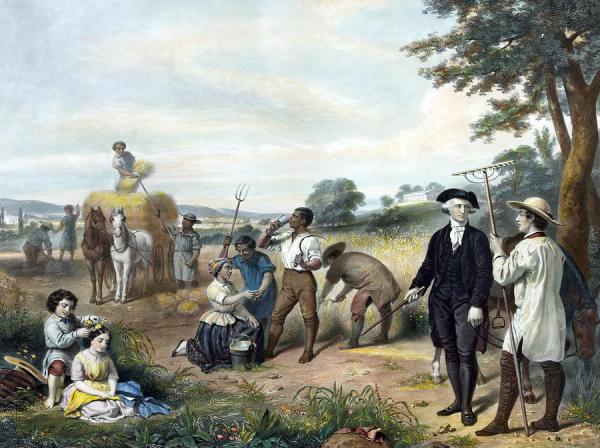
life-of-george-washington-junius-brutus-stearns

George Washington doing what George Washington did. Why is it considered unpatriotic to tell the children about it?

Why not?

The report on students’ knowledge about slavery comes from the Southern Poverty Law Center. The numbers are sadly predictable. Under a quarter of the students surveyed could identify the ways the Constitution gave advantages to slaveholders. Most teachers (over 90%) claimed to want to teach more and better information about slavery, but they reported feeling unsupported by textbooks and state standards.

Our national reticence to teach children the undeniable and important historical truth about slavery has long roots. Time and time again, history classes focus on a feel-good national story. As Yale’s David Blight puts it in the report’s preface:

In America, our preferred, deep national narratives tend to teach our young that despite our problems in the past, we have been a nation of freedom-loving, inclusive people, accepting the immigrant into the country of multi-ethnic diversity. Our diversity has made us strong; that cannot be denied.

And, as the reports’ authors note,

We teach about slavery without context, preferring to present the good news before the bad. In elementary school, students learn about the Underground Railroad, about Harriet Tubman or other “feel good” stories, often before they learn about slavery. In high school, there’s over-emphasis on Frederick Douglass, abolitionists and the Emancipation Proclamation and little understanding of how slave labor built the nation.

This fear of telling students ugly truths has a long history. As I noted in my book about educational conservatism, many of our culture-war battles about teaching US History pitted the bashers against the boasters. Conservatives wanted kids only to hear about America’s glories. Progressives wanted to teach that the US has always had plenty of moral flaws.

In the 1930s, for example, journalist and patriot Bertie Forbes attacked the popular textbooks written by Harold Rugg. Rugg hoped to introduce students to the real complexity of international relations. In Forbes’s opinion, such efforts would rob students of their patriotic fervor. As Forbes wrote in 1940,

If I were a youth, I would be converted by reading these Rugg books to the belief that our whole American system, our whole American form of government, is wrong, that the framers of our Constitution were mostly a bunch of selfish mercenaries, that private enterprise should be abolished, and that we should set up Communistic Russia as our model.

By and large, historically speaking, the Forbeses of the world have always won these fights. Schools primarily teach (and taught) students that America was a place they could love. Teaching too much or too frankly about slavery has always been seen as a dangerous and controversial effort.

It’s not only slavery that is ignored or misrepresented. As SAGLRROILYBYGTH are keenly aware, schools shy away from all types of controversial topics, even when the controversy is contrived.

berkman plutzer chart 2 better text color

From Berkman & Plutzer: Can we please not talk about it?

As Penn State political scientists Michael Berkman and Eric Plutzer found, only a minority of high-school biology teachers teach mainstream evolutionary theory and only mainstream evolutionary theory in their classes. The rest tend to mash together a mix of mainstream science and dissenting creationist ideas. Why? Because most teachers share the ideas of their local communities. If people want their kids to learn a variety of ideas about science, that’s what most teachers will deliver.

This has always been the case. In the 1940s, an enterprising scholar set out to discern how many teachers taught evolution. One teacher from California explained why he avoided the topic of evolution in class. As he put it,

Controversial subjects are dynamite to teachers.

And there’s the rub. Teachers will tend to avoid controversy. There’s no controversy among historians about whether or not slavery was a vital and decisive element in US history. There’s no controversy among mainstream scientists about whether or not mainstream evolutionary theory is a vital and decisive element in biology.

But broad segments of the population disagree. They don’t want their children to learn that America has historical flaws. They don’t want their children to learn that our species developed by a long series of minor changes.

Unless and until those things change, classrooms won’t improve. I heartily concur with the four-point action plan put forth by the recent SPLC report. It recommends the four following steps:

  1. Improve Instruction About American Slavery and Fully Integrate It Into U.S. History.
  2. Use Original Historical Documents.
  3. Make Textbooks Better.
  4. Strengthen Curriculum.

All good ideas. But they won’t be enough. Just like evolutionary theory, the history of slavery won’t be included in our classrooms until it is included in our day-to-day conversations. Until the country as a whole recognizes the importance of America’s ugly past, classrooms will continue to ignore it.

As we’ve seen time and again, we can’t use curriculum to change society. We need to change society and watch curriculum follow along.

Where’s the Beef?

I didn’t think it was all that complicated, but at least two smart people have misunderstood my complaint, so I’ll try to clarify. If SAGLRROILYBYGTH think I’m splitting hairs or being overly persnickety, I’ll shut my yap. But I don’t think I am and I don’t think the point is all that abstruse.duty_calls

Here’s what we’re talking about this morning: Last week, I wondered if evolution maven Jerry Coyne had a glitch in his code. He didn’t think protesters against Steve Bannon had a legitimate right to block Bannon’s appearance at UChicago. Coyne pooh-poohed protesters’ claims that the issue wasn’t really about free speech.

But I assumed—correctly it appears—that Prof. Coyne does reject some claims to free-speech protections. Prof. Coyne and I agree: Just because someone claims free-speech protection doesn’t mean they should get it. Some claims are bogus. Some are even harmful, at least potentially. The most obvious case is the perennial free-speech claim of America’s creationists. In state legislatures, bill after bill purports to protect the free-speech rights of creationist students and teachers.

Especially since we agree on everything, Prof. Coyne wondered what my beef was. As he put it,

Laats’s beef seems to be this: if I, Professor Ceiling Cat Emeritus, favor free speech on college campuses, why don’t I favor free speech in the classroom?

Coyne goes on to explain—and I agree with him as far as he goes—that creationist teaching in classrooms is not the same as controversial invited speakers on university campuses. However, he didn’t identify my beef correctly. Here it is: If Prof. Coyne doesn’t recognize the legitimacy of creationists’ claims to free-speech protections, why doesn’t he grant other people similar rights to un-recognize free-speech claims?

After all, Professor Coyne makes it clear. He says,

I do not recognize creationists’ desire to teach goddy stuff in the classroom as a “free speech” claim. [His emphasis.]

Coyne means, I think, that creationists can’t claim protection for their speech if it establishes a government religion unfairly, contra the First Amendment. By doing so, creationists give up any right to free-speech protection for their creationist teaching. The important point, IMHO, is that Prof. Coyne recognizes that some free-speech claims are faulty. Those claims are not legitimate and they do not deserve the protection they demand. Creationists insist on their right to free speech; they insist that their rights to be heard are often dismissed unfairly. In general, I think Prof. Coyne and I agree—we don’t lose any sleep over such creationist complaints, because we do not recognize them as legitimate claims to the protection of free-speech rights.

Which leads us to the main question again: If Prof. Coyne is willing to dismiss some claims to free-speech protection as illegitimate, why doesn’t he at least respect the anti-Bannon argument, even if he disagrees with it?

In other words, though I agree with Professor Coyne both that Bannon should be allowed to speak and that creationists should not be allowed to teach creationism in public-school science classes, I disagree with his glib dismissal of the arguments of the anti-Bannon protesters.

I think we need to acknowledge that there are real and important reasons why some intelligent, informed, well-meaning people refuse to recognize Bannon’s claims to free-speech protections. Further, there are good arguments to be made that a private (or public) institution has a responsibility to consider the implications of its speaking invitations. By inviting Bannon to speak, an elite university like Chicago is conferring on Bannon and Bannon’s ideas more than a touch of mainstream legitimacy. Blocking someone from speaking at the University of Chicago is not the same as blocking his or her right to holler on a street corner. I don’t think the Chicago protesters are hoping to shut down Breitbart; they are merely hoping to deny Bannon the enormous prestige of a Chicago speaking appearance.

Now, in this particular case I think the decision should swing in Bannon’s favor. But that does not mean that the anti-Bannon protesters don’t have a decent case to make. It does not mean that the UChicago protesters are “discarding one of the fundamental principles of American democracy because they don’t like its results,” as Prof. Coyne accused.

Some free-speech claims are bogus and don’t deserve to be recognized. The Chicago protesters and I merely disagree about the proper decision in this one particular case. They are not necessarily against free speech; they are disputing Bannon’s claim to free-speech protections; they are against their university recognizing Bannon’s legitimate status.

I’m Like a Creationist (and You Are Too)

SAGLRROILBYGTH know I’m no creationist. But this week I had an experience that I think is similar to what some thoughtful creationists go through. When it comes to questions of religion and public life, that is, sometimes the issue is not really the issue. I’m wondering this morning if everyone—creationist or non-creationist—has had similar experiences.

Here’s what I’m talking about: A new bill in Iowa’s state legislature would allow public schools to teach Bible classes. I’m all for public schools teaching about religions, including Christianity. It is clearly constitutional, as long as the teachers aren’t preaching any particular religion. And it is IMHO a vital part of a comprehensive education. How can we expect to teach US History, for example, without teaching about Puritan values? How can we teach literature without reading the Bible? Yet in spite of the fact that I support religious ed in public schools in theory, I oppose this bill and others like it.

Why?

My beef is not directly about Bibles. It’s really a question of trust. When it comes right down to it, I don’t trust the bill’s backers. I think they are hoping to sneak some old-fashioned Protestant devotion into their public schools. They SAY they want students to learn about the historical and literary impact of the Bible, but when they talk about their proposed classes, you can almost smell the revival-tent sweat.

According to the Des Moines Register, for example, one of the bill’s ardent supporters insists the Bible class would help students be better Christian Americans. As he put it,

foundational and historical American values did not spring from the cornucopia of ‘world religions,’ but specifically from the Judeo-Christian scriptures.

To my secular ears, that sounds a lot like a Wallbuilders-style evangelical power play.

Do I want more education about religion in public schools? Yes!

But this bill is not-so-secretly intended to preach a specific, conservative-evangelical religion. It is intended to have a religious impact on students, which public schools should never attempt.

How does this make me like a creationist? Simple. Many creationists have had similar experiences. Throughout the twentieth century and today, even the most radical young-earth creationists often want their children to learn about evolution. But they distrust the motives of public-school types who teach it. Many creationists worry less about evolutionary science than about the sneaky atheistic teachers who they think want to use evolutionary theory Dawkins style, to prove the ridiculousness of religious faith.

I found over and over again in the research for my new book about evangelical higher education that creationist schools promised to teach evolution, but to do it safely.

At Liberty University for example, in 1985 founder Jerry Falwell promised that all Liberty students would learn about evolution. As Falwell explained to potential enrollees,

You’ll learn all about evolution, but you’ll learn why you don’t believe it. . . . To our knowledge, we’ve never graduated an evolutionist.

Closer to home, right here at ILYBYGTH we’ve heard from creationists who are eager to teach their kids about evolution, if they can do it without cramming atheism down their throats.

Beyond these anecdotes, there seems to be solid sociological evidence that creationists like evolution, but worry about something else. In their study of religious people’s attitudes toward science, Elaine Howard Ecklund and Christopher Scheitle found that evangelicals tended to have more positive attitudes about science than the general population. But evangelicals also tended to think more often that scientists were out to get them. In other words, evangelicals—some of them, at least—like science itself, but they are suspicious of people who call themselves scientists.

So here’s my hunch: We’re all the same when it comes to these questions of religion and public life. Even when we support an idea in principle, we don’t support it in practice because we distrust its supporters.

For me, that means opposing Bibles in public schools, even though I ardently desire better religious education in those public schools.

For creationists, that means opposing the teaching of mainstream evolutionary theory alone in public-school science classes, even when they really want their children to learn evolution.

  • For all you creationists out there, am I off the mark?
  • And for my fellow non-creationists, have you had a similar experience?
  • Is the central issue not really Bibles or evolution…but TRUST?