Hello, Florida!

Good morning, SAGLRROILYBYGTH!

Wish me luck–I’m on my way to the Sunshine State.  Thanks to my colleague Sevan Terzian, I’ll be giving a keynote talk at the University of Florida’s research symposium this evening.  I can’t wait.

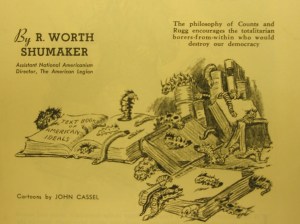
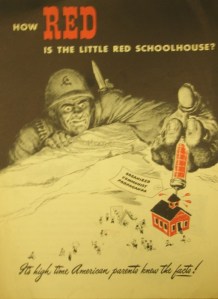
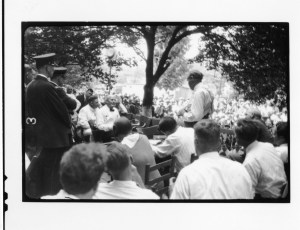
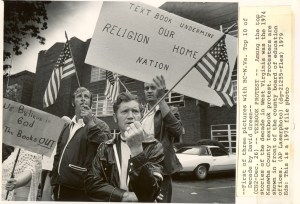
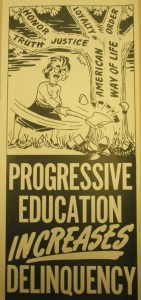
What will I be talking about?  Well, you’ll have to wait until after the talk for a synopsis, but I can tell you that I’ll be using these images from my research into twentieth-century educational conservatism.

Allen Zoll’s attack on progressive education, from Pasadena, 1950

The American Legion warns of treasonous textbooks, 1940

Watch out for communism in your local school, c. 1951

Scopes Trial, 1925

Kanawha County’s protesters, 1974

School = Thanksgiving

Ah, Thanksgiving! Our favorite holiday of all. No gifts, no decorations, no sweat . . . just lots of food and friends and football. Your humble editor has retreated to an undisclosed location in scenic upstate New York to share the holiday with family.
simpsonsturkey

PS 101

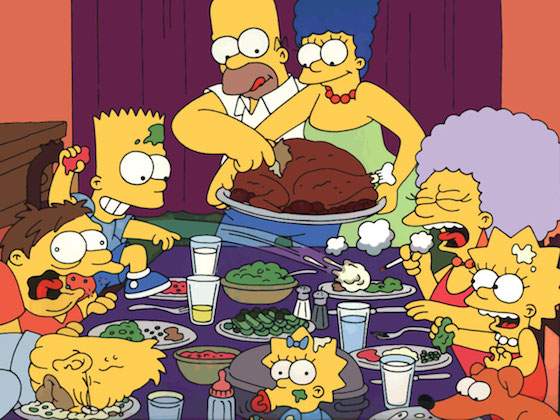
Before we do, however, we must give in to our unhealthy compulsion to share some Thanksgiving reflections about schooling and culture wars. In the past, we’ve noted the central role Thanksgiving has come to play in those battles. Today, though, we want to point out a more basic connection: Why do we keep having culture wars over the teaching in our public schools? Because those schools are like Thanksgiving itself.

First, a review of our ILYBYGTH reflections about culture-wars and Turkey Day:

Today, let’s consider a more fundamental idea: Thanksgiving gives us a chance to see how public schools really function and why they serve so often as lightning rods for culture-war kerfuffles. Thanksgiving dinner might just be the best analogy for the way our schools work.

Because we know they don’t work the way anyone really wants them to.

For generations, progressive activists and intellectuals have dreamed of schools that would transform society. To pick just one example from my recent book, in the 1930s Harold Rugg at Teachers College Columbia hoped his new textbooks would transform America’s kids into thoughtful authentic small-d democrats. The books would encourage students to ask fundamental questions about power and political transparency. They would help young people see that true social justice would come from a healthy transformation of society, with power devolved to the people instead of to plutocrats.

For their part, generations of conservative activists have tried to create schools that would do something very different. There is no single, simple, definition of “conservatism,” of course, but by and large, as I also argue in my recent book, activists have promoted a vision of schooling as the place to teach kids the best of America’s traditions.

As one conservative intellectual asked during a turbulent 1970s school boycott,

Does not the Judeo-Christian culture that has made the United States the envy of the world provide a value system that is worth preserving?

Other conservatives shared this vision. Max Rafferty, one-time superintendent of public instruction in California and popular syndicated columnist, yearned for a golden age when

the main job of the schools was to transmit from generation to generation the cultural heritage of Western civilization.

Max Rafferty was never satisfied. Schools, he thought, failed in their proper job as the distributor of cultural treasures.

Harold Rugg wasn’t happy either. Neither he nor his progressive colleagues in the “Social Frontier” group ever succeeded in using the schools to “build a new social order.”

Why not? Because schools will not fulfill either progressive or conservative dreams. They are not distribution points for ideological imperatives. They are not outposts of thoughtful civilization scattered among a hillbilly hinterland.

Instead, it will help us all to think about schools as a sort of Thanksgiving dinner. At a Thanksgiving dinner, people of all sorts gather together to eat. Friends, family, co-workers, neighbors. Unless you’re lucky enough to escape to an undisclosed location in scenic upstate New York with only a few beloved family members and a dog, you will likely sit at a table with people with whom you don’t share much in common, intellectually.

In every family, you are likely to find some ardent conservatives and some earnest progressives. You are likely to find strong feelings about issues such as abortion, same-sex marriage, evolution, and etc.

That’s why—until the booze kicks in, at least—most Thanksgiving dinners tend to stick with safe topics. We know we can disagree about football, for example. If my Green Bay Packers lose to the horrible Chicago Bears, my cousin knows he can tease me about that.

But we can’t disagree, out loud, at least, about things that really matter to us. If I have an imaginary uncle, for example, who thinks same-sex marriage means opening the door to pederasty and apocalypse, he knows he can’t tease me about it. Our disagreement on that issue won’t be something we can both just laugh about.

So our Thanksgiving dinner conversations, we hope, stick to fairly humdrum topics.

That might just be the best way to understand our schools, too. In spite of the dreams and hard work of intellectuals such as Max Rafferty and Harold Rugg, schools don’t push one ideological vision or another. At least, they tend not to do it very well or for very long.

Instead, they stick to the smallish circle of ideas that we as a society can roughly agree on.

This is why biology teachers tend not to teach a whole lot of evolution.

This is why health teachers tend not to teach a whole lot of sex.

This is why history teachers tend not to teach a whole lot of history.

There are plenty of exceptions, of course. But that also fits into our Thanksgiving analogy. Every once in a while, someone at Thanksgiving will insist on having it out…whatever “it” is. And our holiday turns into a smack-down, leaving everyone a little bruised and shaken.

Similarly, some teachers and some schools will occasionally push for a better vision of education, a more ideologically pure one. As I examine in my recent book, that is when we get culture-war flare-ups.

So as we sit around our tables and eat birds, let’s reflect on the ways this holiday might be the perfect analogy for schools. They are not change agents or tradition-upholders. At least, they are not only that.

Public schools are, rather, a meeting place in which we all implicitly agree to limit ourselves to non-controversial topics. We agree to keep the most interesting ideas, the most provocative ones, and, sadly, often the most educational ones, off the table.

A Field Test for Progressive Education

I’ve spent the past few years of my life trying to figure it out.  What has it meant to be “conservative” about American education? It’s not as obvious as it might look. Similarly, it can be extremely tricky to figure out what makes something educationally “progressive.” Peter Greene offers what might be a handy field test.

A test for the tests...?

A test for the tests…?

As SAGLRROILYBYGTH are aware, my recent book argues that an identifiable tradition of “educational conservatism” emerged in the twentieth century. Speaking broadly, educational conservatives mixed free-market structures with Christian morality; they mixed traditional pedagogy with traditionalist social norms. Jesus and phonics, Friedman and fundamentalism. Time and again, conservative activists successfully asserted their right to be heard about textbooks, school rules, and classroom practices.

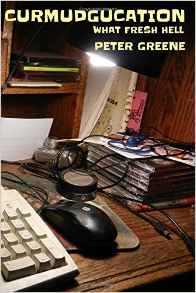
In recent months, I’ve been expanding my reading list to include more non-conservative arguments about education. One of my favorite progressive anti-testers has been Peter Greene at Curmudgucation.

Greene repeated his argument recently that there is an easy way to find out if any evaluation is authentic. Or, more precisely, he offers a quick way to decide if one is inauthentic:

The hallmark of inauthentic assessment is that it’s easy to cheat, because you don’t have to be good at what you’re allegedly being judged for– you just have to be good at the assessment task which, because it’s inauthentic, consists of faking proxies for the real deal anyway. What it really measures is the proxy-faking skills.

If we want a handy-dandy field guide to progressive education—a notoriously slippery concept to define—perhaps Greene’s warning might help.

We might call classroom practices “progressive” if they fundamentally make it impossible for students to cheat. Not by eagle-eyed watchfulness or elaborate security precautions, but because of the nature of the tasks themselves.

In a traditional classroom, for instance, information is transferred from teacher and textbook to student. The student is expected to incorporate this knowledge. At some point, a “test” will be administered, in which said student repeats back the knowledge. He is measured by how much and how well he repeats back the knowledge.

In a progressive classroom, in contrast, students will not have tests of that sort. Rather, they will be expected to make something, perform something, achieve something. Since the parameters are not set up in advance, it is impossible for a student to cheat.

For instance, if assessment is based on a student’s performance in a research-informed discussion, she is free to bring in as many notes as she wishes. If she is able to use that information in a coherent and convincing way, she will have done well on the project.

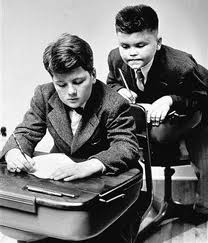
In a traditional classroom, methods of cheating are as traditional as the lectures themselves. Students cheat by writing facts on their arms, by copying answers from another student, or by any of an enormous corpus of tried-and-true methods.

Pssst...I find these methods of assessment inauthentic....

Pssst…I find these methods of assessment inauthentic….

Indeed, we might conclude that the overwhelming political support for traditionalist policies such as No Child Left Behind and Race to the Top results from the fact that progressive education has sunk such shallow roots in the United States. Even the most ardent fans of progressive education admit that it is “hard to beat, but also hard to find.”

By and large, progressive education—as classroom practice, not as political decision—has crashed on the reefs of testing. By and large, American parents and voters cling to the notion that “real” education means acquisition of knowledge. We cling to the idea that “real” education can be evaluated by “real” tests.

Is it true? I know SAGLRROILYBYGTH include self-styled progressives as well as self-styled conservatives. Do the “progressives” out there yearn for evaluations that simply can’t be cheated? And do conservatives agree that the heart and soul of real education can be measured with a good test?

Are Schools Conservative?

Binghamtonians!  Come on down to RiverRead Books on April 21 at 6:30 PM.  Five Court Street in scenic downtown Binghamton.  I’ll be sharing some thoughts from my new book about schooling and conservatism.  Free and open to all.  I’m planning to bring brownies, but we’ll see if I actually get it done.

The place to be...

The place to be…

The book works through several questions:

  • ARE most of America’s public schools conservative places?
  • What has it meant to be “conservative” about education in the USA?
  • How have ideas of “conservatism” and “progressivism” in schools changed over time?
  • What kind of brownies should I make?

As the sophisticated and good-looking regular readers of I Love You but You’re Going to Hell (SAGLRROILYBYGTH) are aware, in my new book I examine four of the most famous educational controversies of the twentieth century: the Scopes Trial of 1925; the Rugg textbook controversy of 1939/40; the Pasadena superintendent ouster of 1950; and the Kanawha County textbook battle of 1974/75.   In each case, conservative activists articulated their ideas about proper education.  In each case, conservative leaders and thinkers viewed education as the best way to improve society.  If schools could be reformed, the thinking has always gone, then society could be saved.

What did they fight for?  How did they envision good schools?  How successful were they?

I’ll try to make the case that these “other school reformers” have played a leading role in determining the course of schooling in this country.  Whether we like it or not (and generally, I don’t), conservative thinking and political clout have played decisive roles in shaping America’s educational system.

So come on down to RiverRead to take place in the conversation.

Does This Chapter Make my Book Look Fat?

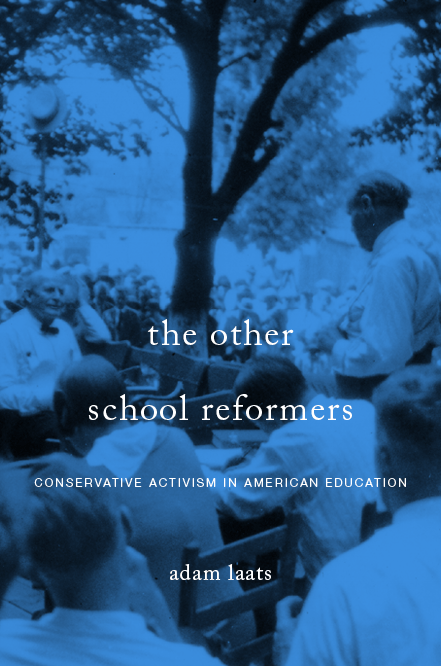
Have you got your copy yet?  My new book is now available.  A conservative ILYBYGTH blog reader was kind enough to read the book and send me some reflections.  I’ll post them in full below.  They are very kind.  I’ll be sure to post news of less flattering reviews as well.

I finished reading The Other School Reformers.  These are just my thoughts and opinions.

I don’t think you made a mockery of conservatives / conservatism.  Some activists confound stereotypes, but there are certainly ones who confirm them.  It wasn’t always pretty, but it wasn’t mockery.  It’s just honest.  You talked about “specific people making specific claims about specific educational programs.”  And “specific times and places.”  (7)  It didn’t mean that every conservative would condone or support every action or idea.

I’m glad extremist examples were included.  Pointing out extremists, I think, can give valuable information.  I didn’t object at all to you talking about it.  In the whole context, it made sense to me to include extreme examples since the survival of the US was at stake.  (I don’t condone extremist tactics of course)  And as time went on, they found themselves “fighting for much narrower aims.”  (16)  I didn’t think this a couple years ago, but now think pointing out extremes is a positive thing and helps lead to an understanding that a reader wouldn’t get otherwise.

I started by reading the index, then going through the index again to see what people or ideas you were going to talk about the most.  That was helpful for seeing the continuity of the issues and just getting an idea of what the book was going to be about.

You made it very clear in the introduction and in the first chapter that your intent was to let conservatives speak for themselves and said that a few times in a few different ways.

Your introduction and first chapter were really well thought out and made the rest of the book clear.  I appreciated the quick progressions under A Moving Target starting on page (14) to get a good overview and to provide some understanding of the changes before delving in.

I appreciate that you started and ended with your personal experience in the schools.

I really enjoy your writing style. Though you allowed conservatives to speak for themselves and you put the spotlight on them, you were still the storyteller.  Imho, the style of your writing accurately portrays the feelings (of some conservatives and certainly the people you talked about), and keeps the reader engaged in the story.  There was a nice ebb and flow of being matter of fact, speaking in a bit of an indignant tone, and using creative language to get your point across.  Your writing enhances without sensationalizing or exaggerating.  (or if it does I think the reader knows that)  It can lead people to be introspective and curious.  (Well, it does for me.)

It was interesting to note that the Gablers didn’t seem to understand what a scientific theory was / is.  (195)   I may have said that before to you, but did note it in here.

You demonstrated all throughout the book change and continuity, and the goals and strategies.  There were many interesting things to note and some confirmations of things I’ve been thinking about.

I’d give it a ten out of ten, or a full 5 stars on Amazon.  I can’t see how it could have been better, it was so well thought out.  It provided the reader with a deep understanding of the issues and people.  It seemed to me that you delivered exactly what you said you were going to deliver in a way that made the argument for why you structured the book the way you did make sense.  If I’m supposed to find something negative about the book, that knowledge is above my head.

I enjoyed it!

The Perfect Valentine’s Day Gift

Nothing says “I Love You” more than a book about conservatism and education in American twentieth-century history. Looks like the timing will be perfect.

How to say "I Love You" (But You're Going to Hell)

How to say “I Love You” (But You’re Going to Hell)

My new book is slated for release in early February. Hard to know how it will be received, but one pre-reviewer has called it “a major rethinking of the history of American education.” Another has added, “it would be flat-out wrong to ignore this important book.” Pshaw. . .

For the sophisticated and good-looking readers of ILYBYGTH, the content might not be surprising. In this book, I try to figure out what it has meant to be “conservative” about education in the United States.  How have issues such as creationism, school prayer, and sex ed developed over the course of the twentieth century?  How are they related?  How have conservative attitudes and strategies changed?  How have they remained the same?

In the early days of my research, I had planned to explore the educational activism of leading conservative groups such as the American Legion and the Institute for Creation Research. I was stuck with two big problems, though.

First, the Legion and other conservative groups remained active throughout the twentieth century. How could I describe different conservatives without rehashing the chronology over and over again? I didn’t want to work from the 1920s to the 1970s in every chapter. What to do?

My second problem was one of definition. How could I choose which “conservative” groups to study? I could copy the method of leading conservative scholars such as Russell Kirk or George Nash and use my selection to make an argument about the definition of conservatism. Both Kirk and Nash picked their subjects to give a particular definition to conservatism. For both writers, being a true conservative has meant being a heroic intellectual battling waves of ignorance and knee-jerk leftism. But I’m no conservative myself, and I wasn’t interested in imposing a flattering (or un-flattering, for that matter) definition on American conservatism. What to do?

Luckily for me, I had some help. At a conference back in 2009, I was describing my research. One of the audience members suggested a new approach. Instead of picking and choosing which activists counted as “conservative,” instead of describing the activism of one group after another, why not do it differently? Why not let conservative activists define themselves? This leading historian suggested that I investigate events, not groups.

That’s what I did. I looked at the four biggest educational controversies of the twentieth century: The Scopes Trial of 1925, the Rugg textbook fight of 1939-1940, the Pasadena superintendent ouster of 1950, and the Kanawha County textbook battle of 1974-1975. In each case, conservative activists and organizations fought for their vision of “conservative” schools. By looking at controversies instead of organizations, I could let conservatives define themselves. And I could move chronologically through the twentieth century without rehashing the stories in each chapter.

Did it work? Now I have to let readers and reviewers be the judge. My goal was to explore what it has meant to be “conservative” in the field of education. I did not want to make the relatively simpler argument that conservatism has really meant X or Y. I did not want to give conservatives a heroic history they could draw upon. Nor did I want to give their enemies a catalog of conservative sins. I’m hoping readers think this approach has worked.

So if you’re looking for that perfect romantic gift, consider The Other School Reformers!

Pre-Orders Now Available!

Want to be the first on your block to get your copy of The Other School Reformers?  Then pre-order your copy today!

Pre-order your copy today!

Pre-order your copy today!

As I was happy to announce recently, Harvard University Press will be releasing the book in early 2015.  But the pre-order just became available on sites such as Amazon.  The hardcover won’t be available until January 12, 2015, but if you pre-order today, you’ll be sure to WOW your friends and family by getting your hands on it first.

The Ink Is Dry!

I’m tickled pink to announce I’ve signed a deal with Harvard University Press to publish my next book.  The subject?  No surprise to ILYBYGTH readers: the book takes a historical look at educational conservatism in America’s twentieth century.  What did conservatives want out of schools?  How did they work to make that happen?

I’m extremely pleased to have the book join HUP’s top roster of educational histories.  All my favorite books are on that list: David Tyack & Larry Cuban’s Tinkering Toward Utopia, Jon Zimmerman’s Whose America?, Jeffrey Moran’s Teaching Sex, and now Bill Reese’s Testing Wars.

I’m honored to join this all-star lineup.  My book—which at this point I’m calling The Other School Reformers: The Conservative Tradition in American Education—takes a look at the four most explosive school controversies of the twentieth century.  My approach has been to examine these four culture-war fights to see what sorts of educational reform conservatives wanted in each case.  At first, I thought I’d pile up histories of leading conservative organizations and individuals: the American Legion, Max Rafferty, the Gablers, etc.  But I couldn’t find a way to decide whom to include and whom to leave out.  Did the White Citizens’ Councils count as educational conservatives?  Did the Institute for Creation Research?  Did Arthur Bestor?

Instead of imposing my own definitions on the outlines of educational conservatism, I took more of a naturalist’s approach.  I set up my blind, so to speak, at the four most tumultuous fights over the content of American schools and watched to see what kinds of conservative activists showed up.

The school controversies were all very different.  First I examine the Scopes Trial of 1925.  Then the Rugg textbook controversy of 1939-1940.  After that, the firing of Pasadena’s progressive superintendent in 1950.  Finally, the literally explosive fight over schools and textbooks in Kanawha County, West Virginia, in 1974 and 1975.

What did I dig up?  In short, I argue that there is a coherent tradition linking conservative school reform across the twentieth century.  Not that these different activists had any sort of conscious organization or program.  Conservatives differed—often differed widely—about key issues such as public religion, race, and the role of government and experts.  More than that, the consensus among conservatives changed over time, as American culture and society changed.  For example, racial attitudes among white conservatives changed enormously between 1925 and 1975.  But in spite of all this change and difference, a recognizable tradition of educational conservatism linked these disparate school reformers.  Conservatives usually agreed with progressive school reformers that good schools were the key to a good society.  But unlike progressives, conservatives wanted schools to emphasize traditional knowledge and beliefs: patriotism, religion, and the benefits of capitalism, for example.

In addition, my book makes the case for the importance of understanding these conservative activists as school reformers in their own right.  Too often, the history of American education is told as the heroic tale of progressive activists fighting bravely against a powerful but vague traditionalism.  My book argues instead that educational conservatism is more than just a vague cultural impulse; conservatism has always been a raft of specific policy ideas for specific historical contexts, fought for by specific individuals and organizations.

So be sure to save some space in your holiday gift list for next year.  The book is slated to appear just in time for Christmas/Hannukah/Kwanzaa/Festivus 2014.