Leading Historian Would Vote for Hitler

He just flew in from New York...

He just flew in from New York…

HT: MM

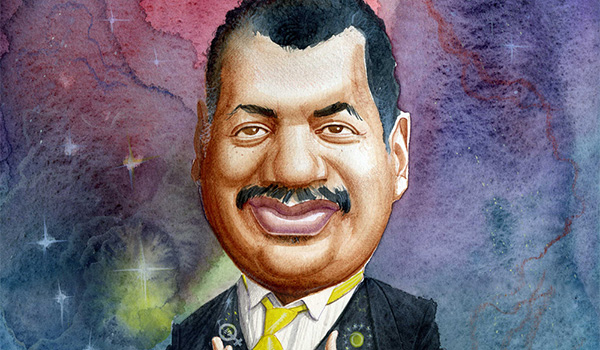
Would you vote for Philip Hitler? Jonathan Zimmerman would. At least, that’s what he told the funny man on The Daily Show the other day.

It’s a pretty funny bit. But more important, it’s great to see our leading educational historian getting to yuk it up with Jon Stewart’s minions.

If you’re not up on the world of educational history, you may not know Jon Zimmerman’s work. But for historians, Zimmerman’s the king. Kind of like the Derek Jeter of educational historians, except Zimmerman shows no signs of quitting.

When I started my graduate work, Zimmerman’s book Whose America pointed me toward the study of culture-war issues in educational history. And now, as part of Zimmerman’s book series on the history and philosophy of education, I’m working with philosopher Harvey Siegel on a volume about the ups and downs of evolution education. So Zimmerman has been hugely influential in my career, and I’m sure every other ed historian out there could say something similar.

And now it looks as if he’s moving into the comedy business. Fantastic.


The Left Seizes Science

You’ve heard the howls from creationists over Neil deGrasse Tyson’s recent Cosmos series.  But did you know non-creationist conservatives also get cheeved at Tyson’s science punditry?

Science Snob?

Science Snob?

The creationist complaints make sense.  The hugely popular new science series pointedly called out young-earthers for their belief in a newish universe.  The series also insisted on the creation of species through evolution.

But the complaints of non-creationist conservatives might not seem so obvious.  In the pages of National Review, Charles C.W. Cooke took Tyson to task for his leftism, not just for his love of evolution.  Cooke accuses Tyson and others of his ilk of a puffed-up condescension, of glibly associating liberal politics with superior intellect.

Too many of these self-righteous faux-nerds, Cooke writes, wrap their insouciance in the mantle of science.  For these Tyson fans and wanna-bes, being smart does not mean doing actual intellectual work, but rather simply adopting a pre-packaged list of things to dislike.  As Cooke puts it, that list includes anything

southern, politically conservative, culturally traditional, religious in some sense, patriotic, driven by principle rather than the pivot tables of Microsoft Excel, and in any way attached to the past.

This sort of prejudice against anything recognizably conservative likes to call itself the side of “science,” Cooke argues.  Yet among progressives, real science often takes a beating.  “Progressives . . . ,” Cooke says,

believe all sorts of unscientific things — that Medicaid, the VA, and Head Start work; that school choice does not; that abortion carries with it few important medical questions; that GM crops make the world worse; that one can attribute every hurricane, wildfire, and heat wave to “climate change”; that it’s feasible that renewable energy will take over from fossil fuels anytime soon . . .

Yet in spite of this demonstrably unscientific attitude, Cooke laments, the Left insists on calling itself the “reality-based” party.

Cooke is not the first to complain about such things.  In the first generation of creation/evolution controversies, anti-evolution activists worked hard—and failed—to claim “science” for their side.  As I noted in my 1920s book, leading anti-evolutionist William Jennings Bryan maintained his membership in the staunchly pro-evolution American Association for the Advancement of Science.  He refused to allow that leading science group to be wholly taken over by fans of evolution.

Similarly, prominent 1920s fundamentalist activist William Bell Riley fought hard to keep his generation of Neil deGrasse Tysons from pushing conservatives out of the world of science.  As Riley put it in a 1927 speech, the creation/evolution debate was not a debate between

Experts on the one hand, and, as someone has said, ‘organized ignorance,’ on the other.  This is not a debate between the educated and the uneducated.

Like Bryan in the 1920s and Cooke in 2014, the conservative Riley was loath to cede the scientific and intellectual high ground to evolution-lovers.

One of the results of that first decade of evolution controversies was the formation of durable cultural associations, the associations about which Cooke complains.  Since the 1920s, “science” has become indelibly associated in the public mind with progress, with social experiment, with iconoclasm.  Politically, if not logically, all of those things are part of the broad package of cultural leftism.  And, like it or not, conservatism has been associated time and again with obstructionism and heedless obscurantism.

For conservative pundits like Cooke, trying to fight that tradition will be an uphill battle.


Orange Is the New Blah…

Okay, I admit it. I’ve been watching Orange Is the New Black. And I like it. But one episode I saw the other night included a painful example of what I’ve been calling the “missionary supposition” of anti-religious folks.

Orange Is the New Hack

Orange Is the New Hack

First, a short introduction for those readers with better things to do: The show follows the prison career of a privileged woman as she serves her time. At first, I didn’t want to watch it. It sounded too much like the terrible genre of ‘brave excursions outside the gated community,’ ignorant self-righteous claptrap along the lines of Barbara Ehrenreich’s Nickel and Dimed.

But after a couple of episodes, I was hooked. The protagonist’s story of elite woe is not as central as I feared. Each of the incarcerated women has her own story and the show makes the most of each.

**SPOILER ALERT: The following contains info about the end of season 1. And some bad language.**

Just because I watch, though, I can’t help but protest some of the stupid blunders incorporated into the story. In a couple of episodes, the protagonist, Piper Chapman, goes a few rounds with fellow inmate Tiffany “Pennsatucky” Doggett. In the show’s depiction of Doggett and in Chapman’s high-handed attitude toward Doggett’s religiosity, we see the worst sort of anti-religious bigotry and ignorance.

Religious = Psychopathic

Religious = Psychopathic

I don’t have much of a problem with the show’s scathing depiction of conservative evangelical religion. We see this most frighteningly in the character of Doggett. Doggett is the unofficial leader of the charismatic Bible group at the prison. She leads deluded healing services and peppers her speech with Biblical references. Not only is Doggett portrayed as a snaggle-toothed, closed-minded, ignorant hillbilly with a heavy penchant for krazy, she actually only won her role as religious prophet by shooting an abortion-clinic worker out of petty spite.

Now, if this show wants to depict religious people that way, fair enough. It is embarrassingly biased, but if the show wants to take that kind of anti-conservative-religion slant, so be it.

But it’s harder for me to swallow the wildly ignorant understanding of religion from one unfortunate scene in the episode “Fool Me Once” [season 1, episode 12, about 55 minutes in]. Pennsatucky wants to baptize Chapman in the laundry sink. At that point, Chapman unleashes her real opinion about the whole thing. IMHO, the following scene demonstrates a terrible misunderstanding of the nature of religious belief, non-religious belief, and the nature of America’s culture wars, not just on the character’s part, but by the makers of this show:

Chapman: Okay, nope, see, I can’t do this. I’m sorry. I really want us to get along. I do. But I can’t pretend to believe in something I don’t. And I don’t.

Pennsatucky: Chapman: We’ve all had our doubts.

Chapman: No, see, this isn’t ‘doubts.’ I believe in Science. I believe in Evolution. I believe in Nate Silver, and Neil deGrasse Tyson, and Christopher Hitchens, although I do admit he could be kind of an asshole. I cannot get behind some supreme being who weighs in on the Tony awards while a million people get whacked with machetes. I don’t believe a billion Indians are going to hell, I don’t think we get cancer to learn life lessons, and I don’t believe that people die young because God needs another angel. I think it’s just bullsh*t, and on some level I think we all know that, I mean, [addressing other Christians] don’t you?

Other Christian #1: [sheepishly] The angel thing does seem kinda desperate…

Pennsatucky: [threateningly, to OC#1] I thought you was a Christian.

OC #1: [defensively] I am, but I got. . . some questions. . .

Whooch! Didja see that? Again, I don’t have a beef if this show wants to malign religious conservatives, if it wants to depict anti-abortion activists as cynical, stupid, self-serving sociopaths. It’s an awkward hack job, IMHO, but not as bad as the wildly ignorant fantasy depicted in the scene above.

As I’ve argued in the pages of the Reports of the National Center for Science Education, too many anti-creationists show this same sort of ignorant “missionary supposition.” They think, along with Piper Chapman and the makers of this show, that the truths of anti-religion are so blindingly obvious that any (thinking) religious person must secretly share them.

Now, to be fair, I should point out that I do (roughly) share those beliefs.  I believe in science.  I believe in evolution.  I like Neil deGrasse Tyson and I don’t think anyone is going to hell.  But just because I agree doesn’t mean I can stomach the weirdly ignorant assumptions in which those statements are wrapped.

When Chapman recites her sophomoric list of village-atheist taunts, the gathered Christians are only kept from agreeing by the bullying of their psychopathic religious leader. In this sort of atheist fantasy, the truths of science only fail to conquer when hearers are not free to acknowledge their obvious awesomeness.

This attitude mirrors nothing so much as the overweening confidence of early religious missionaries. Many Bible missionaries in the early part of the twentieth-century, for example, assumed that the truth of the Bible was so overwhelming that anyone who caught a glimpse of its pages must be supernaturally converted. As a result, Bible missionaries spent a great deal of time and treasure to distribute the Gospel around the world.

At Chicago’s Moody Bible Institute, for example, evangelists distributed printed tracts and gospels throughout the nation and the world, based on this assumption about the supernatural power of Holy Print. As William Norton of the MBI’s Bible Institute Colportage Association related in 1921,

A man was given a tract by the roadside; simply glancing at it, and coming to a hedge, he stuck the tract into the hedge; but it was too late; his eyes had caught a few words of the tract which led to his conversion.

In this understanding of salvation and conversion, some truths have such power that the merest exposure to them is enough to convert the unwilling. Ironically, folks at places such as the Moody Bible Institute have gotten much more sophisticated in their understanding of conversion, while self-satisfied atheists like the makers of Orange Is the New Black apparently have not.

Among conservative evangelical Protestants these days, the difficulties of missionary work are more thoroughly appreciated. As conservative Christian educator David Harley wrote in 1995, missionaries must begin with a “sensitive appreciation of other cultures.” Missionaries who try to plunk down in the midst of a non-Christian population and simply begin spreading Truth amount to nothing more than “evangelical toxic waste,” Harley argued.

Actual missionaries no longer think they can convert without effort. They no longer tell each other to shout out the Gospel and count on it to spread itself. Rather, religious people show a more nuanced understanding of the ways people change their minds.

But there still seem to be people out there so ignorant of other cultures that they think they can convert the heathen with a simple exposition of the Truth. Folks who think that by declaiming a few holy names, such as Christopher Hitchens and Neil deGrasse Tyson, the scales will fall from the eyes of the benighted Christian multitudes.

Pish posh.


US Government Employs Creationist Scientists

Thanks to the ever-watchful Sensuous Curmudgeon, we learn of plans to open a new, enormous creation museum near Boise, Idaho.  But in exploring the announcement of this planned mega-museum, we came across an interesting tidbit: Two of the creationist scientists involved in this project worked for the US government as geologists.  Does this mean that the government is funding creation science?  And does it prove the creationist claim that their experts are engaged in “real” science?

As reported yesterday by the Boise Weekly, the Northwest Science Museum has big ambitions.  Its founders want to open an enormous display area, 300,000 to 450,000 square feet.  They hope to build a full-size replica Noah’s Ark that could rival the plans of the more-established Creation Museum in Kentucky.

Big Plans for Boise

Big Plans for Boise

Whether or not the Idaho creationists succeed in their lavish plans, they will likely end up adding another stop to those who want to tour the nation’s many creation museums.  More interesting, the announced plans also raise crucial questions about creationism and government support for religion.

In their attempt to raise funds for their new project, the leaders of the Boise museum published a prospectus that includes information about themselves.  According to this document, the leadership team includes two experienced geologists.

Douglas J. Bennett, founder of the museum, has degrees in geology and science education from Boise State University.  For the past eighteen years, Bennett has worked as a geologist for the US Bureau of Reclamation.  Similarly, museum founder Brent Carter earned a degree in geology from a large public university and worked for 42 years as a geologist for the same US Bureau, retiring with the title of Chief Geologist of the Pacific Northwest Region.

More than the opening of a new creation museum, these careers raise important questions for those of us interested in issues of evolution and creationism.

First, some might suggest that long governmental careers for these ardent and active creationists implies government support for religion.  But does it really?  After all, the government likely hired them to do specific jobs.  They had the necessary qualifications.  Whatever they chose to do in their private lives wouldn’t be any of the government’s business.  Nor would the government be supporting these men’s religious work, as long as each geologist didn’t do his creationist research while on the clock.

More interesting, we have to ask what these careers tell us about the intersection of mainstream science and creation science.  In the recent debate between leading creationist Ken Ham and leading science pundit Bill Nye, Nye repeated his charge that creationism blocked kids from learning science.  Ham retorted with several examples of successful creationist scientists and engineers.

The careers of Bennett and Carter seem to help the creationist case.  After all, if they have both had successful careers as geologists, how can we say that creationists can’t do science?  One might suggest that the sorts of engineering tasks these creationists engaged in were not primary science.  But it seems to me a stretch to say that these creationist geologists did not have careers specifically in the science that is contested.  In other words, both of these men worked as geologists, though their religious beliefs gave them very non-mainstream ideas about that geology.

Consider—again from the museum prospectus—the tasks Bennett claimed to have worked on for the US government.  As part of his job, Bennett

Performed surface and subsurface geotechnical studies and exploration programs utilizing diamond drill, power-auger, test pits, tunnels, and other processes to secure data for seismotectonic, ground-water, and other special studies of dams, reservoirs, canals, tunnels, spillways, power plants, and related structures.

One might say that none of this engineering work includes primary geological research.  And if it did, someone who believed in a young earth and a recent world-wide flood would be at a crippling disadvantage.  But anti-creationists sometimes make a different point.  Bill Nye, for instance, has warned that a creationist nation will soon fall behind in technology and engineering.

The careers of Bennett and Carter seem to demonstrate the weakness of that argument.  Indeed, Nye argues that creationism will turn kids away from science-related careers.  But in the case of these two men, at least, it was precisely their religious beliefs that led them to careers in geology.

So does this case show government support for creationism?  Not really.  But it does offer evidence that creationism does not necessarily deter young people from going into science-related careers.  Indeed, because of the tumult over the nature of biology and geology, perhaps creationist beliefs actually drive some young people into careers in science.


A Trip to a Catholic-School Science Fair

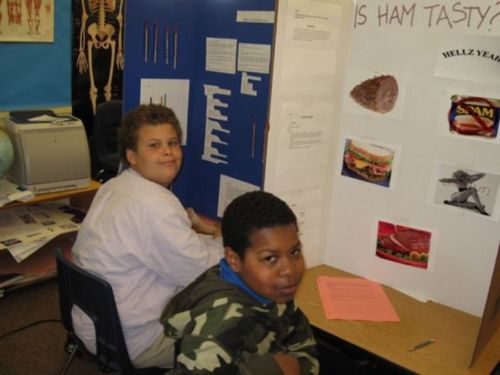
Science Fairs are great.  At their best, they allow students some freedom to experiment and learn on their own.  At their worst, they still provide hilarious examples of wacky adolescent science.  Recently, we saw a field report from the National Center for Science Education blog.  Peter Hess asked the question: What passes for “science” at a Catholic science fair?

In these pages, we’ve eagerly read reports from the field as science mavens visit various sorts of science fairs.  P.Z. Myers has argued that creationist students actively use science fairs to subvert the mind-numbing mental boundaries imposed by creationism.  Greg Laden visited a creationist homeschool science fair and found that some of the science was not bad.  At least not much worse, Laden thought, than the crappy science on display at non-creationist science fairs.

Cutting-edge science from a non-religious science fair...

Cutting-edge science from a non-religious science fair…

Hess found to his great relief that his kids’ Catholic school promoted mainstream science, without adulteration from theology.  Students came up with ambitious projects, such as measuring the distraction levels posed by cell phones and texting.

How distracted are drivers? This kid was not looking to the Bible for answers...

How distracted are drivers? This kid was not looking to the Bible for answers…

Hess also talked with some of the teachers.  Those teachers, too, did not see any conflict between Catholicism and teaching mainstream science in their classes.  One teacher offered an opinion that echoed the view of the late Stephen Jay Gould.  As middle-school teacher Joseph Nagel told Hess,

I sometimes consider science to be the constant investigation of the external world, a quest to analyze and understand the physical world, exclusive of human experience.  Religion I see as the eternal internal investigation, a search to explore and understand what lies within and between us, an examination of the human experience.  If science is our understanding of the world, religion is our understanding of us.  Maybe science is the ‘how’ and religion is the ‘why.’

Of course, different Catholic schools might have different approaches.  But my experience matches up closely with that of Hess.  I taught for a decade in Catholic schools in Milwaukee.  Though we sometimes had arguments about the novels we’d teach or the theology we’d teach, there was never any glimmer of controversy over the science we’d teach.

In fact, at least one of our science teachers also taught biology (or was it chemistry?) at a local public, secular community college.  When I asked him if he taught science differently at our Catholic school, he responded just as did the teachers Hess talked to: “Why would I?”


Bad News for Everyone

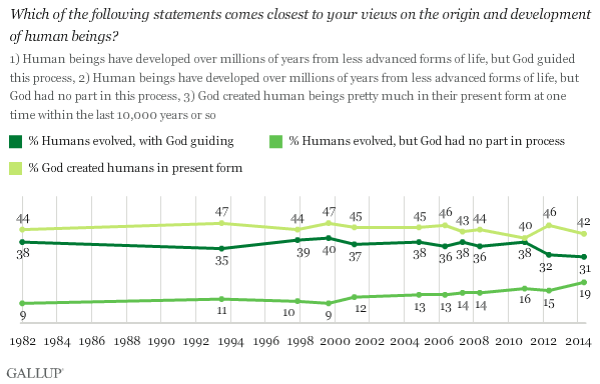
Have you seen it yet?  The new Gallup poll on creationism and evolution is out.  The numbers are about the same as they have been for the past thirty years.  But beyond those numbers, the backgrounds of Gallup’s respondents has some bad news for creationists.  It also has bad news for evolution-lovers.

Stable Numbers Since the 1980s

Stable Numbers Since the 1980s

Since the 1980s, Gallup’s pollsters have been offering respondents three options about the origins of humanity.  This time, 42% chose the young-earth creationist option: “God created human beings pretty much in their present form at one time within the last 10,000 years or so.”  In contrast, 31% chose “Human beings have developed over millions of years from less advanced forms of life, but God guided the process.”  A whopping 19% selected “Human beings have developed over millions of years from less advanced forms of life, but God had no part in the process.”

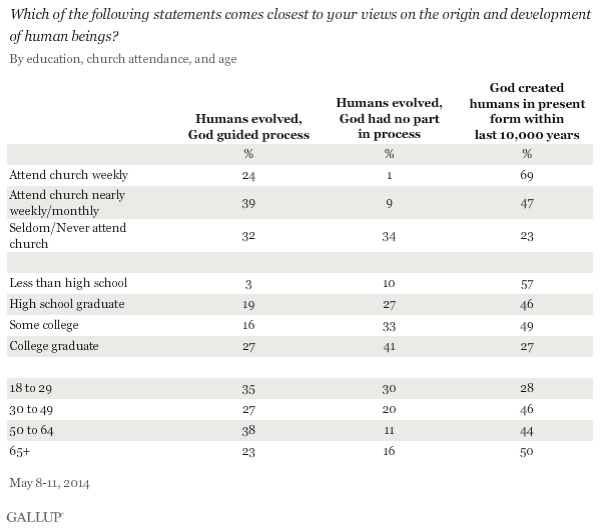
Those numbers have remained fairly stable for the past generation.  But another result of the recent poll numbers needs some examination.  The young-earth position is much more common among less educated adults.  For those with less than a high-school diploma, 57% selected the young-earth option.  A far smaller proportion, only 27%, of Americans with a college degree chose the young-earth explanation.

"Organized Ignorance?"

“Organized Ignorance?”

This is bad news for everyone.

For creationists, these numbers suggest that more education means less creationism.  Throughout the lifespan of American creationism, creationist intellectuals have fought a rearguard action against accusations of ignorance.  In 1927, for example, Minneapolis fundamentalist leader William Bell Riley told a reporter,

Every time I hear the argument that this is a controversy between experts on the one hand, and, as someone has said, ‘organized ignorance,’ on the other, I smile.  This is not a debate between the educated and the uneducated.

Riley’s smile grew more and more strained as the 1920s wore on.  And later generations of creationists found it even more difficult to take the intellectual high ground.  These numbers mean bad news for them.

But the numbers mean bad news for evolution mavens, too.

Though more college grads embrace a non-young-earth understanding of the origins of humanity, 27% is still a significant number.  It means that over a quarter of adults who have been to college—educated adults, that is—select a young earth as the best explanation.  Over a quarter!  Some of those, to be sure, may attend what young-earth creationists embrace as “Creation Colleges.”  Ken Ham of Answers In Genesis, for example, publishes a list (and a map!) of schools that he views as faithful to the Bible’s obvious meaning.

But many of those college-educated young-earth creationists likely attend non-creationist colleges as well.  As anthropologist David Long demonstrated in his study of creationists at a large public university, studying biology at a secular university does not tend to shake the faith of creationist students.  Of his interview subjects, only one abandoned her creation faith as she majored in biology.  And it wasn’t the science that convinced her.  She had already begun to move away from her faith in high school, due to an early pregnancy and the sour reaction of her church community.

As I argued a while back in the pages of the Chronicle of Higher Education, anti-creationists are too fond of calling all creationists “ignoramuses.”  Certainly, some folks must embrace creationism because they just don’t know better.  But many educated adults DO know about evolution.  They simply choose young-earth creationism instead.  That is a troubling fact that anti-creationists have always had a hard time dealing with.


Take the Creation Museum Challenge

We can gnash our teeth.  We can pull our hair.  But no matter what we do, the Creation Museum of Answers In Genesis has pulled it off.  With its new $1.5 million dinosaur exhibit, the flagship museum of young-earth creationism has successfully mimicked the outward appearance of mainstream scientific museums.

Big Valley Creation Science Museum

Big Valley Creation Science Museum

It used to be easy.  Creationist museums used to be only sad little affairs.  They used to look like this one from Alberta, Canada.  The Big Valley Creation Science Museum, pictured here, may do a great job in spreading the creationism gospel.  But no idle tourist would be likely to confuse it with mainstream museums such as the Smithsonian’s Museum of Natural History or Boston’s Museum of Science.

It used to be easy for outsiders like me to mock the lame pretensions of the many creation museums that dotted our great land.  And Canada.  As one angry visitor noted, even the bigger creation museums used to have strange, sad displays like this one from San Diego’s Creation and Earth History Museum.

Not a Lot of Big Bang for your Buck

Not a Lot of Big Bang for your Buck

But here’s the new challenge: Can you tell which of the three pictures below comes from Kentucky’s Creation Museum display and which come from the Smithsonian and Boston’s Museum of Science?  As arch-creationist Ken Ham explained gleefully recently, this new display of a million-dollar Allosaurus fossil puts Ham’s Creation Museum in the same league as those mainstream museums.  As Ham put it,

For decades I’ve walked through many leading secular museums, like the Smithsonian in Washington, D.C., and have seen their impressive dinosaur skeletons. But they were used for evolution. Now we have one of that class, and it will help us defend the book of Genesis and expose the scientific problems with evolution.

So take the Creation-Museum challenge.  Just by looking, can you tell which of these images comes from a young-earth creationist museum and which come from mainstream ones?  (Don’t cheat.  But once you’ve given it a try, you can click on each image to see its provenance.)

Is this "real" science?"

Is This “Real” Science?”

Or Is It This One?

Or Is It This One?

Millions of Years?  Or Millions of Dollars?

Millions of Years? Or Millions of Dollars?

This successful mimicry is important.  In creationism’s twentieth-century struggle to establish alternative educational institutions to rival those of mainstream science, young-earth creationists often wrestled with significant disadvantages.  Not least of these were questions of funding, as historian Ron Numbers described in his must-read book The Creationists and I detailed in my 1920s book.  In the case of this priceless fossil, rich creationists Michael and Stephen Peroutka donated it to help the Creation Museum with its work.

It would be nice to think that America’s public would make its decisions about the age of the earth and the origins of humanity by weighing evidence and considering counter-claims.  To people like me, the Creation Museum’s claim that this well-preserved fossil serves as proof of a worldwide flood 4,300 years ago seems absurd.

But I don’t think we need to be very cynical to guess that appearance matters.  As Dan Kahan argues, what people believe about creation and evolution usually has more to do with their cultural identity than it does with scientific evidence.  If Answers In Genesis can make their museum LOOK like the Smithsonian, many visitors will assume it is just as good.  And if Answers In Genesis can crank out peer-reviewed science publications that attest to the scientific veracity of their claims, many readers will assume their science is just as good.

So take the Creation Museum challenge.  If you can’t tell the difference, how can you expect anyone else to?


Holocaust Denial, Evolution Denial, and “Teaching the Controversy”

Should students learn to think critically in schools?  Should they learn about both sides of controversial issues?  This morning at the National Center for Science Education blog, Glenn Branch compares creationists’ fondness for “teaching the controversy” to an explosively controversial history lesson from California.  For those of us interested in conservative ideas about schooling, this recent flap again demonstrates the ways “conservative” and “progressives” have swapped sides on this issue.

In the Rialto (California) Unified School District, eighth-grade students were asked to evaluate the arguments for and against the existence of the Holocaust.  “When tragic events occur in history, there is often debate about their actual existence,” the assignment reads, according to the San Bernardino County Sun.

For example, some people claim the Holocaust is not an actual historical event, but instead is a propaganda tool that was used for political and monetary gain. Based upon your research on this issue, write an argumentative essay, utilizing cited textual evidence, in which you explain whether or not you believe the Holocaust was an actual event in history, or merely a political scheme created to influence public emotion and gain. Remember to address counterclaims (rebuttals) to your stated claim. You are also required to use parenthetical (internal) citations and to provide a Works Cited page.

When the story came out about ten days ago, some conservative pundits tried to use this as proof of the moral monstrosity concealed in the Common Core State Standards.  The standards, some said, pushed school districts into adopting such terrible ideas as Holocaust denial.

Glenn Branch asks a different question.  How is this example of teaching “critical thinking” any different from creationist attempts to have students evaluate evolution and creationism side by side?  In both cases, students are encouraged to look at evidence.  Students are prompted to evaluate arguments and come to their own decisions.

But in the case of Holocaust denial, one side of the balance sheet has been thoroughly discredited.  It is not morally or educationally appropriate to ask students to decide whether or not the Holocaust happened, critics insist.  One of the sources students were given in this assignment stated the following:

With all this money at stake for Israel, it is easy to comprehend why this Holocaust hoax is so secretly guarded. In whatever way you can, please help shatter this profitable myth. It is time we stop sacrificing America’s welfare for the sake of Israel and spend our hard-earned dollars on Americans.

Offering students these sorts of false, hateful lies as “sources,” critics say, demeans the idea of pushing students to think critically.  If creationists thought that students should really explore every side of every issue, even sides with no intellectual or moral legitimacy, Branch argues,

then they should have been enthusiastically supporting the Rialto assignment. It’s to their moral credit that they weren’t, of course, but it proves—as if proof were needed by now—that “teach the controversy” and the like are merely rhetorical legerdemain intended to distract the spectator from the intellectual hollowness of the proposals they are supposed to support.

To suggest that schools ought to “teach the controversy” when there is in fact no controversy among mainstream scientists, Branch concludes, is just as bogus as having students evaluate the claims of Holocaust deniers.

The historian in me can’t help but notice the flip-flop we’ve seen over the course of the twentieth century.  In 1925, it was the pro-evolution side who pleaded with America to consider both sides in public schools.  Most famously, Scopes-trial attorney Dudley Field Malone begged the nation to allow the teaching of evolution.  “For God’s sake,” Malone implored, “let the children have their minds kept open.”  Ironically, as historian Ronald Numbers pointed out in Darwin Comes to America (pg. 91), later creationists adopted Malone’s plea as their own.

This is one of the themes I’m working with in my upcoming book.  Back in the 1920s, it was the conservative side of school battles who protested that these were false choices.  In 1929, for instance, the staunchly conservative leader of the Daughters of the American Revolution warned DAR members that progressives sneakily insisted on teaching both sides of every issue.  Such choices, she warned, were false ones.  Even to ask the questions tipped students away from truth and morality.  As she memorably argued,

Flagrant cases of un-American tendencies have been brought to light and exposed.  Exotic theories are promulgated in the name of science.  Disdain for law and order, and contempt for our accepted form of Government are subtly injected into the teachings of history.  Such practices are defended by the advancement of the decrepit theory that both sides of the question should be presented to permit the forming of unbiased opinions.  This may be the proper system for the seasoned adult who presumably can, if he will, revoke his errors when faced with the consequences of an unwise choice.  With the young, the chances are too great, for there a dangerous inequality exists.  One does not place before a delicate child a cup of strong black coffee and a glass of milk; or a big cigar and a stick of barley candy; or a narcotic and an orange, and in the name of progress and freedom insist that both must be tested in order that the child be given the right of choice.  Instead, one carefully supplies only what will make for the development of the young body and assure its normal growth.  Why then apply the very opposite theory when dealing with the delicate and impressionable fabric of the mind? (Emphasis added.)

With this historical lens, it seems doubly apparent that the argument for teaching both sides of any tricky issue has always been politically popular among Americans.  If there’s a controversy, many Americans have always agreed, let children hear both sides.

Back in the 1920s, progressives and evolution educators tried to make this case.  Let children hear about socialism and evolution, progressives pleaded.  At least allow schools to teach the controversy.  Back then, conservatives made the case that one side of those ideas was not equal.  To offer students both candy and cigars to choose from, as our DAR leader insisted, was a false choice, a false controversy.

Today, the sides have switched but the argument has not.  One side argues to let children hear both sides of a controversial issue and decide for themselves.  The other side insists that only one side has any truth, any intellectual legitimacy.

Me personally, I agree that Holocaust denial and evolution denial ought not be offered as equals to better history and better science.  But I know many readers might disagree.  How can creationists defend the legitimacy of “teaching the controversy” when most scientists agree that there is no controversy?  Is it like offering children a choice between heroin and citrus fruits?  Milk and coffee?  Candy or cigars?


Friday Night Lights: Evolution in Schools

How can evolutionary ideas help education?  This Friday, biologists and evolution mavens David Sloan Wilson and Richard Kauffman of Binghamton University’s Evolutionary Studies Program will be giving a talk about using evolutionary theory to improve education.  And you’re invited.

Professors Wilson and Kauffman will not just be talking about teaching evolution as a subject, but about ways to use evolutionary ideas to help increase learning in all subjects.  As they put it,

Evolutionary theory is highly relevant to education in ways that go beyond the need to teach evolution in public schools. We will make two additional evolution-education connections in our talk. First, evolutionary theory can be used to design social environments that are maximally conducive to learning all subjects. Second, evolutionary training can increase general cognitive thinking skills, including the ability to transfer knowledge across domains. We will illustrate these points with two studies, involving a program for at risk-high school students and a college course that teaches evolution across the curriculum, respectively.

The talk will take place on the scenic campus of Binghamton University, Friday, May 9, between 5-7 PM, in room 124 of Academic Building B.  All are welcome, but the talk will be targeted toward graduate students and science educators.  There is no need to register and the event is free.

For those of you who are unable to travel to Sunny Binghamton, the presenters will be talking about two academic studies: “A Program for At-Rish High School Students Informed by Evolutionary Science,” and “The Evolutionary Biology of Education: How Our Hunter-Gatherer Educative Instincts Could Form the Basis for Education Today.”


Bill Nye Misses the Boat on Creationism

What does it mean to be a creationist?  Especially a young-earth creationist of the Ken Ham sort?  “Science Guy” Bill Nye argued the other day that creationism represents “striking science illiteracy.”

I like Bill Nye.  I like science.  But Nye’s statement represents a lamentable cultural illiteracy.  In the long run, it doesn’t help the cause of evolution education.  It does not help to bridge the culture-war trenches.

Around minute five of the video above, Nye begins to discuss his recent debate with young-earth creationist leader Ken Ham.  Nye humbly acknowledges that it might not have been a good idea to debate Ham.  But he went ahead with the debate.  Why?  Because Nye worries about the “striking science illiteracy” represented by young-earth creationism in the United States (around 6:23 in the video clip above).  Without science, Nye goes on, there would be no internet.  There would not be enough food for everyone.  Science and especially science education represent basic building blocks of a just and prosperous society.  Nye hopes that high-profile debates might help voters and taxpayers de-fund and delegitimize creationism in America’s public schools.

For the record, I agree that the “Ham-on-Nye” debate was a good thing for those of us who want more and better evolution education in America’s schools.  I applaud Nye’s bravery and his presentation skills.  But I wish he would not rely on this false notion that young-earth creationism represents a simple lack of knowledge about evolution.  It is not true, and it suggests bad policy approaches to improving evolution education.

Consider, for example, our best recent polls about science literacy and creationism.  As political scientists Eric Plutzer and Michael Berkman recount in their book Evolution, Creationism and the Battle to Control America’s Classrooms, creationists are not less scientifically literate than non-creationists.

For instance, one Pew poll from 2005 found that Americans who know about the scientific consensus in favor of evolution still support the teaching of creationism in public schools.  You read that right: Among the 54% of Americans who agree that scientists agree about evolution, large majorities (74%) supported teaching creationism, intelligent design, or some mix of evolution, ID, and creationism in public-school science classes.

Another poll that Berkman and Plutzer summarize found that general scientific literacy was not correlated with belief in evolution.  That is, whether or not one was aware of general scientific information had no relation to whether or not one evinced a belief in evolution.

As Dan Kahan noted recently, even the National Science Foundation has considered removing a question about evolution from its science-literacy poll.  Why?  Because there is no correlation between general scientific knowledge and beliefs about evolution.  What people know or don’t know about evolution does not give us any information about whether they believe it or don’t.

Knowledge is distinct from belief.

Bill Nye’s assumption that young-earth creationism represents a lack of scientific knowledge is more than just an embarrassing ignorance on Nye’s part.  The educational and political tasks in cases of naïve non-knowledge are worlds apart from the educational and political tasks in cases of intentional or constructed non-knowledge.  In the case of evolution education, if creationists were simply unaware of evolutionary science, then outreach programs would have a good chance of success.  The task would be simply to spread information.  But in reality, evolution education must recognize that many students and families are not simply ignorant, but resistant to this form of knowledge.  Educational efforts must strive first to understand the reasons for this resistance.  Only then can evolution educators hope to develop effective strategies to teach evolution.

Consider an example from outside the world of evolution education.  Imagine your task is to deliver polio vaccine in a rural area.  If the people in the area did not know about the vaccine, you could simply publicize the benefits and the location of the vaccination clinic.  Then people would bring their children to receive the vaccine.

But if the people in the area thought that the vaccine was dangerous, you couldn’t simply put up posters and distribute flyers.  You would have to engage in a very different task.  You would have to understand why people thought the vaccine was dangerous.  You would have to get to know the reasoning involved in order to offer counter-arguments that would be convincing.  Only if you could convince people that the vaccine was helpful and not dangerous could you ever hope to vaccinate large percentages of the population.

Bill Nye is talented.  Bill Nye is brave.  Bill Nye is smart.

But he continues to display a puzzling ignorance about the contours of creationism in America.  Instead of using his considerable influence to suggest pragmatic policies to spread evolution education, he continues to misdirect evolution education policy.  He needs to learn about creationism if he wants to debate it intelligently.