Bibles in schools, yes. Anti-LGBTQ sentiment, no. That was the combo pleaded last week by NFL quarterback Drew Brees. To this reporter, the most important question is not about Bibles in schools or Brees’s personal attitudes, but rather about the status of anti-LGBTQ organizations among other conservative evangelicals. Can anti-LGBTQ groups claim much support at all?
Here’s the story: Brees recently recorded a promo video for “Bring Your Bible to School Day.” In the short little clip, Brees tells kids what his favorite Bible verse is, then says,
I want to encourage you to live out your faith on Bring Your Bible to School Day and share God’s love with friends.
So far, so good. But a few progressive New Orleanians tracked down the sponsor of Brees’s video and accused Brees of sharing the anti-LGBTQ animus of Focus on the Family. Reporters asked Brees if he really was as anti-LGBTQ as FoF and he backed up faster than a [insert football-related sports analogy here.]
As Brees put it,
[My school-Bible video] was not promoting any group, certainly not promoting any group that is associated with that type of [anti-LGBTQ]] behavior. I know that there are, unfortunately, Christian organizations out there that are involved in that kind of thing, and to me that is totally against what being Christian is all about. Being Christian is love. It’s forgiveness, it’s respecting all, it’s accepting all.
There are a lot of things we could talk about. First, is it cool for kids to bring their Bibles to their secular public schools, hoping to “share God’s love with friends”? Absolutely. Religious kids in public schools are totally free to be as religious as they want, as long as they aren’t disruptive of school procedures.
The only thing that is necessarily “secular” about public schools is the school’s administration itself. Teachers are no longer allowed to preach any religion, nor are they allowed to imply that some religions are better than others. Students, on the other hand, can do whatever they want—pray by the pole, preach during lunch, whatever. As long as the school doesn’t imply its support (like with the famous Kountze cheerleaders), religious kids can religion all they want in public schools. More power to em.
We could also wonder if Drew Brees were still as awesome as we thought. But then we’d remember the time on the Bear Grylls Show that Brees tackled an alligator.
Finally, we’d get down to the really important issue, from the ILYBYGTH point of view. Namely, this episode makes us wonder if Focus on the Family has really lost its base. If FoF no longer can claim the support even of conservative evangelical Christians like Drew Brees, whom can it appeal to? If evangelical celebrities like Brees won’t allow themselves to be associated with FoF, is there any hope for FoF?
If I were an anti-LGBTQ ministry like Focus or Answers In Genesis, I’d be doing some serious soul- (and Bible-) searching.
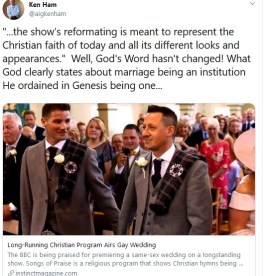
Usually whenever arch-creationist Ken Ham says something shocking, it is because of the zombie science or harsh anti-LGBTQ animus involved. This time, however, I was shocked to see that Ham seemed to be teaching creationist children to cheat in school.
Mean-spirited? Sure. But Ham’s recent advice goes even further…
To see why he would do such a thing and to read my take on why Ham’s advice is actually GOOD news for the rest of us, click over to Righting America for my two cents.
Back to school; back to … losing our religion? Christian colleges that challenge faith, secular colleges that challenge ideas, Rosa Parks Barbie and, of course, Professor Matthew McConaughey all made this week’s list of must-read stories from around the interwebs:
Is the point of a university education simply to provide students a forum in which they can air their political views, no matter how poorly informed? Of course not — and one reason that some students are reluctant to speak in class is because they are confronted, for the first time, by information that undermines their pre-existing assumptions. So how can professors keep exposing students to uncomfortable facts — because that’s our job — while encouraging them to speak their minds and hear out arguments they find outrageous?
At some evangelical schools, religious crisis is provoked by design. Nyack College in New York City offers a slate of first-year classes coordinated with chapel talks meant to challenge students’ beliefs.
“It’s almost that we have to deconstruct their faith, but in a nice way,” said Wanda Walborn, associate professor of spiritual formation at Nyack. “We have to carefully and lovingly get you back to Jesus, get you back to the grace of God, outside of performance.”
There are no shortage of cabinet appointees to take issue with. But I think there’s something particularly egregious with what’s happening with Betsy DeVos in the Department of Education because it’s not just somebody who’s taking the department in a direction I disagree with. She’s somebody who, in my view, is actively undermining the very purpose of the department.
The lawsuit accuses former principal George Finkelstein of targeting the children of Holocaust survivors and then imploring them “to not add to their parents’ suffering by telling them about his assaults.”
tied together with the single thread of distrust and disrespect for teachers. . . . we’ve had decades of federal and state programs meant to force teachers to do a better job. In the classroom, much of these “reforms” have sounded like “You can’t do a good job unless you are threatened, micromanaged, and stripped of your autonomy.” There is a special kind of stress that comes from working for someone who says, in effect, “You have a big important job to do, and we do not trust you to do it.”
Teachers do not experience disrespect only on a national level. Talk to individual teachers about their own work circumstances and you will often hear about district and building administrators who treat teachers like children.
“The label is something that people really crave,” said James Borland, a Teachers College professor who studies “gifted” education. “The fact that the curriculum is very weak in lots of gifted programs — or the fact that it’s not that different — it’s a problematic situation,” he added.
we hear Walke describe something of a conversion narrative. She transformed from a Southern Baptist in the pews of a church whose pastor was teaching that Hurricane Katrina was God’s punishment for sin into a different sort of Christian—one who now leads in the charge of Mayflower UCC’s vote to denounce racism and become a sanctuary church.
The most touching moment in the film gives us a glimpse of the toll of Walke’s conversion. We sit in the passenger seat of her truck as she drives away from her grandmother’s home, where we’ve just seen the two women reflecting awkwardly (but with great compassion) on their connection as Christians, despite their current theological and political divide. The two women sang together an old-time hymn about heaven. But the voices in unison could not cover up the palpable tension, as her grandma, Novella Lore, appeared to struggle to find something to say about her granddaughter’s making headlines in the local paper for public LGBTQ advocacy. In the truck afterward, Walke confides that Lore is worried about her granddaughter’s eternal salvation. “I just want to know one thing. Are you going to go to heaven when you die?” she says Lore asked her.
“The concern is whether the university’s president wanted to do his personal trainer a favor and used Liberty assets to do it,” said Douglas Anderson, a governance specialist and former internal audit chief at Dow Chemical Co, who reviewed both the transaction and Liberty’s explanation of it at Reuters’ request. That would be bad governance, he said. “At a minimum, the terms suggest the buyer got a great deal and Liberty got very little.”
“Due to their alliance with Bolsonaro, the evangelicals started to oppose the protection of the environment. They assimilated the idea that environmentalism is a disguise for communists and for international leaders who want to take the Amazon from Brazil,” said Renan William dos Santos, a researcher at the University of São Paulo who investigates the relations of Christians with environmentalism.
“Student housing standards would face new pressure. Affiliated clinics and hospitals could be compelled to provide religiously objectionable medical procedures. A religious university’s tax-exempt status could be challenged or revoked,” the brief explains.
Why am I able to anticipate these failures in education reform initiatives, while the people devoting fortunes to these efforts and their staff have such a hard time avoiding strategies that result in failure? I’m not that smart and they aren’t that dumb. I suspect the answer is that foundations have organizational interests and cultures that tend to draw them to a mistaken theory about education policy. In its essence, that theory holds that there are policy interventions that could improve outcomes for large numbers of students if only we could discover them and get policymakers and practitioners to adopt them at scale.
I begin with a different theory. I suspect that there are relatively few educational practices that would produce uniformly positive results. Instead, I’m inclined to think of education as similar to parenting, in which the correct approaches are highly context-specific.
The leaders of America’s conservative evangelical colleges are freaking out, and I don’t blame them. An upcoming SCOTUS case threatens to upend the entire premise of evangelical higher ed.
A little background: In October, SCOTUS is slated to hear a trio of cases about LGBTQ rights. At issue is whether or not LGBTQ sexual and gender identity deserve the same legal protections as other factors such as male/female gender, race, and religion. Not surprisingly, conservative evangelical colleges are alarmed. An anti-discrimination ruling could have a serious impact on the way they house students, hire faculty, and earn accreditation. (To be clear here, I don’t agree with most evangelical colleges on LGBTQ issues. I would love to see LGBTQ protections deepened and extended. I DO agree with evangelical leaders that this SCOTUS decision is a big deal.)
If SCOTUS decides that LGBTQ people are covered under Title VII and Title IX, for example, universities that don’t recognize transgender identities could be forced to do so, or give up their federal student funds. That would hurt, but it wouldn’t necessary be deadly. As I examined in Fundamentalist U, conservative evangelical institutions have withstood similar shocks in the past. Bob Jones University famously gave up its tax-exempt status back in the 1980s over racial segregation. BJU took a big financial hit, but it didn’t wither and die. BJU might even have benefited in the long run.
In this case, however, the core premise and promise of conservative-evangelical higher education might be disrupted. Since their foundings in the 1920s, colleges in the fundamentalist (and later conservative-evangelical) movement have promised students something other colleges couldn’t. Namely, institutions such as Wheaton College and Bob Jones University promised that all of their faculty members would reliably agree to a “pure” evangelical statement of faith.
This promise about “safe” and “pure” teachers has always been at the core of the conservative-evangelical college appeal. Back in the 1920s, for instance, Bob Jones Sr. could promise,
Fathers and mothers who place their sons and daughters in our institution can go to sleep at night with no haunting fear that some skeptical teachers will steal the faith of their precious children.
And even in the twenty-first century, as the case of Larycia Hawkins at Wheaton shows, evangelical colleges insist that their faculty members endorse a “safe,” “pure” sort of evangelical faith. At least when anyone is listening.
A religious university identifies itself and its community by religious teachings that ‘cover the gamut from moral conduct to metaphysical truth.’ Hosanna-Tabor, 565 U.S. at 201 (Alito, J., concurring). Because ‘the content and credibility of a religion’s message depend vitally on the character and conduct of its teachers,’ a religious university’s ‘right to self-governance must include the ability to select, and to be selective about’ its employees. Id. For many religious universities, ‘the messenger matters,’ id.—as do tenets of faith and standards of conduct, see Obergefell v. Hodges, 135 S. Ct. 2584, 2625 (2015) (Roberts, C.J., dissenting).
In plain English, evangelical colleges complain that they must be able to discriminate when they hire their faculty. If they can no longer promise that their teachers will embody parents’ vision of proper evangelical faith—which for a lot of parents has no room for LGTBQ Christians—they will no longer have any unique appeal for the conservative evangelical public. They will no longer be able to fill the unique role they laid out in the 1920s: An entire college filled only with professors who agree on key matters of evangelical faith.
The worst case scenario is troubling indeed, from the perspective of evangelical higher ed. If they lose their ability to insist on the beliefs of their faculty, they lose everything. If they can no longer force faculty to sign their annual statements of faith, they can no longer promise students and parents a “pure” or “safe” evangelical college experience.
Hot enough for ya? Even in this July heat wave, the interwebs kept cranking out stories about schools and dinosaurs n stuff. Here are some of the top items in this week’s news roundup:
“We Believe in Dinosaurs:” the new radical-creationist documentary is out. A review at LHL.
The passion we have is not just to train a bunch of people to go into the music industry — or just go into the Christian music industry, for that matter — but to be equipped as musicians that go into the music industry fully equipped to do what they believe God’s called them to do, whether it’s the mainstream market or the faith-based market.
What’s wrong with the “orthodoxy” defense? Ask William Jennings Bryan…
Here’s what we know: According to the New York Times, Cathedral High School fired a teacher in a same-sex marriage after receiving instructions to do from the archdiocese. At Roncalli High last year, two gay teachers were fired. Meanwhile, Brebeuf Jesuit Preparatory School refused to do so, and cut ties with the archdiocese.
[For SAGLRROILYBYGTH who are not savvy about Catholic stuff, Jesuit schools are often not under the direct control of the archdiocese, unlike most parish schools. It is a little easier for Brebeuf to contradict an archdiocesan directive, but it is still very unusual.]
My heart goes out to all the people involved. This must be a wrenching and difficult time for all of them, no matter which side they are on. FWIW, I’m guessing that most people at these schools are not on one side or another, but rather simply want the best education for the kids.
A statement from the archdiocese said its approach to teachers in same-sex marriages was “not about sexual orientation,” but rather its belief that Catholic school employees “are ministers of the faith” who must “abide by all Church teachings, including the nature of marriage.”
“If and when a minister of the faith is publicly not doing so, the Church calls us to help the individual strive to live a life in accordance with Catholic teaching,” the statement said.
Over the years, the archdiocese has “walked with individuals and schools” on other issues that went against the teachings of the church, it said.
When an individual has not “chosen this accompaniment,” the archdiocese said, “it is very difficult to part ways, but we readily honor the person’s dignity and decision.”
From the conservative perspective within the church, then, this is a simple question of orthodoxy. School teachers are expected to uphold the faith, not undermine it.
But it’s not really that simple. The question of “orthodoxy” is never so easy. As progressive Catholic pundit Fr. James Martin told the New York Times, the Indianapolis archdiocese is guilty of very selective enforcement. As he put it, if the archdiocese really wanted to defend Catholic orthodoxy among teachers,
the “categories of people you would need to fire” would amount to “a huge list,” including faculty members who used birth control, skipped Sunday Mass or did not give to the poor.
“Why are those virtues any less important than the church’s teaching on same-sex marriage?” Father Martin said. “It is completely discriminatory.”
This is why I’m always surprised when some conservative pundits bring out the “orthodoxy” defense so unthinkingly. It is a two-edged sword. Just ask William Jennings Bryan.
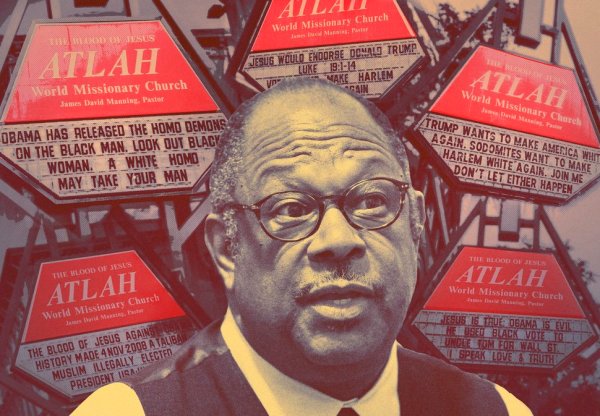
People who attended the school describe its leaders as being rabidly homophobic. Manning would often talk about evil “faggots.” Teachers would echo those sentiments, describing gay people as demons who were doomed to go to hell. A message from Manning on the school’s website directs parents to “Stop the homosexual brainwashing of your children!”
Not to beat a dead horse here, but I’m truly perplexed. During the long long hours I spent yesterday watching Endgame, I couldn’t stop thinking about our recent discussion. David French and other intelligent conservatives want to insist that America’s culture wars are primarily “a religious dispute.” I disagree, but the real question is this: Why do conservatives want to say that they are? The answer seems obvious to me, but maybe I’m missing something.
It’s time to recognize the American culture war for what it is — a religious dispute — and incorporate it into America’s existing religious pluralism.
As strategy, I get it. If conservative ideas are a religious imperative, they will get more respect. If culture wars are religious disputes, then both sides should get equal status, at least from the perspective of the government. But as an intellectually coherent way to understand America’s culture wars, I don’t get it. Lots of people share religious ideas yet find themselves on opposite sides of culture-war issues such as race, gender, and sexuality.
One sharp reader offered a better defense than French did. As PH put it,
we are certainly talking about competing ideas and systems of ethical and metaphysical values, beliefs, and commitments concerning the nature of reality, the basis for human flourishing, and ideal social norms. These are ideas based on faith as much as they are on reason or science. Personally, I think “religious” is a pretty good word for that, even if we’re not talking about formal organized religious groups or particular theological traditions.
The way I see it, though, people who share the same religion still disagree about key culture-war issues. For proof, we don’t need to look any further than the Veep’s office. Does Mike Pence represent conservative evangelical Protestantism? The community of Taylor University says both yes and no. And, as I argued recently in WaPo about Karen Pence’s lame defense of her anti-LGBTQ school, there is not a single, undisputed “orthodox” rule about proper social policy for LGBTQ people. Plenty of conservative evangelical Protestants are plenty “orthodox,” yet they disagree with the Pences on these issues.
So to me, it seems achingly obvious why some conservatives might want to redefine political disagreements as religious ones: For at least half a century now, politically conservative people have tried to insist that only their politically conservative version of religion is the true version of religion. They have argued that people who disagree with them cannot possibly be true Christians or Muslims or whatever.
There was more than theology at play then, and there is now…
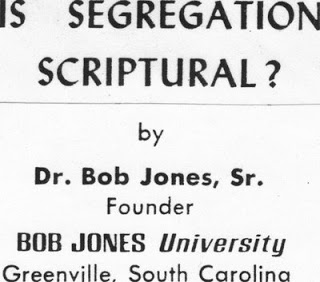
If real, “orthodox” Christianity insists on racial segregation, for example, as Bob Jones Sr. famously argued in 1960, then the US government has no right to demur. If real, “orthodox” Christianity requires belief in a literal six-day flood and a recent creation of humanity, for example, as Ken Ham famously argues today, then evangelicals have no business questioning it.
Just like questions of LGBTQ rights, however, neither of those ideas are really as simple as conservatives like to think. Debates about them divide people who share the same religious backgrounds. The cultural battles over racism, creationism, and sexuality are not battles between people who have different religions. They are fiercest between people who SHARE religious ideas but have different ideas about public policy.
So are America’s culture wars “a religious dispute?” Only if we use a tortuous definition of the phrase. To say that conservative positions on sexuality, race, or gender are just being “orthodox” only makes sense as a political strategy. As an actual description of the divides we face on such issues, it doesn’t help at all.
Another big week. Rough weather outside and culture-war storms on the interwebs. Here are a few of the biggest stories that caught our ILYBYGTH attention:
Friends, please hear me, we Africans are not afraid of our sisters and brothers who identify as lesbian, gay, bi-sexual, transgendered, questioning, or queer. We love them and we hope the best for them. But we know of no compelling arguments for forsaking our church’s understanding of Scripture and the teachings of the church universal.
And then please hear me when I say as graciously as I can: we Africans are not children in need of western enlightenment when it comes to the church’s sexual ethics. We do not need to hear a progressive U.S. bishop lecture us about our need to “grow up.”
Conservatives are celebrating. Progressives are lamenting. From a historical perspective, we can’t help but notice that today’s liberal Methodists are likely feeling the same sort of betrayal and dismay that fundamentalists felt in the 1920s and 1930s.
American Methodists: More conservative than you might have thought…
Here’s what we know: The United Methodist Church (UMC) has long faced a dilemma. Its large US contingent has tipped to the liberal side of the spectrum, with some congregations ordaining LGBTQ ministers, even bishops. At the church’s recent special conference, however, conservatives won the day, powered in part by the surprising strength of American conservatives, but even more so by international conservatism.
Friends, please hear me, we Africans are not afraid of our sisters and brothers who identify as lesbian, gay, bi-sexual, transgendered, questioning, or queer. We love them and we hope the best for them. But we know of no compelling arguments for forsaking our church’s understanding of Scripture and the teachings of the church universal.
And then please hear me when I say as graciously as I can: we Africans are not children in need of western enlightenment when it comes to the church’s sexual ethics. We do not need to hear a progressive U.S. bishop lecture us about our need to “grow up.”
As Emma Green writes in The Atlantic, progressive Methodists are stuck. Do they stay or do they go? As I read her report, I couldn’t help but hear the echoes of conservative Methodists in the 1920s. Back then, conservatives felt their church was being pulled away from them. Like today’s progressives, they often articulated a sense of both surprise and betrayal when they discovered the strength of their 1920s rivals.
To give you a taste of those feelings among early fundamentalist Methodists, I dug back through my files on one of the most famous American fundamentalists, Bob Jones. The founder of Bob Jones University was raised in the Southern Methodist Church and he felt a strong attachment to it his entire life.
However, he chafed at the attempts of the church to limit or control his preaching and institution-building. Most of all, like other fundamentalists of his generation, Jones Sr. believed that liberals had unfairly seized control of denominational institutions and used their power to crush legitimate differences of opinion.
As Jones liked to tell the tale, back in the early days of his career he had donated $300 to a Methodist college—he said it was “all the money I had on earth.” In Jones’ telling, that institution took his money “under false pretenses. They stole it. They are dirty rotten thieves.”
Jones liked to say that his experiences with the Methodist hierarchy led him to found an interdenominational fundamentalist college, one that would “never sell out.” As he put it in 1950,
I couldn’t conceive of anything as mean and low-down as to go out and raise money to build a certain type of school and then build another one…. That’s getting money under false pretenses. That’s playing with the spiritual life of people. That’s making capital out of the humble faith of humble saints.
Despite his antagonism toward the denominational hierarchy, Jones Sr. remained in the Methodist church through the 1930s. When a Methodist magazine refused to carry advertisements for Bob Jones College, the Joneses finally threw in the towel. As Jones Sr. wrote to a former editor in 1939, he had long hoped
there might be some hope for Methodism. Since receiving your letter, I give up. I say this kindly, and I love you just as much as ever, but I feel sad around the heart.
Eighty years later, we might change the reasons, but the language could remain exactly the same. I can picture a liberal Methodist minister sending in their credentials, saying that they had long hoped there was some hope for a progressive Methodism. After this week’s vote at the special conference, however, they might “give up,” even if it makes them feel “sad around the heart.”







 I Love You but You're Going to Hell