Colorado Finds Its Conservative

What would it take to foster true intellectual diversity at a public university?

Some have argued for affirmative action.  The University of Colorado decided to bring in a Visiting Scholar in Conservative Thought and Policy.

For the first year of the three-year program, CU hired Steven Hayward.

Hayward has served as the F. K. Weyerhaeuser Fellow at the American Enterprise Institute.  He is currently Thomas W. Smith distinguished fellow at Ashbrook Center at Ashland University in Ohio.

Hayward will teach classes in environmental conservatism and constitutional law.  As Hayward told ColoradoDaily.com, “I’m not going to pick any fights or start any gratuitous controversies.”

But Hayward’s one-year position has already raised some controversies.  The program was pressed on CU from outside political pressure.  Some Coloradans apparently felt the university unfairly tipped to the left.  They originally wanted to fund a full chair in conservative thought, but the rigmarole of politics reduced the line to three one-year visiting positions.

How was Hayward selected?  Two other finalists visited the Boulder campus, Linda Chavez of the Center for Equal Opportunity and Fox News, and Ron Haskins of the Brookings Institution.

As far as I can tell, this selection process seemed to reinforce the negative stereotype of affirmative action.  Unlike other academics hired to teach political science classes, Hayward does not have a PhD in political science.  His degree comes from Claremont Graduate University in the field of American Studies.  Chavez does not seem to hold a PhD in any field, and Haskins’ PhD was in Developmental Psychology.

The university itself declared that Hayward “brings an impressive breadth of knowledge to this position.”

I don’t doubt it.  But the fact remains that this entire process has encouraged a very different hiring process than usual, and a very different outcome.  The hiring committee itself included five faculty members and five community members, including conservative radio host Mike Rosen.

Will this process encourage CU to embrace Hayward—and future visiting conservative scholars—as part of their intellectual community?  It doesn’t look that way.

Given Hayward’s–and Chavez’s, and Haskins’–very different qualifications, and the different process used to bring them to campus, I wonder if this position will end up confirming the worst fears of some Colorado conservatives.  As John Andrews told the Colorado Observer recently, “this almost plays into the hands of the overwhelmingly left-liberal domination of CU, because it treats conservative thought as sort of an oddity, a zoo exhibit, or the focus of an anthropological field trip.”

Despite Hayward’s and the university’s assurances to the contrary, this experiment seems certain to degenerate into the most fruitless sort of culture-war grandstanding.


Superman & Sex Ed in Mississippi

Superman004Why is it so difficult for people like me to understand entrenched opposition to sex ed?

Part of the problem must come from cartoonish journalism like that of Andy Kopsa in a recent Atlantic article.

Kopsa investigated the meanings of a sex-ed law in Mississippi, House Bill 999.  This law mandates abstinence-only or “abstinence-plus” sex ed in Mississippi schools.  According to Kopsa, Mississippi schools now need to choose from two approved programs, Choosing the Best and WAIT.  Districts may also add information about contraception.  This makes up the “plus” in abstinence-plus.

Always eager to find out more about conservative attitudes and beliefs about sex education, I read the article right away.  To my disappointment, I didn’t find out much.

What does any of this have to do with Superman?  Kopsa’s sort of writing about conservative ideas reminds me of the early years of comics.  The villains in early Superman comics did not need any explanation; Lex Luthor tried to control or destroy the world because he was the bad guy.  That was the sort of thing bad guys did.

In real life—and in more interesting comic books—things are not that simple.  One of the most important things sex-ed supporters like me can do is try to understand the conservative opposition.  Not only mock or attack them, but try to get inside their heads to see their motivations and desires.

Unfortunately, that was not Kopsa’s goal.  Her article paints the opposition to effective sex ed in black-and-white tones.  Mississippi Governor Phil Bryant doesn’t educate teenagers, he only prays with them.  According to Kopsa, Bryant used public money and strong-armed the Department of Health to fund an abstinence-only “Teen Pregnancy Prevention Summit.”  Why does Bryant do these things?  Apparently because these are the things Lex-Luthor-style conservatives do.

Kopsa describes supporters of more effective sex ed, on the other hand, in glowing terms.  Kopsa met with six “experts” who pushed for more sex ed in Mississippi.  One of them, Betti Watters, was a “tiny powerhouse of a lady in her 60s with perfect white platinum hair and pearls. . . .”

Such heroes had battled for decades to improve sex ed in Mississippi.  While Kopsa makes a convincing argument that the sorts of abstinence-only programs now on offer in Mississippi schools are devastatingly inadequate, she gives us no sense of why they are the best Watters can produce.

Doubtless Watters could have provided us with some insights into the ideas of her conservative opponents.  We could have learned about the religious and traditionalist notions that make real sex ed such anathema to conservative Mississippians.

Such questions do not seem to interest Kopsa.  It is a shame.

I think Mississippians deserve effective sex education.  I think young people deserve to learn about condoms and contraception.  I agree with Kopsa that this is a life-or-death issue, with high HIV infection rates and pregnancy rates among Mississippi’s young population.

But hagiography doesn’t help.  In order to understand conservative policies, we need to understand conservative thinking from the inside out.


Do Conservatives Want the Government to Tell Americans What to Do?

Preschool or Parents?

That’s the question education pundits from the Heritage Foundation have been asking lately.  To a non-conservative outsider like me, this question raises key questions about the goals of conservative education policy.  It seems as if Heritage Foundation writers want both a less intrusive government and a more intrusive government.

Don’t get me wrong.  I understand that there are different sorts of conservatives, all of whom may have very different visions of the good society, good education, and the proper role of government.  I’ve read the work of historians such as George Nash who have chronicled the post-World War II tensions between libertarians and social conservatives.  But in this case, it seems as if one conservative organization—a small-government conservative organization—is calling for a big-government solution to education dilemmas.

Here is the recent confounding case: In light of President Obama’s recent call for universal, government-funded preschool, Heritage writers have renewed their push for a different vision.

Lindsey Burke and Rachel Sheffield of the Heritage Foundation insist that government-funded schooling is not the effective or ethical way to improve school achievement.  The obvious answer, Burke and Sheffield write, is to improve families.

They cite research to prove that programs such as Head Start have not been effective.[1]

They also note studies that tie school achievement to stable family structures.  As Burke and Sheffield argue,

 “A stable family, with married parents, provides the best foundation for a child’s academic success. Children raised in intact families are more likely to graduate from high school and more likely to attend and complete college than their peers raised in single-parent or blended families[30] They also score higher on reading and math, and exhibit fewer behavioral problems in school[31] A stable family also prevents a variety of other risk factors that would derail a child’s future success[32]

“However, over 40 percent of children are born outside marriage in America today. These figures are much higher among minorities: 72 percent among African Americans and 53 percent among Hispanics, while 29 percent among whites. Unwed childbearing is the greatest driver of child poverty today. Children in single-parent families are nearly six times as likely to be poor compared to their peers born in married-parent homes[33] Additionally, children in non-intact families have poorer academic performance and are at greater risk for dropping out of school, becoming antisocial and delinquent, and parenting a child outside marriage. These outcomes persist even after controlling for income.34” [N.b., there was no link in original for note 34. It referred readers to the same source as note 33.]

In this excerpt, Burke and Sheffield refer to three earlier Heritage-Foundation research articles: see here, here, and here.  I followed up on those sources, and found that the research came largely from peer-reviewed academic journals such as Journal of Marriage & Family and Social Forces.  (Without a library membership, it can be difficult to access these sources.  However, most public libraries have an EBSCO-or-similar database subscription that will allow readers access to these small-circulation academic journals.)

One conclusion that could be drawn from this is that the government needs to encourage families to stay together.  The public-policy goal would be obvious: if intact families improve school performance, then the government has a compelling interest in promoting stable families.

Burke and Sheffield avoid that conclusion.  Instead, they suggest that government should eliminate or reform Head Start, stop mandating government preschool, and reform existing preschool programs before expanding into new ones.

But other Heritage voices have taken a different approach.  Robert Rector, in 2012 a Senior Research Fellow in the Domestic Policy Studies Department at The Heritage Foundation, argued—in a study cited by Burke and Sheffield—that government should indeed engage in what Rector called a

broad campaign of public education in low-income areas. This campaign should be similar in scope to current efforts to convince youth of the importance of staying in school or to inform the public about the health risks of smoking. While the costs of such an effort would be small, its impact could be considerable.”

Rector also suggests concrete policy suggestions to strengthen families, such as increasing the tax benefits to married couples with children.

I honestly don’t mean to be snarky when I ask this next question; I am truly confused.  Do small-government conservatives such as Heritage’s Robert Rector really want the government to tell people how to regulate their intimate lives?

Heritage’s Derrick Morgan offered what seems to me an awkward patch of these conflicting sentiments a few months ago.  Small government was the answer, Morgan wrote.  But smaller government must also promote “traditional values” as part of its goal to shrink its own purview.

When it comes to education policy, this just doesn’t add up.  Small-government goals of privatized education, smaller government-funded programs, and fewer government education standards seem consistent.  Even if I don’t agree with them, I can see their logic.  But I don’t understand how Heritage’s conservative thinkers connect these goals with a simultaneous government intrusion into the most private, intimate decisions Americans make.

Hostile critics, I think, would assume that Heritage wants to impose government mandates on poor and powerless Americans, while allowing richer and more powerful citizens to enjoy freedom from government interference.  That seems a little simplistic, especially for the sophisticated thinkers preferred by the Heritage Foundation.

But is it true?  Does the Heritage Foundation suffer from—at best—confused ideology about education?  Or, at worst, is Heritage cynically promoting intrusive government for the poor, and small government for the rich?


[1] Here I think Burke and Sheffield need to be more careful.  The reference they cite was actually to a 2010 study, one that reports significant positive effects of 3- and 4-year-old Head Start problems.  But from the text of their article, I gather the authors meant to reference a more recent 2012 follow-up, in which few long-term differences were found between children who attended Head Start and those who did not.

Sarah Palin’s Long March through the Schools

Remember Sarah Palin?

She seems to be working hard to stay in the culture-wars limelight.  According to a story in the Christian Post, in a recent speech at Southeastern University, an Assemblies of God school in Lakeland, Florida, Palin encouraged Christian students to “infiltrate” America.  Christian students, Palin told the assembled multitude, could help remind America about God by becoming active in culture, law, and politics.

The current problems in America, Palin told SEU students, resulted from the fact that “as a nation, we have forgotten God altogether.”  The solution was for religious schools like SEU to send out their students to take jobs in every field, to reinvigorate traditional values by living them every day in every field.

Liberal Education or Left-Wing Indoctrination?

What is college for?  Should students stretch their minds by considering all sorts of competing, even conflicting ideas?  Or should young adults learn to intone the hackneyed, ideologically purified phrases of a single viewpoint?

Many conservative pundits these days insist that too many colleges have become left-wing reeducation camps.  But does that match our experience?

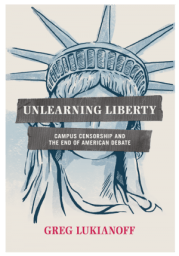
In a recent review of Greg Lukianoff’s Unlearning Liberty for the Hoover Institution’s Defining Ideas, Bruce Thornton heartily agrees that too many institutions of higher education have slid into the heavy mire of politically correct intellectual conformity.

unlearning_libertyA self-proclaimed “liberal,” Lukianoff’s Foundation for Individual Rights in Education has led a campaign to open college campuses to true intellectual controversy.

As Thornton notes, Lukianoff’s book chronicles example after example of over-eager campus authorities cracking down on students’ free speech rights.  For instance, one Yale student was punished in 2009 for wearing a t-shirt that quoted F. Scott Fitzgerald.  The offending shirt proclaimed—in the run-up to a big football game—that “all Harvard men are sissies.”

These and a host of other speech clampdowns are led by an army of humorless, vindictive student enforcers, whom Thornton calls “sensitivity commissars.”  The problem, as Thornton relates, is that “in orientation programs, only one point of view, the progressive-leftist one, is allowed a hearing, and students who resist it are subjected to sanctions and shaming exercises worthy of religious cults.”

The pattern of repression, Thornton insists, is not applied equally.  “Christians,” Thornton writes, “are particularly singled out for censorship, as are Republican organizations and other conservative groups, especially pro-Israel ones, whose publications are often vandalized, campus events attacked, and speakers shouted down.”

These notions of an oppressive left-wing campus Red-Guardism seem widely shared among conservative writers.  But do they match our experience?

I teach at a large public university in the northeast.  Perhaps I’m not sensitive enough to it, but our sprawling campus seems to welcome a real variety of speech, student and otherwise.  We have student groups for a variety of religious viewpoints, some of them resolutely conservative.  Self-identified “conservative” students with whom I talk report that they do not feel particularly shut out or victimized.  The campus is peppered with outside speakers who promote a kaleidoscope of ideas, from Biblical literalism to aggressive atheism.

Colleagues report similar experiences.  One science-education academic from a large public university in the Southeast tells me his education colleagues repeatedly indoctrinate their pre-service teachers with a message of Christian religiosity.

These are admittedly sketchy and anecdotal reports, but some more careful research seems to back it up.  David Long’s ethnography revealed a host of creationist students and faculty at public, pluralistic colleges.  Amy Binder’s and Kate Wood’s study of two leading schools revealed plenty of opportunity for conservative students at such schools, even if some students reported feeling victimized or shut out of campus life.

Perhaps the answer lies in broadening the lens.  Elite schools such as Yale might have rigid thought-police regimes.  However, we must remember two important facts: not many college students go to Yale, and even Yale produced William F. Buckley.

Jesus Increases Graduation Rates

In Christianity Today we find a story about Detroit’s Cornerstone Schools.

Founded in 1991, today these schools serve 1,500 students, 97% of whom graduate from high school and 90% of whom go on to college or the military.

These statistics have attracted national attention.  In one profile for CNN, the schools’ success was credited to “three Cs:” a Culture of education, Commitment to learning, and Community.  (See video clip, 2:28, right at the end.)

The profile in Christianity Today, not surprisingly, focused on another C: Christ.  In an interview with the schools’ leaders Ernestine Sanders and Clark Durant, CT‘s Dwight Gibson concluded that the schools’ success comes from one simple fact: Cornerstone represents “a school whose culture is centered on the person of Jesus.”

Chairman Durant framed the schools’ success this way:

“We have fabulous statistics. Most of our kids graduate from high school in a city where maybe 30 or 35 percent do. More than 90 percent go onto college, the military, or some other kind of learning. But those are not the measurements that really determine a fulfilling life. Sure, it’s important, but is it the measurement we use for our own children? Is it the measurement that God uses for us?”

President Sanders did not credit the schools’ academic successes with innovations such as an 11-month school year, mandatory Mandarin classes, or mandatory parental commitment.  Instead, Sanders explained Cornerstone’s success this way:

“It’s our people, whether it’s our maintenance man, Mr. Cole, or a teacher. In Mr. Cole finding his place in this community, the kids see him as valuable. He has wisdom.  That’s why Cornerstone is excellent—we try so hard even as imperfect as we are to lift up a Christ-centered culture.

“And in lifting up that culture, the education is coming along. So you keep aspiring to that excellence. What we try to do here is not to be daunted by the circumstances. Rather than being daunted by it, we try to be as strategic as we possibly can. I see us trying to build that broad and beloved community that Clark referenced.”

The story raises some key questions about the proper relationship between religion and education.

  • Can public-funded schools use religion to boost graduation rates?
  • Is it enough justification to have religion in public-funded schools if those schools produce academic success?
  • And why didn’t the CNN story mention the religious nature of these schools?

Are Conservatives Facing Oppression in Texas’ Private Schools?

The Texas Freedom Network Insider gives us a look this morning at an intriguing and influential line of conservative educational thinking.  For several decades now, conservative educational activists have claimed to be fighting for their civil rights.

The TFN, a liberal watchdog group, denounced Texas State Senator Dan Patrick’s attempt to make this argument recently.

Patrick, as chair of the Senate Education Committee, made his statement in favor of Senate Bill 573.  The bill would allow homeschool and private-school students to compete in the state’s University Interscholastic League.

Patrick claimed in a recent hearing,

“When you say the UIL has functioned for a hundred years, and everybody’s been happy, if you were black in this state before the civil rights movement, it didn’t function for you. And now I feel there’s discrimination against Catholics and Christians in these parochial schools.”

The TFN columnist and several commentators did not buy Patrick’s argument.  After sharing pictures of a lavish private school and a cramped, inadequate African-American school (c. 1941), the TFN columnist asked, “Seriously, guys?”

Commenter Linda Hunter asked, “Is it possible he [Patrick] actually believes what he’s saying? If so, perhaps he received the standard whitewashed version of history in school. Oh, I don’t think even that explains his argument.”

Whether Patrick is sincere or not, this line of argument has long been a favorite of conservative educational thinkers and activists.

Gish fossils say noTo cite just one example, in the early 1980s the late creationist leader Duane Gish was invited to join a conference of mainstream scientists to discuss evolution and creationism.  At the time, Gish was a leading voice at the Institute for Creation Research and best known for his book Evolution: The Fossils Say No! (1973, 1978, 1979)

At the conference with the American Association for the Advancement of Science, Gish grumbled right away that he had been led into a trap.  He complained that only two creationists had been invited to face a bevy of evolutionists.  As he put it, he would “proceed to take one of the two seats on the back of the bus reserved for the creationists in this meeting.”[1]

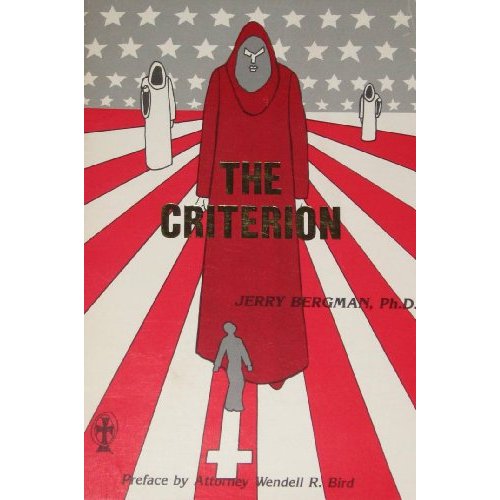
Around the same time, the creationist academic Jerry Bergman protested that he had been denied tenure at Bowling Green State University due to rampant discrimination against his religious beliefs.  As Bergman claimed in his 1984 book The Criterion,

“Several universities state it was their ‘right’ to protect students from creationists and, in one case, from ‘fundamentalist Christians.’. . . This is all plainly illegal, but it is extremely difficult to bring redress against these common, gross injustices.  This is due to the verbal ‘smoke-screen’ thrown up around the issue.  But, a similar case might be if a black were fired on the suspicion that he had ‘talked to students about being black,’ or a woman being fired for having ‘talked to students about women’s issues.’[2]

Bergman the criterionFor Gish and Bergman in the 1980s, as for Senator Patrick today, as for the generation of conservative activists in between, the notion is a powerful one.  Many intellectuals and pundits have claimed that conservatives today face the same kind of repression that bedeviled African Americans in the run-up to the Civil Rights movement in the 1950s.

For those of us who want to understand conservative educational philosophy, the Texas Freedom Network’s question is not the point.  Whether or not conservatives really believe they are oppressed, pundits and politicians have found the claim of minority persecution effective.

Check out Senator Patrick’s speech on the TFN Insider.  They include a video so we can see this ideology in action.


[1] Duane T. Gish, “The Scientific Case for Creation,” in Frank Awbrey and William Thwaites, eds., Evolutionists Confront Creationists: Proceedings of the 63rd Annual Meeting of the Pacific Division, American Association for the Advancement of Science, Vol. I, Part 3 (San Francisco: Pacific Division, American Association for the Advancement of Science, 1984), 26.

[2] Jerry Bergman, The Criterion: Religious Discrimination in America (Richfield, MN: Onesimus Press, 1984), 44.

Conservatives and the Common Core

What do conservatives think about the emerging Common Core State Standards?

As with any question, ask a hundred conservatives and you’ll likely get a hundred different answers.
However, some distinct themes have emerged in recent months.

First, many conservative politicians and activists object to the Common Core’s implications for the creeping expansion of government.  Some insist that the standards add another layer of inaccessible, distant, controlling, expensive central control.

Second, conservatives object that the new national standards chip away at parental control of children’s education.  With greater central control, parents and responsive local governments will lose that much more ability to control directly what goes in their local public schools.

Both of these are storied conservative protests against the trends in public education.

Before we examine these themes and their histories, let’s look at the CCSS themselves.  So far, forty-five states, plus the District of Columbia and Department of Defense schools have adopted these standards.  Supporters of the CCSS insist these are not imposed by the federal government, but rather created jointly by state education officials.  The reasons for such standards are many, according to supporters.  In the words of the CCSS Initiative,

“High standards that are consistent across states provide teachers, parents, and students with a set of clear expectations that are aligned to the expectations in college and careers. The standards promote equity by ensuring all students, no matter where they live, are well prepared with the skills and knowledge necessary to collaborate and compete with their peers in the United States and abroad. Unlike previous state standards, which were unique to every state in the country, the Common Core State Standards enable collaboration between states on a range of tools and policies.”    

Conservatives are not the only ones to dispute these claims.  Progressive critics (see one example here) often lament the new standards’ failure to consider adequately individual student situations.  Some progressives call the standards a greedy corporate power grab.  Others lament the goal of squeezing all young minds into a procrustean bed of regurgitative multiple-choice testing instead of pursuing the more difficult goal of authentic learning for real students.  Alfie Kohn, for instance, insisted that national standards would “squeeze the life out of classrooms” by mandating one-size-fits-all education, dictated by self-seeking corporate interests.

When conservative activists and pundits critique the CCSS, it is usually on different grounds.  Writing for the Heritage Foundation, for example, Lindsey Burke warned, “The push for centralized control over what every child should learn has never had more momentum.”  CCSS, which Burke called “national standards,” represented a “challenge to educational freedom in America.”  Implementation of the standards would be expensive, Burke pointed out.  Even worse, these standards reversed the proper structure of education.  Instead of more and more central control, Burke argued, “Education reform should give control over education to those closest to students.”

The Heritage Foundation’s Rachel Sheffield praised state lawmakers who pushed to exit the CCSS.  In Indiana, for instance, conservative state lawmakers have proposed a bill to put the CCSS on hold.  One of the requirements of Indiana’s Senate Bill 193, for instance, will be to include parent members on the standards committee.  Another will be to allow any parent to challenge their children’s standard-based high-stakes test results.

These themes—federal overreach and parental control—have long been central to conservative educational activism.

As we’ve noted, agitation against federal intrusion into the local politics of education has been an important element of conservative educational activism since at least the 1940s.  Though it might come as a surprise to some, before the 1940s many conservatives endorsed increased centralization of education policy, as Douglas Slawson has noted in his excellent book The Department of Education Battle, 1918-1932.

The second conservative worry about CCSS also has a long history.  Conservative pundits have argued for decades that parents need more control over their children’s education.  Back in the 1960s, conservative educational leader Max Rafferty insisted, “Children do not belong to the state. They do not belong to us educators, either. They belong to their parents and to nobody else.  And don’t you forget it.”  (Source: Rafferty, On Education, pg. 9)
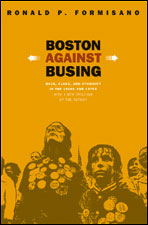
Note one protester's button: "Parent Power"

Note one protester’s button: “Parent Power”

These conservative concerns spanned the country and the decades.  As historian Ron Formisano noted in his landmark 1991 history of Boston disputes over forced busing, parents insisted on their fundamental rights to determine their own children’s educational careers.  As anti-busing leader Louise Hicks fumed, “If under a court order a child can be forcibly taken from his parents into unfamiliar, often hostile neighborhoods, then we shall have opened a pandora’s box of new, unlimited government powers” (pg. 192).

Similarly, President Reagan insisted in 1983, “I believe that parents, not Government, have the primary responsibility for the education of their children.  Parental authority is not a right conveyed by the state; rather, parents delegate to their elected school board representatives and State legislators the responsibility for their children’s schooling.”  (Source: Catherine Lugg, For God and Country, pg. 136).

Across the spectrum of conservative belief and activism, we hear similar echoes.  In 1989, for instance, creationist leader Ken Ham warned that “Most parents have left the training of their children to the church, school or college.”  No wonder, Ham argued, that children embraced anti-God theologies.

So when conservatives in 2013 warn that CCSS will undermine parental control, they draw on a rich tradition of conservative thought and activism.  Schools must remain on a tight leash, many conservatives have insisted over the years.  If allowed too much power, centralizing educational authorities will take over.


Required Reading: Meet Tim LaHaye

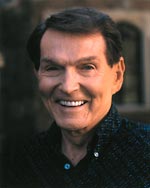
Do you know Tim LaHaye?

LaHaye

LaHaye

If you’re interested in conservative educational thinking in the United States, you should.

Steve Fouse at AliveReligion recently offered a helpful introduction to LaHaye’s enormous influence among conservative and fundamentalist circles.

As Fouse points out, arguments about conservatism that seek to explain away its popularity miss the boat on LaHaye.  Fouse takes Thomas Frank to task for making such oversimplistic assumptions.  Fouse prefers the explanations of historians such as Darren Dochuk.  Dochuk’s more complex perspective fits better the career of a fundamentalist Renaissance Man like LaHaye.

Fouse notes LaHaye’s wide-ranging interests, from LaHaye’s role in the Institute for Creation Research, to his best-selling apocalyptic novels, to his evangelical sex guides.

Fouse mentions LaHaye’s central interest in educational issues, from sex ed to creationism.  If anything, Fouse downplays the influence LaHaye has had in late twentieth-century educational conservatism.

Fouse could have mentioned, for instance, LaHaye’s role in arguing for increased phonics instruction.  In his 1983 book The Battle for the Public Schools, LaHaye argued that abandoning phonics could be part of a massive conspiracy to “reduce the standard of living in our country so that someday the citizens of America will voluntarily merge with the Soviet Union and other countries in a one-world socialist state”   (46).   Disappearing phonics instruction showed the extent to which Christian America had been undermined.  It served as a canary in the secular coalmine.  “Some modern educators,” LaHaye insisted, “use look-and-say instead of phonics because the material enables them to secularize our once God-conscious school system” (50).

Similarly, Fouse did not mention LaHaye’s ardent activism in favor of more traditionalism in US History instruction.  In LaHaye’s 1987 Faith of Our Founding Fathers, LaHaye argued that the nation had endured a “Deliberate Rape of History” (5). Between 1954 and 1976, LaHaye insisted, a generation of “left-wing scholars for hire” worked for secularizing organizations such as the Carnegie Foundation (6).  Such authors systematically distorted the truth of America’s Christian heritage.  Thus, in order to find the true history of America’s founding, readers needed to look to older books, written by those “closest to the events they describe” (6). LaHaye insisted on the Christian beliefs of the Founding Fathers, demonstrating that “most were deeply religious, all had a great respect for the Christian traditions of the colonies, and all were significantly influenced in their thinking by the Bible, moral values, and their church” (30).

Thanks to Steve for offering his post about this important figure.  All of us who hope to understand conservatism in American education should check it out.


David Long at the Smithsonian

Drop your plans for Friday!

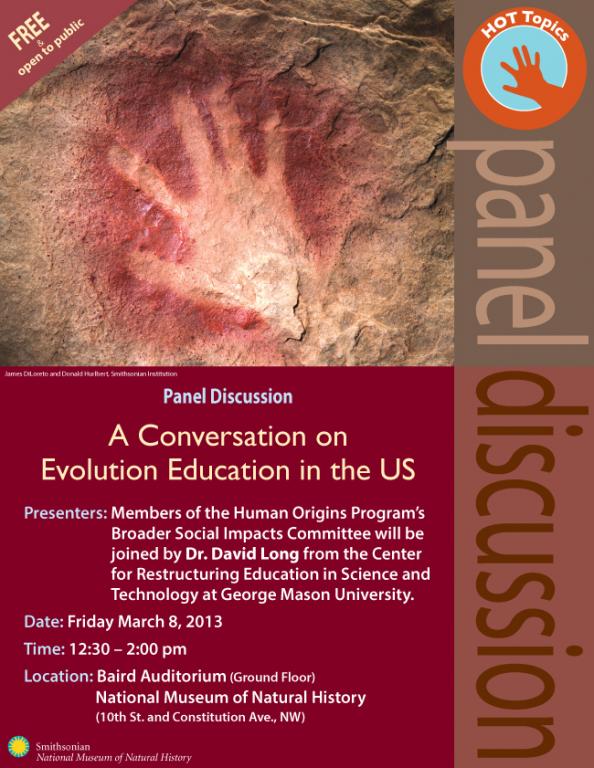
You need to get down to our nation’s scenic capital for a stirring panel discussion of evolution education.

ILYBYGTH contributor David Long will take part, along with participants from the Smithsonian’s “What Does It Mean to Be Human” Broader Social Impacts Committee.

The event will take place at 12:30 in the Baird Auditorium, National Museum of Natural History.  Free and open to the public.  Don’t miss it!

smithsonian flyer