Science at the Creation Museum

Thanks to the ever-watchful Sensuous Curmudgeon, we came across a recent article in Scientific American in which an evolution-believing science teacher journeyed to Answers in Genesis’ Creation Museum outside of Kentucky.

Image Source: Answers in Genesis Creation Museum

Image Source: Answers in Genesis Creation Museum

For folks like me and the author Jacob Tanenbaum, the scientific claims of the museum are impossible to accept.  A science teacher, Tanenbaum recoiled at the misleading scientific claims made by the museum.  “What disturbed me most,” Tanenbaum reported,

“was the theme . . . that the differences between biblical literalists and mainstream scientists are minor. They are not minor; they are poles apart. This is not to say that science and religion are incompatible; many scientists believe in some kind of higher power, and many religious people accept the idea of evolution. Still, a literal interpretation of Genesis cannot be reconciled with modern science.”

Fair enough.  During my trip to the Creation Museum, though, what struck me most powerfully was simply how plausible it all seemed.  For those who did not set out to debunk the information, the museum seemed just as authoritative as Chicago’s Field Museum or any other natural-history museum.

But what Tanenbaum wrote makes sense: the Creation Museum presents a misleading picture of the differences between creation science and mainstream science.

My beef with Tanenbaum is with his own misleading conclusion.  The problem with such creation science education, Tanenbaum argues, is “that 40 percent of the American electorate seems to have forgotten what science is. Considering that our nation put a man on the moon and invented the airplane and the Internet, this development is extraordinary.”

Tanenbaum may be a gifted teacher of mainstream science, but this conclusion suggests that he is not deeply versed in the culture of creation science that he condemns.  For those of us who want to understand creationism, we need to get beyond this naive assumption that creationists don’t know what science is, or that they are somehow hypocritical in their use of technology.

As I argued in a recent commentary in the Chronicle of Higher Education, simple ignorance does not explain American creationism.  Many creationists have studied mainstream science.  In many cases, such as that of leading creation science author Henry Morris, they have earned advanced technical degrees.  And, beyond such stand-out leaders such as Morris, many rank-and-file creationists have extensive science educations.  As political scientists Michael Berkman and Eric Plutzer discovered in their National-Science-Foundation-funded study of high-school biology teachers, of those teachers who espoused a belief in young-earth creationism (i.e., the Creation-Museum type of creationism), fully 55% had earned college degrees in science.   Furthermore, Berkman and Plutzer’s review of other such surveys led them to the following conclusion: “the overall evidence suggests that the high support for creationism in the classroom cannot be attributed primarily, or even substantially, to overall scientific illiteracy in the United States” (pg. 52).

Also, as creationists often remind themselves and their evolutionist foes, belief in evolution is not necessary for sophisticated engineering.  Dobzhansky’s claim that nothing in biology makes sense except in the light of evolution may be true, but that would not stop creationists from traveling to the moon, perfecting airplanes, or inventing the internet.

In the end, I think it makes a big difference whether Americans with creationist beliefs have “forgotten what science is” or if they have a distinctly different definition of science.  Building an anti-creationist argument on the foundation that creationism disables technical education, as does Tanenbaum and other prominent pro-science voices such as Bill Nye, is both a false claim and poor strategy.

Please don’t misunderstand me: this is not a brief for creationism.  However, if those of us, like me, Bill Nye, and Jacob Tanenbaum–who stand outside the borders of creationism looking in–if we really want to understand creationism, we must abandon our own naive assumptions about the meanings of that creationist belief.

From the Archives: Yoga, Schools, and “Those Dirty Books”

As Natalia Mehlman Petrzela has argued in these pages recently, a yoga program in Encinitas public schools has raised the ire of some religious conservatives.  The story has subsequently been  picked up by the New York Times and National Public Radio.

As Professor Mehlman Petrzela pointed out in her article, such fears of yoga as religious indoctrination are not new among American conservatives.

During my research into an earlier generation’s fight over school textbooks, I discovered such complaints as early as 1974.  In that year, a school controversy exploded in Kanawha County, West Virginia.  As journalists such as Trey Kay and scholars such as Carol Mason have described recently, the bitter fight over new textbooks led to a months-long school boycott and repeated shootings and bombings.

In 1974, the beleaguered Kanawha County Board of Education appointed an eighteen-person committee to investigate the accused textbooks.  A majority of the committee found the books unobjectionable.  But in November, 1974, a minority splinter committee issued a blistering 500-page denunciation of the textbook series.  The minority report included specific objectionable passages with comment.

For instance, from a first-grade teachers manual from the DC Heath “Communicating” series, the committee extracted the following suggested discussion-starters: ‘Has anyone ever awakened and found a stranger looking at him?  Has anyone ever broken a toy, a chair, or some other article the first time he was visiting an unfamiliar house?  Has anyone ever had a dream in which he talked with some animals?  Has anyone ever seen a deserted house?  Did you go in?’

In the minority committee’s opinion, “A child should not be forced to discuss his own personal feelings.  This constitutes an invasion of privacy.  This is also
behavioral change.  Why should a 6-year-old child be subjected to questions that will implant fears and frustrations in his mind.  Why not have questions on pleasant and wholesome attitudes?”

The minority report complained that the textbooks’ version of the Jack and the Beanstalk story was “more sadistic and gruesome than usual.”  Elsewhere, the minority report objected, students were instructed to make up their own myths, including one about why all humans don’t speak the same language.  “The question why men do not speak the same language,” the minority insisted, “is answered in the Book of Genesis.  The inference that the answer can be classified as a myth again presupposes that the Bible is based on a myth.”

Most interesting to the folks of Encinitas, however, might be the minority committee’s complaint that articles about yoga amounted to “religious indoctrination.”

Makes me wonder where and when else the conservative campaign against the teaching of yoga in public schools has surfaced.  As Mehlman Petrzela points out, school-yoga supporters in the press and school district seem utterly unaware of this longer history.  As she wrote in her December article,

“The press, the EUSD, and scores of online commenters expressed shock that anyone would suggest, ‘a little stress-reducing exercise ever hurt anyone,’ especially in the context of a much-discussed ‘obesity crisis.’ The Los Angeles Times couldn’t believe the degree of the plaintive parents’ worries, as yoga is regularly practiced in San Diego spots as disparate as the Camp Pendleton naval base and the Jois yoga enclave, which funds the school program. Glamour commented, ‘most people associated with the controversy are scratching their heads,’ quoting similarly incredulous Jois chief executive: ‘It’s hard to know how to respond to someone who says if you touch your toes, you’re inviting the devil into your soul.'”

Perhaps this posture of surprise is put on only to discredit conservative opponents.  After all, if anti-yoga activism seems startling and unexplainable, it might gain fewer political supporters.  But at least some of the surprise sounds genuine to me.  It seems another good illustration of the ways widespread ignorance of the history of conservative educational activism impairs any sort of useful discussion of current educational policy.

Homeschooling and the Common Core

Education folk these days are a-flutter with talk about the Common Core State Standards.

Recently, William Estrada of the Home School Legal Defense Association has warned about the implications for homeschoolers of such national curricula.

Without an historical perspective, it would be easy for readers of recent headlines to assume that conservatives have always opposed greater educational centralism.  After all, Ronald Reagan came to office on a promise to eliminate the then-new Department of Education.  Recently, Republican Presidential hopefuls such as Rick Perry, Michele Bachmann, and Ron Paul promised to fulfill Reagan’s plan.

Back in the 1920s, however, leading conservatives often made the strongest case for a federal department of education.  As I explored in a recent article in the History of Education Quarterly, the 1920s Ku Klux Klan hoped greater educational centralization would help Americanize immigrants and standardize Americanism education.  The main institutional opponent of such centralization in the 1920s, as Douglas Slawson’s wonderful book The Department of Education Battle, 1918-1932 points out, was the Catholic Church.  In that turbulent decade, social traditionalists, conservative Protestants, and many leading progressives all agreed that the nation needed greater centralization and increased educational funding.

By the 1940s, however, educational centralization had become a leading bugbear of anti-communist conservatives.  From the fringes of conservative anti-communism, influential pamphleteer Allen Zoll denounced federal aid to local schools as the central strategic goal of subversive communism.

Allen Zoll, They Want Your Child! (New York: 1949)

Allen Zoll, They Want Your Child! (New York: 1949)

In “They Want Your Child!” (New York: National Council for American Education, 1949), Zoll warned, “We had better stop smiling.  There IS a conspiracy.  The conspiracy against the American way of life, against everything that we hold dear, is probably the most completely organized, ruthless design against other people ever set in motion in all human history. . . . THE INFILTRATION AND CONTROL OF AMERICAN EDUCATION BECAME COMMUNISM’S NUMBER ONE OBJECTIVE IN AMERICA.  THEY WANT THE CHILDREN OF AMERICA.  THEY WANT YOUR CHILD.”  To Zoll and many of his readers, centralization of education meant that subversives could collect all the threads of education policy in their grasping claws.

Once the US Supreme Court began ruling in favor of school desegregation in the 1950s and against school prayer in the 1960s, the notion of greater educational centralization became anathema to wider and wider circles of American conservatives.  Centralization became associated purely with the long-standing enemies of traditionalist and conservative education: evolution science, progressive pedagogy, left-wing anti-racism, anti-patriotic politics, and secularism.

In his December 2012 brief, Will Estrada of the HSLDA made some of the traditional conservative arguments against greater educational centralism.  First, Estrada pointed out, states were pushed into accepting these common standards out of financial desperation, not out of any educational benefit.  President Obama’s Race to the Top funding, as Estrada noted, was often tied to adoption of common core standards.  Second, centralized education would decrease quantifiable student achievement, Estrada argued.  Scores on English and math tests would likely decrease after these standards were in place, at the cost of billions of dollars.  Perhaps most in line with the complaints of many American conservatives, Estrada warned that common standards weakened parental control.  “Top-down, centralized education policy,” Estrada wrote, “does not encourage parents to be engaged.”

Specific to homeschoolers’ interests, Estrada worried that centralized curricula would encourage greater pressure on homeschoolers to follow along.  If every college and every college entrance exam measured student achievement by success on common-core-linked tests, homeschool students would feel pressured to master that common curriculum.

Supporters of today’s Common Core State Standards argue that the standards will bring greater efficiency and equality to education in the United States.  However, the idea of centralization has had a checkered career among American conservatives.  Will Estrada of the HSLDA raised one voice in opposition to today’s centralization effort.

From the Archives: Bobby Squirrel, Billy James Hargis, and the Counter-Subversive Imagination

Quick: What’s the most anti-communist animal?  The ass-kicking bald eagle?  The industrious ant?

Fifty years ago, prominent Mississippi conservative leader Edna Whitfield Alexander lamented the subversive communist takeover of another likely forest-dwelling Cold Warrior: the nut-hoarding squirrel.

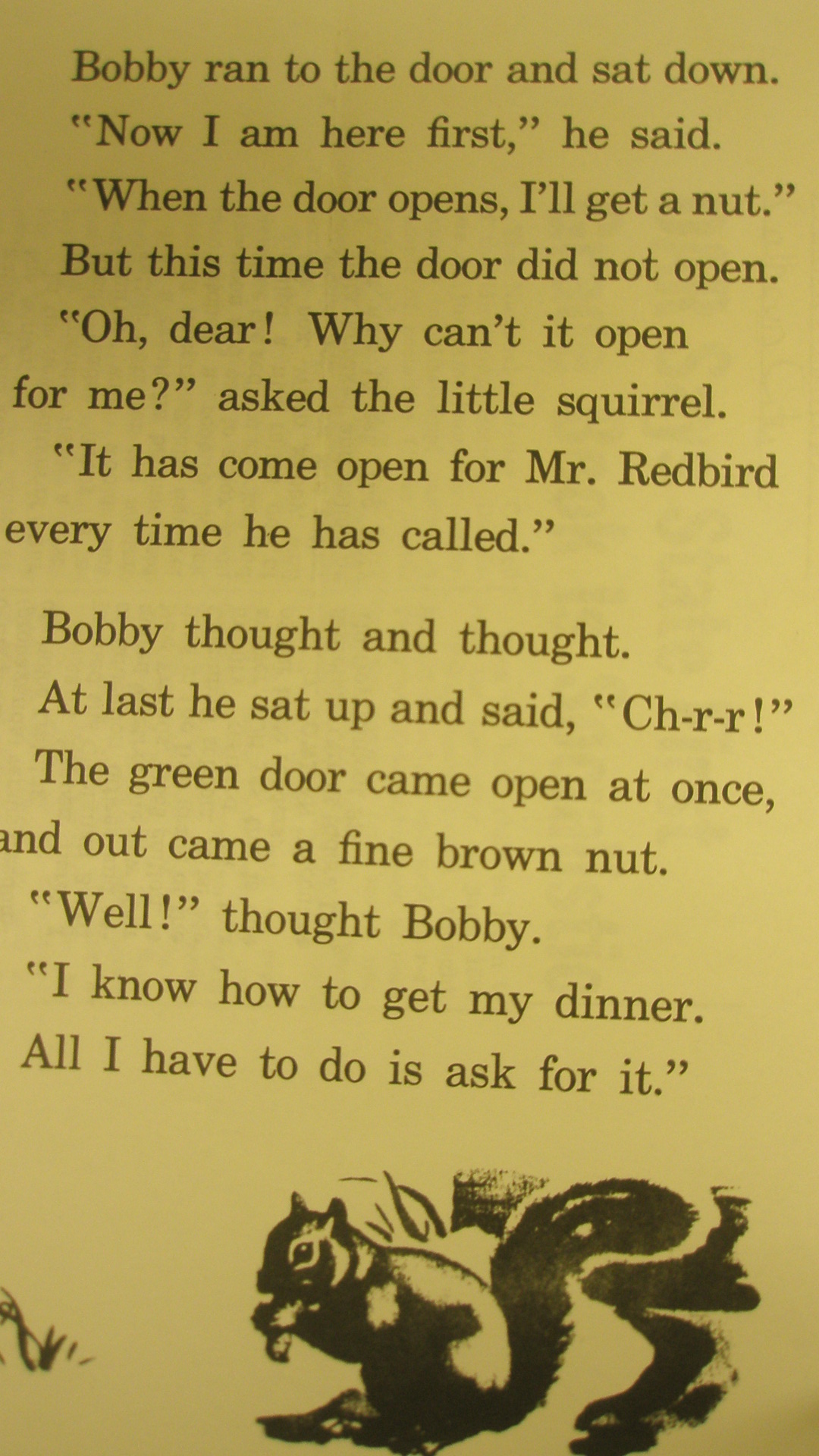
At the time, Alexander chaired the Mississippi Daughters of the American Revolution’s Committee on National Defense.  She complained that a story in one of Mississippi’s first-grade textbooks subverted the naturally capitalistic image of the squirrel.  In “Ask for It,” Alexander charged, “socialistic” authors used a tale of Bobby Squirrel insidiously to undermine the idea of hard work and thrift among Mississippi’s impressionable young school children.

In a pitch-perfect example of what historian Ellen Schrecker has called the “counter-subversive imagination,” Alexander blasted the textbook The New Our New Friends.  Among the seemingly innocuous just-so stories, Alexander sniffed out the “socialistic” message this book included about Bobby Squirrel.

OLYMPUS DIGITAL CAMERA

From “Ask for It,” The New Our New Friends, by William S. Gray, Marion Monroe, A. Sterl Artley, and May Hill Arbuthnot, (Chicago: Scott, Foresman and Co., 1956). Adopted as a school textbook by the State of Mississippi, 1963.

As Alexander asked in the pages of the Monitor Herald (Calhoun City, MS), January 3, 1963, “Have you ever heard or read about a more subtle way of undermining the American system of work and profit and replacing it with a collective welfare system?”

From a twenty-first-century perspective, it is difficult to remember the prominent role anti-communism played in American conservatism throughout much of the twentieth century.  As historian George Nash has argued, anti-communism often served as the intellectual glue that held together a disparate conservative movement, linking free-market activists with libertarians, Catholic intellectuals, and Protestant social traditionalists.

I came across this story in the Billy James Hargis Papers at the University of Arkansas in Fayetteville.  All historians interested in the history of conservatism in twentieth-century American education, religion, and culture should make this one of their first destinations.  Not only did the Reverend Hargis keep his own voluminous collection of small magazines, newsletters, and ephemera from various conservative evangelical and fundamentalist Protestant and anti-communist sources, but he also apparently bought up other collections, such as Allen Zoll’s.  As a result, the Hargis Papers in Fayetteville provide a one-stop reading shop for a vast collection of rare archival gems.

Unfortunately, Hargis did not keep much personal material.  It is not easy to get a sense of Hargis’ own thinking.  But the many boxes of newsletters and clippings include a wide array of pieces like Mrs. Alexander’s attempt to purge Mississippi schoolbooks of creeping, hopping Squirrel socialism.

Truth and Science in Louisiana

What is Truth?  The question is as old as Pilate, and still as troublesome.

As anti-creationist activist Barbara Forrest notes in a perceptive article in the Louisiana Coalition for Science blog, anti-evolutionists in that state have made a telling error in their reading of mainstream science education.

In a struggle to impose a two-model evolution/creation curriculum in Central, Louisiana, creationists misquoted the Louisiana Department of Education’s (LDOE’s) 1997 Louisiana Science Framework (LSF).  In that framework document (see page 12), the LDOE offered a carefully worded articulation of the mainstream vision of the nature of science.  As Forrest notes, the LDOE explicitly demanded that true science should be taught “as a human enterprise and a continuing process for extending understanding, instead of the ultimate, unalterable truth.”

When creationists of the Louisiana Family Forum crafted their argument for teaching both creationism and evolution as science, they misrepresented this statement.  The Louisiana Family Forum’s proposed resolution contained the following assertion:

“WHEREAS, the Louisiana Science Content Standards at page 12 indicate that science should be ‘presented as a . . . [ellipsis in the LFF document] continuing process for extending understanding of the ultimate, unalterable truth’(7);”.

As Forrest points out, there is a world of difference between what the Louisiana standards demand and what the LFF said the standards demand.  Forrest notes that this slip could be due either to dishonesty or carelessness.  True enough.

But I think this mistake also tells us a great deal about the yawning chasm that separates the two sides’ understandings of the nature of education.

For science educators such as Barbara Forrest, the notion that a state standards document would define science education as a quest for “ultimate, unalterable truth” seemed immediately, obviously bizarre and suspicious.  That is simply not the way mainstream science educators talk.  Indeed, the paragraph from which that line came says a great deal about mainstream understandings about education.

Here is that paragraph in full:

“The purpose of science education is not for students to memorize the ‘right’ answer, but for them to move along a learning continuum toward a deeper understanding of science concepts and processes.  Current research indicates that it is best for understanding to be constructed actively by the learner.  This learning style offers a new role for the science teacher as a facilitator of learning versus an imparter of knowledge.  Instruction should minimize rote learning and focus on in-depth understanding of major concepts and topics, with students actively exploring those ideas through activities they can relate to their own lives.  Students often work cooperatively in small groups to exchange and critique their own ideas, with the teacher facilitating discussion rather than providing answers.  Science is presented as a human enterprise and a continuing process for extending understanding, instead of the ultimate, unalterable truth.”

Now THAT is the way mainstream education folks talk!  Note the emphasis on teacher as facilitator, the role of student as an active constructor of knowledge.  Note the emphasis on cooperative learning and the de-emphasis on the traditional delivery of information from teacher to student.

This is how many mainstream education researchers understand the process of learning and teaching.  This is NOT the way most conservatives and traditionalists understand education.  Though I don’t know the LFF and certainly can’t speak for them, many conservatives and educational traditionalists have a very different understanding of the nature of education.  For many conservatives, education—whether it’s about evolution, the American Revolution, or any other topic—is precisely about transmitting “ultimate, unalterable truths” from one generation to the next.

So whether the Louisiana Family Forum made a mistake in reading the Louisiana science standards or whether the LFF deliberately misrepresented those standards, the LFF ended up articulating a vision of education much closer to the understandings of most American conservatives.  Education, in the conservative view, must be about “ultimate, unalterable truth” in order to have any meaning at all.


Creation Colleges

Where did you go to school?  Did you learn about evolution?  WHAT did you learn about it?

Non-creationists like me are often dumbfounded by the notion that so many educated Americans believe in a young human species.  But a quick look at the large number of young-earth-creationist colleges shows us how easy it is to earn a college degree without leaving the intellectual boundaries of young-earth creationism.

As recent Gallup polls consistently demonstrate, almost half of American adults agree that humanity was formed in “pretty much its present form” within the past 10,000 years or so.  And of those young-earth creationist adults, the same proportion went to college as non-creationist adults.  That is, believers in a newish human species are just as likely to have a college degree as believers in a long history for the species.

As always, it’s vitally important for outsiders like me to recognize the many different sorts of creationist belief.  Young-earth creationism, the notion that the earth has only been in existence for about as long as is described in the Bible’s Book of Genesis, is only one version.  Intelligent design theorists, like those of the Discovery Institute, or evolutionary creationists, like those of Biologos, also oppose mainstream evolutionary science, but without insisting on a young earth.

And, to be fair, this Gallup question only asks about the age of the human species, not the age of the earth.

Nevertheless, the notion that such large percentages of educated Americans agree that humanity is so new, and so un-evolved, always makes me wonder what kind of education Americans are receiving.

The leading young-earth creationist organization Answers in Genesis provides a handy guide.  To be fair, the map of creationist colleges provided by AiG makes no claims to be an exhaustive guide to all creationist institutions of higher education.  Rather, this map only includes those schools whose presidents have signed AiG’s statement of faith.

A quick glance at the map shows how easy it will be for most college-bound young people to find a college that affirms young-earth beliefs.  Even in my neighborhood of sunny Binghamton, NY, two schools made the AiG map, Davis College and Baptist Bible College.

The sponsoring schools include such fundamentalist heavy-weights as Bob Jones UniversityLiberty University, and Pensacola Christian Colleges.  Other sponsors include smaller schools such as Jackson Hole Bible College and Ohio Christian University.

For those of us trying to understand creationism from the outside, this thriving culture of creationist higher education provides a crucial clue.  We can’t know what all the students, or even all the professors at these schools believe, but the schools themselves devote themselves to promulgating the notion of a young human earth and divine creation by fiat, as described in Genesis.

Persecution and the Conservative Academic

Do conservative academics suffer persecution?

NYU professor of history and education Jonathan Zimmerman recently called for affirmative action for conservative college professors, even though, Zimmerman insisted, such professors hadn’t suffered from historic discrimination.

That hit a nerve.

Writing in the higher-education blog Minding the Campus, a publication of the conservative Manhattan Institute, Ronald Radosh called foul.

Radosh took exception to Zimmerman’s insistence that liberal professors like himself were not the “wild-eyed Marxists” many conservative pundits had accused them of being.

Radosh disagreed.  “NYU,” Radosh wrote, “is most egregiously guilty of precisely such a bias. Their own history department is dominated by precisely those types, and some of the institutes and centers they have established have gone out of their way to make that crystal clear.”

Radosh complained that his career had suffered for purely political reasons.  At George Washington University, for instance, Radosh claimed that he had been subjected to questions mainly “about my politics, and not about my approach to history or how it should be taught.”  At another school, Radosh said he was buffeted in a job interview with a series of “hostile questions” about his views on Cold-War spies Ethel and Julius Rosenberg.

In the end, Radosh concluded that most history professors discriminate actively and self-consciously against conservative academics.  As Radosh wrote,

“The reason such professors will not hire conservatives is precisely because they do not want ‘other right-leading students’ to ‘follow them, into the academic profession,’ as Prof. Zimmerman hopes they will once conservative professors are hired. Does he really think people like Marilyn Young and Linda Gordon at NYU want anyone to challenge the ideological hegemony they now hold over molding students’ minds?”

Other sorts of conservative academics have long claimed to suffer from similar persecution.

The case of Teresa Wagner, for instance, still bubbles along.  Wagner had applied for jobs at the University of Iowa’s law school.  She was one of five finalists, but was passed over for the most desirable tenure-track job.  Was it due to prejudice against Wagner’s loud-and-proud conservative activism?  Wagner had made no secret of her pro-life and traditional-marriage stances.

One unique element of Wagner’s case was the existence of a smoking gun.  Unlike most hiring-discrimination cases, Wagner was able to produce a document that seemed to make her case.  Associate Dean John Carlson had written in an internal email, “Frankly, one thing that worries me is that some people may be opposed to Teresa serving in any role in part at least because they so despise her politics (and especially her activism about it). I hate to think that is the case, and I don’t actually think that, but I’m worried that I may be missing something.”

That email made Wagner’s case complicated.  A group of jurors agreed that Wagner had been treated unfairly.

These conservative claims of academic persecution are nothing new.

Creationist Jerry Bergman collected cases of such discrimination in his 1984 book The Criterion.  Bergman, who claimed to have been denied tenure at Bowling Green State University in the early 1980s due to his creationist beliefs, described the stories of academics such as Clifford Burdick.  Burdick was allegedly refused his PhD at the University of Arizona in 1960 for including a consideration of divine creation as an explanation for discrepancies in the fossil record.  Bergman argued that such attitudes had no place in a university setting.  Firing a creationist for speaking to students about his or her beliefs, Bergman argued, would be like “if a black were fired on the suspicion that he had ‘talked to students about being black,’ or a woman being fired for having ‘talked to students about women’s issues.’”

Even further back, anti-evolution leader T. T. Martin complained in 1923 that the universities had been taken over.  “We sent our young men to the great German universities,” Martin lamented, “and, when they came back, saturated with Evolution, we made them Presidents and head-professors of our colleges and great universities.”

Of course, the academic politics of evolution are much different than the politics of communism, which are different from the politics of abortion.  I think it is safe to say that a mainstream school will be more open about its discrimination against a creationist than against a neo-conservative anti-communist or a traditional-marriage supporting legal scholar.

However, Professor Zimmerman’s claim that conservatives have not been the subject of historic discrimination still rankles among conservative academics of various backgrounds.  One of the most closely treasured beliefs among conservative intellectuals, after all, is that American universities have been largely captured by a totalitarian and essentially anti-liberal left.


Do Diverse Campuses Need More Christ?

Jonathan Zimmerman recently called for an affirmative action program for conservative college professors.  But what about for conservative students?  Do diverse campuses need to welcome groups with conservative, discriminatory policies?

A Christianity Today piece by Greg Jao, National Field Director for Intervarsity Christian Fellowship, argues that true diversity, true learning, will only take place once universities welcome a “principled pluralism” to their campuses.  This means welcoming not only groups from a variety of racial or ethnic backgrounds, but also Christian groups like Intervarsity.  Campuses must remain, in Jao’s words, “communities with conflicting narratives and ideologies.”

Jao’s argument, like the broader conflict over the presence of conservative religious groups on college campuses, highlights the tension between tolerance and pluralism, between inclusiveness and exclusiveness.

Jao’s comments come largely in response to a continuing controversy over Intervarsity’s presence at Tufts University.

A couple of months ago, Tufts decided to “de-recognize” Intervarsity.  That meant the group would no longer receive university funding.  It could no longer use the Tufts name.  The reason for the decision was Intervarsity’s restriction on its leadership.  Only those who subscribe to the group’s Bible-based Christian theology could become leaders.  University policy at Tufts, as at many schools, requires student groups to welcome all comers, regardless of race, sexuality, religion, or other factors.

As the controversy wends its way through a cycle of appeals and counterappeals, activists on both sides have framed their position as the best chance for schools to achieve a healthily diverse campus.

One student argued in the pages of Tufts’ student newspaper that the Intervarsity group must be de-funded in order to combat bigotry.  As this student argued in September,

“Since when was freedom of religion a ‘Get Out of Jail Free’ card that excused bigotry? Since when was an organization like IVCF given the permission to speak for evangelical Christians such as myself? . . .  it is long past time to tolerate – that word the intolerant hate so much – self-righteous pontificating that says: ‘Yes, we will use your buildings and your money, and we will not treat you as an equal. Because we are religious.’”

Greg Jao’s more recent argument turns this on its head.  Jao insists, “A truly inclusive university should reject anti-discrimination policies which flatten differences and reduce true diversity.”

So which is it?  Must universities tolerate groups that discriminate?  Or, since many groups discriminate—such as an all-male a capella group or an all-engineering student fraternity—are only certain types of discrimination acceptable?  If so, who makes such decisions and on what grounds?

School Shootings and the “Crime of ‘62”

Governor Mike Huckabee is not alone.

As we’ve noted, the former governor of Arkansas and prominent conservative radio personality denounced the lack of prayer and Bible-reading in public schools.  Such a-religiosity, Huckabee declared, must be part of the reason for last week’s terrible school shootings in Connecticut.

More recently, Bryan Fischer, public face of the conservative American Family Association, echoed Huckabee’s sentiments.  In this video posted by the watchdog group RightWingWatch, Fischer intoned, “Back when we had prayer, the Bible, the Ten Commandments in school, we did not need guns.”  In a follow-up article on the AFA website, Fischer offered similar explanations:

“The truth may be that God was made unwelcome and left. God submits himself to the law of faith, and will not go where he is not wanted. He will not force us to put with him if we don’t want him around. It may be that his protective presence is being removed from our land and from our schools because he has been told repeatedly that his protective presence is not wanted.

“We have, as a culture, systematically booted God from our public schools for over five decades.. In 1962, the Supreme Court issued a diktat that American schools could no longer seek his help and protection. In 1963, the Supreme Court issued a second diktat prohibiting the reading of his Word in our public schools. And in 1980, the Supreme Court issued a third diktat prohibiting the display or teaching of the Ten Commandments, God’s abiding and transcendent moral standard for human conduct.

“So God is no longer prayed to, his counsel is no longer sought and his standards are no longer respected. Is it any wonder that he might not be around when we need him? If we have spent 50 years telling him to get lost, it should not come as a surprise that we eventually begin to feel the absence of his powerful presence.”

Fischer’s evocation of 1962 as a major turning point in American culture is one that resonates deeply among conservative evangelical Protestants in the United States.

Yet among the broader culture, the year does not have the same dramatic power.  This was noticed by conservative evangelicals at the time, as well.

First of all, for evangelicals at the time, it was not 1962, but 1963 that was the real watershed.  In 1963, after all, the US Supreme Court’s decision in Abington Township School District v. Schempp ruled that public schools may not lead devotional Bible readings or teacher-led classroom prayers.

The similar but distinct 1962 decision, Engel v. Vitale, was actually welcomed by many evangelical leaders.  In that decision, SCOTUS ruled that the state could not impose an ecumenical state-written prayer on public schools.

As I argue in my recent article in the Journal of Religious History, evangelical intellectuals at the time could not understand the widespread mainstream indifference to the US Supreme Court’s Schempp decision in 1963, especially when contrasted with the popular uproar that met 1962’s Engel decision.  The article is subscription-only, but here is a small snippet:

“A Moody Monthly poll of evangelical editors in early 1964 found that they considered the Schempp decision the most important event of 1963, outranking the year’s civil-rights activism and Birmingham’s 16th Street Baptist Church bombing in importance to American culture and society.[i]  Yet compared to the popular outrage against the Engel decision, the Schempp decision caused less public protest.[ii]  As the editors of Christianity Today noted in the aftermath of the Schempp decision, ‘Why church leaders and the public at large took the broader 1963 decision more calmly deserves nomination for the mystery of the year.’”[iii]

It is difficult to know what to say in the wake of an event like the recent school shootings.  The public remarks of prominent conservative Christians such as Governor Huckabee and Bryan Fischer demonstrate the deeply held feelings among many Americans that the SCOTUS decisions of 1962 and 1963 put America on a woeful path.  Public schools, many feel, must embody the religious traditions of the nation.  Not only as history or literature, but as guideposts for morality and prayer life.

As Fischer’s comments illustrate, it is not the specifics of the SCOTUS decisions of 1962 and 1963 that matter to conservatives, but the notion that mainstream America has turned its back on God by kicking God out of public schools.


[i] “Report: The Month’s Worldwide News in brief,” Moody Monthly 64 (January 1964): 8.

[ii] Donald E. Boles, The Two Swords: Commentaries and Cases in Religion and Education (Ames, IA: Iowa State University Press, 1967), 111-112.

 [iii]  “Compliance, Defiance, and Confusion,” Christianity Today 8 (11 October 1963): 34.

Scooping the New York Times

“All the News That’s Fit to Print” . . . eventually.

An article in yesterday’s New York Times describes the controversy over a yoga program in Encinitas public schools.  The same controversy that guest blogger Natalia Mehlman Petrzela analyzed in these pages a week ago.

I imagine NYT writer Will Carless had a stricter word count, but whatever the excuse, yesterday’s article doesn’t come close to matching the depth or context provided in Professor Mehlman Petrzela’s account.

Sorry, Grey Lady, ILYBYGTH got there first…and better.
