School Shooting? Blame the Supreme Court

Is the US Supreme Court responsible for the recent horrific shooting at an elementary school in Newtown, Connecticut?

That is the implication made by Mike Huckabee, conservative radio personality, former Governor of Arkansas, and occasional presidential candidate.  Huckabee told Fox News that school violence could be prevented by letting God back into public schools.

Asked by reporter Neil Cavuto how God could allow such a tragedy, Huckabee responded,

“We ask why there’s violence in our schools, but we have systematically removed God from our schools. Should we be so surprised that schools would become a place of carnage? Because we’ve made it a place where we don’t want to talk about eternity, life, what responsibility means, accountability. That we’re not just going to have to be accountable to the police if they catch us, but one day we stand before a holy God in judgment. If we don’t believe that, then we don’t fear that. . . . Maybe we ought to let (God) in on the front end and we wouldn’t have to call him to show up when it’s all said and done at the back end.”

As I argued recently in an article in the Journal of Religious History, this argument has been a standard theme among conservative evangelical Protestants since SCOTUS’ 1963 Schempp decision.  The journal is subscription-only, but the essence of my argument is as follows:

many religious Americans, far beyond the ranks of evangelical Protestants, concluded that the Court had kicked God out of public schools.  Unlike other religious Americans, however, evangelicals had long had special influence over public education.  These Court decisions had a unique impact on evangelical attitudes because evangelicals had harbored an implicit trust in their own unique role in public education.  When the Supreme Court ruled that evangelical staples such as recitation of the Lord’s Prayer and reading from the Bible could no longer be performed in public schools, it forced evangelicals to an unexpected grappling with their wider relationship to American society.  Not only did the Court decisions kick God out of public schools, in other words, but it effectively kicked evangelicals out of the American mainstream.  

            As a result, evangelicals shifted from feeling part of a politically invulnerable religious majority to feeling themselves part of a put-upon minority. This dramatic and relatively sudden change in evangelical sentiment had important results.  For decades, politicians and politically minded preachers attracted evangelical support by articulating these new minority sentiments.  Jerry Falwell, for example, organized the significantly named Moral Majority as an effort to represent the values of conservative Fundamentalists, whom Falwell called “the largest minority bloc in the United States.”[i]  Similarly, in a stump speech in early 1984, Ronald Reagan played to the sensibilities of evangelical voters when he condemned “God’s expulsion” from public schools.[ii] 

Could a more robust religious curriculum in America’s public schools have deterred the school shooter in this case?  That does not seem to fit the facts.  However, Governor Huckabee has articulated a notion that remains very common among some religious conservatives: Schools cannot teach without religion.


[i] George Vecsey, “Militant Television Preachers Try to Weld Fundamentalist Christians’ Political Power,” New York Times, January 21, 1980, A21.

[ii] Quoted in Catherine A. Lugg, For God and Country: Conservatism and American School Policy (New York: Peter Lang, 2000), 159.

Zimmerman: Give Us Affirmative Action for Conservative Professors

Jonathan Zimmerman of NYU has offered a bold proposal: Let’s have affirmative action for hiring conservative college professors.  Writing in the Christian Science Monitor, Zimmerman suggested such a program would go a long way to increasing the intellectual diversity of college life.  Zimmerman argues as a liberal Democrat, but one interested in promoting true liberal diversity.

As Zimmerman points out, one US Supreme Court justice’s argument in favor of traditional racial affirmative action,

“included the observations of a Princeton graduate student, who stated that ‘people do not learn very much when they are surrounded only by the likes of themselves.’

“That’s exactly right. And it’s also why we need more right-leaning professors, who would accelerate the intellectual variation that Bakke imagined. Race-based affirmative action has made our universities much more interesting and truly educational places, adding a range of voices and experiences that hadn’t been heard before. Hiring more conservative faculty would do the same thing.” 

Zimmerman makes a compelling argument.  I’m all for authentic intellectual diversity, especially on a university campus.

But there are a couple of points that must be added.  First of all, as we’ve noted, at least one prominent public university has initiated a program to bring high-profile conservatives to its famously liberal campus.  As critics have pointed out, that program has some of the worst elements of tokenism and political engineering of intellectual life.

More important, the heavy tilt toward political liberalism Zimmerman denounces may not be so heavy at non-elite campuses.  Zimmerman notes the profound bias in favor of Democratic election donations among faculty at Columbia, Brown, and Wisconsin.  He notes that none of his NYU colleagues seem to tilt Republican.  But what about at the schools that actually teach most of the country’s college students?  David Long’s provocative ethnography of creationism at a large public university suggests that a substantial proportion of faculty at those schools embrace deeply conservative religious values.

So let’s get a little more specific: What we really need is something beyond a few token conservative faculty.  Just as with racial affirmative action, we need to create intellectual and institutional spaces where conservative scholars can thrive, not just survive.  And we need this specifically at the nation’s top schools, places that can set the trend for other colleges and universities.  Like Professor Zimmerman, I don’t speak as a partisan.  I’m no conservative.  But I do agree that a truly diverse environment is a compelling goal of higher education.  In order to learn about the world, students must be surrounded with people who come from different backgrounds, with different ideas.  Hiring faculty with a wide diversity of ideologies would promote that goal.

Strange Bedfellows: Creationists and the “Cults”

Here’s a stumper: Why do proudly orthodox Protestant young-earth creationists embrace non-orthodox writers?

If anyone were to be touchy about the theological bona fides of their friends, it would seem to be the YECs, the defiantly literalist readers of Genesis.

But for generations, creationists have enthusiastically promoted the work of anti-evolution writers from outside the world of conservative Protestantism.

These days, the best example is the work of Jonathan Wells.  Wells’ 2000 Icons of Evolution received an enthusiastic reception even among the fiercest and most combative young-earth creationists.

Wells has credentials to back up his frontal assault on the scientific establishment.  In addition to his PhD in theology from Yale, Wells earned a doctorate in molecular and cell biology from Berkeley.  He currently holds a fellowship at the intelligent-design mothership Discovery Institute.

It’s not surprising that the big-tent anti-evolutionists of the Discovery Institute would welcome Wells.  But it may come as a shock to see him embraced by the fiercer separatists at the young-earth Answers in Genesis.  Yet, in its review of Wells’ Icons, AiG only describes Wells as follows:

“Wells is a man with indisputable intellectual gifts who does not bow to intimidation. Having been opposed to serving with the American armed forces in Vietnam, he chose jail rather than compromise his convictions. He then went on to earn a Doctorate in Theology (Yale) and a second Doctorate in Molecular and Cell biology (Berkeley).”

Fair enough.  But conspicuously unmentioned is Wells’ leadership role in Rev. Moon’s Unification Church, the once-booming religion often called “the Moonies” by outsiders.

Wells himself makes no secret of his Unification belief.

At best, most conservative evangelical Protestants would likely agree that the Unification Church lies somewhere outside the borders of true Christianity.  One evangelical theologian defined the Unification Church as “a pseudo-Christian cult.”  Less prominent evangelical bloggers have called the Unification Church “the anti-Christ,” and a dangerous, greedy, opportunistic organization peddling “wacky theology.”

Most intriguing, this orthodox embrace of the non-orthodox is nothing new.

As I argued in my 1920s book, the first generation of Protestant fundamentalists eagerly snapped up the anti-evolution writings of authors from far outside the pale of acceptable theology.  Most prominently, early American fundamentalists read the work of Catholic authors such as Alfred McCann.  McCann’s God or Gorilla earned him an invitation from William Jennings Bryan to come to the 1925 Scopes Trial as an anti-evolution expert.

Though Bryan himself had a tetchy relationship with fundamentalism, Bryan saw no reason not to publicly embrace the Catholic McCann.  McCann, however, did not want to play along.  He told Bryan privately in June, 1925 that a big public trial would not solve the problem.  Likely, McCann did not feel comfortable on the side of the prosecution.  In that era, Protestant fundamentalists regularly denounced the Pope as the anti-Christ, and Catholicism as a deadly soul-crushing abomination.

For those like me outside the intellectual world of conservative religion, it might make perfect sense for anti-evolutionists to ally with anyone who fights evolutionary theory.  After all, the enemy of my enemy is my friend.

But when we get inside theological logic, such pragmatism is often denounced as moral compromise and sinful truckling.  Consider, for instance, Answers in Genesis’ recent denunciation of conservative Protestant leader Pat Robertson.  Over the course of his career, Robertson has proven himself to be a staunchly conservative, thoroughly dedicated evangelical Protestant.  Yet when he repudiated the notion of a young earth, the young-earth creationists pounced on him.  In the words of AiG pundit Tommy Mitchell, “It is compromisers like Robertson who actually lead our children astray.”  If creationists accept an ancient earth due to the mainstream scientific evidence, Mitchell asked,

“Why not adopt the views of the secular world about abortion, about marriage, about homosexual behavior, about premarital sex, about child-rearing, and about morality? After all, if the secular world is wise enough to tell us how to interpret our Bibles, it must be wise enough to guide us in other areas, too.”

To my mind, this is the puzzle: Among some young-earth creationists, a thoroughly heterodox Jonathan Wells can be lauded as an exemplar of correct thought.  But a deeply conservative Protestant leader like Robertson can be denounced as leading children into abortion and homosexuality by insisting that Biblical belief does not mandate belief in a young earth.

How are we outsiders to make sense of this?

The first obvious answer is not satisfying.  We might say that young-earth creationists care only about protecting their “brand,” the notion of a young earth.  Any evidence from any source that confirms this will be lauded; any argument from any source that denies it will be attacked.  To believe this, however, we would have to deny that young-earth creationists have a theological reason for insisting on a young earth.  We’d have to think that YECs don’t really care about the wider theological implications of an ancient earth.  That doesn’t fit the evidence.  Leading YECs often argue that only a young-earth allows for true orthodox belief.  Only a literal reading of Genesis, they insist, solves the problem of death before the introduction of sin into the world.  Only a literal reading of Genesis solves the problem of Jesus’ vouching for the veracity of the Genesis account.  The arguments for a young earth consistently point toward the promotion of orthodox Christian belief.  If we think that YECs don’t care about such broader issues of Biblical orthodoxy, we don’t really understand YEC belief.

The second obvious answer also does not work.  Some outsiders might glibly conclude that YECs don’t know about the non-orthodox nature of Jonathan Wells’ Unification Church.  Maybe some don’t, but leading YEC intellectuals are trained to sniff out heresy.  The notion that someone with a proud public history of leading the Unification Church might sneak past YEC heterodoxy detectors doesn’t make sense.

So what is it?  I don’t believe for a minute that many Protestant YECs accept the theological legitimacy of the Unification Church.  Nor do I find the notion of a conspiratorial political pragmatism among YEC leaders plausible.

So why is it okay to follow the Reverend Sun Myung Moon, but not the Reverend Pat Robertson?


CS Lewis: You Don’t Know Jack

WWAD: What Would Aslan Do?

A new essay series at the BioLogos Forum by Intervarsity Christian Fellowship NC State staffer David Williams insists on a more complex understanding of CS Lewis’ theology.

This essay series arose in part as a response to a new collection of essays about Lewis and science. As we’ve noted, editor John G. West of the intelligent-design-friendly Discovery Institute presented a portrait of an evolution-skeptical Lewis in The Magician’s Twin.

Williams argues for a more nuanced understanding of Lewis’ work. Williams gives us a CS Lewis–“Jack” to his friends—that might not be comfortable to many of Lewis’ new best friends in the American evangelical community. As Williams writes,
“Lewis is no safer a lion than Aslan, and he will not go quietly into our tidy evangelical boxes. To be frank, American Evangelicalism’s infatuation with Lewis is in many respects somewhat odd. For here is a pathologically populist movement with a penchant for Big Tent Revivalism, an obsession with liturgical innovation, a deep-seated suspicion of ecclesiastical tradition, and a raw nerve about the doctrine of justification, falling head-over-heels for a tweed-jacketed, Anglo-Catholic Oxford don—a curmudgeonly liturgical traditionalist who was fuzzy on the atonement, a believer in purgatory, and, as we shall see, whose views on Scripture, Genesis, and evolution position him well outside of American Evangelicalism’s standard theological paradigms. All of that is to say that Lewis was not ‘just like us’—any of us—and if we would do him justice, we must be prepared to be surprised by Jack.”

In the first essay of the series, Williams notes that Lewis was not as hostile to modern methods of Biblical criticism as many American evangelicals might like. And the Bible, Lewis felt, must be understood as a human product. For those evangelicals who insist on the theological centrality of a young-earth interpretation of Scripture, Williams offers this warning: For Lewis, “Apart from the Incarnation, then, much of the Old Testament would be but ‘myth,’ ‘ritual,’ and ‘legend.’”

For an evangelical movement that has clung tenaciously to its nineteenth-century hostility to much of this sort of Biblical criticism, Williams’ Lewis presents some challenges. Just as other heroes from outside of the evangelical tradition might make things intellectually difficult for their evangelical fans, so a fuller portrait of Lewis’ intellectual world might generate some healthy confusion.

Progressive Education for Christian Homeschoolers

More evidence that “progressive” and “conservative” labels just don’t fit when it comes to schooling: An interview with educator and filmmaker Micheal Flaherty of Walden Media in the conservative evangelical WORLD magazine.

Flaherty is best known for making films for a wide popular audience that include a healthy moral message. These are not niche “Christian” movies, but movies such as the Chronicles of Narnia series. Each film is based on a popular children’s book. In the longer interview, Flaherty describes the history of Walden Media. Nobody wanted to fund the project, until at last they met with a hearty welcome from conservative Christian Philip Anschutz.

Most interesting for us here at ILYBYGTH, Flaherty describes his reasons for homeschooling his three children. Though he is an evangelical talking to a conservative evangelical magazine, Flaherty doesn’t say he chose to homeschool to avoid sex ed, or Bible-hating, or evolution. Instead, Flaherty explains his thoroughly “progressive” reasons:

“We wanted to spend more time letting them read and not rushing them from bell to bell. We wanted to enjoy them and watch all of those lights go on—the first time they nail their multiplication tables or the first time they read a good book. At home we ask not, ‘What did you learn today?’ but ‘Tell me a great question you asked today.’ We want to keep it focused on the inquiry and on making sure the kids are asking the big questions.”

More evidence, if any were required, that slapping labels such as “progressive” and “conservative” around might only confuse things in today’s kaleidoscopic world of education.

School Wellness Programs: The Latest Frontier in the Culture Wars?

By Natalia Mehlman Petrzela

It was “showdown day” last Tuesday at a packed-to-capacity meeting of the Encinitas, California school board, during which the board faced angry threats of litigation in a heated dispute far afield of those predictable curricular lightning rods, sex education or science instruction. The embattled program is yoga.

Yoga?

In late October, about 60 Encinitas parents approached the board to strenuously oppose an Ashtanga yoga curriculum offered 30 minutes twice weekly to students district-wide. “I will not allow my children to be indoctrinated,” one parent insisted. Another expressed “a deep concern [the District] is using taxpayer resources to promote… religious beliefs and practices” on children “being used as guinea pigs.” Anxieties that opposing parents were forced to “segregate their children” reached fever pitch – one said kids opting out faced ostracism, comparing the situation to Nazi Germany.

As the local and national press has been quick to report, this vocal minority of parents “bent out of shape” or “in a twist” about savasana at school want the program terminated immediately. Their attorney, Dean Broyles, whose firm National Center for Law and Policy, is devoted to defending “faith, family, and freedom,” as well as “traditional marriage” and “parental rights” articulates the core issue as “the EUSD using taxpayer resources to promote Ashtanga yoga and Hinduism, a religious system of beliefs and practices.” The yoga community in Encinitas and beyond has responded fast and furiously, gathering over 2,500 signatures on a petition to preserve the program.

California is no stranger to heated educational controversy – beginning in the 1960s when the state was known (renowned by some, reviled by others) for its breakneck pedagogical innovation, the region became ground zero in some of the nation’s fieriest debates over sex education, character education, ethnic studies and bilingual education.  Such progressivism, conservatives charged, was expensive, immoral, academically unserious, and even un-American. Perhaps worst of all to grass-roots groups like POSSE (Parents Organized to Stop Sex Education) and CPR (Citizens for Parental Responsibility), the emphasis on critical reflection shared by these diverse initiatives undermined parental prerogative to determine their children’s worldview.

Encinitas might just be the perfect theater for a contemporary battle in these culture wars pitting traditionalist parents advocating for “the 3 Rs” against “hippie” pedagogies. The beachfront community embodies the cultural extremes defining California: Encinitas is known as a mecca for kale-eating freethinkers who seek out the diverse yoga practices with local strongholds and the open-minded environment, while surrounding San Diego County remains one of the country’s most politically conservative regions.

But the Encinitas yoga battle is more than just a new skirmish in an old fight waged by familiar combatants; it represents what will likely be a new theater of war in the educational culture wars in the 21st century.

The complaints among conservatives about yoga promoting Hinduism and mysticism are hardly of a piece with recent resistance to Christian Texas cheerleaders reading scripture at football games, as some press accounts have assumed. The rhetoric of the Encinitas parents’ protests may nominally be to free schools of religious influence, but the mission of Broyles’ firm is actually to defend the very principles the Christian cheerleaders espouse. A linchpin of the traditionalist perspective since the 1960s has been that liberals “took God out of schools and put sex [or Chicano studies or black children or the New Math] in,” as said one disgruntled father in the late 1960s. In the Encinitas case, however, the complaint is that there is too much God in the schools, just the wrong deity. This shift speaks to a transformation in how conservatives and liberals envision the appropriate role of spirituality at school… here conservatives position themselves as the defenders of civic secularism, in stark contrast to the stance which first galvanized their movement.

1960s culture warriors of any stripe couldn’t have fathomed the popularity “school wellness” would attain in the last two decades — enfolding not only yoga but also gardening, cooking, exercise, and meditation– and contemporary advocates of such curricula have difficulty understanding how these innocuous initiatives can inspire controversy. The press, the EUSD, and scores of online commenters expressed shock that anyone would suggest, “a little stress-reducing exercise ever hurt anyone,” especially in the context of a much-discussed “obesity crisis.” The Los Angeles Times couldn’t believe the degree of the plaintive parents’ worries, as yoga is regularly practiced in San Diego spots as disparate as the Camp Pendleton naval base and the Jois yoga enclave, which funds the school program. Glamour commented, “most people associated with the controversy are scratching their heads,” quoting similarly incredulous Jois chief executive: “It’s hard to know how to respond to someone who says if you touch your toes, you’re inviting the devil into your soul.”

Onlookers should not be so surprised at the perspectives Broyles raises, and should expect expanding wellness programs to generate more concerns, on the right and left. Encinitas parents are not the first social conservatives to oppose yoga; there’s even a cottage industry of Christian alternatives to the practice. Moreover, historians remind us that yoga’s well-scrubbed image today – think wholesome spectacles such as children doing yoga on the White House Lawn to celebrate Easter – elides the practice’s overtly spiritual and erotic origins. On the other end of the political spectrum, the field of Fat Studies argues the whole “obesity crisis” that provides the rationale for many wellness programs – including that in Encinitas – is fundamentally flawed, based more on our cultural aversion to fat bodies than on any objective health criteria. Michael Pollan, patron saint of the “real food” approach core to so many wellness programs, acknowledges that this new cultural terrain “mixes up the usual categories” even as the origins of the food and wellness movement are the same 1960s impulses that fueled the first round of the polarizing culture wars.

A familiar indignation over squandered tax dollars fuels the frustration of the Encinitas parents, though here it is largely misplaced, as the program is financed by a $533,000 grant from the private non-profit Jois Foundation. If the wellness movement suggests a newly fraught educational politics, so too does this funding situation. Nationwide, budget constraints are making public districts increasingly dependent on private initiative, especially for offerings such as wellness, which despite their popularity are usually deemed as “enrichment” rather than as a core academic need. As outside groups step in to fill curricular gaps and districts have fewer resources to shape these interventions, wellness programs are likely the next theater of battle in our ongoing but evolving educational culture wars… in which the earnest claim of the Encinitas superintendent that “it is just physical activity” sounds ever more naïve.

Natalia Mehlman Petrzela is Assistant Professor of Education Studies and History at Eugene Lang College The New School for Liberal Arts and is also co-founder of HealthClass2.0, a school-based wellness
program (www.healthclass.org). Her forthcoming book on culture wars in education is tentatively entitled SCHOOLED RIGHT: THE EDUCATIONAL ORIGINS OF CONTEMPORARY CONSERVATISM.


Binder on “Becoming Right” at College

Since long before William F. Buckley published his enfant-terrible critique of rampant secularism and slouching liberalism at Yale, conservative intellectuals and activists have attacked the culture of American higher education.  As I argued in my 1920s book, such critiques have always been a central part of the educational culture wars.

A review of Amy Binder’s new book at Inside Higher Ed suggests that conservative worries about campus leftism may be misplaced, or at least oversimplified.

Binder, whose first book was a must-read study of creationism and afrocentrism, told the reviewer,  “I was really surprised at how university context makes a difference in how  students experience being conservative.”

Binder argues in her new book Becoming Right: How Campuses Shape Young Conservatives (Princeton University Press, 2013) that the type of school may have a bigger effect on young conservatives than most people have recognized.  Along with co-author Kate Wood, Binder studied conservative students at an “Eastern elite” university and a “Western flagship” school.  In the Eastern school, conservative students tended to adopt a conversational style of activism.  In the West, young conservatives got more combative.

In addition to the differences a campus can make, Binder & Wood find a much broader spectrum of student experience on “liberal” campuses than the traditional story suggests.  Some students even find themselves converted to conservatism by the liberal atmosphere.

One wonders what William F. Buckley would say.

Creationists: Sass Your Teachers?!?!

Apparently, that is the new strategy promoted by Indiana State Senator Dennis Kruse.

Sometimes, studying cultural battles over America’s schools seems like Yogi Berra’s déjà vu all over again.  But this one sounds new to me.

Thanks to the Sensuous Curmudgeon, we learn of Kruse’s new strategy.  Apparently, having failed to promote a two-models creation/evolution bill in the last legislative session, Kruse plans to offer a bill that will encourage students in Indiana’s schools to ask teachers to back up ideas with facts.

According to the Indianapolis Star, Kruse defended his plan as a “truth-in-education” measure:  “. . . if a student thinks something isn’t true, then they can question the teacher and the teacher would have to come up with some kind of research to support that what they are teaching is true or not true.”

Kruse’s new strategy comes on the heels of new rules in New Hampshire and Missouri that will allow every public school student to recuse himself or herself from curricular materials he or she finds objectionable.  As I’ve argued elsewhere, these laws just won’t work.  Ideology and theology and biology aside, the classroom implementation of such regulations seems utterly impossible.

As the Indianapolis Star reports, critics have pointed out similar flaws with Kruse’s plan.  Nate Schnellenberger, president of the Indiana State Teachers Association, argued that teachers could be asked to supply proof of everything, from evolution to the moon landing.  “It’s not workable,” Schnellenberger concluded.

The intention of such bills is clear: conservatives hope to protect students from indoctrination in ideas they find loathsome.  In Kruse’s case, he takes a weatherbeaten play from the old progressive playbook to make it happen.  If students can direct their own educations—challenging the classroom authority of their teachers on every point—then the chances of swallowing objectionable ideas decreases dramatically.

As in Missouri and New Hampshire, conservatives find themselves fighting for the old progressive dream: an individualized education for every child in public schools.  Will it work in Indiana?


The King’s College and Christian Higher Education

Can a firmly conservative Christian college save America?  Or should it focus on saving souls?  This is a question conservative evangelicals have been asking themselves for almost a century.  As I detail in my 1920s book, the first generation of Protestant fundamentalists hoped a new clutch of truly Christian colleges could heal America’s benighted culture.

The recent dust-up at The King’s College over the personal life of celebrity president Dinesh D’Souza illustrates this inevitable tension.

According to a recent article by Melissa Steffan in Christianity Today, The King’s College has moved itself away from the hurly-burly of D’Souza’s brand of cultural politics.  When asked if the college would keep D’Souza’s trademark political obstreperousness while finding new leadership, interim president Andy Mills replied, “[TKC] is a Christian college.  Period.”

According to Steffan, TKC has changed its self-description:

“In the presidential search that led to D’Souza’s hiring, TKC published a list of ‘”true ideas” that distinguish King’s within … higher education,’ including ‘biblical competition’ and the right to ‘seek prosperity and risk bankruptcy.’ TKC no longer lists these on its website.”

Even more intriguing, Steffan points to similar changes at similar schools:

“Gene Edward Veith, provost at Patrick Henry College, says his school’s conservatism has become ‘more sophisticated’ since its founding in 1998. What he described as a ‘meltdown’ in conflict between faculty and administrators six years ago ‘was mainly a matter of the institution maturing and going through some disillusionment struggles,’ he said. ‘I see that happening across the board. Christian activists who get involved with politics soon find that things are not so simple as getting Christians elected.’”

What direction for Patrick Henry and The King’s College?  Without their distinguishing dedication to ferociously conservative politics, do they become quiescent Christian colleges?  In the case of TKC, the question is whether they return to a long previous life avoiding headlines instead of chasing them.

Pat Robertson and an Ancient Earth

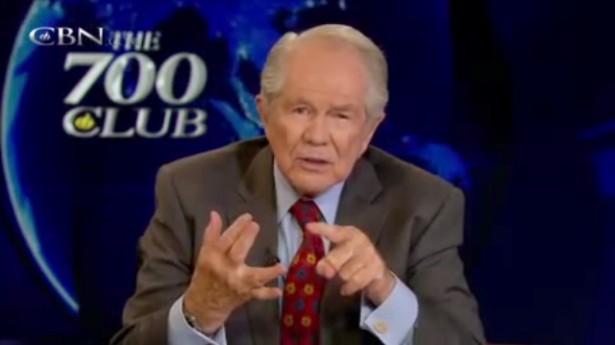
On a recent episode of the 700 Club, [to see the specific section, fast-forward to 56:43] host Pat Robertson warned a viewer that “If you fight science, you are going to lose your children, and I believe in telling them the way it was.”

Pat Robertson on The 700 Club

Pat Robertson on The 700 Club

This extraordinary statement from one of the America’s leading televangelists can teach us a lot about the nature of religious conservatism and education.

A viewer had asked what to do about her children who came to doubt the Bible due to scientific evidence.  Robertson told her that a young earth was not part of the Bible.  Children, he argued, should be taught the truth about the age of the earth.  Robertson prefaced his remarks about the age of the earth by noting that people would try to “lynch” him for saying it.

The truth, Robertson insisted, was as follows:

“You go back in time, you’ve got radiocarbon dating. You got all these things, and you’ve got the carcasses of dinosaurs frozen in time out in the Dakotas. . . .  They’re out there. So, there was a time when these giant reptiles were on the Earth, and it was before the time of the Bible. So, don’t try and cover it up and make like everything was 6,000 years. That’s not the Bible.” 

To be clear, Robertson said nothing about evolution, human or otherwise.  What he did endorse was the mainstream scientific understanding that the earth has been around for far longer than 6000 years.

What does this matter for those of us outsiders trying to understand “fundamentalism” in American education?

First, it demonstrates the complexity of religious conservatism.  Those progressives who insist on a unified, monolithic, even conspiratorial “Religious Right” in education misunderstand the profoundly fractious nature of conservative religion in America.

Robertson understands it.  As he noted, some folks will likely want to “lynch” him for acknowledging the validity of the scientific evidence for an ancient earth.  One response from the leading young-earth group Answers In Genesis ferociously condemned Robertson’s “compromise.”  First, AiG writer Tommy Mitchell argued, the evidence for a young earth does not come only from one theologian, as Robertson implied.  The Bible itself, Mitchell insisted, must be read as advocating a literal young earth.  The scientific mainstream is simply misleading, and when religious leaders endorse mainstream mistakes, it only leads more young people away from true religion.

Second, for those evolution educators who hope to improve science education, Robertson’s statement demonstrates that many devout Bible Christians are open to the central idea of an ancient earth.  Most mainstream scientists and science educators will agree that we do not know the real origin of life.  But we do know that the earth is more than 6000 years old.  Perhaps Robertson’s statement will allow science educators to think more strategically.  Instead of calling creationists ignoramuses and child abusers, those who hope to improve science education can refer creationists to devout Christians like Robertson who agree on the facts of an ancient earth.