Kruse-ing to Conservative Schools

For those of us who follow conservative education policy and ideology, Dennis Kruse of Indiana has been one to watch lately.  Senator Kruse chairs the state senate committee on education and career development.

In December, Kruse attracted our attention with his promise of a new “truth-in-education” bill.  This bill would allow students to question their teachers on any controversial subject.  Teachers would be legally responsible to provide evidence supporting his or her classroom content.

Recently, we discovered a helpful way to track the legislative ambitions of this conservative leader.  The Indiana State Senate website allows anyone to view legislation introduced or sponsored by any legislator.

A review of Kruse’s 2013 activity shows us the educational vision of this particular conservative, at least.  For example, this busy senator has authored bills to support prayer in charter schools, to declare that parents have supreme rights concerning their children, and even to mandate the teaching of cursive in Indiana public schools.

Of course, many of these bills will never see the light of day; many are simply political discussion starters.  But even as such, the vision of America’s schools demonstrated by Senator Kruse’s ambitions can tell us a great deal about what conservatives want out of education.  If somehow Senator Kruse became Supreme Emperor Kruse, we can imagine an education system in which religion played a leading role.  It might also be a school system where students learned traditional skills such as writing cursive.  Parents might be empowered to insist on curricula friendly to their religious backgrounds.

Kruse’s 2013 legislative record also demonstrates the tight connections—among conservatives like Senator Kruse—between educational conservatism and a broader cultural conservatism.  In addition to his school bills, Senator Kruse has supported bills to have mandatory drug testing for all state assistance recipients and to provide every abortion recipient with explicit information about the dangers and risks of abortion.

This tightly bundled conservatism demonstrates, IMHO, the need to understand conservatism broadly.  Too many commentators focus on high-profile issues such as creationism or school prayer in isolation.  By instituting better science standards, for instance, some progressive types think they can derail conservative policy.  Such one-issue reforms will not have much impact unless they recognize that educational conservatism is bigger than any one issue.

So what do conservatives want out of America’s schools?  In the case of Senator Kruse, at least, outsiders like me can see an explicit legislative program.

Rednecks and the Bible

H/t: H.T.

From the I-can’t-believe-I-haven’t-heard-about-this-til-now desk: The American Bible Challenge, a TV game show in which contestants go head-to-head on their knowledge of Bible trivia.  This show, in which a famous redneck asks teams about the Bible, has proven to be enormously popular.

Generally, I can’t say I’m a big fan of comedian Jeff Foxworthy.  His schtick seems to rely only on a single tired question: Are you a redneck?

But Foxworthy has parleyed his aw-shucks routine into major stardom.  First, he starred as part of a painful Blue Collar Comedy Tour.  Then, he asked game-show viewers if they were smarter than fifth-graders.

Now, as host of the Bible quiz show, Foxworthy has participated in the most popular game show in the history of the Game Show Network.

With contestants such as “The Rockin Rabbis” and an evangelical pastor with the nickname “The Walking Bible,” contestants seem to come from a variety of faith backgrounds.  As a segment from the news show Rock Center described, the show seems to be more than just Jesus Jeopardy.  With an on-stage gospel band and a prayer-service-like studio audience, this Bible show feels more like a worship service than a chance to win thousands of dollars.

More proof, if more were needed, that American religiosity is an infinitely malleable thing.  Not a vestige from some imagined past, but part and parcel of the everyday changes in American culture.

The Bible and Atlanta’s Cheating Teachers

What made them do it?  Those dozens of teachers in Atlanta indicted for cheating?  Do they need more Bible?

Some commentators have blamed the high-stakes testing regime itself.  As David Callahan wrote for the Huffington Post, the culture of testing pushes teachers and superintendents to doctor test results.  According to Sean Higgins of the Washington Examiner, Randi Weingarten of the American Federation of Teachers blamed America’s “test-crazed policies.”

Arch-creationist Ken Ham takes a different approach. The problem, Ham insists, is America’s Godless culture.  In a Facebook post yesterday, Ham indicted the schools themselves.  America’s public schools, Ham wrote, “take billions of dollars of your tax money for education,” but they fail to recognize the truths about human nature clearly explained in the Bible.  Most teachers, Ham argued, “are hatched from the same cultural eggs as much of the rest of society,” and that society kicked the Bible out of public life back in the 1960s.

As a result, Ham concluded, “it should NOT be a surprise to us when they try and cheat the testing system in order to make themselves look good!”

For Ham, the problem behind the Atlanta cheating scandal was not the way the tests encouraged teachers to lie.  The problem, instead, was the secularized culture of public life and public schooling.  Without the guidance of the Bible, teachers—like all Americans—will sink into the degrading morass of cheating and lying.


President Carson 2016: The Education President?

What would a President Carson mean for education?

Recent reporting in the New York Times asks if prominent neurosurgeon Ben Carson is a 2016 GOP contender.  Carson has become hugely popular among conservatives.  In a recent speech at Conservative Political Action Conference, Carson received rousing applause when he mentioned that he had some good ideas . . . “if you should magically put me into the White House.”

Conservatives at CPAC loved Dr. Carson.  They should.  Carson has a dramatic life story and is a compelling public speaker.  His values are profoundly conservative.  He wants more public religiosity.  He wants a flat tax and a smaller public debt.  He wants America to beef up its military strength and return to a vision of the past in which Americans shared common values.

New York Times reporter Trip Gabriel noted that a recent Carson speech at a National Prayer Breakfast “criticized the health care overhaul and higher taxes on the rich, while warning that ‘the PC police are out in force at all times.’” True enough.  But those were just the starting points and final words of Carson’s half-hour talk.  By far the bulk of Carson’s address concerned the vital importance of education.

I wonder if reporter Gabriel ignored the bulk of Carson’s speech because Gabriel considered education to somehow be of lesser political interest than health care and tax policy.  If that’s the case, Gabriel couldn’t be more wrong.

Check out the speech itself if you have thirty minutes to spare.  You’ll see that Dr. Carson focused almost entirely on traditional conservative themes in educational policy and reform.

First of all, Carson lamented the sad state of American public education.  Citing statistics about high high-school dropout rates and low college completion rates, Carson deplored the fact that too many Americans are not getting a good education.  This had echoes of the ugly history of slavery, when it was illegal to educate a slave.  The lesson, Carson insisted, is clear: “When you educate a man you liberate a man.”

Carson shared his own remarkable educational history.  As a child, he grew up in a very poor household.  His mother had been married at age thirteen, soon abandoned by her bigamist husband.  She herself had only attained a third-grade education.  But she insisted ferociously that her two sons would be different.

She required young Ben and his brother to write two book reports per week for her to review.  Eventually, of course, Dr. Carson went on to his spectacular career as a leading pediatric neurosurgeon.

In Carson’s prayer-breakfast speech, he argued that Americans had always loved formal education.  But recently, Carson complained, “We have dumbed things down.”

That is not okay, Carson insisted.  America’s form of government requires a well-informed citizenry.  That is why Dr. Carson offers two programs for low-income youth: a college scholarship fund and reading rooms in low-income public schools.

Education, Carson promised, will prevent criminality.

More important, education will prevent cultural decay and decadence.  Look at Ancient Rome, Carson said.  “They destroyed themselves from within.  Moral decay, fiscal irresponsibility.”  The same thing could happen to the United States, Carson worried, if we don’t beef up our education system.

So what would a President Carson do for education?  Could he combine traditionally leftist education policies—such as financial assistance for the lowest income schools and students—with traditionally rightist policies—such as teaching traditional values and public religiosity in schools?

Even the superhuman brain surgeon himself couldn’t answer that.  But it is worth more consideration than some journalists and commentators seem willing to give it.

Jesus Increases Graduation Rates

In Christianity Today we find a story about Detroit’s Cornerstone Schools.

Founded in 1991, today these schools serve 1,500 students, 97% of whom graduate from high school and 90% of whom go on to college or the military.

These statistics have attracted national attention.  In one profile for CNN, the schools’ success was credited to “three Cs:” a Culture of education, Commitment to learning, and Community.  (See video clip, 2:28, right at the end.)

The profile in Christianity Today, not surprisingly, focused on another C: Christ.  In an interview with the schools’ leaders Ernestine Sanders and Clark Durant, CT‘s Dwight Gibson concluded that the schools’ success comes from one simple fact: Cornerstone represents “a school whose culture is centered on the person of Jesus.”

Chairman Durant framed the schools’ success this way:

“We have fabulous statistics. Most of our kids graduate from high school in a city where maybe 30 or 35 percent do. More than 90 percent go onto college, the military, or some other kind of learning. But those are not the measurements that really determine a fulfilling life. Sure, it’s important, but is it the measurement we use for our own children? Is it the measurement that God uses for us?”

President Sanders did not credit the schools’ academic successes with innovations such as an 11-month school year, mandatory Mandarin classes, or mandatory parental commitment.  Instead, Sanders explained Cornerstone’s success this way:

“It’s our people, whether it’s our maintenance man, Mr. Cole, or a teacher. In Mr. Cole finding his place in this community, the kids see him as valuable. He has wisdom.  That’s why Cornerstone is excellent—we try so hard even as imperfect as we are to lift up a Christ-centered culture.

“And in lifting up that culture, the education is coming along. So you keep aspiring to that excellence. What we try to do here is not to be daunted by the circumstances. Rather than being daunted by it, we try to be as strategic as we possibly can. I see us trying to build that broad and beloved community that Clark referenced.”

The story raises some key questions about the proper relationship between religion and education.

  • Can public-funded schools use religion to boost graduation rates?
  • Is it enough justification to have religion in public-funded schools if those schools produce academic success?
  • And why didn’t the CNN story mention the religious nature of these schools?

Required Reading: Meet Tim LaHaye

Do you know Tim LaHaye?

LaHaye

LaHaye

If you’re interested in conservative educational thinking in the United States, you should.

Steve Fouse at AliveReligion recently offered a helpful introduction to LaHaye’s enormous influence among conservative and fundamentalist circles.

As Fouse points out, arguments about conservatism that seek to explain away its popularity miss the boat on LaHaye.  Fouse takes Thomas Frank to task for making such oversimplistic assumptions.  Fouse prefers the explanations of historians such as Darren Dochuk.  Dochuk’s more complex perspective fits better the career of a fundamentalist Renaissance Man like LaHaye.

Fouse notes LaHaye’s wide-ranging interests, from LaHaye’s role in the Institute for Creation Research, to his best-selling apocalyptic novels, to his evangelical sex guides.

Fouse mentions LaHaye’s central interest in educational issues, from sex ed to creationism.  If anything, Fouse downplays the influence LaHaye has had in late twentieth-century educational conservatism.

Fouse could have mentioned, for instance, LaHaye’s role in arguing for increased phonics instruction.  In his 1983 book The Battle for the Public Schools, LaHaye argued that abandoning phonics could be part of a massive conspiracy to “reduce the standard of living in our country so that someday the citizens of America will voluntarily merge with the Soviet Union and other countries in a one-world socialist state”   (46).   Disappearing phonics instruction showed the extent to which Christian America had been undermined.  It served as a canary in the secular coalmine.  “Some modern educators,” LaHaye insisted, “use look-and-say instead of phonics because the material enables them to secularize our once God-conscious school system” (50).

Similarly, Fouse did not mention LaHaye’s ardent activism in favor of more traditionalism in US History instruction.  In LaHaye’s 1987 Faith of Our Founding Fathers, LaHaye argued that the nation had endured a “Deliberate Rape of History” (5). Between 1954 and 1976, LaHaye insisted, a generation of “left-wing scholars for hire” worked for secularizing organizations such as the Carnegie Foundation (6).  Such authors systematically distorted the truth of America’s Christian heritage.  Thus, in order to find the true history of America’s founding, readers needed to look to older books, written by those “closest to the events they describe” (6). LaHaye insisted on the Christian beliefs of the Founding Fathers, demonstrating that “most were deeply religious, all had a great respect for the Christian traditions of the colonies, and all were significantly influenced in their thinking by the Bible, moral values, and their church” (30).

Thanks to Steve for offering his post about this important figure.  All of us who hope to understand conservatism in American education should check it out.


Required Reading: Learning to Hear Why Evangelical Christians Hear God

Guest Post by David Long
Tanya Luhrmann, When God Talks Back

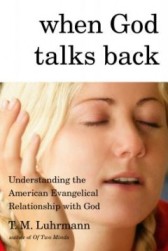
Tanya M. Luhrmann, When God Talks Back: Understanding the American Evangelical Relationship with God (New York: Vintage, 2012).

Adam Laats’s testimonial for his creation of I love you but you’re going to hell was one of the most refreshing perspectives I’ve read in a long time.  Laats’ roots in Boston—having, what those of us living in the “fly-over” states might skeptically be inclined to see as the judgment of a  limited, Northeastern Liberal metropolitan view—make for interesting reading given his apparent surprise at thoughts and tendencies of ‘Red State’ America. In short, the general tone sounds something like—”these creatures really still exist?!”  In fact, as I suppose Laats has encountered through reader feedback, such creatures not only exist but make up a good bit of the Union.Countering Laats, those of us raised where ‘olde-timey’ religion has never faded, and where it remains an assumed keystone of responsible civic participation, raise an eyebrow to what we see as shortsighted judgment of those disinclined to ever value living in the interior.  Calming our nervous eye, Laats is on the right track.  His earnestness rings true.  Try to figure these curious people out.  Know where people are coming from.  But then what?  Historians are great at drawing on the past to inform the present.  Often, due to the normal purview of their back-looking view, they’re not as good at analyzing the dynamics of here and now.

The American relationship to God has not been static as historians show well.  Unabashed liberal  theologians such as Marcus Borg and sociologists such as Robert Putnam and David Campbell show that the American response to the sacred has been changing.  As Putnam and Campbell show most clearly, the old “Mainline” Christianity of Laats’ and many other’s childhood has eroded.  Congregations reduced by half in many cases over the past half century, the “Mainline” is Main no longer.  American Protestantism has changed dramatically in recent decades, ever more and more defined by the new Evangelicalism featured in T.M. Luhrmann’s When God Talks Back.

As Luhrmann sees it, “this is an important story because the rift between the believers and non-believers has grown so wide that it can be difficult for one side to respect the other.  Since evangelical Christianity emerged as a force in American culture, and especially since the younger George Bush rode a Christian wave into office, non-evangelical observers transfixed by the change in the American religious landscape.  Many have been horrified by what they take to be naïve and unthinking false beliefs, and alarmed by the nature of this modern God” (p. xv).

When God Talks Back follows the emergence of the rapidly growing neo charismatic evangelical movement in the U.S. through the lives, thoughts, and hopes of dozens of fellow church goers.  Luhrmann, a psychological anthropologist, presents a salient answer to those ILYBYGTH readers who wonder not only how such people exist, but how such views are cultivated.  Luhrmann’s work is ethnographic—she became a congregant of the Vineyard Church in a number of U.S. cities over a few years.  Countering some of Laats’ personal narrative, and further deflating modernist hopes that science and theories of progress would dissolve American religious commitment in time, Luhrmann shows that neo charismatic Evangelicalism is spreading throughout the U.S.—including major urban areas.  “There are pockets of liberal Christianity left in America and Europe,  but Christianity around the world has exploded in its seemingly least liberal and most magical form—in charismatic Christianities that take Biblical miracles at face value and treat the Holy Spirit as if it had a voltage” (p. 302).

Underscoring Luhrmann’s work, and worth what is a sometimes lengthy and ranging ethnographic treatment of Vineyard Church members, is the strongly theorized, yet easily digestible insight about science, faith, and the near American future.  The neo-Evangelicalism explored in Luhrmann’s work points strongly to a theory of religious practice—of knowing from doing religion—rather than the usually scientistic efforts of explaining Evangelicalism through evaluation of epistemological pathways of coming to know.

As Luhrmann explains, “…what I saw was that coming to a committed belief in God was more like learning to do something than to think something.  I would describe what I saw as a theory of attentional learning—that the way you learn to pay attention determines your experience of God.  More precisely, … people learn specific ways of attending to their minds and their emotions to find evidence of God, and that both what they attend to and how they attend changes their experience of their minds, ad that as a result, they begin to experience a real, external, interacting living presence” (p. xxi).

What unfolds chapter by chapter is a unique and deeply insightful look into the social practice of being an Evangelical Christian in early 21st century America.  As Luhrmann sees it, and given my own experience working and talking with creationists, such views are much more saliently explainable once you come to acknowledge the social support evangelicals get from their churches, appended by the reality of time allocation.  As Luhrmann makes a convincing case, being an Evangelical in today’s charismatic style—through the many, emotionally exuberant hours of praise and worship—changes one’s style of thinking.  Like Aristotelian phronesis, one can become quite good—a master—at the virtues of evangelical worship regardless of whether liberal America thinks it’s silly, backward, or indicative of sloppy thinking.

“They seemed to think about sensing God more or less the way we think about sophisticated expertise in any field: that repeated exposure and attention, coupled with specific training, helps the expert see things that are really present but that the raw observer cannot, and that some experts are more expert than others.  A sonogram technician looks at the wavy grey blur on the screen and sees a healthy boy.  This is not a matter of taste or aesthetic judgment: there is, or is not, a boy in the woman’s womb, and the technician can see evidence for the fact in a picture that leaves the expectant mother bewildered.  And a very good technician sees details that a merely competent one cannot” (p. 60).

In fact Luhrmann’s work offers another compelling insight into the durability of evangelical christianity in the early 21st century American milieu.  Countering the shrillness of some “New Atheists” such as Richard Dawkins, etc., Luhrmann repeatedly follows evangelicals through life trials for which their church homes offer not only a sense of purpose, but a foil to those who might critique religious practice as being an inadequate explanatory matrix to respond to the world.  As Luhrmann makes clear, “in some quite fundamental way, modern believers don’t need religion to explain anything at all.  They have plenty of scientific accounts for why the world is as it is and why some bodies rather than others fall ill.  What they want from faith is to feel better than they did without faith.  They want a sense of purpose; they want to know that what they do is not meaningless” (p. 295).

Luhrmann’s book then is an invitation to those willing to suspend their critique of Christian America’s current form in favor of a an exploration of how and why it currently comes to be.


DAVID LONG is an anthropologist who studies the American relationship towards science, particularly as it unfolds in schools and universities.  His work examines the role of religious faith, social class, ethnicity, and gender in people’s lives as they relate to science.   He is the author of Evolution and religion in American education: an ethnography (Springer 2011), where he followed a cohort of college students, many of whom were Creationists, documenting the rationales and anxieties they encountered while thinking and talking about evolution.  He is currently conducting longitudinal research on the administrative decision making in K-12 schools which does or does not support science teaching.  Dr. Long currently directs implementation research for the Virginia Initiative for Science Teaching and Achievement at George Mason University.  He can be reached at dlong9@gmu.edu


Creationists Love The Bible

The young-earth creationists of Ken Ham’s Answers in Genesis endorse The Bible.  Not just the Good Book, but now also the Good Movie.

Dr. Elizabeth Mitchell (MD) reviewed the new ten-hour History Channel film on the AiG website today.

I believe the folks at AiG will agree with me when I say this: they have a tendency to be extremely particular about the company they keep.  They only endorse those who agree on the importance of a young earth and a six-day creation.  Even other conservative Christians will come into AiG disfavor if they dispute those ideas.  Recently, for instance, founder Ken Ham took the 700 Club’s Pat Robertson to task for making nice with evolutionary science.

So when an AiG reviewer praises the new Bible film as something that “allows the plain truths of biblical history from the time of our origins to speak and connects those truths to the relevant issues of life,” it says a great deal about the content of the film.

Mitchell notes that the film depicts a literal world wide flood.  “Even in its opening scene,” Mitchell writes,

“a believable Noah recounts the six days of creation for his seasick family in a massive, storm-tossed Ark in a Flood that is clearly global. The worldwide scope of the Flood is portrayed by the graphic of a flooded planet and the narrator’s confirmation that the floodwaters had ‘engulfed the world.'”

Mitchell notes the necessary shortcuts that a ten-hour film must make in condensing such a massive set of books.  In the end, however, Mitchell believes that the film is true to the original.  The best proof of the film’s merit will be, in Mitchell’s words, that

“The Bible will likely lead many to Christ. Why? Because it presents the Bible’s history as real history—instead of eroding trust in God’s Word from the very first verse. Because it demonstrates the relevance of the Fall of mankind soon after creation to all the evil that has ever cursed our world. Because it depicts the Old Testament sacrifices that God intended to prefigure the ultimate sacrifice of Christ, the Lamb of God who takes away the sin of the world (John 1:29). And because it presents the Bible’s history as a continuous narrative of God’s plans for us from creation through the covenant people of Abraham and Moses to Christ and the early church, thus showing how Jesus Christ is indeed God’s answer for the sin-guilt of the entire world.”

As long as important doctrine is respected, it seems, including the truths of a young earth and a six-day creation, Answers in Genesis is happy to endorse any work that will lead to more conversions.

As we’ve been discussing lately, the Hollywood Christian power couple behind this film have advocated for more Bibles (books, that is, not films) in public schools.  If ardent young-earth creationists can endorse the film, what does that tell us about the sectarian intentions of the filmmakers?

Celebrity Bibles in Public Schools

If you haven’t bothered reading the book, since you knew the movie would be coming out soon, your plan paid off.

Hollywood Christian power couple Roma Downey (“Touched by an Angel”) and Mark Burnett (“The Voice,” “Survivor”) have produced a ten-hour Bible series for the History Channel.  Their massive movie project is not the sum total of their Bible ambition.  As they wrote recently in the Wall Street Journal, they also want to see more Bible in public schools.

Evangelical Protestants have largely endorsed the new Bible series.  Emily Belz wrote in World Magazine that the parts she saw seemed “theologically orthodox.”  Writing in the Christian Post, George Tunnicliffe declared, “This Time, Hollywood Got It Right.”

In Burnett’s and Downey’s WSJ op-ed, they argue that cultural literacy demands a thorough knowledge of the Bible.  This is not a religious mandate, they insist, only an educational one.  Young people won’t understand basic cultural references without reading the Bible.

Their argument raises some perennial questions about the teaching of the Bible in public schools.

As they correctly note, the Supreme Court in 1963 explicitly stated that the Bible could and should be used in public schools.  It must not be read devotionally, Justice Tom Clark wrote, but it should be used to teach students about culture.

However, as we have seen recently, such Bible courses in Texas have often lapsed into evangelical exercises.  Professor Mark Chancey of Southern Methodist University found plenty of devotional training packed into public-school Bible classes.

Nor should this surprise us.  As I found in my study of the first decade of Protestant fundamentalism, Bible classes in public schools often attracted irresistible public support during the 1920s.  At that time, support usually came from Protestant activists, with opposition from Catholic and Jewish groups.  Such religious dissenters often insisted that “non-devotional” study was just a ruse, meant to sneak Protestant religiosity into public education through a back door.

Do Burnett and Downey want to sneak religious proselytization into public schools?  They say they do not.  Merely to understand Shakespeare, for instance, students should be familiar with Bible language and stories.  The Bible, the celebrities argue, is a foundational text of our culture.  Not including it in public schools means depriving students of basic cultural literacy.

“Can you imagine,” they ask,

“students not reading the Constitution in a U.S. government class? School administrators not sharing the periodic table of the elements with their science classes? A driver’s ed course that expected young men and women to pass written and road tests without having access to a booklet enumerating the rules of the road?”    

Of course, this is the second half of the Bible dilemma.

Not only do religious dissenters fear that purportedly non-devotional Bible classes will serve as a cover for proselytization, but dissenters, pluralists, and secularists fear precisely the celebrities’ attitude toward the Bible.

Burnett and Downey join the conservative evangelical Protestant tradition on the question of Bibles in public schools.

By insisting that the Bible is the cultural equivalent of the US Constitution in government, the periodic table in chemistry, or the road rules in driver’s ed, these Bible-loving celebrities suggest that the Bible is more than just a good book.  After all, the Constitution and the periodic table are more than just good things people should know about.  They are foundational documents that contain essential truths of government or chemistry.  The implication, though the celebrities would likely deny it, is that the Bible is more than just a storehouse of cultural referents.  The implication is that the Bible contains the eternal truths young people need.

By describing the Bible this way, Burnett and Downey suggest that the Bible is not only important for its cultural information, but also for its religious message.

‘Pentecostal Hairdos’ and Teaching the Bible

Kudos to Mark Oppenheimer.

Oppenheimer tells New York Times readers about Mark Chancey’s study of Bible-reading in Texas public schools.  For ILYBYGTH readers, there’s not much news there.

As we noted here weeks ago, Professor Chancey found lots of Bible evangelism going on in public-school Bible classes in Texas.  At the time, we opined that we shouldn’t be too surprised at those findings.

But Oppenheimer explored a little deeper, and spoke with Gay Hart, a 77-year-old Bible teacher from Eastland, Texas.  Hart offered the best Bible-teacher stereotype-busting quotation I’ve seen:

‘“I go to First Baptist,” she said. “I wear a Pentecostal hairdo. I play the organ at the Episcopal church. When I could sing, I was the alto at Church of Christ. I have taught in a Catholic school. I am 77, and I am not a little old lady with a 15-year-old car that has 3,000 miles on it. I sky-dived last summer. I have a life, and I love this class.”’

I don’t know about you, but I had to look up “pentecostal hairdo” to see if that was a real thing.  As usual, turns out I’m the last to know.  Thanks to Erika, I now know how to do it myself!