Science and Its Discontents

What keeps Americans from believing in evolution?  In climate change?

Around here, we focus on principled religious dissent, such as the creationism of ministries such as Answers In Genesis or the Institute for Creation Research.

But what about a much broader, more amorphous sort of anti-science?  What about a strangely popular anti-science that isn’t part of any religious subculture, but is rather a mainstay of mainstream culture itself?

It seems as if the most influential scientific dissenter out there might not be Ken Ham or Henry Morris, but Oprah.

Scientific Dissenter #1?

Scientific Dissenter #1?

In a recent essay in The Verge, Matt Stroud discusses the implications of Oprah’s reign of error.  In this piece, Stroud points out that the alt-science on offer by Oprah’s pet gurus has done more than just confuse schoolchildren.  In the case of James Arthur Ray, Oprah’s scientific influence has actually killed people.

In 2009, according to Stroud, Ray led a group of believers into a sweat-lodge in Arizona.  In the end, three of those scientific dissenters were dead and many more suffered injury.

Why would they subject themselves to this sort of physical peril?

Because Oprah told them to.

Stroud makes a strong case that Ray’s meteoric rise to celebrity depended on Oprah’s alt-science imprimatur.  To be sure, Ray had been peddling his version of energy-science before Oprah discovered him.  But when Oprah touted a 2006 film in which Ray discussed his alt-scientific ideas about “Harmonic Wealth,” Ray became a national and international figure.

Stroud demonstrated the link between Oprah’s support and Ray’s success.  Soon after Oprah showcased the film and book in which Ray made his alt-science case, Ray was everywhere.  As Stroud put it,

Ray soon appeared on Larry King Live to say, “Well, Larry, science tells us that every single thing that appears to be solid is actually energy. Your body is energy. Your car is energy, your house, everything, money, all of it is energy.” The Today Show, Fox Business News, and local network affiliates followed. He toured the country while guesting on smaller venues from Tom Green’s internet talk show to Coast to Coast AM with George Noory. He even judged a Miss America pageant. “Whatever you fear or love will come into your life,” he’d repeat for his agreeable hosts.

Stroud doesn’t make the connection, but this sort of shoot-from-the-hip spiritual guruism can be far more influential, and far more dangerous, than the principled and storied religious dissent of creationists.

Let’s look at another example of the disparate influence of traditional science dissenters and that of Oprah.  Perhaps Ken Ham and his Answers In Genesis ministry can attract attention to the question of atheism with their series of billboards in Times Square and Fisherman’s Wharf.  But Oprah can make a much more influential statement just by questioning one of her guests.  Recently, Oprah told super-swimmer Diana Nyad that Nyad didn’t sound like a real atheist.  More than any billboard, Oprah’s off-the-cuff theism provoked an outpouring of hand-wringing over questions of belief and unbelief.

The disturbing implication for those of us who hope to see better science education in schools is that the problem is not limited to principled religious dissent.  Much more widespread and amorphous is the sort of alternative-science guruism on tap from media moguls like Oprah.

Oprah has made her billions by knowing what millions of Americans want to hear.  Outside the traditional ranks of religious skeptics like the folks at Answers In Genesis, the market-driven dissent of Oprah’s pet gurus can cause much more confusion and consternation.



The Missionary Supposition

Is evolution a religion?  Are its teachers missionaries?

That has long been the accusation by some conservative religious folks.  The godfather of today’s young-earth creationist movement, Henry Morris, insists that it is.

Given that history, it is with trepidation and full humility that I’ve argued recently in the pages of the Reports of the National Center for Science Education that evolution educators might learn something from religious missionaries.

I want to be as clear as I can about this: I do not think that evolution is a religion.  I do not think evolution educators should consider it their job to “convert” young people to an evolutionary worldview.

But I do think evolution educators have been plagued historically by an attitude that creationism is simply an absence of something, a lack of knowledge about evolution.  To be sure, thoughtful evolution educators have long avoided that trap.  The folks at the National Center for Science Education, for instance, have made a strong case that we need to understand creationism if we want better evolution education. 

The attitude of many evolution educators throughout history, however, has been that creationists must simply not know enough about evolution.  Once creationists hear the truth, according to this line of thinking, they will hop on board the evolution train.

Ironically, that understanding of creationism and evolution teeters perilously close to the attitude among many early religious missionaries.  The Bible, many Protestant missionaries believed, contained such powerful, supernatural power that it would be instantly embraced by heathens worldwide.  All missionaries had to do was spread the Word.  Indeed, this faith in the transformative power of Gospel text remains strong among groups such as the Gideons and the American Bible Society.

But most religious missionaries these days understand that conversion needs more than just the Gospel.  Many conservative Protestant missionaries insist that the home cultures of local groups must be studied thoroughly and lovingly by would-be Bible missionaries.  Without that sort of preparation, real missionaries insist, evangelization is a waste of time, and may even be what one missionary writer called “evangelical toxic waste.”

What do I suggest?  I argue in my RNCSE essay that evolution educators need to spend more time understanding creationism.  If we really want to teach evolution in the United States, we need to do more than just spread the word.  We need to spend time learning about the cultures that refuse to believe evolutionary theory.

We need to study history, anthropology, and religion in addition to biology, geology, and genetics.  Awkward as it might be to admit, one “-ology” that evolution educators have ignored to their peril is missiology.


The Real Pharaoh’s Secret: The Creation Museum

Get this: one of the new Doritos commercials was filmed at Answers In Genesis’ Creation Museum.

Image Source: Answers in Genesis Creation Museum

Image Source: Answers in Genesis Creation Museum

How do I know?  Ken Ham told me.  And the other five bajillion people who follow him on Facebook.

Why did Doritos film at the Creation Museum?  Are they peddling their snacks as young-earth creationist favorites?  Not according to Ham.  He says part of the museum simply has the style of an “Egyptian temple” so the filmmakers liked it.


Creationism in Texas: A Foreshortened History

Read it.  It’s good.  But be warned: this story has a fatal flaw.

Brentley Hargrove’s history of the Texas textbook wrangles is a helpful introduction to the recent round of textbook fights in the Lone Star State.

In the pages of the Dallas Observer, Hargrove introduces readers to the recent history of creationist influence in the selection of Texas science textbooks.  He offers the backstory of review-board members such as intelligent-design proponent Raymond Bohlin.

Hargrove takes the story of the Texas Textbook Two-Step back to the 1970s, when self-appointed watchdogs Mel and Norma Gabler wielded outsize influence on the adoption of books.

He describes the rise to educational power of creationist dentist Don McLeroy and the board membership of theologue Cynthia Dunbar.

This story is a must-read for everyone interested in today’s culture wars over education, not just in Texas but around the nation.  It joins films such as The Revisionaries and documentaries such as the Long Game in pointing out both the peculiarities of educational politics in Texas and the broader meanings Texas school politics has for all of us.

But as a historian of these school battles, I must protest against the foreshortened history Hargrove describes.  He gives a nod to the long history of cultural battles over education.  He mentions the nineteenth-century Bible wars that rocked America’s cities.  But then he skips from 1844 to 1961.  He leaves out the formative period of today’s educational culture wars.

As he puts it, since the nineteenth century,

the fear of secularism and modernity remains as potent as ever. Yet it wasn’t until the Gablers came along that this fear took shape in Texas and assumed power.

Now, that’s just not true.  I understand Hargrove is interested in the way these battles have developed over the past fifty years.  But the way they did so was decisively influenced by earlier generations of Texas activists.

To be fair, Hargrove’s historical myopia is widely shared.  In his Observer article, he quotes prominent sociologist William Martin.  “The Gablers,” Martin told Hargrove, “were the first people to have taken this on in such as systematic way.”

Even if we make allowances for the contemporary interests of journalists and sociologists, this sort of misrepresentation of the history of Texas’ school battles can’t be given a pass.

The tradition of conservative activism in which the Gablers, McLeroy, Bohlin, and Dunbar take part has direct roots in the 1920s battles in Texas and elsewhere.

As I argue in my 1920s book, anyone with even a passing familiarity with Texas history will recognize the historical importance of J. Frank Norris, for example.  In the 1920s, Norris established the activist precedent that later conservatives followed.  Norris fulminated against the directions of 1920s public schools in ways that McLeroy, Dunbar, and the Gablers would have appreciated.

And he had even more political pull.  In the 1920s, though a state-wide law banning the teaching of evolution failed in the Texas legislature, the governor ordered textbook publishers to remove any mention of evolutionary science from the state’s textbooks.

All well and good, you might say.  But does that pre-history have anything to do with today’s textbook fights?  If we want to understand the current moment, do we really have to go so far back?  Isn’t it enough to look to the Gablers and start there?

The school fights of the 1920s are of interest to more than just nitpicky academic historians like me.  Even if we want to start with the Gablers, we need to understand the formative school battles of the 1920s.  Mel Gabler was ten years old in 1925.  The content and structure of the schools he attended was decided by the activism of pundits such as J. Frank Norris and the pusillanimity of politicians such as the Governors Ferguson.

It was in the 1920s that America first battled over schooling in the terms that have remained so familiar ever since.  The issues and positions laid down in the 1920s have become the durable trench lines in American education.

As Gabler biographer James Hefley described, by the 1960s the Gablers had become

the cream of self-reliant Middle America.  They lived by the old landmarks, took child-rearing seriously, supported community institutions, sang ‘God Bless America’ with a lump in their throats, and believed that the American system of limited and divided governmental power was the best under the sun.

How did they get to be that way?  How did they become so confident that their vision of proper schooling and society must be fought for?  The Texas the Gablers loved had been defined by the activism of the 1920s and succeeding generations.  The vision of proper education that fueled the self-confident activism of the Gablers had been established as such in the controversies of the 1920s.

If we really want to understand what’s going on today, we need at the very least to acknowledge the longer history of these issues.  We need to understand that today’s fights grew out of earlier generations, and those earlier generations did not just spring up full-grown from the Texas soil.


Can Evolution Match This?

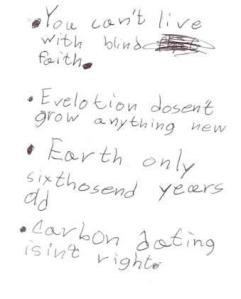
So clear and compelling a seven-year-old can understand it.  That’s the boast of young-earth creationist leader Ken Ham.  As proof, he published the lecture notes of one of his young audience members.

Image Source: Answers In Genesis

Image Source: Answers In Genesis

Image Source: Answers In Genesis

Image Source: Answers In Genesis

Image Source: Answers In Genesis

Image Source: Answers In Genesis

For those of us hoping to improve evolution education in the United States, Ham’s revelation raises a serious question: Can evolution hope to match the gut-level appeal of creationism?

Science pundits have long noticed this yawning gap between the popular acceptability of mainstream science and that of creation science.  The most clear-headed writers have admitted that creationism has better stories.

As Richard Dawkins put it in his 1996 book The Blind Watchmaker,

It is almost as if the human brain were specifically designed to misunderstand Darwinism, and to find it hard to believe.

The creation stories of young-earth creationists, on the other hand, are appealing to all age levels.  There’s a garden, there’s love, there’s disobedience, there’s punishment.  All of these are powerful themes that resonate with young and old alike.

And, lest we evolution-embracers smugly conclude that this stark advantage of creationism will fade as audiences get more intelligent and more sophisticated, let’s remember that creationism’s advantage also pulls in the intellectually sophisticated.

ILYBYGTH readers may remember the postmodern plea of journalist Virginia Heffernan.  A few months back, Heffernan declared her affinity for creationism over evolution.  Why?  In her words,

I was amused and moved, but considerably less amused and moved by the character-free Big Bang story (“something exploded”) than by the twisted and picturesque misadventures of Eve and Adam and Cain and Abel and Abraham.

Obviously, something doesn’t need a compelling narrative in order to be true.  But in the stubborn culture wars over evolution and creationism, popular appeal matters.  Evolution’s biggest selling point is that it does a better job of explaining and predicting than does creationism.  Maybe the winning narratives won’t be the detailed natural-selection classic tales starring finches and moths, but rather the far more stirring story of enlightenment triumphing over dunderheaded fogeys.

That’s a good story.  At least it worked for Kevin Bacon in Footloose.


You Don’t Need a Young Earth to Get to Heaven

Do creationists use intimidation and spiritual threats to coerce young people to believe?  Not as often as some critics assume.

Young-earth creationist leader Ken Ham of the organization Answers In Genesis repeated his call recently that Christians do not need to believe in a young earth.

For outsiders like me, this can appear puzzling.  After all, those of us outside the circle of conservative evangelical belief often assume that all conservative evangelical Protestants spend their time sweating over their eternal fate.  We might make the mistake of assuming that conservative evangelicals thrive by threatening sinners with hellfire, brimstone and damnation.

Take, for example, the Christian beliefs of young-earth creationists.  From the outside, it’s tempting to assume that the more insistent YECs must somehow bully new generations into embracing their beliefs.  After all, those beliefs are so radically different from the ones embraced by mainstream science that it seems impossible for young people to become YECs unless compelled.

This is why some prominent atheists have called this kind of creationism “child abuse.”  As we’ve seen in these pages, smart young people brought up in the faith have wondered why their trusted adult leaders sold them a scientific bill of goods.  As Anna wondered recently in her illuminating ILYBYGTH series about her youth as a YEC, “It is still a bit difficult for me to look back on authority figures and members of my community that I looked up to and respected and wonder: are they just ignorant, or are they purposely deceptive?”

For us outsiders then, it can seem surprising that arch-creationist Ken Ham takes time to point out that young-earth belief is not a salvation issue.  That is, Ham insists that good Christians can disagree about the age of the earth.  As he puts it,

Many great men of God who are now with the Lord have believed in an old earth. Some of these explained away the Bible’s clear teaching about a young earth by adopting the classic gap theory.

Others accepted a day-age theory or positions such as theistic evolution, the framework hypothesis, and progressive creation.

Scripture plainly teaches that salvation is conditioned upon faith in Christ, with no requirement for what one believes about the age of the earth or universe.

Ham hastens to add that discarding a belief in a young earth can have “very severe consequences.”  In sum, since the Bible clearly describes the origins of earth, disregarding that message puts Christians on the very slippery slope to disregarding Biblical authority as a whole.

“All biblical doctrines,” Ham concludes, “including the gospel itself, are ultimately rooted in the first book of the Bible.”

Make no mistake: Ken Ham wants you to believe in a young earth.  But this is not a threat.  This is not a tent-preacher warning that only YEC can save your soul.

Too many outsiders like me ignore these kinds of nuance in the intellectual world of conservative evangelical Protestantism.  We end up calling YECs child abusers or worse, without taking the time to understand the real culture of young-earth creationism.  That might make for good headlines, but it does so at the heavy cost of relying on caricature rather than reality.

Why Are Schools So Terrible?

Conservative intellectuals have long asked the question: What went wrong with America’s schools?

Of course, the question presumes that something HAS gone wrong.

We at ILYBYGTH don’t really care if America’s schools are terrible.  We’re more focused on dissecting conservative approaches to the question. How have different conservatives at different times offered different answers to this perennial question?

Now available free online is an argument I put together a few years back. The article appears in the pages of the storied Teachers College Record.

This article looks at the school-history visions of four very different conservative thinkers: Milton Friedman, Max Rafferty, Sam Blumenthal, and Henry Morris. Each of them agreed that public schools had become ineffective, even dangerous institutions. But the reasons they gave for that lamentable decline differed. Friedman, for example, blamed teachers’ unions and government control, beginning just after the American Civil War. Rafferty blasted the wrong-headed “progressive” takeover of the 1930s. Blumenfeld and Morris both looked further back, to a Unitarian coup at Harvard University variously timed either in 1805 (Blumenfeld) or in 1869 (Morris).

These conservative activists do not only differ in the timelines they gave for America’s educational decline, but also in their diagnoses and prescriptions. Friedman wanted a free-market solution. Rafferty hoped for clear-headed traditionalism. Blumenfeld wanted to scrap public education entirely. Morris hoped to heal schools with creationism.

In every case, these conservatives based their arguments about schooling on a historical vision. They are not alone. Activists of every political stripe use history to prove their points. In this essay, I outlined the ways a few prominent conservatives did so.

Allmon at EVoS

Clear your calendars!

Next week Professor Warren Douglas Allmon will be traveling down scenic Route 96 from Ithaca to talk about creationism.

Allmon’s talk, “Creationism in 2013: Not in the Headlines but Never Far Away,” will be on Monday, November 18, at 5:00 in room AG008 on the beautiful campus of Binghamton University in sunny Binghamton, NY.  The talk will be free and open to the public; no registration is required.

It will be part of the continuing series of Monday seminar talks hosted by the Evolutionary Studies program here on campus.

Allmon is the Hunter R. Rawlings III Professor of Paleontology at Cornell.  He also runs Ithaca’s Museum of the Earth.

I’m excited to hear what Professor Allmon has to say.  A couple years back, Allmon argued in the pages of Evolution: Education and Outreach that evolution educators must begin by understanding the reasons for resistance, not just riding roughshod over it.  As he put it,

This multiplicity of causes [for rejecting evolution] is not sufficiently appreciated by many scientists, educators, and journalists, and the widespread rejection of evolution is a much more complicated problem than many of these front-line practitioners think it is.

Hear hear!  If you want to hear what Allmon has to say, come on down.  Hope to see you there.

Fundamentalism’s Roots: A Review

What does it mean to be a “fundamentalist?”

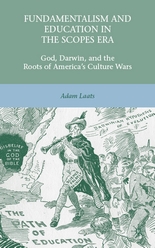
At his lively blog Leaving Fundamentalism, Jonny Scaramanga has offered a review of my 1920s book that puts this question squarely at the center.

Two Thumbs Up...

Two Thumbs Up…

As Scaramanga points out from his current work and from his personal life history, the term “fundamentalist” is often used as more of a bludgeon than a label.  People accuse each other of being “fundamentalist” about this issue or that.  People dither over whether this or that person is a true “fundamentalist.”

Scaramanga notes that unless and until we get a sense of the formative first decade of American fundamentalism—the 1920s—we’ll never wrap our heads around the contentiousness that has always been at the core of defining the term.  I agree entirely.

Best of all, he gave the book a thumbs-up.  As Scaramanga put it,

I was genuinely surprised how much I liked this book. I’m a longtime reader of Adam’s blog and he’s helped me out with research on numerous occasions, so I knew he’s an engaging writer and a top bloke, but I was still expecting to find this a dry, academic slog. Actually, I was riveted. Everything I’ve studied of fundamentalism makes so much more sense in the historical context this book provides. I’d recommend it to people with a casual interest in fundamentalism just as much as those with an academic interest.

Thanks, Jonny.  I don’t think I’ve ever been called a “top bloke” before.  A “top bloke’s” a good thing…right?

Help! My Teacher’s a Girl Now!

Do young children need to be protected from transgender teachers?

Ryan T. Anderson thinks so.  And in his argument, he joins a long conservative tradition of insisting on special culture-war protections for children.

Anderson, a prominent voice in the anti-gay-marriage coalition, argued recently in the pages of the National Review that transgender teachers would force young people to wrestle prematurely with issues of sexuality and gender identity.

His argument came in the context of his opposition to the Employment Non-Discrimination Act (ENDA), a bill that would make it illegal for some employers to discriminate against gay or transgender people.

In Anderson’s opinion, this is not the latest civil-rights bill.  Sexual identity and gender identity, Anderson argues, are self-identified and self-defined, unlike race.

Perhaps most compelling, Anderson thinks, this bill might force elementary schools to employ men who used to be women, or women who used to be men.  It would force children, Anderson says, to know too much too soon.

As he put it,

Issues of sex and gender identity are psychologically, morally, and politically fraught. But we all ought to agree that young children should be protected from having to sort through such questions before an age-appropriate introduction. ENDA, however, would prevent employers from protecting children from adult debates about sex and gender identity by barring employers from making certain decisions about transgendered employees.

Although ENDA includes some exemptions for religious education, it provides no protection for students in other schools who could be prematurely exposed to questions about sex and gender if, for example, a male teacher returned to school identifying as a woman.

Anderson’s argument about age-exemptions for culture-war issues echoes a traditional theme among educational conservatives.  On the issue of evolution, for example, many conservative intellectuals of the first generation of fundamentalists argued that evolution could fairly be taught, but only at the college level.

As I argued in my 1920s book, this seemingly moderate view was held by some of the most vituperative anti-evolutionists.

William Jennings Bryan, for example, the Bible-believing man-of-the-people who stood up for the Bible at the Scopes Trial, repeatedly insisted that evolution should be taught, but with proper regard for the intellectual maturity of students.  In colleges, it should be taught as an influential theory about the origins of life.  But in primary grades, students must not be taught that evolution was the simple and only truth.

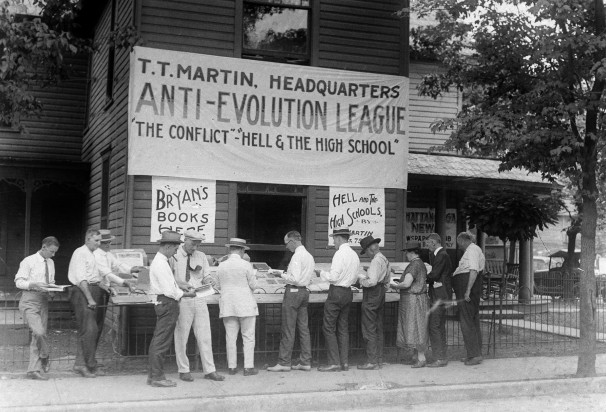
Even the hot-headed polemicist T. T. Martin, author of the relentless Hell and the High Schools, didn’t insist that evolution must be utterly banned from all schools.  In a 1923 speech, Martin suggested a new set of “graded books, from primary to university.”  These books could introduce evolutionary ideas gradually, until at last for the most mature students the books would present “fairly and honestly both sides of the Evolution issue.”

Martin's Booth at the Scopes Trial, 1925

As Anderson’s recent argument about transgender teachers makes clear, the notion that young people in school must enjoy special protection from threatening ideas still has punch in today’s culture-war debates.  Conservatives have long insisted that children must be protected from premature exposure to issues of sex and origins.