The Files Are In!

Well, there’s nothing more to be done about it now.  I’ve just sent my final draft of my next book manuscript to the publisher.  There’s a sense of relief at being done, but also trepidation at the impossibility of further revisions.  After years of researching, writing, then revising, revising, revising, it’s hard to believe I won’t be able to keep tweaking and improving.
Pre-order your copy today!

Pre-order your copy today!

In general, though, I’m extremely pleased with the shape of the manuscript.  In a nutshell, I try to make the case that we’ve seen a potent tradition of educational conservatism in the United States, one that has had a decisive impact on the structure and content of schooling.  And, I argue, that tradition has not been recognized by historians or education scholars.

To make this case, I examine in four looooong chapters the four biggest school controversies in twentieth-century America: the Scopes Trial of 1925, the Rugg textbook controversy of 1939-41, the Pasadena superintendent ouster of 1950, and the Kanawha County textbook battle of 1974-75.  What did conservatives say and do in these controversies?  In each case, the attention-grabbing events attracted conservative participation from both locals and national leaders.  In each case, the issues prompted conservatives to articulate their visions of proper schooling.  To me, that’s the interesting question.

We’re still a ways from final publication.  The publisher will send me proofs in July.  At that stage, I’ll put together the index and fine-tooth-comb the proofs for any typos.  But I won’t be able to make substantive changes at that point, just minor corrections.

During these last weeks, as I’ve been going over the copy-edited chapter files, I’ve been very grateful for the careful work of the editor.  She or he pointed out some embarrassing errors on my part and I’ve been able to make changes in the argument.  Hopefully this draft is as crystal-clear as I can make it.

I’m looking forward to hearing what readers think of the book.  For that, I’ll have to wait until 2015.  The press will release the book on January 12, 2015.  Pre-orders are available!


Learning Purity

Where do young Christian girls learn that they are supposed to be sexually pure?  A photographer recently claimed that it was something girls wanted, something not imposed on them by their families.

As usual, your trusty editor at ILYBYGTH is behind the times.  Apparently, this series of purity-ball photographs by Swedish photographer David Magnusson attracted a good deal of attention several weeks ago.  At these balls, girls dress up in elaborate gowns, dance with their fathers, and finally pledge sexual abstinence.

Purity

Not surprisingly, bloggers and journalists reacted with some predictable outrage to this combination of precocious sexuality, gender coercion, and daddy-ism.  For instance, Tom Hawking called the photos “weird” and “terrifying.”  “It’s hard to know where to start with this:” Hawking wrote,

the notion of sex as “impurity,” the fact that it’s all daughters and no sons, the idea of dressing a preteen girl in something that looks awfully like a wedding dress.

The photographer presented himself as an intrigued outsider.  At first, Magnusson said, he thought these purity balls would be nothing more than another American tragedy.  As he remembered, “I imagined American fathers terrified of anything that might hurt their daughters’ or their family’s honor.” But as he learned more about them, he came to a new understanding. The balls represented something initiated often by the daughters themselves. As Magnusson put it,

It was also often the girls themselves that had taken the initiative to attend the balls. They had made their decisions out of their own conviction and faith, in many cases with fathers who didn’t know what a Purity Ball was before first being invited by their daughters.

As we’ve wrestled with before at ILYBYGTH, purity culture can have educational consequences. Some argue that purity culture encourages a culture of sexual victimization on the campuses of conservative Christian colleges.

PurityBut Magnusson’s claim raises new questions. If, as he asserts, girls don’t learn about purity balls from their families, where do they learn about them? More importantly, where do girls learn that they want to take part in this sort of ceremony? We should be skeptical about Magnusson’s claim that girls themselves chose freely to take part in these ceremonies. That sort of “choice” can involve all sorts of subtle and not-so-subtle influence from parents and others. But it seems plausible that some girls embrace these ideas. And it seems plausible that some girls lead their fathers to this event, not vice versa.

If that’s the case, we need to wonder where girls got the idea. Certainly, some schools teach abstinence-only education curricula that promote a “purity” notion of proper femininity. And independent curricular programs such as True Love Waits have had success in reaching young people as parachurch organizations.

As always, these questions demonstrate the infinitely complicated nature of education. It is difficult to imagine a tradition like purity balls succeeding unless young people had been taught to embrace such a thing. Who taught them? And how?


Can a Woman Teach a Man?

Does it count as un-biblical if a woman teaches a man in seminary classes?  That’s the question debated recently in the pages of Christianity Today.

The issue was sparked by a change in policy at Cedarville University.  The relatively new president, Thomas White, recently announced that only women may enroll in a Bible class taught by a female faculty member.  This has been part of a continuing shift toward greater conservatism by the new administration, which one journalist described as being “taken over by Southern Baptists.”

The question is one of a “complementarian” view of gender relations.  I’m out of my theological depth here, so I invite correction if I get this wrong, but as I understand it, a complementarian view in evangelical Protestantism suggests that men and women have different roles to fulfill in family and church.  Males are meant by God to be the head and women are meant to be helpmates.  Complementarians, I understand, insist that this is not a question of chauvinism or male supremacy.  Rather, both men and women are understood to be equal but different.  In church affairs, following a complementarian interpretation of 1 Corinthians 11:3 (“But I want you to realize that the head of every man is Christ, and the head of the woman is man, and the head of Christ is God”) only men should teach men about church doctrine.

For secular folks like me, this is a difficult cultural pill to swallow.  The core of my social morality is that people are equal.  Talk about “different roles” for men and women, or for different social groups, makes me extremely uneasy.  To folks like me, this sounds like just window dressing for traditional hierarchical domination.

Smart complementarians get this.  Evangelical writers have explained the subtleties of complementarianism and what one woman called the “holy beauty of submission.”

In conservative Christian colleges, the question is whether women can teach men theology.  At Cedarville, the new answer is no.  In the pages of Christianity Today, evangelicals debated the issue. Mind you, this debate seems to have been within the ranks of complementarian theologians.  Respondents did not argue that men and women should be seen as equal.  Rather, those who thought women should be allowed to teach men argued that colleges were different than church.  In church, they granted, women must not lead men.  But college was different.

Those who agreed with the Cedarville policy argued that schools should be logically consistent.  If women should not be leaders of men, then women should not be teachers of men.

To outsiders like me, this debate illustrates the deep cultural divide between conservative evangelical Christian colleges and pluralist ones.  Even the terms of this discussion are foreign to folks like me.  For many secular folks, even the idea of such a discussion seems horrifying.  Even to ask if women should be allowed to take on leadership roles seems like a terrible revival of traditionalist hierarchy.

Yet if we outsiders want to understand conservative thinking, we need to try to understand debates like this one, precisely because the terms of the debate are so far beyond the pale of our thinking.  For example, as Dorothy Patterson, the “first lady” of Southwestern Baptist Theological Seminary responded, when in doubt, go with God.  Though teaching in the university may be a complementarian “gray area,” Patterson conceded, it was better to stay on the theological safe side.  God, Patterson concluded,

is going to have far greater pleasure in seeing a male theologian in the classroom than in our seeing if we couldn’t put a woman in simply because she’s gifted.

Unless and until secular folks like me make an effort to understand the worldview behind statements like that, we’ll never understand conservatism.


In Defense of the Mediocre Male

Why doesn’t anyone care about unfair treatment of males in American schools?  From the American Enterprise Institute, Christina Hoff Sommers accuses educational leaders of being blinded by leftist ideology.  Leaders such as Arne Duncan, Sommers claims, don’t even see the problem.

Sommers, author of such books as Who Stole Feminism? and The War Against Boys, insists that we have a double problem on our hands.  First, we established an education system that favors females over males.  Second, we are putting our heads in the ideological sand and ignoring the problem.

In this short video, Sommers describes her ill treatment at the hands of left-leaning hosts on MSNBC.  When she raised the issue of male underachievement in schools on a talk show, the host dismissed her concerns with a condescending chuckle.

That exchange, Sommers says, demonstrates the double problem.  Males have always done worse in school, Sommers notes correctly.  In the past, however, even a “mediocre” male student could leave school and find work in manufacturing jobs.  These days, Sommers points out, career success demands educational success.  Fewer males than females aspire to higher education.  Sommers asks, “Why isn’t there a national effort to address this ambition gap?”

Congress, Sommers says, funds pro-girl educational efforts.  Education Secretary Arne Duncan, too, shows “apparent indifference” to problem of male underachievement.

Why?  Sommers suggests that educational leaders have been blinded by leftist ideology.  Leaders have assumed that equity in education means boosting female performance.  The real victims here, Sommers says, are the boys that have been ignored and shunted off to the side.

Sommers asks, why won’t educational leaders even admit the vast and growing inequity in our educational system?  Why won’t Arne Duncan do anything to support the mediocre male?


Liberalism Leads to Campus Rape

Well-intentioned liberal rules—plus “binge drinking”—led us to an epidemic of campus sexual assaults.  That is the equation offered recently by conservative intellectual Patrick Deneen.  Deneen argues that the abdication of control by universities in the 1960s, meant to liberate students, has pushed the federal government to step in.

In recent days, we at ILYBYGTH have wondered about the connection between conservative Christianity and campus sexual assault.  Do overzealous reporters try to use uniformed bluster about “fundamentalism” to smear conservative religious peopleOr does there seem to be something peculiarly dangerous about authoritarian institutions such as fundamentalist colleges?

Professor Deneen has different concerns.  He notes the recent announcement by the federal government that it is investigating fifty-five universities for their handling of sexual-assault cases.  When universities and colleges fail to maintain the safety and security of their students, the Office of Civil Rights will step in.

As Deneen points out, this responsibility for the sexual morality of students used to be the responsibility of the universities themselves.  College graduates of a certain age may remember the elaborate rules that enveloped college-student social lives before the 1960s.  Female students at mainstream colleges—even at public institutions—often had to check in with “dorm mothers” at nine o’clock.  In every aspect of student life, the college took on the role of the parent.  In every way, the college acted in loco parentis—in place of the parent.

Of course, in the 1960s campuses in the US and around the world became hotbeds of political and cultural upheaval.  Students demanded more freedom, and they got it.  At many schools, in loco parentis rules were scrapped.  In many schools, indeed, core curricula were also scrapped in the name of freedom.  For instance, at my own beloved school, Binghamton University, students staged the “Bermuda Revolution.”  Not quite up to the office occupations and shotgun-wielding demands that rocked our neighbors at Columbia University or Cornell, but Bearcats managed to come together to protest strict student rules.  At Binghamton, the Bermuda Revolution brought students out to our Peace Quad clad in Bermuda shorts.  At the time, this was against the stern, traditional dress code that required shirts and ties for men and skirts and blouses for women.  As a result, the university changed those rules, giving students more freedom over their own lives.

Campus Revolutionaries, Binghamton Style

Campus Revolutionaries, Binghamton Style

One unintended consequence of this freedom is that more young people on college campuses have been exposed to sexual violence.  When students have more opportunity to drink alcohol and stay out late, more students find themselves in situations that lead to sexual assault.  As a result, the federal government has stepped in to investigate the way universities respond to charges of rape and sexual assault.

Professor Deneen argues that this tale of freedom gone awry can be seen as the history of liberalism in a nutshell.  As he puts it,

Longstanding local rules and cultures that governed behavior through education and cultivation of certain kinds of norms, manners, and morals, came to be regarded as an oppressive limitation upon the liberty of individuals. Those forms of control were lifted in the name of liberation, leading to regularized abuse of those liberties. In the name of redressing the injustices of those abuses, the federal government was seen as the only legitimate authority for redress and thereby exercised powers (ones that often require creative interpretations of federal law to reach down into private institutions) to re-regulate the liberated behaviors. However, now there is no longer a set of “norms” that seek to cultivate forms of self-rule, since this would constitute an unjust limitation of our freedom. Now there can only be punitive threats that occur after the fact. One cannot seek to limit the exercise of freedom before the fact (presumably by using at one’s disposal education in character and virtue); one can only punish after the fact when one body has harmed another body.

Conservative Christian colleges may have a unique set of challenges when dealing with the issue of sexual assault.  But Professor Deneen argues that sexual assault on other campuses has been a result of liberalism, not traditionalism.  Loose rules and permissive attitudes, Deneen notes, have led to an anything-goes culture.  The resulting “sexual anarchy” has left victims vulnerable to attack, with little recourse after the fact.


Does Fundamentalism Promote Sex Abuse?

Do conservative Protestant evangelicals have a problem with sex abuse? Does evangelicalism suffer from an overabundance of “Christian cesspools” of abuse?

I’ve been chastised for asking whether this is a specifically fundamentalist problem—that is, a problem of theology—or rather an institutional problem. That is, is it specifically fundamentalist theology and “purity culture” at fundamentalist schools that encourages rape and sexual assault? Or do we see the same sorts of systemic abuse in non-fundamentalist colleges and universities? At big football schools, for example, administrators protect rapists to protect the football program. Could “party culture” be just as conducive to rape and sexual assault as “purity culture?”

In an article about the sex-abuse travails at Bob Jones University, Boz Tchividjian says this is not a question of theology, but of “authoritarianism.” Tchividjian argues that church structures lend themselves to sex abuse, but that this sort of abuse could happen “in any culture, elevating leaders beyond accountability, leaving victims’ rights to their whim, and sidelining critics who challenge their rule.” Yet Tchividjian’s work has illuminated the gruesome world of sex abuse and rape in evangelical and fundamentalist institutions.

As Kathryn Joyce describes in a recent essay in American Prospect, Tchividjian’s anti-abuse group GRACE was called in to Bob Jones University in 2012 to investigate accusations of widespread institutional neglect of charges of rape and sex abuse. Tchividjian, grandson of evangelist Billy Graham and former law professor at Liberty University, has long campaigned for more transparency about sex abuse among evangelicals. In Joyce’s AP piece, Tchividjian made his case for the terrible evangelical record with sex abuse. “One study,” Joyce writes,

has found that 93 percent of admitted sex offenders describe themselves as religious. Offenders who report strong church ties abuse more often, with younger victims. That’s not because Christians are inherently more abusive, he said, but because they’re more vulnerable to those who are. Tchividjian repeated what one convicted sex abuser told clinical psychologist Anna Salter in her book Predators: Pedophiles, Rapists, and Other Sex Offenders: “Church people”—always looking to see the best in people, to welcome converts, to save sinful souls—are “easy to fool.”

“When something does surface, all too often the church leadership quiets it down. Because they’re concerned about reputation: ‘This could harm the name of Jesus, so let’s just take care of it internally.’

Tchividjian rattled off ways in which Christians’ openness can allow abuse to go unchecked: Perpetrators tend to use scripture to coerce, justify, and silence. If they’re clergy, they will exploit their positions; if they’re laypeople, they will take advantage of a church hungry for volunteers and rely on the trust given to members of a church family. “The reason why offenders get away with what they do is because we have too many cultures of silence,” Tchividjian said. “When something does surface, all too often the church leadership quiets it down. Because they’re concerned about reputation: ‘This could harm the name of Jesus, so let’s just take care of it internally.’

In case after case, Tchividjian and his colleagues unearthed terrible and terrifying stories of abuse and cover-ups. Of students like Katie Landry at Bob Jones University. When Landry reported her rape to Dean Jim Berg, Berg allegedly told her that there was a “sin in your life that caused your rape.”

Tchividjian says this is a question of organizational structure, not of theology. But his own work seems to make the case that fundamentalist culture seems particularly prone to this sort of victim-blaming. As in this story from BJU, it seems fundamentalist cover-ups have the ability to use theologically inflected language to cow victims into silence.

I’m certainly sensitive to charges of fundamentalist-bashing. Indeed, my first take on the recent spate of “exposes” of sex abuse at fundamentalist colleges was to wonder if this was just another attempt to dismiss dissenting colleges. But there does seem to be a connection between fundamentalism—both theology and culture—and this climate of sex-abuse cover-up. It might not generate higher numbers of abuse victims than other opaque institutions—ask anyone at Penn State, Florida State, or a host of other non-fundamentalist institutions—but it seems fair to say that fundamentalism has generated a sick culture of abuse.


Pre-Orders Now Available!

Want to be the first on your block to get your copy of The Other School Reformers?  Then pre-order your copy today!

Pre-order your copy today!

Pre-order your copy today!

As I was happy to announce recently, Harvard University Press will be releasing the book in early 2015.  But the pre-order just became available on sites such as Amazon.  The hardcover won’t be available until January 12, 2015, but if you pre-order today, you’ll be sure to WOW your friends and family by getting your hands on it first.

The Other School Reformers

Clear your calendars! We have a release date. The Other School Reformers will be hitting store shelves in February.  I know that’s a long time to wait, so I’m suggesting everyone dress up as their favorite conservative educational activist and camp out outside their local bookstore.

Coming January 2015.

Coming January 2015.

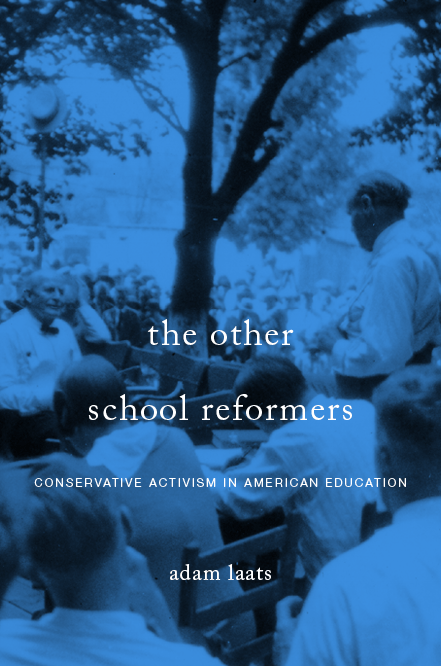
Thanks to the Smithsonian for this terrific cover image.  That’s Clarence Darrow (standing) facing William Jennings Bryan at the Scopes Trial.  In this book, I examine four epochal school controversies from the twentieth century.  In each case, I ask what conservative intellectuals and activists wanted out of schooling.  My goal is to find out what it meant to be “conservative” when it came to education.

The catalog listing just went up.  Here’s how the talented folks at Harvard University Press describe the book:

The idea that American education has been steered by progressive values is celebrated by liberals and deplored by conservatives, but both sides accept it as fact. Adam Laats shows that this widely held belief is simply wrong. Upending the standard narrative of American education as the product of courageous progressive reformers, he calls to center stage the conservative activists who decisively shaped America’s classrooms in the twentieth century. The Other School Reformers makes clear that, in the long march of American public education, progressive reform has more often been a beleaguered dream than an insuperable force.

Laats takes an in-depth look at four landmark school battles: the 1925 Scopes Trial, the 1939 Rugg textbook controversy, the 1950 ouster of Pasadena Public Schools Superintendent Willard Goslin, and the 1974 Kanawha County school boycott. Focused on issues ranging from evolution to the role of religion in education to the correct interpretation of American history, these four highly publicized controversies forced conservatives to articulate their vision of public schooling—a vision that would keep traditional Protestant beliefs in America’s classrooms and push out subversive subjects like Darwinism, socialism, multiculturalism, and feminism. As Laats makes clear in case after case, activists such as Hiram Evans and Norma Gabler, Homer Chaillaux and Louise Padelford were fiercely committed to a view of the curriculum that inculcated love of country, reinforced traditional gender roles and family structures, allowed no alternatives to capitalism, and granted religion a central role in civic life.

Almost makes me want to read it myself.  For me, the next steps will be to review and copy-edit the full manuscript next month.  Then in July I’ll put together the index, with help from a talented graduate student.

Abortion and Social Justice at Yale

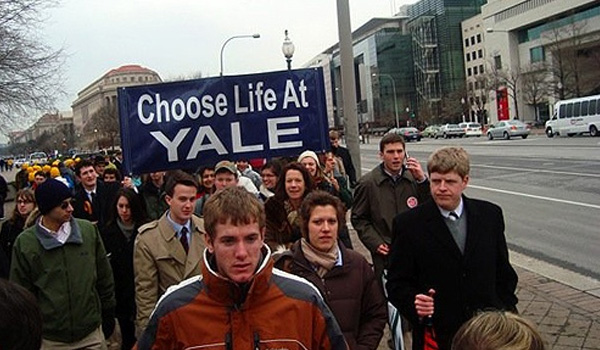
A pro-life student group at Yale University has been refused membership in a “social justice” organization.  Why?  Because, in the words of one student leader, “The pro-life, anti-choice agenda stands in the way of gender equity, and thus in the way of social justice.”

The controversy raises difficult questions: Is conservative religion still seen as a legitimate force for good?  For “social justice?”  Or has conservatism become irredeemably trapped by accusations of bigotry?  At least in the effete environs of Yale, it seems pro-life thinking has been stripped of its moral legitimacy.

Well-dressed Activists

Well-dressed Activists

The student group, Choose Life at Yale (CLAY), had been a provisional member of Dwight Hall, an umbrella group of student social-justice clubs.  Membership in Dwight Hall would have given CLAY access to meeting rooms and a sense of campus legitimacy.

Is pro-life a “social justice” cause?  Former CLAY president Michael Gerken thinks it is.  As he explained in the pages of First Things, CLAY members

realized that abortion has never been solely a matter of a baby’s life and liberty. It’s about the desperation and hopelessness of the mother that walked into the clinic. It’s about the grandfather who will never put that little girl in his lap. It’s about the classmates who will never sit next to her, and the boy who will never work up the courage to write her that awkward poem. It’s even about that friend who she would drift away from over the years, the successful sister who would make her insecure, and the God she’d curse when she lost her job and then her mortgage. The biggest lie in all this is that the choice to end (or to save) a life is a solitary one.

Of course, Yale will always have a special place in the history of conservatism and education.  It was William F. Buckley’s precocious expose of the godless atmosphere on campus that launched his career, and in many ways signaled the start of the modern conservative movement.

And college campuses have become leading forums to debate whether or not conservative religious ideas are legitimate traditions or vestiges of bigotry.  ILYBYGTH readers may remember a case at Tufts University a while back.  In that case, the evangelical student group Intervarsity was stripped of its official student-group status.  Other student groups complained that the prominent evangelical group represented an inherently bigoted worldview, one that did not recognize the full equality of homosexual students.

The current controversy at Yale represents a similar conundrum.  Do conservative religious groups automatically lose the right to participate in campus life?  Is it inherently bigoted to fight against abortion or gay marriage?  Perhaps most important, who gets to define “social justice?”


Women against Woman

What counts more: The fact that you’re a conservative or the fact that you’re a woman?  In Texas, conservative women seem to vote as conservatives first and women second.

A new poll from Public Policy Polling reveals that Texas women prefer conservative (male) gubernatorial candidate Greg Abbott over liberal (female) candidate Wendy Davis.

There’s no doubt about the relative ideology of the two candidates.  Attorney General Abbott has consistently run as the conservative choice.  So much so that the liberal Texas watchdog group Texas Freedom Network refers to Abbott as an “extremist.”  And Davis has been called a “liberal folk hero” for her inspiring personal story and ferocious filibustering of an anti-abortion bill.

But when it comes to voting, more Texas women prefer Abbott.  According to a poll of 559 registered voters conducted between April 10-13 (margin of error +/- 4.1%), Abbott has a 49 to 41 percent lead among women.  About a third of women had a favorable image of Davis, while almost half had an unfavorable opinion.

Of course, this might not be a simple matter of conservatism trumping gender.  Abbott has a much longer record in Texas politics.  It would make sense for him to crush any opponent, no matter what gender.  And it’s silly to think that there is a single “women’s” position on issues such as abortion, education, or the economy.

Nevertheless, conservative politicians have struggled to fight the image that they are conducting a “War on Women.”  It doesn’t help when blundermouthed GOP leaders such as Todd Akin represent conservatism in the minds of many voters.

This news from Texas shows that conservatives can win among female voters.  In Texas, it seems, women voters put their conservatism first, their gender second.