Love Letters from Unexpected Quarters

There aren’t a lot of heroes in Julie Schumacher’s new novel. SAGLRROILYBYGTH will be able to imagine my surprise when I discovered Schumacher’s surprising exception. It wasn’t really the main character, a crusty and cynical novelist and chair of the English Department. It wasn’t even the out-of-touch Shakespeare scholar who insisted on keeping the liberal arts in a liberal arts college. No, the only character that came out as truly sympathetic didn’t come out of the world of elite higher ed but rather from the closed-off world of evangelical home schooling. And it leads us to a bigger question: Do the conservative skeptics have more allies in mainstream higher-ed than they realize?
shakespeare requirement

We’re (almost) all adrift…

I don’t want to give away too much of Schumacher’s plot, so I’ll tell my own story instead. When I first took my current job, a friend in the English Department of the high school at which I worked gave me a copy of Richard Russo’s Straight Man.

“Read it,” my friend said. “You’ll need it.”

Straight Man was my introduction to the field of higher-ed satire. In the novel, a bumbling hero fights to keep college less insane. As the imagined traditions of liberal-arts education crumple in the face of careerism, credentialism, and ruthless bottom lines, Russo’s straight man can only offer ridiculousness in protest.

More recently, one of my current colleagues recommended Schumacher’s fantastic higher-ed satire, Dear Committee Members. Schumacher offered a witheringly on-point send-up of today’s higher-ed scene, with embittered English professor Jay Fitger revealing through a series of recommendation letters his dwindling influence at Payne University. Hilarious and bitterly accurate.

So it was with a lot of eagerness that I finally got my hands on The Shakespeare Requirement. In this novel, Jay Fitger is back, and Payne University is still wallowing in the unenviable position of a small liberal-arts college. In a nutshell, the plot revolves around an attempt to bring the school—and its wacky English Department—into the contemporary world of mainstream higher education.

External funding rules the campus, and notions such as knowledge for knowledge’s sake are out the window. Under pressure, the English Department eliminates its requirement of a Shakespeare class for all English majors. Antics ensue.

All told, I’m pretty disappointed by the novel. It does not capture the wit and weariness that made Dear Committee Members so good. But it does include a curious celebration. Few of the characters or types come off well in the novel. Students are lazy and selfish. Professors are either grasping or clueless. The administration is, at best, pathetic.

Given the bleak landscape, I was surprised to find Schumacher’s ray of hope. One character shines. Angela Vackrey is a freshman, from a family that didn’t want her to come to Payne. She had been homeschooled in a rigorously conservative evangelical household. Angela wanted to find out more about the world than

The pile of paperbound workbooks (Broad Horizon: A Christian’s Historical Perspective) next to the chicken-and-egg-shaped salt and pepper shakers on the maple table where she had completed her schoolwork at home.

Angela is not at all typical of Payne students. For one thing, Schumacher tells us, she still dresses as if she were at church:

Unlike most of the young women in the room, who dressed as if stopping by class on their way to a nightclub, she wore a homely denim skirt and white buttoned blouse.

Also unlike most Payne students, Angela takes her school work seriously. As Professor Fitger discovered, Angela’s writing

Evinced a startling ability to think clearly, express original ideas, and write.

At Payne University, in any case, such abilities make Angela stand out. Her modesty, temperance, and hard work are a stark and startling contrast to the rest of the student body, and even to the debauched faculty.

Indeed, if this novel were to some from some of the usual conservative suspects—higher-ed critics such as Rod Dreher or Peter Wood—it wouldn’t be very interesting at all. But as far as I can tell, Professor Schumacher is no conservative. The yearnings of her characters are not for a purer, Christian society. Rather, Jay Fitger is utterly adrift, and at times, sympathetically so.

In the end, The Shakespeare Requirement is, like Professor Fitger, rudderless. Yet even from that position of cynical drift, Schumacher seems to yearn for a better world, one that can only be maintained by fundamentalist strictures that no one can abide.
Notre Dame and the Fundamentalist Dream

Is it practical? I have no idea. But the proposal last week from students at the University of Notre Dame to block porn from campus pushes all the buttons that animated fundamentalist college reformers a century ago. It goes against the very openness—as Gene Zubovich wrote recently—that has led Catholic higher education to be so much more intellectually vibrant than the conservative evangelical versions.

notre dame

Can they keep the baby if they block the bathwater?

Don’t get me wrong—I’m all for student activism against pornography. I admire the zeal and vision of the Notre Dame students. I’m especially happy to see my fellow men stand up against the exploitation of women and children. As the Notre Dame signatories argued,

We are calling for this action in order to stand up for the dignity of all people, especially women. . . . Pornography is the new sex education, providing a disturbing script about what men find sexually appealing and what women should do to please them. Notre Dame’s sincere efforts to educate students about consent and other aspects of healthy sexuality are pitifully weak in light of the fact that by the time students arrive on campus, many have been addictively watching pornography for years. . . . ​Porn is not acting. The overwhelming majority of contemporary pornography is literally filmed violence against women — violence somehow rendered invisible by the context.

I don’t dispute any of that. Historically, however, the goal of blocking and shielding students as part of a righteous college education has had some unintended consequences. As I argued in Fundamentalist U, the heart and soul of the fundamentalist college dream was to block, ban, prohibit, limit, encircle, and deny. In short, what fundamentalist school founders wanted was to create an alternative system of higher education in which young people could learn without being exposed to the behaviors and attitudes that had taken over mainstream higher education.

As Gene Zubovich argued recently, Catholic higher education has had a different tradition. Of course the Catholic Church has its own long, lamentable tradition of prohibition. Nevertheless, Catholic intellectuals became the big brains of America’s conservative movement in the twentieth century, Zubovich wrote, because

Unlike evangelicals, conservative Catholics could draw on research universities, law schools, medical schools, business schools and other intellectual-producing institutions in the fight against secularism.

Now, I disagree with Zubovich’s across-the-board dismissal of academic and intellectual life at evangelical universities. It was not only Carl Henry (whom Zubovich mentions) who dreamed of creating an academic intellectual powerhouse. As I recount in Fundamentalist U, the roots of the Council for Christian Colleges and Universities were in another ambitious and practical plan to improve the tenor of intellectual life in evangelical schools.

However, that quibble is beside the point this morning. Zubovich is absolutely correct in marking a big difference between the attitudes of leaders at Catholic universities, compared to evangelical ones. Faculty at Catholic universities do not have to sign detailed statements of faith. Hiring for academic positions is done by credentials, not by faith backgrounds. Most important, the expectations of students at Catholic universities has never matched the sometimes-extravagant lifestyle controls imposed by evangelical schools.

What does this all have to do with Notre Dame’s proposed porn filter? Just this: imposing a block or a filter might seem like a laudable purpose, but the long-term impact on any academic institution will be serious, even severe. Do Notre Dame’s signatories want to take their institution down the long path to wall-building?

I Love You but You Didn’t Do the Reading

Some of the big stories n stuff about ILYBYGTH themes from around the interwebs this week:

The big one: Trump administration might redefine gender, at NYT.

Reactions:

Oh, no. Iowan burns gay-friendly books, at DMR.

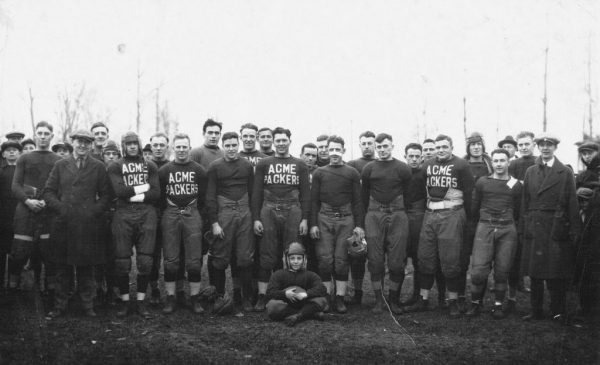
Want to start your own NFL team? The Green Bay Packers got started for only $500, at HT.

acme packers

Got 500 bucks?

Want to succeed in life? Go to a rich-kids’ high school, at IHE. HT: MM

Why did Saudi Arabia kill Khashoggi? Mark Perry says he pointed out an unbearable truth, at AC.

David Berliner on the real roots of America’s school problems, at WaPo.

Difficult truths: Peter Greene on the hardest part of a teacher’s job.

Creationism and climate-change denial lose the standards fight in Arizona, at NCSE.

The latest from the Harvard trial: If you want diversity, forget about race and use this factor instead, at CHE.

Ouch. After all the shouting, Jennifer Burns offers yet another scholarly take on Nancy MacLean’s Democracy in Chains, at HPE.

Democracy in Chains promised to do many important things: insert Buchanan and public choice theory into our history of conservative thought and politics; highlight antidemocratic tendencies in libertarian thought; and probe the intersection of midcentury libertarianism, Southern segregation, and white supremacy. Unfortunately, the book is too heated, partisan, and shallow to accomplish these tasks successfully. Even more unfortunately, at a moment when the nation desperately needs new and creative political thinking, of the kind that often emerges out of liminal spaces between ideologies and academic disciplines, the book serves to reinscribe a Manichean right/ left binary onto the past. Rife with distortions and inaccuracies, the book is above all a missed opportunity to encourage critical thought about intellectual and political change on the American right. . . . MacLean’s eagerness for a conviction leads her to browbeat the jury. . . . Ultimately it is not a book of scholarship, but of partisanship, written to reinforce existing divides and confirm existing biases. As such it will not stand the test of time, but will stand rather as testimony to its time.

Thomas Aquinas and evolution, at Touchstone.

Catholics for Fundamentalist U: Notre Dame men’s group requests a porn filter for campus.

I Am Out of Whack

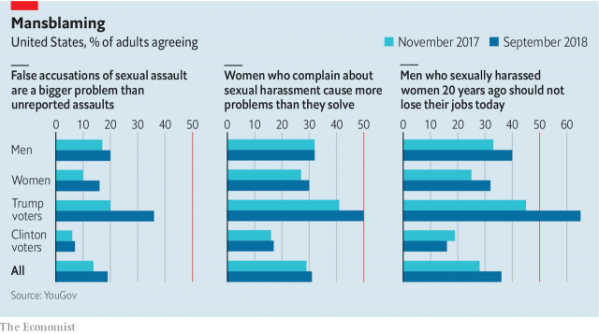
I’m absolutely flummoxed. New poll numbers reported in The Economist make me wonder how I got so out of whack with what most people are thinking. Am I missing something?metoo backlash economist

Here’s what we know: According to The Economist,

this year-long storm of allegations, confessions and firings has actually made Americans more sceptical [sic–wacky Brits] about sexual harassment.

With only one categorical exception, it appears the respondents in the Economist poll tend to feel more suspicious today about women who complain about sexual harassment than they did last year. Only Clinton voters, that is, are more likely today to think that twenty-year-old harassment accusations are worth acting upon. And even those Clinton voters are more likely now to think that false accusations are a bigger problem than unreported assaults, and that women’s complaints cause more problems than they solve.

Can I really be this out of touch with majority opinion? In my imagination, at least, the last year has provided a public coming-to-terms with the dangers and demons of sexual harassment. It has forced all of us to reckon with old demons of frat-boy antics and glib sexual aggression.

But unless I’m reading this wrong, my sense of how my fellow Americans are feeling is not even close to reality. Can someone please explain this to me?

1.) How is it possible that more people are more suspicious of women’s accusations than of men’s aggressive actions? And

2.) What was it in the past year that made people feel this way?

Conservatives Are Right about America’s Schools (but So Are the Rest of Us)

As usual, I’m behind the times. I’m just now catching up with ed historian Jack Schneider’s work. Last summer, Prof. Schneider wrote a great essay in the Atlantic about the differences between real public schools and “public schools” in America’s culture-war imagination. It helps me understand why conservative pundits such as Rod Dreher are both right and wrong about the current state of American education.

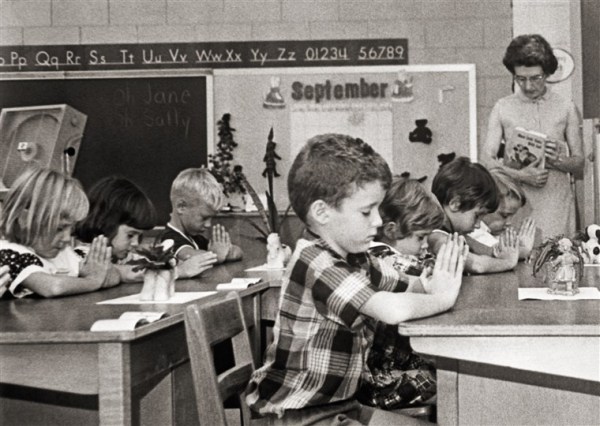
school prayer

Will the real American school please stand up?

As Scheider argued convincingly, there really isn’t anything that we can usefully call a “system” about America’s public schools. As he put it,

The abstraction of “America’s schools” may be convenient for rousing the collective conscience, but it is not particularly useful for the purpose of understanding (or improving) American education. . . . What schools need in order to succeed depends significantly on the needs and concerns of the local community, and policy tends to reflect that. . . . Public schools in the United States differ so much from state to state and from district to district that it hardly makes sense to talk about “America’s schools.”

So when our favorite pundits warn us about the terrible dangers of America’s public schools, they can be convincing. For some conservative readers, for example, the Benedictophile reporting of American Conservative Rod Dreher can be terrifying.

Dreher has told true stories, after all, that might understandably frighten religious conservatives. For example, when it comes to new thinking about gender, some public schools have taken an aggressive role. As Dreher told the tale,

A few years ago, a friend of mine’s daughter, an Evangelical Christian, was in a public school in a Bible Belt town about the size of Brownsburg. The school’s administration had gone all-in on LGBT, particularly on transgender, and the school’s culture was celebratory to the point of militancy. The daughter — a sweet, small-town church kid — was constantly challenged by other students about her hateful religion. The simple fact that she was openly Christian put a target on her back in the culture of that school. . . . I know there are lots of conservatives who think this isn’t going to happen to their kids’ school. Listen to me: you’re wrong. This is a cultural revolution. The day is fast coming where what was once radical will be mainstream, and what was once mainstream will be radical. . . . If you can afford to take your kid out of public school, why aren’t you doing it? [Emphasis in original.]

To this non-conservative reporter, the power of Dreher’s story comes from its plausibility. Public schools really do tend to push a certain vision of sexuality and gender that might go against some conservative beliefs.

But here’s the kicker: As Prof. Schneider’s essay reminds us, it is only some public schools that might do such things. Leaping from one case—or even several cases—to a sweeping pronouncement about the nature of public education today is unwarranted.

And of all people, Dreher himself should be the first to agree. Because in the end, anyone from any side with any axe to grind can put together the same sort of blistering and accurate accusation. Looking at the terrible and heart-breaking record of sexual abuse in private Christian schools, for example—even Dreher’s preferred sort of “Classical” Christian schools—might lead fair-minded observers to conclude that private evangelical-Christian education is foundationally perverted by its penchant for hierarchy, patriarchy, and subjugation.

Indeed, we do not need to look far to see survivors who do just that, concluding, for instance,

 purity culture creates a toxic environment that enables abuse and assault.

Or further,

Predators are enabled by the inherent patriarchy that disbelieves female victims, on the purity culture that treats abuse as a sexual sin rather than a violent crime, and the zealous willingness to believe the abuser’s claims of repentance (to forgive is divine, after all).

Is it in the very nature of evangelical Christian schools to enable sexual abuse? The string of examples certainly seem to point in that direction. And we’ll be wise to heed the warnings. However, we’ll also be wise to remember Schneider’s words.

Though it might be useful for “rousing the collective conscience,” jumping to conclusions about America’s school systems is fundamentally flawed. There is no single public school system. There is no single, coherent evangelical system. The merits and terrors of each need to be understood as they really are, not as judgments on an entire way of life.

More Proof: America Has No Public School System

We could be mad that it took them this long to notice. Or we could celebrate the fact that we’re finally getting some attention to the issue. In addition, though, we have to recognize another big implication of this story.

First, the bummer. How can it be “news” that American public school teachers are working too hard? A recent series in USA Today profiled fifteen teachers across the United States. As they reported,

We found that teachers are worried about more than money. They feel misunderstood, unheard and, above all, disrespected.

That disrespect comes from many sources: parents who are uninvolved or too involved; government mandates that dictate how, and to what measures, teachers must teach; state school budgets that have never recovered from Great Recession cuts, leading to inadequately prepared teachers and inadequately supplied classrooms.

We’re glad to get some front-page attention to the difficulties of teaching, of course, but it’s difficult not to say…well, duh. Of course teachers have a tough row to hoe. After we digest that non-bombshell, though, there’s more in this story that we should notice.

As historian Jack Schneider wrote recently for WaPo, Americans tend to have a unique love/hate relationship with public schooling. We hear over and over again that public schools are failing, yet most of us cherish our local public schools. And statistics tell us that—as a whole—America’s public schools are doing as well academically as they ever have.

Behind the fake-exposé headlines of the USA Today series, we can see a glimmer of truth that helps explain the weird relationship of Americans to their public schools. Reporters fanned out across the country to tag along with teachers.

manseau usa today

Oh give me a home…

In one case, that meant braving the wilds of Montana, where Traci Manseau teaches seventeen kids of all ages, all with the same last name, all in the same one-room schoolhouse. The students are all Hutterites, and they leave school at age sixteen to work on the communal farm.

At another school, 1,584 miles away (I looked it up) in Detroit, students wear a different sort of uniform. Instead of bonnets and cowboy shirts, the mostly African-American students wear uniform polo shirts and khakis. Their teacher, Felecia Branch, loves to hear them relate to fiction. And she hates it when they fight.

Down in Phoenix, meanwhile, teacher Rebecca Garelli welcomes 21 students in her English-Language-Learners class (ELL). Two of them come from Rwanda. Many of them speak only Spanish. Her job is to teach them—according to Arizona law—in English. And get them all to learn science.

branch usa today

…where the Chevrolets roam…

Are there similarities? Sure. All teachers feel stressed. And all good teachers care a lot about all their students. Whatever their backgrounds and locations, teachers want the best for their students and they can get frustrated when bad rules or bad situations make that unlikely.

But the vast differences between just these three examples show how inappropriate it is to talk about an American public school “system.” What it means to go to school in the United States can mean vastly different things.

Of course, SAGLRROILYBYGTH did not need to open the pages of USA Today to find that out. All of us can see the huge disparities in public education if we just take a tour around our local area. Even in the same city, the populations and possibilities of public schools can be worlds apart.

As Professor Schneider concluded,

Our schools haven’t failed. Most are as good as the schools anyplace else in the world. And in schools where that isn’t the case, the problem isn’t unions or bureaucracies or an absence of choice. The problem is us. The problem is the limit of our embrace.

If we waste our time asking about the American public-school system, we’ll always end up at an impasse. America’s schools are so diverse that there’s really no system to it all. When it comes to our sad history of educational culture wars, pundits on all sides have been able to say whatever they wanted about America’s schools and find real evidence to back it up. They could always find proof of almost any trend they wanted to celebrate or despise.

Are America’s schools mere “sorting machines?” Yep. Do they harbor left-wing teachers who sneakily try to subvert patriotic traditions? Uh-huh. Do America’s schools remain trapped in ancient ruts? Of course. Do they engage in innovative, world-class education? That, too.

Like the blind scholars and the elephant, pundits and politicians will always be able to prove anything they want to about America’s schools, because they can all be right.

Three Things that Have Nothing to Do with Evolution (that Have Everything to Do with Evolution)

I’ve said it before and I’ll say it again: I just don’t care. Not just in a passive, lazy way, but in an aggressive, assertive, in-your-face sense. When it comes to creationism and evolution education, I insist on not caring if people think the earth came from Yahweh 6,000 years ago, a raven in the distant past, or a flying spaghetti monster.

Classic Film Reaction GIF - Find & Share on GIPHY

If we want to make progress in our tired old creation/evolution war, I’m arguing in my new book, we all have to stop caring about those things. We have to stop thinking it is our business if students have the correct religious beliefs about evolutionary theory. So if a conservative evangelical pastor tells me that he can put evangelical theology first and still embrace mainstream evolutionary theory, I’m all for it. Not because his theology is correct, because I don’t care about that.

In this case, the pastor is Todd Wilson. He took to the pages of the BioLogos Forum to explain his method for bridging the angry divide between young-earth creationists and evolutionary creationists. All evangelicals, the Rev. Wilson argues, can agree on some faith basics:

1. The Bible, both Old and New Testaments, is the Word of God, inspired and authoritative. Therefore whatever Scripture teaches is to be believed as God’s instruction, without denying that the human authors of Scripture communicate using the cultural conventions of their time. . . .

2. Christians should be well-grounded in the Bible’s teaching on creation but always hold their views with humility, respecting the convictions of others and not aggressively advocating for positions on which Evangelicals disagree. . . .

3. Everything in creation finds its source, goal and meaning in Jesus Christ, in whom the whole of creation will one day achieve eschatological redemption and renewal. All things will be united in him, things in heaven and things on earth.

What do these ideas have to do with evolutionary theory? Nothing, in one sense. They are all about evangelical theology, not evolutionary science. On the other hand, these ideas might hold the key to evolution education in the United States.

The Rev. Wilson hopes that he can use these points to connect better with different types of evangelical creationists. Young-earth creationists, old-earthers, evolutionary creationists, intelligent designers…all of them disagree with one another, sometimes with great vituperation.

Is his theology correct? I have no idea, and this is where those of us watching these battles from the outside should cultivate an awkward and principled indifference. Speaking in terms of public policy, we just shouldn’t care WHAT people believe about creation. What we should always do is help people develop a thorough and meaningful knowledge about evolutionary theory. What they choose to believe about it is not a question public schools can care about.

It is not—it should not be—the purview of the public schools to encourage or discourage students from having any particular religious beliefs. It IS the goal of public schools to teach students the best of everything.

Combined, those two goals mean we should teach mainstream evolutionary theory to all students. And we should be painfully aware not to step into the regions trod by the Rev. Wilson. If his young-earth creationist congregants want to believe that the Bible is the “inspired and authoritative” Word of God, that’s fine. If they want their children to believe that their religion dictates a belief in a young earth, that’s fine too.

Is Wilson right? Not only don’t we care, we shouldn’t care. We should not involve ourselves in big-picture religious beliefs that touch on questions of speciation and evolutionary theory.

Jim Carrey I Dont Care GIF - Find & Share on GIPHY

I Love You but You Didn’t Do the Reading

I don’t know how people had time to write stuff when the Brewers were in the playoffs, but they did. It has been a whirlwind week. Here are some of the top ILYBYGTH-themed stories from the interwebs:

What 81%? A new look at white evangelicals and Trump, at CT.

Some background on the new president of the Moody Bible Institute at RNS.

1940s postcard library

Getting those dispensations right…c. 1940s.

Trump, Pocahontas, and the Cherokee Nation: Senator Warren releases her DNA results, denied by both Cherokee Nation and Trump, at Politico.

Schools and the midterm elections: In Ohio, a failed charter network becomes a political football.

“He was clinically upset.” Rich parents reject Zuckerberg’s edu-plan, at NYMag.

Atheists keep sneaking in God through the back door. A review of Gray’s Seven Types of Atheism at NR.

What Christianity and secular humanism share is more important than their differences: No other religious tradition—Jewish, Greek, Indian, Chinese—envisions history as linear rather than cyclical or conceives of humanity as a unitary collective subject. The very idea of utopia—a place where everyone is happy—could not have occurred to people who took for granted that individuals have irreconcilable desires and ideals, and that conflict is therefore impossible to eliminate. Western universalism, Gray scoffs, is very provincial indeed.

It can happen here: A century after the Spanish flu, what are the chances of another worldwide pandemic? At Vox.

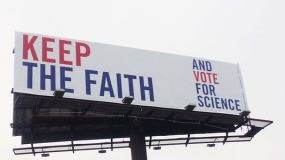
keep the faith vote for science

Hoosiers can love Jesus AND Bill Nye…

Finally! Indiana voters urged to “Keep the Faith and Vote for Science,” at IS.

How are America’s public schools really doing? It’s a trickier question than it seems, says Jack Schneider at WaPo.

America’s schools don’t merely reflect our nation’s material prosperity. They also reflect our moral poverty. . . . Reform rhetoric about the failures of America’s schools is both overheated and off the mark. Our schools haven’t failed. Most are as good as the schools anyplace else in the world. And in schools where that isn’t the case, the problem isn’t unions or bureaucracies or an absence of choice. The problem is us. The problem is the limit of our embrace.

Why is an academic life harder for women and minorities? Columbia offers its findings at CHE.

Conservative campus group restricts audience for Ben Shapiro at USC, at IHE.

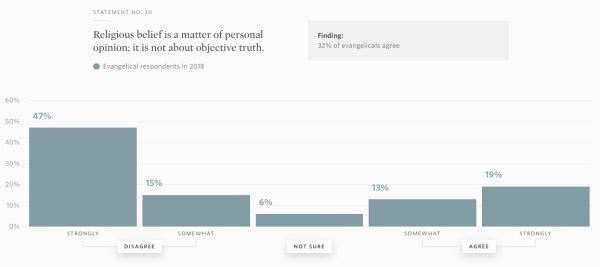
New survey: America’s evangelicals tend to like heresy, at CT.

religion as personal belief

How school reform works, until it doesn’t. Maine tries a new approach, then retreats, at Chalkbeat.

Proponents of proficiency-based learning argue that none of this reflects flaws in the concept. Maine struggled, they say, because they didn’t introduce the new systems thoughtfully enough, moving too quickly and requiring change rather than encouraging it.

Atheist and creationism-basher Lawrence Krauss announces his retirement after harassment allegations, at FA.

Higher Ed: The Conservative Crisis that Isn’t

Beware college! That’s the old cry today’s conservative intellectuals are pretending they invented. But they don’t mean it. The best evidence for conservatives’ real affection for American higher ed is the political campaign we haven’t seen recently.

Here’s what we know: Benedictophile Rod Dreher has grown fond of fanning the flames of crisis among his fellow conservative intellectuals. Recently for example, Dreher shared an exposé of the lamentable practices at one elite university. As Dreher’s correspondent concluded,

the balance has been tipped in higher education. It’s not just useless anymore, but it’s now actually doing harm. Not many normal people will be willing to accept that reality — i.e. that their children (and our culture) will be better served by their NOT going to (most) colleges and universities.

Tough talk! We might be tempted to conclude that conservative intellectuals are moving toward a new antipathy toward higher education, but we’d be wrong in two big ways. For one thing, there is absolutely nothing new about this conservative “crisis” in higher education. Furthermore, conservatives don’t really dislike college as a whole.

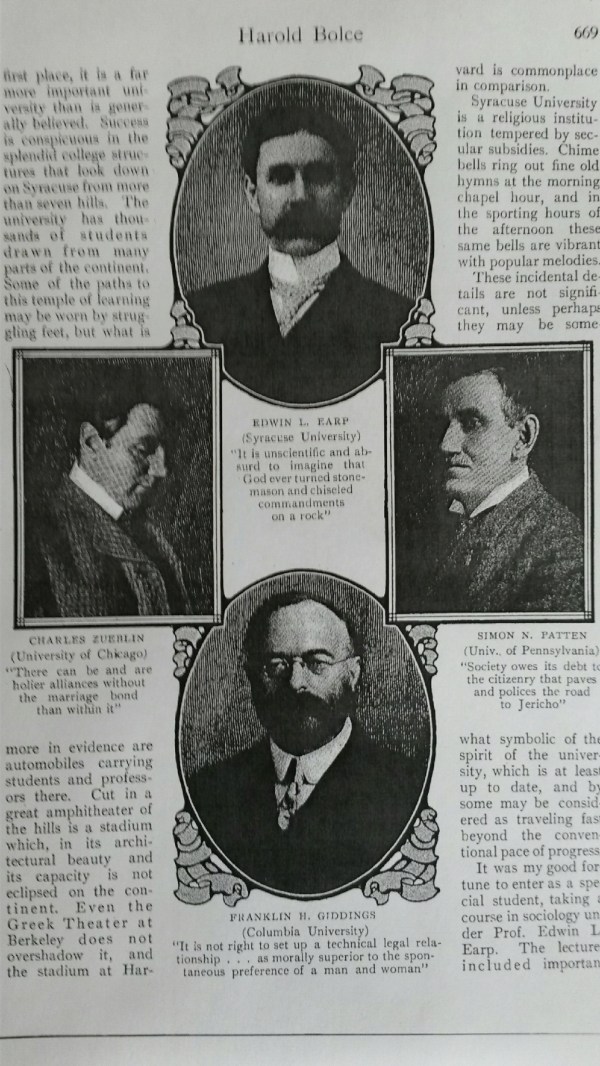
Let’s start with the history. As I argued in Fundamentalist U, conservatives have been noticing the “new” crisis in American higher education for well over a century. In a three-part expose in 1909, journalist Harold Bolce warned readers of the absolutely shocking decline in the state of America’s elite colleges.

bolce page image

Beware! c. 1909

For example, Bolce quizzed Syracuse sociologist Edwin L. Earp and breathlessly reported Earp’s shocking refusal to honor traditional ideas:

“Do you not believe, Professor,” I asked, “that Moses got the ten commandments in the way the Scriptures tell?”

The professor smiled. “I do not,” said he. “It is unscientific and absurd to imagine that God ever turned stone-mason and chiseled commandments on a rock.”

By the 1920s, some conservatives liked to reprint a purported letter home from a pathetic college student. As the student supposedly fretted to his mother,

My soul is a starving skeleton; my heart a petrified rock; my mind is poisoned and fickle as the wind, and my faith is as unstable as water . . . . I wish that I had never seen a college.

We might remind Dreher and his correspondents, then, that their sudden crisis has been percolating for a long time now.

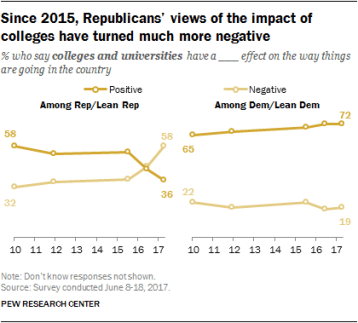
But perhaps something has suddenly changed? After all, we have been told by journalists recently that conservatives have recently begun to distrust American higher education. Last summer, poll results seemed to suggest as much.

pew college gone to the dogsIn fact, though, as we’ve argued before in these pages, it is not college itself that conservatives have come to distrust. Dreher and his associates will surely lose their campaign to warn people away from college as a whole.

How do we know? In this case, we can borrow a page from Sherlock Holmes and listen to the dog that didn’t bark.

True, conservative intellectuals might feel chagrined at their loss of influence in elite universities. Also true, the American public is very willing to believe that silly, leftist things go on in elite colleges. But Americans still want to go. They want their kids to go. And they think people who do go are smart and competent.

Exhibit A: The 2016 presidential campaign of Wisconsin Governor Scott Walker. As journalists noted at the time, Walker was a college drop out. If there really were a widespread, popular disaffection with American higher education, we would have heard him brag about that.

We didn’t. A couple of conservative voices tried to defend Walker’s lack of a degree, but they didn’t say Walker hated college. Rather, they said he had learned from the school of hard knocks instead.

Walker himself bragged that he was a “fighter” who learned from experience instead of in a classroom, but he didn’t pooh-pooh the idea of college as a whole.

What does that tell us?

If nothing else, Governor Walker is a savvy and successful politician. If he thought he could derive political advantage from his drop-out status, he surely would. But Walker is too savvy for that. He knows—even if Rod Dreher doesn’t—that Americans still love higher education. Americans—even conservative Americans—haven’t turned their back on elite colleges. Americans still dream of sending their kids to Yale or Brown or Oberlin, even if they fret about the ideological goings-on.

The “crisis” hasn’t suddenly boiled over in the past year or so. Rather, it is a steady simmering state and has been for a long time now. Even conservatives love and cherish elite universities. If they didn’t, after all, they wouldn’t spend so much time anguishing over them.

Finally! The Right Strategy to End Creation/Evolution Wars

What can we do to promote better public policy about climate-change science and evolution? As one group has done, we can notice the blindingly obvious fact that religion supports good science.

keep the faith vote for science

Hoosiers can love Jesus AND Bill Nye…

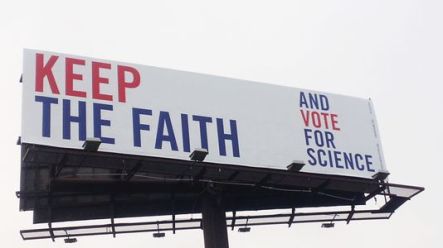
Here’s what we know: In Indiana, a group called Class Action has posted billboards in the run-up to the midterm elections. The billboards link religious faith with mainstream science.

By and large, the goal is to encourage religious voters to vote in favor of savvy climate-change science, to support politicians who want to take action to mitigate the negative effects of climate change.

Too often, radicals on both sides have harped on the old myth that religion and science are enemies. Radical young-earth creationists like Ken Ham have warned, for example, that real religion needs to be skeptical of the fake science being peddled by today’s mainstream experts.

To counter this sort of unnecessary antagonism, it just makes sense to remind voters that mainstream science is entirely compatible with even the most conservative strains of evangelical Protestantism.

As one supporter enthused,

A vote for science is a vote for creation, for the most vulnerable of the Earth and for future generations.

As another agreed,

It is smart political tactics to try to build coalitions between religious and environmental voters. . . . If we are to truly tackle the climate crisis, these efforts will be critical.

Hear, hear!

Want to end the utterly unnecessary century-long antagonism between mainstream science and conservative evangelical religion? Don’t tell religious people they are dumb. Don’t accuse them of “child abuse.” Instead, reach across the trench to notice that we all want the same things.