Betsy Devos: Progressive Champion?

We could be forgiven for being confused. Ed Secretary Betsy Devos just delivered a rousing endorsement of progressive ideas about schooling and education. What gives?

SAGLRROILYBYGTH might be sick of all this—maybe it’s just too obvious even to mention. But since my years wrestling with the history of educational conservatism (you can read all about it here), I can’t help but obsess over the never-clear meanings of “progressivism” and “conservatism” when it comes to schools.
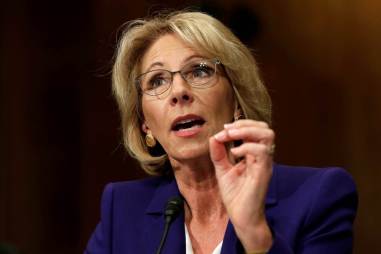
Betsy-Devoe

I hart progressive ed…or do I?

And now arch-conservative Queen Betsy just threw a Grand-Rapids-size rhetorical wrench into the culture-war works. If she’s talking this way, is there any meaningful way to differentiate the two sides? I think there is.

Here’s what we know: Secretary Devos delivered a prepared talk at the free-markety American Enterprise Institute. In her speech, she harped on progressive themes. Consider the following examples:

  • Progressives say: High-stakes testing is bad.

Quoth Queen Betsy:

As states and districts scrambled to avoid the law’s sanctions and maintain their federal funding, some resorted to focusing specifically on math and reading at the expense of other subjects. Others simply inflated scores or lowered standards.

  • Progressives say: Teachers have been disempowered.

Quoth Queen Betsy:

Most teachers feel they have little – if any — say in their own classrooms.

Quoth Queen Betsy:

we must rethink school.

  • Progressives say: Factory schooling is needlessly rigid and dehumanizing, yet it persists.

QQB:

Think of your own experience: sit down; don’t talk; eyes front. Wait for the bell. Walk to the next class. Repeat. Students were trained for the assembly line then, and they still are today.

  • Progressives say: Schooling should focus on the needs and experiences of every individual child.

QQB:

That means learning can, should, and will look different for each unique child. And we should celebrate that, not fear it! . . .

Our children deserve better than the 19th century assembly-line approach. They deserve learning environments that are agile, relevant, exciting. Every student deserves a customized, self-paced, and challenging life-long learning journey. Schools should be open to all students – no matter where they’re growing up or how much their parents make.

  • Progressives say: School must help make society more equitable. More resources must be dedicated to schooling for low-income Americans and students from minority groups.

QQB:

That means no more discrimination based upon zip code or socio-economic status. All means all….

We should hope – no, we should commit – that we as a country will not rest until every single child has equal access to the quality education they deserve.

What are we to make of all this intensely progressive-sounding rhetoric?

Some pundits pooh-pooh it. ILYBYGTH’s favorite progressive ed writer offers a perfect, pointed put-down: “poison mushrooms look edible.

It is not difficult, after all, to see how Secretary Devos’s endgame is different from that of most progressives. Unlike progressives, Queen Betsy’s final goal is an old conservative favorite, namely, the reduction of federal influence in public schooling. If Devos mouths progressive phrases, she also always returns to the same ultimate desire.

Consider these lines:

QQB:

  • federal education reform efforts have not worked as hoped….

  • The lesson is in the false premise: that Washington knows what’s best for educators, parents and students….

  • The lessons of history should force us to admit that federal action has its limits.

In the end, then, what we’re seeing here is the same old, same old. All sides in our hundred-years culture war have shifted tactics from time to time, while generally keeping the same long-term strategies.  As I argue in my book (and if you’re really lazy you can read a brief version of this in my short essay at Time), for example, in the 1920s, it was conservatives who pushed hard for an increased federal presence in local schools. Why? Because they thought it would force greater Americanization of immigrants and pinkos.

Devos’s canny adoption of progressive rhetoric is another example of this culture-war scheme. All sides tend to use whatever language best helps them achieve their long-term goals. They We tend to fight for any short-term goal that promises to bring them us closer to their our ultimate aims.

For Devos and her allies, the big picture is more religion, more privatization, and more tradition in public schools. Right now, they apparently think local school districts are the most likely governments to help achieve those aims. If bashing “factory models” and “inequality” will help achieve the ultimate goals, so be it.
Wait…ARE Creationists Just Dumber?

If you ask the Richard Dawkinses and the Bill Nyes of the world, creationism is a pretty simple problem. Those who won’t accept the evidence for mainstream evolutionary theory must be “ignorant, stupid, or insane (or wicked…)”. Those of us who know better have always pooh-poohed such simplistic science chauvinism. We argue instead that creationism is not mainly a question of knowledge, but of identity. A new study from the UK seems to challenge our assumptions. Maybe people who don’t accept evolution simply aren’t understanding it.

Here’s what we know: A group of researchers at the University of Bath studied over a thousand teenagers. Unlike studies in the USA, these teenagers showed a strong correlation between academic knowledge and acceptance of evolutionary theory. That is, students who understood evolution better tended to accept it more readily. Students who didn’t understand it as well tended to dismiss evolution or to say that both mainstream evolutionary theory and creationism could somehow both be true.

Here’s how the authors describe their conclusions:

before teaching, students with low acceptance had lower understanding of both evolution and of genetics; the low-acceptance students sat disproportionately in the foundation (rather than higher) science classes; low-acceptance students showed lower increments in the understanding of genetics; and student gain in the understanding of evolution correlated positively with gain in the understanding of genetics. We find no evidence either for a role for psychological conflict in determining response to teaching or that strong rejectors are more commonly of a higher ability.

We don’t want to jump to any grand conclusions of our own, but it seems for these students at least, better understanding and knowledge of mainstream evolutionary theory really did lead to greater acceptance.

understanding evolution

T’aint natural…

Does this mean UK creationists just don’t get it? I don’t think so. But I think it does underscore the notion that mainstream evolutionary theory is not a particularly intuitive thing. It is difficult for us to comprehend central notions of deep time and population genetics. As people such as Kostas Kampourakis have pointed out in detail, our intuitions seem to point us away from a thorough understanding of concepts such as natural selection.

Are creationists dumber? No. For these students, though, a passing acquaintance with mainstream evolutionary theory apparently led them away from it, not toward it.

HT: VW

I Love You but You Didn’t Do the Reading

A holiday week didn’t slow down the news. Cussing from the Oval Office, aspirations from Oprah’s couch…it was a weird week. Here are some of the top ILYBYGTH-related stories:

President Oprah?

Why do so many white evangelicals love Trump? Darren Guerra says it’s only “Jacksonian Evangelicals,” at First Things.Bart reading bible

Want to stop school segregation? Stop attacking charter schools, says Emily Langhorne at USNWR.

Liberalism is over, by Patrick Deneen at The Spectator.

San Diego State: Lecturer took anti-white attitudes too far, at CHE.

Museum of the Bible: A “safe space for Christian nationalists,” by Katherine Stewart at NYT.

Leadership shake-up at Moody Bible Institute, at CT.

More Trump/evangelical crack-up. How did evangelicals respond to Trump’s “S***hole” comments?

Big-time college sports—the new Jim Crow. So says Victoria Jackson at LA Times.

How Many Climate-Change Deniers Do You Know?

Count em up. Or, if you’re a denier yourself, do it backwards: How many climate-change accepters do you know? A recent interview with sociologist Elaine Howard Ecklund shows that the real issue with science denialism isn’t knowledge or ignorance. It isn’t religion or science. It’s something else.ecklund religion science

Ecklund is talking these days about her latest research. In the past, she asked elite academics how much they knew about religion. In her new book, she’s sharing her data about religious people. How many scientists do they know? What do they think about science?

In this interview, Professor Ecklund offers a compelling description of the real problem with climate-change politics. As she puts it,

Scientists tend to think that it’s all about knowledge. It’s not actually about teaching people better—there’s good science out there, there’s nearly total consensus that climate change is happening and that humans have something to do with it. But certain groups of constituents really need to build relationships with a scientific community. Once you have a relationship with someone, and you don’t think they’re crazy, then information can pass over that relational tie. [Emphasis added.]

Do religious ideas matter? Sure. Is scientific training important? Of course. But the real issue is trust. When people don’t trust all those “Al Gore” scientists, it doesn’t matter how much talking and outreach scientists do. As Ecklund suggests, if you thinks someone is crazy (or “ignorant,” or “wicked”), it doesn’t matter how many charts and graphs they show you. If you think someone is crazy or evil, you won’t believe what they tell you, no matter what.

And though it hurts to admit, the trust question goes both ways. For those of us who want to see more and better climate-change education, resistance can seem sinister. Indeed, in this very interview, the interviewer criticized Ecklund for being too naïve. The real problem with climate-change denial, the interviewer wrote, comes not from distrust or dissent, but from

well-documented lobbying and misinformation campaigns by fossil fuel interests—which target religious conservatives and the politicians who represent them with cultural kowtows…

In other words, it’s easy to see climate-change denialism as nothing but a dangerous mix of the ignorant and the wicked. For the interviewer, Ecklund’s research is suspicious because it goes against something “the general observer” knows full well. The irony is palpable.

People like the interviewer (and me) are just as susceptible to trust issues as are climate-change denialists. We don’t trust oil companies and their lackies, so we assume that climate-change denial must result from self-serving cover-ups. When research like Ecklund’s disrupts what we think we know, we’d prefer to deny it.

It’s easy to do, because most of us don’t generally hang around with people from the other side. Aside from the annual awkward Thanksgiving dinner, that is, most of us don’t interact with people who disagree about climate change or other tough topics. As Ecklund suggests, many climate-change denialists don’t have productive, healthy relationships with mainstream climate-change scientists. And those of us on the other side don’t know any real live denialists.

The result? We don’t trust one another. We don’t trust the other side’s motives. For denialists, accepting human-caused climate change can seem like a sucker move, a capitulation. For the rest of us, denying the well-founded scientific evidence for human-caused climate change seems the same.

Does ignorance matter? Yes. Does religion influence these issues? Sure. But beyond and behind those sorts of things, as Professor Ecklund points out, the real question is TRUST.

Number One with a Bullet List

How do they rank em? No idea. But by whatever Seattle voodoo they use at Amazon to rank books, Fundamentalist U has ended up at #1.number one new release list

To be fair, it’s only number one in the category of “religious studies education.” Other top denizens of this list include How to Memorize the Bible Fast ‘n’ Easy (selling for a whopping zero dollars and zero cents!) and Empresarios del Reino by “business coach” Raul Lugo.

I never thought I’d share much space with that kind of blockbuster. After all, as a close relative once explained to another relative, I don’t write “the kind of books that people read.”

In any case, I’m looking forward to the book’s release in the near future. The official date is March 1st, but Oxford is shipping pre-orders on February 1st.

Crisis at Moody Bible Institute: The Curse of the Fundamentalists

The revelations coming out of Chicago are sad. Even sadder—for those who know the history of evangelical higher education—is that they fit squarely and depressingly into a century-old pattern. The nature of Protestant fundamentalism as established in the 1920s left schools like Moody Bible Institute in a treacherous position.

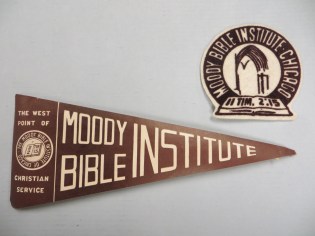
1940s MBI banner and patch

From happier times, c. 1940.

Here’s what we know: As Christianity Today has reported, the flagship Moody Bible Institute in Chicago has shaken up its leadership. The president, chief operating officer, and provost are all out. MBI officially thanked the three for their leadership, but the institute also acknowledged “widespread concerns over the direction of the school,” according to CT.

Many of those concerns were publicized by another ousted employee, Julie Roys. Roys had hosted a radio program on WMBI and she recently raised alarms at the financial and theological misdeeds of top MBI leaders. On her blog, Roys had pointed out that the leaders had made unwise and possibly shady financial arrangements. She also noted alumni complaints that the school had indulged liberal ideas.

I don’t have any inside knowledge of the goings on at MBI. As I argue in my new book about the history of evangelical higher ed, though, the pattern is familiar, and part of the DNA of evangelical higher education. In a nutshell, the fundamentalist movement in the 1920s attracted most of the Bible-institute movement. Flagship MBI became a reluctant leader of fundamentalism, along with other higher-ed institutions such as Wheaton College in Illinois and Bob Jones College in Florida (it moved twice, only becoming Bob Jones University in its current South Carolina location in 1947).

The nebulous nature of interdenominational fundamentalism left these institutions in a bind. Not as an accident, but as an inherent part of this conservative protest movement, there existed no higher (human) power that could set the boundaries of real orthodoxy for these schools.

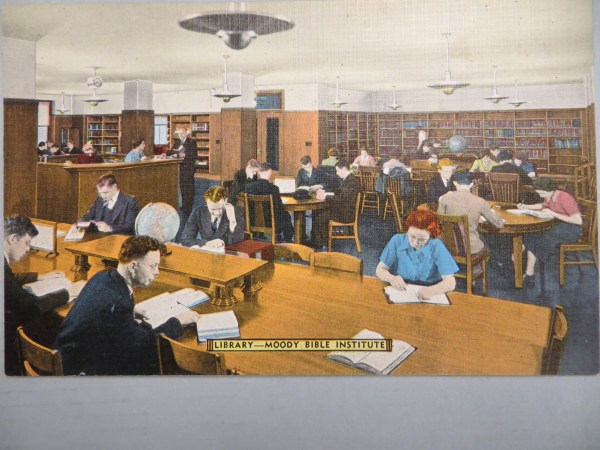
1940s postcard library

Getting those dispensations right…c. 1940s.

As a result, different schools figured out different ways to decide what was kosher and what wasn’t. Bob Jones College established a rigid authoritarian structure. True religion, at Bob Jones College, was what the Bob Joneses said it was.

Wheaton College adopted a more spread-out network of authority. They established a board of fundamentalist celebrities and donors to help guide the school. But they also hired a series of powerful, charismatic presidents to embody the school’s mission. In addition, Wheaton courted alumni to help fund and direct the school. Often, tensions among the various leaders resulted in mixed messages and confusing, conflicting arguments about what constituted proper evangelical religion. Larycia Hawkins’s experience is nothing new.  Just ask Russell Mixter or President Buswell, two stories I describe in detail in the book.

Cover art final

Read all about it…

MBI did something similar, and the results are evident in the recent controversies. Reliance on celebrity fundamentalists and in-group leadership structures has always plagued evangelical colleges. In today’s case, Left Behind author Jerry Jenkins is accused of receiving sweetheart financial deals and tweaking the school’s moral code. MBI’s leaders are accused of giving one another perks without opening their deliberations to the whole school community.

The accusations range beyond financial hanky-panky. MBI’s leaders are accused of winking at theological sloppiness, too, another pattern established in the twentieth century. In today’s MBI case, alumni have charged the top leaders with

trading the sure foundation of God’s Word and the mission of training men and women to know and teach the Gospel for the fragile foundation of the cultural tides of the day. . . . students around campus and on my floor were not acting in ways that showed their desire to love and know the Lord fully. . . . Moody has become not a unique place to study and know God’s Word, but instead a place infiltrated by liberal political stances and clichéd cultural buzzwords without a solid theological foundation.

Such accusations have a timeless ring in the world of evangelical higher education. Similar complaints have been lodged against school leaders in every decade of the twentieth century and the twenty-first. And though they always seem new, they are the predictable result of the uncertain goals of evangelical higher education.

Like all evangelical institutions, MBI is in an impossible situation. It exists as a school dedicated to a certain vision of eternal truth, yet it can only survive if it also changes periodically. For example, few members of today’s MBI community would encourage racial segregation on campus, but in the 1930s it was part of an MBI education. All schools need to change, but this can be difficult for evangelical schools that promise to be purveyors of God’s eternal Truth.

Too often, leaders at evangelical schools fudge this dilemma by making back-room decisions about changes, hoping the evangelical public does not complain too loudly. Every once in a while, however, influential board members, faculty, students, or alumni shout out a protest, like the one we hear today from Chicago.

It’s important to note, of course, that similar problems exist in non-evangelical institutions as well. Wherever charismatic leaders are allowed to make decisions without consulting concerned constituencies, abuse is predictable. Most often, in secular higher education, this has happened with high-profile athletic programs such as the ones at Penn State and Florida State.

The situation at MBI is sadly similar. Instead of a structure by which changes can be discussed and agreed upon, a closed-door group of influential leaders has felt forced to go ahead on its own. None of us should be surprised that structures like that lead to financial malfeasance or unpopular policies.

The Oprah-iate of the Intellectuals

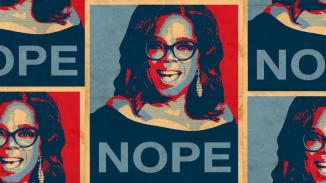
Will she or won’t she? Oprah Winfrey’s speech at the Golden Globes has people talking about a Winfrey presidency. Here’s the ILYBYGTH question: Why aren’t progressive pundits talking about it? I think I know why—it’s a rare moment when conservatives and progressives agree on something.oprah president

For their part, conservative pundits have had a field day with the Oprah news. At National Review, for example, commentators have relished the story. They’ve asked if Oprah will ditch her Hollywood-lefty friends; they have gleefully pointed out that Oprah would be the Left’s Trump; they’ve champed at the bit to see Oprah fight against an establishment Democrat.

At American Conservative, too, Benedictine pundit Rod Dreher has wallowed in the idea of an Oprah papacy/presidency. President Oprah, Dreher crows, would be

the Pallas Athena of Moralistic Therapeutic Deism. She would be the goddess of the nation-state.

On the other side of the culture-war spectrum, there has been markedly less talk about an Oprah presidency. Sure, Rolling Stone wondered about it. And a few other progressive small-fry have opined. But big progressive outlets such as The Nation, Progressive.org, and ThinkProgress have maintained a studied silence on the issue.

Why? I have a hunch and I’d be happy to be better educated by SAGLRROILYBYGTH.

I think smart progressives agree with the conservative National Review crowd on this one. That is, they see Oprah as the Trump of the Left. An Oprah candidacy, progressive strategists might think, will force them into discussing non-issues such as Oprah’s wacky universe-embracing religious quackery.

After all, as Yale’s Kathryn Lofton has argued, Oprah has crafted more than a media empire. Her “gospel” has translated Oprah into something else.

And progressives want to talk about health care and tax plans, not enlightenment through elaborate poster-making.

I Love You but You Didn’t Do the Reading

The deep freeze hasn’t slowed down the pundits. Here are a few ILYBYGTH-themed stories that crossed our desk this week:

What’s wrong with being polite? It might be coded white supremacy—Steve Salerno blasts the campaign against “white-informed civility” at WSJ.

In Google’s shadow: San Francisco public schools failing African American students, from LATimes.

Why is it so hard to recruit and retain teachers? The story from McDowell County, West Virginia, at Hechinger.Bart reading bible

Islam and Evolution, at Beliefnet.

Peter Greene asks if Queen Betsy’s time has already come and gone, at Curmudgucation.

Christian college suspends its pastor for officiating at a same-sex wedding, at IHE.

Cruel and unusual? Baltimore teachers complain that cold classrooms are inhumane, at NYT.

Understanding the un-understandable:

Trumpism on campus: At The Atlantic, Elaine Godfrey looks at the fight for the soul of the College Republicans.

Charter schools aren’t doing the job, by Michelle Chen at The Nation.

College is doomed. Demographic shifts predict fewer students and fewer tuition dollars, at IHE.

Why Conservatives Should Love Obama

He did it! I don’t how it happened, but somehow President Barack Obama managed to accomplish one of the most dreamed-for educational goals of America’s social conservatives. During his presidency, that is, early teen sexual activity dropped significantly, according to the CDC.

I know, I know, it’s ridiculous to give Obama credit for something that merely happened to coincide with his time in the White House. But that’s what culture-war pundits do all the time. In this case, the numbers are pretty significant, and the cause is among those nearest and dearest to the hearts of American conservatives.

As I argued in my book about the history of educational conservatism, helping kids avoid the allure of premarital sex has always been one of the fondest educational dreams of social conservatives, especially conservative religious reformers. Why was evolutionary theory dangerous? If we taught children they were nothing but clever animals, they would certainly behave that way. Why was old-fashioned discipline important? Because children needed to learn to control their sinful, lusting nature.

I hate to do it, but let me quote myself here. When Alice Moore first joined the school board in Kanawha County, West Virginia in the 1970s, one of her first acts was to close down a progressive middle school. When I interviewed Moore I asked her about it. Here’s what I wrote in the book about Moore’s experience:

The school, Moore recalled, was not a proper learning institution. It had become a cesspool of unrestrained sloth and lust. The students, she recalled, did “whatever they wanted to.” As she walked in for her first inspection, a young couple stood in the doorway, wrapped in each other’s arms. She had to ask them to move out of her way, which they did only with notable resentment. Other students wandered around the school and neighboring fields, smoking and engaging in all kinds of sexual activity in nearby barns. When Moore asked the principal to explain this sort of behavior, he informed Moore that the school hoped to do more than simply transmit information to students; it hoped to transform them into agents of social change. Teachers should see their roles as co-learners, not as dictators.

This sort of progressive shibboleth exasperated Moore.

At the heart of warped progressive-ed thinking, Moore believed, was a mistaken notion of the nature of humanity. Lust needed to be schooled out of children, not winked and nodded at as a “natural” thing. Moore was not at all the only conservative activist to think this way. Consider William J. Bennett’s conservative index of cultural indicators. Bennett’s accusations were clear: Hippies had wrecked everything. Progressive attitudes in education had led to woeful increases in dangerous sexual activities among young people, in addition to crime, drug use, etc.

In short, for a hundred years now, educational conservatives have desperately dreamed of reducing the progressive dominance of “If it feels good, do it” attitudes among young people. And now, at long last, we seem to have some evidence that those dreams have come true, at least in part.

CDC teen sex chart 2

The  good news no one will holler about…

Here’s what we know: The excitingly named “Morbidity and Mortality Weekly Report” from the Centers for Disease Control notes significant declines in sexual intercourse among America’s 9th and 10th graders (roughly 14- and 15-year olds). As the authors state,

Nationwide, the proportion of high school students who had ever had sexual intercourse decreased significantly overall and among 9th and 10th grade students, non-Hispanic black (black) students in all grades, and Hispanic students in three grades. A similar pattern by grade was observed in nearly half the states (14), where the prevalence of ever having had sexual intercourse decreased only in 9th grade or only in 9th and 10th grades; nearly all other states saw decreases in some or all grades. The overall decrease in the prevalence of ever having had sexual intercourse during 2005–2015 is a positive change in sexual risk among adolescents (i.e., behaviors that place them at risk for human immunodeficiency virus, STI, or pregnancy) in the United States, an overall decrease that did not occur during the preceding 10 years.

Why? We don’t know. And of course I’m kidding when I give President Obama credit. There are some things we can confidently predict, however. First of all, I don’t think we’ll see pundits shouting about this good news. As we’ve lamented here at ILYBYGTH in the past, good news about America’s schools and youth just never gets headlines.

Second, the warped popular myths about America’s public schools will continue to dominate. Gallup polls make it startlingly clear: When people know public schools, they like them. But when they describe public schools in general, people call them terrible. The notion that America’s public schools are cesspools of drugs, sex, and sloth is not true, but it is very widely held. Similarly, this data about trends in youth culture will not likely change people’s assumptions about schools and youth.

Finally, this student data points out yet again that the common story about the history of American public education is just not true. Many of us assume that progressive types took over public education back in the 1930s. We think that since the 1930s (or maybe since the 1960s) public schools have been dominated by progressive educators from fancy teachers’ colleges and think tanks. It’s just not true. Throughout their existence, public schools have reflected the values of their local communities. When those communities change their ideas about sexual activity, so too do their local schools. Educational change hasn’t come from high-level meetings by New York leftists, but rather from more nebulous and  hard-to-trace shifts in social trends.

Why do more and more young people seem to be avoiding early sexual activity? I don’t know, but I’ll guess: It’s not due to any sex-ed curriculum they’re receiving in their Health classes. No, the change in reported sexual activity is more likely due to changes in our whole society about the allure of sexual intercourse. After all, as we like to say here at ILYBYGTH, schools don’t change society, schools ARE society.

The Ol’ College Tri-al

Want to scare a fundamentalist? Tell them you’re sending their child to a state university. As I’m arguing in my new book about evangelical higher education, anxiety about college has always been a primary concern of Protestant fundamentalists and other conservative evangelicals. Today’s fundamentalists are no different, as I discovered in my recent visit to the Ark Encounter. In this last (I promise) post about the Ark Encounter, I have one final puzzle about the ways the Kentucky creationists depict the dangers of mainstream higher education.

20171226_121522

Watch out! It’s a trap!

First, the history: When evangelist Bob Jones explained his reason for starting his own college in 1926, he liked to tell the story of one woeful Christian family who had scrimped and saved to send their daughter to a fancy university. As Jones told the tale,

At the end of nine months she came home with her faith shattered. She laughed at God and the old time religion. She broke the hearts of her father and mother. They wept over her. They prayed over her. It availed nothing. At last they chided her. She rushed upstairs, stood in front of a mirror, took a gun and blew out her brains.

Who wouldn’t be scared by that sort of story? Or consider the following example, reprinted throughout the early 1920s by a number of fundamentalist pundits. It was supposedly a letter to the folks at home from a recent college graduate. As he put it,

My soul is a starving skeleton; my heart a petrified rock; my mind is poisoned and fickle as the wind, and my faith is as unstable as water. . . . I wish that I had never seen a college.

For fundamentalists in the 1920s, the dangers of college weren’t only about debt burdens and sexual assault. College itself threatened to rob children of their faith, leave them “poisoned.”

Like now, fundamentalists back then didn’t just rely on hearsay. They devoured social-science reports of the deleterious religious effects of college. Most famous was James Leuba’s study of student religiosity, published in 1916. Leuba found that most college freshmen (85%) called themselves Christians, but only 55% of recent college graduates did so. The upshot, fundamentalists told themselves, was that the college experience must do something to undermine evangelical faith.

20171226_121545

Those darn college professors…

What was true in 1916 seems just as true a century later. Conservative evangelicals—at least the ones who built Kentucky’s Ark Encounter—are convinced that mainstream higher education is a spiritual minefield.

There’s good reason to think they’re right, at least in part. Sociologist Elaine Howard Ecklund studied elite academics and found that there did indeed seem to be some elements of anti-evangelical bias among them. Evangelical professors told Ecklund they tended to keep their faith “closeted.” Others reported hearing offhand comments in the faculty lounge deriding “stupid Christianity.”

While elite academics weren’t as uniformly anti-religious as some evangelicals might assume, they did tend to be less religious than the rest of the population. And a small minority told Ecklund that they actively sought to cure students of their religious proclivities. One physicist told her that he viewed religion as a “virus” that he hoped to cure. A social scientist said she started her classes with the following disclaimer:

You don’t have to distance yourself from religion and think about it from an outside perspective, but you do if you want to succeed in this class.  And so if you don’t want to do that, then you need to leave.

If I were an evangelical parent (I’m not), I would hesitate to send my child into an environment where they would be confronted with that sort of hostile, ignorant attitude. And certainly, Ken Ham and the Answers In Genesis crowd are intensely anxious about the goings-on in mainstream higher education. Ham explained his reasoning in a critique of ILYBYGTH a while back, and my trip to the Ark Encounter confirmed it.

20171226_121555

Can college students protect their faith?

Most of the exhibits were fairly predictable, if odd. They depicted the problems with mainstream evolutionary theory and old-earth creationism. They showed the way day-to-day life on the ark could have happened. Not what I’d expect to see in a mainstream science museum, but pretty close to what I expected to find at the Ark Encounter.

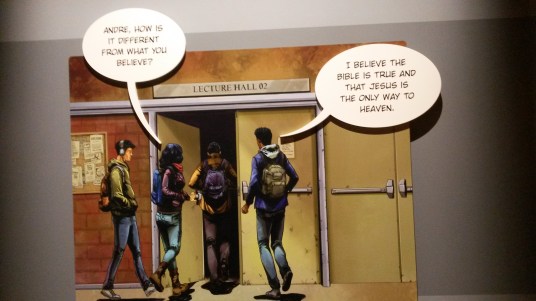
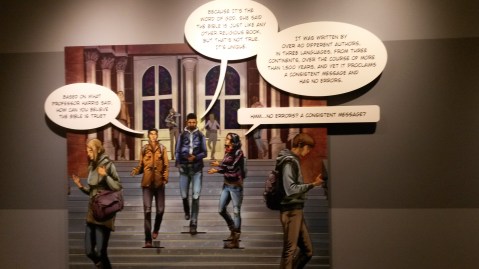
On the top floor, though, I was surprised by what I found. Ark Encounter includes a long corridor dedicated to a huge, walk-through comic-book tract. The comic book’s images have been blown up to fill the walls of the corridor, and visitors walk through the story. The plot is familiar—a student wonders about her faith. After some trials, she embraces it.

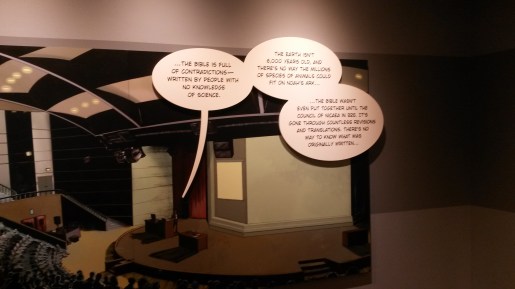
One of the trials is her smarky college professor. The central characters walk into a lecture hall, where they are told,

The Bible is full of contradictions—written by people with no knowledge of science. The earth isn’t 6,000 years old, and there’s no way the millions of species of animals could fit on Noah’s Ark…

One of the characters is a young-earth creationist and he patiently defends his faith to two friends, but their college experience puts that faith to a severe test.

The exhibit itself was a surprise, but the content wasn’t. The fears and anxieties of fundamentalists in 2018 aren’t too different from those of fundamentalists in 1918. But here’s the thing that’s been bugging me: Why does the Ark Encounter devote so much wall space to this college story, when Ken Ham thinks that the college years are already too late for successful soul-saving?

As Ham wrote in his 2009 book Already Gone, the kids that are leaving fundamentalist faith are making those decisions in their middle-school and high-school years. As Ham puts it,

Many parents will fork out big bucks to send these students to Christian colleges, hoping to protect them in their faith. But the fact is, they’re already gone.

If Ham wants his flock to understand that the college years are too late, why include this huge exhibit on the dangers of college at the Ark Encounter?