I Love You but You Didn’t Do the Reading

Another week come and gone–here are some ILYBYGTH-themes headlines you might have missed:

Should colleges ban the laptop?

Trump Trump Trump! More news this week from the land of Lord Dampnut:

Reza Aslan and Lawrence Krauss go head to head: Is religion a good thing?

Could the Museum of the Bible have thwarted Roy Moore-philia? George Weigel connects the dots at National Review.Bart reading bible

Why do school reformers charge in without thinking first? Curmudgucrat Peter Greene offers an explanation.

If Roy Moore wins his election, he still won’t be the worst senator Alabama has ever sent to Washington.

Let’s segregate our schools better, from Rann Miller at Salon.

Is this a “Sputnik moment” for civics education? Robert Pondiscio and Andrew Tripodo make the case at Flypaper.

How did we get the bajillion-dollar Bible Museum? At IHE, Scott McLemee reviews Bible Nation: The United States of Hobby Lobby.

From the Creation-Museum-watching Trollingers: How does the Bible relate to creationism and vice versa?

Required Reading: Textbook Culture Wars

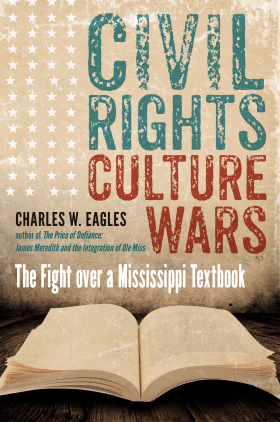
[Editor’s Note: I’m happy to be able to share my review of Charles Eagles’s recent book, Civil Rights: Culture Wars. It will appear in the March, 2018 edition of the Journal of American History. The editors gave us permission to reprint it here verbatim.]

What history should schools teach? Who should decide? And how? These questions have always been central to the United States’ tumultuous culture wars. With Civil Rights, Culture Wars: The Fight over a Mississippi Textbook, Charles W. Eagles offers a valuable new exploration of one twentieth-century battle over these questions.eagles book

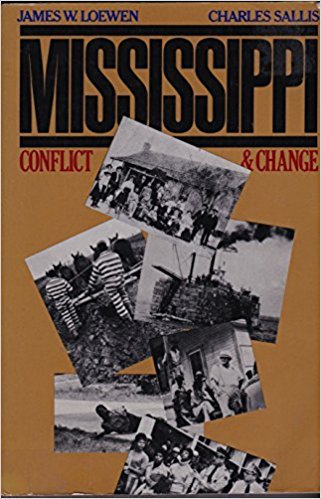
Eagles’ book examines the career of a controversial new state-history textbook in 1970s Mississippi. Sociologist James Loewen and historian Charles Sallis hoped their book, Mississippi: Conflict and Change, would introduce Mississippi’s ninth-graders to the kinds of history that had been widely accepted by academic historians. Instead of preaching a bland, saccharine history of slavery, the Civil War, Reconstruction, and the Civil-Rights Movement, Loewen and Sallis hoped to tell the full story of Mississippi’s conflicted history.

Perhaps not surprisingly, Mississippi’s educational establishment balked. The new textbook was rejected by the state textbook commission as “‘unsuitable’ for classroom use” (156). Critics worried that Loewen’s and Sallis’ text harped on racial animosity. Images of a lynching, especially, caused consternation among commission members. Even one African American member of the commission believed the new textbook would remind African American students of a violent history “they want to forget” (183).

In the end, the authors had to force a federal lawsuit to have their book adopted for state use. Even with their victory in court, they found to their disappointment that not many school districts selected their book.

Eagles tells the story of the origins of the new textbook and its long struggle for adoption in admirable detail. He includes a fascinating examination of earlier history textbooks in Mississippi. By and large, those books told the story of heroic white Mississippians working tirelessly for freedom, assisted by loyal slaves and plagued by corrupt carpetbaggers.

One widely used textbook from 1930, for example, informed Mississippi schoolchildren that “the life of a slave [was] pleasant” (46) and that Reconstruction-era terrorism by the Ku Klux Klan was “a grim necessity” (47).

Eagles’ book also offers a valuable insight into the banality of culture-war bureaucracy. He details the process by which textbooks were adopted in Mississippi. More often than not, texts were not chosen for their intellectual rigor or methodological innovation, but rather for their low cost and ease of use. Members of the textbook committee recoiled at any whiff of controversy, preferring instead to select textbooks that celebrated Mississippi’s history, even the ugliest parts.mississippi conflict and change

At times, Eagles’ perspective seems too close to that of Loewen and Sallis. For example, Eagles praises the authors’ surprising ignorance about the field of secondary history education. As Eagles argued, that ignorance “actually benefitted the MHP [Mississippi History Project] by fueling their effort with an independent, even innocent, evangelical air” (99). It’s hard to believe that ignorance of the field would ever be an asset and Eagles is too willing to explain away Loewen’s and Sallis’ faults.

Despite this minor flaw, Civil Rights, Culture Wars offers a thorough, valuable description of the ways the convoluted politics of history and memory played out in 1970s Mississippi.

Why Is It So Hard for Us to Teach Civics?

We should be freaking out. It’s not just that Americans don’t know about basic democratic principles. In increasing numbers, we don’t seem to care. Pundits lately have hoped we might be in a rock-bottom crisis of civics education, a “Sputnik moment” that drives Americans to re-invest in basic education in democratic ideas. We’re not. Our civics stand-off is even more hopelessly rancorous than our never-ending fights about creation and evolution.

Last year, Richard D. Kahlenberg and Clifford Janey hoped that the ugly, bizarre emanations from Trump’s White House might scare America straight when it came to civics education. It wasn’t only Trumpism that alarmed them. The numbers seemed truly shocking and getting worse. As they explained,

Civics literacy levels are dismal. In a recent survey, more than two-thirds of Americans could not name all three branches of the federal government. . . . Far worse, declining proportions say that free elections are important in a democratic society.

When asked in the World Values Survey in 2011 whether democracy is a good or bad way to run a country, about 17 percent said bad or very bad, up from about 9 percent in the mid-1990s. Among those ages 16 to 24, about a quarter said democracy was bad or very bad, an increase from about 16 percent from a decade and a half earlier. Some 26 percent of millennials said it is “unimportant” that in a democracy people should “choose their leaders in free elections.” Among U.S. citizens of all ages, the proportion who said it would be “fairly good” or “very good” for the “army to rule,” has risen from one in 16 in 1995, to one in six today. Likewise, a June 2016 survey by the Public Religion Research Institute and the Brookings Institution found that a majority of Americans showed authoritarian (as opposed to autonomous) leanings. Moreover, fully 49 percent of Americans agreed that “because things have gotten so far off track in this country, we need a leader who is willing to break some rules if that’s what it takes to set things right.”

More recently, Robert Pondiscio and Andrew Tripodo offered a few specific suggestions about how teachers can “seiz[e] the moment to improve civics education.”

I share their concern and Pondiscio and Tripodo offer some smart concrete steps to start making improvements. As all these authors are surely aware, though, civics education faces an impossible challenge.

Consider the Sputnik analogy: Back in 1957, Americans were rightly dismayed that the Soviet Union had taken the lead in space technology. Among the many results was a new burst of funding for new science textbooks, books that no longer truckled to the political power of creationists. The BSCS series included robust information about evolution, and by the end of the 1960s those books were being widely used in American classrooms. (If you’re looking for a quick guide to this history, check out Teaching Evolution in a Creation Nation.)

We aren’t facing a similar situation when it comes to our shoddy civics education.

Why not? Much as creationists might not like it, by 1957 the mainstream scientific community had reached a powerful consensus about the basic outline and importance of the neo-Darwinian synthesis. There is no similar mainstream establishment that can satisfactorily define the proper aims of civics education.

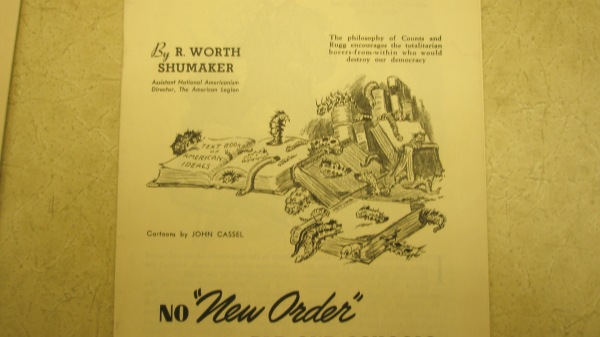
Consider the example I included in my book about educational conservatism. Back in the late 1930s, a set of widely used social-studies textbooks became intensely controversial.  Harold Rugg’s books had been used by millions of students, but in just a few short years they were mostly all yanked from classroom use.

OLYMPUS DIGITAL CAMERA

Watch out: Your school might be teaching civics…

The problem was that Rugg was pushing his vision of civics education. It was a vision that conservatives such as the founder of Forbes Magazine and leaders of the American Legion found subversive.

What did it mean in the World War II years to educate citizens? Harold Rugg thought it meant teaching them the dangers of authoritarianism. He thought it meant teaching them that the United States was one country among many, and that citizens needed to be rigorously skeptical of big business and back-room government deals.

Conservatives thought it meant teaching students to honor and cherish the best American traditions. They wanted children in school to learn to be proud Americans, not weak-kneed socialists. Bertie Forbes explained his beef in one of his popular syndicated columns. He was chatting one day with a group of middle-school students, Forbes related, and they told him about their experience with their Rugg books. When their teacher asked them if the United States was the best country in the world, many of them had answered “Yes.” The correct answer, their teacher read from their Rugg teachers guide, was “No.” In his column, Forbes teed off on that sort of civics education:

Do American parents want their children taught such ideas?  Do they want them to be inculcated with the idea that the United States is a second-rate country, that its form of government is open to question, that there are other countries more happily circumstanced and governed than ours?

Maybe I’m getting too cynical in my old age, but I don’t think we have evolved very far from this 1940s level. When it comes to civics education, we face a stark and glaring divide about the fundamental purposes of such a class. Are students getting a good civics education if they learn how to properly, reverently, fold a flag? Are they getting a good civics education if they can rattle off the correct structure of federal government? Or are they getting a good civics education when they learn how to stage a Black Lives Matter protest?

We can’t agree. And until we can, we will continue to have shameful outcomes in our attempts to teach civics in public schools.

I Love You but You Didn’t Do the Reading

The Thanksgiving break didn’t seem to slow down our educational culture wars. Here are a few stories from this past week you might have missed:

Queen Betsy loves ‘em, but a new research review in EdWeek shows little evidence that voucher programs are good for students.Bart reading bible

Seeing the future? CNN Money looks at Wisconsin after six years of restrictions on teachers’ unions.

At The Atlantic, Hal Boyd asks why it’s still okay to make fun of Mormons.

Why do so many evangelicals still support Roy Moore? David Brooks points to “siege mentality.”

The “college gap” widens. Economist Charles Clotfelder discusses his study of higher education. The takeaway: rich private schools are vastly different from struggling public ones.

Is the new bajillion-dollar Museum of the Bible going to succeed at avoiding controversy? Nope.

A Google, a Plan, a Canal

Why don’t start-up tech types understand school reform? They’re excited about it. By and large, though, their schemes flop. Why? The history of school reform offers a big-picture answer.erie canal

Googlers might think they have the wrong logarithm. Or the wrong charismatic leader. Or maybe the wrong business plan. There’s a simpler, better answer that my current research is making painfully clear to me. It might seem like google has nothing to do with the Erie Canal, but when it comes to school reform, they look depressingly similar. Like the school reformers of the early 1800s, today’s googlers are plagued by a fundamental problem they don’t even see:

The wrong metaphor.

Google-founded schools don’t work. They approach school like a start-up business, as curmudgucrat Peter Greene has pointed out time and time again.

It’s not only google, of course. Other techies have experienced similar flops when they thrust themselves into the school-reform game. We can’t forget, for instance, Mark Zuckerburg’s warm-hearted but dunderheaded efforts in Newark.

Today’s tech types have had enormous success with google and facebook and uber and etc. So they jump too quickly to assume that those successes will apply to school as well. In general, and with some exceptions I’m sure, techies invest in bad school reform schemes because they misunderstand the nature of schooling. They think of it too often as a question of information delivery. They assume—based on google’s big success at shepherding information—that they can improve schools the same way they improved the interwebs. If they can only get their proprietary app right—they assume—and get free of stuck-in-the-mud thinking and red tape, there ain’t nuthin they can’t do.

They aren’t the first to make this sort of goof. In fact (and this is the thing that really chaffs us nerds), though they think they are making ground-breaking social changes, today’s tech-fueled reformers are reading from a very old school-reform script. Though many of them are motivated by the best intentions, if they took time to read even one book they could dodge some of these predictable perils. Heck, they could even avoid the library and just spend time with Larry Cuban’s blog or Peter Greene’s.

clinton opening erie canal

Clinton connecting the waters, 1826.

It wouldn’t take much for today’s ambitious reformers to recognize their similarity to those of earlier generations. As I work on my next book about urban school reform in the early 1800s, I’m struck by the parallels. Take, for example, the big dreams of DeWitt Clinton. Clinton was the 19th-century equivalent of today’s tech heroes. He was brilliant, talented, connected, and far-sighted. Most important for our purposes, he embraced new technology in the face of old-fashioned opposition. He pushed through modern solutions to ancient problems, and it all happened fast enough for him to witness the amazing social improvements wrought by his efforts.

In Clinton’s case, it wasn’t the interwebs, but a really long ditch. Clinton believed in the possibilities of a transformational investment in the Erie Canal. Naysayers said nay, but Clinton was proven right. The canal utterly changed the face of American society. Small farmers and city-dwellers alike benefitted.

Elated and maybe a little puffed-up, Clinton looked around for new worlds to conquer. At the time, New York City was growing by leaps and bounds. Its schools couldn’t keep up. Clinton dived into school reform, putting all his chips on Joseph Lancaster’s scheme to transform and systematize schooling for all students, especially those without a lot of money.

You know the end of the story already: It didn’t work. At least, not the way Clinton planned. Unlike a canal, a school system is not something that can be created once and for all. A school system needs more than a one-time start-up investment. The problems that make schooling difficult are not the same as the problems that make a canal difficult.

urban apple orchard

They can thrive anywhere…

It might help if well-intentioned reformers thought of school differently. School isn’t a start-up business. School isn’t a canal.

What IS school? There are many ways we could think about it, but this morning I’d like to suggest one idea and I invite SAGLRROILYBYGTH to suggest their own.

To get school reform right, we can’t think of school like a start-up business. We can’t think of it like a canal. We might do better if we thought of school like an orchard. Why?

  • Orchards take a long time to be healthy and productive, but can be damaged or killed quickly.
  • Orchards are intensely local; they can’t be shipped or packaged easily.
  • Orchards take constant loving care from many people.
  • There are some things that all orchards need, like sunshine, water, and fertilizer.
    • The exact recipe for success, though, depends on local conditions.
    • …and it isn’t the ingredients themselves that lead to success, but the constant loving care with which they are applied and monitored.
  • Orchards can thrive anywhere, but in some places they need more intensive care and maintenance than others.
  • Orchards can be tweaked easily, but they can’t be radically transformed quickly.
  • A healthy orchard isn’t focused on the people taking care of it, but rather on the things it produces.
  • Different orchards can thrive while producing different things; one measurement won’t compare apples very easily.

Now that I see that list in black and white, I’m not sure. Maybe that’s not the best metaphor. I’m not sure if children are supposed to be the fruit…? Or if kids are the ones picking the fruit of education…?orchard

When it comes to thinking about schools, though, I can’t help but think that imagining schools as orchards is better than thinking about them as start-ups or canals. As today’s tech leaders have discovered, thinking about schools as start-up tech firms leads to predictable flops. As yesterday’s leaders found out, thinking about schools as canals didn’t work either.

So maybe thinking about schools as orchards isn’t the best metaphor. I bet people can come up with better. In the meantime, though, I’ll look forward to a multi-million-dollar school reform plan that starts with a more profound understanding of the way real schools work.

Missing the Boat on Creationism at the New York Times

It’s more than just a couple of minor goofs. A recent “retro” report about creationism and evolution education in the New York Times makes the usual huge mistakes in its description of American creationism.

SAGLRROILYBYGTH know I’m no creationist myself. I want more and better evolution education in America’s public schools, as I argued recently in my book with philosopher Harvey Siegel. But we won’t achieve that goal as long as we keep telling ourselves these comfortable/scary myths about creationism. If we want to fight the political influence of creationism, it is far better to understand creationism as it really is, instead of the clumsy monstrosity we usually imagine.
Jesus on a dinosaur.jpg 1

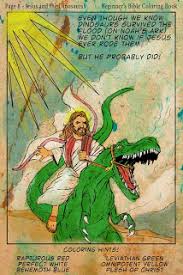
Kicking ass for creation.

Let me start with the positives. The report did a good job of describing the basic history of anti-evolution legislation and court battles from the 1920s to today. As they describe, anti-evolution laws have been struck down by SCOTUS and other courts time and time again. They also did well to include the voices of both the smartest pro-evolution pundit—Brown’s Kenneth Miller—and leading creationists, including Answers In Genesis’s Georgia Purdom and a panel from the intelligent-designing Discovery Institute.

The problems with the report are not mere details or minor interpretative mistakes. No, the danger is that too many of us non-creationists woefully misunderstand the world of American creationism. As with this report from the New York Times, we will repeat misleading notions to ourselves and think we have a better picture of creationism. The real danger, of course, is that we will traipse off with our non-knowledge to make plans and policies, without a whiff of a sense that we are building on the wrong foundation.

As I’m arguing in my current book about American creationism, the first goof most non-creationists make is to treat creationism as a large, scary, undifferentiated mass. In the NYT report, for example, the young-earth Georgia Purdom is cited alongside the intelligent-designing Stephen Meyer as if there is not an enormous difference between their two beliefs.

Why does it matter? For one thing, the suggestion that a huge army of creationists are massing to take control of public schools is scary. But the idea of a fractured and disputatious set of cranky creationists isn’t. And that’s much closer to the truth. Consider, for example, Dr. Purdom’s criticism of intelligent design. While some evangelicals might like the notion at first, Purdom has argued, in the end, in an ID universe,

God appears sloppy and incompetent, if not downright vicious.

For the young-earthers at Answers In Genesis, ID is not an ally but rather another danger to be confronted. In the end, there is no such thing as “creationism”—at least not the way the New York Times article suggests. Rather, there are many creationisms. And those different visions of science and religion often fight one another far more viciously than they fight against mainstream science.

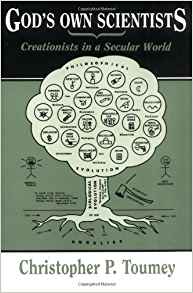
Here’s my second beef. As always, this article and its expert talking heads refer to creationism as “anti-science.” It’s not. All of us love science. As anthropologist Chris Toumey put it in his underappreciated book, God’s Own Scientists, creationists are like all Americans. We all have deep faith in the

plenary authority of science; that is, the idea that something is more valuable and more credible when it is believed that science endorses it.

In other words, whether people are shilling toothpaste, NASA budgets, or creation science, they always dress up in lab coats to make their pitch.

Why does that matter? If there are two simple sides to these culture war fights—science on one side and anti-science on the other—then we would have a much simpler time convincing the antis to get on board. Instead, as we saw so excruciatingly in the Ham-on-Nye debate a while back, what we end up doing instead is wasting time with each side trying to prove just how much it loves science. We don’t need to have that talk again. If we all love science, we can have more productive conversations—even if we disagree—about how to teach science in public schools.
toumey

Read this!

Last and most important, we need to acknowledge the false and misleading myths about creationism’s history. This article is especially egregious in suggesting that creationism is making a bold new political advance, that fundamentalist armies are sweeping state legislatures in a frightening new show of creationist strength.

For example, the NYT report says that creationists haven’t scored a victory since the Scopes trial in 1925, until now. It describes menacingly that a “growing skepticism about science has seeped into the classroom.” I understand the reasons for alarm, but the notion of a huge uptick in creationist political power simply does not match the historical record.

The career of anti-evolution agitation has been one of steady decline in ambition and reach. For nearly a century now, anti-evolution activists have fought for a set of ever-shrinking goals. As I found in my first book, anti-evolution laws in the 1920s wanted nothing less than the imposition of theocratic rule on American public schools. In Kentucky, for example, a 1922 bill would have banned not only evolution, but atheism and agnosticism. An amendment would have pulled any book from a public library that might lead a student to question her religious beliefs.

Compare those bills to creationists’ efforts today. Please don’t get me wrong. I am in full agreement with Kenneth Miller and Zack Kopplin; today’s anti-evolution laws are terrible. But that doesn’t mean that they represent a bold new surge of strength for anti-evolutionism. They don’t. Rather, they are just the latest strategic grab at scraps of influence and power by anti-evolutionists.

Why does it matter? Well, I think I probably don’t need to spell it out, but I will. If creationism is 1.) united, 2.) anti-science, and 3.) surging to greater and greater power, those of us who oppose religious imposition in public schools need to take drastic action. We’d need a wholesale reorganization of the decision-making process in public-school curricula. We would need to come up with radical ways to intervene in local educational decisions, as the US did with racial segregation to such mixed results.

If, on the other hand, creationism is shrinking, fragmented, and in agreement about the fundamental intellectual power of capital-S science, we face a much different environment. It won’t generate as much attention, but it would be better policy to simply continue our efforts. We should continue to do what we’ve been doing: Advocate tirelessly for more and better evolution education; explain and explore the real contours of American creationism; repeat that evolution is not a religious idea—it won’t hurt students’ religious faiths.


I Love You but You Didn’t Do the Reading

Time to give thanks for another batch of hot-mess headlines. This week saw some doozies:

The Roy Moore mess in Alabama; Or, Does anyone really support sexual predators?

Larry Cuban asks what happened to MOOCs.

Bart reading bibleCalifornia approves new guidelines for teaching LGBTQ history in elementary schools.

Williams College president: What if we thought of white-supremacist campus speakers differently?

  • “If the World Wrestling Federation demanded to hold a cage match on the Berkeley campus, would the university be obligated to host it at public expense?”

Is this the end of college? SIU moves to abolish academic departments, from IHE.

Why did white evangelicals vote for a moral monster? Eric C. Miller interviews Stephen Mansfield about his new book, Choosing Donald Trump.

Genocide and Gravy: What should we think about Thanksgiving?

The Prodigal College Returns

The trend seems clear: Michigan, Florida State, Texas State, Ohio State, and other big schools have banned fraternities. School administrators are scrambling to control dangerous drinking, deadly hazing, and horrifying sexual assault. I can’t help but ask: Have the fundamentalists been proven right?

blanchard hall

Do all paths lead back to Blanchard Hall?

A hundred years ago, after all, as I explore in my new book, fundamentalists founded their new network of evangelical colleges, institutes, and universities for two main reasons. First, they wanted an intellectual refuge. Mainstream colleges, fundamentalists universally agreed, had drunk the Kool-aid of evolutionism and materialism. At least as dangerous, however, were the behavioral norms that had come to prevail at mainstream schools.

In the 1920s, fundamentalist school leaders such as Charles Blanchard at Wheaton College in Illinois and Bob Jones at Bob Jones College in Florida promised their schools would protect students from both loose ideas and loose behavior.

At Wheaton, for example, fraternities were banned, along with smoking, drinking, cinema, dancing, and card-playing. The school posted spies outside the downtown movie theater to make sure Wheaton students weren’t sneaking in. At Bob Jones, students were prohibited from “loitering,” talking freely with members of the opposite sex, and absolutely anything that hinted of “jazz.”

For a century now, evangelical schools have been mocked as small-minded anti-intellectual “church colleges,” hopelessly out of touch with modern higher ed. They have also been attacked—often by their own students—as ridiculously controlling.

Back when he was a Wheaton student in 1966, for example, historian Mark Noll led the drive to reexamine the “Pledge.” It was simply not possible, students felt, for them to receive a decent college education if they weren’t allowed to make their own decisions. They were embarrassed to tell their friends at other schools that they weren’t allowed to go to the movies.

But who is embarrassed now? As leaders of secular colleges struggle to find ways to impose restrictions on student behavior, are they reverting to fundamentalist arguments of the 1920s? As Frank Bruni argued recently in the New York Times,

On a range of fronts, fraternities — and sororities — contradict our stated values and undercut our supposed goals for higher education, putting our inconsistencies and hypocrisies under a magnifying glass.

To ban them, though, or even to take real moves to enforce rules against certain types of student behavior, wouldn’t be as simple as it seems. As the first generation of fundamentalist college leaders lamented, a central principle of mainstream higher education has been the notion that students themselves must be in charge of their decisions.

To make any real change in the deadly culture at many frats, mainstream college leaders would need to make big changes in the way they see their role. Like fundamentalist colleges and their evangelical heirs, mainstream schools would need to insist on their roles as moral guardians.

Communism and Creationism, Genocide and Gravy: Thanksgiving’s Greatest Hits

Ah…Thanksgiving. The holiday that brings us together to yell at each other and watch football. How can one Thursday fire up so much culture-war angst? How can it help explain both Rush Limbaugh and creationism?

simpsonsturkey

Carve out some time in the archives…

This year, as your humble editor prepares to head up to an undisclosed location in upstate New York to avoid any hint of culture-war histrionics, we stumbled across the ILYBYGTH Thanksgiving archives. Check out some of the ghosts of ILYBYGTH Thanksgivings past:

First, how does Thanksgiving help us understand the way schools really work? For everything from sex ed to evolution, Thanksgiving dinners can serve as metaphors for the real reasons why it is so hard to get schools to dive into controversial issues.

Second, were the Pilgrims really communists? And why do conservative pundits say they were? It seems to me conservatives would want to defend the tradition of friendly buckle-wearing Pilgrims.

Finally, some bad Thanksgiving advice on how to outsmart your crazy right-wing (or left-wing) uncles.

From the Archives: Take the Creation Museum Challenge

The Challenge: Can you tell creationism apart from mainstream science just by looking?

[Editor’s note: As SAGLRROILYBYGTH are sick of hearing, I’m almost finished with my book manuscript about American creationism. In this book, I’m trying to help my fellow non-creationists understand the complexities of real creationism. For example, in my final chapter I’m arguing that creationists–whether they are radical young-earthers or mild-mannered BioLogians–can’t fairly be accused of being anti-science. Yet smart, well-informed outsiders keep insisting that they are.

[As I polish up this final chapter, I stumbled across the following ILYBYGTH post from a few years back. I thought I’d run it again to see if anything has changed. So here’s the question once again: Whether you’re a creationist, anti-creationist, or other, can you tell radical creationism apart from mainstream science just by looking?

[Please…take the challenge and let us know how you fared!]

Take the Creation Museum Challenge

We can gnash our teeth.  We can pull our hair.  But no matter what we do, the Creation Museum of Answers In Genesis has pulled it off.  With its new $1.5 million dinosaur exhibit, the flagship museum of young-earth creationism has successfully mimicked the outward appearance of mainstream scientific museums.

Big Valley Creation Science Museum

It used to be easy.  Creationist museums used to be only sad little affairs.  They used to look like this one from Alberta, Canada.  The Big Valley Creation Science Museum, pictured here, may do a great job in spreading the creationism gospel.  But no idle tourist would be likely to confuse it with mainstream museums such as the Smithsonian’s Museum of Natural History or Boston’s Museum of Science.

It used to be easy for outsiders like me to mock the lame pretensions of the many creation museums that dotted our great land.  And Canada.  As one angry visitor noted, even the bigger creation museums used to have strange, sad displays like this one from San Diego’s Creation and Earth History Museum.

Not a Lot of Big Bang for your Buck

But here’s the new challenge: Can you tell which of the three pictures below comes from Kentucky’s Creation Museum display and which come from the Smithsonian and Boston’s Museum of Science?  As arch-creationist Ken Ham explained gleefully recently, his new display of a million-dollar Allosaurus fossil puts Ham’s Creation Museum in the same league as those mainstream museums.  As Ham put it,

For decades I’ve walked through many leading secular museums, like the Smithsonian in Washington, D.C., and have seen their impressive dinosaur skeletons. But they were used for evolution. Now we have one of that class, and it will help us defend the book of Genesis and expose the scientific problems with evolution.

So take the Creation-Museum challenge.  Just by looking, can you tell which of these images comes from a young-earth creationist museum and which come from mainstream ones?  (Don’t cheat.  But once you’ve given it a try, you can click on each image to see its provenance.)

Field museum exhibit

Is this “real” science?

Or Is It This One?

Or Is It This One?

dinosaur hall smithsonian natural history museum t rex 550

Millions of year? …or millions of dollars?


This successful mimicry is important.  In creationism’s twentieth-century struggle to establish alternative educational institutions to rival those of mainstream science, young-earth creationists often wrestled with significant disadvantages.  Not least of these were questions of funding, as historian Ron Numbers described in his must-read book The Creationists and I detailed in my 1920s book.  In the case of this priceless fossil, rich creationists Michael and Stephen Peroutka donated it to help the Creation Museum with its work.

It would be nice to think that America’s public would make its decisions about the age of the earth and the origins of humanity by weighing evidence and considering counter-claims.  To people like me, the Creation Museum’s claim that this well-preserved fossil serves as proof of a worldwide flood 4,300 years ago seems absurd.

But I don’t think we need to be very cynical to guess that appearance matters.  As Dan Kahan argues, what people believe about creation and evolution usually has more to do with their cultural identity than it does with scientific evidence.  If Answers In Genesis can make their museum LOOK like the Smithsonian, many visitors will assume it is just as good.  And if Answers In Genesis can crank out peer-reviewed science publications that attest to the scientific veracity of their claims, many readers will assume their science is just as good.

So take the Creation Museum challenge.  If you can’t tell the difference, how can you expect anyone else to?