Is Jerry Falwell an Idiot? Part Deux

If you bet for VHS against Betamax and won a billion dollars, what would you do with your loot? If you’re Jerry Falwell Jr., second-generation president of Liberty University in Virginia, you would invest the money in Betamax. Is he an idiot? Or is he a savvy reader of higher-ed tea leaves?

Here’s why we ask: John Fea directs our attention this morning to another mind-boggling story from Lynchburg. Falwell’s Liberty has guaranteed a whopping $1.32 million to Old Dominion for an early-season football game, according to local news reports.

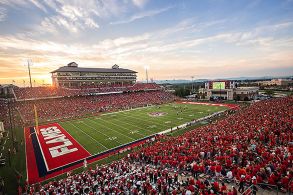
liberty football

Flame out?

Liberty University has that kind of money to throw around. Over the past fifteen years, the school has reaped obscene profits from its online platform. In addition to splashing out for its sports programs, Liberty has poured money into brick-and-mortar campus amenities.

As I noted after the first research trip to Liberty for my new book, that sort of investment seems either stupid or prophetic. If the old-fashioned model of higher education is dead, then why put so much money into it? Why invest in sports and campus gyms if modern higher ed means online ed?

Maybe Falwell is right. Maybe people still want a campus. Maybe they still want eccentric professors. Maybe they want huge sports stadiums. When people think “college,” maybe they want all those things.

If so, Falwell is investing wisely; building his school into a new higher-ed powerhouse.

Or maybe he’s just stuck in a twentieth-century rut. Maybe he’s still insecure about the reputation of fundamentalist colleges and he’s willing to spend whatever it takes to rub his success in the face of Notre Dame and Harvard.

Call Me, Mark Zuckerberg!

B-ding! There it is again, the silver-bullet school-reform alert. As long as there have been rich people and schools, we have seen well-meaning but misplaced attempts at reform. The latest round comes from Priscilla Chan and Mark Zuckerberg, our Facebook Overlords. In order to help people succeed in school and life, their foundation has established a “Manhattan Project” to bring equity to the standardized-testing game.

It won’t work. Historians don’t know much, but we do know one thing: No matter how much money we pour into silver-bullet schemes, they always prove disappointing. It’s not due (only) to mismanagement or incompetence, but rather to the nature of schooling itself. There’s a better way to go about it, but it doesn’t offer the same sort of headline-grabbing oomph.

Here’s the latest: Zuckerberg and Chan are donating a bazillion dollars to get SAT-prep courses to low-income students. The goal is to increase students’ test scores, even if the students can’t afford test-prep courses. So far, the SAT game has been skewed heavily in favor of students who take such courses. They have higher scores, not due to talent or even “grit,” but rather because they come from families with money and time to spare. So they get into college more easily. They get scholarships more easily. In other words, because they had more advantages to start with, they are given more advantages. The Facebook plan wants to offer similar bonuses to students who can’t afford to buy them.

It’s a good idea. And I’m glad Zuckerberg and Chan are looking for ways to give away their money, rather than just guzzling gold smoothies and target-shooting peasants.

But here’s the problem. Test wizard David Coleman of The College Board is over-promising. He is calling the Facebook plan a “Manhattan Project” that will radically improve educational equity. It won’t.

Just like Zuckerberg’s last ill-fated attempt to purchase social justice, this one needs to realize the scope of the problem it claims to address. Giving Cory Booker $100 million will not fix Newark. Making test-prep classes free will not give low-income students equal access to higher education.

The mantra is simple. It is not cynical. It is not depressing. But it does make it difficult for well-meaning reformers to fix things with a single stroke of their check-writing pen. SAGLRROILYBYGTH are sick of hearing it, but here it is again: Schools can’t fix society. Schools ARE society.

In this case, allowing free access to test-prep materials is a good thing. But it does not address the real problems of social equity involved. It is not an accident that college success is based on things like family income and parents’ educational levels.

I’ll say it again: It is a good thing to help students from low-income families do better on high-stakes standardized tests. If the King of Facebook really wants to increase social equality, though, he should not focus on helping some students do better on those tests. He should recognize that fixing schools can only be part of fixing society.

As I argued in my book about educational conservatism, Zuckerberg’s naïve approach to social reform is not just a Facebook quirk. It has been universally accepted by all sorts of school reformers throughout history. No matter what they think society should look like, activists have always blithely assumed that changing schools would automatically make social change happen.

It’s just not that simple.

If Zuckerberg and Chan want to make society more fair, to make things less skewed in favor of the rich, there are still plenty of things they can do. They can even do it by investing in schools. They just need to think differently about the ways schools really work.

What would I do if I had Facebook money? I would invest in schools that don’t rely on SATs in the first place. I’d find schools and programs with proven track records of helping students from low-income families succeed. I’d ignore programs that focus on improving test scores, and donate instead to schools that focus on improving lives.

Priscilla and Mark, please give me a call. We can talk about the details.

I Love You but You Didn’t Do the Reading

Whatta week! The stories were flyin fast ‘n’ furious. SAGLRROILYBYGTH can’t be blamed if we missed some of the action. Your humble editor has collected a few of the biggies:

What did Trump’s religious-freedom order do?

Do we now have a Protestant on the Supreme Court? Sorta, as Richard Mouw points out. Why aren’t there more evangelical jurists?

READING

Words, words, words…

Catholics and science: A long love affair.

More than a culture-war battle: Elesha Coffman reviews Treloar’s Disruption of Evangelicalism at Christianity Today. Instead of the same old story of fundamentalists fighting modernists, Treloar argues for a wide middle in evangelical churches.

Was Susan B. Anthony really the great-godmother of pro-life feminists? Historian Daniel K. Williams sets the record straight at First Things.

They do not like her. Students at Bethune-Cookman University booed mercilessly as Ed Secretary Betsy DeVos tried to deliver a commencement speech. Many stood and turned their backs to her.

Trump seemed to pick his commencement audience better. The Liberty crowd didn’t even seem to mind the fact that he obviously didn’t know nuthin about the Bible. HT: LC

Does Bob Jones University really regret its racist past? As John Fea notes, the school has made moves to put its new anti-racist rhetoric into action.

What is life like for conservative students on liberal college campuses? The New York Times profiled a few of Berkeley’s conservative dissenters.

Thanks to all who sent tips and stories.

Squelching LGBTQ at Wheaton

It’s not in the rulebook. It doesn’t need to be. As at every evangelical college, there is one unwritten rule at Wheaton College that administrators must enforce with merciless rigor. We see it again recently with Wheaton’s ruthless crushing of student attempts to celebrate LGBTQ rights. This attitude is not an exception to Wheaton’s relatively liberal, tolerant, inclusive brand of evangelical Christianity. Rather, as I’m arguing in my new book, there is an unmentionable but inviolable third rail in evangelical higher education, one that no administrator dares to touch.

First, some background for SAGLRROILYBYGTH who aren’t familiar with the world of evangelical higher education: In the family of evangelical colleges and universities, Wheaton has long claimed special status as the “Fundamentalist Harvard.” The college—just outside of Chicago—committed to the fundamentalist movement in the 1920s. In the 1940s, Wheaton led the way in a fundamentalist reform movement, confusingly known as new-evangelicalism, or simply evangelicalism. These days, Wheaton prides itself as the academic jewel in the evangelical crown, alma mater of evangelical academics, intellectuals, and celebrities.

Given the relatively inclusive atmosphere at Wheaton and among Wheaton’s elite alumni, it may seem surprising that the school has cracked down recently. Most famously, it moved to fire a tenured professor who had seemed too friendly to Islam. Now, as alum William Stell reports in the pages of Religion Dispatches, the administration has crushed student expressions of LGBTQ pride.

We shouldn’t be surprised. The unwritten rules are as old as evangelical higher education itself. And they are implacable.

According to Stell, students surreptitiously inserted a rainbow flag into the school’s display of flags of the world. It was quickly removed. Then, students painted a campus bench in a rainbow display. It was painted over. A student who displayed a rainbow flag in a dorm window was forced to remove it.

The message is clear: Wheaton does not want the evangelical public to think that the school is too friendly to LGBTQ rights. But why not?

wheaton gay pride bench

Before & after, from Religion Dispatches…

The school’s history makes it clear. Wheaton, like every other evangelical college and university, has an absolute need to be seen as a safe environment for evangelical students. Anything that is seen as threatening has always been ruthlessly purged from the school’s public image.

There is a lot of wiggle room in the nebulous concept of “safety.” The boundaries of “safe” evangelical environments have changed over the decades. The process has been messy and confusing.

In the 1920s, for example, Wheaton posted student volunteers outside the downtown movie cinema to make sure no Wheaton students were watching movies. In the early 1960s, the administration rammed through an addendum to the school’s statement of faith, clarifying that all faculty believed in a real, historic Adam and Eve. In 1960, too, the administration tried to bury a faculty report calling for greater anti-racist activism among the white evangelical public.

Clearly, the generally accepted evangelical attitude about safe ideas and behaviors changes over time. In the 1960s, polite student rebels won a relaxation of the strict rulebook. They were allowed to decide for themselves if certain movies or TV shows met high evangelical standards for moral decency. And Wheaton’s official attitude toward creationism has changed. The administration no longer feels much need to pander to the notion that only young-earth creationism can save students from atheism. These days, too, the cautious racial conservatism of the administration in the 1960s is an embarrassment for Wheaton.

In short, Wheaton’s administration can go with the flow when enough evangelicals agree that an idea is not dangerously anti-Christian. But there is no clear or simple way to know when that threshold has been reached, and students and faculty have always been punished mercilessly if they cross the invisible line.

Consider the example of Critique. In the early 1960s, the administration clamped down on a student newspaper, Brave Son. In response, five Wheaton students published their own newspaper. They did it all themselves: Wrote it, paid for it to be published, distributed it. Their goal was to puncture some of the crusty fundamentalist attitudes that still dominated campus. As one of the student editors put it,

Christian education must exist in [a] free atmosphere . . . or we will have no choice but to reject Christian education.

The upstart publication was crushed. The student editors were suspended for a full year. As one sympathetic faculty member complained, the punishment seemed excessive. After all, the students had broken no rules. They had, in fact, engaged with important questions of faith and freedom. They had done so in a thoughtful Christian way.

It didn’t matter. They were kicked out for “insubordination.” As one student reported, then-President V. Raymond Edman put it in stark terms. “This college,” Edman reportedly told the student,

will be a place Christian parents can send their children to with the confidence that their faith will be established and not shaken.

The rule is clear, even if it is unwritten. Evangelical colleges like Wheaton can embrace student and faculty dissent. Their campuses benefit from a vigorous intellectual give-and-take that includes a wide and diverse set of voices. But nothing can ever suggest that a school is not a safe environment for evangelical youth. Any glimmer that the school promotes un-safe thinking or behavior must be crushed utterly.
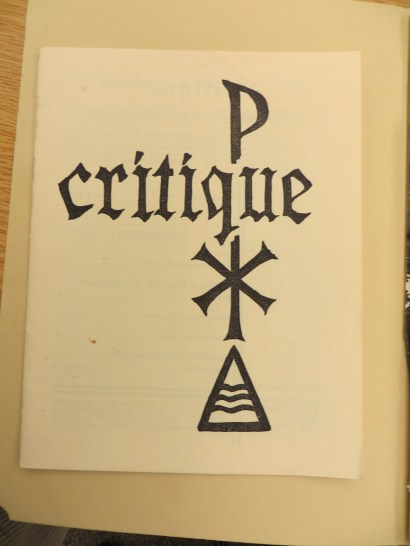
critique student paper BGC

From the archives: student dissent at Wheaton, c. 1963

These crackdowns are not exceptions; they are the rule. Listen to just one more example from 1960. In that year, a faculty committee was empowered to investigate Wheaton’s racial history. The committee decried the way the school’s original anti-racist evangelicalism had been swamped by white supremacist attitudes. The faculty group called for aggressive anti-racist policies.

The administration was sympathetic. Top leaders also wanted to fight for greater racial egalitarianism. But as one administrator at the time put it,

Will some of the parents of our students regard a tacit approval of inter-racial marriage as a danger to their children?

Even asking the question in those terms made the administration’s response clear. Any whiff of danger was unacceptable. They buried the faculty report.

Today’s surprisingly harsh crackdown on student LGBTQ sympathies may seem out of line with Wheaton’s intellectual vigor. It may seem odd for an academically elite school—one that embraces students of all backgrounds, of all nationalities and all races—to crush these seemingly mild and harmless expressions of student LGBTQ sympathies.

We shouldn’t be surprised. They did it decades ago with student and faculty civil-rights activism. They did it decades ago with faculty ideas about progressive creationism. They did it this decade with faculty ideas about God and Islam. And they’re doing it now with student expressions of LGBTQ pride.

No matter what, Wheaton must retain its reputation as a safe campus. For now, the administration clearly believes that LGBTQ pride is outside the boundaries of safe ideas for evangelical youth. Until that changes—until the administration is convinced that a large segment of the evangelical public is cool with LGBTQ pride—the administration will continue its surprisingly harsh no-tolerance policy.

Desperate Times at Bryan College

They might seem like two totally separate things. First, Bryan College awards an honorary doctorate to a young-earth creationist pundit. Second, Bryan’s president conducts some financial hocus-pocus to keep the school officially in the black. They might seem separate, but they are both symptoms of the same deep malaise that plagues Bryan. Moreover, they are irruptions of the perennial life-or-death tension that has always dictated policy at all conservative evangelical schools.

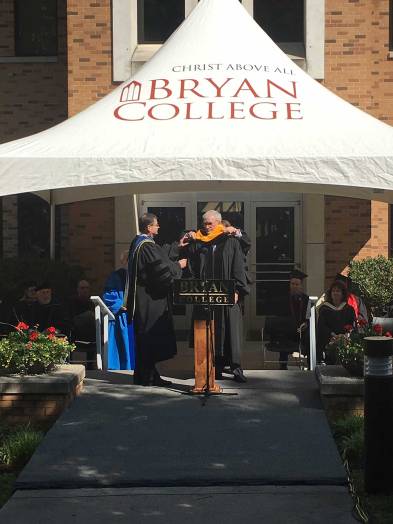
Here’s what we know: Last week, Bryan College awarded an honorary doctorate to young-earth impresario Ken Ham. Bryan President Stephen Livesay praised Ham, saying,

In a day when most of the culture and, sadly, many Christians proclaim a naturalistic worldview, Ken Ham boldly and persuasively argues for a biblical understanding of “In the beginning God.”

At the same time, yet another trustee resigned from Bryan’s board. Wayne Cropp, one of the few trustees who remained after the Night of the Long Knives in 2014, finally had enough. He claimed that President Livesay had sneakily made some real estate transfers to make it look as if Bryan College were in better financial shape than it really is.

Ken Ham hooded at Bryan

I love you but you’re going to boost enrollments…

Now, your humble editor has absolutely no insider knowledge about these goings-on. But based on the research for my current book about the history of evangelical higher education, I can say with confidence that these two events are likely part of the same desperate survival strategy.

In a nutshell, President Livesay is doing whatever it takes to keep Bryan College alive. Like many small colleges in the United States, Bryan is always teetering on the brink of financial collapse. At Sweet Briar, remember, wealthy alumni had to pony up extra just to keep the lights on. Unlike many small colleges, however, Livesay has an extra trump card he can play. And he’s been playing it for years.

In order to attract students with their life-sustaining tuition dollars, Livesay—like leaders at all evangelical colleges—can plant a flag for fundamentalism and young-earth creationism. In Bryan’s case, the school has taken drastic steps to purge any whiff of creationism that doesn’t meet the strict young-earth standards of Ken Ham.

As I discovered in my recent research, the pattern is as old as fundamentalist higher education itself. For example, Wheaton College in Illinois experienced a drastic rise in enrollments when it joined the fundamentalist crusade in the 1920s. Before it became the “Fundamentalist Harvard,” a majority of Wheaton’s students came from Illinois. After it planted a flag for fundamentalist higher education, a full three-quarters of its students came from outside the state. And attendance boomed. Between 1916 and 1928, the college grew by over four hundred percent in terms of student attendance.

It can be a risky game, though. Relying on a reputation as a staunchly fundamentalist or young-earth creationist school can bite schools in the behind. In the 1960s, when Wheaton’s leaders wanted to shake off some of the intellectual baggage of the fundamentalist movement, their enrollment numbers took a huge hit.

In 1964, a total of 8,528 potential Wheaton students had asked for admissions information. Only three years later, that number plunged to only 6,403. Why? Admissions Director Charles Schoenherr had an idea. In a memo to President Hudson Armerding, Schoenherr asked plaintively, “To what extent have rumors about Wheaton going ‘liberal’ hurt?”

Like Bryan, Wheaton relies on reputation to keep tuition dollars coming in. And like Bryan, Wheaton has long relied on honorary doctorates to shore up that reputation. Between 1920 and 1965, Wheaton gave out 180 honorary doctorates.

And the top leadership at Wheaton, just like at Bryan, did not hesitate to use those doctorates to reassure anxious fundamentalist parents. In 1962, then-President V. Raymond Edman wrote to one distressed parent. The parent had heard rumors that Wheaton no longer respected its fundamentalist roots. She had heard that the school had embraced evolution. Was it true? As she put it, “What grieves me most is that our daughter may lose her faith at Wheaton. Is this possible?”

Not in the slightest, President Edman assured her. How could she know for sure? Because prominent creationist Harry Rimmer held an honorary doctorate. Furthermore, Edman told her, the entire faculty at Wheaton were “convinced fundamentalists.”

If you didn’t have a calendar handy, you could simply swap out some names and the story could be from Dayton, Tennessee. Bryan President Stephen Livesay is desperate for dollars. So he gives Ken Ham a hug and a doctorate. At the same time, he rams through an iffy land deal that balances the books, sort of.

The names have changed, but the game is the same. Bryan College is desperate. Like a lot of small colleges, it is running on a financial knife edge. Unlike many schools, though, Bryan has a chance to appeal to a cultural niche market. If Livesay can convince young-earthers that his school is true to their ideas about science and faith, he might just attract enough tuition-paying students to keep Bryan alive. Until then, he’ll have to cook some real-estate books to pump a few more breaths into his campus.

HT: KT

Why Bill Nye Won’t Save the World

I like Bill Nye. I watched his show with my kid. He’s great. I wish he would call me up and we could go eat french fries together. But he won’t save the world, for two main reasons.

On his new show, Bill Nye Saves the World, Nye repeats the same errors about creationism that he has always made. At heart, Nye seems to believe that the main trouble with America is its lack of knowledge about science, our “science illiteracy.” Nye plans to save the world by clearly explaining real science. It won’t work.

On episode five, for example, Nye gives a quick description of the long history of our planet. He even goes out of his way to ridicule the notion of Noah’s ark. Where did life on this planet come from? We don’t know, Nye clarifies, but possibly it blasted in from Mars.

This sort of approach will have only a negative impact on our continuing creation/evolution squabbles. It will do nothing to bring good mainstream science to the creationist multitudes. Its only effect will be to cement them (most of them, at least) even more firmly in their dissident notion of young-earth creationism.

Why will Nye’s approach be so counter-productive? Not only because it is so hokey and strained. As I’m arguing in my current book about American creationism, the main problem comes from two common and related mistakes.

First, Nye falls prey again to the lamentable missionary supposition. Like many science wonks, Nye assumes that the truth—the scientific truth—is so powerful that mere exposure to it will convince people of its truth.

The notion is so remarkably naïve that it is difficult to know where to start. Consider the similar case of vaccinations. If people are simply unaware of the existence and benefits of vaccinations, then providing information will help. Especially if we do it in a fun, entertaining way. But if people already believe that vaccinations are dangerous, and, more important, if they believe that vaccine-promoters will be targeting them with fun, entertaining falsehoods, designed to confuse and beguile them…then we need a different approach.

Creationism, especially in its American young-earth variant, is not merely an absence of knowledge about evolution. Creationism is not a deficit. Creationism is an alternate, dissenting social system, complete with its own schools, textbooks, museums, conventions, TV shows, and celebrities.

And that brings us to the second, related problem with Nye’s approach. Not only is his show not spreading knowledge, it is actually building resistance. Like a lot of science pundits, Nye heightens the religious stakes by talking about “saving the world.” Instead of presenting this as a question of cool-headed deliberation and policy discussion, Nye’s apocalyptic attitude reinforces religious resistance.

In other words, by talking in all-or-nothing terms, Nye gives credence to religious dissenters who insist that religious people have to choose between their religion and mainstream science.

What should he do instead? He should not water down his I-F*$%&@9-Love-Science message. He should not imply that different views are all equal. He should not truckle to religious sensibilities by suggesting that all scientific ideas—even creation-science ones—have the same merit.

But he should learn more about creationism and American creationists. If he did so, he’d find out that there are plenty of creationists out there who also love science. Real, mainstream science. He should establish working alliances with those creationists to marginalize radical notions about creation and evolution. He does not need to endorse any particular view. All he needs to do is point viewers to religious people who agree with him.

Otherwise, he won’t save the world.

Safety Schools: The Exciting Conclusion

Apologies to all the SAGLRROILYBYGTH who haven’t been able to sleep for the last few nights. I know, I know, we’ve all been on the edge of our seats. Well, rest easy: The second part of my argument about Cedarville University is now live over at Righting America at the Creation Museum.

How does Cedarville’s recent purity campaign fit in to the history of evangelical higher education? Check out the exciting conclusion.

Give Creationists Government Rocks!

If you listened only to his press releases, you’d think creationist impresario Ken Ham was the most persecuted man in America, standing boldly in the path of “brainwashed” government leaders set on ruthless atheist indoctrination of America’s creationist kids. Mostly, his puffed-up rhetoric is silly and overblown. In one recent case, though, Ham and his colleagues are exactly right. There is no reason why they should not be allowed to engage in their peculiar science. More specifically, there is no reason why the government should not give them equal access to research materials.

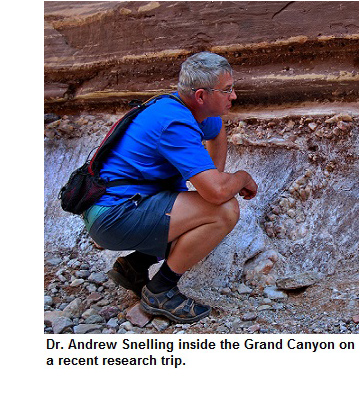
Here’s what we know: Andrew Snelling, a young-earth creationist researcher affiliated with Ham’s Answers in Genesis organization, has been denied permission to remove rocks from the Grand Canyon. Yesterday, the conservative activist organization Alliance Defending Freedom has filed suit on Snelling’s behalf in federal court.andrew snelling grand canyon

The suit alleges that the Department of the Interior unfairly discriminated against Snelling for his creationist religious beliefs. Snelling had hoped to remove about thirty pounds of rocks from the Grand Canyon. He wanted to ship them back to his lab in Kentucky for research purposes.

According to news accounts, Dept. of Interior officials sent his application to mainstream scientists for review. One called Snelling’s creationist research “outlandish.” Another rejected the application due to its “dead-end creationist material.”

Let me be clear: I agree that the science pursued by Snelling is outlandish. It might not be “dead-end,” but it is “zombie science.”

But that does not mean that Dr. Snelling does not have every right to engage in his scientific pursuits. The reviewers in this case seem to have a woefully skewed idea of the proper role of government. According to one report, at least, one of the academic reviewers told the Department of Interior this case was

not a question of fairness to all points of view, but rather adherence to your narrowly defined institution mandate predicated in part on the fact that ours is a secular society as per our constitution.

Of course, that’s not what our First Amendment demands at all. Its two clauses—the establishment clause and the free exercise clause—never demand or even suggest a government role in creating a secular society. Rather, the federal government may not establish a religion. Nor may it inhibit free exercise of religion.

In this case, the government has no mandate to decide if Snelling’s work is secular enough to qualify. Neither the government nor anyone else can say with a straight face that Snelling is not engaged in scientific research. It might be kooky. It might be zombie. But “science” is not subject to a simple demarcation. It’s not a simple matter for anyone to rule something out of the realm of science. It is certainly more than government regulators can hope to do.

What should the Department of Interior do? Let Snelling sample the rocks! Give him equal access to publicly available research materials!

None of this means that the Department of the Interior can never limit the use of Grand Canyon rocks. Obviously, if some scheming entrepreneur wanted to take rocks out of the canyon to sell, he should be denied. Or, if the rocks were extremely rare and fragile—if removing them would harm the canyon—permission should be denied.

Plus, at times the federal government needs to make hard decisions about good science. When there’s federal money on the table, for instance, the government has a duty to choose the best, most promising proposals to fund. So, in this case, if Dr. Snelling was applying for a National Science Foundation grant to pay for his research, it would make perfect sense for reviewers to weigh in on the likely “dead-end” nature of his proposed research.

Similarly, if kids and public education are involved, the government has a similar duty to discern. As Harvey Siegel and I argue in our recent book Teaching Evolution in a Creation Nation, just because we can’t clearly define away creation science as non-science, we can still conclude that it is worse science. We don’t need to include every scientific idea in public-school science classes, only the good ones. And by any reasonable measure Dr. Snelling’s young-earth science is not as good as mainstream evolutionary science.

In this particular case, however, there is no government money on the table. There is no implied endorsement of religious ideas. There are no public schools involved.

So we say: Let Snelling work! Let him study rocks!

Of course, the folks at Answers In Genesis might not like some of the results. If they call for scientific resources to be open for all, they should also open up their one-of-a-kind fossil resources to outside researchers.

Purity Policy at Cedarville U

SAGLRROILYBYGTH are well aware that evangelical colleges tend to insist on stricter rules for student behavior than do secular or liberal schools. Faculty members, too, are held to high expectations for orthodox thinking and behavior. Those tensions are a big part of my new history of evangelical and fundamentalist higher ed.

The goings-on at Cedarville University in Ohio, though, seem to be more extreme than the norm. By insisting on a new definition of “purity” in its curriculum, based on Philippians 4:8, the administration at Cedarville has some evangelical intellectuals scratching their heads in confusion.

righting america at the creation museum

Keeping an eye on Cedarville…

The folks at Righting America at the Creation Museum have been watching Cedarville closely. Recently, they asked your humble editor to offer some historical perspective. Are Cedarville’s new purity rules an odd exception to the usual functioning of evangelical schools?

Today, they kindly published my two cents. (Well, technically one cent. They’ll publish the second half soon.) Check out my argument over at Righting America at the Creation Museum.

Are Cedarville’s purity police something dramatically new? Or just par for the course at evangelical institutions? What do you think? Please head over to RACM to add your insights and comments.

I Love You but You Didn’t Do the Reading

A collection of stories SAGLRROILYBYGTH might have missed this past week from around the interwebs:

From our great neighbor to the north: Alberta’s provincial government stands accused of funneling public money to a school that taught Scientology.  HT: DK

John Fea collected historians’ comments about President Trump’s latest foray into wacky history.

READING goofy washington

Words, words, words…

What’s the real black/white “achievement gap” in public schools? Maybe the problem is that white teachers are not as good as African American ones.

Lots of progressive teachers hate the way the federal government imposed tons of high-stakes standardized tests. Could the Trump administration become their anti-testing friend? California is testing the testing waters.

A new trend? Or a go-nowhere stunt? To alleviate the shortage of STEM teachers, North Carolina’s legislature is mooting a bill to allow college professors to teach in K12 schools without certification or licensure.

Check your calendar: What year is this? A NYC school official is accused of communism, as the New York Times reports.

Senator Mark Green is out. Trump’s creationist pick for Secretary of the Army has withdrawn his nomination, due to criticism over his anti-LGBTQ statements.

Campus protest as a “know-nothing” performance: John McWhorter makes his case at the Daily Beast.

Thanks to all the SAGLRROILYBYGTH who sent in tips and stories.