Trump & DeVos Give Conservatives What They’ve Always Wanted. Sort of.

What have educational conservatives always wanted? As I argue in my 2015 book, it’s not as simple as you might think.

Trump and devos

A gift for educational conservatives…

Today at History News Network, I make the case that President Trump’s latest offering to educational conservative might not be exactly what conservatives were after. Check it out!

Forget Evolution, Sex Ed, and “Christian History.” Here Is the REAL Culture-War Issue in Schools

We Americans can’t stop fighting over our schools. Should we teach evolution? Can we teach kids about sex? Can students read literature that includes “mature” themes? Do schools need to teach kids to be patriots? For at least a century, these questions have roiled our culture-war waters. There is a better way to think about these fights. As we see in a sad recent news story, a profound AGREEMENT about schooling lurks beneath all of our culture-war battles.

The news itself is grim: As reported by the Associated Press, over four years, America’s public K-12 schools logged 17,000 official reports of sexual assault among students. Not only are students targeted by other students, according to the AP story, but schools often downplay the seriousness of the dangers. Legally, schools are required to intervene to protect students. If sexual assaults took place among students, schools could legally be held accountable.
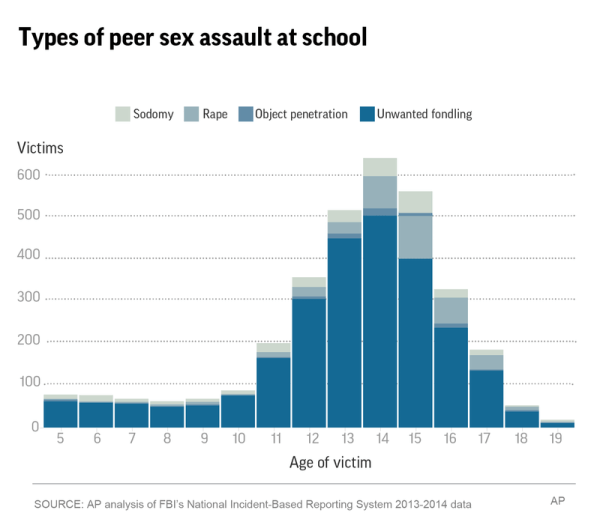
sexual assault at school

A dangerous place…

The story is troubling, but it points to the underlying fact about schooling that undergirds many of our culture-war battles. It is not only in the disturbing field of sexual assault, but in every area. No matter what our ideological or religious beliefs, we all tend to agree on one thing: Schools need to keep students safe. This assumption—often so widely shared that we don’t even need to mention it—has always played an influential role in our educational culture-war fights.

In the sexual-assault story, we see this often-implicit function of schooling come to the surface. As one academic expert said,

Schools are required to keep students safe. . . . It is part of their mission. It is part of their legal responsibility. It isn’t happening. Why don’t we know more about it, and why isn’t it being stopped?

I agree. But for a moment, let’s try to put our strong feelings about sexual assault to one side to consider the implications of this notion. If schools have an absolute mandate to keep children safe, how does that drive our discussions about common culture-war topics such as evolution, racism, and religion?

As I saw during the research for my book about educational conservatism, deeper arguments about student safety often drive the surface arguments about other topics. So, for example, when conservative activists oppose evolution education, they often do so on the grounds that evolution is a dangerous idea for kids. And, when progressives argue in favor, they say that students will be dangerously ignorant if they don’t learn real science.

Consider a couple of examples from 1920s battles over evolution education.

The fight in the 1920s began in earnest on the campus of my alma mater. Anti-evolution activist William Jennings Bryan wanted to clamp down on evolution education at the University of Wisconsin. Ever the sensitive populist, Bryan articulated one anti-evolution argument that played on this notion of student safety. If Wisconsin continued to teach evolution, Bryan noted sardonically, it should attach warning signs to each of its classrooms. What would they say?

Our class rooms furnish an arena in which a brutish doctrine tears to pieces the religious faith of young men and young women; parents of the children are cordially invited to watch the spectacle.

Pish-posh, evolution advocates responded. Savvy progressive politicians attacked the notion that learning evolution was somehow unsafe. As Fiorello LaGuardia argued in 1924, the only way to make sure that students were “safe in schools” was to make sure they were “learning to think.” Banning evolution, LaGuardia argued, was only “hysteria” that would hurt children.

The same assumptions about student safety energized school battles throughout the twentieth century. In the explosive school fight in Kanahwa County, West Virginia in the 1970s, for example, both sides assumed that schools must keep students safe. They disagreed about what that meant. Conservatives often argued that a new set of textbooks put students in danger, since the new books mocked traditional religion and threatened students’ souls. Progressives insisted that the new books kept students safe by helping them see different perspectives and encouraging them to think critically about religion.

At one turbulent school-board meeting in Charleston in 1974, activists made familiar arguments about student safety. The meeting was crowded. Speakers had to sign up in advance. The crowd booed progressives and cheered conservatives. Conservatives often suggested that multicultural textbooks threatened students by deriding their religious beliefs and eroding their faith. Progressives countered that students could only be kept safe by learning about people different from themselves.
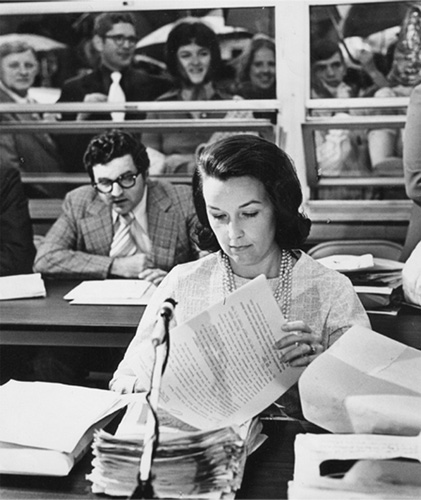
Figure 5.1

Conservative leader Alice Moore at the packed 1974 school-board meeting.

For example, from the conservative side, PTA member Rory Petrie warned that the new books were “very objectionable” because they were “very subtly . . . undermining the religious beliefs of our children.” Similarly, concerned parent Robert Steckert warned that the books threatened his kids when they “cast doubt and skepticism upon my child.”

Progressives agreed on the goal of student safety. But they came to the opposite conclusion. Real student safety meant more, not less, cultural diversity. In order to keep students safe, the school board needed to make sure every student encountered different cultural perspectives. As one progressive parent and former teacher put it, the world was a complicated place. If students didn’t learn about the true diversity out there, they would be in danger. Yes, the real world could be a scary place, but the solution was not to be found in telling students that it was not. School needed to teach students about reality. As this parent put it, “we cannot hide it from our children.”

Another progressive activist from the West Virginia ACLU agreed. Students would be in danger unless they learned about the real world. Students needed to learn that different people saw things differently; students would only be safe if they acquired an “understanding of why people and groups of people are different.”

In all these school fights, whatever the apparent topic, the notion of student safety was paramount. All sides agree that students must be kept safe. All sides used the notion of danger to mobilize support for their positions.

And it continues today. When you hear rumblings of a culture-war battle in school, listen for it. Whether activists are ranting about sex ed or school prayer, evolution or Christian history, someone is sure to say it: Only my side will keep students safe.

What Goes On in Medical School?

HT: MM

It’s probably nothing. But the latest in-your-face conservative pick by President Trump adds one more leg to the stool. Is there some reason why so many prominent radical creationists are medical doctors?

mark green

Creating a modern military….

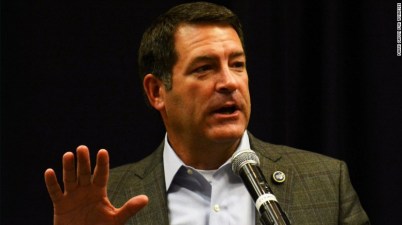
Tennessee Senator Mark Green is only the latest. He is awaiting confirmation hearings to become Secretary of the Army. He’s already taking some heat for his official proclamations about gender and sexuality. In 2015, he delivered a fiery creationist sermon to a Cincinnati church.

For those of us who keep track of such things, Senator Green apparently emphasized two favorite notions of twenty-first century creationists. He insisted that the second law of thermodynamics militated against evolution. Since entropy increases over time, the argument goes, things won’t get more organized over time, but less.

As Green put it,

If you put a lawn mower out in your yard and a hundred years come back, it’s rusted and falling apart. You can’t put parts out there and a hundred years later it’s gonna come back together. That is a violation of a law of thermodynamics. A physical law that exists in the universe.

Green also embraced the “irreducible complexity” argument beloved by today’s intelligent designers. As articulated by biochemist Michael Behe, this argument points to some organic systems such as blood-clotting. If the entire process needs to be in place in order to confer any evolutionary benefit, the argument goes (roughly), then it makes no sense for it to have evolved in pieces.

We don’t want to argue the merits of these creationist arguments here. Our question this morning is different. In his 2015 Cincinnati sermon, Senator Green claimed to be an expert about the scientific weaknesses of evolutionary theory. On what grounds? Because of his work and training as a medical doctor.

It’s not much to go on, but there certainly seems to be a mini-trend involved here. Senator Green joins other prominent doctor/creationists in politics. Most obviously, Secretary Ben Carson rose to prominence as a young-earth creationist and pediatric neurosurgeon. Representative Paul Broun of Georgia, too, headed the House science committee, hated evolution, and claimed that his “scientific” education as a medical doctor had convinced him of the weaknesses of evolutionary science.

What is going on here? One might think that medical training would weed out creationist thinking. Most medical doctors, after all, study lots of biology. And, as the man said, nothing in biology makes sense except in the light of evolution.

Again, our sample of only three prominent doctor/creationists isn’t large enough to prove anything, but it does raise the question. Why do so many of our prominent creationists come from the field of medicine?

One answer would seem to be that medical doctors can claim the prestige of science without actually doing any pure scientific research themselves. They can claim to be experts, but they really are more interested in the mechanics of biology than the driving processes.

As anthropologist David Long found in his study of undergrad bio majors, it is very easy to study biology and remain a committed young-earth creationist.

Clearly, as the case of Senator Green reminds us, simply learning more biology will not convince people out of their creationist beliefs. Just like other prominent doctor/creationists, Dr. Green’s creationism is something besides a lack of knowledge about mainstream science.

Round Peg, Square Hole

What is the proper role for religion in American public schools? That’s the question historian Ben Justice asked us yesterday at the American Educational Research Association meeting. I’m still stumped. I can’t see an easy way to reconcile the fundamental tension between two contrasting goals.

round peg square hole

It ain’t gonna fit.

SAGLRROILYBYGTH may remember the first episode. If you don’t, here’s the catch-up: Historian Ben Justice put together a panel to wrestle with the proper role of religion in public education. Religious studies scholars Stephanie Mitchem and Mark Chancey joined in, as did philosophers Colin MacLeod and Harvey Siegel. And me.

Our panel agreed—public schools need to teach about religion without teaching religion. And public schools need to be inclusive religious spaces. That is, public schools need to welcome people of every faith and none, but they can’t themselves promote or denigrate any specific religion. Sounds simple enough.

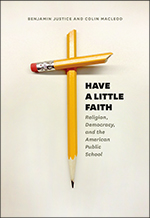
But there have always been disagreements and likely always will be. How do we solve them? As Colin and Ben wrote in their recent book, when it comes to questions of majority rule and minority rights, we’re not all going to agree on every problem. Our goal, instead, should be “legitimacy in the face of religious pluralism.”

In other words, people don’t have to agree with various school policies. If they see them as fair, however, as legitimate, then they will go along with them. And that brings us to our dilemma.

For some religious people, the notion of “inclusive” public schools is not a way to talk about the proper role of religion in the public square. Rather, for many Americans, “inclusivity” is itself a religious idea. So instead of having conversations about how we can all be welcomed in our public schools, we end up with a fight between two religions, only one of which admits to being a religion.

Clear as mud.

But it seems a little clearer when we look at examples. We see it everywhere we look. Consider a class in the history of religion, for example. In an inclusive school, a teacher might teach kids about the development of Hinduism, Buddhism, Judaism, Christianity, and Islam. She might explain to kids—trying to be neutral, trying not to favor any religion or non-religion over another—about the ways different people at different times believed different things about God and humanity. She might describe the ways Christianity grew out of Judaism, the way different Christians came to disagree with one another. Her goal, she would probably tell you, is not religious. She doesn’t want to preach; she only wants to teach.

For some parents, students, and activists, though, such a curriculum is not neutral at all. They might reasonably want their children to share their belief that their religion is true. For many religious people, the universal claims of their religion are absolutely central. That is, many religious people need to understand their faith as True with a capital T, not only true for them at their specific historical moment.

For religious people like that, a school curriculum that thinks of itself as neutral is not neutral at all. It is teaching, instead, the intensely religious idea that religion is a human invention rather than a divine revelation.

This is more than just an abstract game of what ifs. As SAGLRROILYBYGTH know well, in the last hundred years American Protestants split on exactly this sort of disagreement. Liberal Protestants often embraced the notion that their religion was a human creation, or, to be more precise, that their own understanding of religion was a human thing. Conservative Protestants, including those that mobilized as “fundamentalists,” disagreed. Vehemently.

For evangelical Protestants, the notion of an inclusive public square has always been the enemy. It has always been the rallying cry of their religious enemies. As I’ve argued in my 1920s book and my book about educational conservatism, religious conservatives—especially but not only conservative evangelicals—have learned for generations that the fight against “inclusion” was a religious fight against a religious enemy.

So how can we get people to think of “inclusion” as a legitimate goal? It will never be seen as legitimate if it is seen as a strategy by a competing religion. What then?

I Love You but You Didn’t Do the Reading

Up here in the wilds of upstate New York, Spring has finally Sprung. Your humble editor abandoned his computer screen to poke his nose outside of his cave this week. Nevertheless, stuff kept happenin. Here are some of the stories we might have missed this week…

Does American education willfully neglect the needs of smart kids? That’s the argument Pratik Chougule makes this week at The American Conservative.

reading cat

Words, words, words

When are public-school Bible classes problematic? When they ask kids to imagine Adam & Eve frolicking with dinosaurs. We see yet another case this week. This time, it’s from West Virginia, as reported in WaPo.

You’re sick of hearing about the “Benedict Option” for conservative religious folks. Well, how about the “faithful compromise” of a Daniel Option?

New York City just went all in. Conservatives typically denigrate the effectiveness of government preschool programs. Who’s right? A new nerd report from Brookings highlights our knowledge about pre-K effectiveness.

What Should Religion Do in Public Schools?

With apologies to Yogi Berra, I’ll steal his line in this case. I’m heading down to the annual meeting of the American Educational Research Association in San Antonio. It’s the big one for education wonks and nerds. And it’s a zoo. Like Yogi said, no one goes there anymore, it’s too crowded.

crowd

Pardon me, sir, you’re stepping on my PhD.

Why would anyone brave such crowds, heat, and academic foolery? In my case, I’m going because we’ll have a chance to wrestle with the most interesting question in the world: What is the proper relationship between religion and public education in the United States?

A panel of experts was put together by one of my all-time favorite ed historians, Ben Justice. He and his co-author Colin MacLeod just published a terrific book about religion and school. They invited me and my recent co-author Harvey Siegel. We rounded up a few more experts, including Stephanie Mitchem and Mark Chancey.

have a little faith

And you got your church all over my school…or did you get your school all over my church?

I’m looking forward to the discussion. As SAGLRROILYBYGTH are painfully aware, these are questions that keep me up at night:

  • Is it fair to creationists to force their children to learn an idea that they find religiously objectionable?
  • Do conservative evangelical Protestants have any special rights in public schools? If everyone in a town is the same (evangelical Protestant) religion, is it okay for the schools in town to lean that way, too?
  • Are public schools really hostile to religious belief? Conservatives often howl that schools are cesspools of “secular humanism,” but are they really?

And so on.

Each of us only gets a few minutes to say some things, then we’ll open up the room to a wider discussion. I’ll have a hard time keeping my opening presentation short, but I’ll try.

Watch this space—I’ll be sure to fill you in on how it all goes down.

Hoaxing at the End of the World

What happens when we can’t tell the intentionally preposterous from the incidentally ridiculous? Does it mean we’ve reached the end of our rope? When we can’t tell hoaxes from reality, it serves as yet more evidence that we don’t have any solid way to judge.

Most recently from my adopted home state of Wisconsin, we see the hilarious story of Chop & Steele. These two goofs pretended to be innovative fitness instructors. They went on local TV news shows to demonstrate their stupid workouts, including smashing Easter baskets, hitting each other with sticks and racquets, and doing a variety of things with tires. As Steele explained about one maneuver: “This one works your delts, your tris, your plaps.”

Work those plaps.

It was hilarious and obviously ridiculous. But the news shows couldn’t tell. They welcomed Chop & Steele as fitness experts. And now they’re mad. Chop & Steele are being sued for their fakery.

The local TV news shows aren’t the only ones who look idiotic. As SAGLRROILYBYGTH may recall, the academic world was embarrassed by a similarly ridiculous hoax twenty years ago. Professor Alan Sokal at NYU published a garbled nonsense essay in the journal Social Text. As Sokal explained later, his satire was an attempt to prove how ridiculous academic politics had become. The fact that his nonsense essay could be published, Sokal wrote, proved that “some fashionable sectors of the American academic Left have been getting intellectually lazy.”

No one likes to be goofed on. It seems, though, that when satire moves so close to reality, we’ve reached some sort of sad equilibrium.

Forget Benedict, It’s the DeVos Option

You’ve heard it by now: Rod Dreher is pushing a “Benedict Option” for religious conservatives. He wants the good people of America to pull back from mainstream society into purer enclaves. When it comes to our long-simmering creation/evolution debates, that sort of BO has never really been necessary. And Trump’s latest executive order makes it even less so. Why would creationists retreat when they’ve already won?

berkman plutzer REAL chart

Traditional schools, traditional teachers, traditional “science”

In case you haven’t seen it yet, President Trump has continued his charm offensive with America’s conservatives. In his latest executive order, he has promised conservatives something they have long yearned for: greater local control of public education. Ed Secretary Betsy DeVos will conduct a 300-day study into the issue. She is charged to find ways to limit the influence of the federal government in local schools.

As DeVos crowed, this order gives her

a clear mandate to take that real hard look at what we’ve been doing at the department level that we shouldn’t be doing, and what ways we have overreached. . . . And when it comes to education, decisions made at local levels and at state levels are the best ones.

Obviously, there are enough dog-whistles in there to win an Iditarod. Conservative activists have long yearned to shackle the federal education bureaucracy. As I argued in my book about the history of educational conservatism, since the 1930s conservatives have looked askance at federal control of local schools. Time and time again, distant experts have advocated more racial integration, more evolution, and more multiculturalism in K-12 schools. Time and time again, state and local officials have pushed back, fighting for more religion, more segregation, and more traditionalism.

In the specific case of evolution and creationism, creationists have always worried that outside control meant more evolution. Back in the 1920s, for example, anti-evolution leader William Jennings Bryan railed endlessly about the infamous influence of outside “oligarchs” on local schools. The local hand that wrote the paycheck, Bryan insisted, must rule the schools.

Bryan wasn’t alone. In North Carolina, anti-evolution activists blasted their university president for pushing evolution into their flagship public state university. President Harry Chase, they charged, was nothing but a “damn Yankee,” messing up local schools by importing “modernists, Darwinian apologists, and Northerners.”

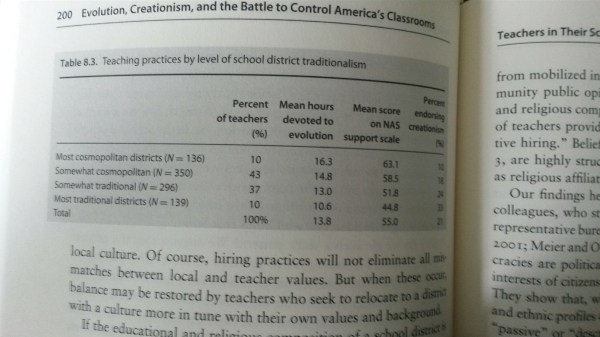
In the case of evolution education, though, creationists have always had the last laugh. Yes, conservatives have worried about the influence of outside experts. But in most schools, as political scientists Michael Berkman and Eric Plutzer found, local values dominate. Local attitudes were the most important factor, they found, in determining how much creationism was taught in public school science classes. As they put it,

Traditional districts and cosmopolitan districts tend to hire teachers whose training, beliefs, and teaching practices serve to reinforce or harmonize with the prevailing local culture (pp. 199-200).

In communities that favor creationism, teachers teach it. In communities that are on the fence, teachers mumble about it.

So why would creationists ever want to retreat to Benedictine purity? They have already won. And, as Secretary DeVos promises even greater local control, creationists have even more cause to celebrate. As young-earth activist Jay Hall put it recently, “we support the efforts of the new Education Secretary Betsy DeVos to promote school choice.”

More choice plus more local control equals more creationism.

So, though there are plenty of other reasons for conservatives to head for the hills, evolution education ain’t one of em. Local schools have always allowed local creationists to dictate the goings-on in most science classes.

And Secretary DeVos’ new local imperative seems destined to only make local creationist control stronger.

I Owe, I Owe

It was a squeaker, but it worked. I promised my editor I’d deliver the manuscript for Fundamentalist U by Monday, and I just mailed it in today. Coupla days to spare. Whew!

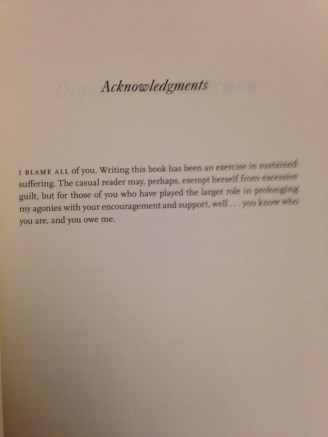
If I were cooler, I would copy Brendan Pietsch’s world’s-coolest acknowledgements page. But I’m not. I’ve accumulated a bunch of debts—financial, intellectual, and otherwise—and I feel a need to express my gratitude the ol-fashioned way.

pietsch acknowledgements

How the cool kids do it these days…

First, the Spencer Foundation footed the bill. Their program for small research grants allowed me to spend the academic year 2014-2015 working full time on this book. I was able to travel to six of the schools I’ve been studying. Without this grant, I would never have been able to put this book together. Thank you Lyle!

There are plenty of other people that also made the book possible. Most important, the archivists at the schools I visited often bent over backward to help me find materials. At Biola, for example, Stacie Schmidt and Sue Whitehead allowed me to work right in their office. They also helped me get permission to use some of the cartoons from Biola’s periodicals that will appear in the book.

At Wheaton, Keith Call helped me find a ton of stuff. He also spent time sharing with me his one-of-a-kind experience with and knowledge of the world of evangelical higher ed. Since my visit, too, he has kept me in the loop about some of the goings-on at Wheaton and elsewhere.

Robert Shuster at the Billy Graham Center kept the room open late for me and helped me dig through the vast resources of their oral history collections. I depended on those oral histories to find out what life was like at fundamentalist colleges for students.

Down South at Bob Jones University, Patrick Robbins over-extended himself to help me locate materials. He has been doing so for years and I’m extremely grateful.

In Chicago, Corie Zylstra and Nikki Tochalauski allowed me to linger late in the Moody Bible Institute archives. They also shared their experiences as students and workers at the most famous Bible Institute in the world.

Even at schools I couldn’t visit in person, friendly archivists were willing to spend time and energy talking to me about my research. At the late Tennessee Temple University, for example, Keith Woodruff took time and risked carpal tunnel syndrome emailing back and forth with me.

One of my local schools, Summit University (the former Baptist Bible of PA) let me use their terrific collections of fundamentalist and evangelical periodicals.

It didn’t work, but I appreciate the efforts of two of my academic heroes, Jon Zimmerman and Ron Numbers, to try to help me get an additional fellowship to fund my work on this book.

And when it came to the book itself, my fellow nerds helped me out enormously. Most especially, Tim Gloege and Dan Williams read several parts of the book and helped me with their enormous expertise. I also conned a group of A-list experts to help me improve the book. The book covers a lot of territory, so I shamelessly braced friends, acquaintances, and even people I only knew by reputation.

First, I reached out to higher-ed historians such as Roger Geiger, Christopher Loss, and Ethan Schrum. The book also wrestles with questions of the nature of conservative evangelical Protestantism, so I asked Molly Worthen, John Fea, Bill Trollinger, and Brendan Pietsch for expert help. There’s a lot about creationism in there, too, and Ron Numbers and Michael Lienesch agreed to read sections and point out my blunders. Then, of course, there are the group of experts specifically in the history of evangelical higher education and I asked them all for their time: Jared Burkholder, Michael Hamilton, and Chris Gehrz. To top it all off, I also pestered other smart people I knew to give me their opinions, including L. Herbert Siewert, Tim Lacy, and David Bernstein.

Thanks to all…but that’s not all. I’m also grateful to all the SAGLRROILYBYGTH for taking part in our conversations about evangelicalism, college, fundamentalism, conservatism, and etc. etc. etc. over the past few years.

What happens next?

It will still be a while before the book hits shelves. The folks at Oxford will give my manuscript some copy-editing. Then they’ll put together a set of proofs, set as the actual pages will look. Once we get to that stage, I’ll pore over the proofs to write my index.

It all takes time and patience. When will the book finally be published? Hard to say exactly, but it’s usually about twelve to eighteen months. I’ll keep you posted.

Could This Happen at an Evangelical College?

As John Leo reports at Minding the Campus, Professor Anthony Esolen is under pressure. He’s accused of being “racist, xenophobic, sexist, homophobic, and religiously chauvinistic.” He says he’s just being truly Catholic and accuses his Catholic college of straying. As I finish up my book on the history of evangelical and fundamentalist higher education, the story brings a question to mind: Would this—could this—DOES this happen at evangelical colleges?

For those who are outside the orbit of Catholic higher education, let’s start with an inadequate primer: The Catholic Church and its schools include several different orders. Many Catholic colleges, including famous ones such as Georgetown, Boston College, and Marquette, are run by the Jesuits. Other big names, such as Catholic University and Notre Dame, are run directly by the Church. Esolen’s Providence College is Dominican. All of them are Catholic, but they have different bureaucracies and different ways of doing things.

Anthony-Esolen

Plus Catholique que L’Administration?

Why does it matter? Each order has its own history and its own theological, cultural, and educational traditions. Some tend to be more conservative; some more liberal. As a very loose and general rule, American Jesuits and Franciscans tend to be more liberal when it comes to some things. Dominicans, in my very limited experience, tend to be more conservative. But it varies enormously.

At his Dominican school, Anthony Esolen thinks that the Dominicans are not being nearly conservative enough. As he has complained,

The dirty not-so-secret is that the same people who for many years have loathed our Development of Western Civilization program — the focus of curricular hostility — also despise the Catholic Church and wish to render the Catholic identity of the college merely nominal.

In a lot of ways, it sounds like the perennial tensions at evangelical colleges. Since the early 1960s, market pressure among evangelical and fundamentalist colleges has been so great that any rumor of faculty heterodoxy at evangelical schools has been ferociously squelched by school administrators. In other words, in their life-or-death struggle to attract as many students as possible, administrators at evangelical colleges have worked hard to shut down any whiff of liberalism among their faculty. They have been terrified of alienating conservative parents and losing their tuition dollars.

And school-watchers know it. Conservative and fundamentalist critics—including trustees and celebrities—have scrutinized the goings-on at evangelical schools with a gimlet eye. In many cases, they have threatened to publicize the liberalism of evangelical schools, hoping to cow administrators into cracking down. Time and time again, evangelical administrators have taken drastic action to head off any accusation that they are no longer trustworthy.

It sounds as if Professor Esolen is working from a similar playbook. As he said on Facebook recently, “It is no longer clear to me that Providence College would qualify as ‘worth attending’.”

In the world of fundamentalist and evangelical higher education, these sorts of enrollment threats carry a great deal of weight. Young-earth creationist Ken Ham, for example, has been able to push schools to shore up their creationist credentials by wondering, in effect, if some evangelical schools are still worth attending.

But here’s where I’m puzzled. Have evangelical schools had to wrestle with professors who are too conservative? Too creationist? Too fundamentalist?

I can think of a few cases, but nothing seems perfectly analogous.

For example, take the story of Gordon Clark at Wheaton. Back in the 1930s, Clark had a sterling resume, with an Ivy League PhD. Wheaton College was happy to have him, for a while. Clark’s ferocious Calvinism, however, sat roughly with Wheaton’s interdenominational, big-tent-evangelical tradition. Clark pooh-poohed the emotional revivalism so popular among Wheaton’s students. In 1943, for instance, he dismissed a campus revival as mere “mass psychology,” not true salvation. And he disdained a popular evangelical method of Bible reading, the dispensational approach. So Clark didn’t last at Wheaton.

It’s sort of similar to Esolen’s case, but not exactly. Professor Clark never accused Wheaton of abandoning its evangelical tradition. Rather, Clark wanted evangelical students to be more rigorously conservative, more systematically Calvinist. But Clark never thought Wheaton had abandoned its Calvinist roots, because it hadn’t. Professor Clark understood that Wheaton shared the perennial problem of interdenominational evangelical schools everywhere: They wanted an impossibly generic orthodoxy.

On the campuses of evangelical colleges and universities, we mostly hear about professors who get in hot water for being too liberal, not too conservative. Most recently, for example, the case of Larycia Hawkins comes to mind. She was booted (yes, she was booted, no matter that she officially agreed to depart on her own) for wearing a hijab, bragging about it, and proclaiming that Muslims, Jews, and Christians all worshipped the same God.

For all you SAGLRROILYBYGTH out there who know the world of evangelical higher education better than I do….am I missing something? Are there other conservative professors who get in trouble for being more fundamentalist than their evangelical schools? Could Professor Esolen’s dilemma be repeated on an evangelical campus? HAS it been?