Badger Bound!

When conservative activists have won their battles about public education, how have they won? I’m excited to make my case next Monday at my alma mater, the University of Wisconsin in Madison.

bucky badger

Thanks, Bucky. It’s great to be back!

Thanks to an invitation from my grad-school mentor William J. Reese, I’ll be traveling to sunny Madison, Wisconsin this week to talk about the history of conservatism and American education. SAGLRROILYBYGTH are well aware that I explored this history in my second book, The Other School Reformers (Harvard University Press, 2015).

In that book, I wondered what it has meant to be conservative about education in these United States. It’s not as simple a question as it seems. Some conservatives want one thing, others want another. Most people–whether they consider themselves conservative or not–don’t have crystal-clear ideas about what they want out of schools.

In my talk next week, I’ll share some of that research, but I’ll also expand it to include my more recent findings. In short, I think that conservatives have won NOT by proving their case for conservative values and ideas, but rather by doing something else.

What’s the “something else?” Well, you’ll just have to come to Wisconsin on Monday to find out. Good seats still available: Monday, October 14, 12:00, Education Building room 245.

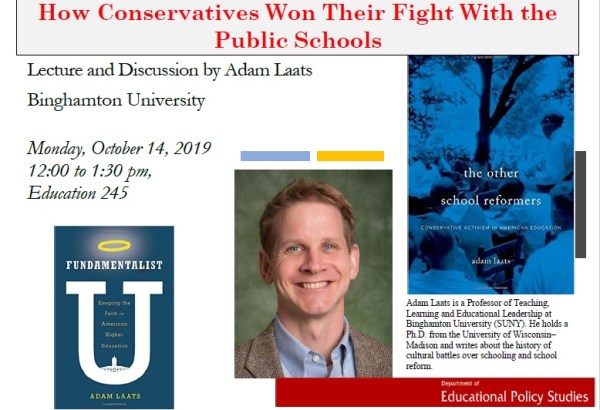
madison talk flyer

A Dangerous Payday for Evangelical Colleges?

Is it worth it? Evangelical college-watchers are agog about a huge new donation to Gordon College in Massachusetts. I have to wonder if this is part of a new culture-war playbook for evangelical higher ed. Will the hidden costs of this largesse end up being too steep? After all, back in the 1960s, Gordon’s faculty turned down this kind of financial support.

Here’s what we know, and it’s not much: Christianity Today reports an anonymous donation of $75.5 million to Gordon. As CT describes, this is a very unusual event in the world of evangelical higher education. Only a handful of evangelical universities have ever received gifts this large.

As SAGLRROILYBYGTH will recall, this comes on the heels of Gordon’s recent belt-tightening announcement. Last May, Gordon restructured its academic offerings. Faculty were let go, budgets were cut. It wasn’t a stretch to wonder how long Gordon would survive.

Now, for a little while at least, the financial wolf seems to have been chased from Gordon’s door. We don’t know why, but it seems fair to assume that the anonymous donor wanted to see Gordon continue its evangelical mission.

We’re only guessing, but it seems reasonable to assume that the donor might have shared the belief that Gordon played a unique role in its region. As CT described,

[Gordon]’s both a well-known liberal arts college among Christians and an evangelical bastion in increasingly secular New England, surrounded by some of the most competitive, prestigious universities on the planet.

“We’re, respectfully, a city on a hill in this part of the world,” [President D. Michael] Lindsay said. “When our chapel services meet, it’s one of the largest gatherings of evangelical Christians in the Northeast. We’re the largest evangelical employer in six states.”

I agree with President Lindsay. His school really does represent a lonely conservative evangelical voice in the Boston metro area. Under his leadership, Gordon has tacked in more conservative culture-war directions. Five years ago, President Lindsay affirmed Gordon’s established policy against sex outside of heterosexual marriage. And at the time, some conservative evangelicals offered Lindsay some advice that turned out to be prophetic. As one conservative writer wrote in 2014,

To Michael Lindsay, the gifted president of Gordon, and to the board of trustees, I remind you: Many eyes are watching you, knowing that the decisions you make could either strengthen or dishearten many other schools that will soon be put under similar pressure.

I have no idea who Gordon’s anonymous benefactor might be, but I can’t help but wonder: Is this huge gift meant to keep President Lindsay’s evangelical “city on the hill” alive and kicking? …to maintain a conservative evangelical citadel in New England? Was the donor one of the many people watching Lindsay back in 2014, and is this donation a result of Lindsay’s conservative stances?

If so, it presents a difficult dilemma for evangelical college leaders worldwide. Yes, taking a firm political stand might earn you huge donations like this one. But they also change inexorably the mission of your school. Instead of focusing primarily on educating young people in evangelical ways, Gordon might now be tempted to organize itself in ways that satisfy big culture-war supporters.

Again, all this is pure speculation at this point. However, none of it seems outlandish. And the danger is clear: If evangelical colleges tack to the political right to attract big donors, will they be able to continue their traditional mission of providing excellent liberal-arts educations to new generations of evangelical students?

In the twentieth century, the faculty at Gordon College rejected attempts to transform their school into a merely politically conservative institution. Today, the power on Gordon’s campus has clearly shifted. Will Gordon and other evangelical colleges resist the allure of a big payday, if it means watering down their traditional liberal-arts focus?

I’ll Give You $1,000,000 if This Creationist Plan Works

Here comes Halloween, and in the USA that means giving out candy to neighborhood kids who come to your door dressed as Elsa. The radical creationists at Answers in Genesis have offered their fundamentalist friends a way to spread the gospel among trick-or-treaters. Can we put aside our differences about creationism and evolution for a second just to consider this simple question: Would any child REALLY prefer a creationist tract to a candy bar?

First, a little background: Like a lot of super-conservative Christians, the folks at Answers in Genesis are nervous about Halloween. They warn that this holiday can turn children’s heads and embroil them in the very real dangers of witchcraft and Satanism.

AIG money treats

Want some candy? How about these tracts instead?

What can Christian parents do? AIG suggests giving out tracts featuring dinosaurs and fake million-dollar bills. As AIG leader Ken Ham enthuses,

Kids love these, and it’s a fun way to share the gospel—something worth far more than a million dollars!—with children and their families.

Ken Ham and I disagree on a lot of things, but this just might be the simplest, starkest disagreement we’ve had.

“Kids love these”? Really? I can’t imagine many kids being excited to receive a fake million dollar bill instead of a Kit Kat or Twix. If I were a creation-evangelist, the last thing I would do is replace candy with fake money and creationist propaganda. I can’t imagine a better way to turn kids AWAY from the radical-creationist message.

Would You Fire This Teacher?

So…would you do it? If you were the principal of his school in Waterloo, Iowa, would you fire a teacher for saying this on Facebook? And, tougher question: Would you fire a teacher if they said similar stuff about someone you despise?

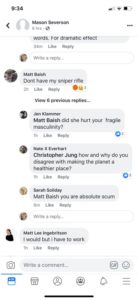
baish teacher greta sniper rifle

Sarcasm? Threat? Free speech?

Here’s what we know: According to the New York Times, chemistry teacher Matt Baish has been put on leave following a Facebook comment. A former student asked who was going to see Greta Thunberg speak at a climate-action rally, and Baish replied,

dont have my sniper rifle

Baish was suspended while the district decides what to do about him.

What do you think they should do? Is this kind of statement an obvious cause for termination? Seems like it to me. After all, this is more than a mere political statement. On its face, this is a threat. To my mind–and I’m guessing lots of people disagree–a high-school teacher who spouts off like this shouldn’t be trusted to teach, even if he says he was joking.

But to be fair, we should consider the reverse as well. If you agree with me about this case, what if you had a teacher in your building who made a sarcastic threat about someone like Donald Trump? Would that be cause for termination?

I Love You but You Didn’t Do the Reading

Impeachment in classrooms, impeachment among evangelicals…and a few stories NOT about impeachment this week, too.

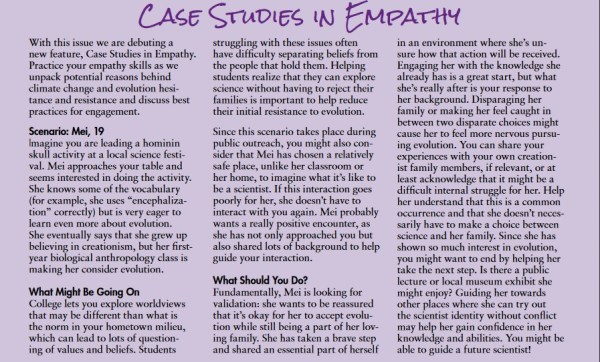
How can Smithsonian tour guides defuse anger about good science? At RNCSE.

most volunteers make a rookie mistake: they focus on what their response should be, rather than taking the time to understand the values and fears of the person they’re speaking with. Often, this takes the form of focusing on communicating the science. While effective and accurate communication of science is a crucial element, it is not enough to reach the most skeptical populations. By taking time to assign real human emotions to the visitors, volunteers can better empathize and use this newfound understanding to decide the best way to share their evidence.

Impeachment in the classroom:

Imagine, for example, a project in which students listen to the Nixon tapes and make the case for and against impeachment in that historical context. Students might research impeachment’s constitutional context as a congressional power and how the Founding Fathers saw this process as a safeguard for democracy.

Teachers might worry about taking on such a controversial political topic, either because they don’t have time for it in a packed regular curriculum, or because they worry about the discussion getting out of hand, possibly angering parents and administrators. But there are ways to treat this as a learning opportunity rather than a political smackdown, especially because many students may raise the news in class and look to teachers for clarification.

Historian Peggy Bendroth wonders why mainline Protestant women didn’t act angrier, at RA.

I am beginning to think the psychological issue isn’t actually mine at all—it’s those churchwomen I’m trying to write about, ladies with pillbox hats and big corsages, smiling gamely from the pages of denominational magazines. How can you tell a compelling human story with so much of its emotional valence buried out of sight?

I cannot believe that they were not angry—i.e., furious beyond measure at being belittled, patronized, and ignored, many years of education and prodigious talents wasted, while they watched feckless male bureaucrats rise through the ranks and then write books about their own accomplishments.

bendroth RAWill the impeachment investigation push some white conservative evangelicals closer to Trump? At AP.

“I do feel like we are, as Christians, the first line of defense for the president,” Christina Jones, 44, said before [Franklin] Graham took the stage. Trump is “supporting our Christian principles and trying to do his best,” she added, even as “everybody’s against him.” . . . In the crowd at Graham’s tour, which will stop in six more North Carolina cities over the next 10 days, believers had reserved their concern for Trump’s Democratic antagonists. “They’re just digging things up and making things up just to try to take him down, and I don’t think that’s fair,” said Mike Fitzgerald, 64.

Students know the rules about prayer in public schools, but many don’t care. At PRC.

Nationwide, roughly four-in-ten teens (including 68% of evangelical Protestant teens) who go to public school say they think it is “appropriate” for a teacher to lead a class in prayer. Some of the teens who express this view are unaware of the Supreme Court’s ruling. But most know what the law is; 82% of U.S. teens in public schools (and 79% of evangelical teens) correctly answer a factual question about the constitutionality of teacher-led prayer in public school classrooms.

Federal judge rules in favor (again) of campus Christian groups, at IHE.

When is “Bring Your Bible to School” Day? Every day, at R&P.

Bringing a Bible to school (public or private) is a legal, common, and regular practice in the U.S. . . . The federal government protects this right, unequivocally. Hindrances in the U.S. to the practice of Christian religious freedom are rare, usually stem from confusion around school policy, and are often quickly resolved.

It might take more than 6,000 to figure out all the financial connections. New Yorker story unpicks the connections between real-estate deals, Congressmen, dinosaur fossils, and sad homeschool “research” trips. HT: CS.

What is school reform like? Larry Cuban reviews the metaphors. Jalopy? Or old house?

Over the years I have used the image of a jalopy.

Incremental change means sanding and re-painting the old car. Getting a tune-up, new tires, and replacement car seats for the torn ones–you get the idea.

Fundamental (or transformational or radical) change, however, refers to giving up the car and getting a different kind of transportation–biking, bus or rapid transit, walking, car pooling, etc.

“Court evangelicals” and the culture of fear, at TWOILH.

John Wilson–you need to get out more. The fearful people I am writing about here do not read back issues of Books & Culture or attend the Calvin College Festival of Faith and Writing.  They do not talk theology in the coffee shops of Wheaton, Illinois.  There is an entire world of evangelical Christians out there who you have not yet met. They are very afraid.  They seek comfort in strongmen of both the political and religious variety.  Donald Trump and the court evangelicals are exploiting their fears for political gain.

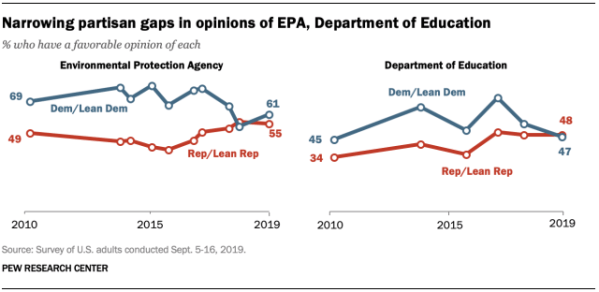
Ouch. Bad news for the Education Department. It was the second-least-favored federal department in a recent survey. Plus, more Republicans (55%) like the EPA than the Ed Dept. (48%). At PRC.

Pew fed agencies EPA or ED

Teachers: Do you buy it? American Enterprise Institute says the ‘underpaid-teacher’ thing is a myth.

predictions generated by the underpaid-teacher hypothesis — such as that teachers must have high quit rates, or that a large percentage of their income flows from second jobs — are not supported by the data. Teachers as a group are generally well compensated, and teacher pay and benefits have risen faster over time than compensation in private-sector jobs. Failure to recognize these facts can lead education reform down a blind alley.

Can universities accept philanthropy tainted by the Oxycontin scandal? Many have, at AP.

Oxford, the University of Glasgow in Scotland and Cornell each received $5 million to $6 million, tax records show. Columbia University followed with nearly $5 million, while Imperial College London and McGill University in Montreal each received more than $3 million.

It’s not only K-12 schools. Preschool programs are even more segregated by race, at Hechinger.

early learning programs are twice as likely to be nearly 100 percent black or Hispanic than kindergarten and first grade classrooms.

Empathize with Racists? Really?

Historians—especially K-12 teachers and public historians—have been struggling with the challenges of teaching the history of slavery. It is time for us to learn from the dearly bought experiences of our science-education colleagues. The hardest lesson of all? Sometimes it’s not about being right.

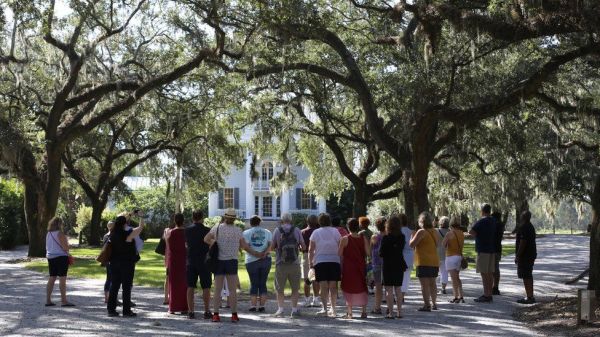
BBC slave plantation

Sometimes tourists say some nasty things. What should we do about it?

First, some background: You’ve probably seen the disturbing stories lately about how difficult it can be to teach tourists about the history of slavery. At Monticello, for example, tourists ask guides not to focus so much on the negative stuff. In South Carolina, tourists sometimes actually defend the institution of slavery. As the BBC reported recently,

“Slavery was not that bad – it’s probably the number one thing we hear,” says plantation tour guide Olivia Williams.

“To my face, people have said: Well, they had a place to sleep. They had meals, they had vegetables.”

It’s not only museums that are having problems. As one contributor to the NYT’s 1619 project described, the history of slavery in the USA has long been ignored by schools, at best. In her words,

It’s ugly. For generations, we’ve been unwilling to do it. Elementary-school teachers, worried about disturbing children, tell students about the “good” people, like the abolitionists and the black people who escaped to freedom, but leave out the details of why they were protesting or what they were fleeing. Middle-school and high-school teachers stick to lesson plans from outdated textbooks that promote long-held, errant views. That means students graduate with a poor understanding of how slavery shaped our country, and they are unable to recognize the powerful and lasting effects it has had.

So what are history teachers to do? There are a lot of resources out there to help students understand the history of slavery, like Teaching Tolerance, PBS, and Stanford History Education Group materials.

But there’s another place to look that might not seem obvious at first. Like historians, science educators have been struggling for generations to break through popular hostility toward central scientific ideas. Most powerfully these days, many people have a strong visceral distrust of any ideas about human evolution and human-caused climate change.

How have science educators grappled with these challenges? What can historians learn?

In the latest edition of Reports of the National Center for Science Education, Kate Carter describes the ways she trains tour guides at the Smithsonian. Carter knows that many visitors will come already hostile to the messages of mainstream science. They are often already convinced that concepts of deep time and human-caused climate change are bogus. For example, she describes one typical couple that walked away from the information concluding, “There are two sides to every story.”

rncse empathy

Can history educators learn from this kind of science-ed training?

What are educators to do? We can’t just throw up our hands and conclude that some people are just not willing to learn about science or history. Carter suggests we avoid a simple “rookie mistake.” Instead of preparing to bombard our students or visitors with the evidence for our cases—whether it be about human evolution or American slavery—we should start with a very different idea: EMPATHY.

Make no mistake: Carter is not suggesting we avoid the subject, or agree that there are simply two sides to every story. No, she agrees that communicating the best information about science is our main goal. To get there, though, she suggests beginning by trying to understand the people with whom we’re speaking. As she explains,

While effective and accurate communication of science is a crucial element, it is not enough to reach the most skeptical populations. By taking time to assign real human emotions to the visitors, volunteers can better empathize and use this newfound understanding to decide the best way to share their evidence.

Seems obvious, right? But when it comes to teaching the full, unvarnished, unpleasant history of American slavery, empathizing with resistant listeners can be extremely difficult. If a tour guide tries to understand a visitor who doesn’t want to learn about Thomas Jefferson’s slaves, is she continuing the lamentable tradition of overlooking the truth? If a teacher spends time trying to understand why her students reject the evidence for the brutality of slave markets and slave labor, is she guilty of contributing to the long, shameful silence of those crimes against humanity?

In short, it seems like the time for polite empathy about the history of American racism and slavery is over. Teachers and tour guides might blanch at the prospect of bonding with racist tourists and students.

In spite of these important challenges, we can still learn from our science-ed colleagues. No one is suggesting any kind of watering-down or truckling, either to neo-creationists or neo-confederates. All we want to do is begin a conversation by filling in culture-war trenches and building connections so that a real conversation can take place. If we don’t start with that, no amount of proof, evidence, or explanation will do any good.

Ed Mystery: Why Don’t More Democrats Like It?

I understand why more Democrats don’t like the Ed Department right now, governed as it is by Michigan’s Evil Queen Betsy. But I’m surprised to find out that the Ed Department has garnered only minority support during the last ten years. There’s one obvious explanation, but are there more reasons?Pew fed agencies EPA or ED

Here’s what we know: New results from Pew show us that the Ed Department is one of the federal government’s least favorite agencies, with 48% of respondents feeling favorable and 48% unfavorable.

No surprise there. Ever since Jimmy Carter instigated the department it has been the target of conservative fury. Reagan’s first appointed secretary, Terrel Bell, was given the unusual mission to dismantle the department which he headed.

More recently, conservatives such as Texas’s Rick Perry have remembered that they wanted to eliminate the Ed Department, even if he couldn’t remember the other department he wanted to get rid of.

So there’s no surprise for the department’s low favorability among GOP respondents. But why do so many Democrats dislike it? Was something happening in 2010 that led a majority of Democratic respondents to say they didn’t like the Ed Dept?

Here’s my hunch: Back in 2010, teachers and schools were still trying to cope with the strictures of the No Child Left Behind act and the unmanageable requirements NCLB mandated for high-stakes testing. By 2015, those testing requirements were tamped down. Among Democrats, at least, the popularity of the Ed Department went up (in fits and spurts) until the ascension of Queen Betsy.

Is there another explanation I’m missing?

Why Are Some People so Uptight about School Prayer?

If you look at the rules, it’s a non-issue. As SCOTUS has made crystal clear, the rights of students in public schools to pray and read prayerfully from their Bibles have never been in question. Yet as Cavan Concannon pointed out recently, the issue still causes hi anxiety among some conservative evangelical activists. Why?SOTL
As Concannon points out, conservative groups such as Focus on the Family still ring alarm bells whenever there is a misunderstanding. As one FoF spokesperson warned recently,

How would you respond if one of these scenarios happened to your child, or to a student in your youth group? . . .

  • A father expresses concern after his daughter, a high school student, tells him an education official stopped her from bowing her head to silently pray before eating lunch.
  • A fifth-grade student brought his favorite book, the Bible, with him to class to read during a free reading period. But according to news reports, the teacher had him come up to her desk and, in front of the class, left a message for his parent explaining that she noticed he had a religious book and was not “permitted to read those books” in her classroom.

Sadly, none of these scenarios are fiction.

Not fiction, sure, but also not all that scary, once you read more about the stories. In one, the school district quickly apologized. In another the teacher said it didn’t happen. Still, there is no reason why students should have to even explain themselves. Their prayers should be un-challenged by their schools. The FoF folks are 100% right when they say, “schools should be celebrating these [prayer] rights and educating students about them, not stifling them.” Students have every right to pray and read the Bible in their public schools, as long as they don’t disrupt the day-to-day functioning of that school.

So what’s the problem?

That’s just it. In spite of the hi anxiety expressed by groups such as FoF, there isn’t really a problem. We do not see—contrary to FoF claims—“more news headlines like these every year.” We do not see—and I’ve been looking!—evidence that public-school districts are scheming to keep students from exercising their religious rights. We do not see, in short, any evidence that the “religious freedom” of conservative evangelical students is under attack.

So why do so many conservative activsts say that it is?

I’ve got a hunch. For the past century, America’s public schools have been moving in fits and starts toward a more secular dynamic. In the 1920s, as I argued in my first book, the so-called anti-evolution campaign was often actually an attempt to install frankly theocratic regime in public schools. One “anti-evolution” bill considered in Kentucky, for example, would actually have done a lot more than ban evolution. One amendment specified that Kentucky’s public libraries could not contain any books that

directly or indirectly attack or assail or seek to undermine or weaken or destroy the religious beliefs and convictions of the children of Kentucky.

That’s right. Back in 1922, conservative evangelical activists didn’t only want their religion included; they wanted it to utterly dominate.

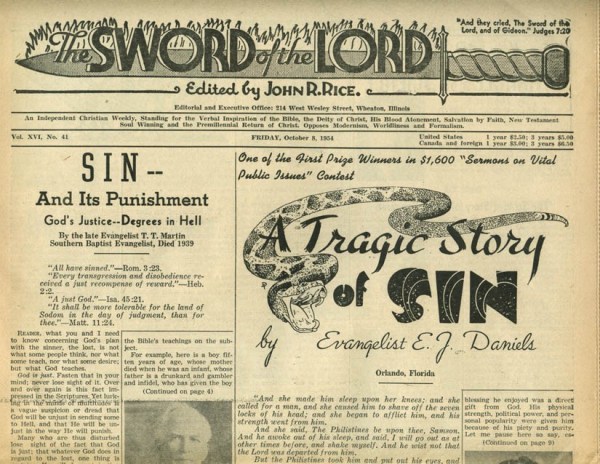
By the 1960s, conservative evangelical activists had long abandoned any hope of taking sweeping control of public institutions. But many were still shocked when SCOTUS ruled in 1963 that teachers could not lead students in the Lord’s Prayer or devotional Bible reading. Consider—as just one example—the fiery sermon delivered by The Rev. Ray Chamberlin on September 8, 1963, at Faith Baptist Church, Cynthiana, Kentucky, as reported in John R. Rice’s Sword of the Lord newspaper.

The problem, Chamberlin preached, was that public schools in America were meant to be Christian. As he put it,

Since the earliest days of our educational system in one-room log cabins, the Bible has been read and prayer has been made to the God of the Bible.

The recent SCOTUS rulings, Chamberlin warned, had thrown that worthy system into the garbage.

What was the solution? Chamberlin liked Alabama Governor George Wallace’s aggressive approach. If public schools stopped reading the Bible, he promised to go to that school and read it himself. Let them send in the troops if they wanted to.

But that’s just it. No one sent in troops. No one is hunting down religious students—Left Behind style—and forcing them to give up their prayer groups. With a few exceptions such as the ones FoF described above, religious students of all backgrounds are praying in their public schools if they want to.

I think the real problem comes from the unique history of conservative evangelical religion in America’s public schools. For good reason, conservative activists feel that they have lost something. As they repeat so often, evangelical Christianity really did serve as the de facto religion in a lot of America’s public schools. When schools act in secular ways, conservative evangelicals feel like they have been usurped, abused, mistreated.

Unlike other religious groups, conservative evangelicals feel like they were kicked out of public schools unfairly. It’s not that they actually are denied many of their rights as citizens. No, it’s more that they sometimes are treated like every other kind of citizen. Namely, they are welcome to express their religion in public schools, but they can no longer expect those schools to give their religion a special place.


Hope for Campus Christians?

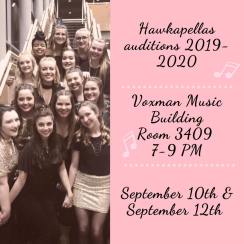
If the decision at Duke left evangelical Christians bummed, this one from Iowa might lift their culture-war spirits. Not only did the Obama-appointed federal judge rule on the side of Intervarsity Christian Fellowship, but she threatened to hit the offending college administrators where it hurts. And she included the Hawkapellas.

hawkapellas Iowa

I’m guessing the Hawkapellas didn’t think they’d be part of this culture-war battle…

Here’s what we know: According to Inside Higher Ed, federal judge Stephanie Rose issued her second ruling against the University of Iowa. Back in January, she ruled that the university could not fairly de-recognize Business Leaders in Christ. Now, she ruled not only that the university unfairly de-recognized Intervarsity, but that the university leaders should have known better. She intimated that specific administrators might be personally financially liable.

This ruling might change the climate of these campus de-recognition battles in two big ways. First of all, Judge Rose explicitly agreed that Christian groups can’t be singled out for their discriminatory policies. In Iowa, at least, plenty of other groups discriminate yet were allowed to remain on campus.

She lists several student organizations. The all-female Hawkapella singing club, for example, restricts its membership to women. The Tau Sigma Military Dental Club is only open to military-sponsored students. The Iowa National Lawyer’s Guild “excludes individuals because of their political views, even though such an exclusion constitutes discrimination on the basis of creed.”

As the judge ruled,

The University purports to apply the Human Rights Policy to RSOs [Registered Student Organizations] such that they may not speak about religion, gender, homosexuality, creed, and numerous other protected characteristics through their membership and leadership criteria. But whereas InterVarsity may not require or even encourage its leaders to subscribe to its faith, other RSOs are free to limit membership and leadership based on the Human Rights Policy’s protected characteristics.

How can a university allow the Hawkapellas without including the Intervarsities? How can it recognize some groups that discriminate in their membership and leadership policies and not others? Judge Rose thinks they can’t. At least, not legally.

Perhaps most important, Judge Rose ruled that specific university administrators could be subject to financial damages. I can’t help but think that that provision will make cautious administrators at other schools sit up and take notice.

From the Archives: Ummm?

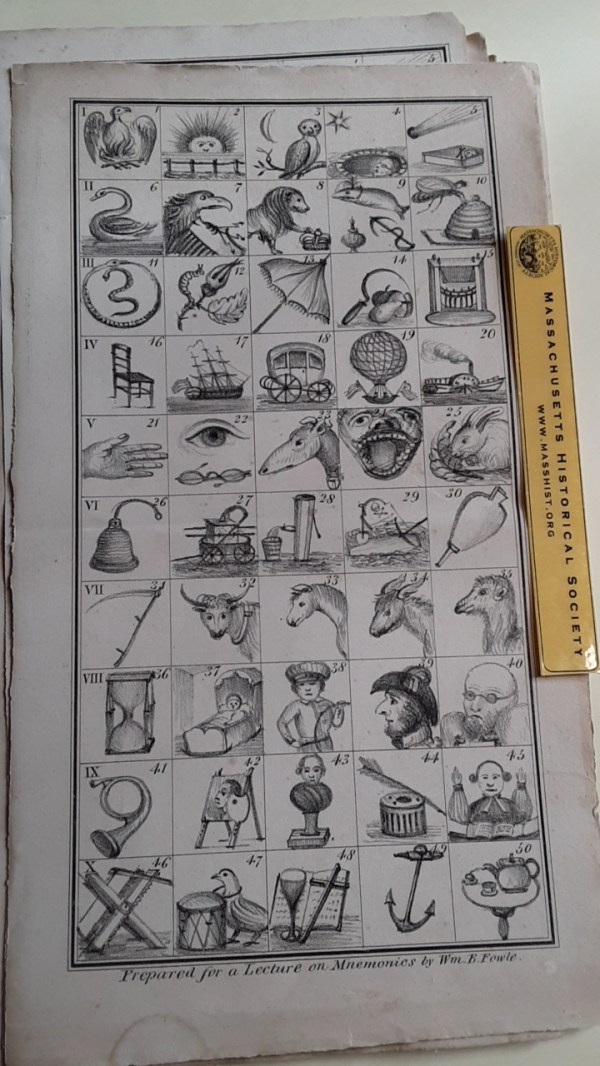
Sometimes you come across stuff you just don’t know what to do with. Here’s one from my recent research for my book about early public schools in the 1800s:chart prepared for a lecture on mnemonics by Wm. B. FowleFowle was an avid lecturer on topics including reading instruction, phrenology, and apparently mnemonics. I can’t tell from the files what this lecture included, but I’m guessing Fowle taught people how to remember these things with a snazzy mnemonic system.