Fundamentalist U: The Original “Safe Space”

It’s not a new idea. In spite of what journalists and pundits might suggest, today’s push on college campuses for “safe spaces” has a century-long tradition. The schools I’m studying these days—conservative evangelical colleges, universities, and Bible institutes—have always promised to provide “safe spaces” for young people.

We’ve talked before about the ways the recent spate of college protests might best be understood as an “impulse to orthodoxy.” Sometimes the ferocity of student protests seems woefully out of proportion to the alleged offenses at elite schools such as Yale and Claremont McKenna College.

At Yale, for example, two faculty members were berated and hounded for their suggestions that some Halloween costumes might be acceptably offensive. And at Claremont McKenna, a top administrator was driven out for her worry that non-white students might have a legitimate reason to feel unwelcome on her campus.
BJU BALMER

You’ll be safe here…

The moral outrage of students, however, makes perfect sense as a defense of a moral orthodoxy. As with any orthodoxy, deviation is not just disagreement. Orthodox thinking raises seemingly mild disagreement into existential threats. Those who veer in the smallest degree from orthodoxy must not only be ostracized. Their heterodox notions must be denounced in the most ferocious terms in order to emphasize one’s own continued loyalty.

Seen in terms of orthodoxy, talk of “safe spaces” makes perfect sense. In the orthodox mindset, challenging ideas raise the specter of unacceptable deviation. Young people must be protected from threatening ideas until they are well-enough schooled in orthodoxy to protect themselves.

Today’s protesters might not like the company, but the network of Protestant fundamentalist schools that emerged in the 1910s and 1920s made such “safe spaces” its raison d’etre.

In the 1920s, for example, President James M. Gray of Moody Bible Institute in Chicago told parents to send their fundamentalist children to his “safe space” for two years of Bible training before they went on to a traditional four-year college. Why? In his words,

It renders [a student] immune to the evolution and modernistic germs, while it enables him to examine them in the light of the Christian revelation as he could not have done before.

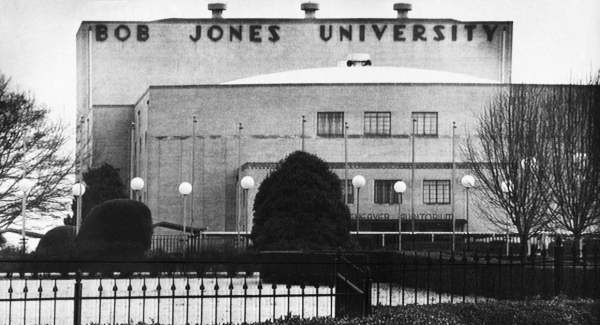
A few years later, school founder and evangelist extraordinaire Bob Jones promised parents a new sort of college, one that would offer a totalized “safe space.” In the June, 1928 edition of Bob Jones Magazine, Jones promised,

If you fathers and mothers who read this magazine have children to educate, and you wish them to attend a school which will protect their spiritual life, send them to the Bob Jones College. The fathers and mothers who place their sons and daughters in our institution can go to sleep at night with no haunting fear that some skeptical teacher will steal the faith of their precious children.

This tradition of fundamentalist “safe spaces” continues today. As young-earth creationist impresario Ken Ham argued last year in response to my questions,

We are burdened to help parents choose a college wisely that does not put stumbling blocks in their children’s way that could lead them to doubt and ultimately disbelieve the Scriptures.

If some ideas are indeed sacred, then young people do indeed need “safe spaces” in order to preserve their impulse to orthodoxy. For fundamentalists, it was easy to declare their schools “safe spaces,” since they wanted explicitly to protect young people from certain heterodox ideas.

It is much harder, of course, for non-fundamentalists to make the same point. Students who want “safe spaces” without acknowledging their impulse to orthodoxy don’t have the same explicit rationale. They want the results of fundamentalist higher education without being able to acknowledge their desire for it.

How Facebook Can Save America

It won’t be by buying new computers for schools. It won’t even be by dumping bajillions of dollars into schools. But Mark Zuckerberg’s recent announcement that he plans to donate 99% of Facebook shares—some 45 BILLION dollars’ worth—might just make a difference if he can learn from his mistakes.

facebook-zuckerberg-chan-launching-private-school-thumb-525x403-16272

Take my money…Please!

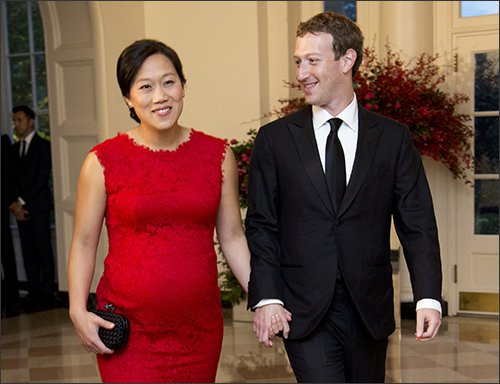
You’ve seen the story by now. Mark Zuckerberg and his wife Priscilla Chan have pledged oodles of their nerd-gotten gains to help low-income families. Good for them. The danger is that they will continue to misunderstand the nature of the relationship between schooling and society.

Money helps. But in the past, philanthropists in general and Zuckerberg in particular have misunderstood the basic relationships involved. As a result, big money has not made a big impact.

You may have read about Zuckerberg’s ill-fated promises in Newark. Charmed by Mayor Cory Booker, Zuckerberg pledged up to $100 million in matching funds to improve Newark schools.

As journalist Dale Russakoff described in her book The Prize, big dreams petered out into only meh results. Russakoff blamed poor communication between philanthropists, city managers, teachers, and parents. The money, she argued, did not go to the right places at the right time, because Zuckerberg and Booker took a “knight in shining armor” approach to complicated educational problems. Instead of communicating with interested locals, they hired fancy $1000-a-day education consultants. Instead of building a consensus about problems and solutions, they dictated solutions and labeled people as problems.

There is a more basic difficulty, however, that Russakoff did not address. She argued that the roll-out of the Newark plan was flawed and ill-considered. At a more foundational level, however, even the best-considered plans to fix society by fixing schools are doomed.

We’ve said it before and we’ll say it again: Schools can’t fix society. Schools ARE society.

In other words, if a society is racist, dominated by a wealthy elite, and strangled by cultural divisions, a new set of textbooks, computers, or state standards will not change that. Throughout the twentieth century, as I argued in my recent book, conservative activists repeated progressives’ attempts to reform society by reforming schools. Without the proper understanding of the ways schools function in society, such plans are doomed before they begin.

Consider the sobering example of Native American education. As a recent article in Politico described, government-run schools are a failure. And they fail despite the fact that they spend more money per student than do comparable schools.

The Facebook folks have made some worrying noises. In announcing their gift, they suggested that they were still trapped in their old, mistaken views. They seemed to be saying that society can be healed—poverty can be alleviated—if only we can make sure that all kids have good schools. It is just not that simple.

In their announcement, for instance, Zuckerberg and Chan declared that their money would help level the social playing field. As they put it,

You’ll have technology that understands how you learn best and where you need to focus. You’ll advance quickly in subjects that interest you most, and get as much help as you need in your most challenging areas. You’ll explore topics that aren’t even offered in schools today. Your teachers will also have better tools and data to help you achieve your goals.

Even better, students around the world will be able to use personalized learning tools over the Internet, even if they don’t live near good schools. Of course it will take more than technology to give everyone a fair start in life, but personalized learning can be one scalable way to give all children a better education and more equal opportunity.

Watch out! Despite their qualification that “it will take more than technology to give everyone a fair start in life,” it sounds as if the rest of their plan depends on their assumption that the right technology can indeed do just that.

To be fair, they make smarter noises elsewhere. They have also argued, for example, that

“We need institutions that understand these issues are all connected.” . . . Only with schools, health centers, parent groups, and organizations working together, they said, “can we start to treat these inequities as connected.”

That is exactly right. Only if we understand that young people are more than just schoolchildren can we see the problem with earlier philanthropic efforts in education.

We need to be careful about the conclusions we draw. Some observers have concluded that since increased spending on schools does not lead to utopia, we don’t need to increase funding for schools. That’s not right.

Rather, we need a better analogy. Spending money on schooling is not like putting a Band-Aid on a gut wound. Rather, spending money on schooling for low-income students is like building a three-legged stool with one strong leg. Only one. Because the other two legs are harder to reach, they are usually ignored. But a three-legged stool needs three strong legs, not just one. The legs need to be improved at the same time, in the same degree, in order to make a real difference.

I’ll say it again and then I’ll be quiet: We DO need to pour money into schools.  But not ONLY into schools.  We need to address questions of poverty and structural racism.

I Love You but You Didn’t Do the Reading

[Editor’s Note: We at ILYBYGTH are happy to announce a new feature, “I Love You but You Didn’t Do the Reading.”  In this weekly column, we’ll point out stories of interest to SAGLRROILYBYGTH, a sort of “in case you missed it” list.  Will we be able to keep it up?  Who knows.  But let’s give it a try and see if people like it.  Suggestions for readings are always welcome to our editorial desk: alaats AT binghamton DOT edu .]

December First, 2015

What did you miss out there? A few stories that caught our eye this past week:

READING

Words, words, words…

Philosopher Michael Ruse warns humanists to curb their enthusiasm.

Paying for college with indentured servitude; a new program hits the streets of Purdue.

What do people think about climate change? Yale survey says that half of Americans believe it is real and that humans are causing it, but only one in ten agree that mainstream scientists are agreed about it.

No yoga in school, for a different reason.

Secret Catholics at Jamestown.

Yik Yak threats shut down campus.

What should Princeton do about progressive racists?

Where can students go for an intellectually diverse college education?

Affirmative Action for College Professors? No, But…

Thank you.  After discussions here and in real life, I’ve changed my mind.  I thought we needed affirmative action for conservative college professors, but now I agree on a different solution.

The other day, I wrote that our campuses needed more ideological diversity. Not, as some commentators have argued, mainly to provide a richer intellectual climate. Nor to be fair to conservative intellectuals. Rather, for me the compelling issue was that many students—conservative students—felt like fair game for both fellow students and professors.

Too many students, I thought (and think!) feel as if their conservative beliefs—especially religious beliefs—are the butt of jokes. They do not feel included; they do not feel like valued members of the campus community. That is not acceptable.

But following Jonathan Haidt’s advice for colleges to “actively seek out non-leftist faculty” won’t help.

Rather, we need to use existing mechanisms on campus to ease the problem.

Let me start by laying out some of the things I am not talking about:

I am not saying that students from some conservative religious backgrounds shouldn’t have their worlds shaken up by what they learn in college. For example, if students come from a young-earth creationist background, as David Long has argued, learning mainstream science will come as a profoundly disorienting experience. Colleges don’t need to protect them from that experience.

I am not saying that students should be allowed to perpetuate anti-minority attacks under the name of fairness. As some schools have experienced, “white student union” groups have argued that they, too, should have the right to be exclusive campus communities. Colleges don’t need to protect this sort of faux equality.

But colleges should protect students—even conservative students—from the sorts of ignorant, ridiculous, hateful talk that they are commonly exposed to. Let me give some examples of the kinds of thing I am talking about.

Example #1: Here in the Great State of New York, we’re divided over a recent gun-control law, the SAFE Act. It limited gun ownership in significant ways. One student told me that the subject came up in one of his classes. It wasn’t the main subject of a lecture or anything, just some side-talk that went on as part of a class discussion, the kind of talk that is a common part of every class. The instructor, according to my student, said something along the lines of, “Only total hillbilly idiots oppose the SAFE Act.” My student was a gun owner, from a family of gun owners and opponents of the SAFE Act. He didn’t say so, but I can’t help but think that the instructor’s comments made the student feel shut out.

Example #2: I was giving a talk a while back about Protestant fundamentalists and their educational campaigns. I’ll leave the host university anonymous. After my talk, one audience member shouted out a question, “What’s WRONG with these people!!??!” Many heads nodded and people giggled a little. I was flummoxed.   I couldn’t believe that such an intelligent person could simply lump together all conservative religious people as “these people.” I couldn’t believe that other audience members found such a question unremarkable. I wondered what someone in the audience would feel like if he or she was a fundamentalist. I don’t think he or she would feel welcomed. I don’t think he or she would feel like part of the campus community.

In situations like that, I think the main culprit is faculty ignorance. Too many of us have no idea about the numbers of conservative students we teach. Too many of us assume that the intelligent people in our classes agree with us on questions of religion and politics. Too many of us assume that any anti-conservatism or anti-religious jokes will be enjoyed by all our students.

I plead guilty myself. As I learn more and more about conservatism and religion, I realize how woefully ignorant I have always been. I worry that some of my off-hand comments in the past made some students feel unwelcome or insulted.

That’s why I think we need to do a better job of spreading the word.   Many of our campuses already have sensitivity-training classes. Why don’t we include conservative ideas? Why don’t we help faculty members recognize that they will be teaching students of all sorts of political and religious backgrounds? Why don’t we educate them about the beliefs of people who are very different from them, people who will likely be in their classes?

Of course, it won’t change the minds of people who really don’t want to change. I know there are some professors out there who consider it their job to belittle conservative ideas. Some academics take a positive glee in subjecting religious conservatives to hostile intellectual attack, hoping to educate them out of their unfortunate backwardness.

To some, that might be enlightenment. If it means subjecting vulnerable students to browbeating at the hands of their fellow students or even of their professors, it’s not the right sort of enlightenment.

Affirmative action for conservative professors isn’t the answer. It won’t work and it doesn’t even address the central problem. Colorado has struggled to fit in its token conservative intellectual. More important, as Neil Gross has argued, hiring on campuses is not really squeezed in a leftist death-grip. Rather, left-leaning types tend to be overrepresented among those who go into academic work in the first place.

We should prepare ourselves to welcome religious and ideological diversity just as we do other forms of diversity. We should ask instructors to attend sensitivity workshops that include a variety of ideas. Why do some creationist students believe in a young earth? Why do some religious traditions emphasize a continuing difference between proper roles for men and women?

The goal is not to avoid teaching ideas that might be startling or uncomfortable for students. In a geology class, young-earth creationists will hear that the earth is very old. A class on feminist theory will certainly shake up some students steeped in patriarchal thinking. But we can convey that information in a way that insults and belittles our students, or in a way that does not.

To me, the choice seems obvious.

When Evil Sounds Like You

No one is in favor of murder. And all of us use pretty heated language at times. That’s why all of us have an extra responsibility to denounce violence perpetrated by those who agree with us. It looks like leading GOP candidates have failed at this important culture-war responsibility.

Dear

War and Culture War

It is still early days, but it seems as if the terrible shootings at the Colorado Planned Parenthood clinic may have been inspired by anti-abortion sentiment.  Suspect Robert Dear seems to have claimed he was motivated by Planned Parenthood’s alleged sale of “baby parts.”

I would expect every prominent cultural conservative to denounce this sort of political violence in the strongest terms. Yet, as progressive sources such as The Nation and ThinkProgress have pointed out, the leading Republican Party presidential hopefuls have done no such thing.

I am truly stumped.  I would think that every politician would rush to distance him- or herself from such an atrocity.  Especially leaders such as Marco Rubio and Ted Cruz, who have campaigned against Planned Parenthood as a retailer of baby parts.

Yet they did not.  Other anti-abortion activist groups have done so, including the National Right to Life Committee, Operation Rescue, and other pro-life activists.

Precisely because they are known to share very strong anti-abortion sentiments, such folks have leaped to denounce the shootings in the strongest terms. This is as it should be. Culture-war activists, after all, stand to be accused of collusion with such crimes. They have a duty to tell the world that such violence is not and never will be part of their strategy.

As NRLC put it,

National Right to Life, which represents 50 state affiliates and more than 3,000 local chapters, unequivocally condemns unlawful activities and acts of violence regardless of motivation.  The pro-life movement works to protect the right to life and increase respect for human life.  The unlawful use of violence is directly contrary to that goal.

The National Right to Life Committee has always been involved in peaceful, legal activities to protect human lives threatened by abortion, infanticide and euthanasia.  We always have and will continue to oppose any form of violence to fight the violence of abortion.  NRLC has had a policy of forbidding violence or illegal activity by its staff, directors, officers, affiliated state organizations, and chapters.  NRLC’s sole purpose is to protect innocent human life.

This kind of talk is not political bravery, but merely common decency mixed with self-protection. Leaders such as Marco Rubio, Ted Cruz, and Donald Trump, then, could simply agree with these pro-life groups. They could work hard—and even cynically try to appear “presidential”—by weighing in against this sort of terrorist attack.

Yet they haven’t.

This is bad news for all of us, regardless of our political opinions or religious beliefs. If it is true that GOP candidates did not want to appear too energetic in their denunciation of this sort of extremist violence, then our political climate offers little hope for any sort of reasonable discussion of sensitive issues.

When simple human decency, combined with savvy political strategizing, don’t compel prominent politicians such as Marco Rubio to distance themselves in the most forceful way from folks such as accused attacker Robert Lewis Dear, we should all tremble.

Why? Because it hints at a breakdown of our implicit agreement about the fundamental nature of civil society. Aspiring GOP leaders should be falling all over themselves to demonstrate their understanding of this central idea. They should be jostling with one another to show just how leader-y they are in their denunciation of this sort of extremism.

If they don’t, we should worry that they think voters won’t like such denunciations. We should worry that these candidates, with their finely tuned political antennae, have decided that plenty of GOP voters condone or at least excuse this sort of terrorism.

If they’re right, we’re facing a frightening prospect.

We hope that in coming hours and days, GOP leaders will recognize their proper role. We hope they will see that it is their job to police their right wing, just as it falls upon progressives to police their left. Both sides, we must agree, must agree that terrorism is not part of their culture-war coalition. Once someone crosses a line into assassinations, we must all agree, they are no longer part of our civil society.

Only this implicit agreement keeps our vicious culture wars from devolving into all-too-common real culture wars.

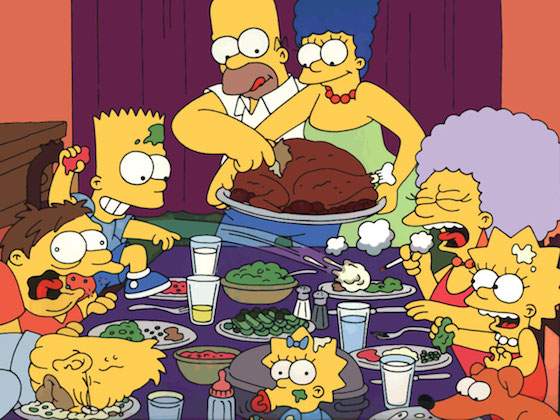
School = Thanksgiving

Ah, Thanksgiving! Our favorite holiday of all. No gifts, no decorations, no sweat . . . just lots of food and friends and football. Your humble editor has retreated to an undisclosed location in scenic upstate New York to share the holiday with family.

simpsonsturkey

PS 101

Before we do, however, we must give in to our unhealthy compulsion to share some Thanksgiving reflections about schooling and culture wars. In the past, we’ve noted the central role Thanksgiving has come to play in those battles. Today, though, we want to point out a more basic connection: Why do we keep having culture wars over the teaching in our public schools? Because those schools are like Thanksgiving itself.

First, a review of our ILYBYGTH reflections about culture-wars and Turkey Day:

Today, let’s consider a more fundamental idea: Thanksgiving gives us a chance to see how public schools really function and why they serve so often as lightning rods for culture-war kerfuffles. Thanksgiving dinner might just be the best analogy for the way our schools work.

Because we know they don’t work the way anyone really wants them to.

For generations, progressive activists and intellectuals have dreamed of schools that would transform society. To pick just one example from my recent book, in the 1930s Harold Rugg at Teachers College Columbia hoped his new textbooks would transform America’s kids into thoughtful authentic small-d democrats. The books would encourage students to ask fundamental questions about power and political transparency. They would help young people see that true social justice would come from a healthy transformation of society, with power devolved to the people instead of to plutocrats.

For their part, generations of conservative activists have tried to create schools that would do something very different. There is no single, simple, definition of “conservatism,” of course, but by and large, as I also argue in my recent book, activists have promoted a vision of schooling as the place to teach kids the best of America’s traditions.

As one conservative intellectual asked during a turbulent 1970s school boycott,

Does not the Judeo-Christian culture that has made the United States the envy of the world provide a value system that is worth preserving?

Other conservatives shared this vision. Max Rafferty, one-time superintendent of public instruction in California and popular syndicated columnist, yearned for a golden age when

the main job of the schools was to transmit from generation to generation the cultural heritage of Western civilization.

Max Rafferty was never satisfied. Schools, he thought, failed in their proper job as the distributor of cultural treasures.

Harold Rugg wasn’t happy either. Neither he nor his progressive colleagues in the “Social Frontier” group ever succeeded in using the schools to “build a new social order.”

Why not? Because schools will not fulfill either progressive or conservative dreams. They are not distribution points for ideological imperatives. They are not outposts of thoughtful civilization scattered among a hillbilly hinterland.

Instead, it will help us all to think about schools as a sort of Thanksgiving dinner. At a Thanksgiving dinner, people of all sorts gather together to eat. Friends, family, co-workers, neighbors. Unless you’re lucky enough to escape to an undisclosed location in scenic upstate New York with only a few beloved family members and a dog, you will likely sit at a table with people with whom you don’t share much in common, intellectually.

In every family, you are likely to find some ardent conservatives and some earnest progressives. You are likely to find strong feelings about issues such as abortion, same-sex marriage, evolution, and etc.

That’s why—until the booze kicks in, at least—most Thanksgiving dinners tend to stick with safe topics. We know we can disagree about football, for example. If my Green Bay Packers lose to the horrible Chicago Bears, my cousin knows he can tease me about that.

But we can’t disagree, out loud, at least, about things that really matter to us. If I have an imaginary uncle, for example, who thinks same-sex marriage means opening the door to pederasty and apocalypse, he knows he can’t tease me about it. Our disagreement on that issue won’t be something we can both just laugh about.

So our Thanksgiving dinner conversations, we hope, stick to fairly humdrum topics.

That might just be the best way to understand our schools, too. In spite of the dreams and hard work of intellectuals such as Max Rafferty and Harold Rugg, schools don’t push one ideological vision or another. At least, they tend not to do it very well or for very long.

Instead, they stick to the smallish circle of ideas that we as a society can roughly agree on.

This is why biology teachers tend not to teach a whole lot of evolution.

This is why health teachers tend not to teach a whole lot of sex.

This is why history teachers tend not to teach a whole lot of history.

There are plenty of exceptions, of course. But that also fits into our Thanksgiving analogy. Every once in a while, someone at Thanksgiving will insist on having it out…whatever “it” is. And our holiday turns into a smack-down, leaving everyone a little bruised and shaken.

Similarly, some teachers and some schools will occasionally push for a better vision of education, a more ideologically pure one. As I examine in my recent book, that is when we get culture-war flare-ups.

So as we sit around our tables and eat birds, let’s reflect on the ways this holiday might be the perfect analogy for schools. They are not change agents or tradition-upholders. At least, they are not only that.

Public schools are, rather, a meeting place in which we all implicitly agree to limit ourselves to non-controversial topics. We agree to keep the most interesting ideas, the most provocative ones, and, sadly, often the most educational ones, off the table.

Ignorance: The Heart of Education

I’ve said it before and I’ll say it again: Our educational culture wars are NOT battles between brutish conservatives who want to keep vital information out of the hands of children, on the one side, and scheming progressives on the other, progressives who want to dump information on hapless children, heedless of the moral consequences. Rather, all of us agree that schooling should promote and protect some forms of ignorance among kids. We only disagree on the details.

miseducation

Known unknowns and unknown unknowns…

Now at long last we will have a collection of scholarly essays about the history of ignorance and education. Thanks to editor AJ Angulo, a new volume will soon hit the libraries. Miseducation will be published in early 2016 with Johns Hopkins University Press.

As the publisher explains,

Ignorance, or the study of ignorance, is having a moment. Ignorance plays a powerful role in shaping public opinion, channeling our politics, and even directing scholarly research. The first collection of essays to grapple with the historical interplay between education and ignorance, Miseducation finds ignorance—and its social production through naïveté, passivity, and active agency—at the center of many pivotal historical developments. Ignorance allowed Americans to maintain the institution of slavery, Nazis to promote ideas of race that fomented genocide in the 1930s, and tobacco companies to downplay the dangers of cigarettes. Today, ignorance enables some to deny the fossil record and others to ignore climate science.

I was honored to be asked to contribute. In my chapter, I look at the publishing efforts of fundamentalist schools such as Bob Jones University and Pensacola Christian College. How have those textbooks, I wondered, promoted a certain form of knowledge? How have they pushed a certain form of ignorance?

Perhaps more interesting, this volume can encourage all of us to examine the ways schools have not simply distributed knowledge. Any school, any educational project, must also encourage certain forms of ignorance.

It may seem outlandish, but it’s really so obvious it can be hard to see. What would we say if a second-grade teacher showed her students a violent movie such as Saving Private Ryan? Not at all appropriate. Not because it’s a bad movie, but because it’s incredibly violent.

What would we say if a second-grade teacher traumatized her students by taking them on a field trip to a slaughterhouse? Not at all appropriate. Not because it’s not educational, but because there are some truths we want to keep from young people.

It’s obvious to most of us: Some things are not appropriate for young kids to learn in school. Not because they’re not true, but because we want children to remain ignorant of some things. We expect schools to work hard to keep them ignorant of some things.

Angulo’s collection of essays will help examine these questions in new ways. Make room on your shelves!

I’m Convinced: We Need More Conservatives on Campus

[Update: For new readers, this conversation has evolved since the post below.  In short, I’m not convinced anymore.  I now think there are better, more practical solutions to this dilemma.  Check out the developments here.]

My eyes were opened a few years back. I was offering a senior seminar in the history of American conservatism. Several students—some of whom eventually took the class and some of whom did not—came to my office and said something along the lines of “Thank God we finally have a conservative professor!” When I explained to them—sympathetically but clearly, I hope—that I was not actually conservative myself, students had a variety of reactions. Some were deflated. But another common response convinced me that Jon Shields and Jon Zimmerman are right.

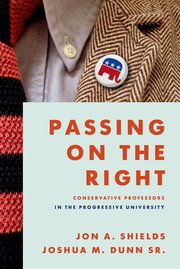
Shields Passing on the Right

Time for more affirmative action?

Shields has made the case again recently that college campuses need to recruit more professors who come from conservative backgrounds. He reviews the available research and concludes that conservatives are victims of explicit, intentional bias. As a result, there are far fewer conservative professors than we need if we want to have truly diverse campuses.

Years ago, Zimmerman made a similar argument. Like me, he’s no conservative himself. But he thinks universities need to be more inclusive places, more representative of our society’s true diversity. The best way to do that, he argued, was to reverse the trend toward intellectual homogeneity among college faculty. As he wrote back in 2012,

Race-based affirmative action has made our universities much more interesting and truly educational places, adding a range of voices and experiences that hadn’t been heard before. Hiring more conservative faculty would do the same thing.

I’m convinced, and not just because Jon Zimmerman is the smartest guy I know. The things I heard from my wonderful students told me that something was indeed wrong with our current set up.

When I told students that I wasn’t conservative myself, many of them told me something along these lines: You may not be conservative personally, but at least you don’t make fun of me or belittle me for being a conservative.   At least I can be “out” with my conservative ideas in your class. In most of my classes, I feel like I have to keep my ideas to myself or I will be attacked by students and teachers alike.

Yikes!

Please correct me if I’m off base, but isn’t that EXACTLY the problem that our campaigns for campus inclusivity have been meant to address? I know some folks think this notion of affirmative action for conservatives is a travesty, an insult to underrepresented groups that have faced historic persecution and discrimination. I understand that position and I agree that conservatives as a group cannot claim the same history as other groups.

But is there anyone out there who would want a campus climate in which students were belittled and attacked for their ideas?

Even if we want to do something about it, however, it is not at all clear how. As Neil Gross has argued, there is not really a liberal conspiracy when it comes to hiring professors. Rather, there has been a more prosaic tendency for people to go into fields in which they think they will be comfortable.

Maybe we could look to Colorado as a guide. They have had a conservative affirmative-action plan going for a while now at their flagship Boulder campus. How has it worked?

In any case, I’m looking forward to Professor Shields’s new book, scheduled for release next year. It promises to share the data gathered from 153 interviews and other sources. Maybe it will help us break out of this logjam.

What Good Teachers Do

It’s a basic premise here at ILYBYGTH: If we want to understand why some parents are so ferociously opposed to evolution or sex ed or ugly history, we have to make an honest and sincere effort to see where they’re coming from. It works for the other side, too. If we hope to figure out why so many progressive teachers and activists are so deeply emotionally mortified by today’s push for teacher measurement, we need to figure out why they feel that way. As usual, the insights of Curmudgucrat Peter Greene offer an eloquent window into that world.

First, a little background. These days, the term “education reform” has come to be dominated by a certain way of thinking. Reformers such as Michelle Rhee and Arne Duncan have advocated a new way of looking at schooling. To oversimplify a little, this “reform” mindset wants to measure student progress at regular intervals. Only by getting hard data about student academic performance, the thinking goes, can we know what educational practices are actually effective.

A big part of this “reform” effort has included a new attitude toward teacher evaluations. In the past—again, speaking very generally—most teachers were evaluated by their school principals or department chairs. As today’s reformers are fond of pointing out, those in-house evaluations tended to sugar-coat their reviews. Almost all teachers turned out to be fantastic.

Reformers asked a fairly simple question: If all teachers were so fantastic, why were so many kids failing to learn?

There was also a fairly obvious follow-up: If we can replace faculty deadwood with effective teachers, our schools will improve dramatically.

Completing the syllogism, reformers implemented programs to use student test scores to measure teachers’ effectiveness. Good teachers could earn more money. Bad teachers could get help, or they could get the boot.

This approach to school reform has proved very powerful politically. It makes sense to a lot of people.

  • Good teachers = good schools.
  • Good schools = good test scores.
  • Good test scores = good teachers.

Yet for the past dozen years, we education-watchers have seen the rise of a new generation of teacher protests. Teachers have tried to explain to themselves and to the general public why this seemingly obvious logic doesn’t fit educational reality.

Most of these teacher-protests have consisted of patient but frustrated explanations of the difficulties with quantifying education success. Teachers feel beleaguered, attacked, demeaned, and misunderstood, they explain.

Such explanations might be helpful for outsiders to understand the tricky policy questions of teacher measurement. But they don’t quite capture the emotional distress many teachers feel. I think it is entirely reasonable for non-teachers to wonder if teachers are just lazy and spoiled. Why don’t teachers buck up—some might ask—and submit to evaluations that are a standard part of every other profession?

This morning we read an essay that might help bridge this gap. Peter Greene did not set out explicitly to deflate the presumptions of value-added reformers. Not in this essay, at least. His description and prescription for extra-curricular advising, though, is something every quantifier should read.

I’m biased, of course, because I whole-heartedly agree with Greene. On the narrow topic of advising as well as the bigger picture of the essential errors of those who seek to quantify good teaching. As always, I invite SAGLRROILYBYGTH to point out those places where my personal bias has led me astray.

Here’s Greene’s advice in a nutshell: teachers who serve as faculty advisors for student projects need to keep their priorities straight. Whether it is planning a prom or a yearbook, students need to be allowed to do the work themselves. They need to be allowed to make mistakes. In essence, students need to be allowed to be inefficient, unprofessional, and maybe even just plain wrong.

Why? Because that, Greene argues, is the essence of learning. As he concludes,

Lord knows, I have failed miserably many times. But I keep working at doing better. There are few things as cool as seeing your students realize their own strength, their own voices. For them to look at a project, a performance, a Thing they have created and to realize that the Thing is them, themselves, taken form in the world and taken a form that is completely in-formed by who they are.

But every time you take a choice or decision away from them, you tell them “Well, this is a thing you can’t do” or “You couldn’t handle it if anything went wrong” and that message just makes them smaller. Don’t give them that message. Don’t lead them to suspect that their voices aren’t legit, can’t hold up, shouldn’t speak out.

Confidence comes with competence, but students aren’t always good judges of their own competence (and in some times and places they don’t have much to judge). But we can help them build both by giving them support and freedom. Maybe you are a genius visionary and students will benefit immensely just by following in your wake and sweeping up the crumbs of your attention and direction. But for the rest of us mortals, giving students the safe space to figure out how they will get things done in the world and still be their best selves will just have to do.

What does any of this have to do with teacher evaluation? It doesn’t, at least not directly. For non-teachers, however, those who don’t understand why some teachers are so steamed by the imposition of value-added measures, it can help immensely.

Greene articulates in this essay two things good teachers do that value-added teacher evaluations make difficult. First, as Greene says, good teachers always work to remind themselves that the focus must be on the students, not the teacher. As Greene puts it, “It’s not about you. Yeah, we can type that out in forty-foot font.”

For good teachers, the continuous struggle is to remember that they themselves are not the main point of their work. Their excellent activities and creative lessons mean nothing if students don’t learn from them.

Value-added measurement pushes teachers to reverse that thinking. Instead of helping teachers with the difficult task of what Greene calls “the vanishing test,” value-added measures push teachers to make their own performance their first worry.

And, of course, there’s a more basic lesson to learn here. Good teachers do things that are both extremely difficult to do and utterly impossible to measure. Good teachers have the wisdom to give students what they need, when they need it. Good teachers put themselves last and students first, even if that means the students fail.

How can a test measure that? How can any number capture that?

Maybe more important, value-added measurement misses a basic and vital part of good teaching. Good teachers must allow students NOT to succeed sometimes. Learning, after all, does not happen by simply adding knowledge to ignorance. Real learning consists of fits and stumbles, mistakes and adjustments. Good teaching, Greene reminds us, is the impossible human task of guiding young people through those infinitely complicated steps.

If a test exists that can measure such things, it can’t be taken with a number two pencil.

Intelligent Design?  Evolution?  Depends on your Point of The View

Thanks to the ever-watchful Sensuous Curmudgeon, we notice that yesterday’s episode of The View took on the topics of creationism, evolution, and intelligent design.

The discussion had been roiling about presidential hopeful Dr. Ben Carson.  One of the personalities opined that Carson could not be considered intelligent, since he believed in creationism.

At that, Candace Cameron Bruce interrupted to point out that plenty of intelligent people—plenty of scientists—do believe in creation and do embrace intelligent design.

The panel seemed split, with two for creationism, two for evolution, and Whoopi Goldberg insisting we can have both.