Why Conservatives Should Love Obama

He did it! I don’t how it happened, but somehow President Barack Obama managed to accomplish one of the most dreamed-for educational goals of America’s social conservatives. During his presidency, that is, early teen sexual activity dropped significantly, according to the CDC.

I know, I know, it’s ridiculous to give Obama credit for something that merely happened to coincide with his time in the White House. But that’s what culture-war pundits do all the time. In this case, the numbers are pretty significant, and the cause is among those nearest and dearest to the hearts of American conservatives.

As I argued in my book about the history of educational conservatism, helping kids avoid the allure of premarital sex has always been one of the fondest educational dreams of social conservatives, especially conservative religious reformers. Why was evolutionary theory dangerous? If we taught children they were nothing but clever animals, they would certainly behave that way. Why was old-fashioned discipline important? Because children needed to learn to control their sinful, lusting nature.

I hate to do it, but let me quote myself here. When Alice Moore first joined the school board in Kanawha County, West Virginia in the 1970s, one of her first acts was to close down a progressive middle school. When I interviewed Moore I asked her about it. Here’s what I wrote in the book about Moore’s experience:

The school, Moore recalled, was not a proper learning institution. It had become a cesspool of unrestrained sloth and lust. The students, she recalled, did “whatever they wanted to.” As she walked in for her first inspection, a young couple stood in the doorway, wrapped in each other’s arms. She had to ask them to move out of her way, which they did only with notable resentment. Other students wandered around the school and neighboring fields, smoking and engaging in all kinds of sexual activity in nearby barns. When Moore asked the principal to explain this sort of behavior, he informed Moore that the school hoped to do more than simply transmit information to students; it hoped to transform them into agents of social change. Teachers should see their roles as co-learners, not as dictators.

This sort of progressive shibboleth exasperated Moore.

At the heart of warped progressive-ed thinking, Moore believed, was a mistaken notion of the nature of humanity. Lust needed to be schooled out of children, not winked and nodded at as a “natural” thing. Moore was not at all the only conservative activist to think this way. Consider William J. Bennett’s conservative index of cultural indicators. Bennett’s accusations were clear: Hippies had wrecked everything. Progressive attitudes in education had led to woeful increases in dangerous sexual activities among young people, in addition to crime, drug use, etc.

In short, for a hundred years now, educational conservatives have desperately dreamed of reducing the progressive dominance of “If it feels good, do it” attitudes among young people. And now, at long last, we seem to have some evidence that those dreams have come true, at least in part.

CDC teen sex chart 2

The  good news no one will holler about…

Here’s what we know: The excitingly named “Morbidity and Mortality Weekly Report” from the Centers for Disease Control notes significant declines in sexual intercourse among America’s 9th and 10th graders (roughly 14- and 15-year olds). As the authors state,

Nationwide, the proportion of high school students who had ever had sexual intercourse decreased significantly overall and among 9th and 10th grade students, non-Hispanic black (black) students in all grades, and Hispanic students in three grades. A similar pattern by grade was observed in nearly half the states (14), where the prevalence of ever having had sexual intercourse decreased only in 9th grade or only in 9th and 10th grades; nearly all other states saw decreases in some or all grades. The overall decrease in the prevalence of ever having had sexual intercourse during 2005–2015 is a positive change in sexual risk among adolescents (i.e., behaviors that place them at risk for human immunodeficiency virus, STI, or pregnancy) in the United States, an overall decrease that did not occur during the preceding 10 years.

Why? We don’t know. And of course I’m kidding when I give President Obama credit. There are some things we can confidently predict, however. First of all, I don’t think we’ll see pundits shouting about this good news. As we’ve lamented here at ILYBYGTH in the past, good news about America’s schools and youth just never gets headlines.

Second, the warped popular myths about America’s public schools will continue to dominate. Gallup polls make it startlingly clear: When people know public schools, they like them. But when they describe public schools in general, people call them terrible. The notion that America’s public schools are cesspools of drugs, sex, and sloth is not true, but it is very widely held. Similarly, this data about trends in youth culture will not likely change people’s assumptions about schools and youth.

Finally, this student data points out yet again that the common story about the history of American public education is just not true. Many of us assume that progressive types took over public education back in the 1930s. We think that since the 1930s (or maybe since the 1960s) public schools have been dominated by progressive educators from fancy teachers’ colleges and think tanks. It’s just not true. Throughout their existence, public schools have reflected the values of their local communities. When those communities change their ideas about sexual activity, so too do their local schools. Educational change hasn’t come from high-level meetings by New York leftists, but rather from more nebulous and  hard-to-trace shifts in social trends.

Why do more and more young people seem to be avoiding early sexual activity? I don’t know, but I’ll guess: It’s not due to any sex-ed curriculum they’re receiving in their Health classes. No, the change in reported sexual activity is more likely due to changes in our whole society about the allure of sexual intercourse. After all, as we like to say here at ILYBYGTH, schools don’t change society, schools ARE society.
I Love You but You Didn’t Do the Reading

Welcome to 2018! You might think the last week of the year would be quiet, but you’d be wrong. Here are a couple of the ILYBYGTH-style stories that jumped out at us over the past week:

Issue in review: Has Trumpism killed evangelicalism?

Conservatives and the higher education “scapegoat,” by Catherine Rampell at WaPo.

The thing white professors won’t talk about, by Robert Cherry at RCEd.

Want to avoid a “death of despair?” Go to college. At CHE, research about the link between higher education and better health.Bart reading bible

Jeffrey Salkin admires LDS (Mormons). But he wants them to stop baptizing dead Jewish people, at RNS.

Why one evangelical leader left Trump’s evangelical council. AR Bernard explains his departure to Samantha Bee: “Better think carefully what you are given in exchange for your life, your reputation.”

What’s wrong with the pseudo-intellectual Right? Paul Gottfried tees off on D’Souza, Prager, and Goldberg at AC. Gottfried’s conclusion:

  • “there is . . . a plague of genuinely ridiculous writings on historical subjects coming from conservative media celebrities that surpass in their arrogant stupidity almost anything I’ve encountered in professional journals. As for people who yap about the ideologically tainted work that originates in our universities, one might hope they’d be somewhat better than those they declaim against. That’s not always the case.”

I Love You but You Didn’t Do the Reading

Those of us who live our lives in semesters are feeling a dizzying sense of high-speed hoopla as we take the final plunge toward the end of the semester. In all the huff and stuff, here are some ILYBYGTH-related news stories you might have missed:

Why do conservatives hate higher education? At The Atlantic, Jason Blakely offers an explanation.

No more safe spaces—except for conservatives. House higher-ed bill throws some brontosaurus-sized bones to campus conservatives, as reported by Politico.

The conservative National Association of Scholars claims another win. AP European History changes its standards in response to NAS criticism. HT: DR

Selling the naming rights to your local school—Peter Greene objects.Bart reading bible

Is Silicon Valley taking over classrooms? Larry Cuban says yes and no.

The latest crisis in public education: Good News. The graduation rate is at an all-time high.

It’s all Greek to me: At The Atlantic, two opposing ancient concepts of free speech.

Moore-o-mania:

At CHE: Can Sexual Predators Be Good Scholars?

When Did Conservatives Get so Angry at Higher Ed?

When I saw the headline, my nerd spidey-sense tingled. I was excited to read about the history of conservative anti-college feelings. But when I read the whole article, I was struck once again by the half-baked nature of the claim. Once again, a smart, well-informed pundit who claims to be examining culture-war history stops half-way. When will we start looking beyond the 1960s?

OLYMPUS DIGITAL CAMERA

An earlier generation also worried…

Here’s the dilemma: at The Atlantic, Jason Blakely recently promised to explain the history of recent GOP ire against higher education. Looking at the current proposed tax plan, for example, it seems as if some members of Congress are out to punish elite universities.

Blakely argues that this conservative resentment of higher education has historical roots. In his analysis, he makes some vital points. Most powerfully, he notices that conservatives seem to mistake a very small segment of higher education for the higher-educational landscape as a whole. As he wisely puts it,

conservative anxiety is best expressed as being about a small set of marquee positions of honor and prestige in the liberal arts that happen to be largely staffed at present by those whose political commitments lean left.

That’s a vital point that is too often ignored. “College” as a whole is not particularly leftish…or even particularly anything. The crazy-quilt patchwork of colleges, universities, and other post-secondary institutions is wildly disparate. It is an absolutely vital notion that people just don’t seem to want to notice. Kudos to Blakely for emphasizing it. But when he proposes to analyze the history of this conservative anger toward elite universities, he puzzlingly only scratches the historical surface. After a nod to the “deep and complex historical roots” of anti-intellectualism in American culture, he argues that

the trope of portraying American universities as a threat to society emerged with particular intensity in the 1970s and ‘80s.

He looks at the work of neoconservatives such as Irving Kristol and Allan Bloom regarding “what they saw as the moral laxity and corrosiveness of the 1960s counterculture.”

Fair enough. And interesting, as far as it goes. But what Blakely and other writers miss is the longer relevant history of this specific trend in culture-war thinking.

As I argue in my book about educational conservatism, if we hope to make any sense of today’s conservative anger at elite higher ed, we can’t start with the 1970s. We need to begin in the 1920s, when conservative intellectuals had their first experience of exile, when the tropes exploited so powerfully by Kristol and Bloom were first developed.

It was not in the 1970s, but in the 1920s that conservatives developed their deep abiding anxiety about trends in elite higher education. Consider a couple of examples.

In the early 1920s, for example, anti-evolution celebrity William Jennings Bryan railed against trends in American higher education. In one public dispute with University of Wisconsin President Edward Birge, for example, Bryan offered the following memorable proposal. If universities continued to promote amoral ideas such as human evolution, Bryan suggested, they needed to post the following notice:

Our class rooms furnish an arena in which a brutish doctrine tears to pieces the religious faith of young men and young women; parents of the children are cordially invited to witness the spectacle.

Elite schools, Bryan warned, had begun actively to teach “moral laxity and corrosiveness.” Universities needed to warn parents that they no longer taught students right from wrong. This sense of conservative outrage at higher-educational trends was a driving force behind the culture wars of the 1920s.

It wasn’t only Bryan and it wasn’t only evolution. Since the 1920s, conservative intellectuals have voiced “with particular intensity” their sense that elite universities had gone off the moral rails. Consider the case made by some patriotic conservatives in the 1930s and 1940s against the anti-American direction of the elite higher-educational establishment.

In 1938, for instance, Daniel Doherty of the American Legion denounced elite institutions as mere “propagandists.” Universities such as Columbia had taken to “attacking the existing order and [to] disparagement of old and substantial values.”

These intense antagonistic feelings toward elite universities were widely shared among conservative thinkers in the 1930s. Bertie Forbes, for example, syndicated columnist and founder of Forbes magazine, warned that elite schools were “generally regarded as infested” with subversive and anti-moral professors.

When we talk about our culture-war history, we can’t short out these voices from the 1920s and the 1930s.

Why not? If you are purporting to explain the history of an idea, you can’t only focus on the most recent articulation. It implies that these questions began to rankle only in the past fifty years, instead of slow-cooking for about a century now. The radicalism of the 1960s, and the reaction of the 1970s, were not new. They did not create new terms of culture-war angst, but rather only perpetuated existing themes.

This is not only a nerdy quibble but a fundamental part of culture-war politics. Think of it this way: When Irving Kristol and Allan Bloom made their arguments in the 1970s—the ones Blakely thinks inaugurated conservative anger at elite universities—they did not need to convince their conservative audiences of their central point. Conservatives had a vague but powerful sense that elite intellectual institutions had long since turned against truth, goodness, and beauty. Convincing someone of something they already believe to be true is a much easier task.

I don’t mean to single Blakely out. He’s not the only writer to woefully misrepresent America’s culture-war history. Plus, I’m not saying that historians can’t cut off their arguments at some reasonable point. We don’t all need to always write about everything. I get that. In a case like this, however, ignoring the vital and intensely relevant precursors to the 1970s history is not okay. We end up with a misleading notion of the genealogy of conservative outrage. We end up thinking we understand something we haven’t really even begun to understand.

Why Is It So Hard for Us to Teach Civics?

We should be freaking out. It’s not just that Americans don’t know about basic democratic principles. In increasing numbers, we don’t seem to care. Pundits lately have hoped we might be in a rock-bottom crisis of civics education, a “Sputnik moment” that drives Americans to re-invest in basic education in democratic ideas. We’re not. Our civics stand-off is even more hopelessly rancorous than our never-ending fights about creation and evolution.

Last year, Richard D. Kahlenberg and Clifford Janey hoped that the ugly, bizarre emanations from Trump’s White House might scare America straight when it came to civics education. It wasn’t only Trumpism that alarmed them. The numbers seemed truly shocking and getting worse. As they explained,

Civics literacy levels are dismal. In a recent survey, more than two-thirds of Americans could not name all three branches of the federal government. . . . Far worse, declining proportions say that free elections are important in a democratic society.

When asked in the World Values Survey in 2011 whether democracy is a good or bad way to run a country, about 17 percent said bad or very bad, up from about 9 percent in the mid-1990s. Among those ages 16 to 24, about a quarter said democracy was bad or very bad, an increase from about 16 percent from a decade and a half earlier. Some 26 percent of millennials said it is “unimportant” that in a democracy people should “choose their leaders in free elections.” Among U.S. citizens of all ages, the proportion who said it would be “fairly good” or “very good” for the “army to rule,” has risen from one in 16 in 1995, to one in six today. Likewise, a June 2016 survey by the Public Religion Research Institute and the Brookings Institution found that a majority of Americans showed authoritarian (as opposed to autonomous) leanings. Moreover, fully 49 percent of Americans agreed that “because things have gotten so far off track in this country, we need a leader who is willing to break some rules if that’s what it takes to set things right.”

More recently, Robert Pondiscio and Andrew Tripodo offered a few specific suggestions about how teachers can “seiz[e] the moment to improve civics education.”

I share their concern and Pondiscio and Tripodo offer some smart concrete steps to start making improvements. As all these authors are surely aware, though, civics education faces an impossible challenge.

Consider the Sputnik analogy: Back in 1957, Americans were rightly dismayed that the Soviet Union had taken the lead in space technology. Among the many results was a new burst of funding for new science textbooks, books that no longer truckled to the political power of creationists. The BSCS series included robust information about evolution, and by the end of the 1960s those books were being widely used in American classrooms. (If you’re looking for a quick guide to this history, check out Teaching Evolution in a Creation Nation.)

We aren’t facing a similar situation when it comes to our shoddy civics education.

Why not? Much as creationists might not like it, by 1957 the mainstream scientific community had reached a powerful consensus about the basic outline and importance of the neo-Darwinian synthesis. There is no similar mainstream establishment that can satisfactorily define the proper aims of civics education.

Consider the example I included in my book about educational conservatism. Back in the late 1930s, a set of widely used social-studies textbooks became intensely controversial.  Harold Rugg’s books had been used by millions of students, but in just a few short years they were mostly all yanked from classroom use.

OLYMPUS DIGITAL CAMERA

Watch out: Your school might be teaching civics…

The problem was that Rugg was pushing his vision of civics education. It was a vision that conservatives such as the founder of Forbes Magazine and leaders of the American Legion found subversive.

What did it mean in the World War II years to educate citizens? Harold Rugg thought it meant teaching them the dangers of authoritarianism. He thought it meant teaching them that the United States was one country among many, and that citizens needed to be rigorously skeptical of big business and back-room government deals.

Conservatives thought it meant teaching students to honor and cherish the best American traditions. They wanted children in school to learn to be proud Americans, not weak-kneed socialists. Bertie Forbes explained his beef in one of his popular syndicated columns. He was chatting one day with a group of middle-school students, Forbes related, and they told him about their experience with their Rugg books. When their teacher asked them if the United States was the best country in the world, many of them had answered “Yes.” The correct answer, their teacher read from their Rugg teachers guide, was “No.” In his column, Forbes teed off on that sort of civics education:

Do American parents want their children taught such ideas?  Do they want them to be inculcated with the idea that the United States is a second-rate country, that its form of government is open to question, that there are other countries more happily circumstanced and governed than ours?

Maybe I’m getting too cynical in my old age, but I don’t think we have evolved very far from this 1940s level. When it comes to civics education, we face a stark and glaring divide about the fundamental purposes of such a class. Are students getting a good civics education if they learn how to properly, reverently, fold a flag? Are they getting a good civics education if they can rattle off the correct structure of federal government? Or are they getting a good civics education when they learn how to stage a Black Lives Matter protest?

We can’t agree. And until we can, we will continue to have shameful outcomes in our attempts to teach civics in public schools.

Read This Before You Freak Out…

Conservatives might be shooting their guns in the air to celebrate. Progressives might be shedding a tear in their IPAs. Whether it’s a triumph or an apocalypse, it’s not a surprise: The Ed Department is filling its ranks with more and more conservative, creationist leaders. Before we freak out, though, let’s take stock of the real situation.

zais

He’s coming for your public school…

First, the creationism part. The new pick for the education department’s undersecretary has made no bones about his creationist sympathies. As head of South Carolina’s schools, Dr. Mick Zais supported the removal of the idea of natural selection from the state’s science standards. As Zais told a local newspaper, “We ought to teach both sides and let students draw their own conclusions.”

It’s not only creationism. Queen Betsy’s pick for undersecretary of education will make conservatives happy for a lot of other reasons as well. Zais comes to the nomination fresh off his post as South Carolina school superintendent. As Politico reports, Dr. Zais became a conservative ed hero for refusing to truckle to the Obama administration’s carrots and sticks.

In South Carolina, Zais pushed hard for vouchers. Time and time again, vouchers are embraced by conservatives who hope to shift public-school money to private schools, often religious schools.

When Zais’s zeal is added to DeVos’s enthusiasm, it might seem to progressives and conservatives alike that conservatives have finally triumphed in the world of educational politics. If ILYBYGTH cared about clickbait, we would certainly write something that exploited that sort of attitude. But we don’t and we won’t. Because, in historical perspective, this moment of conservative triumph looks much less triumphant than it might seem at first.

First, let me repeat the caveats SAGLRROILYBYGTH are sick of hearing: My own politics skew progressive. I think creationism has no place in public-school science classes. I am horrified by Queen Betsy and I think President Trump’s leadership is a blight on our nation that won’t be easy to recover from.

Having said all that, I’m not interested this morning in fighting Trumpism but rather in understanding it. And when we see Queen Betsy’s reign from the perspective of the long history of conservative activism in education, we see just how wobbly her throne really is.

First, as I noted in my book about twentieth-century educational conservatism, today’s conservative push for charters and vouchers is both a novelty and a concession. Milton Friedman promoted the idea of charter schools way back in the 1950s, and nobody listened. Even the free-marketiest of Reaganites didn’t care much about promoting alternatives to traditional public-school funding.

Take, for example, Reagan’s second ed secretary, William J. Bennett. He was far more interested in pushing traditional moral values and classroom rules in public schools than in gutting public-school funding.

What happened? Only in the 1990s did conservative education pundits embrace the notion of charters and vouchers. They did so not as a triumph, but as a grim concession to the obvious fact that they had been stumped and stymied by their lack of influence in public schools.

So when conservative heroes like Queen Betsy and Superintendent Zais push for alternatives to traditional public schools, progressives should fight back. But we should also recognize that the conservative drive to fund alternatives results from conservatives’ ultimate failure to maintain cultural control of public schools.

Plus, the language used by conservatives these days represents another long-term progressive victory. In his public argument for voucher schools, for example, Superintendent Zais voiced his agreement with progressive ideas about the purposes of schooling and public policy. Why should we have more vouchers? Quoth Zais, vouchers will provide “more options for poor kids stuck in failing schools.”

I understand Zais may be less than 110% sincere in his zeal to promote social equity through public school funding. Nevertheless, the fact that he felt obliged to use that sort of progressive reasoning shows how dominant those progressive ideals have become.

In other words, if even South Carolina’s conservatives adopt the language—if not the authentic thought processes—of progressive thinking about the goals of public education, it shows that progressive ideas have come to dominate our shared beliefs about public education.

On the creationist front, too, Zais’s conservatism shows the long-term decline of conservatism. It wasn’t too long ago, after all, that creationists fought and often won the battle to have evolution utterly banned from public schools. These days, all Zais can dream of is maybe wedging some worse creationism-friendly science into public schools alongside real science.

Science educators won’t like it. I don’t like it. But once again, before we freak out, we need to recognize the long-term implications of our current situation. The dreams of creationists are so far reduced they no longer preach the abolition of evolution. If you ask creationist leaders these days what they want in public schools, they’ll tell you they want children to learn evolution, “warts and all.”

We don’t agree about that. And we don’t agree about the value of vouchers. I’m not even ready to concede that Dr. Zais and I agree on the best ways to use public schools to help alleviate poverty and improve the economic life chances of kids in lower-income families.

And I’m perturbed. I’m frightened by Queen Betsy. If he’s confirmed, I’m guessing I’ll be alarmed by Dr. Zais’s work.

I also know, though, that the seeming strength of conservative thinking these days is an illusion.

The Headline You’ll Never Read

Cereal gets stale after about two weeks. Cheese can last a while. Milk goes bad much quicker. But conservatives never seem to tire of hysterical warnings about left-wing takeovers of public schools. Your humble editor experienced a dizzying bout of déjà vu this morning reading Newt Gingrich’s furious warning about the influence of “radical, left-wing” teachers. I had to check my watch and even my calendar to make sure what year it was. It serves as another reminder: When it comes to culture-war rants about public education, there is one headline that we’ll never see.

breaking-news

The headlines we’ll never see…

Don’t get me wrong: I understand why conservative activists like Gingrich want people to think left-wingers are taking over public schools. No conservative parent is likely to open her wallet for a politician who tells her there’s nothing much to worry about. So Gingrich tries to build back his political clout by warning FoxNews readers about a “thinly veiled attempt to instill radical, left-wing political views in impressionable children.”

Gingrich is reacting to an obscure story out of Minnesota, dug up by conservative muckrakers. In Edina, Minnesota (population 51,350), the school board is apparently implementing a new inclusivity curriculum. Students will read books such as A Is for Activism. [SAGLRROILYBYGTH may remember the title from earlier fuss-and-feathers controversies about it.] As Gingrich fumes, “This is pure, unapologetic political indoctrination of American youth.”

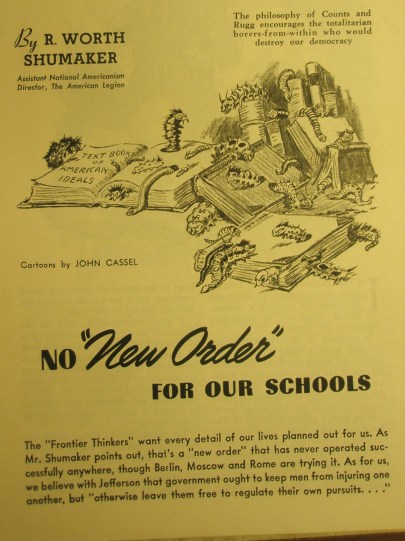
As I argued in my book about the history of educational conservatism, Gingrich is reading word-for-word from an old conservative playbook. In the 1930s, for example, conservative activists went haywire over a textbook series by progressive-ish scholar Harold Rugg. Back then, leaders of the American Legion foamed and fumed that Rugg’s educational scheme “encourages the totalitarian borers-from-within who would destroy our democracy.”

OLYMPUS DIGITAL CAMERA

Boring…boring…boring…(c. 1941)

There’s no doubt that Harold Rugg really did hope to push American school and society to the political left. And I’m guessing some of the teachers in Edina feel the same way. But the notion that teachers and education professors are able to sneakily install a mind-warping left-wing curriculum in American public schools is simply ludicrous. Even if we wanted to—and again, I admit that some teachers and ed-school professors really do want to—such conspiracy theories miss a central truth about American education.

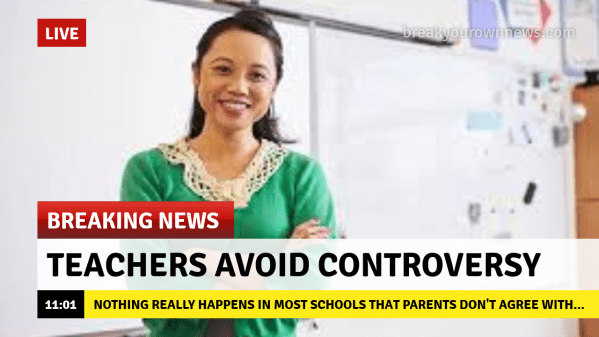
And that fundamental truth about schools and schooling generates the headlines you’ll never see. By and large, when conservatives want to rile up their base, they need to dig pretty hard to find teachers and districts that veer very hard to the political left. By and large, most schools are fairly traditional places, focusing on non-controversial tasks such as preparing students for jobs or college. Teachers, by and large, tend to avoid controversy.gallup people like their local schools

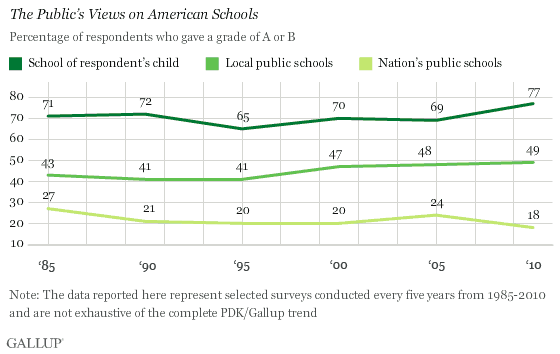
And that, perhaps, is what makes Gingrich’s job so hard. We know that most people—whatever their political affiliation—are happy with their local public schools. When Americans actually send their kids to a public school, they tend to be very happy with that school, even if they are pessimistic about the state of public education as a whole.

For Gingrich to get any attention, he has to pick out unusual examples of school districts far away that are doing something fairly unusual. Why? Because most of Gingrich’s audience is actually HAPPY with their local schools. Those schools don’t dabble in anything even remotely controversial. If a local community is Gingrich territory, the schools will be, too

I Love You but You Didn’t Do the Reading

Campus uproar, SCOTUS deliberations, and a few oddball stories, too. It’s been another whiz-bang week here at ILYBYGTH. In all the fuss, here are some stories we might have missed…

“Like trying to waltz with a wolf:” Jill Lepore in The New Yorker on the history of campus- and NFL free-speech battles.

Things are still weird in Mississippi. Hechinger looks at the ways history textbooks in the Magnolia State still leave out big chunks of uncomfortable history.Bart reading bible

SCOTUS gears up to rule on teachers’ unions. Can non-members really be forced to pay union fees?

Want to play football against the College of the Ozarks? Be sure none of your players take a knee during the national anthem.

Should Virginia Tech fire its alleged white-supremacist teaching assistant? Or is he protected by academic freedom?

Chris Lehmann takes apart the myth that good schools will lead to economic mobility, in The Baffler. HT: D

Why did so many academic historians pooh-pooh Ken Burns’ and Lynn Novick’s new Vietnam War documentary? Jon Zimmerman offers a simple explanation at CHE. HT: NBR

Now they’ve got teachers doing it! Massachusetts substitute kneels during the Pledge of Allegiance. HT: MM

Mick Zais hated the Common Core all the way to the White House.

One liberal college’s attempt to attract conservative students, from Inside Higher Education.

Thanks to all SAGLRROILYBYGTH who sent in stories and tips.

How Not to Woo Conservative Students

They’re not doing it because they’re committed to political diversity. They’re not doing it because of right-wing political pressure. Rather, some left-leaning colleges are trying to attract conservative students simply to keep the lights on. But one school, at least, is going about it the wrong way.

youngconservative_2364114a

What do conservative young people want out of college? Not fiddles and compost.

Your humble editor has attracted some flak for arguing in the past that mainstream colleges should be more welcoming to conservative students. Yet in the aftermath of Trump’s surprise electoral victory, some colleges are feeling a new pressure to widen their pool of prospective students. Not because it would improve the intellectual climate on campus, and not because it would be fair to conservative students, but rather mainly to keep tuition dollars rolling in.

Recently, Scott Jaschik at Inside Higher Ed investigated one such recruiting program at Warren Wilson College in North Carolina. The school is famously liberal and its president worries that conservative students and parents have been frightened off. In an effort to appear more welcoming, Warren Wilson has begun emphasizing two things that it thinks will appeal to conservative families.

They won’t. And the school’s decision to focus on them shows how woefully ignorant many of us progressives are when it comes to understanding conservatism.

Warren Wilson’s first mistake is to think that emphasizing its program in traditional music will attract conservative students. The school’s leaders think that conservative students might not know that Warren Wilson has long nurtured the study of traditional Appalachian music, including fiddling, clogging, and bluegrass.

Second, Warren Wilson is telling potential students more about its farm. The agriculture program has maintained a large farm dedicated to sustainable practices and environmentally friendly husbandry.

Really??? Can the presumably intelligent leaders of Warren Wilson College really believe that conservative families in 2017 are mainly interested in maintaining traditional fiddle music and sustainable agriculture?

It would be harder to blame such dunderheaded misreadings of American culture if there weren’t so many easy ways for school leaders to educate themselves. They wouldn’t have to read academic books such as my history of twentieth century educational conservatism or my new book about one conservative tradition in American higher education. They could, instead, look to things like conservative college guides themselves.

What do conservative students and their families want out of college? Not studies of Appalachian traditional culture or sustainable environmentalism. Such things have long been associated with political and cultural progressivism. Rather, conservative families are looking for colleges that are dedicated to a different approach to teaching, learning, and campus life.

The conservative Intercollegiate Studies Institute, for example, has published a guide to conservative-friendly higher education. What are conservatives worried about? Not a lack of focus on sustainable environmentalism or traditional dancing. Rather, as they put it in their recent edition, conservatives worry about the climate at many colleges, at which

teachers or administrators try to bully or indoctrinate students into towing a narrow, ‘politically correct’ line on intellectual, moral, and religious issues.

Moreover, conservatives want schools that discourage the “party culture” of many mainstream schools. They want their kids to learn about truth, goodness, and beauty. And they want their kids to be well prepared for white-collar jobs. But they don’t want left-leaning ideas shoved down their kids’ throats. And they don’t want their kids lured by the siren songs of booze and “hook-up” culture.

What should conservative students do? Find schools that still study the intellectual tradition of Western Europe, focusing on the contributions of “great works.” Watch out for elaborate but meaningless academic noodling. Beware especially of academic departments that have a record of actively discouraging conservative thinking. And run away from schools that have actively encouraged immoral behavior among their student bodies.

Will Warren Wilson’s new recruiting efforts attract these sorts of conservative college shoppers? Not a chance.

Will the Real Educational Conservative Please Stand Up?

No one can say Michael Petrilli doesn’t understand educational conservatism. As head of the free-marketeer Fordham Institute Petrilli has long championed aggressive conservative activism in schools and educational bureaucracies. In a recent piece at National Affairs, though, Petrilli tries once again to impose an ill-fitting definition of “conservatism” onto America’s educational landscape. This strategic attempt at a flattering self-image for conservatives might help conservatives sleep at night, but it doesn’t fairly depict historical realities.

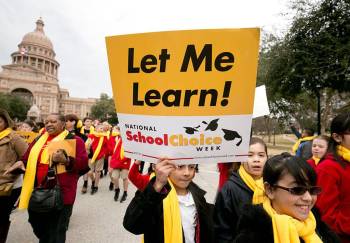
school choice march

Is this conservative?

This isn’t the first time Petrilli has tried and failed to convince conservatives of what they should think. A few years back, when then-new Common Core State Standards reared their heads, Petrilli struggled to convince conservatives that the Common Core was conservative. He failed then and he’ll likely fail in his current attempt as well.

This time around, Petrilli is hoping to impose an image of educational conservatism as split between “accountability-plus-choice” and mere “choice.” All conservatives, Petrilli writes, make school choice a “paramount objective.” “Conservatives believe,” according to Petrilli,

that parents should be able to choose schools for their children that match their educational priorities and moral values. This principle stems from our deep respect for the family as the building block of a free society.

The split, Petrilli writes, is between conservatives who are happy with expanding choice and conservatives who also want to force traditional public schools to improve. Smart conservatives should want both, Petrilli thinks. As he puts it,

If we care about economic growth, upward mobility, and strong families, we should make improving America’s educational outcomes a priority. Education is both a private good and a public good, and a society has a legitimate interest in the education of its next generation — the more so when public dollars pay for it.

In short, Petrilli is hoping to convince conservatives that they should work to improve public schooling for all. He wants conservatives to see themselves as the true guardians of American values and prospects, the side of the future.

If we could all agree on improving public schools for everyone, we could likely skip much of our culture-war shouting and have drinks together on the patio. The problem is that Petrilli’s flattering definition of educational conservatism doesn’t match reality.

For example, Petrilli wants to convince his fellow conservatives that they have always been on the side of social justice for the least powerful members of American society. He writes,

Conservatives view upward mobility as a key objective of social policy, and want to empower poor families to choose schools that can catapult their children into the middle class.

Now, I’m happy to grant that Mr. Petrilli himself truly values such things, but it is more than a stretch to say that such lofty social goals have ever been a primary motivating factor for conservative educational activists. As I argue in detail in my book about educational conservatism in the twentieth century, the primary goals of conservatives have been starkly different.

From Grace Brosseau of the Daughters of the American Revolution to Norma Gabler of Longview, Texas; from Homer Chaillaux of the American Legion to Max Rafferty of California’s State Department of Education; from Bertie Forbes to Alice Moore…conservatives have wanted a bunch of different things out of schools, but elevating the economic prospects of “poor families” has never been their primary motivation.

What have they focused on? I hate to quote myself, but here’s how I put it in the 2015 book:

Educational conservatives have insisted, in short, on two central ideas. First, schools matter. Conservatives, like their progressive foes, have rarely questioned the notion that the schools of today generate the society of tomorrow. Second, because schools matter, their content and structure must be guarded ferociously. Ideas that challenge inherited wisdom must not be crammed down the throats of young, trusting students. And teachers must not abdicate their roles as intellectual and moral authorities. Educational conservatism, in other words, has been the long and vibrant tradition of defending tradition itself in America’s schools.

Of course, Mr. Petrilli is happy to offer any definition he wants for conservatism and his fans are welcome to agree with him. The rest of us, though, should understand that educational conservatism has been mostly about protecting kids from progressive trends in school and society.

And that leads us to Petrilli’s second big goof. Much as he might dislike it, school “choice” has never been anything but a convenient tactic for conservatives. Most conservatives have been decidedly blah about the notion of school choice unless that choice seemed like the best way to achieve their real goals of insulating their kids.

If we need proof, we don’t need to look any further than the mottled history of the idea of school choice itself. When Nobel laureate Milton Friedman proposed the notion of charter schools back in 1950, it met with a profound fizzle. Conservatives back then—everyone back then—mostly ignored the idea, as Friedman himself admitted.

It took nearly fifty years for conservative activists to embrace school choice as their number-one go-to plan for saving their kids from America’s schools. And even then, notions of school choice often take pride of place only in the wonky visions of brainy conservatives like Petrilli himself. Many more conservatives these days look instead to their traditional havens of private schools and the exciting new world of homeschooling.

Looked at one way, Mr. Petrilli might be right. The world of educational conservative activism might really be split in two. The sides, however, aren’t the ones Petrilli imagines. Instead of a split between conservatives who are happy with expanding charter schools and conservatives who also want to improve public schools for all, it might really just be a split between idealistic conservative reformers like Petrilli and almost all the rest of the conservatives out there.