The Oprah-iate of the Intellectuals

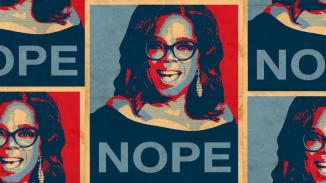
Will she or won’t she? Oprah Winfrey’s speech at the Golden Globes has people talking about a Winfrey presidency. Here’s the ILYBYGTH question: Why aren’t progressive pundits talking about it? I think I know why—it’s a rare moment when conservatives and progressives agree on something.oprah president

For their part, conservative pundits have had a field day with the Oprah news. At National Review, for example, commentators have relished the story. They’ve asked if Oprah will ditch her Hollywood-lefty friends; they have gleefully pointed out that Oprah would be the Left’s Trump; they’ve champed at the bit to see Oprah fight against an establishment Democrat.

At American Conservative, too, Benedictine pundit Rod Dreher has wallowed in the idea of an Oprah papacy/presidency. President Oprah, Dreher crows, would be

the Pallas Athena of Moralistic Therapeutic Deism. She would be the goddess of the nation-state.

On the other side of the culture-war spectrum, there has been markedly less talk about an Oprah presidency. Sure, Rolling Stone wondered about it. And a few other progressive small-fry have opined. But big progressive outlets such as The Nation, Progressive.org, and ThinkProgress have maintained a studied silence on the issue.

Why? I have a hunch and I’d be happy to be better educated by SAGLRROILYBYGTH.

I think smart progressives agree with the conservative National Review crowd on this one. That is, they see Oprah as the Trump of the Left. An Oprah candidacy, progressive strategists might think, will force them into discussing non-issues such as Oprah’s wacky universe-embracing religious quackery.

After all, as Yale’s Kathryn Lofton has argued, Oprah has crafted more than a media empire. Her “gospel” has translated Oprah into something else.

And progressives want to talk about health care and tax plans, not enlightenment through elaborate poster-making.

I Love You but You Didn’t Do the Reading

Welcome to 2018! You might think the last week of the year would be quiet, but you’d be wrong. Here are a couple of the ILYBYGTH-style stories that jumped out at us over the past week:

Issue in review: Has Trumpism killed evangelicalism?

Conservatives and the higher education “scapegoat,” by Catherine Rampell at WaPo.

The thing white professors won’t talk about, by Robert Cherry at RCEd.

Want to avoid a “death of despair?” Go to college. At CHE, research about the link between higher education and better health.Bart reading bible

Jeffrey Salkin admires LDS (Mormons). But he wants them to stop baptizing dead Jewish people, at RNS.

Why one evangelical leader left Trump’s evangelical council. AR Bernard explains his departure to Samantha Bee: “Better think carefully what you are given in exchange for your life, your reputation.”

What’s wrong with the pseudo-intellectual Right? Paul Gottfried tees off on D’Souza, Prager, and Goldberg at AC. Gottfried’s conclusion:

  • “there is . . . a plague of genuinely ridiculous writings on historical subjects coming from conservative media celebrities that surpass in their arrogant stupidity almost anything I’ve encountered in professional journals. As for people who yap about the ideologically tainted work that originates in our universities, one might hope they’d be somewhat better than those they declaim against. That’s not always the case.”

Making Ararat Great Again

What does Noah have to do with homosexuality? For that matter, what does creationism have to do with Donald Trump? The connections might seem jagged, but those of us who hope to understand the real contours of radical American creationism need to understand the connections between the Rainbow Covenant and Trump’s hat. My recent visit to the Ark Encounter gave me a sharp reminder of the cultural politics of creationism.

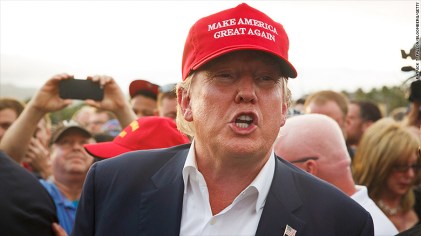
Trump make america great again

It’s the hat, stupid.


SAGLRROILYBYGTH are sick of hearing it, but I can’t help repeating myself: Lots of white evangelicals have always harbored a Trump-ish white nationalist attitude. Not all of them, of course. White evangelicals have also been the most ferocious critics of their coreligionists on this score.

Moreover, the relationship between evangelical religion and chest-thumping American nationalism has always been complicated. White evangelical Americans have tended to think of the USA as both a uniquely Christian country and a dangerously sinful one. As I argued in an academic article a while back, the “establishment-or-outsider paradox” that George Marsden described so long ago has always been a constant source of tension when it comes to evangelical thinking about schools and culture.

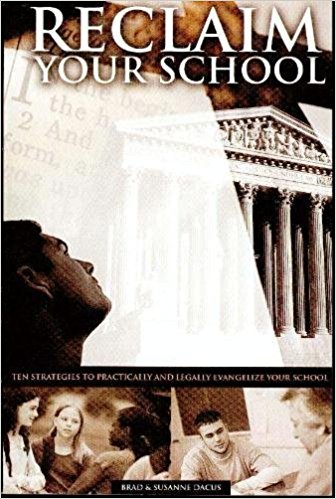
For many conservative evangelicals—especially those on the harder-right end of the broad evangelical spectrum—public schools in particular have been the leading symbol of this tension. In the white evangelical imagination, public schools used to be great. They used to lead children in prayer and Bible reading. In the past fifty years, one popular conservative-evangelical story goes, public schools went terribly awry. In practice, evangelical pundits warn one another, America kicked God out of the public schools.

For a large and influential segment of the white evangelical public, this scary story has a silver lining. In spite of the frightening changes in American public education, there is hope. Conservative evangelicals have told one another, for example, that they can “reclaim” their local schools.

reclaim your school

Good news/Bad news…

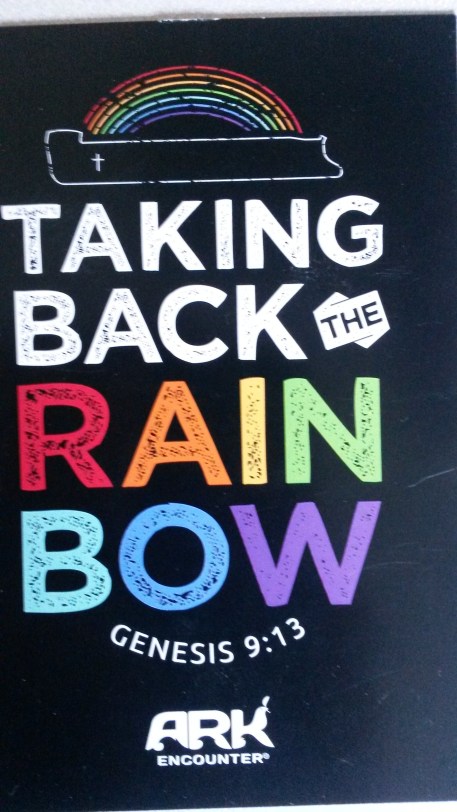
The notion of reclaiming, of taking back, resonates with radical creationists, too. As I browsed the gift shop at the Ark Encounter, I found a fat stack of postcards. Many of them harped on the theme of “taking back” the symbol of the rainbow. Instead of representing gay pride, the Kentucky creationists hope, the rainbow can once again symbolize conservative evangelical faithfulness.

20171228_090906.jpg

Reclaim your rainbow…

It is a central theme for American young-earth creationism, and one that has very little to do with theology or science. The language of many radical creationists is peppered with talk about the good old days, when evangelical Christianity WAS mainstream American religion, when “Merry Christmas” WAS the thing to say to each other in December, when public schools DID reinforce evangelical faith.

Once we grasp this enduring theme among radical creationists, it’s not so difficult to see the appeal of Trump. Any candidate who promises to make America great again will get the white-evangelical vote, or at least the vast majority of it.

What’s the Deal with White People?

The Roy Moore saga might (or might not) finally be coming to an end. Moore lost the Senate race and he might ride his horse into the sunset. The poll results from Alabama, though, give us some puzzles to think about. We might think we understand why so many white evangelicals voted for Moore. But some other groups just don’t make sense.

As we’ve argued in these pages, a central defining feature of white evangelical history over the past century has been what historian George Marsden called the “establishment-or-outsider paradox.” For many white evangelicals, as I explore in my new book about evangelical higher education, America has been both a shining city on a hill and Babylon.

As a result, white evangelical voters have been prone to cheer candidates like our current president who promise to make America great again. President Trump is not the first leader of questionable personal morality to win evangelical votes by pandering to white evangelical yearning to take the USA back to an imagined Christian past, to return the country to Winthrop’s vision.

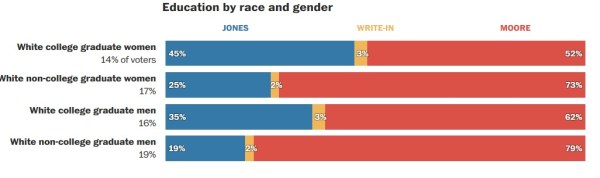
So I’m not too shocked to read that 80% of white evangelical voters in Alabama voted for Judge Moore. There is one result that befuddles me, though. A slim majority of white college-educated women also went for Moore. By a margin of 52% to 48%, this group voted for a man credibly accused of preying on teenage girls.

What gives?

We can even extend this question to the 2016 presidential election. The number of white evangelical voters who voted for Trump and Moore is very similar: 81% and 80%. While a slim majority of college-educated white women voted for Secretary Clinton over President Trump, Trump still claimed a surprising 45% of the college-educated white woman vote.

Can someone explain this one to me?Moore election results

Why do so many white college-educated women vote for these candidates? I have a feeling my cultural blinders are making it hard for me to understand this apparent truth about the American electorate.

I Love You but You Didn’t Do the Reading

I’ve never really wanted to run a textbook company, but I’ve never not wanted to more than now. Pearson and other edu-types have had a rough week–here are some of the highlights:

The fake history we all remember: The myth of the spit-on Vietnam vet. HT: RH

Where do the white nationalists come from? The New Yorker profiles Mike Enoch. HT: RP

New Mexico puts science back in its K-12 science standards. HT: VW

Trump’s war on knowledge, by Ariel Dorfman at NY Review of Books.

What has Bill Gates learned about learning? He describes his twenty-first century education about education on his blog.Bart reading bible

How do writers write? Peter Greene offers his eight rules for writing right.

There’s nothing new about “fake news:” An interview with Kurt Andersen, author of Fantasyland, at Religion Dispatches.

Wowzers. Pearson apologizes for racist stereotypes in nursing textbook. Some examples:

  • “Jews may be vocal and demanding of assistance.”
  • “Blacks often report higher pain intensity than other cultures.”

Thanks to everyone who sent in tips and stories.

History, not Faith

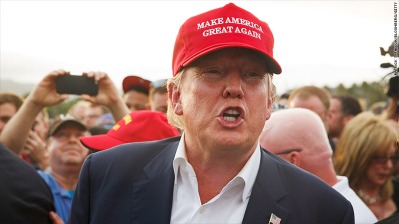
Why do so many white evangelicals support President Trump? Not just in a passive, least-worst, anyone-but-Hillary sort of way, but actively and even enthusiastically? Why have some white evangelical leaders become what historian John Fea calls “court evangelicals?” After all, President Trump is no one’s idea of a Christian. One recent argument ties evangelical Trumpism to faith, but not surprisingly, I think it has a lot more to do with historical imagination. For people who fantasize about a lost American “Shining City upon a Hill,” Trump’s “take-back-America” rhetoric punches important buttons.
Trump make america great again

It’s the hat, stupid.

Over at Religion Dispatches, Eric C. Miller interviews Kurt Andersen about Andersen’s new book Fantasyland: How America Went Haywire. I haven’t read the book yet, but I’ve got it ordered. It sounds fantastic and I’m looking forward to reading the whole thing.

I can’t help but spout off a little, though, about some of Andersen’s arguments in this interview. Andersen describes his explanation of the odd relationship between the starchy moralists of America’s evangelical subculture and the wildly careening leadership of President Trump. Andersen makes connections between charismatic belief and Trumpism, but I think there’s a much more obvious and important explanation. Trump appeals powerfully not to anyone’s ideas about God and worship, but rather to white evangelicals’ implicit vision of American history.

On a side note, I couldn’t help but shudder at one of Andersen’s other statements. Like a lot of pundits, he makes some major goofs about the nature of creationism these days. As Andersen puts it,

Just in the last 15 years, it has become Republican orthodoxy to disbelieve in evolution and to challenge evolution instruction in the public schools. This is a uniquely American phenomenon, and it is a product of a religious tradition that, starting about a half a century ago, decided to make that stand in favor of creationism.

I added the emphasis to point out the problem. Andersen’s not alone on this point, but he is deeply wrong. Radical creationism’s political oomph is not at all uniquely American. To cite just one example, Turkey’s government has made even more aggressive moves in favor of creationism. This is not a minor error, but a major misreading of the nature of modern creationism. As I’m arguing in my current book, following in the footsteps of the great historian of creationism Ron Numbers, radical young-earth creationism is not “uniquely American,” but rather a popular and politically potent response to the dilemma of post-modern life, worldwide and across many religions.fantasyland
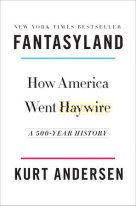
That’s a big intellectual problem, but it is not my major beef with Andersen’s argument this morning. No, the real question today is about the relationship between America’s politically active white evangelical Protestant community and the shoot-from-the-hip political style of President Trump. How could it happen?

For Andersen, the connection can be tied in part to one wing of evangelical belief. For charismatic Christians, Andersen explains, belief in the unbelievable is part and parcel of their culture of dissent. Here’s how Andersen made his point, with emphasis added:

[Miller]: Then I have to ask you about Donald Trump. He is now America’s Conspiracy-Theorist-in-Chief, a position that he attained with support from 81 percent of white evangelicals. Does this research help account for that?

[Andersen]: It’s bizarre. It’s interesting, because he is not, in any meaningful sense, a Christian. So why is it that our most fervently Christian fellow citizens support him so strongly? Well, as you say, our most fervently Christian white citizens. I think there is something there—it suggests that there are other reasons, cultural and economic reasons, together with the religious motivations that are driving that support.

But for my purposes, within this Fantasyland template, I think that they have some things in common beyond resentment of the elites and some of these other traits that are not necessarily connected to belief in the untrue—a lack of respect and all that. But Trump has shown a unique willingness to embrace claims that are demonstrably untrue—that Barack Obama wasn’t born here and a conspiracy covered that up; that Ted Cruz’s father was involved in the JFK assassination; that five million illegal immigrants voted against him in the 2016 election; and on and on and on. The fact that he is so indifferent to empirical reality and so willing to stand up and embrace explanations that simply confirm his pre-existing ideas or are convenient for him because they make him seem better or his enemies worse—it’s somewhat unkind, I understand, to say that he shares that tendency with religious people, but I think that is shared.

There is no evidence that people who speak in tongues are speaking a holy language. There is no empirical evidence that faith healing works. There is no real evidence that Jesus was resurrected. I could go on. So, if believing these sorts of things as a matter of faith is central to your identity, then you might identify with a guy who is willing to take strong stands on unprovable claims. If he also shares—or pretends to share—your cultural biases and resentments, then you’re going to like him! That’s about as close as I can come to explaining this strange embrace. Certainly in terms of his lifestyle, his brutal disdain for the least among us, he is so, so unchristian. I haven’t entirely figured that out—it’s another book.

Now, I agree with a lot of what Andersen has to say. I agree that “cultural biases and resentments” are the key to understanding white evangelical Trumpism. But I disagree that we can best explain Christian Trumpism by invoking “religious motivations.”

Not that there aren’t plenty of white evangelicals who justify their Trumpism in religious language. Some leaders like to say that Trump is their modern David or Cyrus. But they wouldn’t say or even allow themselves to think that they can support Trump because they already believe in unbelievable things. I get what Andersen’s saying: If you are accustomed from your religious background to a conspiratorial or fantastic mindset you are more likely to choose and support a conspiracy-theorist president. However, it’s misleading to suggest that such religiously driven beliefs are a leading explanation for Christian Trumpism.

If it’s not mainly due to their religious beliefs, why DO so many white evangelicals actively support Trump? I think Andersen is on the right track when he talks about “cultural and economic reasons,” and “cultural biases and resentments.” As I’m arguing in my new book [have you pre-ordered your copy yet?] about evangelical higher education, a leading theme in evangelical intellectual life has been the story of evangelical exile, of being kicked out of the centers of political power. Among white American evangelicals, a unique historical vision of themselves as the true Americans has fueled a century of culture-war vitriol.

From the 1920s through today, white evangelicals have been goaded and guided by this unique sense of usurpation. Unlike other powerful religious minorities, such as American Catholics, white evangelicals tell themselves over and over again that the United States used to be solidly theirs. Unlike other religious groups—even groups that are closely connected to them by theology such as African-American evangelical Protestants—white evangelicals have been sure that they deserve to claim or reclaim their role as America’s religious voice.

In short, we can’t look to theology or faith to understand evangelical Trumpism. It’s tricky, because evangelical Trumpists will explain their decisions in the language of faith. But if we listen only to such biblical justifications, we’ll miss the far-more-important real reasons for evangelical Trumpism.

For almost a century now, white evangelicals have wanted to “take back America.” Their college campuses have been seen as both citadels and havens for an imagined real America, the kind of America from which the rest of America seemed to have strayed. When a political candidate comes along and declares his wish to “make America great again,” it resonates powerfully. Just ask Reagan.

It is this history of resentment, of a sense of historical exile, of usurpation, that best explains white evangelical Trumpism.

I Love You but You Didn’t Do the Reading

Leaves are falling and campus speakers are speaking. What else is going on out there? Here’s our ILYBYGTH collection of stories of interest:

Almost two-thirds of colleges/universities missed their enrollment targets this year.

The Wall Street Journal agrees with Ed Stetzer. There is no call for anxiety about religious judges or other officials, they note.

Ben bucks Berkeley boos: What happened when Ben Shapiro brought his in-your-face conservatism to California?

What does it mean for a public school to be “public?” Sarah M. Stitzlein of the University of Cincinnati wonders in the pages of EdWeek.Bart reading bible

“Is this heaven?” Some Iowa schools lock bad kids away in “little dungeons,” from The Progressive.

Should we defend Professor Wax’s right to be wrong? That’s Jonathan Zimmerman’s argument at IHE.

Across the (other) pond: South Korean ministry nominee and professor of engineering testifies about his belief in a young earth.

Free-Marketeer Arthur Brooks in the NYT: Universities need to “form communities that do not just tolerate conservatives but actively embrace ideological diversity.”

Is fundamentalism roaring back? John Fea looks askance at recent developments at Southern Baptist Seminary.

Who blocks campus speakers? A reminder from IHE that progressive speakers are being shouted down, too.

A Trump Victory We Didn’t Expect

Maybe not out of left field, specifically, but out of a field somewhere: Trump’s shocking electoral victory and surprising pockets of continuing popularity have left wonks of all sorts scratching their heads. Here at ILYBYGTH, we’re agog to see some odd recent poll results that show yet another surprising result of Trumpism.

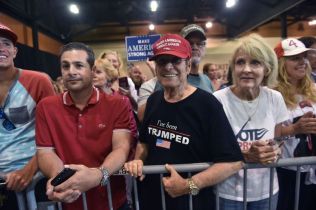
trump supporters

Take my tuition dollars!

The poll we’re talking about would seem to be worlds removed from Trumpism and its unpredictable path. But the Inside Higher Education/Gallup survey of college admissions officials has come up with some intriguing political results.

Some are predictable. Many schools these days are struggling to attract students. Only 34% of the schools surveyed met their enrollment goals this year, down from the last two years. That hits schools hard, right in the pocketbook. Without tuition dollars, most schools would have to pull a Sweet Briar, and few institutions have the wealthy alumni base to hope for a last-minute SB rescue.

One of the most attractive type of student, from a financial perspective, has long been international students. They often pay full tuition. At public state schools, they often pay even more than out-of-state students.

Trump’s anti-immigrant bluster has made it harder for American schools to attract these types of students. Eighty-six percent of admissions officers thought “the statements and policies of President Trump make it more difficult to recruit international students.”

That’s not surprising.

What is a Trump shocker, to us at least, is a different consensus among the admissions bureaucrats. Trump’s victory, many agreed, served as proof that they have been looking in the wrong directions for students. As the IHE report put it,

In the months following the election and the inauguration of President Trump, many educators have been discussing whether the results suggest that higher education is out of touch with the public, and how the image of higher education (fair or not) impacts colleges and their admissions strategies. At a gathering of private college counselors in June, many said that they were seeing an increase in parents vetoing their children’s college choices over the perceived political orientation of institutions, with one counselor saying, “Brown is completely off the table.”

As a result, many schools have begun a new sort of recruitment. In addition to their traditions of recruiting athletes, high-flying nerds, and underrepresented racial and ethnic groups, many schools want to start reaching out to rural, white, and—get this—conservative students.

Admissions Directors Agreeing With Statements on Higher Education, Postelection

Statement Public Private Nonprofit
Higher education needs to redouble its efforts to recruit and retain underrepresented minority groups. 86% 66%
The election outcome suggests Americans are less committed than they were in the past to increasing the number of racial and ethnic minority students who attend college. 44% 35%
The election outcome indicates that colleges — especially elite colleges — should recruit more students from rural areas. 42% 32%
The election outcome indicates that colleges — especially elite colleges — should recruit more low-income white students. 32% 24%
Colleges with overwhelmingly liberal student bodies should increase recruiting efforts, including affirmative action, for conservative students. 16% 12%

In other words, Trump’s victory has convinced some admissions officials—like some ILYBYGTH editors—that they just don’t “get” America. They want to include more students who might be likely to support Trump. They want to expand their notion of “diversity” to include conservative, rural, white students.

Colleges That Are Stepping Up Recruitment of Certain Groups in Wake of Election

  Public Private
Rural students 52% 28%
Low-income white students 41% 22%
Conservative students 9% 8%


We can’t say we haven’t wondered about this sort of thing. For a while now, we at ILYBYGTH have been worried about higher-education’s lack of knowledge and interest in conservative students. But we CAN say it is something we didn’t predict, one more example of the ways the Trump earthquake has changed the political landscape.

I Love You but You Didn’t Do the Reading

Believe it or not, Labor Day is already here. Time to put away those white shoes, fellows. It has been a hectic last week of summer here at ILYBYGTH. Here are a few stories of interest that you may have missed:

Are some cultures better than others?

Love means never having to say you’re sorry: Trump pardons Sheriff Joe Arpaio.

At The Gospel Coalition, an open letter from Christian scholars denouncing racism.

Are white evangelicals more racist than Christian?

The problem with “privilege.” Jeffrey K. Mann wants us to look beyond race and gender.

What happened to all the Christian bookstores?

Yes, you read it correctly: Reese Witherspoon will be playing the role of a defector from the “God-Hates-Fags” Westboro Baptist Church.

Where are all the sinister atheists who are trying to undermine Christian America? The Trollingers couldn’t find them at the American Atheists Convention, from Righting America at the Creation Museum.

Family sues NYC schools over their son’s “gender expansive” preference for dresses. The school accused the parents of sexual abuse.

Vouchers and stealth vouchers: The Progressive offers a guide to the wild and woolly world of public-school funding options.

What should conservative evangelicals think about gender and sexuality?

Only in New York: A Brooklyn school principal accused of recruiting her students into the communist movement.

I Love You but You Didn’t Do the Reading

You may have had difficulties reading the headlines after you burned your retinas looking at the solar eclipse, so we here at ILYBYGTH have done the work for you. Here are some headlines of note from the past week:

Should I stay or should I go? Trump’s evangelical advisors split on splitting.

Update from Arizona: Federal judge rules that the ban on ethnic studies program was racially discriminatory.

Penn State rejects talk by white nationalist Richard Spencer. President Barron: Spencer’s ideology is “abhorrent and contradictory to our University’s values.”Bart reading bible

Should you red-shirt your kindergartener?

They liked him then, they like him now: White evangelicals oppose calls to impeach Trump by big margins.

How can you get Ken Ham and Jerry Coyne to agree? Talk about the similarities between abortion and infanticide.

Don’t like Trump? Is it because, deep down, you know he is you? John Burtka IV argues that Trump IS America.

What do atheists think of creationists? The Trollingers speak at the American Atheist Convention, from Righting America at the Creation Museum.

Looks like Liberty University has some ‘splainin to do. Disclosures suggest Trey Falwell owns a “gay-friendly flophouse with an on-site liquor store” in Miami. Zoiks.